Clinical Demographics and Outcomes in Mechanically Ventilated
Patients in Korean Intensive Care Units
Knowledge of clinical demographics and outcomes of mechanically ventilated patients is important but there are few prospectively collected data in Korea. The objective of the present study was to describe the current status of mechanically ventilated patients in Korea as of 2010. We analyzed the data of Korean patients (275 patients in 12 Korean intensive care units [ICU]) participating in a multinational prospective cohort study on mechanical ventilation. The most common indication for mechanical ventilation was pneumonia (23%). Pressure-limited ventilation modes were preferred over volume-cycled ventilation modes. Non-invasive positive pressure ventilation was used in only seven (2%) patients as the initial ventilatory support. Median duration of mechanical ventilation was 7 days and ICU mortality was 36%. The multiple logistic regression model revealed that the Simplified Acute Physiology Score II (SAPS II) score at ICU admission (odds ratio [OR], 1.034; 95% confidence interval [CI], 1.001-1.036; P = 0.033), peak pressure (OR, 1.054; 95% CI, 1.016-1.095; P = 0.006), and the number of failed organs (OR, 2.132; 95% CI, 1.634-2.781; P < 0.001) were independently associated with ICU mortality. This study provides a snapshot of current practice of mechanical ventilation in Korea.
Keywords: Respiration, Artificial; Epidemiology; Data collection; Outcome; Korea
Byeong-Ho Jeong,1 Gee Young Suh,1
Jin Young An,2 Moo Suk Park,3
Jin Hwa Lee,4 Myung-Goo Lee,5
Je Hyeong Kim,6 Yun Seong Kim,7
Hye Sook Choi,8 Kyung Chan Kim,9
Won-Yeon Lee,10 and Younsuck Koh11 1Division of Pulmonary and Critical Care Medicine, Department of Internal Medicine, Samsung Medical Center, Sungkyunkwan University School of Medicine, Seoul; 2Department of Internal Medicine, College of Medicine, Chungbuk National University School of Medicine, Cheongju; 3Division of Pulmonary and Critical Care Medicine, Department of Internal Medicine, Yonsei University College of Medicine, Yonsei University Health System, Seoul; 4Department of Internal Medicine, School of Medicine, Ewha Woman’s University, Seoul; 5Division of Pulmonary, Allergy, and Critical Care Medicine, Department of Internal Medicine, Hallym University Chuncheon Sacred Heart Hospital, Hallym University College of Medicine, Chuncheon; 6Division of Pulmonary, Sleep and Critical Care Medicine, Department of Internal Medicine, Korea University Ansan Hospital, Korea University College of Medicine, Ansan; 7Division of Pulmonary and Critical Care Medicine, Department of Internal Medicine, Pusan National University Yangsan Hospital, Yangsan; 8Department of Internal Medicine, Dongguk University Gyeongju Hospital, Dongguk University College of Medicine, Gyeongju; 9Department of Internal Medicine, Catholic University of Daegu Hospital, Daegu; 10Division of Pulmonary, Allergy and Critical Care Medicine, Department of Internal Medicine, Yonsei University Wonju Severance Christian Hospital, Yonsei University Wonju College of Medicine, Wonju; 11Department of Pulmonary and Critical Care Medicine, Asan Medical Center, University of Ulsan College of Medicine, Seoul, Korea
Received: 13 November 2013 Accepted: 28 March 2014 Address for Correspondence: Gee Young Suh, MD
Division of Pulmonary and Critical Care Medicine, Department of Medicine, Samsung Medical Center, Sungkyunkwan University School of Medicine, 81 Irwon-ro, Gangnam-gu, Seoul 135-710, Korea
Tel: +82.2-3410-3429, Fax: +82.2-3410-3849 E-mail: [email protected]
http://dx.doi.org/10.3346/jkms.2014.29.6.864 • J Korean Med Sci 2014; 29: 864-870
INTRODUCTION
An awareness of the clinical demographics and outcomes of mechanically ventilated patients in the intensive care unit (ICU) is important because it allows for better use of resources and helps in clinical decision making (1-3). Moreover, it is important to know local epidemiologic data, because available resources vary from country to country (4-6), but few data are available in Korean patients.
A group led by Esteban A., has been conducting surveys on mechanical ventilation periodically since 1998 (1, 2). The third international survey was conducted in 2010 (3) and, for the first time, 12 Korean ICUs participated in this large prospective cohort study. The present study provides analysis of data from 12 Korean ICUs and describes the current status of mechanically ventilated patients in Korea.
MATERIALS AND METHODS
Patients
Consecutive adult patients (age ≥ 18 yr), who received mechanical ventilation for lon-ger than 12 consecutive hours or non-invasive ventilation (NIV) for more than 1 hr dur-ing a 1-month period startdur-ing on 1 March, 2010, and enddur-ing on 31 March, 2010 (3), from participating ICUs of 12 university hospitals in Korea, were included in this study. A full list of participating centers can be seen at the Acknowledgement section of this paper. Data collection
Only the investigator and research coordinator in each ICU were aware that the study was underway, to minimize any changes of behavior as a result of being observed.
Each center was provided with a manual describing data col-lection methods and definitions used in the study.
The following information was collected from each patient: age, sex, weight, height, Simplified Acute Physiology Score II (SAPS II) at ICU admission, reason for initiation of mechanical ventilation, and arterial blood gas analysis at the start of me-chanical ventilation. The following data and events were as-sessed daily during the course of mechanical ventilation for a maximum of 28 days: modes of mechanical ventilation; ventila-tor settings; co-adjuvant therapy (sedatives, analgesics, neuro-muscular blockers, intensive insulin therapy, steroids, and prone position); complications (sepsis, need for renal replacement therapy, acute respiratory distress syndrome [ARDS], ICU-ac-quired pneumonia, barotraumas, and development of each or-gan failure, defined as ≥ 3 points of sequential oror-gan failure as-sessment [SOFA] score for that organ); and clinical outcomes (duration of mechanical ventilation and weaning, re-intuba-tion, tracheostomy, length of stay in ICU and hospital, and ICU and hospital mortality).
The use of sedatives, analgesics, and neuromuscular blockers was recorded when these medications were given for ≥ 3 hr during a 24-hr period. Conventional definitions for sepsis (7), ARDS (8), pneumonia (9), and organ failure (10) were used as described previously. Barotrauma was defined as pneumotho-rax, pneumomediastinum, pneumoperitoneum, and subcuta-neous emphysema, which was thought to be related to mechan-ical ventilation. The duration of mechanmechan-ical ventilation was cal-culated as the time between the initiation of mechanical venti-lation and the date of extubation or ICU discharge (when the patient was referred to another hospital or had died). All patients were followed up until hospital discharge.
Statistical analysis
All data are presented as the medians (interquartile range [IQR]) or means (standard deviation [SD]) for the continuous variables and as numbers (percentages) for the categorical variables. The present data do not fit a normal distribution. However, we pre-sented some data as mean and SD to enable comparison with previous data that are presented using these measures of cen-tral tendency. Some continuous variables, such as tidal volume per predicted body weight (TV/PBW) and positive end-expira-tory pressure (PEEP), were coded as dummy variables, using cut-off points based on published threshold values. The data on initial ventilator settings were compared using Kruskal-Wallis test. When there was statistically significant difference, Mann-Whitney test with Bonferroni adjustment was used to identify between which groups had the difference.
A multiple logistic regression analysis with backward step-wise selection method was used to identify independent prog-nostic factors that were associated with ICU mortality. The cri-terion for entering variables was if P value is < 0.20 in the
uni-variate logistic regression. All of the statistical analyses were performed using PASW Statistics 18.0 (SPSS Inc., Chicago, IL, USA); a two-sided P < 0.05 was considered significant.
Ethics statement
The study protocol was reviewed and approved by the institu-tional review board (IRB) of each hospital (Asan Medical Cen-ter, IRB No. 0224; Samsung Medical CenCen-ter, IRB No. 2010-03-079; Chungbuk National University School of Medicine, IRB No. 2010-04-019; Yonsei University College of Medicine, IRB No. 4-2010-0110; Ewha Woman’s University School of Medi-cine, IRB No. 224-2; Korea University Ansan Hospital, IRB No. AS10028; Pusan National University Yangsan Hospital, IRB No. 02-2010-024; Dongguk University Gyeongju Hospital, IRB No. 10-05; Catholic University of Daegu Hospital, IRB No. CR-10-020; Hallym University Sacred Heart Hospital, IRB No. 2010-16; and Yonsei University Wonju Severance Christian Hospital, IRB No. 2009-03), and the need for consent was waived because of the non-interventional nature of the protocol.
RESULTS
Baseline characteristics
The baseline characteristics are shown in Table 1. Overall, 275 Table 1. Baseline characteristics (n = 275)
Characteristics Median (IQR) (Mean [SD]) or No. (%)
Age (yr) 69 (54-75) (64.5 [15.4])
Male 160 (58)
BMI (kg/m2) 22.1 (18.8-24.4) (22.0 [4.3])
SAPS II score at ICU admission 50 (38-64) (51.6 [18.4]) Reason for initiation of mechanical ventilation
Acute respiratory failure Pneumonia Sepsis ARDS
Congestive heart failure Cardiac arrest Aspiration Postoperative Others*
Acute respiratory failure on chronic pulmonary disease Acute exacerbation of COPD
Other chronic respiratory disease Coma† Others‡ 206 (75) 63 (23) 28 (10) 27 (10) 16 (6) 15 (5) 14 (5) 12 (4) 31 (11) 45 (16) 23 (8) 22 (8) 22 (8) 2 (1) Arterial blood gas analysis
pH PaCO2 (mmHg) PaO2/FiO2 7.31 (7.19-7.40) (7.28 [0.17]) 41.5 (32.0-57.0) (49.3 [27.4]) 143 (88-233) (189 [163]) *Upper gastrointestinal bleeding (n = 3), trauma (n = 2), upper airway obstruction (n = 2), pulmonary embolism (n = 1), pulmonary hemorrhage (n = 1), shock (n = 1), and miscellaneous (n = 21); †Metabolic (n = 8), hemorrhagic stroke (n = 6), ischemic
(n = 5), and intoxication (n = 3); ‡Neuromuscular disease (n = 1) and unknown (n = 1).
IQR, interquartile range; SD, standard deviation; BMI, body mass index; SAPS II, Sim-plified Acute Physiology Score II; ICU, intensive care unit; ARDS, acute respiratory dis-tress syndrome; COPD, chronic obstructive pulmonary disease.
patients were enrolled. The median (IQR) age was 69 (54-75) yr. The common reasons for initiation of mechanical ventilation were pneumonia (23%), acute respiratory failure on chronic pulmonary disease (ARF-CPD, 16%), sepsis (10%), and ARDS (10%). Most of the patients received mechanical ventilation be-cause of medical problems, except for 5% of the population who had surgical problems (patients with postoperative acute respi-ratory failure [n = 12] and trauma [n = 2]).
Mode and setting of mechanical ventilation
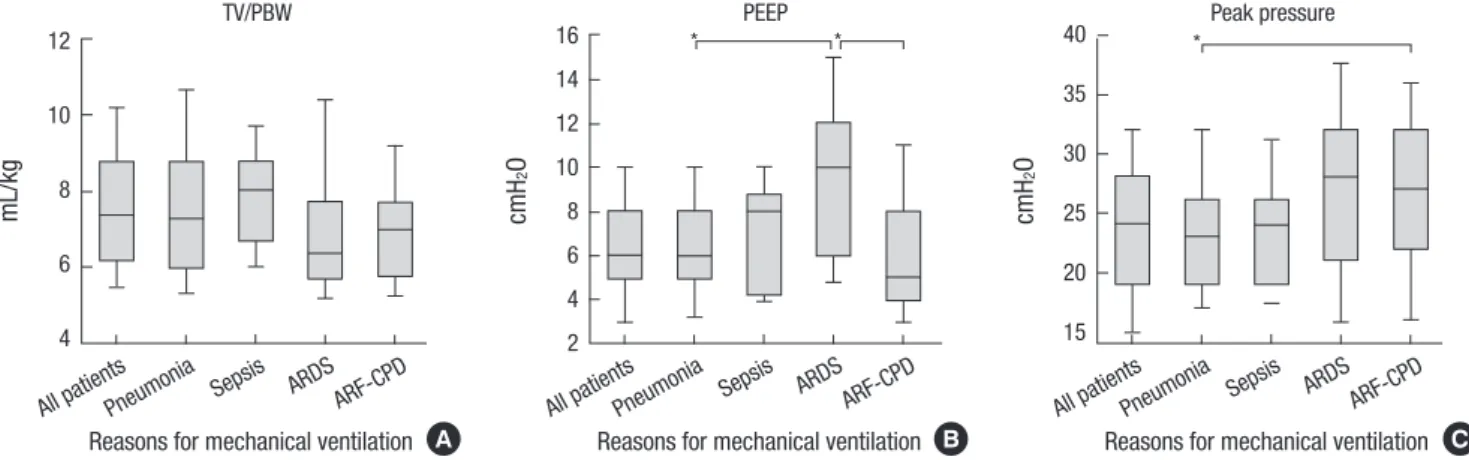
Fig. 1 shows the initial ventilator settings according to each ma-jor reason for initiating mechanical ventilation. Median TV/ PBW for all patients was 7.4 (6.2-8.8) mL/kg. The value for pa-tients with ARDS was 6.4 (5.7-7.7) mL/kg; however, there was no statistically significant difference between the two groups.
Median PEEP for all patients was 6 (5-8) cmH2O. Patients with
ARDS (10 [6-12] cmH2O) received higher PEEP than those with
pneumonia (6 [5-8] cmH2O, P = 0.006) and ARF-CPD (5 [4-8]
cmH2O, P < 0.001). Median peak pressure for all patients was
24 (19-28) cmH2O. Patients with ARF-CPD (27 [22-32] cmH2O)
had higher peak pressure than those with pneumonia (23
[19-26] cmH2O, P = 0.030).
Fig. 2 shows the number of patients ventilated (gray bar) and percentage of each ventilator mode (line graph) in all patients over time. Pressure control ventilation (PCV) mode was the preferred mode initially (40%) and was most preferred during the entire period of mechanical ventilation. Volume assist/con-trol (A/C) mode was the second most common mode initially but the percentage of patients ventilated with this mode de-creased with time. More and more patients were ventilated us-ing pressure support ventilation (PSV) mode as the number of days on the ventilator increased.
Co-adjuvant therapy
The co-adjuvant therapies are listed in Table 2. Sedatives of any
type were administered in 155 patients (56%), analgesics in 141 (51%) patients, and neuromuscular blockers in 71 (26%) patients. Midazolam and fentanyl were the preferred sedative and anal-gesic drugs, respectively.
Clinical courses and outcomes
Clinical course of mechanical ventilation is shown in Fig. 3. NIV as initial ventilator support was attempted in only seven pa-tients (2%). Only three papa-tients were successfully managed with solely NIV. Of 272 intubated patients, 135 (50%) patients were able to be extubated electively. Of these 135 patients, 24 (18%) patients were re-intubated. Of 272 intubated patients, the inci-dence rate of accidental extubation was 10% (27 cases/272 pa-tients), and incidence density of that was 1.1% (27 cases/2,457 Fig. 1. Initial settings of ventilator according to reason for initiating mechanical ventilation. Boxes indicate interquartile ranges and whiskers indicate 10 to 90 percentile ranges. *P < 0.05 by Bonferroni adjusted Mann-Whitney U-test. TV, tidal volume; PBW, predicted body weight; PEEP, positive end-expiratory pressure; ARDS, acute respiratory distress syndrome; ARF-CPD, acute respiratory failure on chronic pulmonary disease.
mL/kg
Reasons for mechanical ventilation All patientsPneumonia Sepsis ARDS ARF-CPD
12 10 8 6 4 TV/PBW A cmH 2 O
Reasons for mechanical ventilation All patientsPneumonia Sepsis ARDS ARF-CPD
16 14 12 10 8 6 4 2 PEEP * * B * cmH 2 O
Reasons for mechanical ventilation All patientsPneumonia Sepsis ARDS ARF-CPD
40 35 30 25 20 15 Peak pressure C
Fig. 2. Ventilator modes used each day during the course of mechanical ventilation. Bar graphs indicate the total number of patients who received mechanical ventilation by days from the start of mechanical ventilation. Lines indicate the percentage of ventilatory mode by each day, respectively. PCV, pressure control ventilation; A/C, as-sist/control mode; SIMV-PS, synchronized intermittent mandatory ventilation with pressure support; PSV, pressure support ventilation; PRVC, pressure regulated vol-ume control.
Pa
tients ventila
ted with each ventila
tor
y mode (%)
No.
of pa
tients mechanically ventila
ted (Bars)
Days from the start of mechanical ventilation D0 D3 D6 D9 D12 D15 D18 D21 D24 D27 60 40 20 0 300 200 100 0 PCV Volume A/C SIMV-PS PSV PRVC Others
Table 2. Co-adjuvant therapy to mechanically ventilated patients (n = 275) Co-therapies At initiation of mechanical
ventilation
Through the whole mechanically ventilated periods Sedatives Midazolam Lorazepam Propofol 108 (39) 85 (31) 23 (8) 6 (2) 155 (56) 129 (47) 31 (11) 26 (9) Analgesics Fentanyl Morphine Remifentanyl 115 (42) 90 (33) 15 (5) 15 (5) 141 (51) 109 (40) 53 (19) 30 (11) Sedatives or analgesics 171 (62) 200 (73) Neuromuscular blockers 45 (16) 71 (26) Intensive insulin therapy 55 (20) 74 (27) Steroids
Maximal daily dose (mg/kg) Duration (day)
59 (21) 82 (30) 2.9 (1.1-4.7) (4.0 [4.6])
7 (3-11) (8.2 [6.5])
Prone position - 4 (1)
Data are presented as median (interquartile range) (mean [standard deviation]) or num-ber (percentage).
Table 3. Clinical outcomes of mechanically ventilated patients (n = 275) Outcomes Median (IQR) (Mean [SD]) or No. (%) Duration of mechanical ventilation 7 (3-13) (11.0 [14.9]) Duration of weaning* 0 (0-2) (2.0 [4.9]) Length of stay in ICU 10 (5-19) (14.7 [15.4]) Length of stay in hospital 23 (12-41) (33.5 [32.5]) Complications
Sepsis
Need of renal replacement therapy ARDS ICU-acquired pneumonia Barotrauma Organ failure† Respiratory Cardiovascular Hematologic Renal Hepatic 132 (48) 62 (23) 59 (21) 20 (7) 11 (4) 219 (80) 172 (63) 89 (32) 79 (29) 27 (10) ICU mortality 98/275 (36) Hospital mortality 112/269 (42)
*n = 135, patients who underwent scheduled extubation; †Each organ failure
indi-cates as ≥ 3 point of sequential organ failure assessment (SOFA) score of each or-gan. IQR, interquartile range; SD, standard deviation; ICU, intensive care unit; ARDS, acute respiratory distress syndrome.
Fig. 3. Clinical course of patients who received mechanical ventilator support. NIV, non-invasive ventilator; IMV, invasive mechanical ventilator; MV, mechanical ventilation. ventilator days). Of these 27 patients, seven (26%) patients were
re-intubated. Of 162 patients who underwent extubation before tracheostomy, 31 (19%) patients underwent re-intubation at a median of 11 (1-38) hr after extubation. The reasons for re-intu-bation in these patients were: increased work of breathing (n = 15), large amounts of secretions (n = 6), neurologic problems (n
= 5), upper airways obstruction (n = 3), and congestive heart failure (n = 1). Excluding those patients admitted to the ICU with a tracheostomy tube in situ, 42/266 (16%) patients under-went tracheostomy during their course of ventilation within a
median of 13 (9-18) days after intubation.
Clinical outcomes and complications are listed in Table 3. The median total duration of mechanical ventilation was 7 (3-13) days and the median length of stay in ICU was 10 (5-19) days. Various complications and organ failures occurred. The medi-an number of failed orgmedi-ans was 2 (1-3). ICU mortality was 36%. Prognostic factors for ICU mortality
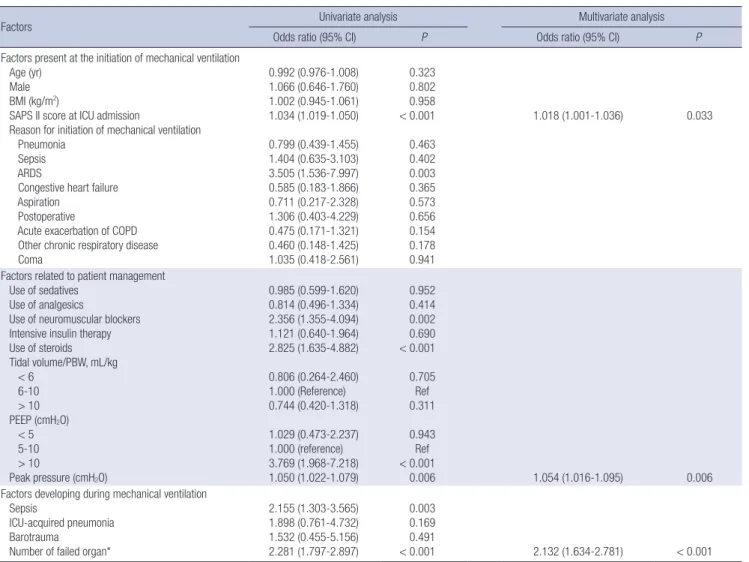
Table 4 lists both univariate and multivariate analysis of factors associated with ICU mortality in mechanically ventilated pa-tients. The multiple logistic regression model revealed that the SAPS II score at ICU admission (odds ratio [OR], 1.034; 95% con-fidence interval [CI], 1.001-1.036; P = 0.033), peak pressure (OR, 1.054; 95% CI, 1.016-1.095; P = 0.006), and the number of failed organ (OR, 2.132; 95% CI, 1.634-2.781; P < 0.001) were indepen-dently associated with ICU mortality.
DISCUSSION
This paper analyzes data that forms the Korean contribution to an international study (3). There were several differences in clinical outcome between the results of the international study and Korean data for the cohort of 2010 (see Table S1 in the on-line supplement). In the Korean data, the mechanically venti-lated patients underwent fewer scheduled extubations (50% vs 57%), more re-intubations (18% vs 12% in patients with a sched-uled extubation; and 26% vs 20% in those with an unplanned extubation), a higher incidence of complications (63% vs 39%, incidence of cardiovascular failure; 32% vs 8%, incidence of he-matologic failure; 48% vs 18%, incidence of sepsis; and 21% vs 6%, incidence of ARDS), a longer duration of mechanical venti-lation (7 [3-13] days vs 5 [3-10] days) and length of stay in ICU and hospital, and finally had higher ICU mortality (36% vs 28%) and hospital mortality (42% vs 35%) compared with the inter-national cohort (3). These differences in the outcomes appear Table 4. Multivariable analysis of factors associated with intensive care unit mortality in ventilated patients
Factors Univariate analysis Multivariate analysis
Odds ratio (95% CI) P Odds ratio (95% CI) P
Factors present at the initiation of mechanical ventilation Age (yr)
Male BMI (kg/m2)
SAPS II score at ICU admission
Reason for initiation of mechanical ventilation Pneumonia
Sepsis ARDS
Congestive heart failure Aspiration
Postoperative
Acute exacerbation of COPD Other chronic respiratory disease Coma 0.992 (0.976-1.008) 1.066 (0.646-1.760) 1.002 (0.945-1.061) 1.034 (1.019-1.050) 0.799 (0.439-1.455) 1.404 (0.635-3.103) 3.505 (1.536-7.997) 0.585 (0.183-1.866) 0.711 (0.217-2.328) 1.306 (0.403-4.229) 0.475 (0.171-1.321) 0.460 (0.148-1.425) 1.035 (0.418-2.561) 0.323 0.802 0.958 < 0.001 0.463 0.402 0.003 0.365 0.573 0.656 0.154 0.178 0.941 1.018 (1.001-1.036) 0.033
Factors related to patient management Use of sedatives
Use of analgesics
Use of neuromuscular blockers Intensive insulin therapy Use of steroids Tidal volume/PBW, mL/kg < 6 6-10 > 10 PEEP (cmH2O) < 5 5-10 > 10 Peak pressure (cmH2O) 0.985 (0.599-1.620) 0.814 (0.496-1.334) 2.356 (1.355-4.094) 1.121 (0.640-1.964) 2.825 (1.635-4.882) 0.806 (0.264-2.460) 1.000 (Reference) 0.744 (0.420-1.318) 1.029 (0.473-2.237) 1.000 (reference) 3.769 (1.968-7.218) 1.050 (1.022-1.079) 0.952 0.414 0.002 0.690 < 0.001 0.705 Ref 0.311 0.943 Ref < 0.001 0.006 1.054 (1.016-1.095) 0.006
Factors developing during mechanical ventilation Sepsis
ICU-acquired pneumonia Barotrauma
Number of failed organ*
2.155 (1.303-3.565) 1.898 (0.761-4.732) 1.532 (0.455-5.156) 2.281 (1.797-2.897) 0.003 0.169 0.491 < 0.001 2.132 (1.634-2.781) < 0.001 *Failed organ indicates as ≥ 3 point of sequential organ failure assessment (SOFA) score of each organ. BMI, body mass index; SAPS II, Simplified Acute Physiology Score II; ICU, intensive care unit; ARDS, acute respiratory distress syndrome; COPD, chronic obstructive pulmonary disease; PBW, predicted body weight; PEEP, positive end-expiratory pressure.
to derive from differences in the composition of the participants studied. In our Korean data, the patients had a higher SAPS II score at ICU admission (52 ± 18 vs 45 ± 18) and mechanical ven-tilation was required for medical reasons (23% vs 10%, pneu-monia; 10% vs 3%, ARDS; and 4% vs 21%, postoperative) more frequently compared with the international cohort (3). As for co-adjuvant therapy, sedatives (56% vs 71%) and analgesics (51% vs 62%) were less commonly used and neuromuscular blockers (26% vs 11%) were more commonly used in Korea. Re-garding the initial ventilator settings, the most important find-ing was that the use of NIV was parsimonious in Korea: NIV was used as the first ventilator mode of ICU admission in only 2% of total ventilated patients in Korea, which is much lower than that of international survey (14%) (3). The usefulness of NIV is well known in patients with acute exacerbation of chronic obstruc-tive pulmonary disease (11), or with cardiogenic pulmonary edema (12), and in immunocompromised patients with acute respiratory failure (13). However, the low use of NIV may be at-tributed to the low nurse-to-patient ratio in Korea and inade-quate reimbursement from the government compared with in-vasive ventilation (6). With regards to the ventilator modes used each day, increased use of PSV mode and decreased use of vol-ume A/C mode, as the number of days on a ventilator increased, were observed in both the Korean and the international cohorts (see Fig. E1 of reference 3). PCV mode was the most popular mode of ventilation in Korea, applied to 35%-50% of patients. In the international data, however, the PCV mode was a less pop-ular mode of ventilation, applied to 10%-20% of patients. Compared with previous Korean data (5, 6, 14), there are sev-eral differences in ventilator management; for example, increas-ed favor of the pressure mode, a decrease in tidal volume, and an increase in applied PEEP. These trends are similar to those reported in international surveys (1-3). Initial ventilator modes were PCV in 40% of patients and volume A/C mode in 31% of patients in the 2010 Korean cohort. In particular, PCV and vol-ume A/C mode were used in 56% and 22% of patients with ARDS, respectively. These findings differ from those of the 2003 Korean cohort, which reported preferred use of the volume A/C mode in 43% of all patients and 45% of ARDS patients, respectively (6). In the present cohort, the initial ventilator settings were TV/
PBW of 7.7 ± 2.3 mL/kg and PEEP of 6.5 ± 3.3 cmH2O, which
were slightly lower (TV/PBW) and higher (PEEP) compared
with the 2003 cohort (8.1 ± 2.1 mL/kg and 5.0 ± 3.8 cmH2O,
re-spectively) (5). Patients with ARDS in the 2010 cohort received initial ventilator settings of TV/PBW = 7.0 ± 2.0 mL/kg and
PEEP = 9.2 ± 3.8 cmH2O. Compared with the 2003 cohort, the
TV/PBW is lower, while the PEEP is no different (7.6 mL/kg and
9.4 cmH2O without presented SD, respectively) (6). This trend
to lower the TV/PBW for ARDS patients may have been influ-enced by several randomized trial results, which concluded that a lower TV/PBW was associated with lower mortality (15,
16). However, the use of NIV was still low in both the 2003 and 2010 cohorts (4% and 2%, respectively) in Korea (5, 6).
Another noticeable change over time has been in the use of sedatives, analgesics, and neuromuscular blockers. In the pres-ent cohort, 21%, 35%, and 26% of the patipres-ents were administered sedatives only, a combination of sedatives and analgesics, and neuromuscular blockers, respectively. In the 2003 cohort of Ko-rea, 50%, 22%, and 41% of the patients received sedatives only, a combination of sedatives and analgesics, and neuromuscular blockers, respectively (14). That means that the strategy of anal-gesia-based sedation, which was recently recommended over the strategy of hypnotic-based sedation (17, 18), was used more frequently, while neuromuscular blockers, which can cause critical illness polyneuropathy/myopathy (19), were used less frequently. Although there were no data recording the incidence of delirium or the use of antipsychotics, these results could be interpreted as an improvement in strategy and the appropriate use of sedatives and analgesics for the management of mechan-ically ventilated patients.
There are no multicenter data available in Korea to compare the incidence of complications occurring while patients are mechanically ventilated compared with the international co-hort (1, 3). Of these complications, according to multivariate analysis in our study, organ failure was associated with ICU mor-tality. This finding suggests that preserving the function of dam-aged organs is important in the management of mechanically ventilated patients. ICU mortality was 36%, unchanged from the findings of the 2003 cohort of Korea (28-day mortality, 41%) (6). This study has several limitations. First, comparisons between the present data and previous reports may be influenced by bias originating in differences of methodology. Hong et al. performed a 1-day point-prevalence study (5), while Koh et al. conducted a survey of patients who received mechanical ventilation for more than 72 hr (6). Second, there may be large discrepancies be-tween data from each participating hospital because of differ-ences in their available resources. Therefore, caution is required before applying these results to the practice of other hospitals. This report is a snapshot showing the current use of mechan-ical ventilation in Korea. NIV is still used infrequently. Some changes were seen in the management of mechanically venti-lated patients, which could be interpreted as the acceptance of recently recommended practice. However, high mortality was still observed in this cohort. Based on this report, we need fur-ther clinical trials of ventilator strategies to improve the mortal-ity of mechanically ventilated patients.
ACKNOWLDGEMENTS
Following participating centers and included patients are ap-preciated: 56 patients in Asan Medical Center, University of Ul-san College of Medicine, Seoul; 43 patients in Samsung Medical
Center, Sungkyunkwan University School of Medicine, Seoul; 35 patients in Chungbuk National University School of Medi-cine, Cheongju; 29 patients in Yonsei University College of Med-icine, Yonsei University Health System, Seoul; 22 patients in Ewha Woman’s University School of Medicine, Seoul; 18 pa-tients in Korea University Ansan Hospital, Korea University College of Medicine, Ansan; 17 patients in Pusan National versity Yangsan Hospital, Yangsan; 15 patients in Dongguk Uni-versity Gyeongju Hospital, Dongguk UniUni-versity College of Med-icine, Gyeongju; 14 patients in Catholic University of Daegu Hospital, Daegu; 11 patients in Hallym University Sacred Heart Hospital, Hallym University College of Medicine, Chuncheon, Anyang; 8 patients in Hallym University Chuncheon Sacred Heart Hospital, Hallym University College of Medicine, Chun-cheon; and 7 patients in Yonsei University Wonju Severance Christian Hospital, Yonsei University Wonju College of Medi-cine, Wonju.
DISCLOSURE
The authors declare that they have no competing interests.
ORCID
Byeong-Ho Jeong http://orcid.org/0000-0002-3124-1718 Kyung Chan Kim http://orcid.org/0000-0001-5697-9674 Won-Yeon Lee http://orcid.org/0000-0002-5461-6770
REFERENCES
1. Esteban A, Anzueto A, Frutos F, Alía I, Brochard L, Stewart TE, Benito S, Epstein SK, Apezteguía C, Nightingale P, et al. Characteristics and out-comes in adult patients receiving mechanical ventilation: a 28-day in-ternational study. JAMA 2002; 287: 345-55.
2. Esteban A, Ferguson ND, Meade MO, Frutos-Vivar F, Apezteguia C, Bro-chard L, Raymondos K, Nin N, Hurtado J, Tomicic V, et al. Evolution of mechanical ventilation in response to clinical research. Am J Respir Crit Care Med 2008; 177: 170-7.
3. Esteban A, Frutos-Vivar F, Muriel A, Ferguson ND, Peñuelas O, Abraira V, Raymondos K, Rios F, Nin N, Apezteguía C, et al. Evolution of mortal-ity over time in patients receiving mechanical ventilation. Am J Respir Crit Care Med 2013; 188: 220-30.
4. Wunsch H, Linde-Zwirble WT, Angus DC, Hartman ME, Milbrandt EB, Kahn JM. The epidemiology of mechanical ventilation use in the United States. Crit Care Med 2010; 38: 1947-53.
5. Hong SB, Oh BJ, Kim YS, Kang EH, Kim CH, Park YB, Han MS, Shin C; the Korean Study Group on Respiratory Failure (KOSREF). Characteris-tics of mechanical ventilation employed in intensive care units: a Multi-center Survey of Hospitals. J Korean Med Sci 2008; 23: 948-53.
6. Koh Y, Lim CM, Koh SO, Ahn JJ, Kim YS, Jung BH, Cho JH, Lee JH, Lee MG, Jung KS, et al. A national survey on the practice and outcomes of mechanical ventilation in Korean intensive care units. Anaesth Intensive
Care 2009; 37: 272-80.
7. Bone RC, Balk RA, Cerra FB, Dellinger RP, Fein AM, Knaus WA, Schein RM, Sibbald WJ. Definitions for sepsis and organ failure and guidelines for the use of innovative therapies in sepsis: the ACCP/SCCM Consensus Conference Committee: American College of Chest Physicians/Society of Critical Care Medicine. Chest 1992; 101: 1644-55.
8. Bernard GR, Artigas A, Brigham KL, Carlet J, Falke K, Hudson L, Lamy M, Legall JR, Morris A, Spragg R. The American-European Consensus Conference on ARDS: definitions, mechanisms, relevant outcomes, and clinical trial coordination. Am J Respir Crit Care Med 1994; 149: 818-24. 9. Garner JS, Jarvis WR, Emori TG, Horan TC, Hughes JM. CDC definitions
for nosocomial infections, 1988. Am J Infect Control 1988; 16: 128-40. 10. Vincent JL, Moreno R, Takala J, Willatts S, De Mendonça A, Bruining H,
Reinhart CK, Suter PM, Thijs LG. The SOFA (Sepsis-related Organ Fail-ure Assessment) score to describe organ dysfunction/failFail-ure: on behalf of the Working Group on Sepsis-Related Problems of the European Society of Intensive Care Medicine. Intensive Care Med 1996; 22: 707-10. 11. Plant PK, Owen JL, Elliott MW. Early use of non-invasive ventilation for
acute exacerbations of chronic obstructive pulmonary disease on general respiratory wards: a multicentre randomised controlled trial. Lancet 2000; 355: 1931-5.
12. Peter JV, Moran JL, Phillips-Hughes J, Graham P, Bersten AD. Effect of non-invasive positive pressure ventilation (NIPPV) on mortality in pa-tients with acute cardiogenic pulmonary oedema: a meta-analysis. Lan-cet 2006; 367: 1155-63.
13. Hilbert G, Gruson D, Vargas F, Valentino R, Gbikpi-Benissan G, Dupon M, Reiffers J, Cardinaud JP. Noninvasive ventilation in immunosuppressed patients with pulmonary infiltrates, fever, and acute respiratory failure. N Engl J Med 2001; 344: 481-7.
14. Jang HJ, Ra SW, Oh BJ, Lim CM, Koh Y, Hong SB; Korean Study Group on Respiratory Failure (KOSREF). Multicenter prospective observational study about the usage patterns of sedatives, analgesics and neuromuscu-lar blocking agents in the patients requiring more than 72 hours mechan-ical ventilation in intensive care units of Korea. Korean J Crit Care Med 2009; 24: 145-51.
15. Ventilation with lower tidal volumes as compared with traditional tidal volumes for acute lung injury and the acute respiratory distress syn-drome: the Acute Respiratory Distress Syndrome Network. N Engl J Med 2000; 342: 1301-8.
16. Villar J, Kacmarek RM, Pérez-Méndez L, Aguirre-Jaime A. A high posi-tive end-expiratory pressure, low tidal volume ventilatory strategy im-proves outcome in persistent acute respiratory distress syndrome: a ran-domized, controlled trial. Crit Care Med 2006; 34: 1311-8.
17. Park G, Lane M, Rogers S, Bassett P. A comparison of hypnotic and an-algesic based sedation in a general intensive care unit. Br J Anaesth 2007; 98: 76-82.
18. Breen D, Karabinis A, Malbrain M, Morais R, Albrecht S, Jarnvig IL, Par-kinson P, Kirkham AJ. Decreased duration of mechanical ventilation when comparing analgesia-based sedation using remifentanil with standard hypnotic-based sedation for up to 10 days in intensive care unit patients: a randomised trial [ISRCTN47583497]. Crit Care 2005; 9: R200-10. 19. Hermans G, De Jonghe B, Bruyninckx F, Van den Berghe G. Clinical
re-view: critical illness polyneuropathy and myopathy. Crit Care 2008; 12: 238.