251
Microbiological Quality Assessment of a Local Milk Product,
Kwacha Golla, of Bangladesh
M. M. Rahman
1, M. Mashiar Rahman
1, S. M. Arafat
2, Atiqur Rahman
3*,
M. Z. H. Khan
4, and M. S. Rahman
51Department of Biotechnology and Genetic Engineering, and
2Department of Applied Chemistry and Chemical Technology, Islamic University, Kushtia 7003, Bangladesh 3Department of Biotechnology, Daegu University, Kyoungsan 712-714, Republic of Korea
4Advanced Analysis Center, KIST, Seoul136-791, Republic of Korea
5Environmental Engineering Department, Dalhousie University, Halifax, Nova Scotia, B3J1Z1, Canada
Received April 28, 2008; Accepted September 11, 2008
Different types of milk products, such as kwacha golla, mawa, cheese, curd, and chocolate are popular in Bangladesh. However, the microbiological safety of these products is poorly understood. This study was performed to assess the microbiological quality of kwacha golla, a local milk product. Kwacha golla samples were collected from ten different areas of Rajshahi and Kushtia regions, and the quality of the each sample was assessed using various parameters including standard plate count, total coliform, fecal coliform, total fungi, and spore-forming bacteria, as well as food-borne microorganisms. Out of 300 samples, total coliform was detected at 56.66% (n= 300), exceeding the minimum allowable limit of 36.66%. Similarly, experiments were carried out with fungi and food-borne pathogens including Escherichia coli, Listeria monocytogenes,
Salmonella sp., and Staphylococcus aureus.Results revealed 85.33, 53, and 49.33% of the samples were contaminated by fungi, E. coli, and L. monocytogenes, respectively. However, all samples showed no contaminations of Salmonella sp. and Staphylococcus sp. Therefore, this study could be helpful to the people of Bangladesh by providing information on the possibility of a major health problem caused by the consumption of kwacha golla.
Key words: food-borne pathogens, microbiological quality assessment, milk product
Illness caused by the consumption of contaminated foods has a detrimental impact on the economy and the public health worldwide [Mead et al., 1999]. So far, many pathogenic microorganisms, such as Escherichia coli, Listeria monocytogenes, Staphylococcus aureus, Salmonella sp., and Candida sp., have been reported as the causal agents of food-borne diseases and/or food spoilage [McCabe-Sellers and Samuel, 2004; Anonymous, 2005]. Contamination of raw and/or processed foods usually occurs during the production, sale, and distribution of the foods [Deak and Beuchat, 1996]. Therefore, it is
important to determine the risks associated with the consumption of various milk products. To produce food with a low number of microorganisms, it is necessary to assay not only the final product, but also the processing equipments, packaging, and raw materials.
Public health problems associated with the consumption of unpasteurized cow milk and raw-milk products have been well documented [Cody et al., 1999; Baird-Parker and Bruce Tompkin, 2000; De Valk et al., 2000; De Buyser et al., 2001; Harrington et al., 2002]. Moreover, there is no evidence that the risk from unpasteurized goat’s or ewe’s milk is any lower [Hutchinson et al., 1985; Kulshrestha, 1990; Allerberger et al., 2001; McIntyre et al., 2002]. Pathogenic microorganisms can gain access to milk either by fecal contamination or through direct excretion from the udder into the milk.
Kwacha golla, a popular sweetmeat in Bangladesh and its neighboring countries, is made with cow milk, buffalo milk or mixed milk through thermal evaporation of the
*Corresponding author
Phone: +82-53-850-4416; Fax: +82-53-850-6559 Email: [email protected]
Abbreviations: cfu, colony-forming units; LB, lactose broth;
LTB, lauryl tryptose broth; MPN, most probable number
milk into 65-70% solids in an open pan. Generally, five times more milk is required for the production of a set amount of kwacha golla. Although the origin of kwacha golla is not known, it has been prepared for centuries in the Indian subcontinent as the base material for sweets. It is sold in city markets and other public places for immediate preparation of food or for later utilization without further processing or preparation [Mosupye and Von Holy, 1999]. Contamination of milk and milk products is largely due to unhygienic conditions. Preparation of these products is mostly based on traditional method without consideration of nutritional and microbiological standards of the raw materials. Such conditions allow many microorganisms easy access to the milk products. The quality of milk product is determined based on the composition and hygiene of the product. Due to its complex biochemical composition and high water activity, milk and milk products serve as an excellent medium for the growth and proliferation of many kinds of microorganisms. Therefore, in the processing of milk product, some of the microorganisms may cause undesirable effects on food or can contaminate the food. Although kwacha golla is a readily available, inexpensive, and nutritious food, several issues were raised over its safety and quality [Bryan et al., 1988; Dawson and Canet, 1991; Moy et al., 1997; Mosupye and Von Holy, 1999]. There is a growing demand for unpasteurized raw milk products by the consumers in Bangladesh. However, no microbiological work on kwacha golla has so far been done. The aim of this study was to assess the microbiological status and the abundance of representative food-borne pathogens such as E. coli, L. monocytogenes, S. aureus, and Salmonella sp. in kwacha golla. This study will aid in the evaluation of the general sanitary practices prevailing during processing and handling of foods and determination of the potential source(s) of contamination.
Materials and Methods
Sample collection. Thirty kwacha golla samples were collected from ten different shops located in Kushtia and Rajshahi regions including Mirpur, Kushtia, Varamara, Natore, Irshardi, Poradha, Pabbna, Lalpur, Putia, and Rajshahi towns. Two hundred grams of each sample was collected in separate sterile polythene bag and stored at 4oC in a refrigerator for further use.
Culture method. Each kwacha golla sample (20 g) was weighed aseptically into sterile conical flask and added with 180 mL of ringer solution. The mixture was then homogenized in a blender at 600 rpm for 5-10 min and diluted up to 10−6 times using sterilized distilled water.
All diluted samples were inoculated in three kinds of
culture media (LB, plate count agar, and dextrose tryptone bromo cresol purple agar) and incubated at 37oC
for 24 h. After successful growth of microorganisms, the colonies were counted using a colony counter (Yc-2A, Prma Optical Works Ltd., Tokushima, Japan). To isolate the endospore-forming bacteria, LB culture was heated at 80oC for 10 min before being used to inoculate the culture
media. Vegetative cells were killed by this treatment, whereas the endospore-forming bacteria survived.
Techniques for the isolation of pure microorganism cultures. Two effective procedures, pour-plate and streak-plate techniques, were used for the isolation and subsequent identification of the microorganisms.
Measurement of growth. Microbial growth was
determined by observing the increase in mass or numbers. Analytical procedures were used to determine the cell mass including dry weight, chemical analysis for protein or nitrogen concentration, turbidity, and cloudiness. Viable count, expressed as cfu, is an estimate of the number of living microorganisms in a given material. Only plates with 30 to 300 colonies can be used. cfu was calculated according to the following equation:
cfu= no of colony/mL × Dilution Factor × TV Amount of solute dissolve/TV where, TV is the total viable count.
Techniques and equipments used to obtain total counts of microorganisms in the materials include the direct microscopic count, proportional counting, counting chamber, and electronic counting devices. For determination of the total mesophilic bacteria count, total coliform, fecal coliform, and the standard procedure of International Commission on Microbiological Specifications for Foods [1986; 2002] methods were used.
Detection of coliform. A three-tube MPN method was performed to identify the coliform bacteria. For presumptive test using LTB, 20 g of the sample was weighed aseptically and diluted up to 10−6. Each 1 mL of
the food homogenate was inoculated into the tubes containing 10, 100, and 1000 mL LTB broth. A Durham tube was placed inversely inside the tube. The whole apparatus was incubated at 37oC for 24-48 h. Tubes that
produced gas were put aside, and those showing no gas production were re-inoculated for additional 24 h. Gas-producing samples grown in a brilliant-green lactose bile broth were collected for further confirmation test as follows. One loop full of the presumptive positive broth was added to the fermentation tube containing brilliant green bile broth medium and incubated for 48 h at 35oC.
Gas production during incubation indicates positive result of the confirmation test.
each Kwacha Golla sample was diluted with sterile distilled water and inoculated on corn dextrose agar medium and incubated at 37oC for 24-48 h. Pale-colored
colony and H2S production were observed, indicating the
presence ofSalmonella sp.
Detection of Staphylococcus sp. Twenty-five grams of
each kwacha golla sample was diluted with sterile distilled water and inoculated onto the MacConkey agar (Difco Laboratories, Detroit, Michigan) and incubated at 37oC for 24-48 h. Change of the medium color to yellow
indicates lactose fermentation.
Detection of fungi. To select a particular fungus, 10−6
times diluted samples were inoculated in the potato dextrose agar medium and incubated at room temperature for 48-72 h. The plates were screened for the presence of discrete colonies, and these colonies were counted using a colony counter.
Detection of E. coli. The samples were inoculated onto
the MacConkey agar (Difco laboratories) and incubated aerobically at 37oC for 24 h. The plates were observed for
the growth of E. coli. A single, isolated colony was picked and subcultured again on the MacConkey agar for purification of the isolate. Simultaneously, another single colony with similar characteristics was picked, smeared, and Gram-stained for the examination of staining and morphological characteristics of the isolate using a bright field microscope. The cultural characteristics of the isolates were confirmed by inoculating the pure colonies on blood agar, nutrient agar, nutrient broth, and violet red bile agar. Biochemical tests were performed to confirm the presence of E. coli using catalase test, Simmon's citrate agar, sugar fermentation on triple sugar iron agar, gelatin liquefaction, indole production, nitrate reduction, urease production, Voges proskaur, methyl red, and presumptive test.
Detection of Listeria sp. For the identification of
Listeria sp. in the food samples, the techniques
recommended by the International Standards Organization were used. Colonies suspected to be Listeria were transferred onto the pre-dried plates of trypticase soy-yeast extract agar (Difco, Becton Dickinson and Company, Sparks, MD) and incubated at 37oC for 18-24
h. The putative Listeria colonies were characterized using Gram staining, motility, catalase test, characteristics of haemolysis, carbohydrate utilization, and Christe Atkins Munch Peterson test following the standard methods.
Results and Discussion
A series of studies were carried out on the various microbiological parameters of a local milk product kwacha golla collected from Kushtia and Rajshahi regions of Bangladesh. The bacteriological analyses of the milk product samples were performed at Biotechnology and Genetic Engineering Department of Islamic University, Bangladesh, and the experimental results are summarized in Tables 1-3.
The term ‘total count’ refers to the sum of living and dead organisms. Because viable counting requires incubation time, it may be necessary to determine the total count to estimate the potential viable count. The total count also gives an estimate of the total number of microorganisms to which a substance has been exposed. The highest bacterial count was found in the sample from Putia area (4385.66×107 cfu/g), while the lowest was
from the Lalpur area (37.0×10⁷ cfu/g) sample (Fig. 1).
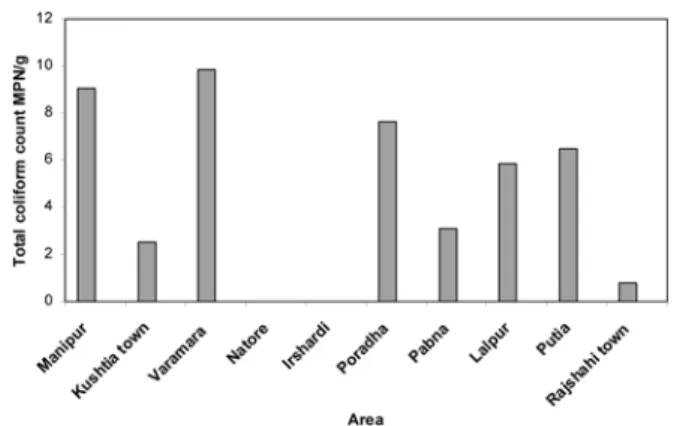
Total coliform count indicates the hygienic standard and the storage quality of the milk product, rather than the presence of human pathogens. Special care is required during the production and handling of the milk-based products in order to lower the coliform count. Among the ten different study areas, the highest the coliform count was found at Varamara (9.86 MPN/g), whereas the lowest was at Rajshahi town (0.78 MPN/g) (Table 1). On the
Table 1. Microbiological quality assessment of kwacha golla collected from cities of Bangladesh
Area Total bacterial count (cfu/g) count (MPN/gm)Total coliform Spore former (cfu/g) Staphylococcus sp. Salmonella sp. Total mold(cfu/g)
Mirpur 0097.89×107 9.06 0487.65×103 Nil Nil 51532.66
Kushtia town 0089.33×107 2.51 1582.66×103 Nil Nil 15500.52
Varamara 0100.63×107 9.86 0137.56×103 Nil Nil 8186.61
Natore 0051.66×107 0.00 1462.66×103 Nil Nil 28569.61
Irshardi 1624.33×107 0.00 08945.3×103 Nil Nil 21973.97
Poradha 2439.33×107 7.63 28754.0×103 Nil Nil 29463.38
Pabna 0915.33×107 3.12 3746.56×103 Nil Nil 6355.39
Lalpur 00037.0×107 5.85 2668.42×103 Nil Nil 16564.57
Putia 4385.66×107 6.46 0435.76×103 Nil Nil 17216.56
other hand, milk product samples from Natore and Irshardi areas were free from coliform contamination (Fig. 4). None of the samples contained fecal coliform. Coliform organisms are present in the non-pasteurized market milk. Coliform count up to 10 MPN/g or /mL is acceptable in the milk products [Wehr and Frank, 2004]. These suggest that kwacha golla sold in various areas can be considered as a hygienic food in terms of coliform count.
The highest count of spore-forming bacteria was obtained from the samples of the Poradha area (28754.0×
103 cfu/g) and the lowest was from the area of Varamara
(137.56×10³ cfu/g) (Fig. 2). The acceptable standard
count of spore-forming bacteria was <10,000 cfu/mL (Nørrung, 2000). The results of the present study showed that the kwacha golla samples from nine areas contained spore-forming bacteria below the standard acceptable level except for the samples from the Varamara area. Therefore, it could be said that kwacha golla milk product sold in most cities were hygienic.
Representative food-borne pathogens including Salmonella sp., Staphylococcus sp., E. coli, Listeria sp., and fungi (mold), which cause food-borne illnesses [Kulshrestha, 1990], were assayed. Salmonella is a type of a pathogenic organism. Salmonellosis may result following the ingestion of viable cells of the member of the genus
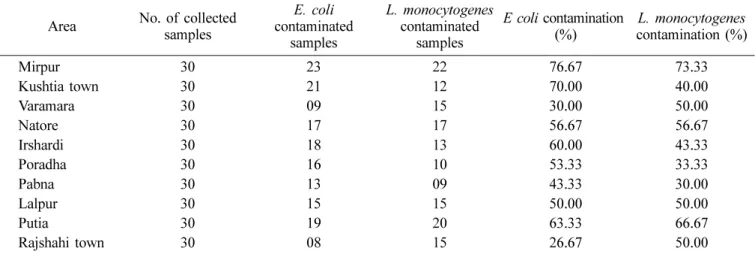
Table 2. Overall percentages of E. coli and L. monocytogenes contamination in kwacha golla samples
Area No. of collected samples contaminated E. coli samples
L. monocytogenes
contaminated
samples E coli contamination (%) contamination (%)L. monocytogenes
Mirpur 30 23 22 76.67 73.33 Kushtia town 30 21 12 70.00 40.00 Varamara 30 09 15 30.00 50.00 Natore 30 17 17 56.67 56.67 Irshardi 30 18 13 60.00 43.33 Poradha 30 16 10 53.33 33.33 Pabna 30 13 09 43.33 30.00 Lalpur 30 15 15 50.00 50.00 Putia 30 19 20 63.33 66.67 Rajshahi town 30 08 15 26.67 50.00
Table 3. Percentage of samples contaminated with different types of microorganisms
No. of total samples Types of Bacteria/ Fungi No. of positive samples Contaminated samples (%)
300 Total coliform 170 56.66 300 Spore-forming bacteria 300 100 300 Fungi 250 85.33 300 Escherichia coli 159 53.00 300 Listeria monocytogenes 148 49.33 300 Staphylococcus sp. 00 00
Salmonella; it is the most frequently occurring bacterial food infection [Barro et al., 2002]. In addition to the typical food-poisoning salmonellosis, typhoid fever and paratyphoid fever can also occur following the consumption of Salmonella-contaminated food [Bhan et al., 2005]. One of the most commonly occurring food poisoning incidences is caused by the ingestion of the enterotoxin formed in food during the growth of certain strains of S. aureus. The toxin was termed as enterotoxin, because it causes gastroenteritis or inflammation of the lining of the intestinal tract. All samples tested negative for the presence of Salmonella and Staphylococcus.
Mold growing on foods, with its fussy or cottony appearance, and sometimes colored, is familiar to everyone. Generally, moldy or “mildewed” food is considered unfit to eat. Although molds are involved in the spoilage of many kinds of foods, some molds are useful in the manufacture of certain foods or as ingredients of food [Carroll, 2003]. The highest mold count was found in the kwacha golla samples from the Mirpur area (51532.66 cfu/g), and the lowest count was in the Rajshahi town (1520.42 cfu/g) (Fig. 3). The mold standard plate count was 100 cfu/g [Tarakchi et al., 2003]. Therefore, all milk product samples tested exceeded the maximum allowable level of fungi.
Results of the present study revealed that the kwacha golla samples were contaminated by the two leading food-borne microorganisms, E. coli and L. monocytogenes (Fig. 4); the highest E. coli contamination, 23 out of 30 samples (76.67%), was recorded in the samples from the Mirpur city area, whereas the lowest was found in the samples obtained from Rajshahi town, 8 out of 30 samples (26.67%) (Table 2), indications that kwacha golla products sold in various city markets are highly contaminated with E. coli.
Indeed, indigenous sweet products are commonly manufactured and consumed in Bangladesh; the method of production, handling, transportation, and marketing of
the products are entirely depended upon the local traditional system used. Such system could pose a favorable environment for bacterial contamination. The unclean hands of workers, poor quality of milk, unhygienic conditions of the manufacturing unit, and inferior quality of the materials used and water supplied for washing the utensils could be the sources accelerating the bacterial contamination of milk products and the post-manufacturing contamination as well [Kumar and Sinha, 1989; Masud et al., 1989; Kulshrestha, 1990]. However, although E. coli is a commonly occurring organism in milk and milk-based products, the presence of E. coli in milk and milk products as a possible cause of food-borne disease is insignificant, because E. coli normally is a ubiquitous organism [Hahn, 1996].
The presence of L. monocytogenes, a food-borne pathogen, can be found in a wide variety of raw and processed foods including milk and dairy products [Rocourt and Cossart, 1997]. The highest L. monocytogenes contamination was recorded from the samples of Mirpur city area, which were 22 out of 30 (73.33%) samples, and the lowest contamination, 9 out of 30 (30.0%) samples, was recorded in samples from Pabna city area (Table 2).
L. monocytogenes is responsible for the severe food-borne illness, listeriosis. Listeriosis has recently been recognized to be one of the emerging zoonotic diseases and is contracted mainly through the consumption of Listeria-contaminated foods [Kulshrestha, 1990; Farber, 2000; Cordano and Rocourt,2001]. Increasing evidence suggests that substantial numbers of the human listeriosis cases are attributable to the food-borne transmission of L. monocytogenes [Kulshrestha, 1990; Nørrung, 2000]. In the present study, 49.33% of the food samples examined were found to be positive for L. mononcytogenes, and 85.33 and 53.0% of the samples were contaminated with fungi and E. coli, respectively (Table 3). However, all samples were free from the contamination of Salmonella sp. and Staphylococcus, comparable with the results of
the surveys undertaken in other countries [Uyttendaele et al., 1999; Farber, 2000; Inoue et al., 2000; Cordano and Rocourt, 2001; Dhanashree et al., 2003]. The present study showed the possibility of a significant public health hazard linked to the consumption of foods contaminated with L. monocytogenes.
In conclusion the milk product kwacha golla sold in various areas of Bangladesh is safe in terms of spore-forming and coliform bacteria, but not from fungi, E. coli, and L. monocytogenes, which may cause pathogenicity in the kwacha golla products. As kwacha golla is produced through thermal evaporation of raw milk, contamination could occur during storage and use of unhygienic utensils. Therefore, monitoring the hygienic conditions of the concerned shops is of utmost importance to prevent the microbial contamination.
Steps that should be taken to prevent the microbial contamination of foods include regular monitoring or inspection of the overall hygienic condition following the recommendations of the Bangladesh Standards and Testing Institution and the International Commission on Microbiological Specifications for Foods, as well as an appropriate heat treatment of the food during preparation for eradication the food pathogens in the milk samples.
References
Allerberger F, Wagner M, Schweiger P, Rammer HP, Resch A, Dierich MP, Friedrich AW, and Karch H. (2001)
Escherichia coli O157 infections and unpasteurised milk.
Euro Surveill 6, 147-151.
Anonymous. (2005) Preliminary Food Net data on the inci-dence of infection with pathogens transmitted com-monly through food-10 sites, United States. Morbidity and Mortality Weekly Report54, 352-356.
Baird-Parker TC and Tompkin RB. (2000) Risk and Micro-biological criteria. In The Microbiological Safety and Quality of Foods (Vol II), Lund B, Baird-Parker TC, and Gould GW (eds), pp. 1852-1885. Aspen Publishers, Maryland.
Barro N, Ouattara CA, Nikiema PA, Ouattara AS, and Tra-ore AS. (2002) Microbial quality assessment of some street food widely consumed in Ouagadougou, Burkina Faso. Sante 12, 369-374.
Bhan MK, Bahl R, and Bhatnagar S. (2005) Typhoid and paratyphoid fever. Lancet366, 749-762.
Bryan FL, Michanie SC, Alvarez P, and Paniagua A. (1988) Critical control points of street-vended foods in the Dominican Republic. J Food Protect 51, 73-383.
Cardinale E, Perrier Gros-Claude JD, Tall F, Gueye EF, and Salvat G (2005) Risk factors for contamination of ready-to-eat street-vended poultry dishes in Dakar, Senegal. Int J Food Microbiol 103, 157-165.
Carroll R. (2003) Making Cheese, Butter, and Yogurt.
Sto-rey Publishing, MA.
Cody SH, Abbott SL, Marfin AA, Schulz B, Wagner P, Robbins K, Mohle-Boetani JC, and Vugia DJ. (1999) Two outbreaks of multidrug-resistant Salmonella serotype Typhimurium DT104 infections linked to raw-milk cheese in Northern California. J Amer Med Assoc 281,
1805-1810.
Cordano AM and Rocourt J. (2001) Occurrence of Listeria
monocytogenes in food in Chile. Int J Food Microbiol
70, 175-178.
Dawson RJ and Canet C. (1991) International activities in street foods. Food Control 2, 135-139.
De Buyser ML, Dufour B, Maire M, and Lafarge V. (2001) Implication of milk and milk products in food-borne diseases in France and in different industrialised countries. Int J Food Microbiol 67,1-17.
De Valk H, Delarocque-Astagneau E, Colomb G, Ple S, Godard E, Vaillant V, Haeghebaert S, Bouvet PH, Gri-mont F, Grimot P, and Desenclos JC. (2000) A community-wide outbreak of Salmonella enterica sero-type Typhimurium infection associated with eating a raw milk soft cheese in France. Epidemiol Infect124, 1-7.
Deak T and Beuchat LR. (1996) In Handbook of Food
Spoilage. CRC Press, NY.
Dhanashree B, Otta SK, Karunasagar I, Goebel W, and Karunasagar I. (2003) Incidence of Listeria spp. in clini-cal and food samples in Mangalore, India. Food Micro-biol20,447-453.
Farber JM. (2000) Present situation in Canada regarding
Listeria monocytogenes and ready-to-eat sea food
prod-ucts. Int J Food Microbiol 62, 247-251.
Hahn G. (1996) Pathogenic bacteria in raw milk-situation and significance. In Bacteriological Quality of Raw Milk, pp. 67-83. International Dairy Federation, Belgium. Harrington P, Archer J, Davis JP, Croft DR, Varma JK, and
EIC officers. (2002) Outbreak of Campylobacter jejuni infections associated with drinking unpasteurized milk procured through a cow-leasing program-Wisconsin, 2001. Morbidity and Mortality Weekly Report 51,
548-549.
Hutchinson DN, Bolton FJ, Jelley WC, Mathews WG, Telford DR, Counter DE, Jessop EG, and Horsley SD. (1985) Campylobacter enteritis associated with consumption of raw goat’s milk. Lancet 1, 1037-1038.
International Commission on Microbiological Specifications for Food (ICMSF) (1986) Sampling for microbiological analysis: Principles and specific applications. In Microor-ganisms in Food (2nd ed.), Blackwell Scientific
Publica-tions, UK.
International Commission on Microbiological Specifications for Food (ICMSF) (2002) Microbiological testing in food safety management. In Microorganisms in Foods
(7th ed), Aspen Publishers, NY.
Inoue S, Nakama A, Arai Y, Kokubo Y, Maruyama T, Saito A, Yoshida T, Terao M, Yamamoto S, and Kumagai S. (2000) Prevalence and contamination levels of Listeria
monocytogenes in retail foods in Japan. Int J Food Microbiol 59, 73-77.
Kulshrestha SB. (1990) Prevalence of enteropathogenic sero groups of E. coli in milk products samples from Bareilly and their multiple drug resistance. Indian J Dairy Sci 43,
337-378.
Kumar V and Sinha RN. (1989) Incidence of coliforms in indigenous milk products. Indian J Dairy Sci 42,
579-580.
Low JC and Donachie W. (1997) A review of Listeria monocytogenes and listeriosis. Vet J 153, 9-29.
Masud T, Athar IH, Chishti MA, and Shah MA. (1989) Microbiological studies on indigenous Dahi with special reference to public health. J Anim Health Prod 8, 8-13.
McCabe-Sellers BJ and Samuel EB. (2004) Food safety: Emerging trends in foodborne illness surveillance and prevention. J Am Diet Assoc104,1708-1717.
McIntyre L, Fung J, Paccagnella A, Isaac-Renton J, Rockwell F, Emerson B, and Preston T. (2002)
Escherichia coli O157 outbreak associated with the
ingestion of unpasteurized goat’s milk in British Columbia, 2001. Canada Communicable Disease Report,
28, 6-8.
Mead PS, Slutsker L, Dietz V, McCaig LF, Breese J S, Sha-piro C, Griffin PM, and Tauxe RV. (1999) Food related illness and dead in the United States. Emerg Infect Dis
5, 607-625.
Mosupye F and Von Holy A. (1999) Microbiological qual-ity and safety of ready-to-eat street-vended foods in Johannesburg, South Africa. J Food Protect 62,
1278-1284.
Moy G, Hazzard A, and Käferstein F (1997) Improving the safety of street-vended food. World Health Statistics
Quarterly50,124-131.
Murphy S. (1997) NMC Regional Meeting Proceedings, pp. 34-42. National Mastitis Council, Verona, WI.
Nørrung B. (2000) Microbiological criteria for L.
monocyto-genes in foods under special consideration of risk
assessement approaches. Int J Food Microbiol 62,
217-221.
Rocourt J and Cossart P. (1997) Listeria monocytogenes. In
Food Microbiology-Fundamentals and Frontiers, Doyle
MP, Buechat LR, and Montville TJ (eds.), pp. 337-352. American Society for Microbiology Press, Washington DC.
Soomro AH, Arain MA, Khaskheli M, and Bhutto B. (2002) Isolation of Escherichia coli from raw milk and milk products in relation to public health sold under market conditions at Tandojam. Pakistan J Nutr 1,
151-152.
Tarakci Z and Erdogan K. (2003) Physical, chemical, micro-biological and sensory characteristics of some fruit-fla-vored yogurt. Y.Y.U. Vet. Derg.14, 10-14.
Uyttendaele M, Troy PD, and Debevere J. (1999) Incidence
of Listeria monocytogenes in different types of meat
products on the Belgian retail market. Int J Food Micro-biol 53,75-80.
Vollaard AM, Ali S, van Asten HA, Ismid IS, Widjaja S, Visser LG, Surjadi C, and van Dissel JT. (2004) Risk factors for transmission of foodborne illness in restau-rants and street vendors in Jakarta, Indonesia. Epidemiol Infect 132, 863-872.
Wehr MH and Frank JF. (2004) Standard Methods for the Examination of Dairy Products (17th ed), pp. 22-247. American Public Health Association, Washington, DC.