221 -P3-28
Phytochemical Study and Anticancer Potential from the Fruits of
Elaeagnus multiflora in Human Glioblastoma Cells
1Graduate School of Oriental Medicinal Materials & Processing, Kyung Hee
University, Yongin 446-701, Korea.
2Department of Neurosurgery, Ajou University School of Medicine, Suwon 443-749,
Korea
3Graduate School of Oriental Medicine, Kyung Hee University, Seoul 130-701, Korea 4Food Analysis Reseatch Center, Suwon Women's College, Hwaseong 445-890, Korea
Dae-Young Lee1, Mi-Kyoung Lee2, Byeung-Ju Cha1, Nam-In Baek1, Sung-Hoon Kim3, Jin-Sik Nam4, and Min-Ho Lee1*
실험목적 (Objectives)
Elaeagnus multiflora is renowned as a phychemical-rich plant which has been used in traditional Chinese medicine. This species belongs to the family of Elaeagnaceae, the fruits, leaves, and roots of which have been used to treat cough, diarrhea, itching, and foul sores for a long time. The purpose of this study was to investigate the phytochemical contents and biological activities from the fruits of Elaeagnus multiflora. Its fruits have been reported to have anti-tumor. So, this study is focused on isolation, and identification of the single compounds from this plant and evaluated the anti-proliferative and proapoptotic effects in human glioblastoma U87 cells.
재료 및 방법 (Materials and Methods)
1H-NMR (400 MHz), 13C-NMR (100 MHz) and 2D-NMR spectra were recorded on a
Varian Unity Inova AS-400 FT-NMR spectrometer. Methanol-d4 with TMS as an
internal standard was purchased from Sigma. RPMI Medium 1640, Dulbecco’s Modified Eagle Medium and Penicillin-Streptomycin were purchased from GIBCO. FBS was from Hyclone. MTT and DMSO were purchased from Sigma. The methanol extract was fractionated into an EtOAc layer, an n-BuOH layer and a H2O layer
through solvent fractionation. The repeated SiO2, ODS and Sephadex LH-20 c. c. of
EtOAc fractions yielded compounds. The cell viability was evaluated by MTT reduction. Soft agar colony assay was performed for clonogenic activity for 2 weeks. Subtoxic effect was identified by proliferation assay. Cell cycle analysis was performed by FACS analysis with PI (Propidium iodide) staining. Western blot analysis
222 -결과 및 고찰 (Results and Discussion)
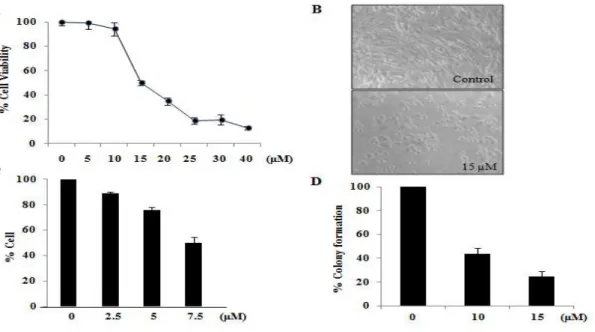
The fruits of Elaeagnus multiflora were extracted with 70% EtOH and the concentrated extracts were successively partitioned using EtOAc, n-BuOH and H2O. From the EtOAc fractions, four compounds were isolated through repeated silicagel, octadecyl silicagel (ODS) and SephadexLH-20 column chromatographies. Based on the spectroscopic data from NMR, MS and IR, the chemical structures of the compounds were determined to be 24-methylenecycloartanol (1), oleanolnic acid (2) and, betulinic acid (3). These compounds were isolated from the fruits of Elaeagnus multiflora for the first time. The human glioblastoma cells were treated with different concentrations of isolated compounds and tested for growth inhibition, cytotoxicity, cell cycle modulation and induction of apoptosis. 3 inhibited growth of tumor cell s in cell proliferation assay, enhanced cytotoxicity, and induced apoptosis by activation of capase-3, caspase-7 and caspase-9 and by cleavage of Poly-(ADP)-ribose polymerase. Finding from this study could provide a basis for potential usefulness of 3 as promising therapeutic agents in the prevention of brain tumors.