Long-term Variation of a Finless Porpoise (Neophocaena asiaeorientalis)
Population in Taeanhaean National Park after Hebei Spirit Oil Spill
Byungkwan Jeong, Jung Won Park, Seong Geon Jang, Da Hye Hwang,
Jin Hyun Kim, Jong Hyun Lee and Won Ok Jeong*
Oil Pollution Research Center, National Park Research Institute, Taean 32105, Korea
Abstract : As part of the long-term monitoring effort following the Hebei Spirit oil spill that occurred in Taean County, the present study tracked the long-term variation in population size and spatial distribution of finless porpoises (Neophocaena asiaeorientalis). In the damage survey spanning one year since the accident, a total of nine finless porpoise carcasses were found on the Taean coast, but because most carcasses had severely decayed, the exact cause(s) of death could not be identified. In the sighting survey, large groups assumed to be engaging in feeding activity were frequently observed after 2011, while the survey also suggested a trend of steady increase in the number of individuals. With respect to spatial distribution, the frequency of finless porpoise appearance was high in the northern waters off the Taean coast, which was found to follow the distribution of food sources.
Key words : finless porpoise, Neophocaena asiaeorientalis, marine mammals, Hebei Spirit, oil spill, Long-term variation
Introduction
Marine mammals are generally classified as cetaceans, pinnipeds, sirenians, and marine fissipeds. There are many individuals distributed throughout the world, and because they have bigger body size than that of other organisms, they are believed to have a significant impact on the structure and function of aquatic ecosystems. However, research on the role of these animals within such ecosystems is relatively scarce owing to high research costs and the near impossibility of conducting biological experiments with these animals (Bowen 1997).
Finless porpoises, which are members of the family Phoco-enidae, are small cetaceans that lack a true dorsal fin but have a protruding ridge. They can grow to approximately 2 m in length and 80 kg in weight and are found mostly in the Indian and western Pacific oceans, inhabiting the shallow waters from the Persian Gulf to Japan (Jefferson and Hung 2004; Amano 2018). Finless porpoises are classified largely into two species (Neophocaena phocaenoides and N. asiaeorientalis) based on the shape of the dorsal area, skull, and occipital lobe, while N. asiaeorientalis is further divided into two subspecies: N. asiaeorientalis asiaeorientalis inhabiting
the Yangtze River, and N. a. sunameri found on the coasts of the Korean Peninsula, Japan, and Taiwan Strait (Wang et al. 2008; Jefferson and Wang 2011). While the typical lifespan of a finless porpoise is less than 25 years, some individuals older than 30 years have been found (Kasuya 1999; Jefferson et al. 2002). They reach maturation at 4-6 years after birth, and the total gestation period is estimated to be approximately 11 months. N. phocaenoides breeds during winter, whereas N. asiaeorientalis is known to breed from spring to summer (Jefferson et al. 2002).
Although the total global number of population of finless porpoise is unknown, the number of N. phocaenoides individuals inhabiting the waters near Hong Kong and Bangladesh are estimated to be 220 and 1,382, respectively, while the number of N. asiaeorientalis individuals inhabiting the waters near Japan, west coast of Korea, and the Yangtze River is estimated to by approximately 19,000, 13,000, and 1,800, respectively (Amano 2018). Research into finless porpoises in Korea have included studies on food species and distribution of finless porpoises appearing throughout the West and South Seas (Zhang et al. 2004; Choi et al. 2010; Park et al. 2011), and seasonal changes and regional di-stributions of finless porpoises appearing in waters near Wi
*Corresponding author E-mail: [email protected]
island (near Byeonsan peninsula in Jeollabuk-do), Gadeok island (near Busan), and Saemangeum (Lee et al. 2014; Park et al. 2014; Park et al. 2017). However, studies are lacking relative to other marine biota.
Finless porpoises, which occupy the highest trophic level in the marine food chain, are opportunistic predators that feed on fish, crustaceans, and cephalopods throughout the pelagic and benthic zone (Park et al. 2002; Jefferson and Hung 2004; Park et al. 2011). Therefore, decreases in food sources due to ecosystem disturbance and changes in habitat environment caused by pollution should have a significant impact on the number and distribution of populations of finless porpoises. An oil spill occurred on December 7, 2007 in the waters of Taeanhaean National Park (TNP), the study site of the current study, which caused major damage throughout the ecosystem (Hong et al. 2014; Jung et al. 2015). Accordingly, monitoring studies are being conducted for long-term observation of such changes. As part of the long-term monitoring effort following the oil spill, we tracked variation in the population size and spatial distribution of finless porpoises caused by the oil spill and aimed to obtain evidential data for ecological recovery.
Materials and Methods
1. Damage surveyTo identify the damage to finless porpoises caused by the oil spill, surveys were conducted between December 2007 and December 2008, focusing on a total of 18 coastal locations and islets in TNP. In addition, reports of carcass sighting by residents were verified and included in the data. Collected carcasses were sent to the management office of Seoul Grand Park for necropsy to determine the cause(s) of death.
2. Sighting survey
To identify long-term population size variation in finless porpoise inhabiting TNP, sighting surveys were conducted 3-4 times a year between 2008 and 2018 (Table 1). Observations were made on board a ship traveling at 3-7 knots along a transect line, starting from waters near Hakampo in northern sea to waters near Godae island under the jurisdiction of Boryeong (Figure 1). Three surveyors were positioned at the front, left, and right of the bow of the ship and one surveyor was positioned at the rear of the stern of the ship. Observations were made with the naked eye and using binoculars, and one additional surveyor was assigned for recording the survey chart and taking photographs on each survey. The surveyor in charge of inputting data in the survey chart recorded the distance and angle of finless porpoise sighting notified by
each observer and used a portable GPS device (Oregon-550, Garmin®) for confirmation of locational data.
3. Food source survey
Food source surveys were conducted during June, July, and
Figure 1. Transect line for finless porpoise sighting survey and stations for the estimating potential prey in TNP.
Table 1. Survey frequency during 2008-2018.
Season
Years Winter Spring Summer Fall
2008 - ○ ○ ○ 2009 ○ ○ ○ ○ 2010 ○ ○ ○ ○ 2011 - ○ ○ ○ 2012 - - - -2013 - - - -2014 - ○ ○ ○ 2015 - ○ ○ ○ 2016 - ○ ○ ○ 2017 - ○ ○ ○ 2018 - ○ ○ ○
October 2015, using small otter trawls at two fixed points selected in waters near TNP (Figure 1). The fishing gear used for sample collection had a length of 15 m, width of 3 m, height of 8 m, and mesh size of 2.2 mm. At each fixed point, towing was performed for approximately 30-60 min at a speed of approximately 1-2 knots. The collected samples were stored in an icebox and transported to the laboratory where the number of individuals was counted and identified to species level (Cha et al. 2001; Kim and Kim 2001; Kim et al. 2005; Hong 2006) and their biomass (wet weight) was measured.
Results and Discussion
Necropsy findings of nine finless porpoise carcasses, which were suspected to have died in coastal locations along TNP, showed that the exact cause(s) of death could not be deter-mined due to severe decay. Among these, one carcass found in Magumpo area on December 12, 2007 was pregnant, while the cause of death of another carcass found on January 17, 2008 was determined to be a cerebral hemorrhage caused by cranial trauma (Figure 2, Table 2).
During an oil spill, marine mammals are expected to sense and avoid the oil spill, but studies investigating the Regal
Figure 2. Finless porpoise carcasses found in TNP (A-C) and a necropsy conducted on a finless porpoise carcass (D). Table 2. Status of finless porpoise carcasses found and necropsy findings.
Discovery date Location Number of individuals Necropsy findings
Dec. 12, 2007 Magumpo 1 N.F. Decomposition, Pregnancy
Dec. 13 Sinjindo 1 N.F. Decomposition
Dec. 14 Bangpo 1 N.F. Decomposition
Dec. 21 Iwon dike 1 N.F. Decomposition
Dec. 24 Uihang 1
Jan. 17, 2008 Gureum 1 C.T. Cerebral hemorrhage caused by a trauma
Oct. 29 Cheollipo 2 N.F. Decomposition
Dec. 29 Hagampo 1 N.F. Decomposition
Sword Oil Spill that occurred in 1979 on the east coast of Massachusetts, USA reported that cetaceans were swimming or engaging in feeding activity in areas exposed to the oil spill (Goodale et al. 1979; Rainer Engelhardt 1983). Cetaceans surface to breathe, and may thus be exposed to the oil spill, with the oil flowing into their body through the blow hole. Because of this, individuals exposed to oil spills could suffer various kinds of damage, including loss of swimming ability and sense of direction, impaired thermoregulation, skin damage, ingestion of toxic hydrocarbons, inhalation of toxic gases, stress, and asphyxiation or drowning (Engelhardt 1987; Fair and Becker 2000; Peterson et al. 2003). The damage survey conducted after the oil spill could not determine the exact cause(s) of death in finless porpoise carcasses, but considering the findings of previous studies, it is highly likely that they were directly and indirectly affected by the oil spill. In the
case of the finless porpoise that died of cerebral hemorrhage caused by cranial trauma, the possibility that the trauma may
Table 3. Seasonal and inter-annual changes of number of finless porpoise observations following oil spill.
Season
Years Winter Spring Summer Fall Annual total
2008 - 56 6 34 96 2009 5 15 1 22 43 2010 1 44 53 0 98 2011 - 216 3 90 309 2012 - - - - -2013 - - - - -2014 - 76 40 185 301 2015 - 60 43 40 143 2016 - 117 184 35 336 2017 - 59 12 23 94 2018 - 82 26 8 116 Total by season 6 725 368 437 1536 -, No survey
Figure 3. Long-term variation and trend in finless porpoise sightings during the survey period
Figure 4. Spatial distribution of finless porpoises in 2011 and 2014 to 2018.
have been caused by loss of swimming ability and sense of direction from the effect of the oil spill cannot be dismissed. When individuals observed for 10 years since the oil spill were grouped by season, the highest number of individuals was observed in spring (725), while 368 and 437 individuals were observed in summer and fall, respectively (Table 3). Considering the difficulty of observations during winter owing to adverse sea conditions, winter surveys were not conducted from 2011 onwards. Consequently, only 6 individuals (5 in 2009 and 1 in 2010) were observed during winter (Table 3). While there are almost no studies on the seasonal distribution of finless porpoises in Korea, a study by Park et al. (2017) reported that finless porpoises in Gadeokdo, Busan, were found in high numbers only in May, during spring. In addition, finless porpoises on the west coast of Kyushu, Japan were also observed at a high density in April, followed by gradual decrease (Shirakihara et al. 1994). Kasuya and Kureha (1979) reported that the density of sighted finless porpoises was closely associated with the breeding season. According to a study by Lee et al. (2013), finless porpoises inhabiting the West Sea of Korea breed between May and September, with the peak breeding season being May and June.
The number of individuals observed by year ranged between 43 individuals (2009) and 336 individuals (2016),
with over 300 individuals observed in 2011, 2014, and 2016 (Table 3). Even after the oil spill, finless porpoises continued to appear, with an annual total sighting of up to 56 individuals during 2008-2010 (Figure 3), usually as single individuals or pairs (Figure 5A, B). However, starting from the survey in spring of 2011, populations assumed to be engaging in feeding activity (spring and fall of 2011, spring and fall of 2014, spring and summer of 2016, and spring of 2018) continued to appear and the number of individuals observed together showed a trend of steady increase (Figure 3, Table 3). Generally, finless porpoises form small groups (mating pairs or mothers and offspring) (Jefferson and Hung 2004; Amano 2018) and they appear active, exhibiting behavior such as jumping above the water’s surface, when they are engaging in feeding activity (Parson 1998; Jefferson and Braulik 1999). In the present study, finless porpoises exhibited very active movement when they were observed during what was assumed to be feeding activity, and in particular, they formed groups of 20-50 individuals (Figure 5C, D). Till date, there have been no reports of finless porpoises forming groups during feeding activity, but some dolphins are known to exhibit the strategic behavior of forming groups to increase their hunting efficiency (Markowitz et al. 2004; Gowans et al. 2007; Vaughn et al. 2007). These results from previous
Figure 5. Photographs of finless porpoises taken during sighting surveys. Porpoises rising to the surface water to breathe (A). Porpoises rarely form large schools and are usually found in breeding or mother and calf pairs (B). Assumed feeding activities (C and D).
studies support our hypothesis that the multiple groups of finless porpoises observed were engaging in feeding activity. It is believed that additional studies investigating such phenomena are needed to establish the ecological framework of finless porpoises.
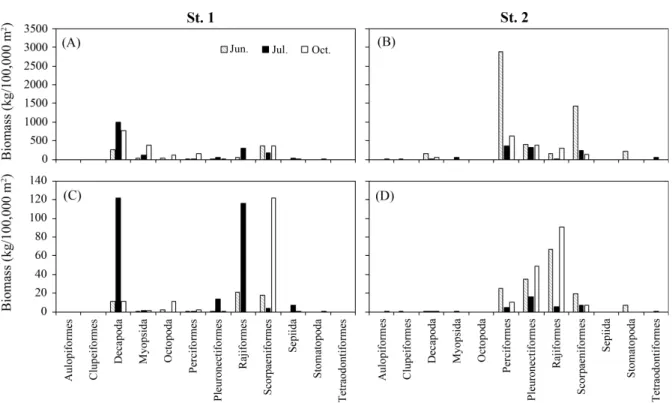
With respect to the spatial distribution investigated using locational data of finless porpoise sightings between 2011 and 2018, porpoises were observed at high frequency in the northern waters of the national park. In particular, they were primarily concentrated in waters between Gageo island and Port Sinjin, and groups assumed to be feeding were continuously observed in this area (Figure 4). Although the reason why finless porpoise sightings were concentrated in this area cannot be identified, it is possible that this area may be rich in food sources preferred by finless porpoises, or that the area has favorable topographical conditions encouraging finless porpoise inhabitation. In the survey conducted in 2015 for estimation of finless porpoise food sources, a high number of individuals and biomass of Decapoda, Rajiformes, and Scorpa-eniformes were found at Station 1 located in the northern region, while high densities of Perciformes, Pleuronectiformes, Rajiformes, and Scorpaeniformes were found at St. 2 located in the southern region (Figure 6). When the stomach contents of incidentally caught individuals were checked to identify the feeding habits of finless porpoises in the western sea, the results showed that crustaceans accounted for 50-98% of the diet, with an especially high percentage of shrimp (Park et al.
2002; Park et al. 2011). In the present study, northern waters where finless porpoises appeared frequently had a high density of shrimps inhabiting the area, which may have influenced the spatial distribution of finless porpoises to some extent.
When pollution, such as an oil spill, occurs in a marine ecosystem, such pollution can have significant impact on not only water quality and environment, but also on a variety of organisms, while also causing disturbance throughout the trophic levels and the entire ecosystem. The apex predators in an ecosystem show variation according to the distribution of food sources, and thus, increase in the number of finless porpoises could be used as an indicator for the recovery of their food sources. In Taean County, where the oil spill occurred, an increased number of finless porpoises and increased activity, assumed to be feeding activity, were continuously observed after 2011, which suggested that the ecosystem had gradually recovered. Moreover, because the accident period was included within the long lifespan of finless porpoises, the findings could also be used as an indicator for long-term impact of oil spill.
Acknowledgement
The present study was conducted as a part of the “Long-term Monitoring of Ecological Impact of HS Oil Spill” project.
References
Amano M. 2018. Finless Porpoises: Neophocaena phocaenoides, N. asiaeorientalis. Pp. 372-375 in B. Würsig, J. G. M. Thewissen, and K. M. Kovacs, editors. Encyclopedia of Marine Mammals (Third Edition). Academic Press.
Bowen WD. 1997. Role of marine mammals in aquatic eco-systems. Marine Ecology Progress Series 158: 267-274. Cha HK, JU Lee, CS Park, CI Baik, SY Hong, JH Park, DW Lee,
YM Choi, K Hwang, ZG Kim, KH Choi, H Sohn, MH Sohn, DH Kim, JH Choi. 2001. Shrimps of the Korean Waters. National Fisheries Research and Development Institute Pusan, Korea.
Choi S-G, KJ Park, HW Kim, YR Lee, JE Park, DY Moon, YR An. 2010. Finless porpoise, Neophocaena phocaenoides, Distribution in the South Sea of Korea. Korean Journal of Fisheries and Aquatic Sciences 43: 665-669.
Engelhardt FR. 1987. Assessment of the Vulnerability of Marine Mammals to Oil Pollution. Pp. 101-115. Springer Netherlands, Dordrecht.
Fair PA, PR Becker. 2000. Review of stress in marine mammals. Journal of Aquatic Ecosystem Stress and Recovery 7: 335-354.
Goodale DR, MAM Hyman, HE Winn. 1979. Cetacean responses in association with REGAL SWORD oil spill. Chapter XI. In: A Characterization of Marine Mammals and Turtles in the Mid-and North Atlantic Areas of the US Outer Continental Shelf, ed. R. K. Edel, M. A. Hyman & M. F. Tyrell: Cetacean and Turtle Assessment Program, Annual Report, University of Rhode Island, pp. XI-1 to XI-15.
Gowans S, B Würsig, L Karczmarski. 2007. The Social Structure and Strategies of Delphinids: Predictions Based on an Ecological Framework. Pp. 195-294 Advances in Marine Biology. Academic Press.
Hong S, JS Khim, J Ryu, S-G Kang, WJ Shim, UH Yim. 2014. Environmental and ecological effects and recoveries after five years of the Hebei Spirit oil spill, Taean, Korea. Ocean & Coastal Management 102: 522-532.
Hong SY. 2006. Marine invertebrates in Korean coasts. Academy-book, Seoul, Korea.
Jefferson TA, GT Braulik. 1999. Preliminary report on the ecology of the finless porpoise in Hong Kong waters. IBI reports 9: 41-54.
Jefferson TA, SK Hung. 2004. Neophocaena phocaenoides. Mammalian Species:1-12.
Jefferson TA, KM Robertson, JY Wang. 2002. Growth and reproduction of the finless porpoise in southern China. The Raffles Bulletin of Zoology 10: 105-114.
Jefferson TA, JY Wang. 2011. Revision of the taxonomy of finless porpoises (genus Neophocaena): the existence of two species. Journal of Marine Animals and Their Ecology 4: 3-16.
Jung Y-H, K-T Yoon, W-J Shim, H-S Park. 2015. Short-Term Variation of the Macrobenthic Fauna Structure on Rocky Shores after the Hebei Spirit Oil Spill, West Coast of Korea. Journal of Coastal Research 299: 177-183.
Kasuya T. 1999. Finless porpoise Neophocaena phocaenoides (G. Cuvier, 1829). In “Handbook of Marine Mammals” (S.H. Ridgway and R. Harrison, Eds), 6: 411-442. Academic Press, San Diego, CA.
Kasuya T, K Kureha. 1979. The population of finless porpoise in the Inland Sea of Japan. Scientific Reports of the Whales Research Institute 31: 1-44.
Kim IS, Y Chio, C-L Lee, YJ Lee, BJ Kim, J-h Kim. 2005. Illustrated book of Korean Fishes. Kyohaksa, Seoul, Korea. Kim W, H-S Kim. 2001. Crab: food & resources. Junghaengsa,
Seoul, Korea.
Lee Y-W, Y Choi, HH Lee, B-k Hwang. 2014. Inhabitant and Appearance of Finless Porpoise (Neophocaena asiaeorientalis) in the Coastal Wido, Korea. Journal of Fisheries and Marine Sciences Education 26.
Lee YR, YR An, KJ Park, H Sohn, DH An, SA Kim. 2013. Age and reproduction of the finless porpoises, Neophocaena asiaeorientalis, in the Yellow Sea, Korea. Animal Cells and Systems 17: 366-373.
Markowitz TM, AD Harlin, B Würsig, CJ McFadden. 2004. Dusky dolphin foraging habitat: overlap with aquaculture in New Zealand. Aquatic Conservation: Marine and Freshwater Ecosystems 14: 133-149.
Park KJ, YR An, YR Lee, J-E Park, DY Moon, S-G Choi. 2011. Feeding Habits and Consumption by Finless Porpoises (Neophocaena asiaeorientalis) in the Yellow Sea. Korean Journal of Fisheries and Aquatic Sciences 44: 78-84.
Park KJ, SY Lee, YR An, HW Kim, DH An, DN Kim, KY Hye. 2014. Reappearance and Distribution Tendency of Finless Porpoises (Neophocaena asiaeorientalis) after their Mass Mortality in the Saemangeum Dyke. Korean Journal of Fisheries and Aquatic Sciences 47: 978-982.
Park KJ, YG Yoon, J-H Sin, H Sohn, Y-M Choi. 2017. Distribution and Seasonal Changes in Finless Porpoise (Neophocaena asiaeorientalis) Populations Near Gadeok Island, Korea. Korean Journal of Fisheries and Aquatic Sciences 50: 561-566.
Park KJ, CI Zhang, ZG Kim, H Sohn. 2002. Feeding habits and trophic level of finless porpoise, Neophocaena phocaenoides in the Yellow Sea. Journal of the Korean Society of Fisheries Resources 5: 52-63.
Parson ECM. 1998. The behaviour of Hong Kong's resident cetaceans: The Indo-Pacific humpbacked dolphin and the finless porpoise. Aquatic Mammals 24: 91-110.
Peterson CH, SD Rice, JW Short, D Esler, JL Bodkin, BE Ballachey, DB Irons. 2003. Long-Term Ecosystem Response to the Exxon Valdez Oil Spill. Science 302: 2082.
Aquatic Toxicology 4: 199-217.
Shirakihara M, K Shirakihara, A Takemura. 1994. Distribution and Seasonal Density of the Finless Porpoise Neophocaena phocaenoides in the Coastal Waters of Western Kyushu, Japan. Fisheries Science 60: 41-46.
Vaughn RL, DE Shelton, LL Timm, LA Watson, B Würsig. 2007. Dusky dolphin (Lagenorhynchus obscurus) feeding tactics and multi‐species associations. New Zealand Journal of Marine and Freshwater Research 41: 391-400.
Wang JY, TR Frasier, SC Yang, BN White. 2008. Detecting recent
speciation events: the case of the finless porpoise (genus Neophocaena). Heredity 101: 145-155.
Zhang CI, KJ Park, Z-G Kim, H Sohn. 2004. Distribution and Abundance of Finless Porpoise (Neophocaena phocaenoides) in the West Coast of Korea. Journal of the Korean Fisheries Society 37: 129-136.
(2019년 11월 11일 접수; 2019년 11월 24일 수정; 2019년 12월 14일 채택)