The Effect of Cognitive Emotional Control on Life Goals
Jungae Kim
1Assistant Professor, Department of Nursing, Chodang University, Korea1
[email protected]
Abstract
This study was a cross-sectional descriptive investigative study to analyze the effects of sub-factors of cognitive emotional control on life goals. The subjects of the study were 184 people in their 20s, and they were collected online from December 2020 to January 5, 2021 using structured cognitive control capabilities and life goal questionnaires. The collected data were performed using SPSS 18.0 for Frequency, Independent Sample t-test, Pearson correction analysis, Simple regression analysis, and Multiple regression analysis. According to the study, men had both life-oriented and achievement-oriented life goals higher than women. Among the sub-factors of cognitive emotional control (positive focus change, positive reassessment, expansion of view, re-accept plan, acceptance, rumination, self-criticism, others criticism, and destruction) were male and female were higher in self-criticism. Factors affecting life-oriented life goals have been shown to be expanding views, re-accepting plans, and criticizing others, while positive re-evaluation negatively affects achievement-oriented life goals. Based on these results, life-oriented life-goals tend to exhibit adaptive responses to expand views and revise plans and maladaptive responses to blame others, while achievement-oriented life-goals have the ability to positively reassess situations, modify plans and accept negative reactions.
Keywords: Achievement-oriented life goals, Cognitive emotional control, Life-oriented life goals, People in their 20s
1. INTRODUCTION
People experience various and unpredictable events in their lifetime, regardless of their will. In situations where there are emotional problems in the home or are not socially and environmentally stable, it is more often left out or placed in a negative position in society [1-2]. Basically, people make various efforts to escape from such life, but in times of crisis, they often have to solve it on their own without proper support, which can lead to losing the direction of life and living a hard life. The recent unexpected virus-infected disaster worldwide is adding more pain to the socially disadvantaged than those who are not [3]. This also changes the way people relate, exposing themselves to more stress than previous lives, and without a cycle of improvement in environmental stress, problems that are not controlled in relationships and their own worlds can become more and more social problems. In other words, the problem is becoming more complex and unresolved as the new problem covers it without solving the existing problem. However, efforts must continue to be made to find the order hidden in these complex societies and to find alternatives to solving complex problems so that life can move in a desirable direction.
Humans have goal-oriented properties that basically strive to achieve what they want [4]. Goal is a
IJACT 21-3-11
Manuscript received: January, 31, 2021 / revised: February 8, 2021/ accepted: February 15, 2021 Corresponding Author: [email protected]
Tel:+82-61-450-1818, Fax: +82-61-450-1801
psychological expression of what the object of aspiration is, and is also an important source of synchronization
in an individual's life [5]. The goal that a person ultimately aims to achieve in life is defined as a life goal, which becomes the final destination in a person's life and guides the motivation and direction necessary to reach it [6]. Life goals are a comprehensive concept that incorporates the past, present and future perspectives of the past, present, and future into an individual's entire life, with goal-oriented characteristics that humans basically strive to achieve what they want [7]. That is, a person actually acts on cognitive aspects, such as their importance to the goal in order to achieve life goals, and internalizes them to an appropriate level for the individual.
According to the research on life goals, JH Shin et al. [8] categorized the goals as life-oriented goals to achieve success through competition in the social sector, such as jobs, work, and academic fields, and to gain a sense of well-being through relationships with people around them. These two goals play an important role in determining the development and happiness of life in many aspects of the individual, and when these two goals are balanced, the satisfaction of the individual's life according to the achievement of the goal [9]. In other words, life goals are divided into achievement-oriented life goals to achieve success in social areas such as occupation, honor, and academic fields, and life-oriented goals that focus on enhancing the well-being of life through personal life and interpersonal relationships. Achievement-oriented life goals include extrinsic concepts that represent dimensions of external goals, such as economic success, appearance, and social recognition, and furthermore, goals that cover the entire future life [5]. Achievement-oriented life goals mean goals to achieve important things and succeed in social areas by competing with others in occupation, work, and study. Many people spend a lot of time in school and work to gain social recognition or gain social recognition, and it is an important factor that affects social identity, status, and social contact. Achievement-oriented life goals are essential goals for individuals living in modern society [8]. In other words, life goals are divided into achievement-oriented life goals to achieve success in social areas such as occupation, honor, and academic fields, and life-oriented goals that focus on enhancing the well-being of life through personal life and interpersonal relationships. Achievement-oriented life goals include extrinsic concepts that represent dimensions of external goals, such as economic success, appearance, and social recognition, and furthermore, goals that cover the entire future life [5]. However, achievement-oriented goals can cause an individual's emotional instability and stress in that they can be achieved through competition with others. This is because competition with others is necessary to acquire economic wealth or achieve social position, and mental stress felt in the competition process is inevitable. On the other hand, life-oriented goals are such as belonging, physical health, community consciousness, and self-acceptance, which are aimed at gaining a sense of well-being through relationships with people around them [5]. These life-oriented goals also have a positive effect on individual self-esteem and overall life satisfaction, such as friendship. It also has a positive effect on happiness in that it satisfies the intrinsic needs of the individual [10]. However, life-oriented goals are not the only positive effects on life [11]. There are also factors that make the direction of life happy in different ways in which one person experiences various events in life [12].
Maslach and Jackson [13] defined that people are exhausted when they experience emotional exhaustion, dehumanization, and feeling of diminished personal achievement. In psychology, exhaustion refers to a psychological and physical frustration caused by stress. In other words, the exhausted person would give up the initiative in his life by negatively evaluating himself and being unhappy with himself. Therefore, it is important to reduce negative emotions and foster positive emotions in order to pursue a happy life. Everyone has potential abilities and possibilities, whether large or small. Identifying what emotional characteristics affect the direction of life for each individual is important to infer desirable life goals. Emotional control methods used by people to reduce negative emotions are largely distinguished by cognitive and behavioral methods depending on which aspects of emotions they intervene.[14-15]. Cognitive emotion control methods are cognitive techniques to reduce negative emotions through changes in thought and belief in cognitive therapy as a way of causing emotional changes through cognitive changes. Garnefski [14] can alter the interpretation of events through cognitive evaluation when accepting information that causes negative emotions, and thus the way cognitive approaches are used in the emotion control process is called cognitive emotion control method. He divided cognitive emotional control methods into nine sub-factors, including
positive focus change, positive reassessment, expansion of view, re-accept plan, acceptance, rumination, self-criticism, others criticism, and destruction. Self-criticism is to blame yourself for what you have experienced. Other people's criticism is an accident that blames others for what they have experienced. Acceptance is an accident that seeks to be free from accepting what you have experienced and obsessing over it. Reconsideration of a plan is an idea of how to deal with negative events and what steps to take. A positive focus change is a kind of avoidance strategy in which people think of other pleasant things instead of thinking about real events. Reflection is to keep thinking about feelings and accidents related to negative events. Positive re-evaluation refers to an accident that gives positive meaning to the events you experienced in terms of personal growth. Expanding the view is an accident that lowers the severity of an individual's experiences by comparing them with other events. Destruction are accidents that often emphasize the frightening aspects of events experienced by individuals. Among these regulation methods, acceptance, plan rethinking, positive focus change, positive reevaluation, and view augmentation correspond to adaptive strategies, and self-criticism, blame others, rumination, and destruction are judged to be maladaptive strategies [14].
According to recent research on life goals, the majority of teenagers and young people have analyzed life goals and relationships with certain variables; a longitudinal search for adolescent life goals (16), a relationship between career goals and career adaptability [17], social sentiment, life goal level and structural relationship [18], HS Chang is the only one who analyzes personality strengths and the impact of life goals on life satisfaction [20]. However, the lower part of personality strength does not show clear results in which factors affect life satisfaction. Therefore, this study aims to obtain basic data for pursuing more positive life goals by analyzing the effects of sub-factors of cognitive emotional control on life goals by segmenting them. The specific objectives of this study are as follows: First, the correlation between cognitive emotional control and life goals is identified. Second, analyze the effects of cognitive emotional control on life goals, third, analyze the effects of sub-factors on life-oriented life goals, and fourth, identify the effects of sub-components of cognitive emotional control on achievement-oriented life goals.
2. METHODS
2.1 Research Design 2.1.1. Data CollectionThis study was an investigative study that analyzes the impact of cognitive emotional control on life goals and collects data online using structured questionnaires. A total of 184 participants responded to the survey, targeting only those who had voluntary will. The data collection period was from 20 December 2020 to 5 January 2021. Participants in the study were randomly surveyed online in their 20s.
2.1.2. Data Analysis
For the collected data were used SPSS 18.0 program for Frequency, Pearson correlation, Independent sample t-test, Simple regression analysis, and Multiple regression analysis.
2.2 Research Tools
2.2.1. Cognitive Emotional Control
SH Kim [21] developed the Cognitive Emotion Regulation Questionnaire (CERQ) developed by Garnefski [14] to measure the cognitive emotion regulation variables used in this study. This is a measurement conducted by JI Yoon [22] for counseling visitors. Sub-factors consist of nine: positive focus change, positive reassessment, expansion of view, re-accept plan, acceptance, rumination, self-criticism, others criticism, and destruction. These sub-factors are the previous five more adaptive methods and the remaining four less adaptive methods. The nine sub-factors consist of a total of 36 questions. For each
question, a Likert five-point scale was used from one point of "almost not" to five points of "almost always yes", and the higher the score, the higher the level of corresponding cognitive emotional control. The reliability of the cognitive emotional control tool used in this study was Chronbach alpha = 0.645.
2.2.2. Life Goal
In this study, tool for measuring life goal was used on a life goal scale developed by JH Shin et al. [8], referring to Aspirations Index [10] and Life Regards Index [23]. The Aspirations Index [10], a life-goal test, measures the degree of individual pursuit of life goals in various ways by asking the cognitive aspect through importance and possibility, and the level of achievement at the level of achievement. The questions of life goal tests consist of cognitive and behavioral aspects of life goal, such as ‘Having a lot of wealth in the future is important in my life’, ‘I think it is important for others to recognize me in my life’, and ‘building a happy family’. The behavioral aspects of life goals consist of ‘I try to save money for the future’, ‘I study hard to gain social recognition’, and ‘I try to spend time with my family’. It consists of two sub-measurements of achievement-oriented goals and life-oriented goals, with a total of 24 questions. Each question consists of a five-point scale from 'not at all' (1 point) to 'very yes' (5 points). In this study, the reliability of life goals was Chronbach alpha = 0.835, and Chronbach alpha = 0.866.
3. RESULTS
3.1 General Characteristics
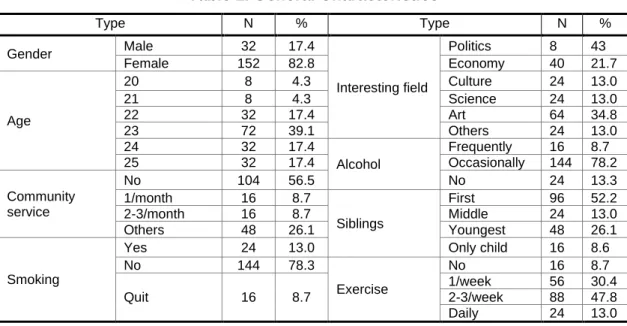
A frequency analysis was conducted to identify the general characteristics of the study participants (Table 1). According to the analysis, 32 men (17.4%) and 152 women (82.8%). 64 people (34.8%) liked the art field, 40 people (21.7%) said the interest was the economy, 24 people (13.0%) said culture, science and others, and 8 people (4.3%) said politics. In terms of smoking, 24 people (13.0%) smoked, 144 (78.3%) did not smoke, and 16 (8.7%) currently quit smoking. As for drinking, 144 people (78.2%) drank occasionally, 24 people (13.3%) drank poorly, and 16 people (8.7%) drank frequently. In siblings, 96 were the first (52.2%), 48 were the youngest (26.1%), 24 were the middle (13.0%) and 16 were the only children (8.6%). Regarding participation in community service activities, 104 people (56.5%) said they do not do any social service activities, 48 people (26.1%) said they do social service once a month, and 16 people (8.7%) said they do social service 2-3 times a month, respectively. When asked about health exercise, 16 (8.7%) people did not do it at all, 56 (30.4%) did it once a week, 88 (47.8%) did it 2-3 times a week, and 24 (13.0%) did it every day.
Table 1. General Characteristics
Type N % Type N % Gender Male 32 17.4 Interesting field Politics 8 43 Female 152 82.8 Economy 40 21.7 Age 20 8 4.3 Culture 24 13.0 21 8 4.3 Science 24 13.0 22 32 17.4 Art 64 34.8 23 72 39.1 Others 24 13.0 24 32 17.4 Alcohol Frequently 16 8.7 25 32 17.4 Occasionally 144 78.2 Community service No 104 56.5 No 24 13.3 1/month 16 8.7 Siblings First 96 52.2 2-3/month 16 8.7 Middle 24 13.0 Others 48 26.1 Youngest 48 26.1 Smoking
Yes 24 13.0 Only child 16 8.6
No 144 78.3 Exercise No 16 8.7 Quit 16 8.7 1/week 56 30.4 2-3/week 88 47.8 Daily 24 13.0
3.2 Differences in Cognitive Emotional Control and Life goals by Gender
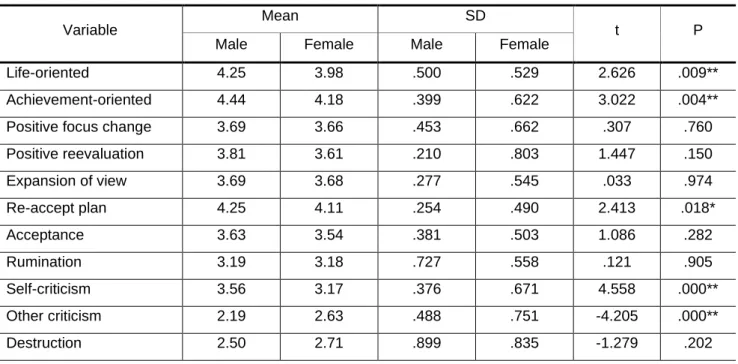
An independent sample t-test was conducted to analyze differences between cognitive emotional control capabilities and life goals according to gender (Table 2). According to the analysis, men have both life-oriented and achievement-oriented life goals higher than women, depending on gender under the statistical level of attention. Life-oriented life goals were 4.25 for men and 3.98 for women (t=2.626, p<0.01), while achievement-oriented life goals were 4.44 for men and 4.18 for women (t=3.022, p<0.01). In cognitive emotional control, sub-factors of ‘re-accept plan’, ‘self-criticism’, and ‘other criticism’ were found to differ under the statistical level of attention. The sub-factor ‘re-accept plan’ showed that males were higher at 4.25 and females at 4.11 (t=2.413, p<0.05), the ‘self-criticism’ sub-factor showed that men were 3.56 and women were 3.17 (t=4.558, p<0.01). In the 'other criticism' sub-factor, men were 2.19 and women were 2.63, indicating that women were high (t=-4.205, 0<0.01).
Table 2. Differences in Cognitive emotional Control and Life goals by Gender
Variable Mean SD t P
Male Female Male Female
Life-oriented 4.25 3.98 .500 .529 2.626 .009**
Achievement-oriented 4.44 4.18 .399 .622 3.022 .004**
Positive focus change 3.69 3.66 .453 .662 .307 .760
Positive reevaluation 3.81 3.61 .210 .803 1.447 .150 Expansion of view 3.69 3.68 .277 .545 .033 .974 Re-accept plan 4.25 4.11 .254 .490 2.413 .018* Acceptance 3.63 3.54 .381 .503 1.086 .282 Rumination 3.19 3.18 .727 .558 .121 .905 Self-criticism 3.56 3.17 .376 .671 4.558 .000** Other criticism 2.19 2.63 .488 .751 -4.205 .000** Destruction 2.50 2.71 .899 .835 -1.279 .202 **,<0.01, *,<0.05
3.3 Correlation between Cognitive Emotional Control and Life Goal
Analysis Results, Sub-factors of cognitive emotional control correlated with achievement-oriented life goals under statistical significance levels were ‘positive reevaluation’ (R=.300, p<0.01), ‘expansion of views’(R=.183, p<0.01), ‘re-accept plan’ (R=.586, p<0.01), ‘acceptance’ (R=.471, p<0.01), ‘rumination’ (R=.421, p<0.01), ‘self-criticism’ (R=.327, p<0.01), ‘other criticism’ (R=.231, p<0.01), and ‘Destruction’ (R=.228, p<0.01). Under statistical significance, sub-factors of life-oriented life goals and cognitive emotional control have been shown to be ‘positive focus changes’ (R=.219, p<0.01), ‘positive reevaluations’ (R=.307, p<0.01), ‘expansion of views’ (R=.277, p<0.01), ‘re-accept Plan’ (R=.590, p<0.01), ‘acceptance’ (R=.509, p<0.01), ‘rumination’ (R=.399, p<0.01), ‘self-criticism’ (R=.165, p<0.05), and ‘destruction’ (R=.221, p<0.01)
Table 3. Correlation between cognitive emotional control and life goals
Variable Mean SD Correlation
1 2 3 4 5 6 7 8 9 10 11
1.achievement oriented 4.22 0.597 1 .669** 0.097 .300** .183** .586** .471** .421** .327** .231** .228**
2.life oriented 4.03 0.532 1 .219** .307** .277** .590** .509** .399** .165* 0.089 .221**
3.Positive focus changes 3.66 0.629 1 .420** .409** .406** .356** 0.1 -0.13 -0.114 0.028
4.positive reevaluation 3.64 0.939 1 .491** .612** .353** .264** .318** -.166* -0.079 5.expansion of view 3.68 0.508 1 .398** .225** -0.099 0.039 -.226** -.208** 6.re-accept Plan 4.13 0.46 1 .445** .319** 0.069 -.248** -0.121 7.acceptance 3.55 0.484 1 .570** .560** -0.039 .589** 8.rumination 3.17 0.589 1 .464** .225** .722** 9.self-criticism 3.24 0.646 1 -0.085 .517** 10.other criticism 2.55 0.732 1 11.destruction 2.67 0.847 1
3.4 Correlation between Cognitive Emotional Control and Life Goal
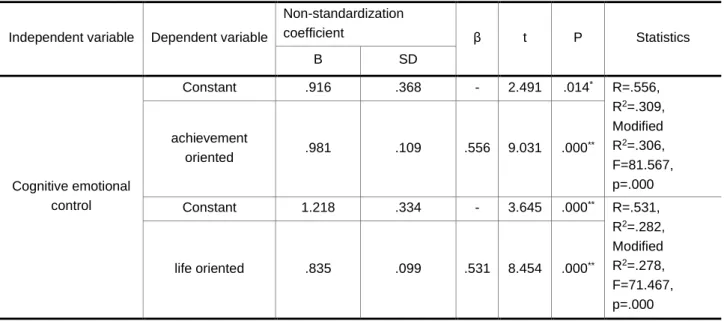
A simple regression analysis was conducted to analyze the effects of cognitive emotional control on life goals (Table 4). The analysis shows that cognitive emotional control influences achievement oriented life goals (β=.556, p<.001) and life oriented life goals (β=.531, p<.001) under a statistical level of attention. Cognitive emotional control influenced achievement-oriented life goals by 30.9%, and life-oriented life goals by 28.2%.
Table 4. The Effects of Cognitive Emotion Control on Life Goals
Independent variable Dependent variable
Non-standardization coefficient β t P Statistics B SD Cognitive emotional control Constant .916 .368 - 2.491 .014* R=.556, R2=.309, Modified R2=.306, F=81.567, p=.000 achievement oriented .981 .109 .556 9.031 .000 ** Constant 1.218 .334 - 3.645 .000** R=.531, R2=.282, Modified R2=.278, F=71.467, p=.000 life oriented .835 .099 .531 8.454 .000** **,<0.01, *,<0.05
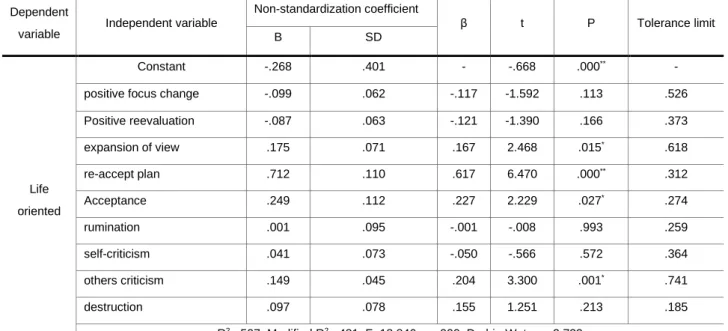
Multiple regression analyses were conducted to analyze the effects of sub-factors of cognitive emotional control on life-oriented life goals (Table 5). Independent variables have been shown to account for 48.1% of the dependent variables. With the Durbin Watson value of 2.732 for this statistic, residual independence of the statistic was obtained, and multi collinearity was also not problematic. Analysis shows that among the sub-factors of cognitive emotional control, ‘expansion of view’ (β=.167, p<0.05), ‘plan re-acceptance’ (β=.617, p<0.01), and ‘other criticism’ (β=.204, p<0.05) were shown to affect under statistical significance levels. In this analysis, the adaptive strategy of cognitive emotional control, which significantly influenced life-oriented life goals, was to ‘expansion of view’ and ‘re-accept plan’, and the negative strategy of cognitive emotional control has been shown to be ‘other criticism’.
Table 5. Effects of Cognitive Emotion Control Sub-factor on Life-Oriented Life Goals
Dependent
variable Independent variable
Non-standardization coefficient β t P Tolerance limit B SD Life oriented Constant -.268 .401 - -.668 .000** -
positive focus change -.099 .062 -.117 -1.592 .113 .526
Positive reevaluation -.087 .063 -.121 -1.390 .166 .373 expansion of view .175 .071 .167 2.468 .015* .618 re-accept plan .712 .110 .617 6.470 .000** .312 Acceptance .249 .112 .227 2.229 .027* .274 rumination .001 .095 -.001 -.008 .993 .259 self-criticism .041 .073 -.050 -.566 .572 .364 others criticism .149 .045 .204 3.300 .001* .741 destruction .097 .078 .155 1.251 .213 .185
R2=.507, Modified R2=.481, F=18.846, p=.000, Durbin Watson=2.732
**,<0.01, *,<0.05
3.6 The Effects of sub-factor Cognitive Emotional on Achievement oriented Life Goals
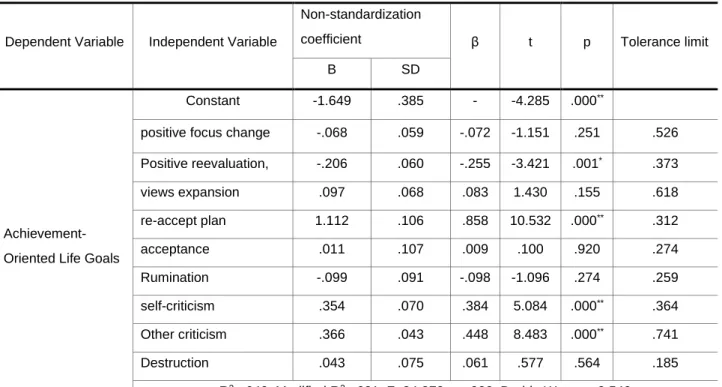
Multiple regression analyses were conducted to analyze the effects of lower factors in cognitive emotional control on achievement-oriented life goals (Table 6). Sub-factors of cognitive emotion regulation were shown to account for 64.1% of achievement-oriented lifetime goals, with the Durbin Watson value of 2.540, the residual independence of the statistical formula was ensured, and multi collinearity was not problematic. The analysis found that the sub-factors of cognitive emotion control ‘positive revaluation’ (β=-.255 p<0.05), ‘plan re-acceptance’ (β=.858, p<0.01), ‘self-criticism’ (β=.384, p<0.001), and ‘other criticism’ (β=.448, p<0.01) had an effect at a statistical level of significance. The analysis found that the sub-factors of cognitive affective control were ‘positive revaluation’, ‘plan re-acceptance’, ‘self-criticism’, and ‘other criticism’ at a statistical level of significance. A statistically significant adaptive strategy of cognitive emotional regulation of achievement-oriented life goals is to re-evaluate positively and to re-accept planning. However, positive re-evaluations have been shown to adversely affect achievement-oriented life goals, and resumption of plans has a static impact.
Table 6. The Effect of Sub-factor Cognitive Emotional Control on Achievement-Oriented Life Goals
Dependent Variable Independent Variable
Non-standardization
coefficient β t p Tolerance limit
B SD
Achievement- Oriented Life Goals
Constant -1.649 .385 - -4.285 .000**
positive focus change -.068 .059 -.072 -1.151 .251 .526
Positive reevaluation, -.206 .060 -.255 -3.421 .001* .373 views expansion .097 .068 .083 1.430 .155 .618 re-accept plan 1.112 .106 .858 10.532 .000** .312 acceptance .011 .107 .009 .100 .920 .274 Rumination -.099 .091 -.098 -1.096 .274 .259 self-criticism .354 .070 .384 5.084 .000** .364 Other criticism .366 .043 .448 8.483 .000** .741 Destruction .043 .075 .061 .577 .564 .185
R2=.640, Modified R2=.621, F=34.372, p=.000, Durbin Watson=2.540
**,<0.01, *,<0.05
4. CONCLUSION
Compared to the past, people living in modern times certainly enjoy material affluence. However, despite the abundance, people are experiencing more confusion and conflict than ever before. People with various lifestyles and values ultimately all want to be happy and have a shared life goal of living to achieve it. Material affluence always has the characteristics of wanting something bigger, so it is difficult to ensure that it is a lifetime goal. Then, for people's ultimate happiness, they should look at it from a different perspective than from the hedonism of material abundance. Based on this interest, this study began to identify how cognitive emotional control affects life goals. For this study, online surveys were randomly distributed and responses were received and analyzed to those who wanted to participate in the study voluntarily.
According to the analysis, men have both life-oriented and achievement-oriented life goals higher than women between their ability to control cognitive emotions by gender and their life goals. Life-oriented life goals were 4.25 for men and 3.98 for women (t=2.626, p<0.01), while achievement-oriented life goals were 4.44 for men and 4.18 for women (t=3.022, p<0.01). Life-oriented life goals such as belonging, physical health, community consciousness, and self-acceptance are aimed at achieving a sense of well-being through relationships with people around them [5] and overall life satisfaction, such as personal self-esteem and companionship [10].
Given that men are more active in social life than women, the higher sense of belonging and community in the organization is still understandable as men have a wider range of social life than women. Achievement-oriented life goals include extrinsic concepts of external goals such as economic success, appearance, and social recognition, and furthermore, goals that encompass the entire future of life. Thus, achievement-oriented goals can cause emotional stress for one individual in that they can be achieved through competition with others. Achievement-oriented life goals are also higher for men than for women, but the difference in average is narrower than life-oriented life goals. Based on the results above, men's life goals are higher than women on average, but in achievement-oriented, women's needs are more interested
than life-oriented life tables. For the happiness of life, life goals must be set correctly so that it is easy to overcome stress and conflict [13][23]. Life goals can be said to be linked to happiness in life, depending on whether you deal with stress positively or negatively. What kinds of emotional characteristics affect life goals can be an important factor in inferring happiness in life. Everyone has feelings, whether big or small. Identifying how to control these emotions cognitively affects life goals will help you plan your future. The study found that among the sub-factors of cognitive emotional control, there was a difference between re-accept of plans, self-criticism, and criticism of others, with males higher than females, and females higher than females in self-criticism. While re-accept of plans, an adaptive response to cognitive control, was high in men, self-criticism, which is an inappropriate response, was also high in men. However, it is an interesting result that the inappropriate response of criticizing others was high in women. The way to deal with the situation can be seen that men respond inappropriately to self-criticism rather than to blame others, while women are criticizing others. Analysis of the impact of sub-factors of cognitive emotional control on life-oriented life goals showed that expanding views, re-accepting plans, and criticizing others affected at a statistical level of significance. The analysis showed that expanding views and re-accepting plans, which are adaptive strategies of cognitive emotional control, affect life-oriented life goals, along with negative emotional control strategies, other people's criticism, positively affect life-oriented life goals. Positive reevaluations, plan re-accept, self-criticism, and other critics have been shown to affect achievement-oriented life goals, which are interpreted as having fewer achievement-oriented life goals, and those who use methods of re-accepting plans or self-criticism and blame others. In other words, people with achievement-oriented life goals used a lot of maladaptive methods of self-criticism and other criticism. However, it is also possible to use a positive method of re-accepting the plan.
Based on these results, the conclusion can be made as follows: Depending on gender, men have both higher life-oriented and achievement-oriented life goals than women. People with life-oriented life goals tend to show an adaptive response to expand views and re-accept plans to accommodate them, and an inappropriate response to blame others. People with achievement-oriented life goals tend to have a positive ability to positively reevaluation, modify and re-accept the situation in their situations, while showing a negative reaction to self-criticism and other criticism.
REFERENCES
[1] Fenesy MC, The SE, Lee SS, Negative Parenting Moderates the Prospective Association of ADHD Symptoms and Youth Social Problems, J Abnorm Child Psychol, Vol. 47, No. 10, pp. 1583-1597, 2019. doi: 10.1007/s10802-019-00542-5
[2] Luebbe AM, Bell DJ, Positive and negative family emotional climate differentially predict youth anxiety and depression via distinct affective pathways, Vol. 42, No. 6, pp. 897-911, 2014, doi: 10.1007/s10802-013-9838-5.
[3] Dubey S, Biswas P, Ghosh R, Chatterjee S, Dubey MJ, Chatterjee S, Lahiri D, Lavie CJ, Psychosocial impact od COVID-19, Diabetes Metab Syndr, Vol. 14, No. 5, pp. 779-788, 2020. doi: 10.1016.j.dsx.2020.05.035.
[4] Locke. E. A,, Shaw. K. A., & Saati, L. M., & Latham, G. P., Goal setting and task performance: 1969-1980, Psychological Bulletin, Vol. 90, No. 1, pp. 125-152, 1981.
[5] MJ Kim, Effects of Parenting Attitudes on Juvenile Problem Behavior: focusing on target instability and mediating effects of life goals, Master's Degree unpublished thesis, Kyungpook National University, 2013.
[6] Schmuck, P., & Sheldon, K. M, Life goals and well-being, Hogrefe & Huber Publishers, 2001.
[7] Locke. E. A,, Shaw. K. A., & Saati, L. M., & Latham, G. P., Goal setting and task performance: 1969-1980, Psychological Bulletin, Vol. 90, No. 1, pp. 125-152, 1981.
[8] JH Shin, EJ Seo, YG Lee, Development and Validation of Life Objective Inspection, Educational Psychology, Vol. 25, No. 2, pp. 255-276, 2011.
[9] Keeton, K,, Fenner, D. E., Johnson, T. R. B., & Hayward. R. A., Predictors of physician career satisfaction, work-life balance, and burnout, Obstetrics & Gyncology, Vol. 109, pp. 949-955, 2007.
[10] Kasser, T., & Ryan, R. M. Further examining the American dream: Differential correlates of intrinsic and extrinsic goals. Personality and Social Psychology Bulletin, Vol. 22, pp. 280-287, 1996, 1996. [11] Russell, B. The Conquest of Halliness, New York: H. Liverlight, 1930; Seligman, D. H., Authentic
Halliness, Free Press, 2004.
[12] Yang Y, Long and happy living: trends and patterns of happy life expectancy in the U,S., 1970-2000, Soc Sci Res, Vol. 37, No. 4, pp. 1235-1252, 2008. doi: 10.1016/j.ssresearch.2007.07.004.
[13] Maslach & Jackson, Emotional exhaustion and its relationship with suicide risk in emergency responders, Psychiatry Res, 1981. doi: 10.1016/j.psychres.2020.113379.
[14] Garnefski, Kraajj & Spinhoven, 2001; Parkinson & Totterdell, 1999). (Garnefski, N., & Kraaij, V., & Spinhoven, P. Negative life events, cognitive emotion regulation and emotional problems. Personality and Individual differences, Vol. 30, pp. 1311-1327.
[15] Parkinson, B., & Totterdell, P. Classifying affect-regulation strategies, job satisfaction, and well-being, Motivation and Emotion, Vol. 23, pp. 125-154, 1999.
[16] CH Seong, YH Park, Exploring Longitudinal Changes in Life-Goal Directedness of Adolescents: Focusing on Student-and School-Level Predictors and Career Maturity Outcome, Chung-Ang University Institute for Korean Education Studies, Vol. 36, No. 4, pp. 97-122, 2018.
[17] SH Yoo, Relationsip between Life Goals and Career Adaptability of Female College Students, Busan National University Women's Research Institute, Vol. 28, No. 2, pp. 283-310, 2018.
[18] HJ Lee, YJ Chae, The Structural relationships and gender differences in youth activity involvement, social-emotional aspects, and life goals, Korean Youth Research, Vol. 25, No. 2, pp. 173-207, 2014. [19] SA Yoon, Relationships between Adolescents Life Goal and Parenting Attitude, Emotional Problem and
School Adjustment, A Study on Learner-Centered Curriculum, Vol. 6, No. 1, pp. 887-908, 2016.
[20] HS Chang, The Effect of Character Strengths, Life Goals on Subjective Satisfaction for Early Childhood Teachers, Journal of Future Early Childhood Education, Vol. 23, No. 3, pp. 169-196, 2016.
[21] SH Kim, The relationship between stress events, cognitive emotional control strategies and psychological well-being, master's unpublished thesis, Catholic University, 2004.
[22] JI Yoon, GS Nak, Relationship between cognitive emotional control and consumption of counselors, master's unpublished thesis, Catholic University, 2008.
[23] Debats, D. L. Measurement of personal meaning: The psychometric properties of the life regards index. In: Wong, P. T. P, Fry, P. S. (eds). The human quest for meaning. A handbook of psychological research and clinical applications. Mahwah, N. J.: Lawrence Erlbaum Associates, pp. 37-259, 1998.