An evaluation on a research paper using hycz
시《
model:
'Project Risk Assessment Using the Analytic Hierarchy
Process' by Mustafa, M. A. and Al-Bahar, J. F.
Mincheol Kim*
INDEX
I . Introduction
H. Evaluation
ifi. Conclusion: Overall Evaluation
I . Introduction
자te 正££ Transactions on Engineering Management is a research-based, refereed
journal in engineering management. Published quarterly since 1954 by the IEEE
Engineering Management Society, the journal's worldwide subscription base is
approximately 10,000. In 囚이, 出e journal published an article 汕out using analytic비
hierarchy process (AHP) methodology in project risk management. The article,
"Project Risk Assessment Using the Analytic Hierarchy Process," was written by
Mustafa and Al-Bahar (1991, see Appendix A for the article's abstract). Their study
analyzed and assessed the risks involved during the bidding stage of a construction
project. They then examined how AHP can be used as a decisioli making method in
project management in order to overcome, the limitations of the traditional approaches
used by contractors. The AHP implementation steps were simplified by using the
* Professor, Department of Management Information Systems, College of Economics and Commerce. Jeju National University
36
飇經論柒 第36
輯"Expert Choice" professional software that is available commercially and designed for
implementing AHP (go to http://www.expertchoice.com).
The objective of this paper is to evaluate Mustafa and Al-Bahar's article on the
potential of using AFIP method in project management area. Subsequent articles by
Ahmad et al. (2006), Al-Tabtabai et al. (2004) and Mahmoodzadeh et al. (2007)
discuss actual cases where AHP was applied in project management. The other
sections of this paper are to use the model developed by Pyrczak (2008) in
evaluating research in academic journals with subjective view of author. All of the
questions used to evaluate the article were taken from Appendix D of Pryczak's study
(pp. 151-156).
II. Evaluation
2.1 Evaluation of title
A good title helps readers identif' articles of interest as well as to reflect on the
contents of the article. First, the title of this article is sufficiently specific and the
title is reasonably concise with exactly eight words. Two primary terminologies, i.e.
Analytic Hierarchy Process and Project Risk, are specified in the title of this article
but "Analytic Hierarchy Process" should be changed and expressed as an abbreviated
word "Analytic Hierarchy Process (AHP)."
- Questions for Evaluating the Title
5
4
3
2
1
N/A 1/1
Is the title sufficien
山specific?
x
Is the title reasona
비y concise?
x
Are the primary variables referred to in the
title?
X
When there are many variable, are the types
of variables referred to?
X
Dose the title identify the types of individuals
An evaluation on a research paper using Pryczak model 37
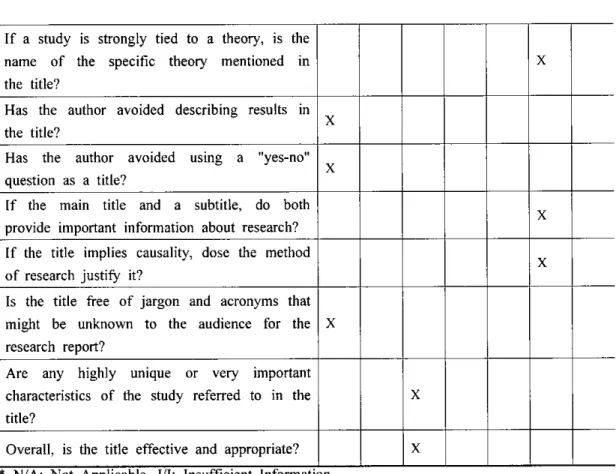
If a study is strongly tied to a theory, is the name of the specific theory mentioned in
小e title?
x
Has 小e author avoided describing results in
山e title?
x
Has the author avoided using a 'yes-no"
question as a utie?
x
if the main title and a subtitle, do both
provide important information about research?
x
If the title implies causality, dose the method
of research justif' it?
x
Is 出e title free of jargon and acronyms 小at might be unknown to the audience for the research report?
x
Are any highly unique or very important
하taracteristics of 小e study referred to in the title?
x
Overall, is the title effective and appropriate?
x
* N/A: Not Applicable, I/I: insufficient InformationTable 1. Evaluation of Title. This table represents scoring of the "Project Risk Assessment Using the Analytic Hierarchy Process' rMust a/a αm/ 灘βα/7αr, /躬》/, /ㅈ 46기’ the questions are based 〃'7 Pyrczak 's model (p. 151).
It is often desirable that titles identify' the population that was studied in the research (Pyrczak, p.15). The title of their study, however, does not show the types of individuals who participated. Moreover, the specific theory was not mentioned in the title because 小is article was not tied to a theory. 자〔e authors described results in the title, which is not a "yes-no" type of question, and they did not use a subtitle. In their paper, causal relationships were not examined because the title does not contain the word "effects." The title does not contain jargon and acronyms. The title does not refer to unique characteristics of the study. The title is effective and appropriate.
The Pyrczak model (p. 151) presents a scale from I (very unsatisfactory) to 5 (very satisfactory) which can be used to score journal articles. Using this scale, the title of their research received a score of 36 out of 50 points. Four questions were
88
産紐!論柒 第36
輯deleted from the assessment as they were not applicable (N/A) (see Table 1).
2.2 Evaluation of abstract
The purpose of an abstract is to clearly and succinctly provide the reader with
objectives of the specific article. In this paper, the author proposes that project risk
assessment can be used as an example for using AHP in project management.
Questions (or Evaluating the Abstract
5
4
3
2
.
N/A
I/I
Is the purpose of the study referred to or at least
clearly implied
x
Does the abstract mention highlights of the
research methodology?
x
Has the researcher omitted the titles of measures
(except when these are the focus of
the
research?)
x
Are the
highlights of the results described?
'C
If the study
is strongly tied to a theory, is the
theory mentioned in the abstract?
x
Has
the
researcher
avoided
making
vague
references to implications and future
research
directions?
x
Overall, is the abstract effective and appropriate?
x
Tahle 7 Vvni,nninn nf Ahcf..,n* ㅜ』`沁 ^`什.‘ '∼一一 ^一 一 =一→-A1-Ba/iar, (p. 46
꺄 〃'e questions are based on Pyrczak c model (151-152).
The usual length of abstracts is between 100 to 250 words (Pyrczak, p. 23).
Because the abstract of the article contains 119 words, their abstract is appropriate
(see Appendix A). The abstract usually provides important information about the
resear
야ㄴmethodology as well as a description of the results of the research. As
discussed in the previous section, Their's article is not tied to a theory so the
abstract does not mention a specific theory. They did not make vague references to
implications and future research directions in the abstract. Generally, the abstract of
the article is effective and appropriate. Using the Pyrczak model, the abstract scored
L
驢
i
An evaluation on a research paper using Pryczak model 39
28 out of 30 points. One question - "if the study is strongly tied to a theory, is the theory mentioned in the abstract" - was deleted because it was not applicable (see Table 2).
2.3 Evaluation of introduction and 蹴nature review
This section will determine if their study fulfilled five purposes: a) introduce the problem area; b) establish its importance; c) provide an overview of the relevant literature; d) show how the current study will advance knowledge in the area; and e) describe the researcher's specific research questions or purposes (Pyrczak, p.33).
They wrote a proper introduction (seven paragraphs less than one full page) and a separate literature review (13 paragraphs over three full pages). The authors began by encouraging the application of AMP method in the field of project management. They also stated that problem area is important because 'a number of systematic m"odels have been proposed for use "1 r/7α risk evaluation phase of the risk management process. Some q/ these mnodels 'αα〃'rα detailed quantitative informnation 'v/1/c/2 is not norma/I;' available in the real constructi( " world.' (Mustafa and 시-Bahar, p. 46).
Subheadings usually guide readers through long introductions (Pyrczak. p. 38). Their study, however, has a short introduction so there was no need for subheadings. Their article adequately described the theory with separate sections namely, 小e analysis hierarchy process, identification, and classification of project risks (pp. 46-47).
- Questions for Evaluating the Introduction and Literature - Review
Introduction SDecific Ouestions
Dose the researcher begin by identifying a specific
problem area?
x
Dose the researcher establish the importance of the
problem area?
x
`Are any underlying theories adequately described?
x
Dose the introduction move from topic to topic instead offrom citation to citation?
x
Are very long introductions broken into subsections, each
Wi小 its own subheading?
x
5 't 3 2 1 r녘/^
40
麗經論集 第36
輯Has
the
researcher
provided
adequate
conceptual
definitions of key terms?
x
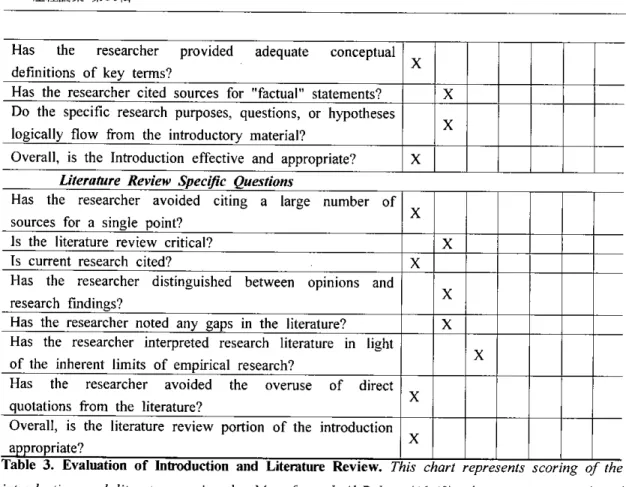
Has the researcher cited sources for "factual" statements?
x
Do the specific research purposes, questions, or hypotheses
logically flow from the introductory material?
x
Overall, is the Introduction effective and appropriate?
x
Literature Review Spec
价c Questions
Has the researcher avoided citing a large number of
sources for a single point?
x
is the literature review critical
x
Is current research cited?
x
I-las the researcher distinguished between opinions and
research findings?
x
Has
小e researcher noted any gaps in
疏e literature?
x
Has the researcher interpreted research literature in light
of the inherent limits of empirical research?
x
Has
the
researcher avoided the overuse of direct
quotations from the literature?
x
Overall, is the literature review portion of the introduction
appropriate?
x
table 3. Evaluation of Introduction and Literature Review. """ chart represents scor' ng of the
introduction α
'7'/ literature review by Mustafa and Al-Bahar (46-48); the questions are based
on Pyrcza/c's model rr'. 152).
The authors also provided clear conceptual definitions of key terms. For example: "The AHP provides a flexible and easily understood way to analyze project risks. It is a multi-criteria decision analysis methodology that allows subjective as well as objective analysis methodology that allows subjective as well as objective factors to be considered in the process which is precisely what is needed"(p. 46). They presented the statements like "facts" along with their sources. The specific research purposes and questions upon which this study is based are stated in the last paragraph of the Introduction. Overall, the introduction of this article is very appropriate.
source to
words that
or research
On a scale
Their study cited a single 50urce t
《〕
supp0「
t a PO[nt and refbrs t0 "w이
l-de`igned" studies. The authors used w0rd`小
at herp reader` unde「
stand,祚
Le什【
er出
e cited literature presents opinions 0r「
e8earch re`ult`. over枕
lI,小
e hterature rev[eW of小
is article is very appropriate. on a `cale of 1-5 for ea아'
0f小
eㅁ
questi《)
n5ㅆ
1i야'
support a point and refers to "well-designed"
help readers understand whether the cited
results. Overall, the literature review of this
of 1-5 for each of the 17 questions which
An evaluation on a research paper using Pryczak model 41
evaluated the introduction and the literature review, this article received 72 points out of 80. One question was eliminated as it was not applicabile (see Table 3).
2.4 Evaluatio뀁1 of sainp쬐es (when researchers do not 볍eneralize)
Their study presented the application of AHP to assess the risks in an international construction project, specifically the Jamuna Multipurpose Bridge in Bangladesh (Mustafa and Al-.Bahar, p. 48). Six criteria - acts of God, physical, financial and economic, political and environmental, design, and job site-related - were described in y separate sections (pp. 47-48). The authors developed the hierarchy of problems as shown in Table 2 (p. 48). The AMP method uses purposive, rather than random, samples made by the relevant experts on any project. Therefore, the samples used by the research will be evaluated based Pyrczak's questions for articles 'when researchers do not generalize' (p. 69).
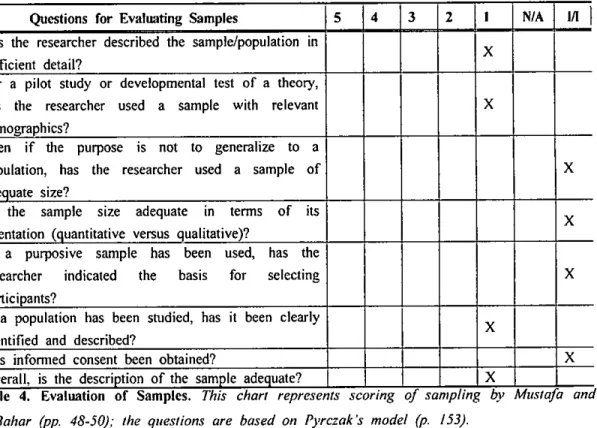
Qucstions for Evaluating Sa·끼:iles 5 4 3 2 】 N仇
m
ㅣ
Has the researcher described the sample/population insufficient detail?
x
For a pilot study or dcv이아》mental test of a 小eory, has the resear아Ier used a sam이e with relevant demographics?
x
Even if the purpose is not to gener히ize to apopulation, has 出e resear햐ter used a sa때:沈 of adequate size?
x
Is the sample size adequate in terms of itsorientation (quantitative versus qualitative)?
x
If a purposive sample has been used, has the researcher indicated 小e basis for selecting participants?
x
If a population has been studied, has it been clearlyidentified and described?
x
Has informed consent been obtained?
x
Overall, is the description of the sample adequate?
x
Table 4. Eva묘uation of Samp별Cs. This chart represents scoring of sampling bP Must afa an
邢βα^αr (pp. 48-5(2』l,. 价α questions are based ‘〃궁 /沙rczak '5 〃〃〃/α/ (p. 153).
42 産經論巢 第36韓
Their study, however, neither discussed information about their respondents. This reason for this might be that the research
小e sampling process nor provided detailed is a very weak point in the article. The was a pilot study or a developmental test for applying the AblY method. While the authors mentioned that they chose 10 experts on Al-IP, they did not discuss the exact criteria they used for selecting experts. The quality of the sample was more important point than sample size.
In conclusion, the description of the sample is not adequate. Due to this sam힌e problem, their overall score is very low at 4 out of 20 points on the Pyrcak model. Four questions were deleted in the evaluation was they were either not applicable or there was insufficient information (see Table 4).
2.5 Evaluation of instrumentation
Their study used Expert Choice software (go to http://www.expertchoice.com) as an instrument to apply the AI-IP method. The authors proposed that Expert Choice can calculate the results manually or automatically. They also argued that using AI-IP to model and analyze real world problems can be made much easier using a microcomputer application such as Expert Choice. This software makes it simpler and quicker to structure and modi& the hierarchy (Mustafa and Al-Bahar, p. 47).
Pyrczak suggests that it is desirable for researchers to indicate the response format (p. 79); however, their research did not describe in detail any specialized response formats including settings, or restrictions, or both. The authors did not the present multiple methods used to collect data/information on each variable. They also did not cite the sources for additional information. Instead, the authors classified the various potential sources of risk in construction projects with detailed explanations (p. 47). The authors also proposed the sensitivity analysis of the level of total risk for additional outcome. They also pointed out that while the AHP method can be susceptible to subjectivity in collecting and coding observations, it emphasizes the consistency of respondents. To avoid inconsistency and stability in the data, Consistency Ratio (CR) should be calculated. If the CR value for a matrix is less than 0.1, it is considered to consistently provide good consistency calculations of the weights of the factors. If the CR value is more than 0.1, the researcher should again
An evaluation 이i a resear야》 paper using Pryczak model 43
obtain a response through the same questionnaire until the CR value is less than 0.1 (Saaty, 1980). This paper shows the pair-wise comparison matrix and priority vector for the validity (Pyrczak. pp. 25-26). Although they do not discuss the obvious limitations of the instrumentation, the instrumentation section is somewhat adequate.
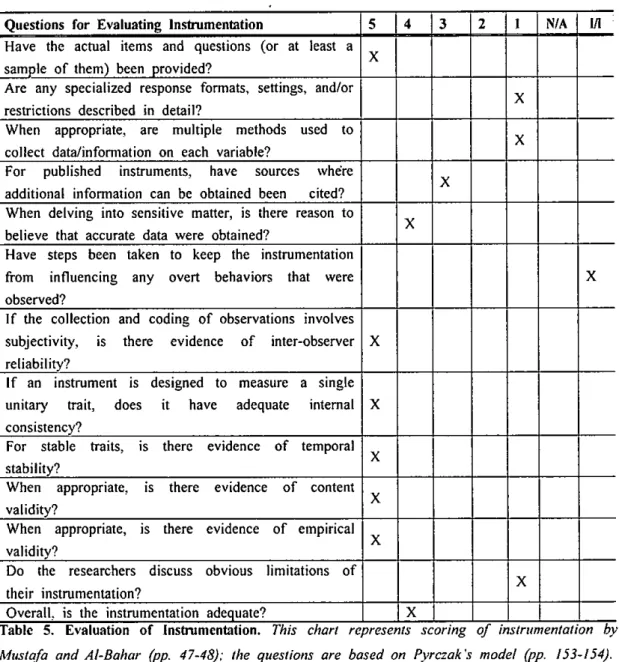
Quest쵸ens for Evaluating In弛iimentation 5 4 3 2 1 N/A Ill Have the actual items and ques轍)fl5 (or at least a
pie of them) been provided?
x
Are any specialized response formats, settings, and/or
restrictions described in detail?
x
When appropriate, are multiple methods used to
collect data/information on each variable?
x
For published instruments, have sources where
additional information can be obtained been cited?
x
When delving into sensitive matter, is there reason tobelieve that accurate data were obtained?
x
Have steps been taken to keep the instrumentationfrom influencing any overt behaviors that were observed?
x
If the c해ection and coding of 아》servations mnv이yessubjectivity, is there evidence of inter-observer reliability?
x
If an instrument is designed to measure a single unitary trait, does it have adequate intern비 consistency?x
For stable traits, is there evidence of temporalstability?
x
When appropriate, is there evidence of content
V비idity?
x
When appropriate, is there evidence of empirical
validity?
x
Do the researchers discuss obvious limitations of
their instrumentation?
x
Overall, is the instrumentation adequate?
x
Table 5. Evaluation of .lnstrumentati빼기i. This chart represents scoring qr ,nstrz,mentatu가? 勿7 紬is,하b and Al-Baliar (pp. 47-48기뱁 价e questions are based 〃'1 /긴yrczak's model (pp. 153-15큉.
Using the Pyrczak model, the article scored 44 out of 60 points. One question was deleted because it was not applicable (see Table 5).
44
璂;未蚤[論柒 第36
輯2.6 Evaluation of analysis and resu
拗(for quantitative researelo
In an article, this section usually discusses the evaluation of quantitative research
which often use descriptive and inferential statistics. The AHP method used in their
study focused on calculating the relative weights of various factors through the
quantitative method. AHP is composed of three main steps: (I) decomposition or
structuring the decision problem; (2) comparative judgment or evaluating pairs of
criteria at a hierarchical level; and (3) determination of priority or determining the
weight of the alternative decision.
Their study also presented sensitivity analysis which showed that the outcome of
the analysis is highly dependent on the hierarchy established by the management and
the relative judgments made about the various elements of the problem. Changes in
the hierarchy or in judgments may change the outcome. The sensitivity of the
outcome to different changes can be tested using Expert Choice. This article showed
the calculations, including the percentages of the analyzed results, in Tables 12
(Mustafa and Al-Bahar, p. 50).
The authors also discussed the highlights of all of their tables in the narrative for
explaining the process of calculation. Because the AFI.P method was not related to
inferential tests, the authors did not present descriptive statistics. The presentation of
this section is comprehensible and adequate. Using the Pyrczak model (pp. 103-109),
this section scored 29 out of 35 points except. Three questions were not included
(see Table 6).
lQuestions
for Evaluating Analysis and
lResu·
맡`S
4
1-F2
1
N/A
I/I
When percentages are reported. are the
underlying numbers of cases also reported?
x
Are means reported only for approximately
symmetrical distributions?
x
If any differences are statistically significant
and small, have the researchers noted that
they are small?
x
An evaluation on a research paper using Pryczak model 45
Does the researcher refer back to the
research hypotheses, purposes, or questions
origin
끼ly stated in 小e introduction?
x
When there are a number of related
statistics, have they been presented in a
table?
x
If there are tables, are their highlights
discussed in the narrative of the results
section?
x
Have the researchers presented descriptive
statistics before presenting
小e
results of
inferential tests?
x
Overall, is the presentation of the results
comprehensible?
x
Overall, is the presentation of the results
adequate?
x
Table 6. Evaluation of Analysis and Results. This chart represents sporing v the
analysis αm/ results section in α research αrr/'/e 乙夕 Mustafa and 크/-及ihar (p. 5(쟈
r/7e questions are based on Pyrczak 's '"〃‘7e/ (p. 155).
2.7 Evaluation of discussion section
This section of an academic article can have different titles such as "Discussion
and Conclusions," "Conclusions and Implications," or "Summary and Implications"
(Pyrczak, p. 121). They used the heading "Summary and Discussion." The discussion
of this article was comprehensive and, thus, adequate for reader to understand the
intention of the article.
The authors showed that AHP provides valuable support for contractors in the
decision making process. In addition, this article identified some limitations regarding
the efficient use of the AHP. The first limitation is related to building the hierarchy
so the authors recommended that certain elements under any node should be included
in order to preserve consistency. The second limitation is the number of judgments
required to derive relative priorities. The authors also suggested that futtLre research
should specifically address how AHP has been extended to deal with situations where
46 飇經論築 第36.輯
experts have conflicting judgments. Although their research did not discuss any relevant theories, they proposed using sensitivity analysis to distinguish between speculation and data-based conclusions.
muestions for Evaluating Discussion $ 뀁 노
4 3 2 N/A 1/1
In long articles, do the researchers briefly summarize the purpose and results at 小C be聊n輛ng of 小C 小scuss沁n?
x
Do the researchers acknowledge specific
methodological limitations?
x
Are the results discussed in ternis of the literature
cited in the introduction?
x
Have the researchers avoided citing new references
in the discussion?
x
Are specific implications discussed?
x
Are the results discussed in terms of any relevant
theories?
x
Are suggestions for future research specific?
x
Have the researchers distinguished between_】〕eculation and data-based conclusions?
x
Overall, is the discussion effective and appropriate?x
EjYdluduoll ui utsvussIon. m7is ciian represents scorng (2/ the discussion section including summary in α research ankle by Mustafa and Al-Ba/tar (pp. 50-50:
〃'
α questions are based α'
'/견
yrczak 's model (p. .156).Overall, the discussion in this article is effective and appropriate. The score, based on the Pyrczak model (pp. 121-127), is 36 out of 45 points with all questions used (see Table 7).
ifi. Conclusion: Overall Evaluation
The concluding section of academic articles provides an oyerall judgment by considering this article as a whole (Pyrczak. p. 129). Although some of the questions (e.g. "pulling it all together") are subjective, table 8 can show the problems in this a
띠이
e.An evaluation on a research paper using Pryczak model 47
The authors selected an important problem: Risk assessment and questions about the efficient use of
사
P (p. 47). This article is somewhat reflective.卄
ere were no unavoidable methodological in the article. Although the research does not directly inspire additional research, the authors emphasized the use of AHP method in project management. That is, the paper proposes that the project manager may find AHP useful to support decision making in evaluating bids, selecting equipment, hiring staff, enabling corporate stability and competitiveness, among others. Their study is likely to help in future studies on decision making and, therefore, worth publishing in an academic journal.Questions for Evaluating the Research Article
;("Putting it all Together") b 4 `J 2
N/A
뻐
In your judgment, has the researcher selected an
important problem?
x
Were the researchers reflective?
x
Is
山
e report c햐
tesive? XDose the report extend the boundaries of the knowledge on a topic, especially for understanding relevant theories?
x
Are any major methodological flaws unavoidable
or forgivable?
x
Is
山
e resear야[
likely to inspire addition이
research?
x
Is the research likely to help in decision making?
x
세
things considered, is小
e report worthy of publication in an academic journal?x
Would you be proud to have your name on the research article as co-author?x
Table 8. Evaluation of the Research Article. This chart represents scoring ar the frill researc article ki' Mustafa α
'
《'
7 Al-Bahar α〃’.
4 6-52j'价
e questions are based o〃
Pyrczak 's model (p. 156).The overall score (Pyrczak, pp. 129-133) is 40 out of 45 points, with all questions applicable to this article (see Table 8).
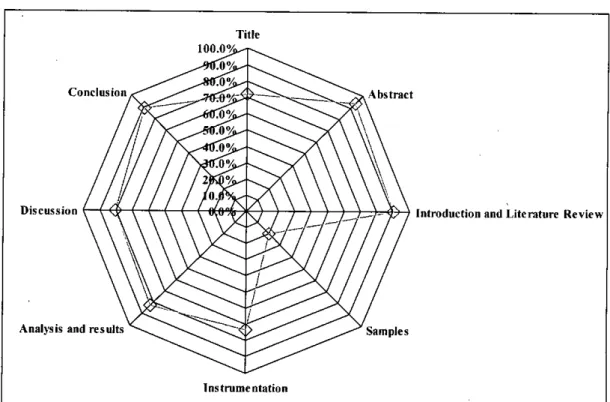
Consequently, based on all evaluation tables, figure I presents the percentage (%) of evaluation scores for all sections of their study. This chart does include questions that were not applicable or those where the article contained incomplete information.
Conclusion : .걀綢-' Abstract
pjS C uss ion Introduction and Literature Review
Analysis and results Samples
48
産經論集 第36輯
One can see that of all the sections in the article, the section on samples was the
weakest.
Title 1帆L[〕
'nsti기met'軸ti이겸
Figure 1. Evaluation scores by section. This chart represents scoring of α
// the sections from
the full article by Mustafa and Al-Bc汭
α
/(pp. 46-52,); //7
巳questions αrα based
倂1
/沙rczak '5
model (p. 15
이.An evaluation on a research paper using Pryczak model 49
REFERENCES
Ahmad N. & Laplante P. A. (2006). Software Project Management Tools: Making a
Practical Decision Using Al-IP, Proceedings v the 3(J"Annual IEEE/NASA Software
Engineering Workshop.
A1-Tabtabai H. M. & Thomas V. P. (2004). Negotiation and resolution of conflict
using Al-IP: an application to project management, Engineering, Construction and
Architecture 脈inagement, Ii (2): 90-100.
Mahmoodzadeh S., Shahrabi J., Pariazar M., & Zaeri M. S. (2007). Project Selection
by Using Fuzzy AMP and TOPSIS Technique, International Journal of Human and Social
Sciences, 30: 135-140.
Mustafa M. A. & Al-Bahar J. F. (1991). Project Risk Assessment Using the Analytic
Hierarchy Process, 正EE Transactions on Engineering Management, 38 (1): 46-52.
Pyrcz楙; F. (2008). Evaluating Research in Academic Journals: A 乃‘actical Guide to
Realistic Evaluation, 4thed.Glendale,CA:PyrczakPublishing.
Saaty, T. .L. (1980). The Analytical Hierarchy Process. New York: McGraw-I-Jill
50 麗經論集 第36韓
Appendix A
Abslnct from "Project Risk Assessment Using the Analytic Hierarchy Process" by Mustafa and Al-Bahar (1991)
Often, construction projects fail to achieve their time, budget, and quality goals. This is frequently due to the failure of the contractor to analyze and assess unanticipated risks. The analytic hierarchy process (AHP) is a new approach that can be used to analyze and assess project risks during the bidding stage of a construction project and to overcome the limitations of the traditional approaches currently used by contractors. The AMP presents a flexible, easily understood way to assist the decision-maker in formulating his problem in a logical and rational manner. The paper also includes a review of the AMP and its application in the assessment of the riskiness of constructing the Jamuna Multipurpose Bridge in Bangladesh (Mustafa and Al-Bahar, p. 46).
Professor, Department of Management Information Systems, College of Economics and Commerce, Jeju National University