N A N O E X P R E S S
Open Access
Improved conversion efficiency of Ag
2
S quantum
dot-sensitized solar cells based on TiO
2
nanotubes
with a ZnO recombination barrier layer
Chong Chen
1, Yi Xie
1, Ghafar Ali
1,2, Seung Hwa Yoo
1and Sung Oh Cho
1*Abstract
We improve the conversion efficiency of Ag2S quantum dot (QD)-sensitized TiO2nanotube-array electrodes by
chemically depositing ZnO recombination barrier layer on plain TiO2nanotube-array electrodes. The optical
properties, structural properties, compositional analysis, and photoelectrochemistry properties of prepared
electrodes have been investigated. It is found that for the prepared electrodes, with increasing the cycles of Ag2S
deposition, the photocurrent density and the conversion efficiency increase. In addition, as compared to the Ag2S
QD-sensitized TiO2nanotube-array electrode without the ZnO layers, the conversion efficiency of the electrode
with the ZnO layers increases significantly due to the formation of efficient recombination layer between the TiO2
nanotube array and electrolyte.
Keywords: quantum dots, TiO2nanotube, Ag2S, solar cells
Introduction
In recent years, dye-sensitized solar cells (DSSCs) have attracted much attention as a promising alternative to conventional p-n junction photovoltaic devices because of their low cost and ease of production [1-4]. A high power conversion efficiency of 11.3% was achieved [5]. The con-ventional DSSCs consist of dye-sensitized nanocrystalline TiO2film as working electrode, electrolyte, and opposite
electrode. In DSSCs, the organic dyes act as light absor-bers and usually have a strong absorption band in the visi-ble. Various organic dyes such as N719 and black dye have been applied for improving the efficiency, light absorption coverage, stability, and reducing the cost. However, the organic dyes have a weak absorbance at shorter wave-lengths. Materials that have high absorption coefficients over the whole spectral region from NIR to UV are needed for high power conversion efficiency. During the last few years, instead of organic dyes, the narrow band gap semi-conductor quantum dots (QDs) such as CdS [6,7], CdSe [7-9], PbS [10,11], InAs [12], and InP [13] have been used
as sensitizers. The unique characteristics of QDs over the organic dyes are their stronger photoresponse in the visi-ble region, tunavisi-ble optical properties, and band gaps sim-ply by controlling the sizes. The QD-sensitized solar cells (QDSSCs) have been considered the next-generation sen-sitizers [14]. In either DSSCs or QDSSCs, the nanoparticle porous film electrode plays a key role in the improvement of power conversion efficiency. Recently, to improve the properties of TiO2film electrode, one-dimensional
nanos-tructure arrays as working electrodes, including nanowires and nanotubes, have been proposed and studied. Com-pared with the nanoparticle porous films, aligned one-dimensional nanostructure arrays can provide a direct pathway for charge transport and superior optical absorp-tion properties. Therefore, more and more studies focus on QDSSCs based on one-dimensional nanomaterials, such as the TiO2nanotubes (TNTs) [15-17].
Among QDs, Ag2S is an important material for
photo-catalysis [18-20] and electronic devices [21-24]. Ag2S has
a large absorption coefficient and a direct band gap of 0.9 to 1.05 eV, which makes Ag2S an effective semiconductor
material for photovoltaic application. In the past several years, although there are some reports on the photovol-taic application of Ag2S [10,25], few studies on Ag2S
QDSSCs based on TNTs are reported. In this work, we
* Correspondence: [email protected]
1Department of Nuclear and Quantum Engineering, Korea Advanced Institute of Science and Technology (KAIST), 373-1 Guseong, Yuseong, Daejeon 305-701, Republic of Korea
Full list of author information is available at the end of the article
© 2011 Chen et al; licensee Springer. This is an Open Access article distributed under the terms of the Creative Commons Attribution License (http://creativecommons.org/licenses/by/2.0), which permits unrestricted use, distribution, and reproduction in any medium, provided the original work is properly cited.
report on the synthesis of Ag2S QD-sensitized TNT
photoelectrode combining the excellent charge transport property of the TNTs and absorption property of Ag2S.
Besides, to improve the efficiency of as-prepared photo-electrodes, we interpose a ZnO recombination barrier layer between TNTs and Ag2S QDs to reduce the charge
recombination in Ag2S QDSSCs because the ZnO layer
can block the recombination of photoinjected electrons with redox ions from the electrolyte. Recently, we have reported the improved conversion efficiency of CdS QD-sensitized TiO2nanotube array using ZnO energy barrier
layer [26]. Similar method has been used by Lee et al. to enhance the efficiency of CdSe QDSSCs by interposing a ZnO layer between CdSe QDs and TNT [27]. Our results show that Ag2S QD-sensitized TiO2 nanotube-array
photoelectrodes were successfully achieved. The more important thing is that the conversion efficiency of the Ag2S-sensitized TNTs is significantly enhanced due to
the formation of ZnO on the TNTs.
Experimental section Materials
Titanium foil (99.6% purity, 0.1 mm thick) was pur-chased from Goodfellow (Huntingdon, England). Silver nitrate (AgNO3, 99.5%) and glycerol were from Junsei
Chemical Co. (Tokyo, Japan). Ammonium fluoride (NH4F), sodium sulfide nonahydrate (Na2S, 98.0%), and
zinc chloride (ZnCl2, 99.995+%) were available from
Sigma-Aldrich (St. Louis, MO, USA).
Synthesis of TNTs
Vertically oriented TNTs were fabricated by anodic oxida-tion of Ti foil, which is similar to that described by Paulose et al. [28]. Briefly, the Ti foils were first treated with acet-one, isopropanol, methanol, and ethanol, followed by dis-tilled (DI) water and finally drying in a N2stream. Then,
the dried Ti foils were immersed in high-purity glycerol (90.0 wt.%) solution with 0.5 wt.% of NH4F and 9.5 wt.%
DI water and anodic oxidized at 60 V in a two-electrode configuration with a cathode of flag-shaped platinum (Pt) foil at 20°C for 25 h. After oxidation, the samples were washed in DI water to remove precipitation atop the nano-tube film and dried in a N2stream. The obtained titania
nanotube film was annealed at 450°C in an air environ-ment for 2 h.
Synthesis of Ag2S-sensitized plain TNT and ZnO/TNT
electrodes
The ZnO thin films on TNTs were prepared by using the successive ionic layer adsorption and reaction method, as described elsewhere [27,29]. Briefly, the annealed TNT electrodes were immersed in 0.01 M ZnCl2solution
com-plexed with an ammonia solution for 15 s and then in DI
water at 92°C for 30 s, with the formation of solid ZnO layer. Finally, the as-prepared TNT electrodes were dried in air and annealed at 450°C for 30 min in air for better electrical continuity. Ag2S QDs were assembled on the
crystallized TNT and ZnO/TNT electrodes by sequential chemical bath deposition (CBD) [25,30]. Typically, one CBD process was performed by dipping the plain TNT and ZnO/TNT electrodes in a 0.1 M AgNO3ethanol
solu-tion at 25°C for 2 min, rinsing it with ethanol, and then dipped in a 0.1 M Na2S methanol solution for 2 min,
fol-lowed by rinsing it again with methanol. The two-step dip-ping procedure is considered one CBD cycle. After several cycles, the sample became dark. In this study, 2, 4, and 8 cycles of Ag2S deposition were performed (denoted as
Ag2S(2), Ag2S(4), and Ag2S(8), respectively). Finally, the
as-prepared samples were dried in a N2stream. The
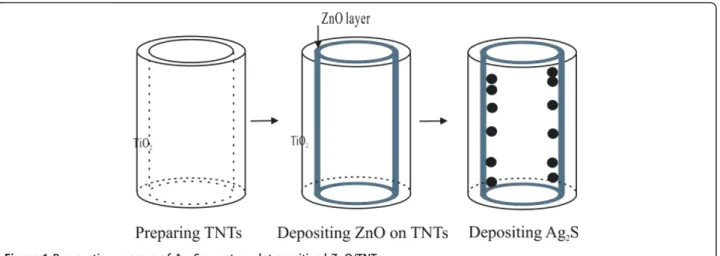
pre-paration process of as Ag2S-sensitized ZnO/TNT
elec-trode is shown in Figure 1. For comparison, Ag2
S-sensitized TNT electrodes without ZnO films were also fabricated by the same process.
Materials characterization
The surface morphology of the as-prepared electrodes was monitored using a scanning electron microscope (SEM) (Nova230, FEI Company, Eindhoven, Nether-land). The mapping and crystal distribution of the sam-ples were done using a scanning transmission electron microscope (TEM) (Tecnai G2 F30, FEI Company Eind-hoven, Netherland) to which an Oxford Instruments (Abingdon, Oxfordshire, UK) energy dispersive X-ray spectroscopy (EDS) detector was coupled. The surface compositions of the samples were analyzed using EDS. The crystalline phase and structure were confirmed by using X-ray diffraction (XRD) (Rigaku D/MAX 2500 V diffractor; Rigaku Corporation, Tokyo, Japan). The UV-visible (UV-vis) absorbance spectroscopy was obtained from a S-4100 spectrometer with a SA-13.1 diffuse reflector (Scinco Co., Ltd, Seoul, South Korea).
Photoelectrochemical measurements
The photoelectrochemical measurements were per-formed in a 300-mL rectangular quartz cell using a three-electrode configuration with a Pt foil counter elec-trode and a saturated SCE reference elecelec-trode, and the electrolyte was 1.0 M Na2S. The working electrode,
including the TNTs, ZnO/TNTs, Ag2S(n)/TNTs, and
Ag2S(n)/ZnO/TNTs (n = 2, 4, and 8), with a surface
area of 0.5 cm2 was illuminated under UV-vis light (I = 100 mW cm-2) with a simulated solar light during a vol-tage sweep from -1.4 to 0 V. The simulated solar light was produced by a solar simulator equipped with a 150-W Xe lamp. The light intensity was measured with a digital power meter.
Chenet al. Nanoscale Research Letters 2011, 6:462 http://www.nanoscalereslett.com/content/6/1/462
Results and discussion Morphology of the TNTs
Figure 2a shows the SEM image of the plain TNT film fabricated by anodization of Ti foil before coating with ZnO and Ag2S, which reveals a regularly arranged pore
structure of the film. The average diameter of these pores is found to be approximately 200 nm and the thickness of the wall of the TNTs approximately 30 nm.
Characterization of the Ag2S QD-sensitized ZnO/TNT (and
TNTs) electrodes
Figure 2a shows the surface SEM image of the Ag2S(4)/
TNT film. It can be clearly seen from Figure 2b that Ag2S is deposited as spherical nanoparticles on the
TNTs and the wall thickness of the Ag2S(4)/TNTs is
similar to that of the plain TNTs. In addition, a uniform distribution of the Ag2S nanoparticles with diameters of
approximately 10 nm is also observed.
For a comparison, the surface SEM image of the ZnO/ TNTs covered by Ag2S after four CBD cycles (i.e., the
Ag2S/ZnO/TNT electrode) is shown in Figure 2c. It is
found that after the formation of the ZnO thin layer on the TNTs, the diameter and distribution of Ag2S
nano-particles did not change much. However, the diameter of the ZnO-coated TNTs increased slightly compared to that of the plain TNTs shown in Figure 2b. These results are similar to previous reports [26,27].
The detailed microscopic structure of the Ag2S(4)/
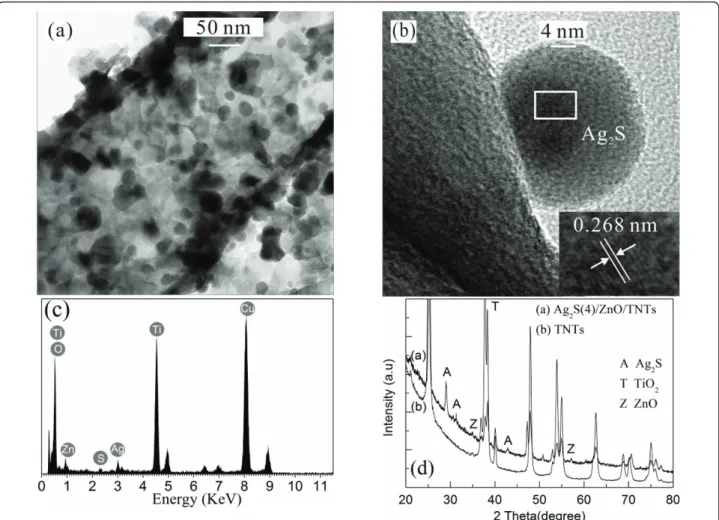
ZnO/TNTs was further investigated by a high-resolution transmission electron microscope (HR-TEM). Figure 3a shows the low-magnification TEM image of the Ag2S(4)/
ZnO/TNTs. It can be clearly seen that many Ag2S
nano-particles with diameters of approximately 10 nm were deposited into the TNTs. This is supported by our earlier observation in the SEM measurement (Figure 2c). Figure 3b shows the high-magnification image of the Ag2S(4)/
ZnO/TNTs. It is observed that the crystalline Ag2S
nanoparticles were grown on crystalline TNTs. In addi-tion, the HR-TEM image in Figure 3b reveals clear lattice fringes, the observed lattice fringe spacing of 0.268 nm is consistent with the unique separation (0.266 nm) between (120) planes in bulk acanthite Ag2S crystallites.
To determine the composition of the nanoparticles, the corresponding energy dispersive x-ray (EDX) spec-trum of the Ag2S(4)/ZnO/TNTs was carried out in the
HR-TEM as seen in Figure 3c. The characteristics peaks in the spectrum are associated with Ag, Ti, O, Zn, and S. The quantitative analysis reveals the atomic ratio of Ag and S is close to 2:1, indicating the deposited materi-als are possible Ag2S.
In order to determine the structure of the Ag2S(4)/
ZnO/TNTs, the crystalline phases of the Ag2S(4)/ZnO/
TNTs and the corresponding TNTs were characterized by XRD, as shown in Figure 3d. The XRD pattern shows peaks corresponding to TiO2 (anatase), ZnO
(hexagon), and Ag2S (acanthite). The observed peaks
indicate high crystallinities in the TNTs, ZnO, and Ag2S
nanoparticles, consistent with the SEM results shown in Figure 2. The results further confirm that the obtained films are composed of TiO2, ZnO, and Ag2S.
Optical and photoelectrochemistry properties of Ag2S
QD-sensitized TNT electrodes in the presence of ZnO layers
Figure 4 shows optical absorption of annealed TNTs, ZnO/TNTs, and Ag2S(n)/ZnO/TNTs (n = 2, 4, and 8). It
can be seen from Figure 4 that both plain TNTs and ZnO/TNTs absorb mainly UV light with wavelengths smaller than 400 nm. However, for the ZnO/TNT film, the absorbance of the spectra slightly increases compared to that for plain TNTs, suggesting the formation of ZnO thin film on TNTs. This result is similar to that for ZnO-coated TiO2films in DSSCs [29], which can be attributed
to the absorption of the ZnO layers coated on TNTs.
After Ag2S deposition, the absorbance of the Ag2S(n)/
ZnO/TNT films increases with the cycles of Ag2S
chemi-cal bath deposition process. Moreover, a significant shift of the spectral photoresponse is observed in the Ag2S(n)/
ZnO/TNT films, indicating that the Ag2S deposits can be
used to sensitize TiO2nanotube arrays with respect to
lower energy (longer wavelength) region of the sunlight. In addition, the absorbance increases with the increase in the cycles of Ag2S deposition, resulting from an increased
amount of Ag2S nanoparticles.
For the performance comparison of as-prepared Ag2
S-sensitized TNT and ZnO/TNT electrodes, the curves of photocurrent density vs. the applied potential for the Ag2S
(n)/TNT and Ag2S(n)/ZnO/TNT (n = 2, 4, and 8)
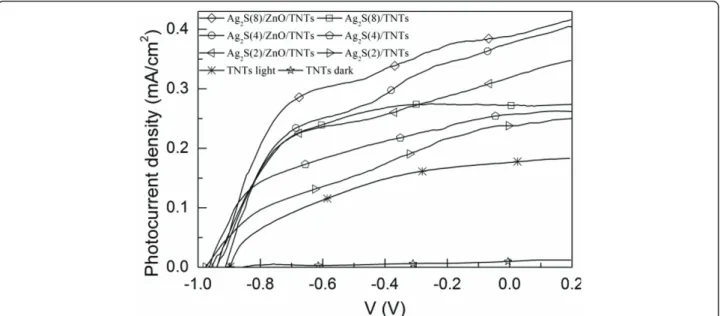
electro-des in the dark and under simulated AM 1.5 G sunlight irradiation (100 mW cm-2) are shown in Figure 5.
It is clearly seen from Figure 5 that for a chemical bath deposition (CBD) cyclen and an applied potential, the photocurrent density of the Ag2S(n)/ZnO/TNT electrode
is higher than that of the Ag2S(n)/TNTs without ZnO
layer. This can be explained from the increased absor-bance of the Ag2S(n)/ZnO/TNT electrode shown in
Fig-ure 4 and the energy diagram of Ag2S-sensitized ZnO/
TNT solar cells presented in Figure 6a. Due to the forma-tion of ZnO energy barrier layer over TNTs, the charge recombination with either oxidized Ag2S quantum dots
or the electrolyte in the Ag2S-sensitized ZnO/TNT
elec-trode is suppressed compared to the Ag2S-sensitized
TNTs. This explanation can be supported by the dark current density-applied potential characteristics of the Ag2S(n)/ZnO/TNTs and Ag2S(n)/TNTs because the dark
current represented the recombination between the elec-trons in the conduction band and the redox ions of the electrolyte. As an example, Figure 6b shows the curves of dark density vs. the applied potential for the Ag2S(4)/
ZnO/TNTs and Ag2S(4)/TNTs. Apparently, for the
Ag2S-sensitized TNTs with ZnO-coated layers, the dark
current density decreases significantly. In addition, it is found that for both Ag2S-sensitized ZnO/TNT and TNT
electrodes, the photocurrent density at an applied poten-tial increases with increasing CBD cycles, which can be attributed to a higher incorporated amount of Ag2S that
can induce a higher photocurrent density. This result is consistent with the observed UV-vis absorption spectra shown in Figure 4. Similar results have been obtained in CdS-sensitized QDSSCs [31]. Moreover, it should be noted that although the conduction band (CB) level of ZnO is slightly higher than that of TiO2(Figure 6a), it
seems that the electron transfer efficiency from Ag2S to
ZnO is not much lower than that from Ag2S to ZnO
because the photocurrent density of the Ag2S/ZnO/
TNTs is more higher than that of the Ag2S/TNTs. This
phenomenon can be explained as follows. According to Marcus and Gerischer’s theory [32-34], the rate of elec-tron transfer from elecelec-tron donor to elecelec-tron acceptor depends on the energetic overlap of electron donor and acceptor which are related to the density of states (DOS) at energy E relative to the conductor band edge, reorgani-zation energy, and temperature. Therefore, in our case, even though The CB level of electron donor (Ag2S) is Figure 2 SEM images of (a) the plain TNTs, (b) Ag2S(4)/TNTs,
and (c) Ag2S(4)/ZnO/TNTs.
Chenet al. Nanoscale Research Letters 2011, 6:462 http://www.nanoscalereslett.com/content/6/1/462
lower than that of electron acceptor (TiO2or ZnO), the
electron transfer may also happen if there is an overlap of the DOS of Ag2S and TiO2 (or ZnO), which may be
the reason for the photocurrent generation in Ag2
S-sen-sitized TNT electrodes. The more important thing is that for semiconductor nanoparticles, the DOS may be strongly influenced by the doped impurity [35], the size of the nanoparticles [36], and the presence of surround-ing media such as liquid electrolyte (i.e., Na2S electrolyte
in our case) [37]. This means that the DOS of semicon-ductor nanoparticles may distribute in a wide energy range. Recently, the calculation results [38] showed that the DOS of Ag2S can distribute in a wide energy range
from about -14 to 5 eV, indicating that the electron can probably transfer from Ag2S to TiO2or ZnO due to the
overlap of the electric states of Ag2S and TiO2or ZnO.
Besides, considering that the difference between the CB level of TiO2and that of ZnO is not so large, it may be
possible that the electron transfer rate from Ag2S to ZnO
is not much lower than that from Ag2S to TiO2. The
photocurrent and photovoltage of Ag2S QD-sensitized
TiO2electrode have been experimentally found not only
by us but also by others [10,25].
Figure 3 The low- and high-magnification TEM images, EDX spectrum, and XRD pattern. (a) TEM image of the Ag2S(4)/ZnO/TNT electrode showing the formation of ZnO on the TNTs and the Ag2S nanoparticles inside the TNTs, (b) an HR-TEM image of a deposited Ag2S quantum dot, (c) the EDX spectrum, and (d) XRD pattern of the Ag2S(4)/ZnO/TNTs.
Figure 4 UV-vis absorption spectrum of the plain TNT, ZnO/ TNT, Ag2S(n)/TNT, and Ag2S(n)/ZnO/TNT films. n = 2, 4 and 8.
Figure 5J-V characteristics of the plain TNT, Ag2S(n)/TNT, and Ag2S(n)/ZnO/TNT electrodes. n = 2, 4, and 8.
Figure 6 Energy diagram and dark current. (a) Energy diagram of Ag2S-sensitized ZnO/TNT solar cells and (b) the dark current of the Ag2S(4)/ ZnO/TNT and Ag2S(4)/TNT electrodes.
Chenet al. Nanoscale Research Letters 2011, 6:462 http://www.nanoscalereslett.com/content/6/1/462
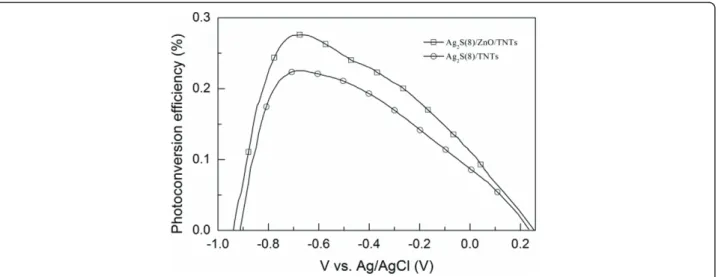
Figure 7 shows the photoconversion efficiencyh as a function of applied potential (vs. Ag/AgCl) for the Ag2S
(8)/ZnO/TNT and Ag2S(8)/TNT electrodes under
UV-vis light irradiation. The efficiency h is calculated as [39], h (%) = [(total power output-electric power input)/ light power input] × 100 =jp[(Erev |Eapp|)/I0] × 100,
wherejp is the photocurrent density (milliamperes per
square centimeter), jp×Erev is the total power output,
jp × Eapp is the electrical power input, and I0 is the
power density of incident light (milliwatts per square centimeter).Erevis the standard state-reversible
poten-tial, which is 1.23 V/NHE. The applied potential is Eapp
=Emeans -Eaoc, whereEmeans is the electrode potential
(vs. Ag/AgCl) of the working electrode at which photo-current was measured under illumination andEaocis the
electrode potential (vs. Ag/AgCl) of the same working electrode under open circuit conditions, under the same illumination, and in the same electrolyte. It can be clearly seen from Figure 7 that the Ag2S(8)/ZnO/TNT
electrode shows a higher photoconversion efficiency compared to the Ag2S(8)/TNT electrode with a ZnO
layer for an applied potential. In particular, a maximum photoconversion efficiency of 0.28% was obtained at an applied potential of -0.67 V vs. Ag/AgCl for the Ag2S
(8)/ZnO/TNT electrode, while it was 0.22% for the Ag2S
(8)/TNT electrode at an applied potential of -0.67 V. The maximum photoconversion efficiency of the Ag2S
(8)/ZnO/TNT electrode is about 1.3 times that of the Ag2S(8)/TNT electrode. However, it should be noted
that the efficiency of the Ag2S-sensitized TNT electrode
is worse than the value obtained from Ag2S
QD-sensi-tized nanocrystalline TiO2 film, which was recently
reported by Tubtimtae et al. [25]. The main reason may be due to the different architecture of TiO2 electrode.
Ag2S QDs cannot be deposited in large numbers on the
inner surface of TNTs due to the limited space in TNTs, while the number of Ag2S QDs deposited on the
surface of nanocrystalline TiO2 film is almost not
lim-ited. This means that compared to the TNTs, more Ag2S QDs can be deposited on nanocrystalline TiO2
film and absorb more light leading to a higher photo-current. Besides, in our case, we use TNT electrode and 1 M Na2S electrolyte. However, Tubtimtae et al. used
nanocrystalline TiO2 film and a polysulfide electrolyte
consisted of 0.5 M Na2S, 2 M S, 0.2 M KCl, and 0.5 M
NaOH in methanol/water. Clearly, the electrolyte will affect the performance of the devices. Moreover, the photocurrent measurements are performed under differ-ent conditions. A three-electrode configuration was employed in our experiments. However, a two-electrode configuration was used in the experiments of Tubtimtae et al. In addition, our results show that the efficiency obtained from Ag2S-sensitized TNTs is also lower than
that of CdS-sensitized TiO2 electrode [31]. The main
reason for this may be that the CB level of Ag2S is
lower than that of TiO2 as shown in Figure 6a[40], but
the CB level of CdS is higher than that of TiO2.
There-fore, the electron transfer is more efficient in CdS/TNT solar cells. The comparison of our current experiments with those by Tubtimtae et al. indicates that there is still much scope for improving the performance of the Ag2S-sensitied ZnO/TNT electrode. Nevertheless, our
results show that the ZnO layer leads to an increasedh.
Conclusions
In conclusion, Ag2S quantum dot-sensitized TiO2
nano-tube array photoelectrodes were successfully achieved using a simple sequential chemical bath deposition (CBD) method. In order to improve the efficiencies of as-prepared Ag2S quantum dot-sensitized solar cells, the
Ag2S quantum dot-sensitized ZnO/TNT electrodes were
prepared by the interposition of a ZnO energy barrier between the TNTs and Ag2S quantum dots. The ZnO
thin layers were formed using wet-chemical process. The formed ZnO energy barrier layers over TNTs significantly increase the power conversion efficiencies of the Ag2S(n)/ZnO/TNTs due to a reduced
recombination.
Acknowledgements
This work was supported by the Korea Science and Engineering Foundation (KOSEF) grant funded by the Korea Ministry of Education, Science and Technology (MEST) (no. 2010-0026150).
Author details
1Department of Nuclear and Quantum Engineering, Korea Advanced Institute of Science and Technology (KAIST), 373-1 Guseong, Yuseong, Daejeon 305-701, Republic of Korea2Nanomaterials Research Group, Physics Division, PINSTECH, Islamabad, Pakistan
Authors’ contributions
CC carried out the experiments, participated in the sequence alignment and drafted the manuscript. YX participated in the design of the study and performed the statistical analysis GA and SHY participated in the device preparation. SOC conceived of the study, and participated in its design and coordination. All authors read and approved the final manuscript.
Competing interests
The authors declare that they have no competing interests.
Received: 5 April 2011 Accepted: 21 July 2011 Published: 21 July 2011
References
1. Grätzel M: Dye-sensitized solid-state heterojunction solar cells. MRS Bull 2005, 30:23-27.
2. Wei D: Dye sensitized solar cells. Int J Mol Sci 2010, 11:1103-1113. 3. Fan SH, Wang KZ: Recent advances on molecular design of ruthenium (II)
sensitizers in dye-sensitized solar cells. Chinese J Inorg Chem 2008, 24:1206-1212.
4. Grätzel M: Dye-sensitized solar cells. J Photoch Photobio C 2003, 4:145-153. 5. Gao F, Wang Y, Shi D, Zhang J, Wang MK, Jing XY, Humphry-Baker R,
Wang P, Zakeeruddin SM, Grätzel M: Enhance the optical absorptivity of nanocrystalline TiO2film with high molar extinction coefficient ruthenium sensitizers for high performance dye-sensitized solar cells. J Am Chem Soc 2008, 130:10720-10728.
6. Vogel R, Pohl K, Weller H: Sensitization of highly porous, polycrystalline TiO2electrodes by quantum sized CdS. Chem Phys Lett 1990, 174:241-246. 7. Niitsoo O, Sarkar SK, Pejoux C, Ruhle S, Cahen D, Hodes G: Chemical bath
deposited CdS/CdSe-sensitized porous TiO2solar cells. J Photochem Photobiol A: Chem 2006, 181:306-313.
8. Diguna LJ, Shen Q, Kobayashi J, Toyoda T: High efficiency of CdSe quantum-dot-sensitized TiO2inverse opal solar cells. Appl Phys Lett 2007, 91:023116.
9. Lόpez-Luke T, Wolcott A, Xu LP, Chen SW, Wcn ZH, Li JH, De La Rosa E, Zhang JZ: Nitrogen-doped and CdSe quantum-dot-sensitized
nanocrystalline TiO2films for solar energy conversion applications. J Phys Chem C 2008, 112:1282-1292.
10. Vogel R, Hoyer P, Weller H: Quantum-sized PbS, CdS, Ag2S, Sb2S3, and Bi2S3 particles as sensitizers for various nanoporous wide-bandgap semiconductors. J Phys Chem 1994, 98:3183-3188.
11. Lee H, Leventis HC, Moon SJ, Chen P, Ito S, Haque SA, Torres T, Nuesch F, Geiger T, Zakeeruddin SM, Grätzel M, Nazeeruddin MK: PbS and CdS quantum dot-sensitized solid-state solar cells:“Old Concepts, New Results”. Adv Funct Mater 2009, 19:2735-2742.
12. Yu PR, Zhu K, Norman AG, Ferrere S, Frank AJ, Nozik AJ: Nanocrystalline TiO2solar cells sensitized with InAs quantum dots. J Phys Chem B 2006, 110:25451-25454.
13. Zaban A, Micic OI, Gregg BA, Nozik AJ: Photosensitization of nanoporous TiO2electrodes with InP quantum dots. Langmuir 1998, 14:3153-3156. 14. Nozik AJ: Quantum dot solar cells. Physica E: Low-Dimensional Systems &
Nanostructures 2002, 14:115-120.
15. Roy P, Kim D, Lee K, Spiecker E, Schmuki P: TiO2nanotubes and their application in dye-sensitized solar cells. Nanoscale 2010, 2:45-59. 16. Xu CK, Shin PH, Cao LL, Wu JM, Gao D: Ordered TiO2nanotube arrays on
transparent conductive oxide for dye-sensitized solar cells. Chem Mater 2010, 22:143-148.
17. Uchida S, Chiba R, Tomiha M, Masaki N, Shirai M: Application of titania nanotubes to a dye-sensitized solar cells. Electrochemistry 2002, 70:418-420.
18. Xie Y, Heo SH, Kim YN, Yoo SH, Cho SO: Synthesis and visible-light-induced catalytic activity of Ag2S-coupled TiO2nanoparticles and nanowires. Nanotechnology 2010, 21:015703.
19. Neves MC, Nogueira JMF, Trindade T, Mendonca MH, Pereira MI, Monteiro OC: Organic dyes with a novel anchoring group for dye-sensitized solar cell applications. J Photochem Photobiol A 2009, 204:168-173.
20. Kryukov AI, Stroyuk AL, Zińchuk NN, Korzhak AV, Kuchmii SY: Optical and catalytic properties of Ag2S nanoparticles. J Mol Catal A Chem 2004, 221:209-221.
21. Morales-Masis M, van der Molen SJ, Fu WT, Hesselberth MB, van Ruitenbeek JM: Conductance switching in Ag2S devices fabricated by in situ sulfurization. Nanotechnology 2009, 20:095710.
22. Reid M, Punch J, Ryan C, Franey J, Derkits GE, Reents WD, Garfias LF: The corrosion of electronic resistors. IEEE Tran Components and Packaging Technologies 2007, 30:666-672.
23. Wang HL, Qi LM: Controlled synthesis of Ag2S, Ag2Se, and Ag nanofibers by using a general sacrificial template and their application in electronic device fabrication. Adv Funct Mater 2008, 18:1249-1256.
24. Kitova S, Eneva J, Panov A, Haefke H: Infrared photography based on vapor-deposited silver sulfide thin films. J Imaging Sci Technol 1994, 38:484-488.
25. Tubtimtae A, Wu K, Tung H, Lee M, Wang GJ: Ag2S quantum dot-sensitized solar cells. Electrochem Commun 2010, 12:1158-1160. 26. Chen C, Xie Y, Ali G, Yoo SH, Cho SO: Improved conversion efficiency of
CdS quantum dots-sensitized TiO2nanotube array using ZnO energy barrier layer. Nanotechnology 2011, 22:015202.
27. Lee W, Kang SH, Kim JY, Kolekar GB, Sung YE, Han SH: TiO2nanotubes with a ZnO thin energy barrier for improved current efficiency of CdSe quantum-dot-sensitized solar cells. Nanotechnology 2009, 20:335706. 28. Paulose M, Shankar K, Yoriya S, Prakasam HE, Varghese OK, Mor GK,
Latempa TA, Fitzgerald A, Grimes CA: Anodic growth of highly ordered TiO2nanotube arrays to 134μm in length. J Phys Chem B 2006, 110:16179-16184.
29. Roh SJ, Mane RS, Min SK, Lee WJ, Lokhande CD, Han SH: Achievement of 4.51% conversion efficiency using ZnO recombination barrier layer in TiO2based dye-sensitized solar cells. Appl Phys Lett 2006, 89:253512. 30. Sun WT, Yu Y, Pan HY, Gao XF, Chen Q, Peng LM: CdS quantum dots sensitized TiO2nanotube-array photoelectrodes. J Am Chem Soc 2008, 130:1124-1125.
31. Chi CF, Lee YL, Weng HS: A CdS-modified TiO2nanocrystalline photoanode for efficient hydrogen generation by visible light. Nanotechnology 2008, 19:125704.
32. Gerischer H: Charge transfer processes at semiconductor-electrolyte interfaces in connection with problems of catalysis. Surf Sci 1969, 18:97-122.
33. Marcus RA: On the theory of oxidation-reduction reactions involving electron transfer. J Chem Phys 1956, 24:966-978.
34. Marcus RA: Chemical and electrochemical electron-transfer theory. Ann Rev Phys Chem 1964, 15:155-196.
35. Feng Y, Badaeva E, Gamelin DR, Li XS: Excited-state double exchange in manganese-doped ZnO quantum dots: a time-dependent density-functional study. J Phys Chem Lett 2010, 1:1927-1931.
36. Lei Y, Liu H, Xiao W: First principles study of the size effect of TiO2 anatase nanoparticles in dye-sensitized solar cell. Modelling Simul Mater Sci Eng 2010, 18:025004.
37. Abayev H, Zaban A, Kytin VG, Danilin AA, Garcia-Belmonte G, Bisquert J: Properties of the electronic density of states in TiO2nanoparticles Chenet al. Nanoscale Research Letters 2011, 6:462
http://www.nanoscalereslett.com/content/6/1/462
surrounded with aqueous electrolyte. J Solid State Electronchem 2007, 11:647-653.
38. Sun S, Xia D: An abinitio calculation study on the super ionic conductors α-AgI and Ag2X (X = S, Se) with BCC structure. Solid State Ionics 2008, 179:2330-2334.
39. Khan SUM, Shahry MA, Ingler WBJ: Efficient photochemical water splitting by a chemically modified n-TiO2. Science 2002, 297:2243-2245.
40. Xu Y, Schoonen MMA: The absolute energy positions of conduction and valence bands of selected semiconducting minerals. American Mineralogist 2000, 85:543-556.
doi:10.1186/1556-276X-6-462
Cite this article as: Chen et al.: Improved conversion efficiency of Ag2S
quantum dot-sensitized solar cells based on TiO2nanotubes with a ZnO
recombination barrier layer. Nanoscale Research Letters 2011 6:462.
Submit your manuscript to a
journal and benefi t from:
7 Convenient online submission 7 Rigorous peer review7 Immediate publication on acceptance 7 Open access: articles freely available online 7 High visibility within the fi eld
7 Retaining the copyright to your article