강박스 거더교의 FE 모델 개선을 위한 평균값 반복 신경망
MINNs for FE model updating of a steel box girder bridge
트위 둥1∙취 진타오2∙김 두기3*∙구 기 영4
Thuy Dung Vu, Jintao Cui, Dookie Kim, Ki Young Koo
1)
Abstract
Updating model parameters are required in order to simulate the actual behavior of the dynamic structure. A new strategy, mean-iterative neural networks (MINNs) has been proposed in this paper for model parameter updating of a steel box girder bridge. With new strategy for structural dynamic model updating, it offers many advantages such as potential savings of computational effort, more consistent in reaching convergence. The dynamic response obtained from the experimental test on a two span continuous bridge is used as the target for model updating. And the presented algorithm is applied to update the model parameters. These results show a good possible of using MINNs in practice for dynamic model updating.
keywords : MINNs, neural networks, model updating, stell box girder bridge.
1. Introduction
Model updating is a typical area that has received a lot of attention because the modeling and identification of dynamic systems through the use of measured experimental data are a problem of considerable importance in control engineering (Hart et al., 1977). The purpose of FE model updating is to modify the mass, stiffness and damping parameters of the numerical model in order to obtain better agreement between numerical results and experimental results. Dynamic structural parameters updating based on neural networks (NNs) are open loop in nature and are capable of providing a confidence measure of the accuracy only during the training phase (Chu et al. 1990). In developing an iterative NNs technique for model updating of dynamic structures, convergence and consistence for prediction-error estimates are treated as one of the most important matters (Wald 1949). In this paper, finite element (FE) based NNs (Ramuhalli et al. 2005) has been developed for estimating the system parameters in the
* 1 Graduate, Kunsan National University, Korea. [email protected]
2 Graduate, Kunsan National University, Korea. [email protected]
3* Correspondent, Associate Professor, Kunsan National University, Korea. [email protected] 4 Associate Researcher, University of Sheffield, Sheffield, UK. [email protected]
case of many similar variables. Mean-iterative neural networks (MINNs) strategy is proposed in this paper in order to provide a suitable tool in these problematic cases to analyze an observed data record. The simulation results determine that the new algorithm is effective and efficient. Its application to identify stiffness of a steel box girder bridge proves the reputability of this new strategy.
2. Mean-iterative neural networks (MINNs)
The general procedure of a new iterative algorithm approach for parameter model updating loop based on the mean-iterative optimization process. MINNs strategy is divided into two stages: First, the initial defect profile from numerical analysis is trained by NNs in order to identify origin structural parameters; the trained NNs are then used in an iterative algorithm to estimate the parameters given the measurement signals. Mathematically, each of the NNs approximates the function mapping the input to the output. Therefore, the network can interpolate between the training set points to obtain a reasonable prediction. Desired parameter estimation can be found by iteratively minimizing an objective function. It is marked that, for the presented method, after each loop the mean of the origin and the estimated values are calculated to be a new training data for the next loop. By doing so, the chosen parameters will jump up and down, but not progressively step up throughout the optimization process, like regular NNs. As a consequence, the differences between identified variables are kept similar during iteration for physical meaning. Better approximation in the solution of the equations is achieved, and therefore, the convergence is speeded up. Because the mean value is required after each loop, the new strategy is named mean-iterative neural networks (MINNs).
3. Experimental study
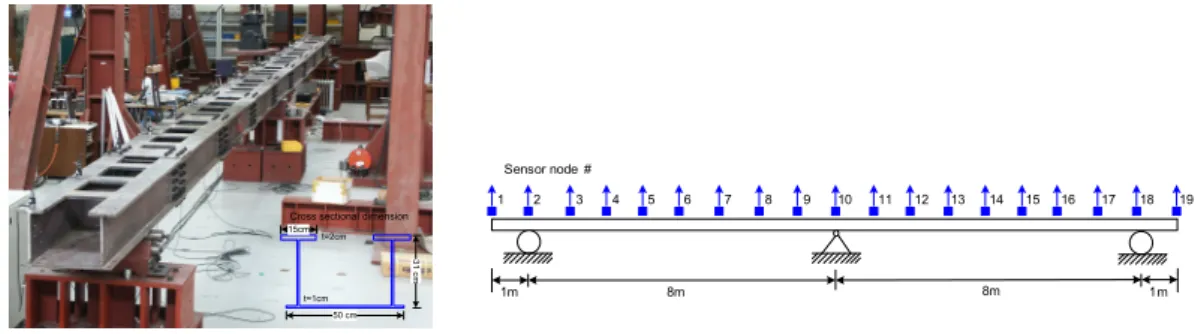
The experiment, demonstrated in Fig. 1, was carried out on a test model. The structure is a two-span box girder bridge with 18-meter long, which was composed of nine segmental boxes connected by bolts and plates. Acceleration was chosen to record for dynamic test. Therefore, nineteen sensors were set along the upper surface with a distance of one meter as shown in Fig. 1. The vibration responses were measured with 200 Hz sampling rate and were repeated eighteen times under the impact loads, which were applied at four minute interval. The experiment was performed for about six hours at the almost same temperature condition to neglect the temperature effects.
1m 8m 8m 1m 1 2 3 4 5 6 7 8 9 10 11 12 13 14 15 16 17 18 19
Sensor node #
Fig. 1. Overview of test set-up on a steel-box girder bridge model (Koo et al. 2008)
4. Results and discussion
The FE model updating using natural frequencies, MAC values and objective optimization updating converges at the end of about nine iterations for training data set.
Furthermore, the convergences of two different iterative procedures which are normal NN and MINN are studied in this paper. The fluctuations in a comparison according to the number of iterations are illustrated in Fig. 2, which demonstrates the improvements by the proposed method.
0 2 4 6 8 10 12 0.025 0.050 0.075 0.100 0.125 0.150 O bject iv e f un ctio n va lu e Iteration 0 2 4 6 8 10 12 0.030 0.035 0.040 0.045 0.050 0.055 O bje cti ve f un ctio n valu e Iteration
(a) Iterative NNs (b) MINNs
Fig. 2. In a comparison during iteration
Since variables are made by steel and the condition is nearly same, in order to be physically meaningful, all of the variables should be converged to one value. In practice, it is reasonable to assume that the absolute error between each parameter and their mean value is less than 10.0%. The variables’ error detection is shown to be small for the practical purpose.
50 cm 31 c m t=1cm t=2cm
Cross sectional dimension
15cm
5. Conclusions
MINNs approach for dynamic model updating is proposed and verified by numerical and experimental examples. By setting the boundary condition for training data based on mean-iterative strategy. The outputs of the NN are chosen properly so that the structural model can be identified efficiently. Results from the study of the responses of a steel box girder bridge show a great promise in convergence for structural dynamic model updating in order to estimate the uncertain parameters of FE model.
Acknowledgements
This work was supported by the National Research Foundation of Korea Grant funded by the Korean Government (NRF-2010-0013642). The authors wish to express their sincere gratitude for the moral and financial support. The experimental tests performed in Korea Research Institute of Standards and Science (KRISS) are sincerely appreciated.
References
Chu, SR., Shoureshi, R. and Tenorio, M. (1990), Neural Networks for System Identification, IEEE Control Systems Magazine, 10(3), pp.31~35.
Hart, G. C. and Yao, James T.P. (1977), System Identification in Structural Dynamics, J. Engineering Mechanics. Division, 103(6), pp.1089~1104.
Koo, K. Y., Lee, J. J., Yun, C. B. and Kim. J. T. (2008), Damage detection in beam-like structures using deflections obtained by modal flexibility matrices, J.SmartStructuresandSystems, 4(5), pp. 605~628.
Ramuhalli, P., Udpa, L. and Udpa, S.S. (2005), Finite-element neural networks for solving differential equations, IEEE Trans. Neural Networks, 16(6), pp. 1388~1391.
Wald, A. (1949), Note on the consistency of the maximum likelihood estimate, Ann. Math. Statist., 20(4), pp. 595~601.
Muspratt, M.A. (1972) Elastic design of slabs for uniformly distributed loads, Computers & Structures, 2(6), pp.893~895.