Optimization of Mixing Ratio to Improve Antioxidant Activity of
Aged Garlic with Pine Needle Using Response Surface
Methodology
Jae-Hee Park, Eunji Shin, and Eunju Park
Department of Food, Nutrition and Biotechnology, Kyungnam University, Gyeongnam 51767, Korea
pISSN 2287-1098ㆍeISSN 2287-8602
Research Note
Received 18 May 2017; Accepted 21 June 2017; Published online 30 September 2017 Correspondence to Eunju Park, Tel: +82-55-249-2218, E-mail: [email protected] Copyright © 2017 by The Korean Society of Food Science and Nutrition. All rights Reserved.
This is an Open Access article distributed under the terms of the Creative Commons Attribution Non-Commercial License (http://creativecommons.org/licenses/by-nc/4.0) which permits unrestricted non-commercial use, distribution, and reproduction in any medium, provided the original work is properly cited.
ABSTRACT: Aged garlic has been reported to possess beneficial pharmacological activities, including anti-stress and an-ti-fatigue properties, and to exert protective effects on the cardiovascular system and liver. Pine needles are widely used in folk medicine and as food additives owing to their pharmacological properties such as anti-aging and anti-inflamma-tory effects. It has long been known that combining certain phytochemicals with other phenols or organic acids can pro-duce synergistic effects. Therefore, the purpose of this study was to develop an optimal formula of aged garlic with added pine needle powder for improved antioxidant activity using the statistical technique of response surface methodology. The antioxidant activities of aged garlic mixed with pine needle powder were confirmed by measuring oxygen radical ab-sorbance capacity and total polyphenol content. An optimized antioxidant formula was identified that contained 5.08 g aged garlic and 1.97 g pine needle powder. The antioxidant activities of the mixture prepared using this optimal formula were significantly higher than the predicted values according to an additive model. Hence, this study confirms that the addition of pine needle powder to aged garlic can improve its antioxidant activity. This study demonstrated an optimal mixing ratio to produce an aged garlic product with improved functionality through the addition of pine needle powder that could be successfully employed by the food industry to prepare functional foods.
Keywords: aged garlic, pine needle, response surface methodology, ORAC value, synergistic effect
INTRODUCTION
Currently, many garlic products are used in alternative medicine, including fresh garlic extract, garlic oil, aged garlic, and various organosulfur compounds derived from garlic (1). Aged garlic is produced by aging fresh garlic at a high temperature for at least 1 month. During the ag-ing of garlic, non-enzymatic brownag-ing produces changes in physicochemical parameters including color, flavor, texture, and the contents of macro- and micronutrients (2). Aged garlic contains water-soluble allyl amino acid derivatives that account for most of its organosulfur con-tent, stable lipid-soluble allyl sulfides, flavonoids, sapo-nins, and essential macro- and micronutrients (3). Fur-ther, pharmacological studies have found that aged gar-lic and its components possess antioxidative, antiaging, cardiovascular, and hepatoprotective effects (4).
Pine (Pinus densiflora) needles have been used in Asia to prepare folk medicines to treat conditions such as hyper-tension (5). Pine needle extracts were reported to show
protective effects against oxidative DNA damage and apoptosis induced by hydroxyl radicals (6).
Studies involving the evaluation of synergistic effects of plant combinations are emerging and seem to highlight the potential for the mixtures to have enhanced func-tional properties when compared with the effects of each plant individually (7). Synergy assessment has become a key area in phytomedicine research in recent years to find a scientific rationale for the centuries-old, often observed therapeutic superiority of multidrug combinations over single constituents in traditional medicine (8).
Response surface methodology (RSM) is a statistical tool for performing, improving, and optimizing the in-dependent factors that influence responses in a given set of experiments. RSM defines not only the effects of in-dependent variables, but also their interaction effects (9). When multiple factors and interactions affect the desired responses for a given process, RSM is an effective techni-que for evaluating the process parameters with the few-est experiments (10,11).
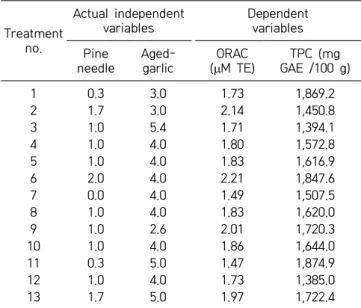
Table 1. Response of dependent variables to mixing ratio for independent variables Treatment no. Actual independent variables Dependent variables Pine needle Aged-garlic ORAC (μM TE) TPC (mg GAE /100 g) 1 0.3 3.0 1.73 1,869.2 2 1.7 3.0 2.14 1,450.8 3 1.0 5.4 1.71 1,394.1 4 1.0 4.0 1.80 1,572.8 5 1.0 4.0 1.83 1,616.9 6 2.0 4.0 2.21 1,847.6 7 0.0 4.0 1.49 1,507.5 8 1.0 4.0 1.83 1,620.0 9 1.0 2.6 2.01 1,720.3 10 1.0 4.0 1.86 1,644.0 11 0.3 5.0 1.47 1,874.9 12 1.0 4.0 1.73 1,385.0 13 1.7 5.0 1.97 1,722.4
ORAC, oxygen radical absorbance capacity; TE, Trolox alents; TPC, total polyphenol content; GAE, gallic acid equiv-alents.
The objective of this study was to investigate the opti-mal mixing ratio of aged garlic and pine needle powders for maximizing the functional properties of the resultant mixtures, including their total polyphenol content (TPC) and oxygen radical absorbance capacity (ORAC), using RSM.
MATERIALS AND METHODS
Samples and sample preparation
For the preparation of aged garlic, raw garlic cloves were put into an incubator within Chamaecyparis obtusa boxes and then fermented for more than 600 h in the temper-ature range of 25oC to 75oC. The aged garlic was dried to a moisture content of 40%, ground to pass through a 6-mm sieve, and then cooled to 50oC. It was then gelati-nized at 80oC for 2 h, dried at 60oC, and ground again to pass through a 3-mm sieve. This procedure was repeated with grinding to pass through a 1-mm sieve. Finally, the mixture was dried to a final moisture content of approx-imately 3%. The pine needle powder was purchased at a local market (Garunara, Gyeonggi, Korea).
Measurement of TPC
TPC was determined according to the method of Park et al. (12). Briefly, each sample was mixed with 2 mL of 1 N Folin-Ciocalteu reagent and incubated at 25oC for 3 min. Then, 2 mL of 10% Na2CO3 was added, and the
mix-ture was incubated at 25oC for 1 h. The absorbance at 690 nm was measured with a microplate reader (Tecan, Männedorf, Switzerland). TPC was expressed as gallic acid equivalents (GAE).
ORAC assay
According to the method of Kim et al. (13), ORAC as-says were performed using a GENios multi-functional plate reader (InfiniteⓇ F500; Tecan) with fluorescent fil-ters (excitation wavelength 485 nm and emission wave-length 535 nm). In the final assay mixture, fluorescein (40 nM) was used as a target of free radical attack with 2,2’-azobis-(2-amidinopropane) dihydrochloride (AAPH) (20 mM) as a peroxyl radical generator in peroxyl radi-cal-scavenging capacity (ORAC ROO・) assays. Trolox (1 μM) was used as a control and prepared fresh daily. The analyzer was programmed to record the fluorescence sig-nal every 2 min after AAPH was added. All fluorescence measurements were expressed relative to the initial read-ing. Final results were calculated based on the difference in the area under the fluorescence decay curve between the blank and each sample. ORAC ROO・ values were ex-pressed as μmol of Trolox equivalents (TE). One ORAC unit was equivalent to the net antioxidant effect pro-vided by 1 μM Trolox.
Experimental design and statistical analysis
The tested mixing ratios of aged garlic and pine needle powders are given in Table 1. Aged garlic powder (X1)
and pine needle powder (X2) were chosen as
independ-ent variables. The range and cindepend-enter point values of these two independent variables, as presented in Table 1, are based on the results of preliminary experiments. The TPC and ORAC values were selected as responses for the combination of the independent variables given in Table 2. Two experiments for each ratio were carried out, and the mean values are reported as the observed re-sponses. The mixtures of aged garlic and pine needle powders (total weight 5 g) were extracted with ethanol (100 mL) for 72 h, and the extracts were filtered through Whatman No. 1 filter paper (Whatman, Maidstone, UK). The extraction solvents were removed with an evapora-tor (Eyela N-1000, Tokyo Rikakikai Co., Tokyo, Japan), and the dry residue was re-dissolved in dimethyl sulf-oxide to a concentration of 50 mg/mL and kept at 20oC until use.
The experimental runs were randomized to minimize the effects of unexpected variability in the observed re-sponses.
The variables were coded according to the equation:
x=(Xi−X0)/ΔX (Eq. 1)
where x is the coded value, Xi is the corresponding
ac-tual value, X0 is the actual value in the center of the
do-main, and ΔX is the increment of Xi corresponding to a
variation of 1 unit of x.
compo-Table 2. Coefficients and R2 values of variables in the predictive
model for dependent variables
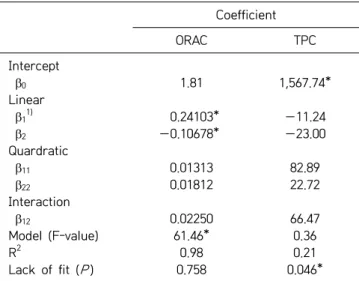
Coefficient ORAC TPC Intercept β0 1.81 1,567.74* Linear β11) 0.24103* −11.24 β2 −0.10678* −23.00 Quardratic β11 0.01313 82.89 β22 0.01812 22.72 Interaction β12 0.02250 66.47 Model (F-value) 61.46* 0.36 R2 0.98 0.21 Lack of fit (P ) 0.758 0.046*
ORAC, oxygen radical absorbance capacity; TPC, total poly-phenol contents.
*Significant at P<0.05.
1)β
1, pine needle powder; β2, aged-garlic powder.
site design is:
Y=β0+
βiXi+
βiiXi2+
βijXiXj (Eq. 2)where Y is the dependent variable (ORAC or TPC), β0 is
the model constant, and βi, βii, and βij are the model
co-efficients, which represent the linear, quadratic, and in-teraction effects of the variables, respectively. Analysis of the experimental design data and calculation of the predicted responses were carried out using Minitab 14 software (Minitab, State College, PA, USA). Additional confirmatory experiments were subsequently conducted to verify the validity of the experimental design. The pa-rameters measured were expressed as mean±standard deviation, and the expected and actual values were com-pared using the unpaired Student’s t-test. A P value of <0.05 was considered statistically significant.
RESULTS AND DISCUSSION
In this study, the ORAC and TPC values of aged garlic powder combined with pine needle powder at various ratios were modeled using RSM. The ORAC assay, which closely reflects the antioxidant capacity of a test sub-stance in biological systems (12), is a method for assess-ing total antioxidant activity. Polyphenols and other an-tioxidant compounds may contribute to the health-pro-moting effects of fruits, vegetables, whole grains, and nuts. Revealing an association between the amount of polyphenols and their potential health benefits requires an accurate assessment of the content of these
com-pounds in plant foods. Significant positive correlations have been reported between ORAC and TPC, indicating that a high antioxidant activity could be attributed to a high content of total polyphenols (14-17). For this rea-son, two dependent variables, namely ORAC and TPC, were chosen in this experimental design. In a study by Quispe-Fuentes et al. (18), only the ORAC value was chosen as a dependent variable for the optimization of antioxidant activity from Maqui berries.
The experimental data for all responses using different mixing ratios are presented in Table 1. Aged garlic in the range of 2.6∼5.4 g was mixed with pine needle powder in the range of 0∼2.0 g. Values of the dependent varia-bles were within the range of 1.47∼2.21 μM TE for the ORAC value and the range of 1,385.0∼1,874.9 mg GAE/ 100 g for the TPC. The experimental data were used to calculate the coefficients of the second-order polynomial equation. The regression coefficient and significance of the coefficients of the models are presented in Table 2. The coefficient of determination (R2) indicates the degree to which a model fits the experimental data (19), and the calculated R2 values are also presented in Table 2. A linear relationship with a good regression coefficient be-tween ORAC and the mixing ratio was found; this rela-tionship is shown in Eq. 3.
ORAC=1.81+0.24103 X1−0.10678 X2 (Eq. 3)
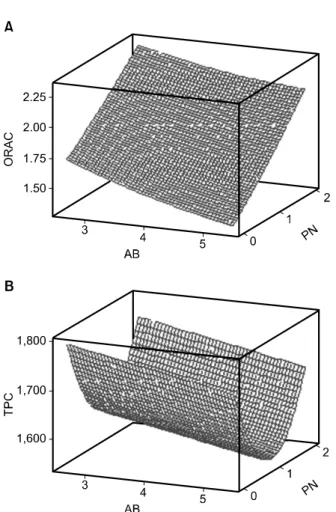
The correlation coefficient of the regression equation was 0.98, indicating a good fit between the experimental data and the regression model for the ORAC values, with a non-significant lack of fit (Table 2). Hence, it can be concluded that the proposed model approximates the response surfaces and is suitable for predicting any val-ues of the parameters within the experimental domain. The addition of increasing concentrations of pine needle powder showed a significant positive linear relationship with ORAC values. The addition of aged garlic had a lin-ear negative influence, and higher contents of aged garlic resulted in lower ORAC values. The quadratic and inter-action effects had no significant influence. The response surfaces of the ORAC values are shown in Fig. 1.
The correlation coefficient (0.21) of the TPC model was lower than that of the ORAC model, and the lack-of- fit value was significant (Table 2). Therefore, this model could not be used for the prediction of TPC. A quadratic relationship with a poor regression coefficient (R2=0.21) was found between the TPC values and the mixing ratio with a significant lack of fit. Moreover, the concentrations of aged garlic and pine needle powders showed no sig-nificant effect on TPC. The response surfaces of the TPC are shown in Fig. 1.
Fig. 1. Response surface plots for the oxygen radical absorb-ance capacity (ORAC) value (A) and total polyphenol contents (TPC) (B) in aged-garlic powder (AB) added with pine needle powder (PN).
the optimal combination of independent variables that maximized the ORAC value. The optimal mixing ratio for producing a high ORAC value was an aged garlic powder content of 5.08 g and a pine needle powder content of 1.97 g. Using this mixing ratio, ORAC and TPC values of 2 μM TE and 1,798.7 mg GAE/100 g were predicted, res-pectively. The predictive capacities of the developed mod-els were tested and validated using this optimal mixing ratio and actual ORAC and TPC values of 6.4 μM TE and 2017.8 mg GAE/100 g were obtained, respectively. The actual TPC and ORAC values of the mixture prepared using the optimal formula of aged garlic with pine nee-dle powder were significantly higher than the predicted values (P<0.05).
In conclusion, RSM proved to be a useful tool for es-tablishing the optimum mixing ratio of aged garlic (5.08 g) and pine needle powder (1.97 g) for maximizing the antioxidant activity of the resultant mixture. The results obtained using the optimized mixing ratio exhibited a high antioxidant activity. From these results, it can be concluded that the predictive model described herein produced a well-fitted mixing ratio. The outcomes of this study will contribute to the development of other opti-mized mixtures of herbal powder to obtain desired
func-tional properties.
ACKNOWLEDGEMENTS
Following are results of a study on the “Leaders in IN-DUSTRY-University Cooperation +” Project, supported by the Ministry of Education and National Research Foundation of Korea.
AUTHOR DISCLOSURE STATEMENT
The authors declare no conflict of interest.
REFERENCES
1. Capasso A. 2013. Antioxidant action and therapeutic effica-cy of Allium sativum L.. Molecules 18: 690-700.
2. Nencini C, Menchiari A, Franchi GG, Micheli L. 2011. In vitro antioxidant activity of aged extracts of some Italian Allium species. Plant Foods Hum Nutr 66: 11-16.
3. Amagase H. 1998. Intake of garlic and its components. Ab-stract No 4 presented at Nutritional and Health Benefits of Garlic as a Supplement Conference, Newport Beach, CA, USA.
4. Morihara N, Sumioka I, Ide N, Moriguchi T, Uda N, Kyo E. 2006. Aged garlic extract maintains cardiovascular homeo-stasis in mice and rats. J Nutr 136: 777S-781S.
5. Kim KY, Chung HJ. 2000. Flavor compounds of pine sprout tea and pine needle tea. J Agric Food Chem 48: 1269-1272. 6. Jeong JB, Seo EW, Jeong HJ. 2009. Effect of extracts from pine
needle against oxidative DNA damage and apoptosis in-duced by hydroxyl radical via antioxidant activity. Food Chem Toxicol 47: 2135-2141.
7. Pereira C, Calhelha RC, Barros L, Queiroz MJRP, Ferreira ICFR. 2014. Synergisms in antioxidant and anti-hepatocel-lular carcinoma activities of artichoke, milk thistle and boru-tutu syrups. Ind Crops Prod 52: 709-713.
8. Wagner H, Ulrich-Merzenich G. 2009. Synergy research: ap-proaching a new generation of phytopharmaceuticals. Phyto-medicine 16: 97-110.
9. Myers RH, Montgomery DC, Anderson-Cook CM. 1995. Re-sponse surface methodology: process and product optimization using designed experiments. John Wiley & Sons, Inc., Hoboken, NJ, USA. p 1-6.
10. Firatligil-Durmus E, Evranuz O. 2010. Response surface meth-odology for protein extraction optimization of red pepper seed (Capsicum frutescens). LWT-Food Sci Technol 43: 226-231. 11. Özdemir M, Devres O. 2000. Analysis of color development
during roasting of hazelnuts using response surface meth-odology. J Food Eng 45: 17-24.
12. Park JH, Kim RY, Park E. 2011. Antioxidant and α-glucosi-dase inhibitory activities of different solvent extracts of skull-cap (Scutellaria baicalensis). Food Sci Biotechnol 20: 1107-1112. 13. Kim GN, Shin JG, Jang HD. 2009. Antioxidant and antidiabe-tic activity of Dangyuja (Citrus grandis Osbeck) extract treated with Aspergillus saitoi. Food Chem 117: 35-41.
14. Prior RL, Wu X, Schaich K. 2005. Standardized methods for the determination of antioxidant capacity and phenolics in foods and dietary supplements. J Agric Food Chem 53: 4290- 4302.
15. Wang Y, Zhu J, Meng X, Liu S, Mu J, Ning C. 2016. Com-parison of polyphenol, anthocyanin and antioxidant capacity in four varieties of Lonicera caerulea berry extracts. Food Chem 197: 522-529.
16. Hwang SJ, Yoon WB, Lee OH, Cha SJ, Kim JD. 2014. Radical- scavenging-linked antioxidant activities of extracts from black chokeberry and blueberry cultivated in Korea. Food Chem 146: 71-77.
17. Zheng W, Wang SY. 2001. Antioxidant activity and phenolic compounds in selected herbs. J Agric Food Chem 49: 5165- 5170.
18. Quispe-Fuentes I, Vega-Gálvez A, Campos-Requena VH. 2017. Antioxidant compound extraction from maqui (Aristo-telia chilensis [Mol] Stuntz) berries: optimization by response surface methodology. Antioxidants 6: 10.
19. Patel TM, Bhatt NM. 2016. RSM and MLR model for equiv-alent stress prediction of Eicher 11.10 chassis frame: a com-parative study. In Proceedings of First International Conference on Information and Communication Technology for Intelligent Systems. Satapathy SC, Das S, eds. Springer, Dordrecht, Netherlands. Vol 2, p 390.