1108
-Abstract - In general, when a high-temperature superconducting(HTS) field coil breaks down, the overall field coils of a superconducting synchronous generator (SCSG) are also stopped working, because of the HTS field coils are connected in series. Therefore, the HTS field coils have to be modularized. The modularized HTS field coil is operated individually. Therefore, even if the HTS field coils are broken-down, the generator still operates under the fault conditions. But the output power and torque of the generator will be affected. This paper deals with the fault characteristics analysis of a 12 MW class SCSG with the modularized HTS field coils when the coils were broken-down. The steady-state and transient state characteristics of the modularized 12 MW class SCSG were analyzed and compared. The fault characteristics analysis results of the 12 MW class superconducting generator for the wind turbines were discussed in detail.
1. Introduction
Recently, superconducting synchronous generators (SCSG) are being studied to solve the weight and size issues of large-scale gearless type generators. However, the SCSGs have the issue relating to operational availability [1]. The whole system of a SCSG is stopped when the HTS field coil breaks down, because of the HTS field coils are connected in series [2]. The issue is closely related to the stability of the generators. Therefore, the HTS field coils have to be modularized. The modularized HTS field coil is operated individually. Therefore, although the HTS field coils have broken-down, the modularized generator is still generating the power under the fault conditions. This paper deals with the fault characteristics analysis of a 12 MW class SCSG with the modularized HTS field coils under the steady-state and transient-states. The overall structure of the modularized large-scale SCSG is designed by using 3D CAD program. The steady-state and transient-state characteristics of the modularized 12 MW class SCSG were analyzed and compared using 3D FEM program. As the comparative analysis results, even though the output power and torque of the SCSG are reduced and fluctuated under the fault conditions, the variations are not too much to make an issue. Therefore, the modularized HTS field coils have higher stability than series-connected HTS field coils. The modularized HTS field coils can be effectively utilized to design a large-scale SCSG for the wind turbine.
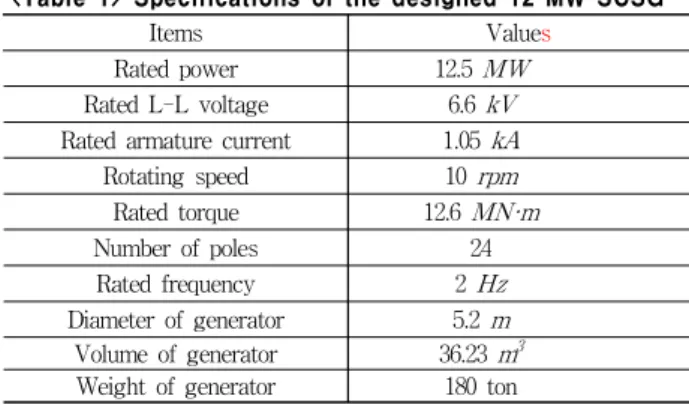
2. Design of the modularized HTS field coil The SCSG is composed of the HTS coil, rotor body, vacuum vessel, stator coil, stator body, and magnetic shield. The HTS coils consist of a racetrack-type double pancake coils (DPC). The rotor body and the vacuum shield consist of non-magnetic material to prevent iron loss. Laminated silicon steel is used at the stator teeth to increase the magnetic field. Table 1 represents the basic specifications of the 12.5 MW class SCSG for wind turbine. The line-to-line voltage and the armature current are 6.6 kV and 1.05 kA, respectively. The rotating speed and the frequency are 10 rpm and 2 Hz, respectively, at a 11.4 m/s of wind velocity. As a 3D FEM analysis results, the designed 12 MW class SCSG have a total diameter of 5.2 m, and the axial length of the DPC is 700
mm. The volume and weight of the generator are 36.23 m3 and 180 tons, respectively.
<Table 1> Specifications of the designed 12 MW SCSG
Items Values
Rated power 12.5MW Rated L-L voltage 6.6kV Rated armature current 1.05kA
Rotating speed 10rpm Rated torque 12.6MN·m Number of poles 24 Rated frequency 2Hz Diameter of generator 5.2m Volume of generator 36.23m3
Weight of generator 180 ton
Table 2 represents the specifications of the designed HTS field coil for the 12 MW class SCSG. The axial length and width of the bobbin are 700 mm and 150 mm. Turns of the DPC and the number of the DPC layer are 850 turns and 4 layer, respectively. The used total length of the HTS wire is 529.2 km.
<Table 2> Specifications of the designed HTS field coil
Items Value Operating temperature 20K Axial length 700 mm Width of bobbin 150 mm DPC turns 850turns Number of DPC layers 4 Operating current of DPC 132.5A Total length of HTS wire 374.6 km
<Figure 1> Modularized HTS field coil for a 12 MW SCSG
모듈화된 계자코일을 가지는 12 MW급 초전도 발전기의 고장 특성 분석
고병수*, 성해진*, 박민원*, 유인근*
창원대학교*
Fault characteristic analysis of a modularized HTS field coil-based 12 MW class SCSG
Byeong-Soo Go*, Hae-Jin Sung*, Minwon Park*, In-Keun Yu*
Changwon National University*
1109
-<Figure 2> Whole shape of the designed 12 MW SCSGFigure 1 and 2 show the modularized HTS field coil and the whole shape of the designed 12 MW class SCSG. The modularized HTS magnet has one cryo-cooler and one flux pump. The cryo-coolers cool-down the HTS field coil. The flux pumps flow the field current to the magnet without the DC power supply, cooper current lead, and slip ring.
3. Simulation and analysis results 3.1 Case of the fault conditions
When the quench phenomenon is occurred in the HTS field coil of the SCSG, the coil has broken-down. We changed the number of broken-down poles and the position and interval of the broken-down poles to analyze the fault characteristics of the SCSG.
<Figure 3> Case of the fault conditions 3.2 Output characteristics under fault conditions
<Figure 4> Output power characteristics of the designed 12 MW class SCSG
Figure 4 and 5 show the output power and torque characteristics of the designed 12 MW class SCSG. The amplitude of the output power and torqure is decreased in proportion to the number of broken-down poles. The total harmonic distortion (THD) of a synchronous machine must be less than 5 %. The THD of the designed 12 MW class SCSGs satisfies the THD standard.
<Figure 5> Output torque characteristics of the designed 12 MW class SCSG
<Figure 6> Variation of the torque ripple according to the number of broken-down poles
Figure 6 shows the variation of the torque ripple according to the number of broken-down poles. The torque ripple is increased rapidly when the number of broken-down poles is half of the total poles.
4. Conclusion
This paper deals with the fault characteristics analysis of a modularized HTS field coil-based 12 MW class SCSG. As the analysis results, the amplitudes of the output power and torqure are decreased in proportion to the number of broken-down poles. The THD of the designed 12 MW class SCSGs satisfies the THD standard. The torque ripple rarely did not changed until the number of poles is half of the total poles. Therefore, the modularized HTS field coils have a higher stability than series-connected HTS field coils. The modularized HTS field coil-based SCSG can be effectively utilized to design a large-scale SCSG for the wind turbine.
[References]
[1] Naoki Maki, Tomoaki Takao, Shuichiro Fuchino, Hiromichi Hiwasa, Masazumi Hirakawa, Kagao Okumura, Munoru Asada, and Ryukichi Takahashi, "Study of practical applications of HTS synchronous machines", IEEE Trans. Appl. Supercond., vol.15, no.2, pp.2166-2169, 2005
[2] H. Polinder, F. F. A. van der Pijl, G-J. De Vilder, and P. J. Tavner, “Comparison of direct-drive and geared generator concepts for wind turbines”, IEEE Trans. Energy convers., vol.21, no.3, pp.725-733, 2006
Acknowledgement
This work was supported by the Power Generation & Electricity Delivery Core Technology Program of the Korea Institute of Energy Technology Evaluation and Planning (KETEP), granted financial resource from the Ministry of Trade, Industry & Energy, Republic of Korea.