631 www.eymj.org
South Korea’s past experiences with Severe Acute Respiratory Syndrome (SARS) and Middle East Respiratory Syndrome (MERS) have made us aware of the importance of protecting healthcare workers from the start of the current coronavirus disease 2019 (COVID-19) crisis.1,2 During this period of pan-demic, it is more crucial to maintain the sustainability of medi-cal resources by preventing healthcare workers from infection. However, it became seemingly impossible to maintain even the minimal level of sustainability, as the number of COV-ID-19 cases have increased explosively and reached the maxi-mum capacity of the healthcare system.3 Amid continued strug-gles to stop the spread of COVID-19 in South Korea, private healthcare sectors have established prevention strategies ac-cording to the guidelines provided by the Korea Centers for
Disease Control and Prevention (KCDC).4 Here, we report on the results of 184 hospital employees who experienced in-hos-pital contact with COVID-19 patients before they were official-ly confirmed with infection at a university hospital in Seoul, Korea.
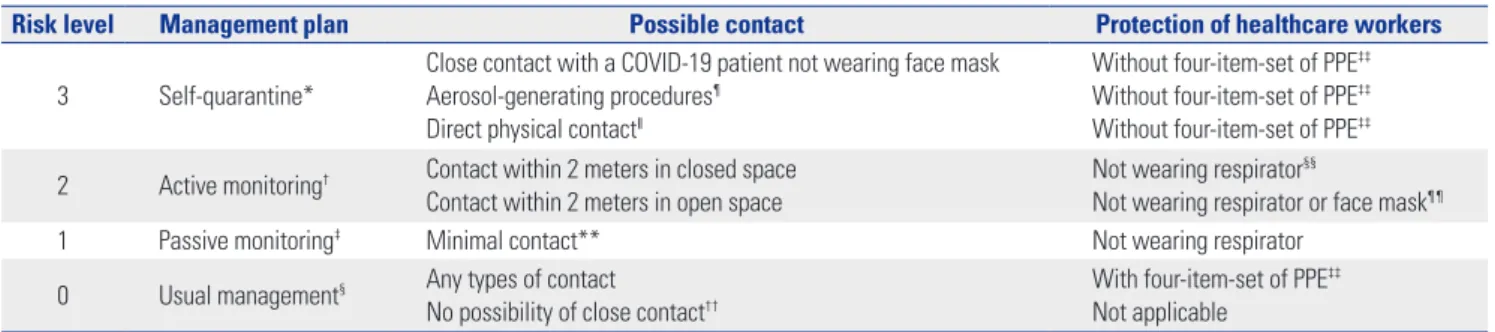
We analyzed anonymized data from Severance Hospital, which has about 2400 beds and over 10000 outpatients daily (IRB Approval No. Y-2020-0020). Thirteen cases of COVID-19 visited the hospital a few days before their confirmation with the disease, between February 29 and March 27, 2020. For each case, the Department of Infection Control conducted in-hospi-tal epidemiological investigation by interviewing the patients and searching hospital information system and CCTV records, and then identified 184 hospital employees who had possible contact with the cases. The employees were classified into four risk levels according to the epidemiologic investigation team’s instruction for management of those who were possibly ex-posed to COVID-19. Initially, the instruction was developed based on the KCDC’s guidelines,4 and then it was modified by the opinions of medical professionals in the COVID-19 infec-tion control task force team. The task force team consisted of the hospital director, vice directors, members of the Depart-ment of Infection Control, infectious disease specialists, pre-ventive medicine specialists, emergency medicine specialists, respiratory disease specialists, pediatric disease specialists, laboratory medicine specialists, executive members of the Di-vision of Nursing, and administrative executives. Depending on the level classified, the employees having possible contacts
Protection of Healthcare Workers Against COVID-19
at a Large Teaching Hospital in Seoul, Korea
Yong Woo Jeon
1*, Eun Suk Park
2*, Sun Jae Jung
1, Yeon Kim
2, Jun Yong Choi
2,3, and Hyeon Chang Kim
1,21Department of Preventive Medicine, Yonsei University College of Medicine, Seoul;
2Department of Infection Control, Severance Hospital, Yonsei University Health System, Seoul;
3Department of Internal Medicine and AIDS Research Institute, Yonsei University College of Medicine, Seoul, Korea.
Thirteen patients with coronavirus disease 2019 (COVID-19) visited a university hospital in Seoul before recognizing their disease infections, causing contact with 184 hospital workers. We classified the patients into four risk levels and provided corresponding management measures. At 31 days after the last event, all screening laboratory results were negative, and no symptoms/signs were reported.
Key Words: COVID-19, SARS-CoV-2, health personnel, cross infection
Brief Communication
pISSN: 0513-5796 · eISSN: 1976-2437
Received: April 27, 2020 Revised: June 1, 2020 Accepted: June 1, 2020
Co-corresponding authors: Hyeon Chang Kim, MD, PhD, Department of
Preven-tive Medicine, Yonsei University College of Medicine, 50-1 Yonsei-ro, Seodaemun-gu, Seoul 03722, Korea.
Tel: 82-2-2228-1873, Fax: 82-2-392-8133, E-mail: [email protected] and
Jun Yong Choi, MD, PhD, Department of Internal Medicine, Yonsei University Col-lege of Medicine, 50-1 Yonsei-ro, Seodaemun-gu, Seoul 03722, Korea.
Tel: 82-2-2228-1974, Fax: 82-2-393-6884, E-mail: [email protected] *Yong Woo Jeon and Eun Suk Park contributed equally to this work. •The authors have no potential conflicts of interest to disclose. © Copyright: Yonsei University College of Medicine 2020
This is an Open Access article distributed under the terms of the Creative Com-mons Attribution Non-Commercial License (https://creativecomCom-mons.org/licenses/ by-nc/4.0) which permits unrestricted non-commercial use, distribution, and repro-duction in any medium, provided the original work is properly cited.
Yonsei Med J 2020 Jul;61(7):631-634 https://doi.org/10.3349/ymj.2020.61.7.631
632
Protection of Hospital Workers Against COVID-19
https://doi.org/10.3349/ymj.2020.61.7.631
Table 2. Classification of Healthcare Workers who Came in Contact with COVID-19 Patients
Variables Total (n=184) Risk level
Level 0 (n=145) Level 1 (n=17) Level 2 (n=9) Level 3 (n=13)
Age (yr), median [min-max] 28 [21–66] 28 [22–66] 37 [21–58] 29 [23–41] 27 [24–56]
Sex Male 58 (31.5) 43 (29.7) 7 (41.2) 4 (44.4) 4 (30.8) Female 126 (68.5) 102 (70.3) 10 (58.8) 5 (55.6) 9 (69.2) Occupation Physicians 32 (17.4) 27 (18.6) 2 (11.8) - 3 (23.1) Nurses 60 (32.6) 50 (34.5) 4 (23.5) - 6 (46.2) Therapists 45 (24.5) 40 (27.6) - 5 (55.6) -Radiologic technologists 11 (6.0) 9 (6.2) 2 (11.8) - -Hospital porters 11 (6.0) 9 (6.2) 1 (5.9) - 1 (7.7) Hospital administrators 5 (2.7) 2 (1.4) 3 (17.6) - -Maintenance workers 3 (1.6) 2 (1.4) - - 1 (7.7) Security guards 13 (7.1) 5 (3.4) 3 (17.6) 3 (33.3) 2 (15.4) Others* 4 (2.2) 1 (0.7) 2 (11.8) 1 (11.1) -Face mask/respirator N95/KF94† 92 (50.0) 80 (55.2) 2 (11.8) 4 (44.4) 6 (46.2) Dental 61 (33.2) 35 (24.1) 15 (88.2) 5 (55.6) 6 (46.2) Not equipped 2 (1.1) 1 (0.7) - - 1 (7.7) Undetermined 29 (15.8) 29 (20.0) - - -Site of exposure Emergency room 80 (43.5) 69 (47.6) - 4 (44.4) 7 (53.8) Inpatient wards 6 (3.3) - - - 6 (46.2) Outpatient clinics 21 (11.4) 16 (11) 5 (29.4) -
-COVID-19 screening center 19 (10.3) 17 (11.7) 2 (11.8) -
-Rehabilitation center 45 (24.5) 40 (27.6) - 5 (55.6) -Others 13 (7.1) 3 (2.1) 10 (58.8) - -Number of RT-PCR test‡ Twice 47 (25.5) 26 (17.9)§ - 9 (100.0) 12 (92.3) Once 79 (42.9) 62 (42.8)§ 16 (94.1) - 1 (7.7) None 58 (31.5) 57 (39.3) 1 (5.9) -
-COVID-19, coronavirus disease 2019; RT-PCR, reverse transcription-polymerase chain reaction. Values are number (%), if not indicated otherwise.
*Including medical technicians in the emergency room, ambulance drivers, in-hospital pharmacists, and convenience store cashiers, †KF94 is a respirator
certi-fied by Korea Food & Drug Administration, which filters at least 94% of 0.4 μm-sized particles, ‡RT-PCR virus tests for SARS-CoV-2 on nasopharyngeal swab; all
results were negative, §RT-PCR virus tests were performed upon request for a part of the group.
Table 1. Risk Classification and Management Plan for Healthcare Workers in Possible Contact with COVID-19 Patients
Risk level Management plan Possible contact Protection of healthcare workers
3 Self-quarantine*
Close contact with a COVID-19 patient not wearing face mask Aerosol-generating procedures¶
Direct physical contact‖
Without four-item-set of PPE‡‡
Without four-item-set of PPE‡‡
Without four-item-set of PPE‡‡
2 Active monitoring† Contact within 2 meters in closed space
Contact within 2 meters in open space
Not wearing respirator§§
Not wearing respirator or face mask¶¶
1 Passive monitoring‡ Minimal contact** Not wearing respirator
0 Usual management§ Any types of contact
No possibility of close contact††
With four-item-set of PPE‡‡
Not applicable COVID-19, coronavirus disease 2019; PPE, personal protective equipment; RT-PCR, reverse transcription-polymerase chain reaction.
*Daily checklist of COVID-19 related symptom/signs; RT-PCR virus tests on day 1 and day 14; self-quarantine for 14 days, †Daily checklist of COVID-19 related
symptom/signs; RT-PCR virus tests on day 1 and day 14, ‡Self-monitoring for COVID-19 related symptom/signs; single time RT-PCR virus test, §Routine screening
at the same level as other hospital staff; RT-PCR virus tests upon request, ¶Including open suctioning of respiratory tract, intubation, bronchoscopy, and
cardio-pulmonary resuscitation. ‖Including vital sign check-up, blood sampling, potential contact with patient’s body fluid, and therapies requiring physical contact,
**Brief or distant (>2 m) contact with a COVID-19 patient while wearing face masks, ††No possibility of close contact, but working in the same department when
a COVID-19 patient visits, ‡‡Personal protective equipment consisting of gloves, long-sleeved gowns, eye protection, and fit-tested respirator, §§N95/KF94
633 Yong Woo Jeon, et al.
https://doi.org/10.3349/ymj.2020.61.7.631
with the COVID-19 cases were subject to the SARS-CoV-2 vi-rus test using reverse transcription-polymerase chain reaction (RT-PCR) on a nasopharyngeal swab or monitoring for COV-ID-19-related symptoms/signs (Table 1).
The majority of the 184 hospital employees were nurses (32.6%), therapists (24.5%), and doctors (17.4%). We confirmed that most of them (83.2%) were wearing face masks/respira-tors; however, information on 29 people’s respiratory protec-tion were unclear due to the lack of CCTV monitoring inside the hospital rooms. Risk classification resulted in 145 (78.8%), 17 (9.2%), 9 (4.9%), and 13 (7.1%) cases for Level 0, 1, 2 and 3, respectively. In Level 3, a relative high-risk group, there were many nurses (46.2%) and doctors (23.1%); and staffs working at the emergency room (53.8%) and inpatient wards (46.2%). A total of 126 RT-PCR virus tests (twice for everyone at Levels 2 and 3, except for one person who retired before the 14th day) were performed, and all test results were negative (Table 2). No COVID-19 related symptoms/signs were reported until April 27, 2020, which was the 58th day since the first COVID-19 case’s visiting and the 31st day since the last.
A large number of healthcare workers were protected from COVID-19, despite their possible contact with COVID-19 pa-tients before confirmation.
In-hospital transmission can lead to a shortage of medical staff and even partial/complete closure of the hospital, result-ing in serious loss of the already-deficient medical resources. As the first in-hospital cluster infection in South Korea, an 800-bed university hospital, located in northwest Seoul, had temporarily closed its entire outpatient service, including the emergency room, for 17 days.5 Since the two community-ac-quired COVID-19 cases had no high-risk epidemiologic histo-ry or distinguished symptoms, the diagnosis was delayed while two hospital workers were infected, followed by 10 additional transmissions to families and co-workers. Two other large hos-pitals also had been shut down due to nosocomial COVID-19 transmission in other areas as well.6,7 The sudden hospital clo-sures not only decreased the healthcare resources offered by the venues, but also hindered the capacity of other regional facilities by transferring the admitted patients.5-8
After a sudden increase of COVID-19 transmissions in mid-February, the KCDC encouraged hospitals to step up monitor-ing of all visitors.4 People without face masks were not allowed into most hospitals, and those with suspicious symptoms and possible exposure history were forced to visit COVID-19 test centers. Hospitals emphasized hand sanitization and respira-tory protection for employees and patients. In addition to these measures, our hospital conducted immediate epidemi-ological investigation when a new infection was discovered, identified people who were at risk of exposure, and tested and monitored such cases according to the risk classification. One of the nosocomial transmission cases at a large hospital in South Korea led to the infection of 17 hospital workers, includ-ing physicians and nurses, in 22 days;9 and the transmission is
suspected to have started from an unidentified asymptomatic case.8 Fortunately, there was no COVID-19 transmission to employees in our hospital, despite the 13 asymptomatic pa-tients visiting our premises with various contacts with hospital workers. We believe that our preventive strategies might help reduce the risk of in-hospital transmission, which would mini-mize the loss of healthcare resources. It is urgent to establish more efficient strategies to protect our valuable but insufficient healthcare workers and facilities.
ACKNOWLEDGEMENTS
We would like to acknowledge the endless efforts of the De-partment of Infection Control at all private sectors of the Kore-an healthcare system to prevent in-hospital spread of COV-ID-19, as well as the dedication of the Korea Centers for Disease Control and Prevention as the national control tower.
AUTHOR CONTRIBUTIONS
Conceptualization: all authors. Data curation: Yong Woo Jeon and Yeon Kim. Investigation: all authors. Resources: Eun Suk Park, Yeon Kim, and Jun Yong Choi. Supervision: Jun Yong Choi and Hyeon Chang Kim. Validation: Eun Suk Park and Jun Yong Choi. Visualiza-tion: Yong Woo Jeon and Hyeon Chang Kim. Writing—original draft:
Yong Woo Jeon and Eun Suk Park. Writing—review & editing: Yong Woo Jeon, Eun Suk Park, Sun Jae Jung, Jun Yong Choi, and Hyeon Chang Kim. Approval of final manuscript: all authors.
ORCID iDs
Yong Woo Jeon https://orcid.org/0000-0002-0659-4159 Eun Suk Park https://orcid.org/0000-0002-9974-1807 Sun Jae Jung https://orcid.org/0000-0002-5194-7339 Yeon Kim https://orcid.org/0000-0001-5913-0502 Jun Yong Choi https://orcid.org/0000-0002-2775-3315 Hyeon Chang Kim https://orcid.org/0000-0001-7867-1240
REFERENCES
1. Peeri NC, Shrestha N, Rahman MS, Zaki R, Tan Z, Bibi S, et al. The SARS, MERS and novel coronavirus (COVID-19) epidemics, the newest and biggest global health threats: what lessons have we learned? Int J Epidemiol 2020 Feb 22 [Epub]. Available at: https:// doi.org/10.1093/ije/dyaa033.
2. Wu Z, McGoogan JM. Characteristics of and important lessons from the coronavirus disease 2019 (COVID-19) outbreak in Chi-na: summary of a report of 72 314 cases from the Chinese Center for Disease Control and Prevention. JAMA 2020 Feb 24 [Epub]. https://doi.org/10.1001/jama.2020.2648.
3. Mason DJ, Friese CR. Protecting health care workers against CO-VID-19—and being prepared for future pandemics. JAMA Health Forum [Internet]. 2020 Mar 19 [accessed on 2020 May 27]. Avail-able at: https://jamanetwork.com/channels/health-forum/ful-larticle/2763478.
4. Korea Centers for Disease Control and Prevention. The guideline of infection prevention and control against COVID-19 in health-care setting (hospitals) [accessed on 2020 May 27]. Available at:
634
Protection of Hospital Workers Against COVID-19
https://doi.org/10.3349/ymj.2020.61.7.631
http://ncov.mohw.go.kr/shBoardView.do?brdId=2&brdGubun=2 4&ncvContSeq=1277.
5. Lee H, Heo JW, Kim SW, Lee J, Choi JH. A lesson from temporary closing of a single university-affiliated hospital owing to in-hospi-tal transmission of coronavirus disease 2019. J Korean Med Sci 2020;35:e145.
6. SER MJ. Bundang Jesaeng General Hospital shuts ER, outpatient facilities. Korea JoongAng Daily in association with the New York Times [Internet]. 2020 Mar 6 [accessed on 2020 May 27]. Available at: https://koreajoongangdaily.joins.com/2020/03/06/socialAf- fairs/Bundang-Jesaeng-General-Hospital-shuts-ER-outpatient-facilities/3074655.html.
7. KBS-WORLD. Uijeongbu Hospital plans lockdown after reporting 9 coronavirus cases. KBS-WORLD [Internet]. 2020 Mar 31 [ac-cessed on 2020 May 27]. Available at: http://world.kbs.co.kr/ser-vice/news_view.htm?lang=e&Seq_Code=152442.
8. Paek SJ. Asymptomatic transmission supspected among the in-dex case of Uijeongby St.Mary’s hostpital. Dailymedi [Internet]. 2020 April 24 [accessed on 2020 May 27]. Available at: https:// www.dailymedi.com/detail.php?number=855497&thread=22r02. 9. Korea Centers for Disease Control and Prevention. The updates
on COVID-19 in Korea as of 24 April [accessed on 2020 May 27]. Available at: https://is.cdc.go.kr/upload_comm/syview/doc. html?fn=158772564799500.pdf&rs=/upload_comm/docu/0030/.