P1-89 / J. J. Yang
• IMID 2009 DIGEST
Abstract
Tandem white organic light emitting diodes (WOLEDs) are fabricated by using a transparent interconnecting layer of Al:LiF composite/molybdenum oxides (MoO3). We demonstrate two types of tandem WOLEDs consisting of two color emissions (red and blue emission) and three color emissions (red, green and blue emission). Tandem WOLED consisting of three color emission shows higher external quantum efficiency and current efficiency.
1. Introduction
WOLEDs are a major parts of OLED research because of wide range of their applications including light source for full color display, back light in liquid crystal display and solid state lighting.[1-3] In order to achieve high brightness and efficiency WOLEDs, tandem structure is needed.[4] The inter connecting layer plays most important role for the tandem WOLED. The efficiency and the device performance depend on the charge generating efficiency of the interconnecting layer. Although there are many interconnecting layer reported for organic light emitting diodes (OLEDs) and organic solar cell.[5-13] Still the good interconnecting layer is needed for efficient tandem organic semiconductor devices.
The optimization and the mechanism for carrier generation of interconnecting layer Al:LiF composite/MoO3 has been studied.[14-15] The first OLEDs and the second OLEDs are connected with the interconnecting layer in a tandem device. Hence the optimization and proper selection of the two OLEDs is required for an efficient tandem OLEDs. In this paper, we demonstrate two types of tandem WOLEDs and their device performance has been extensively studied.
2. Experimental
All devices were prepared by thermal evaporation onto ITO substrates which were ultrasonically cleaned with solvents. Organic and metal evaporation were conducted under the base pressure of 4x10⁻⁶ Torr
without breaking the vacuum. The evaporation rate, monitored by a quartz-oscillator thickness monitor, was 1~2 Å/sec for organic materials and 3~5 Å/sec for Al. Doping concentration was adjusted with the relative evaporation rate between host and dopant materials.
Two types of tandem WOLEDs are demonstrated. One is consisting of two color emissions (red and blue emission) and the other is consisting of three color emissions (red, green and blue). The structure of a tandem WOLED consisting two color emissions is ITO/MoO3 (10 nm)/4,4'-bis[N-(naphthyl)-N-phenyl-amino]biphenyl (α-NPD) (50 nm)/8 % iridium (III)bis(4,6-(di-fluorophenyl)-pyridinato-N,C2′)
picolinate (FIrpic) doped in mCP (30 nm)/2,2',2''-(1,3,5-phenylene)tris[1-phenyl-1H-benzimidazole] (TPBI) (40 nm)/LiF-doped Al (10 %, 3 nm)/MoO3 (10 nm)/α-NPD (50 nm)/8 % Tris(1-phenylisoquinoline)iridium(III) (Ir(piq)3) doped in CBP (30 nm)/TPBI (40 nm)/LiF (0.5 nm)/Al (100 nm). And the structure of a tandem WOLED consisting three color emissions is same with above structure except one layer. Here, Ir(piq)3 doped in CBP is changed to 8 % Tris(2-phenylpyridine)iridium(III) Ir(ppy)3 and 1 % Ir(piq)3 doped in CBP.
The current-voltage (I-V) characteristics were measured by using Keithley-236 source measurement unit and luminance and external quantum efficiency (EQE) were calculated from calibrated Si photodiode (Hamamatsu S5227-1010BQ). Electroluminescence spectra were measured by using monochromator (Acton ARC275) with a PMT detector.
3. Results and discussion
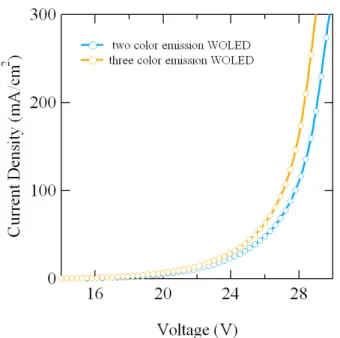
The current density Vs Voltage characteristics for two and three color emission tandem WOLEDs are shown in the Fig. 1. The turn on voltage for the three color emission WOLEDs is lower than the two color emission WOLEDs. The turn on voltage (at 1 cd/m2) for two color emission WOLEDs is 10 V. Whereas for the three color emission WOLEDs it is 9V.
Tandem white organic light emitting diodes comprising of
red, green, blue emission
Jungjin Yang, C.K.Suman and Changhee Lee*
School of Electrical Engineering and Computer Science, Inter-University Semiconductor Research center, Seoul National University, Seoul 151-744, Korea
Tel.:+82-2-880-9093, E-mail: [email protected] Keywords: tandem, OLED, efficiency, doping, spectra.
P1-89 / J. J. Yang
IMID 2009 DIGEST • Fig. 1. Current density Vs Voltage characteristics of the
tandem WOLEDs.
Fig. 2 shows the external quantum efficiency and current efficiency as a function of the current density for tandem WOLEDs. The highest external quantum efficiency and current efficiency of two color emission WOLEDs are 13.2 % and 13.2 cd/A. And that of three color emission WOLEDs are 15.5 % and 23.5 cd/A. The highest luminance observed for the three color emission WOLEDs is 32,661 cd/m2 and for two color emission WOLEDs is 15,199 cd/m2.
Fig. 2. External quantum efficiency and current efficiency graphs of tandem WOLEDs.
Fig. 3 shows the electroluminescence (EL) spectra of
the tandem WOLEDs. EL spectra show red and blue emission peaks or red, green and blue emission peaks. So it is indicating that the Al:LiF/MoO3 layer works very well as an the interconnecting unit. In three color emission WOLED, we doped Ir(ppy)3 and Ir(piq)3 in CBP. From EL specrum of that device, we can see the green peak (~ 505 nm of wavelength) and the red peak (~ 620 nm of wavelength). It attributes that energy transfer from Ir(ppy)3 to Ir(piq)3 well.
Fig. 3. EL spectra of tandem WOLEDs.
Fig. 4. CIE color coordinates of tandem WOLEDs. Fig. 4 shows Commission Internationale de l’Éclairage (CIE) color coordinates of tandem WOLEDs. The CIE coordinates for two and three color emission
P1-89 / J. J. Yang
• IMID 2009 DIGEST
WOLEDs are (0.41, 0.34) and (0.37, 0.44), respectively. Both devices are little far from the ideal white color coordinate (0.33, 0.33). It is because blue emission is lower than green and red emission. And for getting good white emission, the deep blue emission with shorter wavelength is required.
4. Summary
We fabricated the tandem WOLEDs comprising of red, green and blue emission. The turn on voltage for the three color emission WOLEDs is lower than the two color emission WOLEDs. The external quantum efficiency and current efficiency is higher for three color emission WOLED than that of the two color emission WOLED. The CIE coordinate shifts towards pure white in case of three color WOLDs.
Acknowledgement
This work was supported by the Ministry of Knowledge Economy (MKE), Korea.
5. References
1. J. Kido, M. Kimura, and K. Nagai, Science, 267, pp1332 (1995).
2. S. R. Forrest, Org. Electron., 4, pp45 (2003).
3. B. W. D’Andrade and S. R. Forrest, Adv. Mater., 16, pp1585 (2004).
4. F. W. Guo, and D. G. Ma, Appl. Phys. Lett., 87, pp173510-173512 (2005).
5. H. M. Zhang, Y. F. Dai, and Ma, D. G., J. Phys. D:
Appl. Phys., 41, pp102006-102009 (2008)
6. T. -W. Lee, T Noh, B. -K Choi, M. -S. Kim, D. W. Shin, and J Kido, Appl. Phys. Lett., 92, pp043301-043303 (2008)
7. C. -C Chang, J. -F. Chen, S. -W Hwang, and C. H. Chen, Appl. Phys. Lett., 87, pp253501-253503 (2005)
8. L. S.Liao, K. P Klubek,. and C. W. Tang, Appl.
Phys. Lett., 84, pp167-169 (2004)
9. H Kanno,. N. C Giebink., Y Sun,. and S. R Forrest,
Appl. Phys. Lett., 89, pp023503-023505 (2006)
10. F. Guo and D. G. Ma, Appl. Phys. Lett., 87, pp173510-173512 (2005)
11. S. L Lai,. M. Y Chan, M. K Fung, C. S. Lee, and S. T Lee, J. Appl. Phys., 101, pp014509-014512 (2007) 12. M.Terai, and T Tsutsui, Appl. Phys. Lett., 90,
pp083502-083504 (2007)
13. T. -Y Cho, C. -L. Lin, and C. -C Wu, Appl. Phys.
Lett., 88, pp111106-111108 (2006)
14. Jungjin Yang, C.K.Suman, Changhee Lee,
Proceeding of SPIE-2009, (2009) Communicated
15. Jungjin Yang, C.K.Suman, Changhee Lee, Org.