광자 Qubit을 이용한 약한 양자 측정 회복의 실험적 구현
Reversing the weak quantum measurement
for a photonic qubit
Yong-Su Kim, Young-Wook Cho, Young-Sik Ra and Yoon-Ho Kim POSTECH 물리학과
The projection postulate states that measurement of a variable of a quantum system irrevocably collapses the initial state to one of the eigenstates (corresponding to the measurement outcome) of the measurement operator and is one of the basic postulates of the standard quantum theory(1). The initial state can never be recovered after a projection measurement on a quantum system. If the measurement is not sharp (i.e., non-projective measurement), however, the situation is different. It is possible to reverse the measurement-induced state collapse and the unsharpness of a measurement has been shown to be related to the probabilistic nature of the reversing operation which can serve as a probabilistic quantum error correction(2).
We report a linear optical implementation of conditional reversal of weak (or partial-collapse) quantum measurements on a photonic qubit. We demonstrate experimentally that a nonunitary transformation of a photonic qubit, caused by a weak quantum measurement, can be reversed by applying an appropriately designed reversing operation. We also quantify and experimentally study information gain due to the weak measurement and discuss the role of the reversing operation as an information erasure.
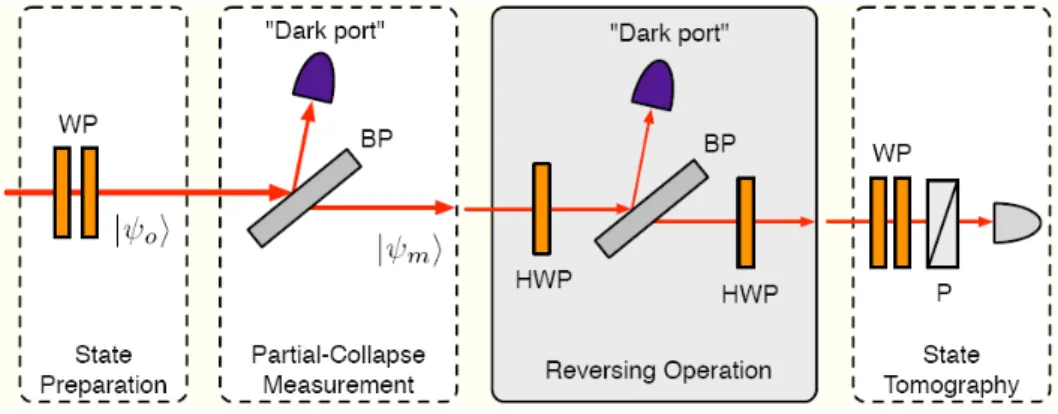
The experimental setup to implement the weak measurement and the reversal operation for a photonic qubit is schematically shown in Fig. 1. The single-photon state necessary for the implementation was prepared by spontaneous parametric down-conversion (SPDC)(3).
Fig. 1. Schematic of the experimental setup.
When the trigger detector detects the idler photon (not shown in Fig. 1), the signal photon is conditionally prepared in the single-photon state. The initial state of the photonic qubit
〉
is thenprepared by polarization encoding of the heralded single-photon state with a set of half-wave and quarter-wave plates (WP).
The weak (or partial-collapse) measurement on the photonic qubit is implemented by using a set of uncoated glass plates oriented at the Brewster angle (BP) and a single-photon detector positioned at the reflected mode, see Fig. 1. Since BP only reflects the vertical polarization state, 〉, with a probability of reflection p, finding a single-photon in the reflected mode is equivalent to subjecting the photonic qubit to projection to 〉〈 measurement and this results in irreversible state collapse to the state 〉. we can easily vary p value from 0.4 to 0.9 by changing the number of BPs. In the case of transmitted photon, the polarization state doesn't project to a specific state rather change to
〉
which depends on both initial state and p value. We call the transmitted mode of BP as weak(or partial-collapse) measurement since the measurement doesn't project to its eigenstate. Quantitative study about
〉
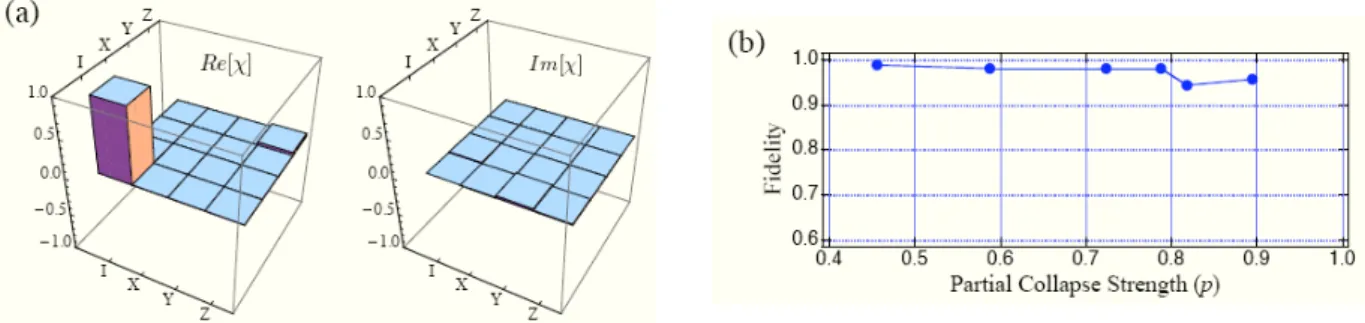
has been done and will be presented in the talk.Both quantum state tomography (QST)(4) and quantum process tomography (QPT)(5) are done in order to confirm the reversing of quantum measurement and both results show successful implementation of reversing of quantum measurement. Here, we present the result of QPT for both weak measurement and reversing operation together at p=0.895 (Fig. 2 (a)) and QPT fidelity as a function of partial-collapse strength p (Fig. 2 (b)). Information gain and erasing via weak measurement and its reversing operation also have been studied and will be shown in the talk.
Fig. 2 (a) Quantum process tomography matrix for both the partial-collapse measurement and the reversing operation together at partial-collapse strength p=0.895. It is clear that the quantum process due to the partial-collapse measurement and the reversing operation together is mainly of the identity operation acting on the qubit. (b) The fidelity of the quantum process is over 94 % for all the partial-collapse strength p tested in the experiment.
1. R. Shankar, Principles of Quantum Mechanics, 2nd ed., (Plenum Press, New York, 1994). 2. M. Koashi and M. Ueda, Phys. Rev. Lett. 82, 2598 (1999).
3. S.-Y. Baek, O. Kwon, and Y.-H. Kim, Phys. Rev. A 77, 013829 (2008). 4. D. F. V. James et al., Phys. Rev. A 64, 052312 (2001).
5. J. Fiurasek and Z. Hradil, Phys. Rev. A 63, 020101(R) (2001).