Market Segmentation Based on Attributes for the Purchase of
Fresh Ginseng
1
Dongmin Lee · Seul Gi Yu · Jaeseok Jeong · Junghoon Moon · Gu Hyun Jung
Abstract This study aims to subdivide consumers by
at-tributes determined mainly by consumers of fresh ginseng. It is to compare and analyze the characteristics by cluster, and to deduce the implications on distribution and marketing. For this study, a survey was conducted targeting 250 consumers of fresh ginseng. The factors were deduced through performing the exploratory factor analysis on the results of the survey, and the consumers of fresh ginseng were classified through cluster analysis. As a result of the study, the attributes considered for the purchase of fresh ginseng were condensed to the three factors: physical char-acteristic factor, safety factor, and cultivation indication in-formation factor. With these as the standard, the consumers of fresh ginseng were subdivided into the three clusters: safety-oriented consumption type, label-centered con-sumption type, and high involvement concon-sumption type. It was found that there were differences in demographic characteristics and attributes considered for purchase of fresh ginseng by cluster analysis. This study suggests the
D. Lee · S. G. Yu · J. Moon
College of Agriculture and Life Sciences Seoul National University, South Korea D. Lee e-mail : [email protected] S. G. Yu e-mail : [email protected]( ) J. Moon e-mail : [email protected] J. Jeong
Department of International Business
Graduate School of Pan-Pacific International Studies Kuyng Hee University
e-mail : [email protected] G. H. Jung
Gyeonggi-do Agricultural Research & Extension Services e-mail : [email protected]
implications for revitalization of the fresh ginseng industry by subdividing consumers of fresh ginseng and suggesting the characteristics by cluster.
Keywords Fresh ginseng, market segmentation
1 Introduction
The health functional food market is rapidly growing due to an increased desire for health and self-health care, devel-opment of biotechnology, and an acceleration of aging. The production of health functional food in Korea has increased from 250.6 billion won in 2004 to 1.368 trillion won in 2011, showing the annual average rate of increase of 27.4%
(Korea Food & Drug Administration (KFDA), 2011). In 2011, red ginseng takes first place in health-func-tional foods production at 719.1 billion won. Ginseng (except red ginseng) is also in the top 10 of Korean health-functional foods at 38.1 billion won as of 2011. Hence, ginseng and red ginseng holds a key post in the Korean health functional food market. The annual average rate of consumption increased 23.7% for red ginseng and 12.1% for ginseng. Consumption of red ginseng and gin-seng is expected to show a steady growth from now on (KFDA, 2012).
Studies on ginseng have been conducted in various fields. Park, Cho, Pee & Hong (2006) found that 32% of these studies consisted of the study of ginseng cultivation and agricultural science, 25% of the studies concerned the medical effect of ginseng, 18% of the studies concerned functional food and product development, 15% of the stud-ies concerned the field of chemical components, and 10% of the studies occurred in other fields. Studies on ginseng marketing and consumers are insignificant.
An effective marketing strategy is needed for long-term
development of the ginseng industry. For this purpose, studies are needed on the segmentation of the ginseng con-sumption market and purchase behaviors of each sub-divided market with demographic, psychological, and soci-ocultural standards. In particular, studies on the attributes considered when purchasing ginseng products are required. However, studies in Korea and abroad on ginseng market segmentation and attributes for purchase consist of less than 10 cases. In addition, most of the studies are on the entire ginseng market, including original and processed products such as red ginseng, red ginseng processed goods, fresh ginseng, and white ginseng, thus making market seg-mentation challenging.
The purpose of this study is to determine the major at-tributes of consumers for the purchase of ‘fresh ginseng’, which is ginseng that has not been processed, and to sub-divide consumers of fresh ginseng on the basis of those attributes. This study examines the behavior of purchase of fresh ginseng, major attributes for purchase, behavior after purchase, lifestyle, and demographic characteristics by conducting a survey targeting consumers of fresh ginseng. Then we subdivided the consumers of fresh gin-seng and deduced the implications on the revitalization of fresh ginseng market based on clusters.
2 Characteristics of Fresh Ginseng Market
2.1 Definition
Ginseng is a plant belonging to the Araliaceae family and the genus Panax whose roots are used for medicinal purposes. Its botanical classification is the perennial plant of docotyledon, umbelliflorae, and araliaceae (Korea Agro-Fisheries & Food Trade Corporation, 2011).
Ginseng grows naturally in East Asia including the Korean Peninsula and the Northeastern part of America, both of which are cold, humid, deciduous, forested areas with low temperatures in winter and sufficient rainfall in summer, ginseng’s growing season. The quality of ginseng produced in Korea is acknowledged in the marketplace.
Korean ginseng is produced under proper geographical conditions which include good soil and weather. It contains many saponins, which are the pharmacological active com-ponent (Kim, 2010).
Ginseng is classified into fresh ginseng, red ginseng, taegeuk ginseng, white ginseng, etc. The type of ginseng product that is not dried after harvest, and is still in its original shape, is called fresh ginseng. Fresh ginseng can be processed into red ginseng, Taegeuk ginseng, white gin-seng, black gingin-seng, sliced gingin-seng, and tiny-sized ginseng depending on the processing method.
Red ginseng is made by heating fresh ginseng with steam or other methods and then drying it. Red ginseng is a light reddish brown or dark brown. Taegeuk ginseng is made by cooking fresh ginseng with water or other meth-ods then drying it. White ginseng is made by not cooking but drying with sunlight or hot air. Black ginseng is made by heating fresh ginseng with steam and so on, and is light dark blackish brown or blackish dark brown. Sliced gin-seng and tiny-sized gingin-seng are distinguished from each other depending on which part of ginseng is used. Slicked ginseng is made by slicing the body of red ginseng and Taegeuk ginseng into a certain thickness, and tiny-sized ginseng is made by cutting and drying only the parts of the legs (Ministry for Food, Agriculture, Forestry and Fisheries (MIFAFF), 2012).
2.2 Production status
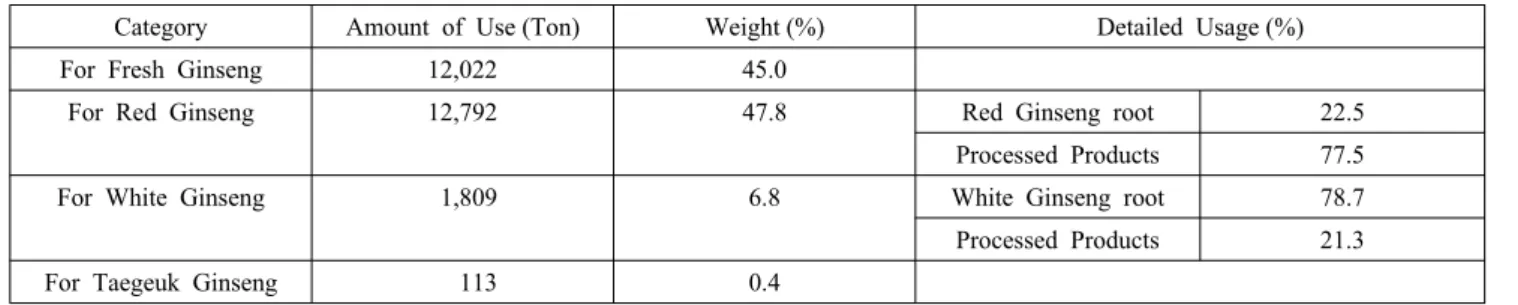
The types of processing of ginseng produced in Korea in 2011 are listed in Table 1. Fresh ginseng distributed in its original shape accounts for 45.0%, by weight, of the ginseng produced in Korea. Production of red ginseng ac-counts for the greatest weight, 47.8%. Red ginseng is pri-marily consumed as a processed product in Korea (77.5% by weight) while red ginseng root represents 22.5% by weight. White ginseng accounts for 6.8% of ginseng pro-duction and is mainly processed for ginseng root. Taegeuk ginseng accounts for 0.4% by weight of Ginseng produced in Korea.
Table 1 Amount of Use of Ginseng Produced in Korea in 2011 by Type of Processing (Unit : Tons, %)
Category Amount of Use (Ton) Weight (%) Detailed Usage (%)
For Fresh Ginseng 12,022 45.0
For Red Ginseng 12,792 47.8 Red Ginseng root 22.5
Processed Products 77.5
For White Ginseng 1,809 6.8 White Ginseng root 78.7
Processed Products 21.3
For Taegeuk Ginseng 113 0.4
The status of cultivation of ginseng produced in Korea and the distribution of fresh ginseng over the past 5 years are listed in Table 2. Farms cultivating ginseng have in-creased about 18.7% in 2011, from 19,850 households in 2007 to 23,578 households. The cultivated area has also increased from 17,831 ha in 2007 to 19,408 ha in 2009, and then gradually decreased to 17,601 ha in 2011.
The production of ginseng increased from 21,818 tons in 2007 to 27,460 tons in 2009 and then decreased to 26,737 tons in 2011. From among these, the distribution of fresh ginseng increased from 11,075 tons in 2008 to 12,377 tons in 2009 and then decreased to 12,022 tons in 2011. The data from 2007 was insufficient and thus excluded.
Table 2 Status of Production of Ginseng in Korea and the Amount of Distribution of Fresh Ginseng from 2007 to 2011
(Unit : Tons, %) Year Farms Cultivating
Ginseng (Household)
Cultivated Area for Ginseng
Production of Ginseng (Ton)
Weight of Ginseng for Fresh Ginseng
(%) Amount of Distribution of Fresh Ginseng (Ton) 2007 19,850 17,831 21,818 - -2008 24,298 19,408 24,613 45.0 11,075 2009 23,285 19,702 27,460 45.1 12,377 2010 23,857 19,010 26,944 45.7 12,313 2011 23,578 17,601 26,737 45.0 12,022
Source : MIFAFF (2008 through 2012), 2007 through 2011 Ginseng Statistics Data Collection.
2.3 Export and Import status
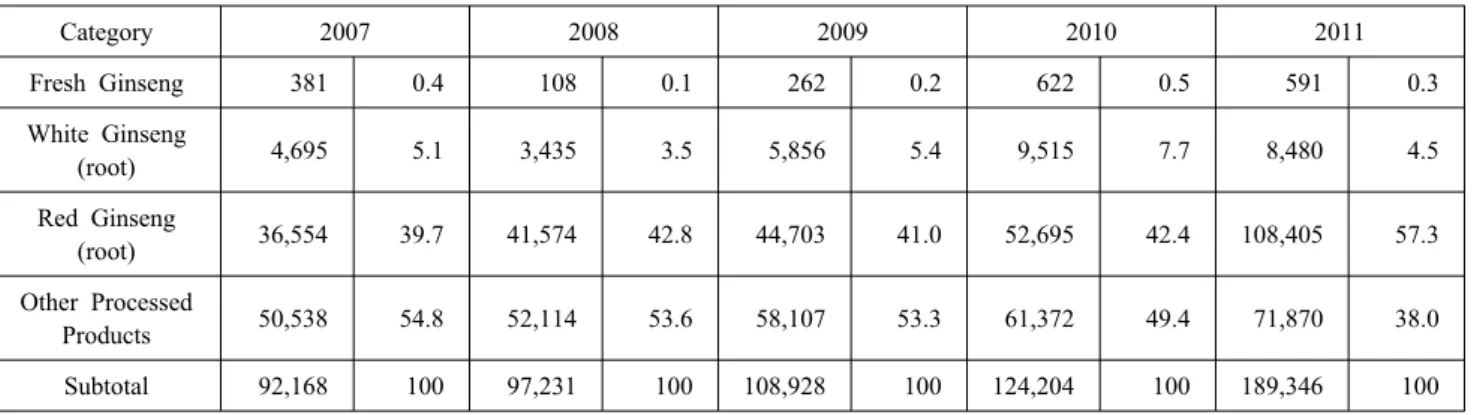
The export of fresh ginseng is insignificant compared with other ginseng products (Table 3). The reason for the lack of export is because of the difficulties in distribution due to the characteristic of fresh ginseng, which is not
processed. The export of ginseng is on the rise from 381 thousand US dollars as of 2007 to 591 thousand US dollars as of 2011, but fresh ginseng shows only a slight increase accounting for 0.3 to 0.5% among all the ginseng items. Most of the export of ginseng items (95.3%, 2011) consists of red ginseng root and other processed products.
Table 3 Results of Export by Type of Ginseng in 2007 through 2011
(Unit : US Dollars in Thousands, %)
Category 2007 2008 2009 2010 2011 Fresh Ginseng 381 0.4 108 0.1 262 0.2 622 0.5 591 0.3 White Ginseng (root) 4,695 5.1 3,435 3.5 5,856 5.4 9,515 7.7 8,480 4.5 Red Ginseng (root) 36,554 39.7 41,574 42.8 44,703 41.0 52,695 42.4 108,405 57.3 Other Processed Products 50,538 54.8 52,114 53.6 58,107 53.3 61,372 49.4 71,870 38.0 Subtotal 92,168 100 97,231 100 108,928 100 124,204 100 189,346 100
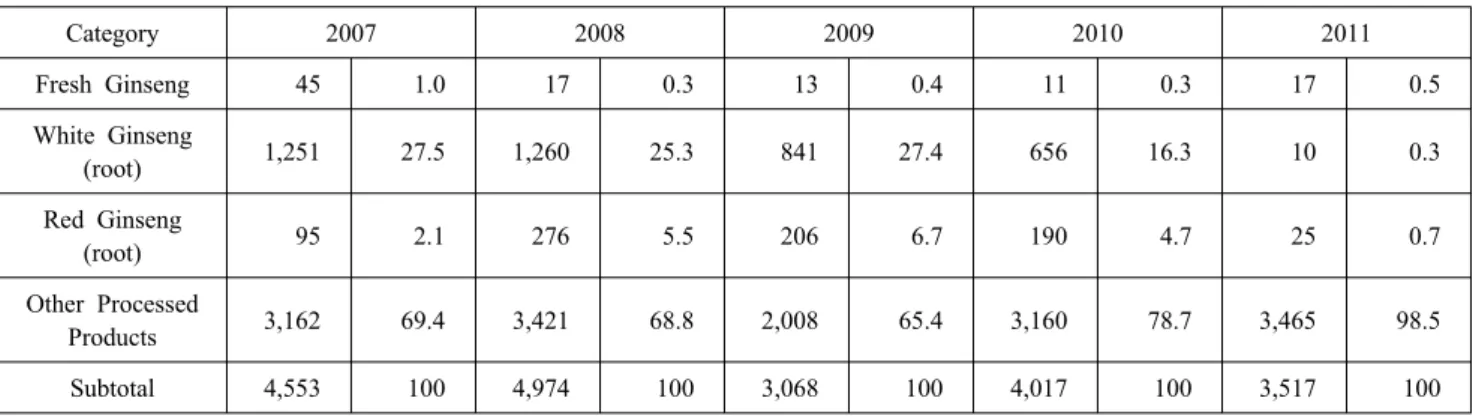
Source : MIFAFF (2012), 2011 Ginseng Statistics Data Collection. The import of fresh ginseng decreased from 45 thousand US dollars in 2007 to 17 thousand US dollars in 2011, and is extremely insignificant accounting for 0.3 through 1.0% among all types of ginseng products (Table 4). In
addition, the amount of money used for the import of gin-seng is about 2% of the amount of money used for the export of fresh ginseng.
Table 4 Results of Import by Type of Ginseng in 2007 through 2011
(Unit : US Dollars in Thousands, %)
Category 2007 2008 2009 2010 2011 Fresh Ginseng 45 1.0 17 0.3 13 0.4 11 0.3 17 0.5 White Ginseng (root) 1,251 27.5 1,260 25.3 841 27.4 656 16.3 10 0.3 Red Ginseng (root) 95 2.1 276 5.5 206 6.7 190 4.7 25 0.7 Other Processed Products 3,162 69.4 3,421 68.8 2,008 65.4 3,160 78.7 3,465 98.5 Subtotal 4,553 100 4,974 100 3,068 100 4,017 100 3,517 100
Source : MIFAFF (2012), 2011 Ginseng Statistics Data Collection.
3 Theoretical Backgrounds
According to Park, Cho, Pee, and Hong (2006), the studies on ginseng in Korea consist of the field of cultivation and science of agriculture at 32%, medical effects at 25%, functional food and product development at 18%, chemical components at 15%, and other fields at 10%. The other fields at 10% include the studies on policy measures, con-sumer awareness, concon-sumer behavior, measures for revital-ization of e-commerce, etc. Jeong and Kim (2011) found that studies conducted on ginseng worldwide in 2010 con-sisted of pharmacodynamics at 44%, analytical chemistry at 15%, horticulture at 10%, manufacturing at 9%, pharma-cokinetics at 7%, medicine at 7%, and other items at 7%. According to this study, the studies dealing with marketing examination in 2010 accounted only for 1% of all the stud-ies on ginseng.
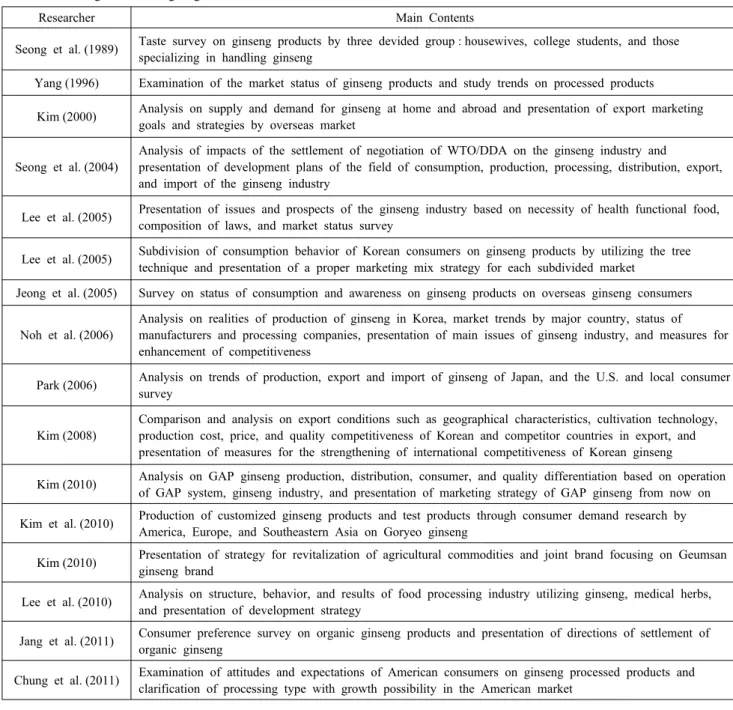
The following review of the literature focuses on studies of marketing ginseng products. Marketing studies of gin-seng products are listed in Table 3. The mainstream studies examine the realities of the Korean ginseng market focus-ing on: production, processfocus-ing, distribution and so on, and suggests long-term strategy for the development of the gin-seng market (Yang, 1996; Lee & Doh, 2005; Noh & Kwon, 2006; Kim, 2010; Lee & Lee, 2010). The studies conducted that focused on brands and consumers include Seong, Yang, Jeon, Kim, & Kim (1989), Seong, Lee, Kim, & Seo (1989), Seong, Jeon, Lee, & Yang (1989), Lim, Koh, Heonbae Jeong, & Yundu Kim (2005), Hyeonwan Kim (2010), and Jang, Park, Cha, & Yun (2011) were conducted. The studies on ginseng product marketing targeting over-seas markets mostly present the export strategies through analysis of the ginseng market at home and abroad (Kim, 2000; Seong, Lee, Lim, & Lee, 2004; Kim, 2007) or deal with overseas consumer surveys (Jeong, Koh, Park, Cho, & Lim, 2005; Park, 2006; Kim et al., 2010; Chung et al.,
2011).
In the past, studies focused on the macroscopic ginseng market research, but currently the studies on the ginseng consumption market are on the rise. Kim (2010) presented the need for consideration of a marketing aspect of the enhancement of consumption of GAP ginseng, and empha-sized that systematic examination and studies are needed on the production and distribution structure of ginseng and consumer reactions. In their study to deduce the develop-ment plans for organic ginseng industry, Jang, Park, Cha, & Yun (2011) also mentioned that the marketing strategies should be established by the consumer to deal with changes in the ginseng market at home and abroad and to strengthen competitiveness. Jang, Park, Cha, & Yun’s survey on the ginseng purchasing behavior of consumers and attributes for the purchase of ginseng products conducted in the perti-nent study is important data for the establishment of a mar-keting strategy.
This study also intensively reviews the studies utilizing the attributes for the purchase of ginseng products and studies dealing with ginseng consumption market segmen-tation for the ginseng consumption market research. Jeong, Koh, Park, Cho, and Lim (2005) classified the attributes for purchase of ginseng products into the country of origin, price, packing design, packing unit, remedial effect, scent, and taste. Kim (2010) utilized the three attributes of safety, size, and price, and clustered the consumers following the preference score. Lee & Lee (2010) aimed to deduce the importance by product attribute by presenting the items in a list of price, nutritive components, scent, color, wheth-er the raw matwheth-erial is from Korea or not, manufacturwheth-er, brand, reputation, food safety, new packaging and new product, taste, product diversity, eco-friendly cultivation of raw material, seller and place of sales, convenience for use, certification mark, and area of production as the attrib-utes of ginseng products. Jang, Park, Cha, & Yun (2011)
utilized the items of price, kind, grade, whether it is organ-ic or not, country of origin, and etc.
Of the studies on ginseng consumption market segmen-tation, Seong, Yang, Jeon, Kim, & Kim (1989), Seong, Lee, Kim, & Seo (1989), and Seong, Jeon, Lee, & Yang (1989) presented the necessity of classification of consum-er groups and conducted study by dividing consumconsum-ers into three groups: housewives, college students, and those spe-cializing in handling ginseng in advance. Lim, Koh, Jeong, & Kim (2005) presented the marketing strategies for gseng products through subdividing the gingseng markets in-to a in-total of seven kinds of markets by using the Tree analysis. Park (2006) conducted the study on ginseng mar-ket segmentation in Japan and in the U.S. with 7 attributes
for purchase of ginseng products consisting of country of origin, price, and etc. and 10 variables in total on the fre-quency of purchase of the product, age, income, etc. Kim (2010) also presented a study subdividing the Korean gin-seng market with three attributes of safety, size, and price. The existing studies on attributes for the purchase of ginseng had a small number of attributes dealt with and the attributes were not systematically categorized. In addi-tion, though the necessity of segmentation of ginseng prod-uct consumption market emerged earlier, there are few studies targeting Korean consumption market. Also, the variables used for segmentation in the existing studies are fragmentary.
Table 5 Marketing Studies Targeting Markets at Home and Abroad
Researcher Main Contents
Seong et al. (1989) Taste survey on ginseng products by three devided group : housewives, college students, and those specializing in handling ginseng
Yang (1996) Examination of the market status of ginseng products and study trends on processed products
Kim (2000) Analysis on supply and demand for ginseng at home and abroad and presentation of export marketing goals and strategies by overseas market
Seong et al. (2004)
Analysis of impacts of the settlement of negotiation of WTO/DDA on the ginseng industry and
presentation of development plans of the field of consumption, production, processing, distribution, export, and import of the ginseng industry
Lee et al. (2005) Presentation of issues and prospects of the ginseng industry based on necessity of health functional food, composition of laws, and market status survey
Lee et al. (2005) Subdivision of consumption behavior of Korean consumers on ginseng products by utilizing the tree technique and presentation of a proper marketing mix strategy for each subdivided market
Jeong et al. (2005) Survey on status of consumption and awareness on ginseng products on overseas ginseng consumers Noh et al. (2006)
Analysis on realities of production of ginseng in Korea, market trends by major country, status of manufacturers and processing companies, presentation of main issues of ginseng industry, and measures for enhancement of competitiveness
Park (2006) Analysis on trends of production, export and import of ginseng of Japan, and the U.S. and local consumer survey
Kim (2008)
Comparison and analysis on export conditions such as geographical characteristics, cultivation technology, production cost, price, and quality competitiveness of Korean and competitor countries in export, and presentation of measures for the strengthening of international competitiveness of Korean ginseng
Kim (2010) Analysis on GAP ginseng production, distribution, consumer, and quality differentiation based on operation of GAP system, ginseng industry, and presentation of marketing strategy of GAP ginseng from now on Kim et al. (2010) Production of customized ginseng products and test products through consumer demand research by
America, Europe, and Southeastern Asia on Goryeo ginseng
Kim (2010) Presentation of strategy for revitalization of agricultural commodities and joint brand focusing on Geumsan ginseng brand
Lee et al. (2010) Analysis on structure, behavior, and results of food processing industry utilizing ginseng, medical herbs, and presentation of development strategy
Jang et al. (2011) Consumer preference survey on organic ginseng products and presentation of directions of settlement of organic ginseng
Chung et al. (2011) Examination of attitudes and expectations of American consumers on ginseng processed products and clarification of processing type with growth possibility in the American market
4 Study Methods
4.1 Data Collection and Analysis Methods
This study conducted surveys and analysis focusing on the attributes for the purchase of fresh ginseng. As mentioned in the status of the Korean ginseng market, ginseng is clas-sified by processing or non-processing type into fresh gin-seng, red gingin-seng, white gingin-seng, etc. Red ginseng has a high weight consumed as processed products at 77.5%. When the processed products are included in the scope of study, it was judged that the scope may be too broad to generalize attributes considered by consumers when pur-chasing ginseng products. This study selected ‘fresh gin-seng’, which is unprocessed, as the subject of survey for the deduction of intensive attributes for consumers.
This study conducted a survey to collect data on major attributes for the purchase of fresh ginseng by consumers. The subject of survey was the consumers 20 years old or older who have purchased fresh ginseng over the past year. The period of survey was spanned one week from May 9th, 2012 to May 16th, 2012. The survey was conducted under the name of ‘Survey on Fresh Ginseng Purchase and Consumption Behavior’ through an online survey institution. The 250 pieces of survey data collected were used for the empirical analysis.
The empirical analysis on the collected data was con-ducted by using the SPSS 18.0 program. First, the fre-quency and descriptive analysis were conducted to grasp the characteristics of the data. The exploratory factor analy-sis and reliability analyanaly-sis were conducted to analyze the validity and reliability of variables of attributes for purchase. N ext, the cluster analysis were conducted in the order of hierarchical technique and non-hierarchical technique on the basis of deduced factors to classify the fresh ginseng consumers into homogeneous groups. The ANOVA and Post-hoc test (Duncan test) were conducted to verify the differences between groups. Finally, the cross-tab analysis was conducted to grasp the demographic char-acteristics by groups, and difference analysis (T-test and ANOVA) were conducted to grasp the differences in the purchase behavior and behavior after purchase by types of attributes for purchase.
4.2 Composition of Questionnaire
The questionnaire was divided into five areas concerning fresh ginseng: purchase behavior, major attributes for pur-chase of fresh ginseng, behavior after purpur-chase of fresh ginseng, VALS, and demographic characteristics. The
questionnaire consisted of a total of 72 questions. The fresh ginseng purchase behavior was composed of 10 questions including reason for purchase, informant, expected effect, place of purchase, and frequency of purchase. For the at-tributes considered by consumers when purchasing fresh ginseng, 17 questions were on the stage of cultivation (species, period of cultivation, time of harvest, and so on), physical characteristics (weight, thickness, color, etc.), in-dication data (product certification, nutritional information, quality grade) and was measured by using 5-point Likert scales; the respondents could select the item of ‘I don’t know’. The behavior after purchase was measured through three questions: satisfaction, willing to purchase again, and willing to recommend by using the 5-point Likert scales. The ‘VALS’ program to grasp the lifestyle of consumers was measured through 35 questions with 5-point Likert scales. Demographic characteristics were examined through 7 questions of gender, age, marital status, educa-tional level, and etc.
The VALS (Value and Lifestyle) included in the ques-tions, which is value measuring tool that considers the val-ues on the life of the individuals as the most important reflected element in the consumer behavior. VALS is a program developed by Mitchell at SRI, and it aims to di-vide the subdidi-vided markets following the values and life-style of consumers and to conduct a follow-up survey for the changes in each of the subdivided markets. The useful-ness of VALS is acknowledged in that it casts light upon not only the demographic data and consumption statistics but also the individuals in general. The questionnaire items used in this study consisted of 35 items with the VALS-2 program, and classifies the consumers into a total of 8 groups: innovators, thinkers, achievers, experiencers, be-lievers, strivers, makers, and survivors.
4.3 Demograhpic Characteristics
The frequency analysis was conducted to examine the dem-ographic characteristics of the respondents. The analysis results are listed in Table 6. Women accounted for 55.2% (138 persons) of all the respondents, while men accounted for 44.8% (112 persons). Those in their 50s accounted for the majority of respondents of those surveyed at 49.6% (124 persons) with those in their 40s accounting for 28.4% (71 persons) and those in their 30s accounting for 20.0% (50 persons). Hence, more than half of the respondents were middle-aged. Most respondents were married (88.8%). Those with average monthly income of 2 million through 3.99 million won accounted for 38.4% (96 per-sons) of those surveyed, while those with that of 4 million
through 5.99 million won accounted for 35.6% (89 per-sons).
More than half of the respondents were at college or had graduated from college (64.0%, 160 persons), followed by those graduated from high school (26.4%, 66 persons). Most respondents lived in the capita area (Seoul,
Gyeonggi, Incheon) accounting for 59.2% of those sur-veyed (148 persons). The occupations of respondents were company workers (44.4%, 111 persons), housewives (24.8%, 62 persons), and self-employed (16.4%, 41 per-sons).
Table 6 Demographic Characteristics of Respondents
(Unit : Person, %) Variable Questionnaire Item Frequency
(Person) Ratio (%) Variable Questionnaire Item
Frequency
(Person) Ratio (%)
Gender Male 112 44.8
Education al Level
Under Graduation from
Middle School 1 0.4
Female 138 55.2 Graduated from High School 66 26.4
Age 20s 5 2.0 At College/Graduated from College 160 64.0 30s 50 20.0 At Graduate School/Graduated from Graduate School 23 9.2 40s 71 28.4 Residenti al Region
Capital Area (Seoul,
Gyeonggi/Incheon) 148 59.2
50s 124 49.6 Metropolitan Cities
(Excluding Capital Area) 51 20.4 Marital
Status
Single 28 11.2 Other Provinces 51 20.4
Married 222 88.8 Occupati on Company Worker 111 44.4 Average Monthly Income Under 2 Million
Won 15 6.0 Public Servant 13 5.2
2 Million through
3.99 Million Won 96 38.4 Self-Employed 41 16.4
4 Million through
5.99 Million Won 89 35.6 Student 2 0.8
6 Million through
7.99 Million Won 33 13.2 Housewife 62 24.8
8 Million Won or
More 17 6.8 Others 21 8.4
5 Results
5.1 Verification of the Validity and Reliability of the Measuring Tool
Of the 250 pieces of questionnaire data, 206 pieces, ex-cluding 44 pieces that has the missing value, were used for the analysis of the validity of attributes for the purchase of fresh ginseng. In addition, the factor analysis was con-ducted with 11 items, excluding the cross-loaded 4 items and 2 items with low reliability of the attributes for
purchase. The principal component analysis and Varimax rotation were used for the extraction and rotation method respectively, and the factors with the Eigenvalue of 1.0 or higher were extracted.
The KMO value is 0.793, and sphericity test of Bartlett is χ²=786.034(.000). Thus, it is judged that the overall cor-relation between variables is significant, and the data is proper so as to be able to use the factor analysis. The total variance explained is 62.313%, and Cronbach’s Alpha, which is the internal consistency reliability by fac-tor, is 0.612 through 0.832. Hence, the reliability was
secured.
As a result of factor analysis, the 11 items of attributes for the purchase of fresh ginseng were condensed to the three factors: physical characteristic, safety, and cultivation indication information (Table 7). The first factor, ‘physical characteristic’, pertains to the items of color, shape, thick-ness, and scent loaded and is reflected by the common characteristics explaining the external appearance of fresh ginseng. The second factor, ‘safety’, contains items of
whether the ginseng passes the test of environment of culti-vation, whether the ginseng passes the residual pesticide test, and product certification indication loaded. It explains the dgree of the safety of the fresh ginseng. The third factor contains four items concerning species of fresh ginseng’s own, region of production, period of cultivation, and qual-ity grade loaded. It was named as the ‘cultivation dication information factor’ on the basis of indication in-formation generated during the process of cultivation.
Table 7 Results of Factor Analysis and Reliability Analysis on the Items of Attributes for the Purchase of Fresh Ginseng
Name of Factor Factor Variable Factor
Loading Eigen Value
Variance Explained Crombach's α Physical Characteristic Factor Color .794 3.843 23.321% .821
Shape: Shape of roots and stem .787
Thickness .780
Scent .701
Safety Factor
Whether the environment of cultivation passes the
heavy metal/soil/water quality test .901
1.940 22.623% .832
Whether the ginseng passed the residual pesticide test .900 Product certification indication: Eco-friendly
certification, GAP, organic certification, etc .745
Cultivation Indication Information Factor Species .787 1.071 16.370% .612
Brand name of region of production : Punggi,
Geumsan, etc. .637
Period of cultivation : 4-year-old, 6-year-old, etc. .589 Quality grade indication : Extra-large, large, medium,
small .471
- KMO = .793, Bartlett Sphericity Test χ²=786.034(.000), Total Variance Explained: 62.313%
The descriptive analysis was conducted on each factor extracted through factor analysis to grasp the degree of importance (Table 8). Of the factors of attributes for
pur-chase, the physical characteristic factor was the highest at the average of 4.14, followed by the cultivation indication information factor, and the safety factor.
Table 8 Degree of Importance of Attributes for Purchase Considered When Purchasing Fresh Ginseng
(Unit : Point)
Category Average Standard Deviation
Attributes for Purchase
Importance of the physical characteristic factor 4.14 .545
Importance of the safety factor 4.06 .770
5.2 Cluster Analysis based on Attributes for the Purchase of Fresh Ginseng
The cluster analysis was conducted by three attributes for purchase to classify the fresh ginseng consumers into the subdivided groups considering the homogeneous attributes. First, the hierarchical technique was used to determine the number of clusters. There were 205 stages of clusters, and the proper number of clusters was determined by applying the ‘stopping rule’. The cohesion coefficient increases as the stage indicated by the cluster schedule progress, and the stopping rule is the method to stop the clustering at
the immediate prior stage of rapid rise of fluctuation ratio (Haksik Lee and Jihun Lim, 2009).
In case of Table 9 indicating the last 10 stages where the changes of the cohesion coefficient are great following the decrease in number of clusters, the cohesion efficient rapidly increases when passing from the stage 203 to the stage 204 (59.4%). Hence, this study stopped at the stage 203 and determined the number of final clusters to be three. Afterwards we finalized the clusters by using the k-average cluster analysis among the non-hierarchical techniques.
Table 9 Analysis on Fluctuation of the Cohesion Coefficient
Stage Number of Clusters Cohesion Coefficient Ratio of Fluctuation of Cohesion Coefficient (%)
⋮ ⋮ ⋮ ⋮ 196 10 5.156 3.3 197 9 5.592 8.4 198 8 6.078 8.7 199 7 6.745 11.0 200 6 6.936 2.8 201 5 7.804 12.5 202 4 8.759 12.2 203 3 10.416 18.9 204 2 14.061 35.0 205 1 14.125 0.5
The one-way ANOVA was conducted with the factor score of clusters deduced to verify the differentiation be-tween the subdivided three clusters, and the Duncan test (post-hoc test) was conducted. As a result of analysis, the significance level was 0.000 through 0.003 showing that there is a significant difference between the subdivided three clusters (Table 10). There was a significant difference
between the physical characteristic factors of Cluster A, B, and C. There was a significant difference between the safety factor of Cluster A and C with Cluster B. There is a significant difference between the cultivation in-dication information factor of Cluster B and C with Cluster A.
Table 10 Verification of Differentiation Following the Type of Attributes for Purchase
Category Cluster A (n=85) Cluster B (n=47) Cluster C (n=74)
Physical Characteristic Factor*** -0.7260 -0.1367 0.9207
Safety Factor*** 0.4410 -1.4020 0.3840
Cultivation Indication Information Factor** -0.2824 0.1485 0.2301
- Significance at the level of ** p < 0.01 and *** p < 0.001 - Duncan test was conducted at the significance level of 5%
5.3 Characteristics by Consumer Cluster
The crosstab analysis was conducted with the variables on demographic characteristics, purchase behavior, behavior after purchase, and lifestyle in order to understand the char-acteristics by cluster deduced through cluster analysis. In addition, this study conducted the one-way ANOVA and performed the post-hoc test with a Duncan test to verify the differentiation of age (ratio scale) and the will to pur-chase again and the will to recommend (interval scale) by deduced cluster. The results are listed in Table 11.
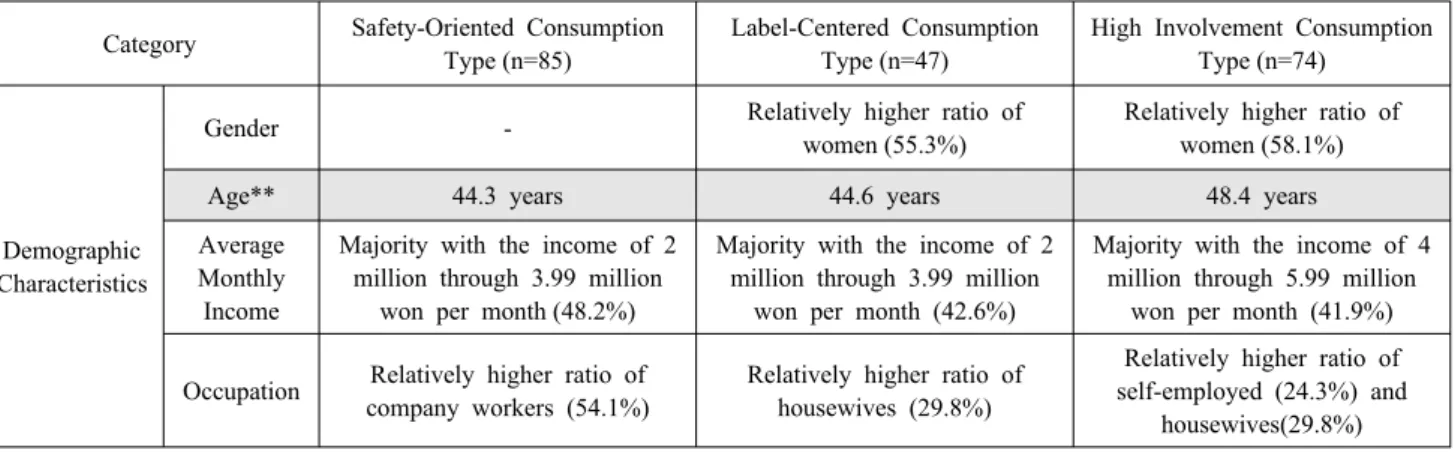
Cluster A is a group considering the safety factor as relatively important and not considering the physical char-acteristics greatly; it is named ‘the safety-oriented con-sumption type’. It has the greatest scale (n=85) with a sim-ilar distribution of women and men with an average age of 44.3 years. The respondents with an average monthly income of 2 million through 3.99 million won account for 48.2%. The company workers account for a relatively high ratio of 54.1%. The reason for the purchase of fresh gseng accounted for the greatest weight is the family’s in-take at 65.9%. But, the respondents’ own inin-take accounts for 23.5%, which is higher compared with that of other clusters. Of the respondents of Cluster A, 44.7% purchase fresh ginseng at traditional markets, and 22.4% at depart-ment stores and large discount stores. The regional brands for purchase are Geumsan at 51.8% and Punggi at 15.3%. The average amount of money spent on a purchase at one time of 100 thousand won or less accounts for 94.2%. Cluster B considers the cultivation indication in-formation factor as the most important, and is named ‘the label-centered consumption type’. That is, it can be judged that the fresh ginseng consumers belonging to the Cluster B purchase fresh ginseng by considering the place of pro-duction, species, quality grade, and its age. It is the small-est group (n=47) with women accounting for a relatively high ratio (55.3%). The most respondents are company
workers (46.8%), but the ratio of housewives (29.8%) is relatively high compared with the first cluster, the safe-ty-oriented consumption type. The purchase for the fam-ily’s intake accounts for 72.3%, and mostly the purchases are made at traditional markets (55.3%). The ratio of pur-chases of 6-year-old ginseng is high at 42.6%, but the ratio of purchases of 3-year-old ginseng (14.9%) is relatively high compared with other clusters. The average amount of money spent on a purchase at one time of 100 thousand won or less accounts for 72.3%.
Cluster C is a group considering all factors as important, and is named ‘the high involvement consumption type’. It is composed of more women (58.1%) than men. The average age is 48.4 years with a significant difference from the safety-oriented consumption type and the label-cen-tered consumption type. With the older age, the weight of self-employed (24.3%) and housewives (29.8%) is high-er than that of othhigh-er clusthigh-ers, and also the avhigh-erage monthly income is higher with those with an income of 4 million through 5.99 million won accounting for 41.9%. In Cluster C, 76.0% of the consumers purchased the product at tradi-tional markets and agricultural cooperatives specializing in ginseng. The ratio of purchase of the regional brand of Geumsan (58.1%) and the ratio of purchase of 6-year-old ginseng (51.4%) are higher than those of other clusters. The average amount of money spent on a purchase at one time is relatively evenly distributed. The will to purchase again (4.14) and the will to recommend (3.92) have a sig-nificant difference from the safety-oriented consumption type and the label-centered consumption type as a result of post-hoc test with Duncan test after one-way ANOVA. In addition, on the basis of the results of VALS in Table 9, it can be known that the high-involvement consumption type consumers are interested in contentious issues, like to hold a meeting and to wear and make sophisticated clothes, and have an active lifestyle preferring many changes.
Table 11 Characteristics of Consumer Clusters Following the Type of Attributes for Purchase Category Safety-Oriented Consumption
Type (n=85)
Label-Centered Consumption Type (n=47)
High Involvement Consumption Type (n=74)
Demographic Characteristics
Gender - Relatively higher ratio of
women (55.3%)
Relatively higher ratio of women (58.1%)
Age** 44.3 years 44.6 years 48.4 years
Average Monthly
Income
Majority with the income of 2 million through 3.99 million
won per month (48.2%)
Majority with the income of 2 million through 3.99 million
won per month (42.6%)
Majority with the income of 4 million through 5.99 million
won per month (41.9%) Occupation Relatively higher ratio of
company workers (54.1%)
Relatively higher ratio of housewives (29.8%)
Relatively higher ratio of self-employed (24.3%) and
Purchase Behavior
Reason for Purchase
Relatively higher ratio of purpose of respondents’
own intake (23.5%)
Relatively higher ratio of purpose of family’s
intake (72.3%)
-Place of Purchase
High ratio of purchase at traditional markets (44.7%), and department stores/large discount stores (22.4%)
High ratio of purchase at traditional markets
(55.3%)
High ratio of purchase at traditional markets (51.3%) and agricultural
cooperatives specializing in ginseng(25.7%) Regional
Brands of Purchase
Relatively higher preference for regional brands of Geumsan (51.8%) and
Punggi (15.3%)
Relatively higher preference for regional brand of Punggi (23.4%)
Relatively higher preference for regional brand of Geumsan (58.1%) Years of
Ginseng Purchased
-Relatively higher ratio of purchase of 3-year-old
ginseng (14.9%)
Relatively higher ratio of purchase of 6-year-old ginseng (51.4%) Average
Amount of Money of Purchase
Majority with the purchase of 100 thousand won or
less (94.2%)
Majority with purchase of 100 thousand won or
less (72.3%)
Relatively even distribution of purchase of 100 thousand won or less
(60.0%) and purchase of more than 100 thousand won (40.0%) Behavior after Purchase (5-Point Scale) Will to Purchase Again*** 3.94 3.81 4.14 Will to Recommend** 3.71 3.53 3.92 VALS (5-Point Scale) Interested in Contentious Issues* 3.40 3.11 3.45 Preference for Many Changes* 3.07 2.72 3.09 Preference for Holding Meetings** 3.05 3.09 3.50 Wearing Sophisticated Clothes* 2.98 3.11 3.31 Preference for Making* 3.25 3.28 3.58 Main Characteristics - Company workers 44.3 years old on average with average monthly income of 2 million through 3.99 million won
- Purchase of fresh ginseng of 100 thousand won or less on average at traditional markets or large discount stores for the intake of themselves or family
- Company workers or housewives 44.6 years old on average with average monthly income of 2 million through 3.99 million won
Purchase of 6 or 3 -year - old fresh ginseng from Punggi region of 100 thousand won or less on average for the family’s intake at traditional markets
- Women 48.4 years old on average with average monthly income of 4 million through 5.99 million won - Purchase of 6-year-oldfresh ginseng
from Geumsan region at traditional markets or agricultural cooperatives specializing in ginseng
- Relatively higher will to purchase again or to recommend
- Interested in contentious issues and preference for many changes. Preference for holding meetings and wearing and making sophisticated clothes.
- One-way ANOVA and post-hoc test with Duncan test at the significance level of 5% (gray shadow) - Significant at the level of * p < 0.05, ** p < 0.01, *** p < 0.001
6 Conclusion
This study aims to deduce the attributes for fresh ginseng purchase to compare and analyze the characteristics of clusters by subdividing the fresh ginseng consumers by at-tributes for purchase, and to deduce the implications on distribution and marketing.
Major conclusions of this study are as follows. The at-tributes for purchase were condensed to three factors; the physical characteristic factor, the safety factor, and the cul-tivation indication information factor. The cluster analysis was conducted with this standard to divide into three clus-ters of safety-oriented consumption type, label-centered consumption type, and high-involvement consumption type. This study grasped the demographic characteristics, purchase behavior, behavior after purchase, and lifestyle (VALS) characteristics by cluster through crosstab analysis and one-way ANOVA on the deduced clusters, and veri-fied if there is any significant difference between clusters. As there are differences in the main attributes consid-ered by a subdivided cluster of fresh ginseng consumers, the inducement to consumers should be strengthened by conducting the proper publicity marketing for each sub-divided cluster reflecting that.
The characteristics by subdivided type of attributes for purchase of ginseng and the implications are summarized as follows:
First, a device is needed to sufficiently check the safety at the time of purchase of fresh ginseng for the safety-oriented consumption type groups con-sidering that the safety of fresh ginseng is important. In this cluster, the weight of those in their 30s (23.5%) and company workers (54.1%) is higher than that of other clusters. Thus, it is thought that relatively objective data should be presented. For example, the anxiety can be dispelled by sug-gesting objective data that can enhance the safety of agricultural commodities such as GAP, organic certification, residual pesticide assessment, etc. at the place of sales.
Second, a device is needed to increase the reli-ability of labeling for the label-centered con-sumption type group considering the ‘label’ includ-ing the ginseng from Geumsan region and 6-year-old ginseng known to be great. For example, the reliability can be raised by attaching an in-struction on self-diagnosis that allows the consum-ers to check the age of the ginseng and quality grade visually or by presenting concrete in-formation on the producers and place of production.
In particular, as many purchase ginseng products for their family’s intake, it is necessary to present the mixed products so that family members of vari-ous ages and genders can intake the product together.
Third, the high involvement consumption type con-sumers who consider all the attributes for the pur-chase of fresh ginseng should be set as the major target as they have a significantly higher will to purchase again and to recommend compared to oth-er clustoth-ers. Their avoth-erage age is 48.4 years, which is relatively high. Therefore, they are judged to have many experiences in purchasing fresh ginseng. In addition, their average amount of purchase for one time is higher than other clusters, and they have a leading and active lifestyle to be thought of as a group with far-reaching power. Their choices should be broadened by preparing a variety of in-formation and products focusing on their main pla-ces of purchase, that is, traditional markets and ag-ricultural cooperatives specializing in ginseng. In conclusion, this study is significant in that it deduced the major attributes for purchase of fresh ginseng by con-sumers, and deduced the theoretical and practical im-plications for revitalization of the fresh ginseng industry by subdividing consumers. However, as it is an online sur-vey, it has limitations in samples in that it failed to include consumers in their 60s or older, and has a problem general-izing the results of study. Therefore, in the subsequent studies, it will be meaningful to conduct a survey focusing on the field that can expand the range of subjects of the survey. In addition, if the survey is conducted targeting not only fresh ginseng but also various types of processing of ginseng products, it will be more helpful for the estab-lishment of a marketing strategy with a greater diversity.
References
Kwanhu Kim. (2010). Marketing Strategy for GAP Certified Ginseng. Doctor’s thesis at Chungnam National University.
Doeon Kim, Jaeyun Jeong, Heecheol Jeong, Hyoungmin Kim, Jiseon Lim, Jaegak Lim, et al. (2010). Development of Customized
Ginseng Products for Overseas Potential Ginseng Markets.
Newtree Co., Ltd., MIFAFF.
Seongyeop Kim. (2000). Export Marketing Facilitation Strategy for Korean Ginseng Industry. Social Science Research. 2000(4), 95-117.
Hyeonwan Kim. (2010). Strategy for Revitalization of Agricultural
Commodities Joint Brand: With Special Emphasis on Ginseng Brand of Geumsan-gun, Chungcheongnam Province. Master’s
the-sis at Paichai University.
Heecheol Kim. (2008). Process of Changes and Strengthening Measures of International Competitiveness of Korean Ginseng.
Business History. 23 (3), 69-102.
Jaeseon Noh, Ohsang Kwon, and College of Agriculture and Life Sciences at Seoul National University. (2006). Measures for
Nurture and Competitiveness Enhancement of Ginseng Industry.
Suwon: Rural Development Administration.
MIFAFF. (2012). 2011 Ginseng Statistics Data Collection. Seoul: MIFAFF.
MIFAFF. (2011). 2010 Ginseng Statistics Data Collection. Seoul: MIFAFF.
MIFAFF. (2010). 2009 Ginseng Statistics Data Collection. Seoul: MIFAFF.
MIFAFF. (2009). 2008 Ginseng Statistics Data Collection. Seoul: MIFAFF.
MIFAFF. (2008). 2007 Ginseng Statistics Data Collection. Seoul: MIFAFF.
Sujin Park, Yongjin Cho, Jaeho Pi, and Heedo Hong. (2006). Realities of Korean Ginseng Studies and Future Demand Forecast: With Special Emphasis on Science of Agriculture, Food Science and Pharmacology over the Past 5 Years. Journal
of Korean Society of Ginseng. 30 (4), 212-219.
Seonghun Park. (2006). Ginseng Market Segmentation in Japan and the U.S. Food Distribution Study. 23 (1), 127-143.
Myounghwan Seong, Dongpil Lee, Songsu Lim, and Wonjin Lee. (2004). Strategies and Measures for Expansion of Mid- and
Long-Term Export of Goryeo Ginseng. Seoul: Korea Rural
Economic Institute.
Hyeonsun Seong, Jaewon Yang, Byoungseon Jeon, Nami Kim, and Yundong Kim. (1989). Taste for Ginseng of Koreans. – Vol. 2: With Special Emphasis on College Students. Journal of
Korean Society of Ginseng. 13 (1), 130-135.
Hyeonsun Seong, Jongtae Lee, Nami Kim, and Kibong Seo. (1989). Taste for Ginseng of Koreans – Vol. 1: With Special Emphasis on Housewives. Journal of Korean Society of Ginseng. 13 (1), 123-129.
Hyeonsun Seong, Byoungseon Jeon, Jongtae Lee, and Jaewon Yang. (1989). Taste for Ginseng of Koreans – Vol. 3: With Special Emphasis on Those Specializing in Handling Ginseng. Journal
of Korean Society of Ginseng. 13 (1), 136-141.
KFDA. (2012). 2011 Analysis on Production Results of Health
Functional Food. Cheongwon: KFDA.
Jaewon Yang. (1996). Realities of Ginseng Products and Study Trends. Journal of Korean Society of Ginseng. 20 (4), 501-519. Yongseon Lee and Seonryoung Lee. (2010). Development Strategy for
Food Processing Industry Utilizing Ginseng and Medical Herb.
Seoul: Korea Rural Economic Institute.
Jongwon Lee and Jaeho Doh. (2005). Realities of Market of Health Functional Food and Prospect of Ginseng Market. Journal of
Korean Society of Ginseng. 29 (4), 206-214.
Haksik Lee and Jihun Lim. (2009). SPSS 16.0 Manual. Paju: Bobmunsa.
Byoungok Lim, Seongkwon Koh, Heonbae Jeong, and Yundu Kim. (2005). Marketing Strategy for Ginseng Products Using Tree Analysis: With Special Emphasis on Domestic Market. Food
Distribution Study. 22 (2), 19-43.
Inbok Jang, Kichun Park, Seonwoo Cha, and Byoungsam Yun. (2011). Consumer Preference for Organic Ginseng and Development Plans of Organic Ginseng Industry. Agricultural
Science Study. 27 (4), 245-251.
Heonbae Jeong, Seongkwon Koh, Seonghun Park, Hunhyeon Cho, and Byoungok Lim. (2005). Realities of Ginseng Consumption and Awareness of Major Countries. Journal of Korean Society
of Ginseng. 29 (3). 152-158.
Korea Agro- Fisheries & Food Trade Corporation. (2011).
Information on Realities of Distribution by Item, Ginseng. Seoul:
Korean Agro- Fisheries & Food Trade Corporation. Chung, H. S., Hong, H. D., Kim, K., Cho, C. W., Moskowitz, H.
R., & Lee, S. Y. (2011). Consumer Attitudes and Expectations of Ginseng Food Products Assessed by Focus groups and Conjoint analysis. Journal of sensory studies. 26 (5), 346-357. Kim, S. K., & Park, J. H. (2011). Trends in Ginseng Research in