- 30 - [Original Article] Received September 29, 2018 Revised October 30, 2018 Accepted November 25, 2018 †Corresponding author ([email protected]) ORCID Hyo Jin Eom
http://orcid.org/0000-0003-0611-1994 Patricia Hunt-Hurst
http://orcid.org/0000-0003-1023-9210 Zhenqiu (Laura) Lu
http://orcid.org/0000-0001-9482-1368
The Importance of Brand and Retailer Associations in
Evaluating a Product Category Extension
Hyo Jin Eom
1†, Patricia Hunt-Hurst
2and Zhenqiu (Laura) Lu
3 1Dept. of Textiles, Merchandising and Interiors, The University of Georgia, USA2College of Family and Consumer Sciences, The University of Georgia, USA 3College of Education, The University of Georgia, USA
Abstract
This study investigates the importance of brand and retailer associations when consumers evaluate a product category extension in the context of brand and retailer collaborations. Although brand extensions are considered to reduce costs for introducing a new product category, limited study has focused on the role of brand and retailer associations in the context of brand and retailer collaborations. Using a total of 440 participants, a hypothesized model was tested using a structural equation modeling (SEM). The results show that brand and retailer associations influence the perceived fit between a brand and a retailer. In addition, the image fit and quality fit are significantly related to brand and retailer attitudes as well as brand extension evaluation. Since consumers may use their associations with brands or retailers when they perceive product differentiation, market position, and brand extensions, the role of brand or retailer associations is important to marketers, retailers, and consumers. Given the importance of brand and retailer collaborations as a brand positioning strategy in the global branding and retail setting, the findings of this study contribute to brand and retail management by providing empirical evidence on how consumers perceive new products from extended brands in the marketplace when a brand collaborates with a retailer.
Keywords: attitude accessibility, brand and retailer collaboration, brand association, brand extension
I. Introduction
Fashion brands have been experiencing market saturation and have strived to fine new market opportunities (Kim, Jolly, & Kim, 2007). With regard to such market saturation, many fashion brands use a multi-tiered portfolio using brand extensions as a vehicle for growth to offer their products to a wider range of consumers with lower marketing
expenditures. With its importance in the marketplace, extensive studies have demonstrated different perspectives on brand extensions and have investigated the role of consumers’ perceptions on the parent brand as determinants of brand extension (Aaker & Keller, 1990; Bhat & Reddy, 2001; Sattler, Völckner, Riediger, & Ringle, 2010). Some studies supported that brand extensions could create reciprocal effects by enhancing the equity of the parent brand (Chen & Liu 2004; Pitta & Katsanis, 1995) and others provided evidence that brand extensions might lead to adverse effects on the parent brand by diluting the parent brand image (Loken & John, 1993; Dacin & Smith, 1994; Kim & Lavack, 1996). Contradictorily, in explaining brand extension reciprocal effects to the parent brand, brand extension failure may not systematically cause the parent brand dilution (Michel & Donthu, 2014).
As widely acknowledged, brand extensions may be beneficial for the extended brand to reduce perceived risk of introducing new product categories by sharing the original brand’s recognition and image (Aaker & Keller, 1990; Baek & King, 2015; Kim & John, 2008; Pitta & Katsanis, 1995). Related research on brand extensions has suggested that brand extension success may depend on the brand-related variables and characteristics of parent brand (Monga & John, 2010; Park, Milberg, & Lawson, 1991) and the degree of brand extension similarity between a parent brand and an extension category (Dimitriu, Warlop, & Samuelsen, 2017). In the fashion industry, fashion brands often introduce a new product line in a new product category using a brand category extension by collaborating with retailers as a channel for new products to make their products more accessible to potential consumers (Childs & Jin, 2015; Oeppen & Jamal, 2014). Ailawadi and Keller (2004) suggest that retailers may create their image using different marketing efforts similar to the brands and such image of a retailer as an image in the minds of consumers is one of the key elements of a retailer’s equity. Since fashion brands have often collaborated with retailers to improve access to distribution channels, consumers’ associations with brands or retailers may affect their evaluative processes toward extended brand products.
In investigating the role of brand associations on brand extensions, previous studies suggest the perceptions of the logical connection between the product and the brand reflect consumers’ perception of the success of brand extensions (Aaker & Keller, 1990; Broniarczyk & Alba 1994; Völckner & Sattler, 2006) as well as the market positioning of extended brands (Dimitriu, Warlop, & Samuelsen, 2017). Similar to those studies, the perceptions of the logical connection between brands and retailers may influence differently consumers’ evaluative processes because extrinsic information such as brand name, price, or store image may differ depending on the types of brand and retailer collaborations. However, it has not yet been examined whether brand extension evaluations are based on brand associations or retailer associations in the context of brand and retailer collaborations. Thus, this study investigates the influence of brand and retailer associations on perceived fit between brands and retailers, and brand extension evaluation in the context of brand and retailer collaborations.
II. Hypotheses and the Model
Research in consumer psychology has provided a conceptual and theoretical basis for the consumer’s tendency to understand the underlying process of consumers’ associations to an object (Fazio, 1986; Fazio, Powell, & Williams, 1989; Lafferty & Goldsmith, 2005). Attitude accessibility theory (Fazio, 1986) explains that attitude accessibility as the strength of an association to an object influences individuals’ behavior. The theory explains that more accessible attitudes toward a product or a brand may display a greater attitude-behavior correspondence than less accessible attitudes toward a product or a brand (Fazio, Powell, & Williams, 1989). Further the theory explains that an individual’s evaluation and behavior are influenced by a salient or accessible attitude toward an entity due to the information asymmetry between two entities (Lafferty & Goldsmith, 2005). Ahluwalia and Gürhan-Canli (2000) suggested that accessibility of extension information as a factor influences the valence of extension information and extension category on brand evaluations. In this regard, consumers’ pre-existing associations formed from previous information or experiences to brands or retailers may influence their attitudes or behaviors. Consistent with this reasoning, the associations toward brands or retailers may form attitudinal accessibility to affect perceived fit or brand extension evaluations when interpreting new collaborations or evaluating new products from extended brands offered in the retail stores.
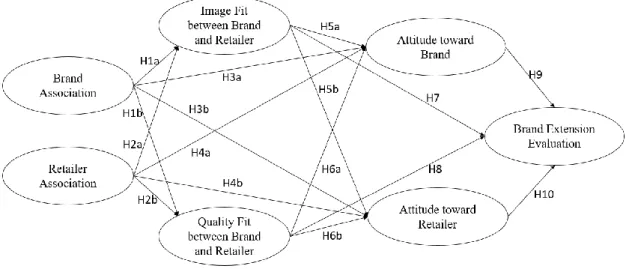
The structural equation modeling (SEM) is often used to evaluate how well the conceptual model including latent constructs and indicators fits the data. This study used the SEM approach to test hypotheses and to evaluate the model presented in Figure 1. We interpret each hypothesis in the model in the next sub-sections.
Figure 1. The structural equation model for the conceptual framework of the hypothesized relationships
1. Brand Associations
Brand associations as a consumers’ psychological representation of brands reflect their perception of brands or meaning of the brand for which consumers held in their memory (Keller, 1993; Low & Lamb, 2000). Brand associations refer to a level of abstracted information according to their favorability (Keller, 1993). Such brand
associations may play a role in reducing perceived risk and information searching costs. Several research efforts have explored the role of brand associations in evaluating brand extensions and suggested brand associations may influence consumers’ perception of fit between parent brand and its extension. Other studies have also indicated that consumers transfer brand associations from the parent brand to its extension (Kim, Lavack, & Smith, 2001; Sattler, Völckner, Riediger, & Ringle, 2010). Similar to consumers’ response to brand extensions, since consumers may use such brand associations to assist their purchase decisions by retrieving information in memory, brand or retailer associations may influence their attitudes in the context of brand and retailer collaborations. To address this, the current study viewed brand associations as anything linked in memory to a brand (Aaker, 1991) and retailer associations as anything linked in memory to a retailer. In light of the previous discussion, consumers may expect that brand retailer collaborations would be consistent with the existing entity’s (brand or retailer) associations. Therefore, hypotheses are formulated as follows:
H1: Brand association significantly influences image fit (H1a) and quality fit (H1b). H2: Retailer association significantly influences image fit (H2a) and quality fit (H2b).
H3: Brand association significantly influences the attitude toward the brand (H3a) and the attitude toward the retailer (H3b).
H4: Retailer association significantly influences the attitude toward the brand (H4a) and the attitude toward the retailer (H4b).
2. Perceived Fit
In brand extension research, perceive fit is regarded as the most important determinant of brand extension success no matter how previous researchers have differently conceptualized the concept of perceive fit (Völckner & Sattler, 2006). Most commonly, perceive fit as a determinant of consumer attitude towards brand extension products refers to consumers’ perception of fit from product quality or its performance (Dacin & Smith, 1994; Park, Milberg, & Lawson, 1991) or consumers’ perception of fit between parent brand and extended brand (Kim & John, 2008; Park, Milberg, & Lawson, 1991). Goedertier, Dawar, Geuens, and Weijters (2015) examined the effect of brand proto-typicality on the consumer’s acceptance of close and distant novel extensions, suggesting that brand proto-proto-typicality has a positive impact on consumer acceptance in both close and distant product categories. Park, Milberg, and Lawson (1991) examined product feature similarity and brand concept consistency as two different factors that may influence successful brand extensions. Similar to the role of perceived fit in brand extensions, perceive fit is a degree of similarity between a brand and retailer that can be applied to the context of brand and retailer alliance (Arnett, Laverie, & Wilcox, 2010). From the retailer perspective, Mitchell, Dan, and Chaudhury (2014) investigated factors that influence the retail brand extension success and found that the retail brand extension’s success depends on perceptual extension-fit judgments of relevance, concept fit, typicality, and understanding. Since consumers tend to consider information about the concept consistency as well as the product level features, this study predicts as follows:
H5: Image fit between brand and retailer significantly influences the attitude toward the brand (H5a) and the attitude toward the retailer (H5b).
H6: Quality fit between brand and retailer significantly influences the attitude toward the brand (H6a) and the attitude toward the retailer (H6b).
H8: Quality fit between brand and retailer influences brand extension evaluation.
3. Attitude
Brand attitudes as consumers' overall evaluations of a brand have been explored in the investigation of the consumer acceptance on brand extensions because they often provide the underlying explanations for consumer behavior or choice (Czellar, 2003; Keller, 1993; Martin & Stewart, 2001). In evaluating brand extension success, Czellar (2003) suggested that attitude toward the brand extensions may be influenced by certain parent brand attitudes in terms of knowledge structure and affect. Bhat and Reddy (2001) explained that consumers are likely to evaluate the extension based on the more familiar and well-known parent brand. Further, positive feelings of the parent brand can be directly transferred to its extensions (Bhat & Reddy, 2001). This implies that positive attitudes toward the parent brand may influence consumers’ evaluation of brand extensions. In addition, since brand and retailer collaborations may affect attitude toward brand or retailer attitudes, subsequently, this may influence consumers’ responses to the brand extensions when the brand introduces new products in different category. Consistent with this reasoning, consumers’ attitudes may serve as a filter to interpret new information related to new products from a newly extended brand.
H9: The attitude toward the brand influences brand extension evaluation. H10: The attitude toward the retailer influences brand extension evaluation.
III. Research Method
A pretest was conducted to select reasonably suitable brands and retailers, and a total of 30 female university students assessed their perception on brands and retailers. Based on the results of the pretest, Burberry (M = 6.20, SD = 0.91) and H&M (M = 4.17, SD = 1.37) were selected for brands and JCPenney (M = 2.97, SD = 1.62) and Nordstrom (M = 5.90, SD = 0.84) were selected for retailers. Using an online survey company (Qualtrics.com), data of 440 participants were obtained in the U.S and two groups were given different types of brand and retailer collaborations. In terms of the demographics of data, the participants were American female consumers between the ages of 26 and 45. Approximately 69.3% of the participants were White Caucasian, followed by Asian at 13.2%, African-American at 9.1%, Hispanic at 6.6%, and others at 1.8%. More than half of the participants (74.5%) were employed full-time and the proportion of participants with a household income over $15,000 was 96.4%.
A 7-point Likert-type scale was used to measure the five variables, and measurements were modified to measure the variables: image and quality fit (Fedorikhin, Park, & Thomson, 2008; Moon & Sprott, 2016), and brand extension evaluation (Dawar & Anderson, 1994). To measure brand association and retailer association (Bhat & Reddy, 2001; Chaudhuri & Holbrook, 2001), and brand attitude and retailer attitude (Kim, Park, & Kim, 2014; Valta, 2013). Table 1 shows reliability statistics for all variables and the reliability coefficients ranged from .88 to .96 and all measurement items are presented in Appendix 1.
Table 1. Reliability statistics for all variables (N = 440)
Variables Number of items Coefficient alpha
Brand association 6 .88
Retailer association 6 .92
Image fit 4 .93
Quality fit 4 .95
Attitude toward brand 4 .95
Attitude toward retailer 4 .96
Evaluation 4 .94
IV. Results and Discussion
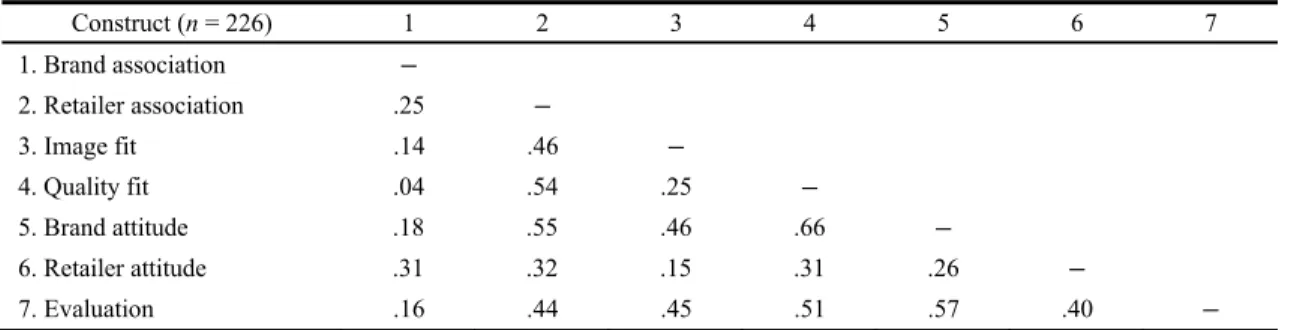
Tables 2 and 3 present the correlation matrices of the seven variables in each group.
Table 2. Correlation matrix of model constructs for a high-end brand and a low-end retailer case
Construct (n = 226) 1 2 3 4 5 6 7 1. Brand association െ 2. Retailer association .25 െ 3. Image fit .14 .46 െ 4. Quality fit .04 .54 .25 െ 5. Brand attitude .18 .55 .46 .66 െ 6. Retailer attitude .31 .32 .15 .31 .26 െ 7. Evaluation .16 .44 .45 .51 .57 .40 െ
Table 3. Correlation matrix of model constructs for a low-end brand and a high-end retailer case
Construct (n = 214) 1 2 3 4 5 6 7 1. Brand association െ 2. Retailer association .21 െ 3. Image fit .40 .19 െ 4. Quality fit .44 .17 .19 െ 5. Brand attitude .26 .57 .37 .27 െ 6. Retailer attitude .44 .13 .35 .56 .23 െ 7. Evaluation .43 .20 .63 .48 .37 .62 െ
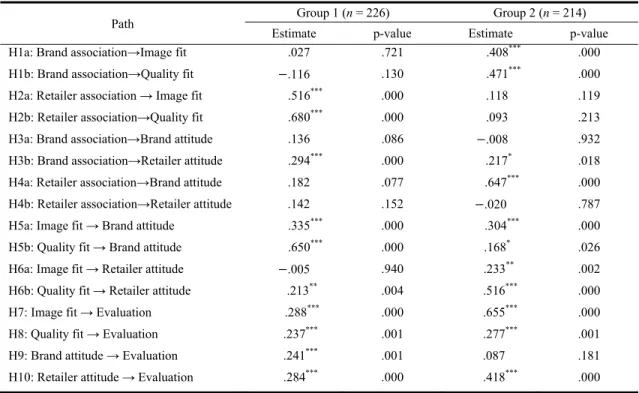
The SEM analysis was conducted by using the Mplus v7.4 program. The results of path analyses for both brand and retailer collaborations for the brand category extension are presented in Table 4. The fit of the hypothesized model of the high-end brand and low-end retailer case revealed an acceptable model fit: χ²/df = 2.47, which is less than 3, RMSEA = .08, CFI = .90 and TLI = .90. Also, the goodness of fit indices indicated that the conceptual model for the low-end brand and high-end retailer case achieved an acceptable fit model: χ²/df = 2.27, RMSEA = .077, which is less than 0.8, and both CFI and CFI are larger than 0.9 with CFI = .92 and TLI = .92.
Table 4. A summary of SEM results
Path Group 1 (n = 226) Group 2 (n = 214)
Estimate p-value Estimate p-value
H1a: Brand association→Image fit .027 .721 .408*** .000
H1b: Brand association→Quality fit െ.116 .130 .471*** .000
H2a: Retailer association → Image fit .516*** .000 .118 .119
H2b: Retailer association→Quality fit .680*** .000 .093 .213
H3a: Brand association→Brand attitude .136 .086 െ.008 .932
H3b: Brand association→Retailer attitude .294*** .000 .217* .018
H4a: Retailer association→Brand attitude .182 .077 .647*** .000
H4b: Retailer association→Retailer attitude .142 .152 െ.020 .787
H5a: Image fit → Brand attitude .335*** .000 .304*** .000
H5b: Quality fit → Brand attitude .650*** .000 .168* .026
H6a: Image fit → Retailer attitude െ.005 .940 .233** .002
H6b: Quality fit → Retailer attitude .213** .004 .516*** .000
H7: Image fit → Evaluation .288*** .000 .655*** .000
H8: Quality fit → Evaluation .237*** .001 .277*** .001
H9: Brand attitude → Evaluation .241*** .001 .087 .181
H10: Retailer attitude → Evaluation .284*** .000 .418*** .000
Note. * p < .05. ** p < .01. *** p < .001. Group 1 represents a high-end brand and a low-end retailer case whereas Group 2 represents a low-end brand and a high-end retailer case.
This study explored two different brand and retailer collaborations to investigate whether consumers evaluate differently depending on the types of brands or retailers. In comparison between high-end and low-end positions in the marketplace, the results showed that low-end brand association (H1: supported in group 2) and low-end retailer association (H2: supported in group 1) were significantly related to the perceived fit, indicating that low-end associations were more influential. More importantly, low-end brand attitude was not associated with brand extension evaluation (H9: rejected) while low-end retailer attitude was related to brand extension evaluation (H10: supported), indicating the important role of retailers in evaluating brand extensions. Similar to the previous studies’ suggestions, our results showed that different types of brand and retailer collaborations displayed different evaluative processes toward the brand category extension. We have included only two types of fashion brand and retailer associations in the current study. Different associations should be explored in future investigations. Dimitriu, Warlop, and Samuelsen (2017) indicated that consumers’ responses to brand extensions may be influenced by contextual or marketing aspect factors. Further, they suggested the degree of brand extension similarity may influence consumers’ perception on how new products from brand extensions be positioned in the marketplace (Dimitriu, Warlop, & Samuelsen, 2017). Overall, the findings provide empirical evidence on how brand and retailer associations influence perceived fit between brand and retailer and subsequently influence consumers’ attitudes and brand extension evaluations.
In the current fashion industry, various types of collaborations draw attention from academic researchers to cope with intense competitions. Since brand extension success may depend on where to sell new offerings or how to
increase accessibility of new products to the target markets, brands may increase the efficiency of promotional efforts, improve their distribution channels and reduce marketing costs by collaborating with retailers. In this regard, the current study contributes to both academia and industry practitioners by explaining how consumers evaluate new products from extended brands when extending new product category. Since consumers may use their associations with brands or retailers when they perceive product differentiation, market position, and brand extensions, the role of brand or retailer associations is important to marketers, retailers, and consumers. This study emphasized the role of retailers on brand extension evaluations and suggested the importance of how the extended brand can effectively provide its exposure to the target consumers using effective retail channels. By extending the findings of this study, future research may provide a better understanding of how brand and retailer associations may increase consumers’ response to brand extensions when consumers shop with different channels such as in online or mobile shopping situations.
APPENDIX 1. Measurement items
Variables Items Brand association/ retailer association
(Bhat & Reddy, 2001; Chaudhuri & Holbrook, 2001)
not very preferred (1)/ very preferred (7) not very familiar (1)/ very familiar (7) not very valuable (1)/ very valuable (7) not very trustworthy (1)/ very trustworthy (7) not very reliable (1)/ very reliable (7) not very favorable (1)/ very favorable (7) Image fit/ quality fit
(Moon & Sprott, 2016; Fedorikhin, Park, & Thomson, 2008)
The image/quality of --- are complementary.
The image/quality of --- and that of the other brands at the --- are complementary.
The image/quality of --- fits well with the image of ---. The image/quality of --- are similar.
Attitude toward brand/retailer
(Kim, Park, & Kim, 2014; Valta, 2013) less appealing (1)/ more appealing (7) less exciting (1)/ more exciting (7) less favorable (1)/ more favorable (7) less desirable (1)/ more desirable (7) Brand extension evaluation
(Dawar & Anderson, 1994) The new apparel line from --- at --- makes a lot of sense to me. It sounds reasonable to me that --- would be offered at ---. The --- at --- is a very good idea.
The new apparel line from --- at --- is very plausible.
References
Aaker, D. A. (1991). Managing brand equity: Capitalizing on the value of a brand name. New York, NY: The Free Press
Aaker, D. A., & Keller, K. L. (1990). Consumer evaluations of brand extensions. Journal of Marketing, 54(1), 27-41. doi:10.2307/1252171
Ahluwalia, R., & Gürhan-Canli, Z. (2000). The effects of extensions on the family brand name: An accessibility-diagnosticity perspective. Journal of Consumer Research, 27(3), 371-381. doi:10.1086/317591
Ailawadi, K. L., & Keller, K. L. (2004). Understanding retail branding: Conceptual insights and research priorities.
Arnett, D. B., Laverie, D. A., & Wilcox, J. B. (2010). A longitudinal examination of the effects of retailer-manufacturer brand alliances: The role of perceived fit. Journal of Marketing Management, 26(1-2), 5-27. doi:10.1080/02672570903534647
Baek, T. H., & King, K.W. (2015). When comparative valence frame affects brand extension evaluations: The moderating role of parent-extension fit. International Journal of Advertising, 34(2), 382-401. doi:10.1080/02650487.2014.996196
Bhat, S., & Reddy, S. K. (2001). The impact of parent brand attribute associations and affect on brand extension evaluation. Journal of Business Research, 53(3), 111-122. doi:10.1016/S0148-2963(99)00115-0
Broniarczyk, S. M., & Alba, J. W. (1994). The importance of the brand in brand extension. Journal of Marketing
Research, 214-228. doi:10.2307/3152195
Chaudhuri, A., & Holbrook, M. B. (2001). The chain of effects from brand trust and brand affect to brand performance: the role of brand loyalty. Journal of Marketing, 65(2), 81-93. doi:10.1509/jmkg.65.2.81.18255 Chen, K. J., & Liu, C. M. (2004). Positive brand extension trial and choice of parent brand. Journal of Product &
Brand Management, 13(1), 25-36. doi:10.1108/10610420410523821
Childs, M., & Jin, B. (2015). A new age in clothing brand and retailer collaborations: Trends and recommendations for a successful partnership. Journal of Brand Strategy, 5(1), 83-100.
Czellar, S. (2003). Consumer attitude toward brand extensions: an integrative model and research propositions.
International Journal of Research in Marketing, 20(1), 97-115. doi:10.1016/S0167-8116(02)00124-6
Dacin, P. A., & Smith, D. C. (1994). The effect of brand portfolio characteristics on consumer evaluations of brand extensions. Journal of Marketing Research, 31, 229-242. doi:10.2307/3152196
Dawar, N., & Anderson, P. F. (1994). The effects of order and direction on multiple brand extensions. Journal of
Business Research, 30, 119-129. doi:10.1016/0148-2963(94)90031-0
Dimitriu, R., Warlop, L., & Samuelsen, B. M. (2017). Brand extension similarity can backfire when you look for something specific. European Journal of Marketing, 51(5/6), 850-868. doi:10.1108/EJM-09-2015-0662
Fazio, R. H. (1986). How do attitudes guide behavior? In R. M. Sorrentino & E. T. Higgins (Eds.), The handbook of
motivation and cognition: Foundations for social behavior (pp. 204-243). New York, NY: Guilford Press.
Fazio, R. H., Powell, M. C., & Williams, C. J. (1989). The role of attitude accessibility in the attitude-to-behavior process. Journal of Consumer Research, 16(3), 280-288. doi:10.1086/209214
Fedorikhin, A., Park, C. W., & Thomson, M. (2008). Beyond fit and attitude: The effect of emotional attachment on consumer responses to brand extensions. Journal of Consumer Psychology, 18(4), 281-291. doi:10.1016/j.jcps.2008.09.006
Goedertier, F., Dawar, N., Geuens, M., & Weijters, B. (2015). Brand typicality and distant novel extension acceptance: How risk-reduction counters low category fit. Journal of Business Research, 68(1), 157-165. doi:10.1016/j.jbusres.2014.04.005
Keller, K. L. (1993). Conceptualizing, measuring, and managing customer-based brand equity. Journal of Marketing, 57(1), 1-22. doi:10.2307/1252054
Kim, C. K., & Lavack, A. M. (1996). Vertical brand extensions: Current research and managerial implications.
Journal of Product & Brand Management, 5(6), 24-37. doi:10.1108/10610429610152813
Kim, C. K., Lavack, A. M., & Smith, M. (2001). Consumer evaluation of vertical brand extensions and core brands.
Kim, H., & John, D. R. (2008). Consumer response to brand extensions: Construal level as a moderator of the importance of perceived fit. Journal of Consumer Psychology, 18(2), 116-126. doi:10.1016/j.jcps.2008.01.006 Kim, H. Y., Jolly, L., & Kim, Y. K. (2007). Future forces transforming apparel retailing in the United States an
environmental scanning approach. Clothing and Textiles Research Journal, 25(4), 307-322. doi:10.1177/ 0887302X07306851
Kim, K., Park, J., & Kim, J. (2014). Consumer-brand relationship quality: When and how it helps brand extensions.
Journal of Business Research, 67(4), 591-597. doi:10.1016/j.jbusres.2013.03.001
Lafferty, B. A., & Goldsmith, R. E. (2005). Cause-brand alliances: Does the cause help the brand or does the brand help the cause? Journal of Business Research, 58(4), 423-429. doi:10.1016/j.jbusres.2003.07.001
Loken, B., & John, D. R. (1993). Diluting brand beliefs: When do brand extensions have a negative impact? Journal
of Marketing, 57(3), 71-84. doi:10.2307/1251855
Low, G. S., & Lamb Jr, C. W. (2000). The measurement and dimensionality of brand associations. Journal of
Product & Brand Management, 9(6), 350-370. doi:10.1108/10610420010356966
Martin, I. M., & Stewart, D. W. (2001). The differential impact of goal congruency on attitudes, intentions, and the transfer of brand equity. Journal of Marketing Research, 38(4), 471-484. doi:10.1509/jmkr.38.4.471.18912 Michel, G., & Donthu, N. (2014). Why negative brand extension evaluations do not always negatively affect the
brand: The role of central and peripheral brand associations. Journal of Business Research, 67(12), 2611-2619. doi:10.1016/j.jbusres.2014.03.020
Mitchell, V., Dan, E., & Chaudhury, A. (2014). Predicting retail brand extension strategy success: A consumer based model. Journal of Customer Behaviour, 13(2), 93-111. doi:10.1362/147539214X14024779483555
Monga, A. B., & John, D. R. (2010). What makes brands elastic? The influence of brand concept and styles of thinking on brand extension evaluation. Journal of Marketing, 74(3), 80-92. doi:10.1509/jmkg.74.3.80
Moon, H., & Sprott, D. E. (2016). Ingredient branding for a luxury brand: The role of brand and product fit. Journal
of Business Research, 69(12), 5768–5774. doi:10.1016/j.jbusres.2016.04.173
Oeppen, J., & Jamal, A. (2014). Collaborating for success: Managerial perspectives on co-branding strategies in the fashion industry. Journal of Marketing Management, 30, 925-948. doi:10.1080/0267257X.2014.934905
Park, C. W., Milberg, S., & Lawson, R. (1991). Evaluation of brand extensions: The role of product feature similarity and brand concept consistency. Journal of Consumer Research, 18(2), 185-193. doi:10.1086/209251
Pitta, D. A., & Katsanis, L. P. (1995). Understanding brand equity for successful brand extension. Journal of
Consumer Marketing, 12(4), 51-64. doi:10.1108/07363769510095306
Sattler, H., Völckner, F., Riediger, C., & Ringle, C. M. (2010). The impact of brand extension success drivers on brand extension price premiums. International Journal of Research in Marketing, 27(4), 319-328. doi:10.1016/ j.ijresmar.2010.08.005
Valta, K. S. (2013). Do relational norms matter in consumer-brand relationships? Journal of Business Research, 66(1), 98-104. doi:10.1016/j.jbusres.2011.07.028
Völckner, F., & Sattler, H. (2006). Drivers of brand extension success. Journal of Marketing, 70(2), 18-34. doi:10.1509/jmkg.70.2.18