19-1 / R. –S. Liu
IMID 2009 DIGEST •
Mechanism of Energy Transfer and Improvement Moist Stability of
BaMgAl
10O
17:Eu
2+, Mn
2+Phosphor
Ru-Shi Liu* and Wei-Chih Ke
Department of Chemistry, National Taiwan University, Taipei 106, Taiwan
TEL:+886-2-3366-1169, e-mail: [email protected]
Keywords: Phosphor, LED, BAM
Abstract
BaMgAl10O17 (BAM) co-doped with Eu2+ and Mn2+
was synthesized in a solid-state reaction and their lumi-nescence properties were investigated as functions of the concentrations of the sensitizer and activator. BAM:Eu2+
had a broad blue emission band at 450 nm and BAM:Mn2+
exhibited green emission at 514 nm. The energy transfer from Eu2+ to Mn2+ was mainly of the resonance-type via
an electric dipole-quadrupole interaction. Additionally, the addition of various fluxes such as AlF3 and BaF2 in the
synthesis improves the moist and thermal stability. This is particularly important for the phosphor in white light emitting diodes (LEDs).
1. Introduction
White light-emitting diodes (LEDs) are regarded as the next-generation light source because of their high efficiency, weak environmental impact, long lifetimes, absence of mercury, short response times, applicability in final products of various sizes, and many more favorable properties. [1] Many methods are commonly applied to generate white light. The blue LED that coated with yellow phosphor is simpler and more widely used. However, the method faces serious problems of patent issue, poor color retention and high color temperature. Another approach is to use UV LEDs fitted with three phosphors emitting blue, red and green, this type offers superior color uniformity with a high color rendering index and excellent quality of light.
BaMgAl10O17:Eu2+ and BaMgAl10O17:Mn2+ are
used as commercial blue and green phosphors for
plasma display panels because of their high VUV efficiency. [2] The excitation spectrum of the blue BAM:Eu2+ had a broad absorption feature in the
range 210-410 nm. Hence, BAM is expected to play an important role as the fluorescent material for UV LEDs. The spectral overlap between the excitation of the BAM:Mn2+ and the emission of the BAM:Eu2+
supports the expectation of effective energy transfer from Eu2+ to Mn2+ in the co-doped phosphor. [3] In
the present work, BaMgAl10O17 (BAM) co-doped
with Eu2+ and Mn2+ were synthesized in a solid-state
reaction and their luminescence properties, energy transfer, and critical distance (Rc) were investigated.
The BAM:Eu0.15, Mn0.3 with various fluxes was
prepared and the influence of the fluxes on the luminescence, moist and thermal stability were examined. These properties are particularly important for phosphor in white light emitting diodes (LEDs).
2. Experimental
A series of BAM:Eu0.15, Mny (y = 0-0.5)
compounds were prepared by the solid state reaction method. The precursors BaCO3, MgO, Al2O3, Eu2O3,
and a trace amount of a specific flux such as AlF3,
BaF2 or H3BO3 were weighed in stoichiometric
amounts. Subsequently, mixture was mixed and ground together in an agate mortar. The powder products were then transferred into crucibles and fired at 1600°C in a 5% H2/95% N2 reducing
atmosphere for 12 h. After firing, the samples were cooled to room temperature in the furnace, ground again into powders, and washed in deionized water
19-1 / R. –S. Liu
• IMID 2009 DIGEST
several times for further use. The composition and phase purity of the products were examined by synchrotron X-ray diffraction (XRD) using a large Debye-Scherrer camera that was installed at the BL01C2 beam line of National Synchrotron Radiation Research Center (NSRRC) with λ = 0.7749 Å, The photoluminescence (PL) of the samples was measured using a FluoroMax-3 & FluoroMax-P. Thermal quenching and activation energy were studied using a heating apparatus (THMS-600) in combination with PL equipment. The morphology of phosphors was analyzed using a Hitachi S2400 electron microscope.
3. Results and discussion
XRD patterns of the BAM:Eu0.15, Mny (y =
0-0.5), which match those of pure BaMgAl10O17
phase (JCPDS 26-0163) with the β-alumina structure. Figure 1 plots experimental, calculated, and differ-ence results of the XRD refinement of BAM:Eu0.15,
Mn0.3. This crystallizes as an orthorhombic structure
with a space group of P63/mmc and lattice constants
of a = b = 5.6456(5) Å, c = 22.7016(2) Å, and v (cell volume) = 626.633(10) Å3. All of the observed peaks
satisfy the reflection condition, χ2 = 2.61, R
p = 5.31%, and Rwp = 7.04%. 5 10 15 20 25 30 35 40 In te ns ity (a .u .) 2θ (degree)
Fig. 1. XRD refinement of BAM:Eu0.15, Mn0.3.
Emission and excitation of BAM:Eu2+ occur
through the 4f -5d transition. A broad excitation band was observed, matching closely that of the widely used near-UV LED chips. The 370 nm excitation produced a very strong emission band that peaked at 450 nm. The excitation spectrum of BAM:Mn2+
con-sists of four peaks around 360, 386, 427, and 452 nm, corresponding to the transitions from 6A
1 → 4T2 (4D), 6A
1 → (4A1,4E)(4G), 6A1 → 4T2 (4G), and 6A1 → 4T1
(4G) in the 3d levels of Mn2+ ions, respectively. The
452 nm excitation produced a broad emission band that peaked at 514 nm. The spectral overlap between the excitation of the activator (Mn2+) and the
emis-sion of the sensitizer (Eu2+), effective energy transfer
from Eu2+ to Mn2+ is expected in the co-doped
phos-phor. Figure 2 shows the PL and PLE spectra of Eu2+
and Mn2+ co-doped BAM:Eu
0.15, Mny phosphors with
various dopant contents y of 0-0.5 with the fixed Eu2+
concentration at 0.15. The excitation spectrum shows a broad band, which corresponds to the 4f-5d transi-tion of Eu2+ ions, implying this phosphor can be well
excited by NUV light. The intensities of the emission from Eu2+ decrease and those from Mn2+ increase.
350 400 450 500 550 0.0 4.0x10⁵ 8.0x10⁵ 1.2x10⁶ 1.6x10⁶ 2.0x10⁶ y = 0 y = 0.1 y = 0.2 y = 0.3 y = 0.4 y = 0.5 Emission Excitation In te ns ity (a .u .) Wavelength (nm)
Fig. 2. Excitation and Emission spectra of BAM:Eu0.15, Mny (y = 0-0.5). (excited at 370 nm)
Based on Förster and Dexter’s energy transfer formula of multi-polar interaction and Reisfeld’s ap-proximation, the following relation can be obtained. [4-6] / 3 0 n S Eu Mn S I C I ∝ +
where IS0 is the intrinsic luminescence intensity
of Eu2+ and I
S is the luminescence intensity of Eu2+ in
the presence of the Mn2+; C is the sum of the contents
of Eu2+ and Mn2+; and n = 6, 8, and 10, corresponding
to dipole–dipole, dipole–quadrupole, and quadru-pole–quadrupole interactions. The nature of the in-teraction in the transfer process can be determined by plotting IS0/IS vs CEu-Mnn/3 , as in Figure 3a and b; a
linear relationship is observed only when n = 8. This result clearly indicates that the energy transfer from Eu2+ to Mn2+ is the dipole-quadrupole mechanism,
which is expected to be the dominant mode due to the parity allowed transition of Eu2+ and the parity
19-1 / R. –S. Liu
IMID 2009 DIGEST •
Fig. 3. Dependence of Iso/Is of Eu2+ on (a)
CEu-Mn6/3 and (b) CEu-Mn8/3.
The transfer probability of d-d and d-q
interac-tions is given by Förster. [4,6] For the di-pole-quadrupole mechanism, the critical distance (Rc)
of energy transfer from Eu2+ to Mn2+ can be found
using eq. 2 8 28 4 0.63 10 q S A ( ) ( ) c S A d S f Q R F E F E dE f E λ = ×
∫
where QA = 4.8×10⁻¹⁶ fd cm2·eV is the integrated
absorption cross-section of the activator (Mn2+); f d =
10−7 and f
q = 10−10 are the oscillation strengths of the
electric dipole and quadrupole transitions for Mn2+;
λS = 4500 Å and E = 2.8 eV are the emission
wave-length and emission energy of Eu2+, and
∫FS(E)FA(E)dE represents the spectral overlap
be-tween the normalized shapes of the Eu2+ emission
FS(E) and Mn2+ excitation FA(E), and is estimated at
about 1.83 eV-1. Accordingly, the critical distance for
energy transfer was calculated to be about 10.9 Å. Flux is generally employed to improve the qual-ity of phosphors. [7-9] Figure 4 shows the PL spectra of BAM:Eu0.15, Mn0.3 with various fluxes and the
relative intensity and CIE coordinates are listed in Table 1. The fluxes significantly enhance the lumi-nescence intensity and color saturation. Therefore, the synthesized with AlF3 has a higher relative
emis-sion intensity (116%) compare than commercial phosphor and higher color purity.
400 450 500 550 600 0.0 2.0x10⁵ 4.0x10⁵ 6.0x10⁵ 8.0x10⁵ 1.0x10⁶ 1.2x10⁶ 1.4x10⁶ commercial no flux AlF3 BaF2 H3BO3 In te ns ity (a .u .) Wavelength (nm)
Fig. 4. PL spectra of BAM:Eu0.15, Mn0.3 with
various fluxes. (excited at 370 nm)
Table 1. Relative intensity and CIE coordinates of BAM:Eu0.15, Mn0.3 with various fluxes.
Flux emission
(nm) intensity Relative CIE x CIE y
commercial 514 100 0.1292 0.5832
no flux 514 88 0.1338 0.6214
AlF3 514 116 0.1355 0.6302
BaF2 514 94 0.1329 0.6226
H3BO3 514 109 0.1337 0.6412
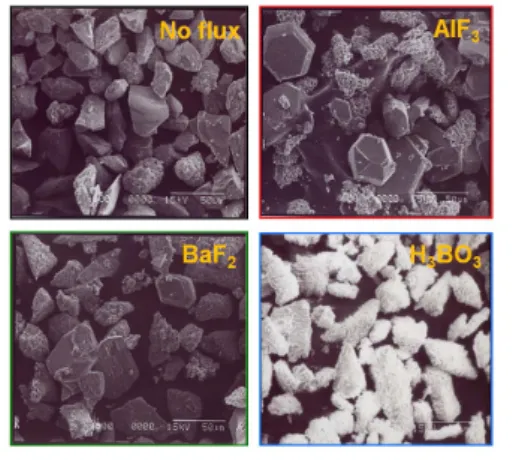
Figure 5 shows the SEM morphology of BAM:Eu0.15, Mn0.3 with various fluxes. In general,
BAM phosphor has a plate-shaped morphology due to its crystallographic characteristics. The phosphor particles with a fluoride base flux have a hexagonal surface morphology. A sample prepared by H3BO3
flux is semispherical and not smooth. The results also show that the morphology of phosphor particles af-fects their luminous property and stability.
Fig. 5. SEM image of BAM:Eu0.15, Mn0.3 with
various fluxes.
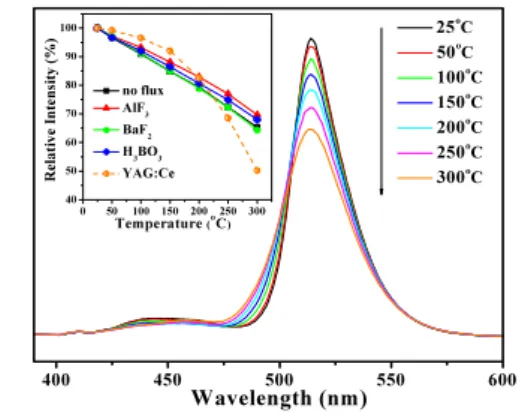
Figure 6 depicts the thermal quenching of the luminescence spectra of BAM:Eu0.15, Mn0.3 at various
temperatures from 25°C to 300°C. The decrease in the emission intensity and the corresponding FWHM (Full Width at Half Maximum) were obtained, which can be assigned to thermal quenching at configura-tionally coordinate diagram. [10,11] The inset plots the temperature dependent relative emission intensity of BAM:Eu0.15, Mn0.3 with various fluxes and
com-mercial YAG:Ce3+. In particular, synthesis with
fluxes such as AlF3 can enhance the thermal
quench-ing temperature (T50), all the samples have a higher
T50 than a commercial YAG:Ce3+, with values of over
300°C, indicating superior thermal stability as a lu-minescent material for white LEDs.
19-1 / R. –S. Liu • IMID 2009 DIGEST 400 450 500 550 600 0 50 100 150 200 250 300 40 50 60 70 80 90 100 no flux AlF3 BaF2 H3BO3 YAG:Ce Temperature (oC) R el at iv e In te ns ity (% ) Wavelength (nm) 25oC 50oC 100oC 150oC 200oC 250oC 300oC
Fig. 6. Temperature dependence of emission spectra of BAM:Eu0.15, Mn0.3. Inset shows
tem-perature-dependent relative emission intensity of samples with various fluxes and YAG:Ce3+.
Moist Stability is one of the important techno-logical parameter for phosphors used in white LEDs. In this work, the measurement of conductivity as a function of time has been used. Figure 7 plots the measurements for BAM:Eu0.15, Mn0.3 with various
fluxes. The increase in conductivity depends on time due to the interaction between moisture and host of phosphor, and fact that some ions of the phosphor host are dissolved in water. Especially, Synthesis with fluoride base fluxes such as AlF3 and BaF2 can
enhance the moist stability. The result is obtained because the phosphor particles with a fluoride base flux, which have a highly crystalline hexagonal sur-face morphology, cannot interact easily with the moisture. However, the sample with H3BO3 as flux
has lowest stability owing to the absence of high crystalline particles and smoothness surface. The PL spectra of as-received and hydrated for sampleswith AlF3 and H3BO3 as fluxes indicate the approximate
change in total integrated radiance is about −9% and −22%. Hence, synthesis with fluxes can enhance the moist stability, it is found that AlF3 has better
per-formance than BaF2 or H3BO3.
0 50 100 150 200 250 300 350 2 4 6 8 10 12 Co nd uc tiv ity (u s/c m) no flux AlF3 BaF2 H3BO3 Time (min.)
Fig. 7. Conductivity of BAM:Eu0.15, Mn0.3 as
function of time with various fluxes.
4. Summary
BaMgAl10O17 co-doped with Eu2+ and Mn2+ was
synthesized in a solid-state reaction. The energy transfer from Eu2+ to Mn2+ was mainly of the
reso-nance-type via electric dipole-quadrupole interaction. The critical distance (Rc) was calculated of 10.9 Å. In
addition, the addition of various fluxes such as AlF3
and BaF2 in the synthesis improved the moist and
thermal stability. This was an important requirement for phosphor of white light emitting diodes (LEDs).
Acknowledgments
The authors would like to thank for the financial supports from the National Science Council (Contract nos. NSC 97-2113-M-002-012-MY3 and NSC 97-3114-M-002-005), the Economic Affair (Contract no. 97-EC-17-A-07-S1-043), Taiwan and the Chi Mei Corporation (Tainan, Taiwan).
5. References
1. Schubert, E. F.; Kim, J. K. Science 2005, 308, 1274.
2. Zhang, J.; Zhang, Z.; Tang, Z.; Yao, Y.; Long, X. Chem. Mater.2002, 14, 3005.
3. Yang, P.; Yao, G. Q.; Lin, J. H. Opt. Mater. 2004, 26, 327.
4. Förster , Th. Ann. Physik.1948, 2, 55.
5. Dexter, D. L.; Schulman, J. A. J. Chem. Phys.
1954, 22, 1063.
6. Yang, W. J.; Luo, L.; Chen, T. M.; Wang, N. S. Chem. Mater.2005, 17, 3883.
7. Jung, K. Y.; Lee, H. W.; Kang, Y. C.; Park, S. B.; Yang, Y. S. Chem. Mater. 2005, 17, 2729.
8. Deng, C. Y.; He, D. W.; Zhuang, W. D.; Wang, Y. S.; Kang, K.; Huang, X. W. Chin. phys. 2004, 13, 473.
9. Rao, R. P. J. Electrochem. Soc.2005, 152, H115. 10. Shionoya, S.; Yen, W. M. Phosphor Handbook, Laser&Optical Science&Technology Series (CRC,
New York, 1998), pp. 65-220.
11. Kim, J. S.; Park, Y. H.; Kim, S. H.; Choi, J. C.; Park, H. L. Solid State Comm. 2005, 133, 445.