J Korean Acad Community Health Nurs (지역사회간호학회지)
Vol. 29 No. 3, 322-334, September 2018 https://doi.org/10.12799/jkachn.2018.29.3.322
Compliance with Respiratory Infection Preventive Behaviors and Its
related Factors in Older Adults using a Senior Center
Park, Yeon-Hwan
1· Lee, Seong Hyeon
2· Yi, Yu Mi
3· Lee, Chi Young
4· Lee, Min Hye
31Professor, College of Nursing, Seoul National University, Seoul 2Master's Degree Student, College of Nursing, Seoul National University, Seoul 3Doctoral Student, College of Nursing, Seoul National University, Seoul, Korea 4Doctoral Student, School of Nursing, Duke University, Durham, NC, USA
Purpose: The purpose of this study is to identify factors related to compliance with respiratory infection preventive behaviors including hand washing, cough etiquette, and oral hygiene of older adults. Methods: A cross-sectional study was conducted with a convenience sample of 100 older adults (mean age: 76.11±6.35 years, female: 86.0%). Data were collected from a community senior center through face to face interviews by using instruments including measuring knowledge, perceived threat, self-efficacy, compliance with respiratory infection preventive behaviors. Results: The mean score of knowledge was 7.52 out of 13 in total. The compliance with hand washing with soap was 6.0% for 8 or more times per day. Among the participants, 12.0% adhered to the cough etiquette. Sixty-two older adults (62.0%) didn't use interdental brushes or floss at all. The stepwise linear regression indicated that age and self-efficacy for respiratory infection preventive behaviors were significant factors and explained 24.0% of the com-pliance with hand washing and the cough etiquette. Education level, cancer diagnosis, and self-efficacy for respira-tory infection preventive behaviors were significant predictors of oral hygiene. The factor with the greatest effect was self-efficacy in the two models. Conclusion: The findings suggest that it is necessary to improve compliance with respiratory infection preventive behaviors among older adults using senior centers. In order to enhance the com-pliance, it is necessary to develop nursing programs based on the self-efficacy for respiratory infection preventive behaviors in the senior centers.
Key Words: Respiratory tract infections; Aged; Hand hygiene; Oral hygiene; Senior centers
Corresponding author: Lee, Min Hye
College of Nursing, Seoul National University, 103 Daehak-ro, Jongno-gu, Seoul 03080, Korea. Tel: +82-2-740-8413, E-mail: [email protected]
- This work was supported by the National Research Foundation of Korea (NRF) grant funded by the Korea government (Ministry of Science and ICT) (No. NRF-2016R1A2B4008890).
Received: Apr 23, 2018 / Revised: Aug 14, 2018 / Accepted: Aug 17, 2018
This is an open access article distributed under the terms of the Creative Commons Attribution Non-Commercial License (http://creativecommons.org/licenses/ by-nc/3.0), which permits unrestricted non-commercial use, distribution, and reproduction in any medium, provided the original work is properly cited.
INTRODUCTION
1. Background
Since the 20th century, following the development of antibiotics and vaccines, the focus of the medical system has shifted from the treatment of acute diseases such as in-fection to chronic disease management. However, recently interest in infectious diseases has been increased as emerg-ing infectious diseases have occurred and spread with the changes in the pathogens, increasing growth and mobility of population, and globalization. With the outbreaks of emerging infectious diseases worldwide, such as the Se-vere Acute Respiratory Syndrome (SARS) in 2002, H1N1
influenza in 2009, the Ebola virus disease in 2015, and the Middle East Respiratory Syndrome (MERS) in 2015, Korea also experienced public health emergency and social pro-blems. In addition, as the mortality rate from respiratory infections has increased over the past decade [1], the need for systematic preparation of resources and capacity in community level for respiratory infections has been in-creasing.
Older people are very vulnerable to infectious diseases due to health status, including decreased immune func-tion and comorbidities. Compared with other age groups, respiratory infections are more likely to lead to serious consequences in older people due to the risk of morbidity and mortality from complications [2]. About 90% of all
in-fluenza-related deaths occur in elderly population [3], and the mortality from pneumonia is the highest in people aged 65 years and over [1]. Therefore, it is very important to take measures to prevent respiratory infections for the older population. To prevent respiratory infections, the World Health Organization recommends non-pharma-ceutical interventions in daily life, such as hand washing and cough etiquette [4]. Hand washing is a cost-effective way to reduce the incidence of gastrointestinal and respi-ratory infections [5]. In a randomized controlled trial, it was found that compliance with both cough etiquette and hand washing can reduce the incidence of influenza by 52.0%[6]. With hand washing and cough etiquette, oral hy-giene is important for the prevention of respiratory in-fections in older people. If oral hygiene is not effectively performed, colonization with pathogenic bacteria in oral cavity increases the risk of pneumonia [7]. A systematic re-view showed that oral hygiene plays an important role in preventing respiratory infections such as pneumonia and associated mortality [8]. Therefore, compliance with non- pharmaceutical behaviors such as oral hygiene, hand wash-ing, and cough etiquette is needed to in order to prevent respiratory infections such as pneumonia [5,6].
Vaccination rate of influenza among Korean older peo-ple was reported to be over 80.0%, which is relatively high level [9] and pneumococcal vaccination rate was 56.3% [10]. However, analysis of previous studies of hand wash-ing compliance conducted in 19 countries showed that hand washing prevalence was low especially in Korea among high income countries [11]. Actually, according to a large-scale survey conducted in Korea, compliance with hand washing using soap in adults aged 50 and over was only 27.4% [12], and compliance with cough etiquette was 30.9% [13]. The rate of tooth brushing among older people was also reported to be low in Korea [14]. In short, com-pliance of non-pharmaceutical preventive behaviors in-cluding hand washing, cough etiquette, and oral hygiene were found to be low in Korea.
In order to establish strategies to improve compliance with respiratory infection preventive behaviors, the prob-lem diagnosis is first required through investigation of the status and actual condition of target population. However, there are few studies which reported compliance with res-piratory infection preventive behaviors in Korean older population, it is difficult to know the current status pre-cisely. Also, it is necessary to identify factors related to compliance with preventive behaviors among older peo-ple, but there is little evidence in previous studies in Korea. The Health Belief Model is useful to explain pre-ventive behaviors and health behaviors for a specific
dis-ease [15]. This theory explains that when individuals per-ceive that they are susceptible to illness or health prob-lems, and perceive the consequences to be serious, they are more likely to perform health behaviors [15]. In the modi-fied Health Belief Model, this concept is termed as per-ceived threat [15]. This is an important factor in various health behaviors [16] and has been reported to be a related factor of respiratory infection preventive behaviors in Hong Kong [17]. When people perceived that they are highly susceptible to respiratory infectious diseases and the consequences are serious, they were more likely to per-form preventive behaviors [17]. In addition, self-efficacy, which was reported to increase the explanatory power of the health belief model, was also an important factor influ-encing compliance with respiratory infection preventive behaviors [17]. A study conducted among older people in Hong Kong found that older people with higher self-effi-cacy were more likely to have good compliance with pre-ventive behaviors [17]. In addition to, knowledge is a fac-tor influencing preventive behaviors, and it was reported that people were less likely to take preventive actions when knowledge about influenza was lacking [18]. As described so far, previous studies in other countries have shown that knowledge, perceived threat, and self-efficacy are factors related to respiratory infection preventive behaviors.
In Korea, studies have been conducted mainly with children, students, and military personnel. There have been studies on preventive behaviors against influenza in older people, but the items used to measure preventive be-haviors were not expressed clearly enough to reflect actual conditions, and validity verification was not clearly des-cribed. In addition, it is possible that the patterns of the preventive behaviors in the older population in Korea may have been changed since the MERS outbreak in 2015 caused public anxiety. Therefore, there is a need to exam-ine the level of compliance with respiratory infection pre-ventive behaviors in older people by complementing the limitations of previous studies and reflecting the changed social background and to investigate the related factors, including the factors reported in previous studies of other countries, such as knowledge, perceived threat, and self- efficacy. In recent years, some developed countries have emphasized infection control in social welfare facilities. A senior center is an environment where older people ac-tively and regularly interact with each other, it is a place where infectious diseases may occur and spread. There-fore, this study aimed to investigate compliance with res-piratory infection preventive behaviors and to identify the related factors among older people using a senior center.
2. Purpose
The purpose of this study was to investigate compliance with respiratory infection preventive behaviors such as hand washing, cough etiquette, and oral hygiene among elderly people using a senior center and to identify influ-encing factors. The specific objectives are as follows:
To investigate compliance with respiratory infection preventive behaviors among elderly people using a senior center
To examine differences in knowledge, perceived threat, self-efficacy, and respiratory infection preventive be-haviors according to the characteristics of elderly peo-ple using a senior center
To identify factors related to compliance with respira-tory infection preventive behaviors among elderly people using a senior center
METHODS
1. Study Design
This study is a descriptive study to investigate compli-ance with respiratory infection preventive behaviors such as hand washing, cough etiquette, and oral hygiene among elderly people using a senior center and to identify the in-fluencing factors such as knowledge, perceived threat, and self-efficacy about respiratory infection and preventive behaviors.
2. Participants
The participants of this study were people who met the inclusion and exclusion criteria and who voluntarily agreed to participate in the study among elderly people aged 65 and over using a single senior center located inJ District, S City from the population of elderly people aged 65 and over using senior centers in S City. The sample size was determined using G power 3.1.9 program by applying the significance level of .05, power of .80, effect size of 0.15 (medium) and including 5 variables (the sample size was based on 5 variables because 5 variables as the factors in-fluencing hand washing and cough etiquette and 3 varia-bles as the factors influencing oral hygiene were included in the regression analysis) for stepwise regression analy-sis, and as a result, the calculated sample size was 92. A to-tal of 100 participants voluntarily agreed to participate in the study and were included in the final analysis.
(1) Inclusion criteria
Person who has no difficulty in communication and
can read and understand Korean (2) Exclusion criteria
Person who has pneumonia and influenza at the time of the survey
3. Measures
1) General characteristics and health related characteristics
A structured questionnaire was used to investigate gen-eral characteristics such as gender, marital status, education level and health related characteristics such as the diagnosis of chronic diseases (cancer, hemato-oncologic disease, etc), history of respiratory diseases, history of hospitalization in the previous year, smoking and drinking status, and his-tory of influenza and pneumococcal vaccination.
2) Knowledge
The knowledge about respiratory infection and pre-ventive behaviors was assessed with a modified version of the tool which Choi et al. [19] used to measure knowledge about pneumonia and pneumococcal vaccination. We mo-dified that by revising and supplementing the contents about respiratory infection and preventive behaviors based on influenza guidelines. This instrument consists of 3 items about general knowledge, 2 items about transmission routes, 3 items about symptoms and complications, 2 items about the risk factors, and 3 items of preventive behaviors. Each item is dichotomous scored (1=correct, 0=incorrect or don’t know). Higher scores indicate higher levels of knowledge. The content validity was verified by two nurs-ing professors, one expert on infection management, and two experts on long-term care facilities, and the content validity index (CVI) was 0.98. In this study, the reliability (Kuder-Richardson 20) was .76.
3) Perceived threat
In the modified Health Belief Model proposed by Ro-senstock et al. [15], perceived threat is the combination of perceived susceptibility and perceived severity. Perceived susceptibility refers to an individual’s belief about the likelihood of getting a disease, and perceived severity means an individual’s belief about the seriousness of con-sequence of contracting a disease [15]. In this study, per-ceived threat of respiratory infection refers to an indivi-dual’s perception of susceptibility to respiratory infection and severity of the disease.
In this study, perceived threat was operationally de-fined as the sum of perceived susceptibility and severity based on Rosenstock et al.[15] and Champion and Skinner [16]. The Health Belief Model Applied to Influenza
pro-posed by Erkin and Ozsoy [20] was used to measure per-ceived threat after approval from the developer. We trans-lated and modified the original tool through the process of translation and back-translation. The tool was composed of a total of 12 items on a 5-point Likert scale, including 6 items about perceived susceptibility and 6 items about perceived severity. Higher scores indicate greater degrees of perceived threat. A graduate student in the research team who was fluent in both English and Korean first translated it into Korean and another graduate student back-translated it into English. We compared the transla-tions to examine the content correspondence, and revi-sed and supplemented the contents to make them suitable for older people in Korea. The content validity was eval-uated by five experts, and the CVI was 0.92. The reliability (Cronbach’s ⍺) was .70 in this study.
4) Self-efficacy
Self-efficacy for respiratory infection preventive behav-iors refers to the belief that one can successfully perform respiratory infection preventive behaviors. The items about oral hygiene were added to Park’s [21] tool which is used to measure self-efficacy for hand washing and cough eti-quette. The tool consists of a total of 12 items on a 5-point Likert scale, and it includes 9 items about hand washing and cough etiquette and 3 items about oral hygiene, such as ‘I am confident that I wash my hands 8 times a day for at least 30 seconds everyday’, ‘I am confident that I cover my mouth with a tissue when I cough or sneeze’, and ‘I am con-fident that I brush my teeth regularly 3 times a day for at least 3 minutes at a time everyday’ Higher scores indicate higher levels of self-efficacy. The CVI was 0.98 and the reli-ability (Cronbach’s ⍺) was .82 in this study.
5) Respiratory infection preventive behaviors
Respiratory infection preventive behaviors are medi-cally recommended behaviors that individuals voluntari-ly perform to prevent respiratory infections, and they in-clude hand washing, cough etiquette and oral hygiene.
Hand washing and cough etiquette were measured with a modified version of Park’s [21] tool used to measure hand washing and cough etiquette. We mo-dified that by adding and supplementing some items to reflect the proper methods of hand washing and cough etiquette recommended by the Korea Centers for Disease Control and Prevention. The tool consists of a total of 4 items on 5-point Likert scale, such as ‘I wash my hands with soap 8 times a day for at least 30 seconds’ and ‘I cover my mouth with a tissue or my el-bow when I sneeze or cough’. Higher scores indicate
higher level of compliance with hand washing and cough etiquette. The content validity of the tool was verified by five experts, and the CVI was 0.95. The reli-ability(Cronbach’s ⍺) was .74 in this study. In addition, the item about frequency according to time and method was added to examine the specific hand washing com-pliance.
The Index for Oral Hygiene Behavior developed by Buunk-Werkhoven et al.[22] was used to assess oral hygiene after approval from the developer. The origi-nal tool was modified through the processes of trans-lation, back-transtrans-lation, and supplementation. One graduate student who is fluent in both English and Korean translated the original version into Korean, and another graduate student back-translated the transla-tion into English. Then, the translatransla-tions were reviewed and the tool was modified to make it suitable for older people in Korea. This instrument consists of a total of 8 items, each item is rated on 0~4 point according to the method presented by Buunk-Werkhoven et al. [22], and the total scores range from 0 to 17 points. Higher scores indicate higher levels of compliance with oral hygiene. The CVI calculated by the five experts was 0.98, and the reliability (Cronbach’s ⍺) was .77 in this study.
4. Data Collection
Data collection was conducted inJuly 2017 after receiv-ing approval from the Institutional Review Board of Seoul National University (IRB No. 1706/003-003). Eight under-graduates were recruited as interviewers, and two-hour training was conducted on the survey guidelines such as research ethics, study purpose, and method before the da-ta collection. Before the survey, the research team pro-vided the participants with explanation about the purpose of the research, the contents of the survey, the procedure, the time required for the survey, voluntary participation, and withdrawal, and asked the participants to decide whether to participate or not after checking the contents. Data were collected by face-to-face interview with partici-pant who voluntarily signed the informed consent. The time required for each participant to complete the ques-tionnaire was about 20~30 minutes.
5. Data Analysis
The collected data were analyzed using SPSS version 22.0 for Windows.
The general and health related characteristics of the participants were calculated as the frequency,
per-centage, mean, and standard deviation.
The data of respiratory infection preventive behav-iors, knowledge, perceived threat and self-efficacy of the participants were calculated as the frequency, per-centage, mean, and standard deviation.
Differences in knowledge, perceived threat, self-effi-cacy, and respiratory infection preventive behaviors according to the characteristics of the participants were analyzed using the t-test and one-way ANOVA. The post-hoc tests were performed using Scheffé test when variances were equal, but when variances were unequal, Welch’s t-test was used and Dunnett T3 test was also performed.
Pearson’s correlation was used to examine the corre-lations between variables and respiratory infection preventive behaviors, and stepwise linear regression was performed to examine related factors by convert-ing the nominal variables into dummy variables. The reliability was estimated using Cronbach’s ⍺
co-efficient and Kuder-Richardson 20 (KR-20).
RESULTS
1. General Characteristics and Health related
Char-acteristics of the Participants
Table 1 shows the general characteristics and health re-lated characteristics of the participants. Half of the partic-ipants were 75~84 age group, and the mean age of the par-ticipants were 76.11 years. Eighty six parpar-ticipants (86.0%) were women, and the average education level was 7.45 years. Three out of 5 participant (62.0%) were widowed, 46.0% were living alone, and the number of family mem-bers living with the participants was 0.94 person on aver-age. More than half of participants (52.0%) had hyperten-sion, and 4 participants (4.0%) had asthma at the time of da-ta collection. Seven participants had experienced influen-za and 4 persons had experienced pneumonia in the past 5 years. Fifteen out of 100 participants had history of hospi-talization in the previous year. Seven participants were smokers and 24 elderly were drinkers. The largest pro-portion of the participants (65.0%) responded that they had received the pneumococcal vaccination and 83.0% of par-ticipants said that they were vaccinated against influenza.
2. Knowledge, Perceived Threat, Self-efficacy, and
Respiratory Infection Preventive Behaviors
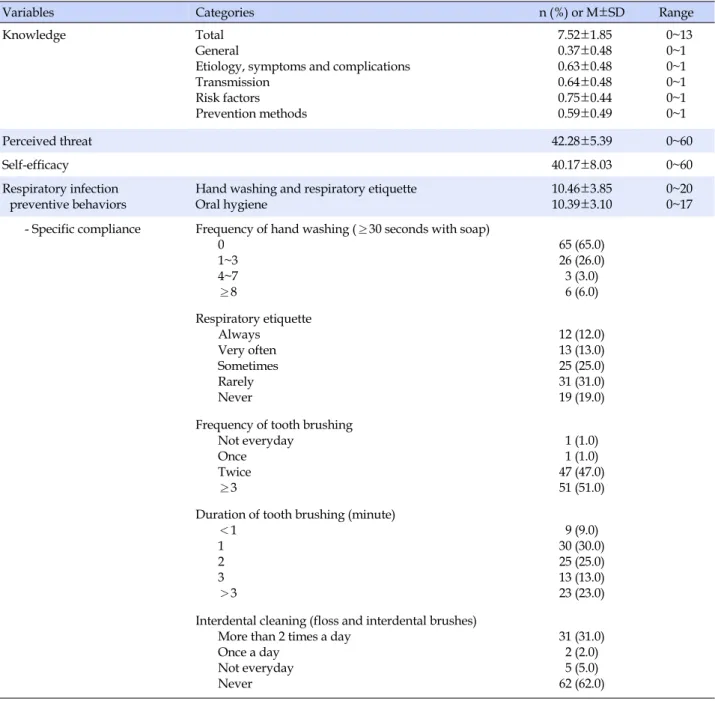
The variables related to respiratory infection and pre-ventive behaviors are presented in Table 2. The mean
score for knowledge was 7.52 out of 13 points. The mean score for perceived threat was 42.28 out of 60 points, and the mean score for self-efficacy was 40.17 points out of 60 points. The mean score for compliance with hand washing and cough etiquette was 10.46 out of 20 points, and the mean score for compliance with oral hygiene was 10.39 out of 17 points. Table 2 also shows the specific compliance with respiratory infection preventive behaviors. Of the to-tal participants, only 6 participants (6.0%) reported that they performed hand washing with soap for at least 30 sec-onds 8 times or more a day, and 12.0% responded that they always adhered to cough etiquette. It was shown that 51.0% brushed their teeth more than 3 times a day, and that 36.0% brushed their teeth for more than 3 minutes. The largest proportion of the respondents (62.0%) did not use interdental brushes or dental flosses.
3. Differences in Knowledge, Perceived Threat,
Self-efficacy, and Respiratory Infection Preventive
Be-haviors according to the Characteristics of the
Participants
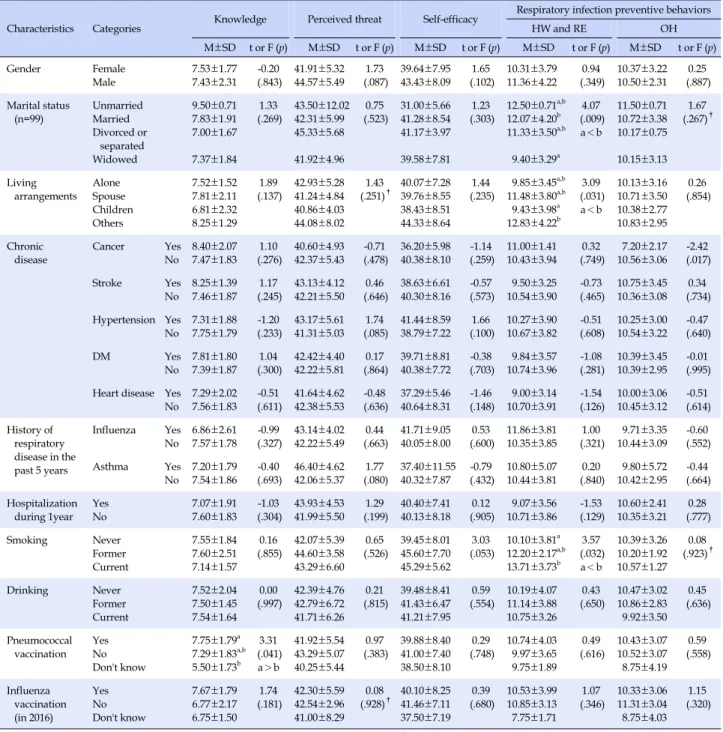
Table 3 shows the differences in knowledge, perceived threat, self-efficacy, and respiratory infection preventive behaviors according to the general characteristics and health related characteristics of the participants. There was a significant difference in knowledge of the partici-pants according to the history of pneumococcal vaccina-tion (F=3.31, p=.041). However, there was no statistically significant difference in knowledge according to gender, marital status, living arrangement, chronic disease, history of respiratory disease, smoking and drinking status, his-tory of hospitalization in the previous year, and hishis-tory of influenza vaccination. In addition, there was no statisti-cally significant difference in perceived threat and self-effi-cacy according to the characteristics of the participants.
There was a significant difference in compliance with hand washing and cough etiquette according to marital status (F=4.07, p=.009), living arrangement (F=3.09, p= .031), and smoking status (F=3.57, p=.032). The level of compliance was higher in married participants than peo-ple were widowed. According to the result of post-hoc analysis, the level of compliance was higher in people clas-sified as other cases, such as those living with three gen-erations or those living together with spouse and children than people living with only their children. According to smoking status, the level of compliance was higher in smo-kers. There were no statistical differences in compliance with hand washing and cough etiquette according to gen-der, chronic disease, history of respiratory disease, history
Table 1. General and Health related Characteristics of the Participants (N=100) Characteristics Categories n (%) or M±SD Age (year) 65~74 75~84 ≥85 76.11±6.35 42 (42.0) 50 (50.0) 8 (8.0) Gender Female Male 86 (86.0) 14 (14.0)
Education level (year) 7.45±4.78
Marital Status (n=99) Unmarried
Married Divorced or Separated Widowed 2 (2.0) 29 (29.0) 6 (6.0) 62 (62.0)
Living arrangements Alone
Spouse Children
Others (3rd generation, spouse+children)
46 (46.0) 21 (21.0) 21 (21.0) 12 (12.0)
Household size 0.94±1.20
Chronic disease Cancer
Stroke Hypertension Diabetes mellitus Heart disease 5 (5.0) 8 (8.0) 52 (52.0) 31 (31.0) 14 (14.0) History of respiratory disease in the past 5 years Influenza
Pneumonia Asthma
Chronic obstructive pulmonary disease Others (rhinitis, bronchitis)
7 (7.0) 4 (4.0) 5 (5.0) 1 (1.0) 4 (4.0)
Respiratory disease in present Asthma
Chronic obstructive pulmonary disease Others (rhinitis, bronchitis)
4 (4.0) 1 (1.0) 2 (2.0)
Hospitalization during 1 year Yes
No 15 (15.0)85 (85.0) Smoking Never Former Current 88 (88.0) 5 (5.0) 7 (7.0) Drinking Never Former Current 62 (62.0) 14 (14.0) 24 (24.0)
Pneumococcal vaccination Yes
No Don't know
65 (65.0) 31 (31.0) 4 (4.0)
Influenza vaccination (in 2016) Yes
No Don't know
83 (83.0) 13 (13.0) 4 (4.0)
of hospitalization in the previous year, drinking status, and history of influenza and pneumococcal immunization.
There was a significant difference in compliance with oral hygiene according to cancer diagnosis. The level of compliance with oral hygiene was significantly higher in participants without cancer than those who were
diag-nosed with cancer (t=-2.42, p=.017). However, there were no significant differences in compliance with oral hygiene according to gender, marital status, living arrangement, history of respiratory disease, history of hospitalization in the previous year, smoking and drinking status, and his-tory of influenza and pneumococcal vaccination.
Table 2. Knowledge, Perceived Threat, Self-efficacy, and Preventive Behaviors for Respiratory Infection (N=100)
Variables Categories n (%) or M±SD Range
Knowledge Total
General
Etiology, symptoms and complications Transmission Risk factors Prevention methods 7.52±1.85 0.37±0.48 0.63±0.48 0.64±0.48 0.75±0.44 0.59±0.49 0~13 0~1 0~1 0~1 0~1 0~1 Perceived threat 42.28±5.39 0~60 Self-efficacy 40.17±8.03 0~60 Respiratory infection preventive behaviors
Hand washing and respiratory etiquette Oral hygiene
10.46±3.85 10.39±3.10
0~20 0~17 - Specific compliance Frequency of hand washing (≥30 seconds with soap)
0 1~3 4~7 ≥8 65 (65.0) 26 (26.0) 3 (3.0) 6 (6.0) Respiratory etiquette Always Very often Sometimes Rarely Never 12 (12.0) 13 (13.0) 25 (25.0) 31 (31.0) 19 (19.0) Frequency of tooth brushing
Not everyday Once Twice ≥3 1 (1.0) 1 (1.0) 47 (47.0) 51 (51.0) Duration of tooth brushing (minute)
<1 1 2 3 >3 9 (9.0) 30 (30.0) 25 (25.0) 13 (13.0) 23 (23.0) Interdental cleaning (floss and interdental brushes)
More than 2 times a day Once a day Not everyday Never 31 (31.0) 2 (2.0) 5 (5.0) 62 (62.0)
4. Factors related to Respiratory Infection
Preven-tive Behaviors
Table 4 shows the correlations among age, education level, household size, knowledge, perceived threat, self- efficacy, and respiratory infection preventive behaviors. The perceived threat was positively correlated with edu-cation level (r=.23, p=.024), while hand washing and cough etiquette were negatively correlated with age (r=-.20, p= .048) and positively correlated with household size (r=.24,
p=.018) and self-efficacy (r=.45, p<.001). Oral hygiene was
positively correlated with educational level (r=.23, p=.022) and self-efficacy (r=.32, p=.001). There was a negative cor-relation between age and education level (r=-.37, p<.001). Stepwise regression analysis was performed to identify the factors related to respiratory infection preventive be-haviors among the variables that were found to be sig-nificant in the correlation test and univariate analysis. In the regression analysis for hand washing and cough eti-quette, age, living arrangement, smoking status, house-hold size, and self-efficacy were included and nominal variables such as living arrangement and smoking status
Table 3. Difference of Knowledge, Perceived threat, Self-efficacy and Preventive Behaviors by Characteristics of the Participants
(N=100)
Characteristics Categories Knowledge Perceived threat Self-efficacy
Respiratory infection preventive behaviors
HW and RE OH M±SD t or F (p) M±SD t or F (p) M±SD t or F (p) M±SD t or F (p) M±SD t or F (p) Gender Female Male 7.53±1.777.43±2.31 -0.20(.843) 41.91±5.3244.57±5.49 (.087)1.73 43.43±8.0939.64±7.95 (.102)1.65 10.31±3.7911.36±4.22 (.349)0.94 10.37±3.2210.50±2.31 (.887)0.25 Marital status (n=99) UnmarriedMarried Divorced or separated Widowed 9.50±0.71 7.83±1.91 7.00±1.67 7.37±1.84 1.33 (.269) 43.50±12.0242.31±5.99 45.33±5.68 41.92±4.96 0.75 (.523) 31.00±5.6641.28±8.54 41.17±3.97 39.58±7.81 1.23 (.303) 12.50±0.71 a,b 12.07±4.20b 11.33±3.50a,b 9.40±3.29a 4.07 (.009) a<b 11.50±0.71 10.72±3.38 10.17±0.75 10.15±3.13 1.67 (.267)† Living arrangements Alone Spouse Children Others 7.52±1.52 7.81±2.11 6.81±2.32 8.25±1.29 1.89 (.137) 42.93±5.28 41.24±4.84 40.86±4.03 44.08±8.02 1.43 (.251)† 40.07±7.2839.76±8.55 38.43±8.51 44.33±8.64 1.44 (.235) 9.85±3.45a,b 11.48±3.80a,b 9.43±3.98a 12.83±4.22b 3.09 (.031) a<b 10.13±3.16 10.71±3.50 10.38±2.77 10.83±2.95 0.26 (.854) Chronic
disease Cancer YesNo 8.40±2.077.47±1.83 (.276)1.10 40.60±4.9342.37±5.43 (.478)-0.71 36.20±5.9840.38±8.10 -1.14(.259) 11.00±1.4110.43±3.94 (.749)0.32 7.20±2.1710.56±3.06 (.017)-2.42
Stroke Yes No 8.25±1.39 7.46±1.87 1.17 (.245) 43.13±4.12 42.21±5.50 0.46 (.646) 38.63±6.61 40.30±8.16 -0.57 (.573) 9.50±3.25 10.54±3.90 -0.73 (.465) 10.75±3.45 10.36±3.08 0.34 (.734) Hypertension Yes No 7.31±1.88 7.75±1.79 -1.20 (.233) 43.17±5.61 41.31±5.03 1.74 (.085) 41.44±8.59 38.79±7.22 1.66 (.100) 10.27±3.90 10.67±3.82 -0.51 (.608) 10.25±3.00 10.54±3.22 -0.47 (.640) DM Yes No 7.81±1.807.39±1.87 (.300)1.04 42.42±4.4042.22±5.81 (.864)0.17 40.38±7.7239.71±8.81 -0.38(.703) 9.84±3.5710.74±3.96 -1.08(.281) 10.39±3.4510.39±2.95 (.995)-0.01 Heart disease Yes
No 7.29±2.027.56±1.83 -0.51(.611) 41.64±4.6242.38±5.53 (.636)-0.48 40.64±8.3137.29±5.46 -1.46(.148) 9.00±3.1410.70±3.91 -1.54(.126) 10.00±3.0610.45±3.12 (.614)-0.51 History of respiratory disease in the past 5 years Influenza Yes No 6.86±2.617.57±1.78 -0.99(.327) 43.14±4.0242.22±5.49 (.663)0.44 40.05±8.0041.71±9.05 (.600)0.53 11.86±3.8110.35±3.85 (.321)1.00 9.71±3.3510.44±3.09 (.552)-0.60 Asthma Yes No 7.20±1.79 7.54±1.86 -0.40 (.693) 46.40±4.62 42.06±5.37 1.77 (.080) 37.40±11.55 40.32±7.87 -0.79 (.432) 10.80±5.07 10.44±3.81 0.20 (.840) 9.80±5.72 10.42±2.95 -0.44 (.664) Hospitalization
during 1year YesNo 7.07±1.917.60±1.83 -1.03(.304) 43.93±4.5341.99±5.50 (.199)1.29 40.40±7.4140.13±8.18 (.905)0.12 9.07±3.5610.71±3.86 -1.53(.129) 10.60±2.4110.35±3.21 (.777)0.28
Smoking Never Former Current 7.55±1.84 7.60±2.51 7.14±1.57 0.16 (.855) 42.07±5.3944.60±3.58 43.29±6.60 0.65 (.526) 39.45±8.0145.60±7.70 45.29±5.62 3.03 (.053) 10.10±3.81 a 12.20±2.17a,b 13.71±3.73b 3.57 (.032) a<b 10.39±3.26 10.20±1.92 10.57±1.27 0.08 (.923)† Drinking Never Former Current 7.52±2.04 7.50±1.45 7.54±1.64 0.00 (.997) 42.39±4.7642.79±6.72 41.71±6.26 0.21 (.815) 39.48±8.4141.43±6.47 41.21±7.95 0.59 (.554) 10.19±4.0711.14±3.88 10.75±3.26 0.43 (.650) 10.47±3.0210.86±2.83 9.92±3.50 0.45 (.636) Pneumococcal vaccination Yes No Don't know 7.75±1.79a 7.29±1.83a,b 5.50±1.73b 3.31 (.041) a>b 41.92±5.54 43.29±5.07 40.25±5.44 0.97 (.383) 39.88±8.40 41.00±7.40 38.50±8.10 0.29 (.748) 10.74±4.03 9.97±3.65 9.75±1.89 0.49 (.616) 10.43±3.07 10.52±3.07 8.75±4.19 0.59 (.558) Influenza vaccination (in 2016) Yes No Don't know 7.67±1.79 6.77±2.17 6.75±1.50 1.74 (.181) 42.30±5.5942.54±2.96 41.00±8.29 0.08 (.928)† 40.10±8.2541.46±7.11 37.50±7.19 0.39 (.680) 10.53±3.9910.85±3.13 7.75±1.71 1.07 (.346) 10.33±3.0611.31±3.04 8.75±4.03 1.15 (.320) HW=hand washing; RE=respiratory etiquette; OH=oral hygiene; DM=diabetes mellitus; †Welch's t-test.
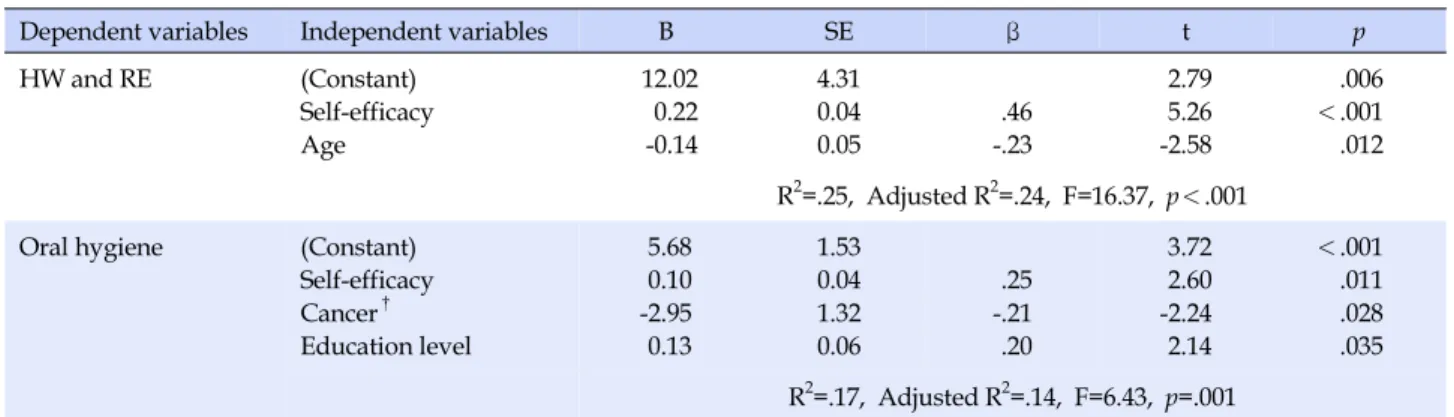
were converted into dummy variables and analyzed. Mari-tal status was not included in the analysis because the number of subjects in category was very small. In the re-gression analysis for oral hygiene, education level, cancer diagnosis, and self-efficacy were included. The analysis results showed that two models satisfied the assumption of independence of residuals, and neither multi-collinear-ity nor outliers were detected. For hand washing and cough
etiquette, the regression model with the two variables of age and self-efficacy was significant (F=16.37, p<.001), and for oral hygiene, the regression model with the three variables of self-efficacy, education level, and cancer diag-nosis status was found to be significant (F=6.43, p=.001). Self-efficacy was identified as the most important factor affecting both hand washing and cough etiquette and oral hygiene (Table 5).
Table 4. Correlation among Variables (N=100) Variables Age Education level Household size Knowledge Perceived threat Self-efficacy HW and RE Oral hygiene r (p) r (p) r (p) r (p) r (p) r (p) r (p) r (p) Age 1.00 -.37 (<.001) -.15 (.149) -.08 (.429) .02 (.857) .06 (.545) -.20 (.048) .03 (.801) Education level 1.00 .05 (.633) .20 (.052) .23 (.024) .12 (.234) .13 (.188) .23 (.022) Household size 1.00 .04 (.714) -.08 (.445) .13 (.189) .24 (.018) -.03 (.774) Knowledge 1.00 -.01 (.932) .14 (.163) .14 (.157) .09 (.356) Perceived threat 1.00 .05 (.602) -.03 (.762) -.01 (.962) Self-efficacy 1.00 .45 (<.001) .32 (.001) HW and RE 1.00 .15 (.136) Oral hygiene 1.00
HW=hand washing; RE=respiratory etiquette.
Table 5. Factors related to Respiratory Infection Preventive Behaviors by Stepwise Linear Regression Analysis (N=100)
Dependent variables Independent variables B SE β t p
HW and RE (Constant) Self-efficacy Age 12.02 0.22 -0.14 4.31 0.04 0.05 .46 -.23 2.79 5.26 -2.58 .006 <.001 .012 R2=.25, Adjusted R2=.24, F=16.37, p<.001
Oral hygiene (Constant)
Self-efficacy Cancer† Education level 5.68 0.10 -2.95 0.13 1.53 0.04 1.32 0.06 .25 -.21 .20 3.72 2.60 -2.24 2.14 <.001 .011 .028 .035 R2=.17, Adjusted R2=.14, F=6.43, p=.001
HW=hand washing; RE=respiratory etiquette; †
Reference category: participants without cancer.
DISCUSSION
It is important to promote compliance with preventive behaviors of individuals in community for preventing outbreak and infection control. This study identified the level of compliance with respiratory infection preventive behaviors and its related factors in community dwelling elderly as high risk population at a critical time of respira-tory infection control. The results of this study may be use-ful for developing specific interventions to improve pliance as prevention measure for older people in com-munity-based approach. In addition, previous studies have focused mainly on the vaccination rate, which is a pharma-ceutical intervention, but this study is differentiated from other studies in that it deals with several major non-phar-maceutical preventive behaviors against respiratory infec-tions. Also, since the specific compliance with each behav-ior was examined, the results are expected to serve as a ba-sis in understanding the problems of the target group and developing appropriate promotion strategies. Above all, it
is meaningful that this study paid attention to social wel-fare facilities, a blind spot in the management of infectious diseases which has not yet been actively dealt with in stud-ies in Korea, and this study targeted the elderly using a se-nior center at potential risk of infection transmission be-cause where social contact and activities of many elderly people occur.
In this study, we investigated the vaccination rate of older people as one of their health related characteristics. As a result, 65.0% of the participants responded that they had received pneumococcal vaccination and 83.0% re-sponded that they had received influenza vaccination. The results are consistent with a prior study which reported that the influenza vaccination rate in older people in Korea is over 80.0%[9], but they are somewhat different from the results of other previous studies [10,19] which reported that the pneumococcal vaccination rate was 19.3% in 2011 [19] and 56.3% in 2015[10]. These discrepancies in the study results can be attributed to the differences in the time of survey. In Korea, the free pneumococcal
immuni-zation program for older people aged 65 years and over has been implemented since 2013, which is thought to ex-plain the fact that the pneumococcal vaccination rate in this study investigated in 2017, seems to be higher than the vaccination rate reported in the previous study. In a pre-vious study, most elderly people did not receive pneumo-coccal vaccines because they didn't know about the vacci-nation well [19]. In a similar vein, the univariate analysis of this study showed that the level of knowledge related to respiratory infection and preventive behaviors was higher in participants who were vaccinated against pneumococ-cal disease. As a result of the free immunization program as cost support, active provision of information through the public health center and the mass media is thought to have contributed to the improvement of pneumococcal vaccination rate. However, since it is still lower than the influenza vaccination rate, considering the fact that the ad-vice of healthcare providers affects vaccination rate, pro-fessional advice and active promotion by the healthcare providers in community institutions such as senior centers are expected to contribute to the prevention of respiratory infections and health promotion in older people.
The mean score for knowledge of respiratory infection and preventive behaviors was 7.52 points, and older peo-ple using a senior center had correct knowledge about on-ly half of 13 items. Particularon-ly, the scores of general know-ledge and knowknow-ledge of preventive behaviors were low. The responses of the items about general knowledge showed that many people incorrectly knew that ‘influenza and the cold are the same disease and influenza isjust se-vere type of a cold’ and many respondents also had the misinformation that ‘a person who have received vaccines does not get pneumonia or influenza’. The respondents showed a lack of knowledge about the correct method of hand washing among the items on preventive behaviors. It is important to perform hand washing with proper me-thod, duration, and frequency as recommended [2]. Al-though the survey was conducted by the self-report meth-od in this study, only 6.0% of the participants reported that they wash their hands using soap for at least 30 seconds 8 times or more a day. Compared with a Thailand study of various age groups in which compliance with hand wash-ing uswash-ing soap was 33.5% [23], and a study conducted in Korean which reported compliance with hand washing was 15.9% in adults [12], the compliance with hand wash-ing among elderly people in this study was rather lower. These results indirectly show that although elderly people know the conventional wisdom that they should wash their hands and self-report that they frequently wash their hands, but they do not practice hand washing with proper
way because of lack of knowledge about recommended method. Although the Korea Centers for Disease Control and Prevention (KCDC) has been providing information through various strategies to raise public awareness such as ‘1830 hand washing’, it might be an ineffective way to improve knowledge and compliance with health behav-iors in the older population in view of study results [2]. Therefore, behavior change strategies are needed to help to get correct knowledge and this can be linked to com-pliance with health behaviors.
Among the older people using a senior center who par-ticipated in this study, only 12.0% responded that they al-ways adhere to cough etiquette. This result is slightly dif-ferent from that of a previous study which reported that compliance with cough etiquette was 30.9% in 1,000 peo-ple aged 13 years or older [13]. However, the results in this study is similar to that of Nasreen et al. [24] which found that 7.7% adhered to cough etiquette in a proper way among people aged 1 to 83 years old through direct ob-servation by visiting schools and homes. Korea has experi-enced an outbreak of MERS, and the incidence of tuber-culosis and associated mortality are the highest among OECD countries. Recently, there has been massive promo-tion about cough etiquette to increase the public aware-ness about it. However, the results of this study revealed that the compliance with cough etiquette was very low among older people. In a previous study, the main reason for not complying with cough etiquette was that ‘I don’t have a habit of cough etiquette’ (72.3%) [13], confirming the importance of the habitual practice of health beha-viors. Health behaviors are difficult to become habitual in a short period, so long-term plans for the habituation of correct cough etiquette is required.
In this study, 51.0% of the participants responded that they brushed their teeth more than three times a day. This was slightly higher than reported by a previous study [14]. However, only 36.0% of the participants said that they brushed their teeth for more than 3 minutes, 62.0% did not practice dental cleaning using a interdental brush or tooth floss. Many older people performed oral hygiene behav-iors for a shorter time than recommended or did not per-form required essential oral hygiene behaviors. If the pla-que is not properly removed by toothbrushing and inter-dental cleaning, it will increase the risk of oral disease, and this may lead directly to general diseases such as pneumonia. Therefore, there is a need to implement edu-cation to provide elderly using a senior center with in-formation about the proper brushing technique and the types, effects, and uses of oral hygiene products.
the rate of compliance with hand washing and cough eti-quette according to marital status, living arrangement, and smoking status. Married people had a higher level of compliance than people who were widowed, and this finding is consistent with a prior study by Song and Yang [2] which reported that compliance was higher in married people. However, this study has limitations in interpre-tation of the findings because only two of the participants were unmarried. In order to consistently explain the rela-tionship between marital status and preventive behaviors, further research is needed. When considered with the re-sult that household size was positively correlated with compliance with hand washing and cough etiquette, the finding that compliance was higher in those who live with three-generation or with the spouse and children may be explained that an individual who live with more family has more opportunity to acquire health information and to perform self-care through the family dynamics, and there is an effect of monitoring the health behavior among the family members [2]. A higher compliance in smokers was inconsistent with the results of Lee and Suh [10] that showed that pneumococcal vaccination rate was higher in non-smokers. This can be interpreted as a solution to the cognitive conflict to compensate for the negative con-sequences of health risk behaviors by implementing other health behaviors [25]. In this way, compliance with respi-ratory infection preventive behaviors were found to be different according to the characteristics of individuals. Especially, older people living alone may have poor com-pliance with health behavior. The number of elderly peo-ple living alone is expected to increase in the future [26], so support and management for them are needed.
In order to identify the factors influencing compliance with respiratory infection preventive behaviors, stepwise regression analysis was performed, and the results showed that self-efficacy was the most significant factor in the two models for hand washing and cough etiquette (β=.46, p< .001) and for oral hygiene (β=.25, p=.011). In this study, we attempted to examine perceived threat and self-efficacy in the modified health belief model as major variables, but only self-efficacy was found to be a significant factor. This is similar to the results of a meta-analysis study of the health belief model [27], in which perceived susceptibility and perceived severity constituting perceived threat were somewhat less influential in explaining health behaviors except medication adherence. However, perceived threat may be influenced by situational contexts, so it may be helpful to understand relationship between perceived threat and preventive behaviors if additional survey and research are conducted in autumn and winter, when
respi-ratory infectious diseases are more common, rather than in summer. On the other hand, people with higher level of self-efficacy have good compliance with respiratory in-fection preventive behaviors. This result is consistent with a study in Hong Kong which showed a high correlation between self-efficacy and preventive behaviors [17]. Self- efficacy is an important theoretical concept in the disease prevention and health promotion of older people, and in-terventions including strategies to enhance self-efficacy have been reported to have positive effect on compliance with health behaviors [28]. These findings suggest that strategies to improve self-efficacy should be considered when developing interventions to promote respiratory in-fection preventive behaviors in Korean older people.
In the regression model for hand washing and cough etiquette, age was a significant factor. As age was increased, compliance with hand washing and cough etiquette was decreased. This finding is consistent with a study in UK [29] which found that compliance with recommended pre-ventive behaviors was lower in older adults than those aged 18~24 at the novel influenza A (H1N1) outbreak in 2009. This might be due to the fact that younger people have higher goals to achieve through health behaviors or that younger people have more experience about health education or exposure to health information in light of a negative correlation between age and education level found in this study.
In the regression model for oral hygiene, education lev-el and cancer diagnosis were significant factors. Partici-pants with high education level or without cancer are more likely to compliant oral hygiene. This result is consistent with that of a previous study conducted in Hong Kong which reported that as the education level was higher, the level of compliance with preventive behaviors against se-vere acute respiratory syndrome was increased [17]. These findings may be explained by the fact that older people with higher education level may have more favorable liv-ing conditions for performliv-ing health promotion activities or have more opportunities to receive information about the importance or effects of oral hygiene. In addition, com-pliance was higher in people without cancer than those with cancer. This result is consistent with a prior study which reported that older people without cancer were more likely to perform health promotion behaviors such as sleeping and exercise [30]. Cancer patients are required to perform oral hygiene because of compromised immune function and a high risk of respiratory infections due to chemotherapy and hospitalization. Considering that there may be differences in physical and psychosocial function between cancer patients and general older people, other
approaches recommending methods that are easy to per-form or suitable for cancer patients are required.
According to the Korean National Statistical Office, the proportion of older women among people aged 65 and over was 57.5% in 2017 [26]. In this study, 86.0% of the par-ticipants were older women, and the parpar-ticipants were se-lected from the older people using a senior center in a region. For this reason, there are limitations on the gen-eralization of this study findings to the entire older pop-ulation in Korea. In addition, in this study, the environ-mental status such as hand sanitizers, paper towels, and posters promoting respiratory infection preventive behav-iors was not considered. Thus, further studies are required to investigate the environment or supplies of senior cen-ters in Korea by evaluation methods. Moreover, the com-pliance with respiratory infection preventive behaviors were measured by self-report in this study, compliance with hand washing or cough etiquette may have been over-reported in socially desirable direction, and thus cau-tion is needed in interpretacau-tions of the results.
CONCLUSION
The purpose of this study was to investigate the level of compliance with respiratory infection preventive behav-iors and the related factors among older people using a se-nior center. The study results showed that compliance with hand washing, cough etiquette, and oral hygiene were low in older people using a senior center. Therefore, it is necessary to promote hand washing, cough etiquette, and oral hygiene behaviors for prevention of infectious diseases of elderly people using senior centers.
In order to explore the measures to promote the behav-iors, stepwise regression analysis was conducted to identi-fy the related factors. As a result, for hand washing and cough etiquette, the regression model with self-efficacy for respiratory infection preventive behavior and age showed the explanatory power of 24.0% and was statistically signi-ficant. For oral hygiene, the regression model with self-ef-ficacy, educational level, and cancer diagnosis showed the explanatory power of 14.0% and was statistically signifi-cant. In two models, self-efficacy for respiratory infection preventive behavior was the most influential factor. The results of this study suggest that differentiated approach should be applied considering the characteristics such as age and education level and that it is necessary to develop programs based on self-efficacy. In addition, in future stu-dies, it is necessary to conduct research on the qualitative aspects of respiratory infection preventive behaviors con-cerning whether preventive behaviors are properly
per-formed among elderly people based on the results of pre-vious studies and the fact that the participants of this study showed lack of knowledge about the recommended methods of preventive behaviors.
REFERENCES
1. Korean Statistical Information Service. Cause of death, 2016 [Internet]. Seoul: Korean Statistical Information Service. 2017 [cited 2018 March 13]. Available from:
http://www.kostat.go.kr/portal/korea/kor_nw/2/6/2/index .board?bmode=read&aSeq=363268&pageNo=&rowNum=10& amSeq=&sTarget=&sTxt
2. Song MS, Yang NY. Impact of knowledge, attitude, and in-ternal health locus of control on performance of hand washing among elders.Journal of Korean Gerontological Nursing. 2015; 17(3):175-183. https://doi.org/10.17079/jkgn.2015.17.3.175 3. Thompson WW, Shay DK, Weintraub E, Brammer L, Cox N,
Anderson LJ, et al. Mortality associated with influenza and respiratory syncytial virus in the united states.JAMA. 2003; 289(2):179-186. https://doi.org/10.1001/jama.289.2.179 4. World Health Organization. Limiting the spread of pandemic,
zoonotic and seasonal epidemic influenza [Internet]. Geneva: World Health Organization. 2010 [cited 2017 March 12]. Avail-able from:
http://www.who.int/influenza/resources/research/research _agenda_influenza_stream_2_limiting_spread.pdf
5. Aiello AE, Coulborn RM, Perez V, Larson EL. Effect of hand hygiene on infectious disease risk in the community setting: A meta-analysis. AmericanJournal of Public Health. 2008;98(8): 1372-1381. https://doi.org/10.2105/AJPH.2007.124610 6. Stebbins S, Cummings DA, StarkJH, Vukotich C, Mitruka K,
Thompson W, et al. Reduction in the incidence of influenza A but not influenza B associated with use of hand sanitizer and cough hygiene in schools: A randomized controlled trial. The Pediatric Infectious DiseaseJournal. 2011;30(11):921-926. https://doi.org/10.1097/INF.0b013e3182218656
7. Coleman P. Improving oral health care for the frail elderly: A review of widespread problems and best practices. Geriatric Nursing. 2002;23(4):189-198.
https://doi.org/10.1067/mgn.2002.126964
8. Pace CC, McCullough GH. The association between oral micro-organisms and aspiration pneumonia in the institutionalized elderly: Review and recommendations. Dysphagia. 2010;25(4): 307-322. https://doi.org/10.1007/s00455-010-9298-9
9. Lee HY, Yu JH, Hong JI. Elderly immunization program against influenza in Korea, 2015 [Internet]. Cheongju: Korea Centers for Disease Control & Prevention. 2016 [cited 2017 May 20]. Available from:
cid=67630&fieldName=attach1&index=1
10. Lee SY, Suh SR. Coverage rate and factors associated with vac-cination in adult recommended pneumococcal vaccine.Journal of Health Informatics and Statistics. 2016;41(2):231-238. https://doi.org/10.21032/jhis.2016.41.2.231
11. Freeman MC, Stocks ME, Cumming O,Jeandron A, HigginsJ, WolfJ, et al. Hygiene and health: Systematic review of hand washing practices worldwide and update of health effects. Tro-pical Medicine and International Health. 2014;19(8):906-916. https://doi.org/10.1111/tmi.12339
12. Lee MS. A study on the development of hand washing pro-motion strategy and hand washing survey for preventing infectious diseases [Internet]. Cheongju: Korea Centers for Dis-ease Control & Prevention; 2013 [cited 2017January 15]. Avail-able from:
http://www.cdc.go.kr/CDC/info/CdcKrInfo0201.jsp?menu Ids=HOME001-MNU1154-MNU0004-MNU1889&fid=28&q_ type=title&q_value=%EC%86%90%EC%94%BB%EA%B8%B 0&cid=25531&pageNum=
13. HongJY. Conducting survey on behaviors of cough etiquette and developing promotion campaign for preventing respira-tory infectious disease [Internet]. Cheongju: Korea Centers for Disease Control & Prevention; 2014 [cited 2017January 10]. Available from:
http://www.cdc.go.kr/CDC/mobile/info/CdcKrInfo0201.jsp ?menuIds=HOME001-MNU1154-MNU0004-MNU1889&fid= 28&q_type=&q_value=&cid=61793&pageNum=1
14. Lee HO, ParkJY. Relationship between oral health behavior and happiness index in elderly people.Journal of Dental Hy-giene Science. 2016;16(6):415-423.
https://doi.org/10.17135/jdhs.2016.16.6.415
15. Rosenstock IM, Strecher VJ, Becker MH. Social learning theory and the health belief model. Health Education Quarterly. 1988; 15(2):175-183. https://doi.org/10.1177/109019818801500203 16. Champion VL, Skinner CS. The health belief model. In: Glanz
K, Rimer BK, Viswanath K, editors. Health behavior and health education: Theory, research, and practice. San Francisco, CA: Jossey-Bass; 2008. p. 45-65.
17. Tang CS, Wong C. Factors influencing the wearing of face masks to prevent the severe acute respiratory syndrome among adult Chinese in Hong Kong. Preventive Medicine. 2004;39(6):1187- 1193. https://doi.org/10.1016/j.ypmed.2004.04.032
18. Kuo PC, HuangJH, Liu MD. Avian influenza risk perception and preventive behavior among traditional market workers and shoppers in Taiwan: Practical implications for prevention. PloS One. 2011;6(9):e24157.
https://doi.org/10.1371/journal.pone.0024157
19. ChoiJS, Kim CG, Park S. The knowledge, awareness and pre-ventive behaviors of pneumococcal vaccination for the elderly. Journal of Korean Academy of Community Health Nursing.
2012;23(3):266-275.
https://doi.org/10.12799/jkachn.2012.23.3.266
20. Erkin O, Ozsoy S. Validity and reliability of health belief model applied to influenza. Academic Research International. 2012;2 (3):31-40.
21. Park SY. A study on factors affecting children's preventive be-haviors for Novel Influenza A (H1N1) [master's thesis]. [Seoul]: Ewha Womans University; 2010. 98 p.
22. Buunk-Werkhoven YA, Dijkstra A, van der Schans CP. Deter-minants of oral hygiene behavior: A study based on the theory of planned behavior. Community Dentistry and Oral Epide-miology. 2011;39(3):250-259.
https://doi.org/10.1111/j.1600-0528.2010.00589.x
23. Kaewchana S, Simmerman M, Somrongthong R, Suntaratti-wong P, Lertmaharit S, Chotipitayasunondh T. Effect of inten-sive hand washing education on hand washing behaviors in Thai households with an influenza-positive child in urban Thai-land. Asia PacificJournal of Public Health. 2012;24(4):577-585. https://doi.org/10.1177/1010539510393728
24. Nasreen S, Azziz Baumgartner E, Gurley E, Winch P, Unicomb L, Sharker M, et al. Prevalent high risk respiratory hygiene practices in urban and rural Bangladesh. Tropical Medicine and International Health. 2010;15(6):762-771.
https://doi.org/10.1111/j.1365-3156.2010.02531.x
25. Rabia M, Knäuper B, Miquelon P. The eternal quest for optimal balance between maximizing pleasure and minimizing harm: The compensatory health beliefs model. British Journal of Health Psychology. 2006;11(1):139-153.
https://doi.org/10.1348/135910705X52237
26. Statistics Korea. 2017 Statistics on the Aged [Internet]. Seoul: Statistics Korea. 2017 [cited 2018 March 15]. Available from: http://kostat.go.kr/portal/korea/kor_nw/2/6/5/index.boa rd?bmode=read&aSeq=363362
27. Carpenter CJ. A meta-analysis of the effectiveness of health belief model variables in predicting behavior. Health Commu-nication. 2010;25(8):661-669.
https://doi.org/10.1080/10410236.2010.521906
28. Luszczynska A, Schwarzer R, Lippke S, Mazurkiewicz M. Self-efficacy as a moderator of the planning-behaviour rela-tionship in interventions designed to promote physical activity. Psychology and Health. 2011;26(2):151-166.
https://doi.org/10.1080/08870446.2011.531571
29. Rubin GJ, Amlôt R, Page L, Wessely S. Public perceptions, an-xiety, and behaviour change in relation to the swine flu out-break: Cross sectional telephone survey. British Medical Jour-nal (Clinical research ed). 2009;339:b2651.
https://doi.org/10.1136/bmj.b2651
30. LeeJC, ParkJS, Kim GH. Factors associated with the health promotion activities of the Korean elderly. KoreanJournal of Health Education and Promotion. 2010;27(2):121-139.