Morphological Variation of Two Cultivated Types
of
Perilla Crop from Different Areas of China
Shi Jun Ma and Ju Kyong Lee*
Department of Applied Plant Sciences, College of Agriculture and Life Sciences, Kangwon National University, Chuncheon 24341, Korea
*Corresponding author: [email protected]
To better understand the morphological variation for Perilla crop in different areas of China, we studied the morphological variation in 87 accessions (84 cultivated var. frutescens and three cultivated var. crispa) from high latitude (Northeast China) and middle latitude (North and Northwest China) areas of China by examining seven quantitative and 10 qualitative characters. Analysis of the morphological variation determined that there was significant morphological differences in five quantitative traits between cultivated var. frutescens and cultivated var.
crispa, including effective number of branches (QN2), number of internodes (QN3), number of branches (QN4), length of the largest inflorescence (QN5), and days from germination to flowering (QN7). However, two quantitative traits-plant height and number of florets of the largest inflorescence-did not show any significant differences between cultivated var. frutescens
and cultivated var. crispa. In addition, significant differences for six quantitative traits were found between the accessions of cultivated var. frutescens originating from high and middle latitude areas in China, which included QN2, QN3, QN5, number of florets of the largest inflorescence (QN6), and QN7. Principal components analysis (PCA) identified five quantitative characters [plant height (QN1), QN2, QN3, QN4, QN7] and six qualitative characters [fragrance of plant (QL1), color of reverse side of leaf (QL3), degree of pubescence (QL5), color of flower (QL6), shape of leaf (QL7), and hardness of seed (QL10)] that contributed to the positive direction on the first axis. The other quantitative and qualitative characters contributed to the negative direction on the first axis. Most accessions of cultivated var. frutescens and cultivated var. crispa were clearly separated by the first axis. In addition, most accessions of cultivated var. frutescens are from high latitude and middle latitude areas that were clearly separated by the first axis, except for several accessions. The findings from this study will provide useful information towards understanding the morphological variation of Perilla crop according to geographical distribution in high and middle latitude regions of China.
Introduction
Perilla frutescens (L.) Britt. (Labiatae) is a perennial, self-pollinated crop. Perilla cropis widely distributedintheHimalayanMountains, SoutheastAsia, andEastAsia; i.e., China, Korea, andJapan (Lee
OPEN ACCESS Received: Revised: Accepted: March 15, 2017 March 30, 2017 April 19, 2017
Abstract
Additional key words: geographic differentiation, geographical distribution, quantitative and qualitative traits, Perillafrutescens, principal components analysis
This study was supported by the Basic Science Research Program through the National Research Foundation of Korea (NRF) funded by the Ministry of Education, Science, and Technology (2016R1D1A1B01006461). HORTICULTURAL SCIENCE and TECHNOLOGY 35(4):510-522, 2017
URL: http://www.kjhst.org
pISSN : 1226-8763 eISSN : 2465-8588
This is an Open-Access article distributed under the terms of the Creative Commons Attribution NonCommercial License which permits unrestricted non-commercial use, distribution, and reproduction in any medium, provided the original work is properly cited.
Copyrightⓒ2017 Korean Society for Horticultural Science.
andOhnishi, 2001, 2003; Saetal., 2015). Thiscropisseparatedintotwodifferentcultivatedtypesonthebasisoftheirmorphology andutilization. P. frutescens var. frutescens, isanoilcropthatisknownbythecommonnamesreninChinese, deulggaein Korean, andegomainJapanese. P. frutescens var. crispa, isamedicineorvegetable cropinEastAsia. Itscommonnamesare zisuinChinese, cha-jo-kiinKorean, andshisoinJapanese (Leeetal., 2002; LeeandOhnishi, 2001, 2003). P. frutescens var. frutescens isgenerallyatallplantwithlarge, softseeds (> 2mm), greenleavesandstems, andnon-wrinkledleaveswitha fragrancespecifictovar. frutescens. Conversely, P. frutescens var. crispa issmallerplantwithsmallhardseeds (< 2mm), andred orgreenleavesandstems, wrinklyornon-wrinklyleaves, andafragrancespecifictothevar. crispa (Leeetal., 2002; Leeand Ohnishi, 2001, 2003).
ThesetwovariantshavebeencultivatedandusedinEastAsiasinceancienttimes. InEastAsiatoday, P. frutescens var. frutescens isextensivelycultivatedandusedinKorea (Nitta, 2001; Nittaetal., 2003), althoughcultivatedvar. frutescens
probablyoriginatedinChina (Makino, 1961). InKorea, var. frutescens isusedbothasanoilcropandvegetable crop; however,
var. crispa isnotcurrentlybeingcultivatedbecauseofitsuseasaChinesemedicinehasdecreased, althoughitisoccasionally foundasarelictinKorea (LeeandOhnishi, 2001; Leeetal., 2002). Conversely, var. crispa isextensivelycultivatedandusedin Japan, whereitsleavesareusedforspicyvegetablesorpickles (Nitta, 2001; Nittaetal., 2003). InEastAsia, althoughthewild ancestorof Perilla crophasnotbeenidentified, weedyplantsof Perilla cropwererecentlydescribed (NittaandOhnishi, 1999;
LeeandOhnishi, 2001, 2003; Leeetal., 2002; Nittaetal., 2003, 2005). InEastAsia, theseweedyplantsgrownaturallyandare commonlyfoundnearroadsides, wastelands, andfarmfieldsorhouses. InChina, thetwocultivatedtypesof Perilla cropcanbe foundinmultipleprovinces, butthemainproducingareasofcultivatedvar. frutescens areinthecentralandsouthernregionsof China, suchasTaiwan, Hunan, Jiangxi, Jiangsu, Anhui, Henan, andHulunbuirCityofInnerMongolia. Inaddition, theweedy typesof Perilla cropusuallygroweitherontheedgeofavillageorfield, oraroundfarmhouses. Thecultivatedvar. frutescens is mostwidelygrownintheYanbianareaofNortheastChinainhabitedbyChinese-Koreans, followedbyChangchun, Jilin, and SongyuanofJilinprovince (Wuetal., 2005). InnorthernareasofChina, seedsofcultivatedvar. frutescens arechieflyusedasan oilcrop (Tanetal., 2012), while P. frutescens var. crispa isusedmainlyforChinesemedicine (Mengetal., 2009). Forexample,
theseedsanddryleavesof P. frutescens var. crispa areusedinseveralclassicalprescriptions (Luoetal., 2000; Maoetal., 2010),
aswellasforthetreatmentofdepression (Yuetal., 2016), relievingpainandaidinginmiscarriageprevention, treatmentsfor coughorasthma, andconstipation (Yuetal., 2016). Inaddition, theleavesof P. frutescens var. crispa arecommonlyusedinthe preparationofcraborfishduetoitsuseindetoxificationinChinaformorethan2,000years (Yuetal., 2016). However, var. crispa
iscultivatedonasmallscaleandonlyfoundinarelictforminfarmfieldsorbesidefarmhousesinChina.
Domesticationisanevolutionaryprocessthroughwhichdomesticatedplantsbecomemorphologicallyandphysiologically divergentfromtheirwildancestors (Schwanitz, 1966; Harlan, 1992), andthemorphologicaldifferentiationincropspecies withintheirgeographicdistributionareashasbeenofconsiderableinterestinthestudyoftheevolutionofcropspecies (Gould andJohnston, 1972; WyattandAntonovics, 1981). AlthoughChinahasaverylongcultivationhistoryof Perilla crop, information onthemorphologicalvariationinaccessionsof Perilla cropcollectedfromvariousregionsinChinahasnotbeensufficiently collected. Therefore, thepurposeofthisstudywastoanalyzethemorphologicalvariationinaccessionsof Perilla cropcollected fromdifferentareasofChinausing17morphologicalcharactersasparametersformeasuringtheirvariation.
Materials and Methods
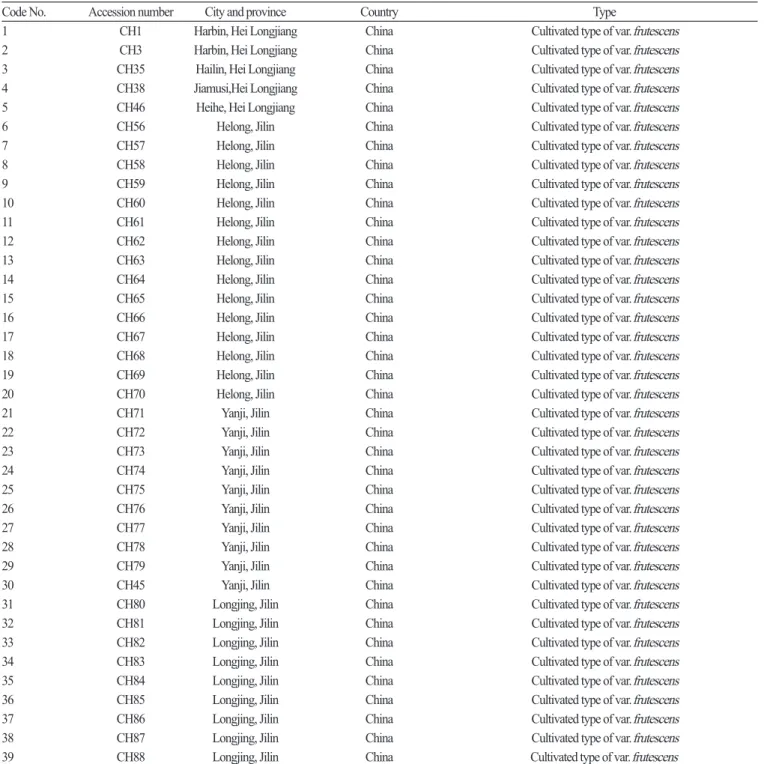
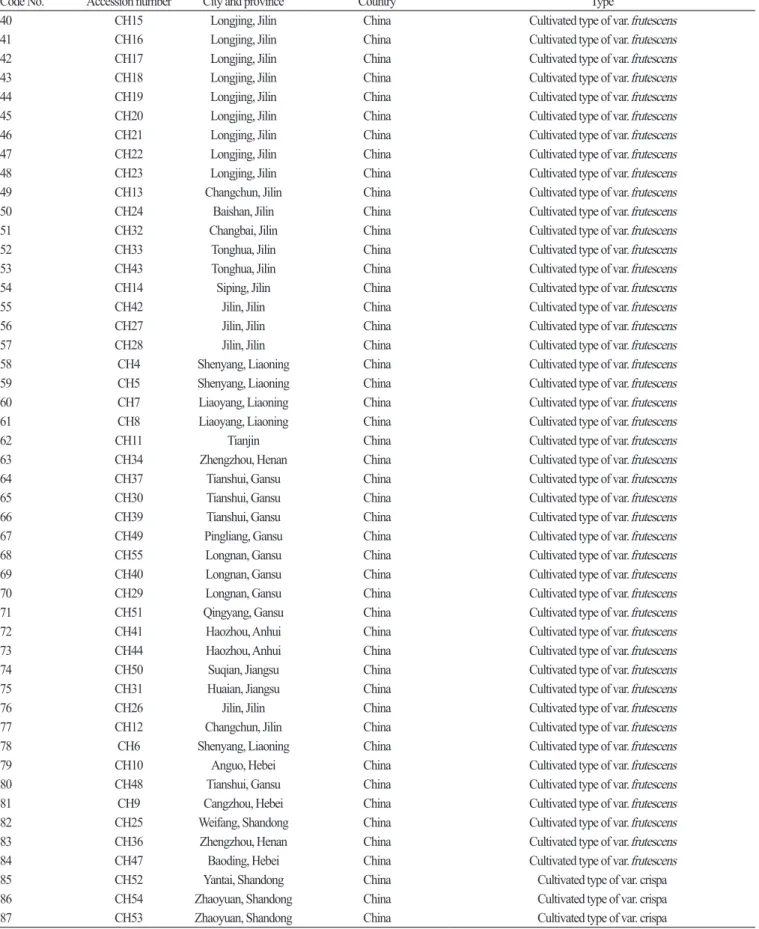
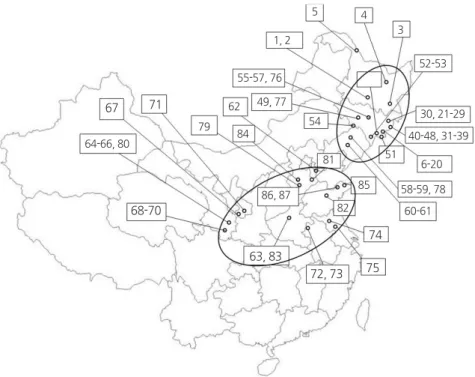
Plant MaterialsThematerialsforthisstudyconsistof87accessions (84cultivatedvar. frutescens and3cultivatedvar. crispa) collectedin differentprovincesofChina. Theseprovincesarelocatedinthehighlatitude (NortheastChina) andmiddlelatitudeareas (North ChinaandNorthwestChina) ofChina. Thenumberofaccessionsandthenameofthecollectionplacesfor Perilla accessions collectedinChinaareshowninTable1andFig. 1.
Table 1. Perilla frutescens accessions collected from northern areas of China that were surveyed for morphological trait differences.
Code No. Accession number City and province Country Type
1 CH1 Harbin, Hei Longjiang China Cultivated type of var. frutescens
2 CH3 Harbin, Hei Longjiang China Cultivated type of var. frutescens
3 CH35 Hailin, Hei Longjiang China Cultivated type of var. frutescens
4 CH38 Jiamusi,Hei Longjiang China Cultivated type of var. frutescens
5 CH46 Heihe, Hei Longjiang China Cultivated type of var. frutescens
6 CH56 Helong, Jilin China Cultivated type of var. frutescens
7 CH57 Helong, Jilin China Cultivated type of var. frutescens
8 CH58 Helong, Jilin China Cultivated type of var. frutescens
9 CH59 Helong, Jilin China Cultivated type of var. frutescens
10 CH60 Helong, Jilin China Cultivated type of var. frutescens
11 CH61 Helong, Jilin China Cultivated type of var. frutescens
12 CH62 Helong, Jilin China Cultivated type of var. frutescens
13 CH63 Helong, Jilin China Cultivated type of var. frutescens
14 CH64 Helong, Jilin China Cultivated type of var. frutescens
15 CH65 Helong, Jilin China Cultivated type of var. frutescens
16 CH66 Helong, Jilin China Cultivated type of var. frutescens
17 CH67 Helong, Jilin China Cultivated type of var. frutescens
18 CH68 Helong, Jilin China Cultivated type of var. frutescens
19 CH69 Helong, Jilin China Cultivated type of var. frutescens
20 CH70 Helong, Jilin China Cultivated type of var. frutescens
21 CH71 Yanji, Jilin China Cultivated type of var. frutescens
22 CH72 Yanji, Jilin China Cultivated type of var. frutescens
23 CH73 Yanji, Jilin China Cultivated type of var. frutescens
24 CH74 Yanji, Jilin China Cultivated type of var. frutescens
25 CH75 Yanji, Jilin China Cultivated type of var. frutescens
26 CH76 Yanji, Jilin China Cultivated type of var. frutescens
27 CH77 Yanji, Jilin China Cultivated type of var. frutescens
28 CH78 Yanji, Jilin China Cultivated type of var. frutescens
29 CH79 Yanji, Jilin China Cultivated type of var. frutescens
30 CH45 Yanji, Jilin China Cultivated type of var. frutescens
31 CH80 Longjing, Jilin China Cultivated type of var. frutescens
32 CH81 Longjing, Jilin China Cultivated type of var. frutescens
33 CH82 Longjing, Jilin China Cultivated type of var. frutescens
34 CH83 Longjing, Jilin China Cultivated type of var. frutescens
35 CH84 Longjing, Jilin China Cultivated type of var. frutescens
36 CH85 Longjing, Jilin China Cultivated type of var. frutescens
37 CH86 Longjing, Jilin China Cultivated type of var. frutescens
38 CH87 Longjing, Jilin China Cultivated type of var. frutescens
Table 1. Continued.
Code No. Accession number City and province Country Type
40 CH15 Longjing, Jilin China Cultivated type of var. frutescens
41 CH16 Longjing, Jilin China Cultivated type of var. frutescens
42 CH17 Longjing, Jilin China Cultivated type of var. frutescens
43 CH18 Longjing, Jilin China Cultivated type of var. frutescens
44 CH19 Longjing, Jilin China Cultivated type of var. frutescens
45 CH20 Longjing, Jilin China Cultivated type of var. frutescens
46 CH21 Longjing, Jilin China Cultivated type of var. frutescens
47 CH22 Longjing, Jilin China Cultivated type of var. frutescens
48 CH23 Longjing, Jilin China Cultivated type of var. frutescens
49 CH13 Changchun, Jilin China Cultivated type of var. frutescens
50 CH24 Baishan, Jilin China Cultivated type of var. frutescens
51 CH32 Changbai, Jilin China Cultivated type of var. frutescens
52 CH33 Tonghua, Jilin China Cultivated type of var. frutescens
53 CH43 Tonghua, Jilin China Cultivated type of var. frutescens
54 CH14 Siping, Jilin China Cultivated type of var. frutescens
55 CH42 Jilin, Jilin China Cultivated type of var. frutescens
56 CH27 Jilin, Jilin China Cultivated type of var. frutescens
57 CH28 Jilin, Jilin China Cultivated type of var. frutescens
58 CH4 Shenyang, Liaoning China Cultivated type of var. frutescens
59 CH5 Shenyang, Liaoning China Cultivated type of var. frutescens
60 CH7 Liaoyang, Liaoning China Cultivated type of var. frutescens
61 CH8 Liaoyang, Liaoning China Cultivated type of var. frutescens
62 CH11 Tianjin China Cultivated type of var. frutescens
63 CH34 Zhengzhou, Henan China Cultivated type of var. frutescens
64 CH37 Tianshui, Gansu China Cultivated type of var. frutescens
65 CH30 Tianshui, Gansu China Cultivated type of var. frutescens
66 CH39 Tianshui, Gansu China Cultivated type of var. frutescens
67 CH49 Pingliang, Gansu China Cultivated type of var. frutescens
68 CH55 Longnan, Gansu China Cultivated type of var. frutescens
69 CH40 Longnan, Gansu China Cultivated type of var. frutescens
70 CH29 Longnan, Gansu China Cultivated type of var. frutescens
71 CH51 Qingyang, Gansu China Cultivated type of var. frutescens
72 CH41 Haozhou, Anhui China Cultivated type of var. frutescens
73 CH44 Haozhou, Anhui China Cultivated type of var. frutescens
74 CH50 Suqian, Jiangsu China Cultivated type of var. frutescens
75 CH31 Huaian, Jiangsu China Cultivated type of var. frutescens
76 CH26 Jilin, Jilin China Cultivated type of var. frutescens
77 CH12 Changchun, Jilin China Cultivated type of var. frutescens
78 CH6 Shenyang, Liaoning China Cultivated type of var. frutescens
79 CH10 Anguo, Hebei China Cultivated type of var. frutescens
80 CH48 Tianshui, Gansu China Cultivated type of var. frutescens
81 CH9 Cangzhou, Hebei China Cultivated type of var. frutescens
82 CH25 Weifang, Shandong China Cultivated type of var. frutescens
83 CH36 Zhengzhou, Henan China Cultivated type of var. frutescens
84 CH47 Baoding, Hebei China Cultivated type of var. frutescens
85 CH52 Yantai, Shandong China Cultivated type of var. crispa
86 CH54 Zhaoyuan, Shandong China Cultivated type of var. crispa
Fig. 1. Collection sites of Perilla frutescens accessions that were evaluated in this study. Perilla frutescens accessions collected from high-latitude areas (Northeast China, 41°21′N--53°33′N) are shown in the upper oval; Perilla frutescens accessions collected from middle -latitude areas (North China and Northwest China, 32°18′N-41°21′N) are shown in the lower oval.
63, 83 68-70 72, 73 74 75 71 67 51 85 82 5 52-53 6-20 55-57, 76 84 4 30, 21-29 58-59, 78 62 54 3 40-48, 31-39 64-66, 80 60-61 79 81 1, 2 49, 77 86, 87
Morphological Character Detection
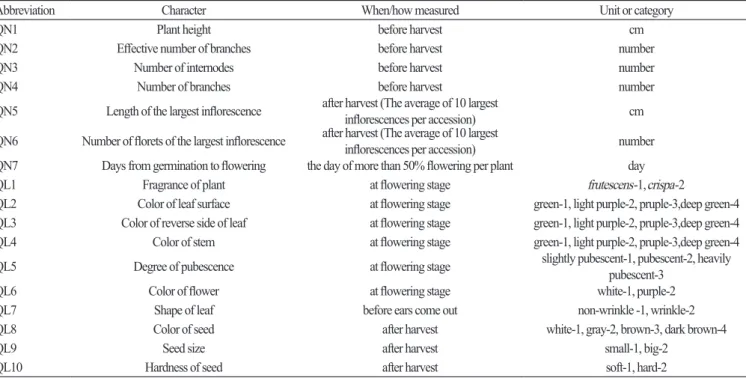
Toassessthemorphologicalvariationoftheaccessionsoftwocultivatedtypesof Perilla cropplants, tenindividualsofeach accessionweregrowninafieldattheCollegeofAgricultureandLifeSciences, KangwonNationalUniversity, Chuncheon,
Gangwon-doinKorea. ApproximatelytwentyseedsfromeachaccessionweresowninanurserybedinearlyMayandkeptin aglasshouseforamonth. TenseedlingsofeachaccessionwerethentransplantedintothefieldinearlyJune. Weexamined sevenquantitativeand10qualitativecharactersthatwereselectedonthebasisofthepreviousreportbyLeeandOhnishi (2001)
andevaluatedattheappropriategrowthstagesasdescribedindetailinTable2ofthisreport. Measurementsoftheseven quantitativecharactersandobservationof10qualitativecharactersweremadeon10individualsforeachaccession.
Data Analysis
Themeasurementsofeachtraitwerecomparedamongtheaccessionsusingone-wayanalysisofvariance (ANOVA)
followedbytheStudent-Newman-Keulstestformultiplecomparisonofmeansamongtheaccessionsofcultivatedtypesofvar. frutescens andvar. crispa collectedfromdifferentareasofChina. Principalcomponentanalyses (PCAs) wereconductedto detectdifferencesamongaccessionsandtotrytodivideintogroupstheaccessions. Geographicalcomparisonoftheaccessions collectedfromhighandmiddlelatitudeareasofChinawasalsomadebyusingunivariateandmultivariateanalyses. These comparisonsweremadeonlyforaccessionsofcultivatedvar. frutescens andvar. crispa becausetherewasnosampleofweedy typesofvar. frutescens andvar. crispa availableinthisstudy. MicrosoftExcelStatisticalAnalysisSystemProgramwasused forunivariateandmultivariateanalyses.
Results
Morphological Variation Between the Two Cultivated
Perilla
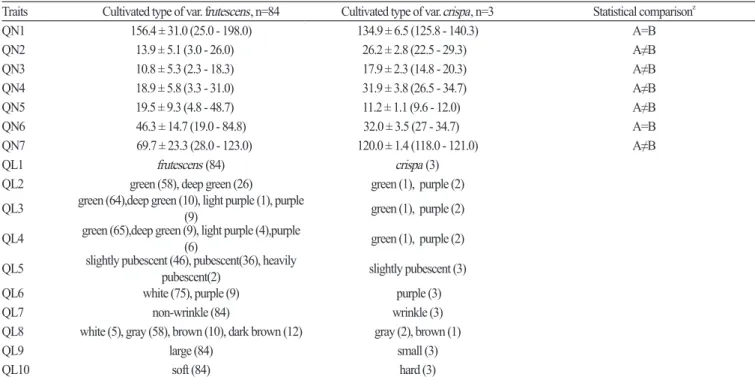
Crop Variants from Different Areas of ChinaTheaveragevalues, standarddeviation, rangeofthesevenquantitativetraits, andmorphologicalcharacteristicsof10 qualitativetraitsforaccessionsofcultivatedtypesofvar. frutescens andvar. crispa weresummarizedinTable3. Accordingto theresultsofourquantitativetraitssurvey, QN1was156.4cm (25 - 198cm) and134.9cm (125.8 - 140.3cm) incultivatedtypes ofvar. frutescens andvar. crispa accessions, respectively. QN2was13.9 (3.0 - 26.0) and26.2 (22.5 - 29.3) inaccessionsof cultivatedtypesofvar. frutescens andvar. crispa, respectively. QN3were10.8 (2.3 - 18.3) and17.9 (14.8 - 20.3) inaccessionsof cultivatedtypesofvar. frutescens andvar. crispa, respectively. QN4was18.9 (3.3 - 31.0) and31.9 (26.5 - 34.7) inaccessionsof cultivatedtypesofvar. frutescens andvar. crispa, respectively. QN5was19.5 (4.8 - 48.7) and11.2 (9.6 - 12.0) inaccessionsof cultivatedtypesofvar. frutescens andvar. crispa, respectively. QN6was46.3 (19.0 - 84.8) and32.0 (27.0 - 34.7) inaccessionsof cultivatedtypesofvar. frutescens andvar. crispa, respectively. QN7was69.7 (28.0 - 123.0) and120.0 (118.0 - 121.0) inaccessions ofcultivatedtypesofvar. frutescens andvar. crispa, respectively.
Theresultsofthequalitativecharacterssurveyforfragrance (QL1) foundthatthe84accessionsofcultivatedvar. frutescens
havetheirownspecificfragrances, whileonlythreeaccessionsofthecultivatedvar. crispa haveaspecificfragrance. Intermsof leafsurfacecolor (QL2), 58accessionsofcultivatedvar. frutescens hadgreenleavesand26accessionsofcultivatedvar. frutescens hadleavesthatwereadeepgreencolor. Furthermore, theaccessionsofcultivatedvar. crispa hadgreen (one accession) andpurple (twoaccessions) coloredleaves. Whensurveyedforthecolorofthereversesideofleaf (QL3), the accessionsofcultivatedvar. frutescens hadgreen (64accessions), deepgreen (10accessions), lightpurple (1accession), and purple (9accessions) colors; whereastheaccessionsofcultivatedvar. crispa hadgreen (1accession) andpurple (2accessions)
colors, respectively. Thestemcolor (QL4) oftheaccessionsofcultivatedvar. frutescens includedgreen (65accessions), deep green (9accessions), lightpurple (4accessions), andpurple (6accessions) colors, whiletheaccessionsofcultivatedvar. crispa
Table 2. Quantitative and qualitative characters used in the morphological analysis of Perilla frutescens accessions.
Abbreviation Character When/how measured Unit or category
QN1 Plant height before harvest cm
QN2 Effective number of branches before harvest number
QN3 Number of internodes before harvest number
QN4 Number of branches before harvest number
QN5 Length of the largest inflorescence after harvest (The average of 10 largest inflorescences per accession) cm QN6 Number of florets of the largest inflorescence after harvest (The average of 10 largest inflorescences per accession) number QN7 Days from germination to flowering the day of more than 50% flowering per plant day
QL1 Fragrance of plant at flowering stage frutescens-1, crispa-2
QL2 Color of leaf surface at flowering stage green-1, light purple-2, pruple-3,deep green-4 QL3 Color of reverse side of leaf at flowering stage green-1, light purple-2, pruple-3,deep green-4
QL4 Color of stem at flowering stage green-1, light purple-2, pruple-3,deep green-4
QL5 Degree of pubescence at flowering stage slightly pubescent-1, pubescent-2, heavily pubescent-3
QL6 Color of flower at flowering stage white-1, purple-2
QL7 Shape of leaf before ears come out non-wrinkle -1, wrinkle-2
QL8 Color of seed after harvest white-1, gray-2, brown-3, dark brown-4
QL9 Seed size after harvest small-1, big-2
weregreen (1accession) andpurple (twoaccessions) only. Thedegreeofpubescence (QL5) intheaccessionsofcultivatedvar. frutescens showedslightlypubescent (46accessions), pubescent (36accessions), andheavilypubescent (2accessions) degrees,
andthethreeaccessionsofcultivatedvar. crispa showedonlyslightlypubescentdegree. Flowercolor (QL6) intheaccessions ofcultivatedvar. frutescens includedwhite (75accessions) andpurple (9accessions), whiletheflowersofallcultivatedvar. crispa accessionswerepurpleincolor. Theshapeofleaves (QL7) inthecultivatedvar. frutescens accessionswasonlythenon
-wrinkled (84accessions) type, andtheaccessionsofcultivatedvar. crispa showedonlywrinkled (threeaccessions) leaves. The seedcolor (QL8) oftheaccessionsofcultivatedvar. frutescens includedwhite (5accessions), gray (58accessions), brown (10 accessions), anddarkbrown (11accessions), whiletheaccessionsofcultivatedvar. crispa weregray (2accessions) andbrown
(oneaccession) incolor. Seedsize (QL9) oftheaccessionsofcultivatedvar. frutescens includedthelarge (84accessions) type,
andtheaccessionsofcultivatedvar. crispa werethesmalltype (threeaccessions). Seedhardness (QL10) intheaccessionsof cultivatedvar. frutescens wasfoundtobebothsoft (74accessions) andhard (10accessions), whileallaccessionsofcultivated var. crispa wereonlythehardseedtype.
Statisticalcomparisonsofthemeans (p < 0.05) wereasfollows: Significantdifferenceswerefoundbetweencultivatedvar. frutescens andcultivatedvar. crispa forQN2, QN3, QN4, QN5, QN7. However, QN1QN6werenotsignificantlydifferent betweencultivatedvar. frutescens andcultivatedvar. crispa (Table3).
Geographical Differences in Cultivated var.
frutescens
Found in High and Middle Latitude Areas of ChinaInordertounderstandthegeographicaldifferencebetweentheaccessionsofcultivatedvar. frutescens fromhigh-latitudeand middle-latitudeareasofChina, weperformedastatisticalanalysisofthesevenquantitativecharactersontheaccessionsof
Table 3. Mean values, standard deviation, and range for 17 quantitative and qualitative characters among 87 Perilla crop accessions from northern areas of China.
Traits Cultivated type of var. frutescens, n=84 Cultivated type of var. crispa, n=3 Statistical comparisonz
QN1 156.4 ± 31.0 (25.0 - 198.0) 134.9 ± 6.5 (125.8 - 140.3) A=B QN2 13.9 ± 5.1 (3.0 - 26.0) 26.2 ± 2.8 (22.5 - 29.3) A≠B QN3 10.8 ± 5.3 (2.3 - 18.3) 17.9 ± 2.3 (14.8 - 20.3) A≠B QN4 18.9 ± 5.8 (3.3 - 31.0) 31.9 ± 3.8 (26.5 - 34.7) A≠B QN5 19.5 ± 9.3 (4.8 - 48.7) 11.2 ± 1.1 (9.6 - 12.0) A≠B QN6 46.3 ± 14.7 (19.0 - 84.8) 32.0 ± 3.5 (27 - 34.7) A=B QN7 69.7 ± 23.3 (28.0 - 123.0) 120.0 ± 1.4 (118.0 - 121.0) A≠B QL1 frutescens (84) crispa (3)
QL2 green (58), deep green (26) green (1), purple (2) QL3 green (64),deep green (10), light purple (1), purple (9) green (1), purple (2) QL4 green (65),deep green (9), light purple (4),purple (6) green (1), purple (2) QL5 slightly pubescent (46), pubescent(36), heavily pubescent(2) slightly pubescent (3)
QL6 white (75), purple (9) purple (3)
QL7 non-wrinkle (84) wrinkle (3)
QL8 white (5), gray (58), brown (10), dark brown (12) gray (2), brown (1)
QL9 large (84) small (3)
QL10 soft (84) hard (3)
zTest of statistically significant differences between the two cultivated types of Perilla crop. Comparison analysis was performed with ANOVA followed by
cultivatedvar. frutescens collectedfromtheseregionsandthemeanvalues, standarddeviation, andrangeoftheseven quantitativetraitsaresummarizedinTable4.
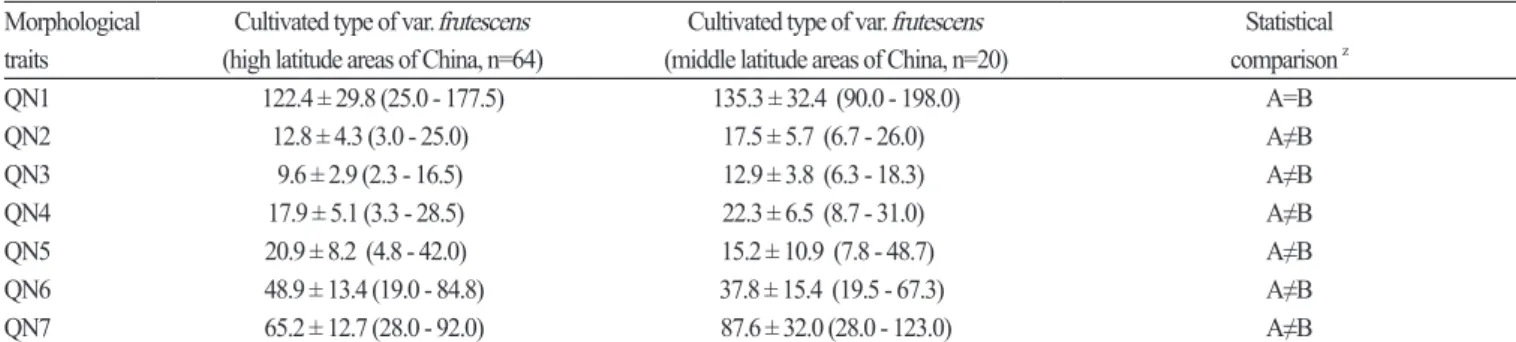
AsshowninTable4, QN1was122.4cm (25 - 177.5cm) and135.3cm (90.0 - 198.0cm) incultivatedvar. frutescens accessions fromhighandmiddlelatitudeareasofChina, respectively. QN2was12.8 (3.0 - 25.0), and17.5 (6.7 - 26.0) inaccessionsof cultivatedvar. frutescens fromhighandmiddlelatitudeareasofChina, respectively. QN3was9.6 (2.3 - 16.5), and12.9 (6.3 -18.3)
inaccessionsofcultivatedvar. frutescens fromhighandmiddlelatitudeareasofChina, respectively. QN4was17.9 (3.3 - 28.5),
and22.3 (8.7 - 31.0) inaccessionsofcultivatedvar. frutescens fromhighandmiddlelatitudeareasofChina, respectively. QN5 was20.9 (4.8 - 42.0), and15.2 (7.8 - 48.7) inaccessionsofcultivatedvar. frutescens fromhighandmiddlelatitudeareasofChina,
respectively. QN6was48.9 (19.0 - 84.8), and37.8 (19.5 - 67.3) inaccessionsofcultivatedvar. frutescens fromhighandmiddle latitudeareasofChina, respectively. QN7was65.2 (28.0 - 92.0) and87.6 (28.0 - 123.0) inaccessionsofcultivatedvar. frutescens
fromhighandmiddlelatitudeareasofChina, respectively.
Inaddition, theresultsofthestatisticalcomparisonofmeans (p < 0.05) wereasfollows: asignificantdifferencewasfound betweenaccessionsofcultivatedvar. frutescens fromhighandmiddlelatitudeareasinChinafor QN2, QN3, QN4, QN5, QN6,
QN7. However, QN1wasnotsignificantlydifferentbetweenaccessionsofcultivatedvar. frutescens fromhighlatitudeand middlelatitudeareasinChina(Table4).
Multivariate Analysis of Quantitative and Qualitative Characteristics in
Perilla
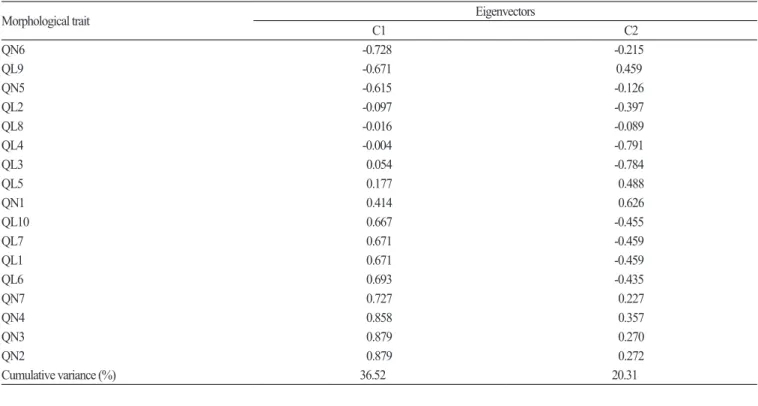
variant accessionsInthisstudy, principalcomponentsanalysis (PCA) wasusedtodetectthemorphologicalvariationamongtheaccessions fromdifferentareasofChina. Thefirstandsecondcomponentsaccountedfor36.5% and20.3% ofthetotalvariance, respectively (Table5). Fivequantitativecharacters (QN1, QN2, QN3, QN4, QN7) andsixqualitativecharacters (QL1, QL3, QL5, QL6, QL7,
QL10) contributedinthepositivedirectiononthefirstaxis(Table5). Theotherquantitativeandqualitativecharacterswere contributedinthenegativedirectiononthefirstaxis.
Mostaccessionsofcultivatedvar. frutescens andcultivatedvar. crispa wereclearlyseparatedbythefirstaxis. Inaddition,
mostaccessionsofcultivatedvar. frutescens fromhighandmiddlelatitudeareaswereseparatedbythefirstaxis, exceptfor severalaccessions (Fig. 2); namely, thosefromcultivatedvar. frutescens fromhighandmiddlelatitudeareasweresituatedtothe leftandrightonthefirstaxis, respectively(Fig. 2).
Table 4. Mean values, standard deviation, and range of the 18 quantitative and qualitative characters among 84 accessions of cultivated type of Perilla frutescens var. frutescens from high and middle latitude areas of China.
Morphological Cultivated type of var. frutescens Cultivated type of var. frutescens Statistical traits (high latitude areas of China, n=64) (middle latitude areas of China, n=20) comparison z
QN1 122.4 ± 29.8 (25.0 - 177.5) 135.3 ± 32.4 (90.0 - 198.0) A=B QN2 12.8 ± 4.3 (3.0 - 25.0) 17.5 ± 5.7 (6.7 - 26.0) A≠B QN3 9.6 ± 2.9 (2.3 - 16.5) 12.9 ± 3.8 (6.3 - 18.3) A≠B QN4 17.9 ± 5.1 (3.3 - 28.5) 22.3 ± 6.5 (8.7 - 31.0) A≠B QN5 20.9 ± 8.2 (4.8 - 42.0) 15.2 ± 10.9 (7.8 - 48.7) A≠B QN6 48.9 ± 13.4 (19.0 - 84.8) 37.8 ± 15.4 (19.5 - 67.3) A≠B QN7 65.2 ± 12.7 (28.0 - 92.0) 87.6 ± 32.0 (28.0 - 123.0) A≠B
zTest of statistically significant differences between the two geographical areas of cultivated var. frutescens. Comparison analysis was performed with ANOVA followed
by Student-Newman-Keul test (p < 0.05). A = Cultivated type of var. frutescens from high-latitude areas of China; B = Cultivated type of var. frutescens from middle latitude areas of China.
Discussion
Morphological Variation Between Two Cultivated Types of
Perilla
Crop from Different Areas of ChinaThemeasurementofthemorphologicalcharactersofplantspecieswithintheareaoftheirgeographicdistributionisan essentialprocessintheidentificationofvarietalorsubspeciesdifferentiationinplantspecies (GouldandJohnston, 1972; Wyatt
Table 5. Cumulative variance of the first and second principal components and loadings of seven quantitative and 10 qualitative traits on each principal component.
Morphological trait Eigenvectors
C1 C2 QN6 -0.728 -0.215 QL9 -0.671 0.459 QN5 -0.615 -0.126 QL2 -0.097 -0.397 QL8 -0.016 -0.089 QL4 -0.004 -0.791 QL3 0.054 -0.784 QL5 0.177 0.488 QN1 0.414 0.626 QL10 0.667 -0.455 QL7 0.671 -0.459 QL1 0.671 -0.459 QL6 0.693 -0.435 QN7 0.727 0.227 QN4 0.858 0.357 QN3 0.879 0.270 QN2 0.879 0.272 Cumulative variance (%) 36.52 20.31
Fig. 2. Projection of 87 accessions of Perilla crop in the first and second principal components (PC1 and PC2). “Red squares” and “blue diamonds” represent accessions of cultivated var. frutescens from middle and high latitude areas of China, respectively; “green triangles” indicate accessions of cultivated var. crispa from middle latitude areas of China.
CH52 CH49 CH54 CH55 CH53 CH30 CH46 CH37 CH71 CH51 CH82 CH8 CH7 CH15 CH65 CH41 CH29 CH31 CH40 CH39 CH34 CH50 CH26 CH11 CH47CH48 CH25 CH6 CH9 C10 Principal Componant 1 Principal Componant 2 CH36 Ι ΙΙ ΙΙΙ ΙV 1.5 0 0.5 2.5 -0.5 -1 -1.5 0 1 2 0.5 -0.5 -1 -1.5 1
andAntonovics, 1981). Themorphologicalvariationamongaccessionsofplantspeciesmaybeattributedtomicro-evolutionary changesindifferentenvironmentsduringthelong-termevolutionaryprocess. Theprocessofcropdomesticationisgenerally associatedwiththecultivationofplantspeciesincontrolledenvironments (Harlan, 1992; ZoharyandHopf, 1993).
Inthisstudy, 87accessions (84cultivatedvar. frutescens andthreecultivatedvar. crispa) frommiddleandhighlatitudeareas ofChinawereexaminedforsevenquantitativecharactersand10qualitativecharacters. Accordingtoourresults, significant differencesbetweenaccessionsfromtwocultivatedtypesofvar. frutescens andvar. crispa, respectively, wereshowninseveral morphologicalcharacters(Table3). Inaddition, basedontheexaminationofthequalitativetraits, thetwocultivatedtypesof cultivated Perilla alsoshowedmorphologicaldifferences(Table3). Therefore, thesemorphologicaltraitscanbeconsidered usefulcharactersindistinguishingthetwocultivatedtypesof Perilla crop.
InapreviousreportbyLeeandOhnishi (2001), theysuggestthatseedsize, plantheight, andbranchnumbercouldbeuseful morphologicaltraitstodistinguishthetwocultivatedtypesof Perilla crop. Inourstudy, seedsizewasalsofoundtobeareliable charactertodifferentiatebetweenvar. frutescens andvar. crispa. However, thestatisticalcomparisonofthemeans (p < 0.05)
showedthatplantheightbetweencultivatedvar. frutescens andvar. crispa wasnotsignificantlydifferent(Table3). The differencebetweenourresultsandthepreviousresultsofLeeandOhnishi (2001) isprobablyduetothesmallerpopulationsize ofcultivatedvar. crispa usedforthisanalysis.
AccordingtoPCAanalysis, mostaccessionsofcultivatedvar. frutescens andvar. crispa wereclearlyseparatedbythefirst axis(Fig. 2). Thisindicatesthatthecombinationofquantitativeandqualitativetraitscanbeusedtodiscriminatethetwo cultivatedtypesof Perilla cropthroughmultivariateanalysis, consistentwiththereportfromLeeandOhnishi (2001). Asshown inTable5inourstudy, fourquantitativecharacters (QN2, QN3, QN4, QN6) andsixqualitativecharacters (QL1, QL5, QL6,
QL7, QL9, QL10) greatlycontributedinthepositiveandnegativedirectionsonthefirstaxis. Thus, thesemorphological charactersmaybeconsideredasusefulcharactersfordistinguishingthetwocultivatedtypesof Perilla crop. Chinahasalong historyofcultivationof Perilla inEastAsia. Therefore, theresultsofpresentstudywillprovideusefulinformationfor understandingthedifferentiationofthetwocultivatedtypesof Perilla cropfoundinChina.
Geographical Differences in Cultivated var.
frutescens
between High Latitude and Middle Latitude Areas of ChinaUndernaturalconditions, thereisacloserelationshipbetweenthemorphologicaltraitsoflocalcroplandracesandthehabitats inwhichthetraitshaveevolvedandareexpressed. Theecologicaldifferentiationinlocalcroplandracesaffectsmanytraitssuch astherelativerateofdevelopment, resistancetobioticandabioticstresses, edaphicresponsesandresponsestosoilfertility, and adaptationtocultivationandharvestingmethods (RaoandHodgkin, 2002). Ingeneral, adaptivegeneticvariationisgenerally consideredtobequantitativeandresponsiveeveninsmallhabitatdifferences, andoftenreactswithgreatsensitivity. Many studieshavedemonstratedthatthereisaclearassociationbetweenpopulationcharacteristicsandtheenvironment (Astonand Bradshaw, 1966; Al-Hiyalyetal., 1993; RaoandHodgkin, 2002). Mostimportantisthatthelocalcroplandracesarethe consequenceoflongperiodsofinteractionbetweentheenvironmentandgeneticsystems (IPGRI, 1994; Brush, 1995).
The Perilla accessionsusedinthisstudywerecollectedinNortheast, Northwest, andNorthChina. Theseregionsrepresent thediversityinecologicalandgeographicfactors, suchaslatitude, altitude, moisture, rainfall, temperature, andtopographic featuresthatmighthaveastronginfluenceontheevolutionanddevelopmentof Perilla species. Previousresearchhasfound thattheformationofdifferentmorphologicaltraitsisrelatedtogeographicorigin. LeeandOhnishi (2001) reportedthatmost
accessionsofcultivatedvar. frutescens fromChinahadsignificantdifferencesfromthevar. frutescens accessionsfromKorea andJapan, includingdifferencesinseedsize, leafsize, plantheight, internodenumber, andfloweringtime. Inthisstudy, many accessionsofcultivatedvar. frutescens fromdifferentregionsinChinaalsohadsignificantvariationinquantitativetraitssuch asbranchnumber (QN2, QN4), internodenumber (QN3), floretnumber (QN6), lengthoflargestinflorescence (QN5), and floweringtime (QN7) (Table4). Mostaccessionsofcultivatedvar. frutescens fromhighlatitudeareasofChina (Northeast China) producedshorterplantsthanthoseaccessionsfrommiddlelatitudeareas. Furthermore, accessionsofcultivatedvar. frutescens fromhighlatitudeareashadlongerprimaryinflorescencewithmorefloretsandshorterafloweringtime. Growing daysandtemperaturesinhighlatituderegionsofChina (NortheastChina) aremuchshorterandlowerthanthoseofmiddle latitudeareasofChina. Therefore, thesetraits (i.e. lowerplantheightandshorterfloweringtime) maybeadaptationstothe relativelyharshenvironmentandaselectionpressureofcultivationbylocalfarmersinhighlatituderegions. InEastAsia, the floweringtimeof Perilla accessionswereclassifiedintothreetypes: early-maturity (floweringtime < 100days), middle-maturity
(100days < floweringtime < 130days, andlate-maturity (floweringtime > 130days) (LeeandOhnishi, 2001). Inthisstudy, all accessionsofcultivatedvar. frutescens fromNortheastChinafellintotheearly-maturitytypewithafloweringtimeranging from28daysto92days. Foraccessionsofcultivatedvar. frutescens frommiddlelatitudeareasofChina, nineaccessionswere ofthemiddle-maturitytypewithafloweringtimeof100daysto130days. Theotheraccessionswereearly-maturitytype. In addition, threeaccessionsofcultivatedvar. crispa wereidentifiedtobemiddle-maturitytypewiththefloweringtimeranging from118to121days.
AccordingtoLeeandOhnishi (2001), allaccessionsofbothcultivatedandweedytypesofvar. frutescens collectedinSouth Chinabelongtoonlythelate-maturitytype (floweringtime >130days). Theseresultsindicatethatlatitudewithgeographical distributionmaybeacriticalfactorthataffectsthefloweringtimein Perilla speciesbecause Perilla cropiswellknownasoneof therepresentativeshort-daycrops. Inaddition, thedifferenceinfloweringtimeisalsorelatedtofarmerselection. Theduration ofcoldweatherwithtemperatureslowerthan0°Cgenerallylastsforsixmonths inNortheastChina. Furthermore, the temperaturerange (20 - 26°C) thatissuitable forthegrowthof Perilla accessionsismuchshorterthanthatofSouthChinaand middlelatitudeareasofChina. Therefore, these Perilla accessionswithshorterfloweringtimesaremorelikelytobeselectedfor bylocalfarmersinNortheastChina. Inourstudy, sevenofthe10accessionswerecollectedintheprovincesofNortheastChina andhadashortfloweringperiod (28days).
AccordingtothePCAanalysis, mostaccessionsofcultivatedvar. frutescens fromhighandmiddlelatitudeareaswereclearly separatedbythefirstaxis, exceptforseveralselectaccessions(Fig. 2). AsshowninFig. 2, theseaccessionswerecollectedfrom highlatitudeareasanddidnotclearlyseparatefromthoseaccessionsfrommiddlelatitudeareasofChina. Thismaybearesult oftheoverlappingdistributionof Perilla accessionsoriginatingfromdifferentregionswithdifferentenvironmentalfeatures. In addition, geneflowhasasignificanteffectonthedifferentiationandpopulationstructureofplants (Duminiletal., 2009). Gene flowmayoccureasilythroughseeds, pollens, andothernaturalapproachesinplainareasandhumanactivities (Mengetal.,
2015), especiallybusinessactivities. Forexample, Perilla seedsfromhighlatitudeareasmayhavemigratedtonorthwestern areasofChinaorothermiddlelatitudeareasthroughhumanbusinessactivities, likeasexpansioncultivationareaandsalesof
Perilla seedsbyhumans. Afterbeingintroducedintodifferentareas, similarmorphologicaltraitsofthelocal Perilla accessions wouldbeformedundertheselectionfromnewenvironmentalstressandlocalfarmers. Duetothelackofhumaninterference,
theplantspeciescollectedinmountainous, highaltitudeterrainsareusuallyrevealedtohavehighgeneticdiversityandalarge rangefordifferentiationofmorphologicaltraitsamongandwithinpopulations (Mengetal., 2015; Chenetal., 2016; Zhangetal.,
Literature Cited
Aston DL, Bradshaw AD (1966) Evolution in closely adjacent populations. II Agrostis stolonifera in maritime habitats. Heredity 21:649–
664. doi:10.1038/hdy.1966.64
Al-Hiyaly SEK, McNeilly T, Bradshaw AD (1993) The effect of zinc contamination from electricity pylons. Genetic constraints on selection for zinc tolerance. Heredity 70:22-32. doi:10.1038/hdy.1993.4
Brush SB (1995) In situ conservation of landraces in centers of crop diversity. Crop Sci 35:346-354. doi:10.2135/cropsci1995.0011183
X003500020009x
Chen T, Li L, Zhang J, Huang ZL, Zhang HW, Liu Y, Chen Q, Tang HR, Wang XR (2016) Investigation, collection and preliminary evaluation of genetic resources of Chinese cherry [Cerasus pseudocerasus (Lindl.) G. Don]. J Fruit Sci 33:917-933
Duminil J, Hardy OJ, Petit RJ (2009) Plant traits correlated with generation time directly affect inbreeding depression and mating system and indirectly genetic structure. BMC Evol Biol 9:177. doi:10.1186/1471-2148-9-177
Gould SJ, Johnston RF (1972) Geographic variation. Ann Rev Ecol Syst 3:457-498
Harlan JR (1992) Origins and processes of domestication. In GP Chapman, ed, Grass Evolution and Domestication, Cambridge
University Press, Cambridge, UK, pp 159-175
IPGRI (1994) In situ conservation of crop and agroforestry species. Prepared for the CGIAR Mid-Term Meeting, 23-26 May 1994, New
Delhi, India
Lee JK, Nitta M, Kim NS, Park CH, Yoon KM, Shin YB, Ohnishi O (2002) Genetic diversity of Perilla and related weedy types in Korea
determined by AFLP analyses. Crop Sci 42:2161-2166. doi:10.2135/cropsci2002.2161
Lee JK, Ohnishi O (2001) Geographical differentiation of morphological characters among and their weedy types in East Asia. Breed Sci 51:247-255. doi:10.1270/jsbbs.51.247
Lee JK, Ohnishi O (2003) Genetic relationships among cultivated types of Perillafrutescens and their weedy types in East Asia revealed
by AFLP markers. Genet Resour Crop Evol 50:65-74. doi:10.1023/A:1022951002271
Luo L, Wang JN, Kong LD, Jiang QG, Tan RX (2000) Antidepressant effects of Banxia Houpu decoction, a traditional Chinese medicinal empirical formula. J Ethnopharmacol 73:277-281. doi:10.1016/S0378-8741(00)00242-7
Makino T, Hara H, Tuyama T, Fumio M (1961) Makino’s New Illustrated Flora of Japan. Hokuryukan, Tokyo, Japan, p 1060
Mao QQ, Huang Z, Zhong XM, Feng CR, Pan AJ, Li ZY, Ip SP, Che CT (2010) Effects of SYJN, a Chinese herbal formula, on chronic unpredictablestress induced changes in behavior and brain BDNF in rats. J Ethnopharmacol 128:336-341. doi:10.1016/ j.jep.2010.01.050
Meng L, Lozano Y, Bombarda I, Gaydou EM, Li B (2009) Polyphenol extraction from eight Perillafrutescens cultivars. C R Chim
12:602-611. doi:10.1016/j.crci.2008.04.011
Meng F, Liu L, Peng M, Wang Z, Wang C, Zhao Y (2015) Genetic diversity and population structure analysis in wild strawberry (Fragaria nubicola L.) from Motuo in Tibet Plateau based on simple sequence repeats (SSRs). Biochem Syst Ecol 63:113-118. doi:10.1016/j.bse.2015.09.018
Nitta M (2001) Origin and their weedy type. PhD Thesis, Kyoto University, Kyoto, Japan, p 78
Nitta M, Lee JK, Kobayashi H, Liu D, Nagamine T (2005) Diversification of multipurpose plant, Perillafrutescens. Genet Resour Crop
Evol 52:663-670. doi:10.1007/s10722-003-6013-9
Nitta M, Lee JK, Ohnishi O (2003) Asian Perilla crops and their weedy forms: Their cultivation, utilization and genetic relationships.
Econ Bot 57:245-253. doi:10.1663/0013-0001(2003)057[0245:APCATW]2.0.CO;2
Nitta M, Ohnishi O (1999) Genetic relationships among two , shiso and egoma, and the weedy type revealed by RAPD markers. Jpn J Genet 74:43-48. doi:10.1266/ggs.74.43
Rao VR, Hodgkin T (2002) Genetic diversity and conservation and utilization of plant genetic resources. Plant Cell Tissue Organ Cult 68:1-19
Sa KJ, Choi SH, Ueno M, Lee JK (2015) Genetic diversity and population structure in cultivated and weedy types of Perilla in East Asia and other countries as revealed by SSR markers. Hortic Environ Biotechnol 56:524-534. doi:10.1007/s13580-015-0039-8 Schwanitz F (1966) The Origin of Cultivated Plants. Harvard University Press, Cambridge, MA USA, p 175
Tan M, Yan M, Wang L, Wang L, Yan X (2012) Research progress on Perillafrutescens. Chinese J Oil Crop Sci 34:225-231
2016). ThesefactorsprobablycausedtheaccessionsfromdifferentareastobeambiguouslyseparatedinthePCAanalysis.
Morphologicalcharacteristicsof Perilla accessionsfromhighandmiddlelatitudeareasofChinahavebeenillustratedinthis study. Ourfindingswillcontributetobetterunderstandingofthemorphologicalvariationsin Perilla accessionsfromdifferent regionsofChinaandwillalsobeusefulforevaluating Perilla germplasmresourcesfortheutilizationoftheseaccessionsin breedingandnewcultivardevelopment.
Wyatt R, Antonovics J (1981) Butterfly weed re-revisited: Spatial and temporal patterns of leaf shape variation in Asclepias tuberosa. Evolution 35:529-542. doi:10.1111/j.1558-5646.1981.tb04915.x
Wu S, Wu M, Quan X, Cai C (2005) High-yield cultivation technique of Perillafrutescens (Linn.) Britt. in Yanbian area. J Agric Sci
Yanbian Univ 27:48-55
Yu H, Qiu JF, Ma LJ, Hu YJ, Li P, Wang JB (2016) Phytochemical and phytopharmacological review of Perillafrutescens L. (Labiatae), a
traditional edible-medicinal herb in China. Food Chem Toxicol doi:10.1016/j.fct.2016.11.023
Zhang J, Chen T, Wang J, Chen Q, Luo Y, Zhang Y, Tang H (2016) Genetic diversity and population structure in cherry [Cerasus
pseudocerasus (Lindl). G. Don] along Longmenshan Fault Zones in China with newly developed SSR markers. Sci Hortic 212:11-19. doi:10.1016/j.scienta.2016.09.033