J. Korean Soc. Appl. Biol. Chem. 51(4), 305-308 (2008) Article
305
Phytochemical Constituents of the Roots of
Erigeron annuus
Nam Hee Yoo, Dae Sik Jang, and Jin Sook Kim*
Department of Herbal Pharmaceutical Development, Korea Institute of Oriental Medicine, Daejeon 305-811, Republic of Korea
Received August 13, 2008; Accepted October 8, 2008
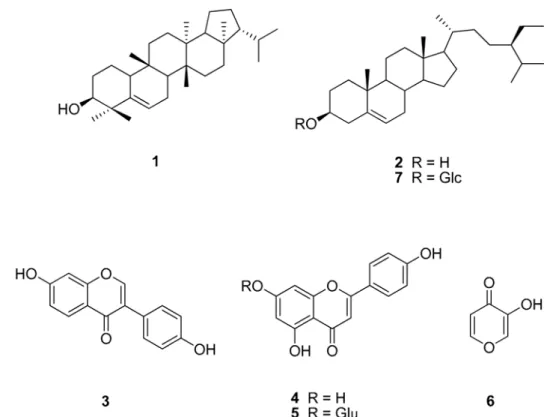
Seven compounds (1-7) were isolated from n-hexane and EtOAc-soluble fractions of the roots of Erigeron annuus by repeated silica gel column chromatography. They were identified as simiarenol
(1), β-sitosterol (2), daidzein (3), apigenin (4), apigenin 7-O-β-D-glucuronide (5), 3-hydroxy-pyran-4-one (6), and β-sitosterol glucoside (7) on the basis of physical and spectroscopic data. Compounds
1 and 3 were isolated for the first time from the Erigeron species.
Key words: Compositae, Erigeron annuus, phytochemical constituents
The genus Erigeron is a member of the Compositae (Asteraceae) family and contains more than 400 species that occur widely in temperate North America, South America, East Asia, and Europe [Bennington et al., 1998]. Some of these have a long history of applications in Korean and Chinese folk medicines, especially
Erigeron annuus (L.) Per., traditionally used for the treatment of indigestion, enteritis, epidemic, hepatitis, and hematuria [Jiangsu College of New Medicine, 1977]. Previous phytochemical investigations on this plant resulted in the isolation of γ-pyranone derivatives [Hashidoko, 1995; Oh et al., 2002; Li et al., 2005], cyclopentenone derivatives [Iijima et al., 2003a], sesquiterpenoids [Iijima et al., 2003b; Li et al., 2005], flavonoids [Hashidoko, 1995], triterpenoids [Hashidoko, 1995], and phenolic derivatives [Oh et al., 2002; Li et al., 2006]. Recently, flavonoids [Yoo et al., 2008], γ -pyranone derivatives [Yoo et al., 2008], and phenolic compounds [Jang et al., 2008] have been isolated from the flowers of this plant by our group. However, a systematic phytochemical study on the roots has not been carried out yet. We now report on the isolation and identification of seven compounds (1-7) from the roots of
E. annuus.
Materials and Methods
Plant materials. The roots of E. annuus were collected from Daejeon, Korea, in June 2006 and were identified by a plant taxonomist, Prof. Joo-Hwan Kim, Division of Life Science, Daejeon University, Daejeon, Korea. A voucher specimen (KIOM-ERAN2) has been deposited at the Herbarium of the Department of Herbal Pharmaceutical Development, Korea Institute of Oriental Medicine, Korea.
Instruments. Melting points were measured on an IA9100 melting point apparatus (Barnstead International, Dubuque, IA) and were quoted uncorrected. Optical rotations were obtained using a P-2000 digital polarimeter (JASCO, Tokyo, Japan). NMR experiments were conducted on a DRX-300 FT-NMR (Bruker, Karlsruhe, Germany), and the chemical shifts were referenced to the residual solvent signals. TLC analyses were performed on Kieselgel 60 F254 (Merck, Darmstadt,
Germany) plates (silica gel, 0.25 mm layer thickness); compounds were visualized by dipping plates into 10% (v/v) H2SO4 reagent (Aldrich, St. Louis, MO) and then
heated at 110oC for 5-10 min. Silica gel (Merck 60A,
70-230 or 70-230-400mesh ASTM), Sephadex LH-20 (Amersham Pharmacia Biotech, Uppsala, Sweden), and reversed-phase silica gel (YMC Co, Kyoto, Japan; ODS-A 12 nm S-150µm) were used for column chromatography. All solvents used for the chromatographic separations were distilled before use.
Extraction and isolation. The dried and cut plant materials (1.25 kg) were extracted with MeOH (3×13 L) by maceration at room temperature for 3 days. The extracts were combined and concentrated in vacuo at
*Corresponding author
Phone: +82-42-868-9465; Fax: +82-42-868-9471 E-mail: [email protected]
Abbreviations: CC, column chromatography; TLC, thin layer
chromatography
306 Nam Hee Yoo et al.
40oC. The concentrated extract (61 g) was suspended in
H2O (1 L) and partitioned successively with n-hexane (3
×1 L) and EtOAc (3×1 L) to afford the n-hexane- (6.04 g), EtOAc- (3.32 g), and H2O-soluble fractions (51.64 g).
The n-hexane-soluble fraction was chromatographed through silica gel (7.0×40 cm, 70-230 mesh) using an n -hexane/EtOAc gradient from 20:1→1:1 (v/v) and finally with 100% MeOH to yield 17 fractions (H01-H17). Simiarenol (1, 19 mg) and β-sitosterol (2, 8 mg) were purified from fractions H05 (80 mg) and H10 (100 mg) by recrystallization, respectively. The EtOAc-soluble fraction was chromatographed through silica gel (5.0×50 cm, 70-230 mesh) using a CHCl3/MeOH/H2O gradient
from 10:1:0.1→7:4:1 (v/v) and finally with 100% MeOH to yield 13 fractions (E01-E13). Fraction E03 (400 mg) was further fractionated using Sephadex LH-20 CC (5.0 ×44 cm, MeOH) to afford ten subfractions (E0301-E0310). Fraction 0307 (5.5 mg) was subjected to reversed phase CC (2.8×38 cm, 12 nm S-150µm; MeOH/H2O=
6:4) to give daidzein (3, 1.1 mg). Apigenin (4, 16 mg) was obtained from fraction E0309. β-Sitosterol glucoside (7, 20mg) was purified from fraction E05 by recrystallization (MeOH). The remaining E05 fraction was further purified over a Sephadex LH-20 CC (4.0×48 cm) with MeOH, yielding 3-hydroxy-pyran-4-one (6, 1.4mg). Fraction E12 (860 mg) was further fractionated using Sephadex LH-20 CC (5.0×72 cm, MeOH) to give apigenin 7-O-β -D-glucuronide (5, 9 mg).
Simiarenol (1): White powder; mp 210-212C; +55.76 (c 0.5, CHCl3); 1H-NMR (300 MHz, CDCl3) δ 5.62 (1H, brd, J=5.7 Hz, H-6), 3.47 (1H, brs, H-3α), 1.15, 1.05, 1.01, 0.93 and 0.90 (each 3H, s, H-24, 23, 26, 27, 25), 0.87 (3H, brd, J=5.1 Hz, H-29), 0.84 (3H, d, J= 6.6, H-30), 0.79 (3H, s, H-28); 13C-NMR (75 MHz, CDCl3) δ 142.2 5), 122.2 6), 76.5 3), 60.2 (C-21), 51.9 (C-18), 50.4 (C-10), 44.4 (C-8), 43.0 (C-17), 41.0 (C-14), 39.5 (C-4), 38.8 (C-13), 35.6 (C-16), 35.0 9), 34.3 11), 30.9 22), 29.3 15), 29.29 (C-23), 29.23 (C-12), 28.5 (C-20), 28.0 (C-2), 25.6 (C-24), 24.2 (C-7), 23.1 (C-30), 22.1 (C-29), 20.1 (C-19), 18.2 (C-1), 18.0 (C-25), 16.2 (C-28), 15.9 (C-26), 15.2 (C-27).
Daidzein (3): Yellowish powder; 1H-NMR (300 MHz,
CD3OD) δ 8.10 (1H, s, H-2), 8.04 (1H, d, J=9.0 Hz, H-5),
7.36 (2H, d, J=8.0 Hz, H-2', 6'), 6.92 (1H, dd, J=8.0, 2.0 Hz, H-6), 6.84 (2H, d, J=8.0 Hz, H-3', 5'), 6.81 (1H, d, J =2.0 Hz, H-8).
Results and Discussion
Seven compounds (1-7) were isolated from n-hexane and EtOAc-soluble fractions of the roots of E. annuus by repeated CC. Structural identifications of these compounds were carried out by interpretation of the spectral data and comparison with the data described in the literature. Compounds 2 and 7 were identified as a common plant sterol, β-sitosterol [Yoo et al., 2007] and β-sitosterol
α [ ]D25
Phytochemical constituents of Erigeron annuus 307 glucoside[Yoo et al., 2007], respectively. Compounds
4-6 were identified as apigenin [Han et al., 2003], apigenin 7-O-β-D-glucuronide [Hase et al., 1995] and 3-hydroxy-pyran-4-one [Oh et al., 2002]; the compounds have also been reported as constituents of the flowers of this plant [Yoo et al., 2008].
Compound 1 was obtained as a white powder. The 1
H-NMR spectrum of 1 showed an olefinic proton at δ 5.62 (1H, brd, J=5.7 Hz, H-6), a carbinol proton at δ 3.47 (1H, brs, H-3α), two methyl doublets at δ 0.84 and 0.87, and six methyl singlets at δ 0.79-1.15. The 13C-NMR spectrum
of 1 exhibited the presence of 30 carbon signals as well as 2 olefinic carbon signals at δ 122.2 and 142.2, and 1 oxygenated carbon signal at δ 76.5. The structure of 1 was determined to be a migrated hopane-type triterpene, simiarenol, by comparison of the above data with those published in the literature [Kwon et al., 2001]. Although simiarenol (1) has been isolated from Artemisia stolonifera [Kwon et al., 2001], A. argyi [Lao et al., 1984], and Caraipa densifolia [Gunasekera et al., 2001], to the best of our knowledge, the present study is the first to report on the isolation of simiarenol from the Erigeron
species.
The 1H-NMR spectrum of 3 showed a resonance for an
isoflavone skeleton that exhibited a diagnostic vinylic singlet at δ 8.10 (1H, s, H-2). Two ortho-coupled doublets centered at δ 7.36 (2H, d, J=8.0 Hz, H-2', H-6') and 6.84 (2H, d, J=8.0 Hz, H-3', H-5') were assigned to the protons of a para-di-substituted benzene ring (B ring). A set of ABX-type signals at δ 8.04 (1H, d, J=9.0 Hz, H-5), 6.92 (1H, dd, J=8.0, 2.0 Hz, H-6), and 6.81 (1H, d, J=2.0 Hz, H-8) were also observed in the 1H-NMR spectrum of 3.
On the basis of these evidences and comparison with the published data, 3 was determined to be daidzein [Jung et al., 2004]. Although daidzein is a well known phytoestrogen and is very common in the plant kingdom, especially Leguminoceae, there are only few reports on the presence of daidzein in Compositae [Cho et al., 2008]. The present study is the first to report on the isolation of daidzein from the Erigeron species.
Acknowledgment. We thank Prof. J. H. Kim, Division of Life Science, Daejeon University, Daejeon, Korea, for identifying the plant material. NMR and MS experiments were performed by the Korea Basic Science Institute (KBSI). This research was supported by a grant [L07010] from Korea Institute of Oriental Medicine.
References
Bennington CC and Stratton DA (1998) Field tests of den-sity- and frequency-dependent selection in Erigeron
annuus (Compositae). Am J Bot 85, 540-545.
Cho MH, No HK, and Prinyawiwatkul W (2008) Chitosan treatments affect growth and selected quality of sun-flower sprouts. J Food Sci73, S70-77.
Gunasekera SP, Cordell GA, and Farnsworth NR (1983) 3β
-Hydroxy-28-p-coumaroyloxy-lup-20(29)-en-27-oic acid from Caraipa densifolia. J Nat Prod46,118-122.
Han WS (2003) Isolation and structure elucidation of radi-cal scavengers from Chrysanthemum boreale Makino.
Korean J Med Crop Sci11, 1-4.
Hase T, Ohtani K, Kasai R, Yamasaki K, and Picheansoon-thon C (1995) Revised structure for hortensin, a fla-vonid from Millingtonia hortensis. Phytochemistry 40,
287-290.
Hashidoko Y (1995) Pyromeconic acid and its glucosidic derivatives from leaves of Erigeron annuus and the sid-erophile activity of pyromeconic acid. Biosci Biotech Biochem59, 886-890.
Iijima T, Yaoita Y, and Kikuchi M (2003a) Two new cyclo-pentenone derivatives and a new cyclooctadienone deriv-ative from Erigeron annuus (L.) PERS., Erigeron philadelphicus L., and Erigeron sumatrensis RETZ.
Chem Pharm Bull51, 894-896.
Iijima T, Yaoita Y, and Kikuchi M (2003b) Five new ses-quiterpenoids and a new diterpenoid from Erigeron annuus (L.) PERS., Erigeron philadelphicus L., and Eri-geron sumatrensis RETZ. Chem Pharm Bul. 51,
545-549.
Jang DS, Yoo NH, Lee YM, Yoo JL, Kim YS, and Kim JS (2008) Constituents of the flowers of Erigeron annuus
with inhibitory activity on the formation of advanced glycation end products (AGEs) and aldose reductase.
Arch Pharm Res 31, 900-904.
Jiangsu College of New Medicine (1997) A Dictionary of the Traditional Chinese Medicines. Peoples’ Hygiene Publisher, Beijing, China.
Jung MJ, Kang SS, Jung HA, Kim GJ, and Choi JA (2004) Isolation of flavonoids and a cerebroside from the stem bark of Albizzia julibrissin. Arch Pharm Res 27,
593-599.
Kwon HC, Choi SU, and Lee KR (2001) Phytochemical constituents of Artemisia stolonifera. Arch Pharm Res
24, 312-315.
Lao A, Fujimoto Y, and Takashi T (1984) Studies on the constituents of Artemisia argyi LEVL et VANT. Chem Pharm Bull32, 723-727.
Li X, Pan J, and Gao K (2006) γ-Pyranone derivatives and
other constituents from Erigeron annuus. Pharmazie 61,
474-477.
Li X, Tang M, Han YF, and Gao K (2005) New sesquiter-penes from Erigeron annuus. Planta Med71, 268-272.
Oh HC, Lee SY, Lee HS, Lee DH, Lee SY, Chung HT, Kim TS, and Kwon TO (2002) Germination inhibitory constituents from Erigeron annuus. Phytochemistry 61,
175-179.
308 Nam Hee Yoo et al.
Kim JS (2008) Erigeroflavanone, a flavanone derivative from the flowers of Erigeron annuus with protein glyca-tion and aldose reductase inhibitory activity. J Nat Prod
71, 713-715.
Yoo YB, Nakamura N, Miyashino H, Hattori M, and Park JC (2007) Triterpenoids and flavonoids isolated from the leaves of Alnus firma. Kor J Pharmacogn 38, 76-83.