Employment status and unmet dental
care needs in South Korea: a
population-based panel study
Jae Woo Choi,1,2 Young Choi,3 Tae-Hoon Lee,4 Hyo Jung Lee,5 Yeong Jun Ju,3 Eun-Cheol Park 6
To cite: Choi JW, Choi Y, Lee T-H, et al. Employment status and unmet dental care needs in South Korea: a population-based panel study. BMJ Open 2019;9:e022436. doi:10.1136/ bmjopen-2018-022436
►Prepublication history for this paper is available online. To view these files please visit the journal online (http:// dx. doi. org/ 10. 1136/ bmjopen- 2018- 022436).
Received 3 March 2018 Revised 28 February 2019 Accepted 1 March 2019
For numbered affiliations see end of article.
Correspondence to Dr Eun-Cheol Park; ecpark@ yuhs. ac © Author(s) (or their employer(s)) 2019. Re-use permitted under CC BY-NC. No commercial re-use. See rights and permissions. Published by BMJ.
AbstrACt
Objectives This study was designed to evaluate whether employment status is associated with the experience of unmet dental care needs.
Methods A total of 4620 workers were retrieved from Korea Health Panel data (2010–2013), and potential relationships were explored among their income levels, changes in employment and unmet dental care needs. results Among the 4620 workers, 17.3% said they had failed at least once to get dental treatment or check-up, despite their needs. Precarious workers and those not in employment were more likely to experience unmet dental care needs due to economic burden compared with permanent workers (OR 1.36, 1.40, respectively). In addition, people in low-income group were 4.46 times more likely to experience unmet dental care needs caused by economic burden, compared with those with the highest income.
Conclusion This disparity means that precarious workers and those not in employment are more likely to face barriers in obtaining needed health services. Given the insecure employment status of low income people, meeting their healthcare needs is an important consideration.
IntrOduCtIOn
South Korea achieved universal health insur-ance coverage just 12 years after its national health insurance system was implemented.1
However, people with national health insur-ance are still paying rather high amount of out-of-pocket (OOP) payments. The propor-tion of total medical spending financed by the public sector in South Korea is only 56% of the country’s population, which is lower than the Organization for Economic Coop-eration and Development (OECD) average (73%). Furthermore, South Korea had the fourth lowest level of spending out of OECD nations after Chile (46%), the USA (48%) and Mexico (51%).2 Relatively low coverage
by health insurance may result in unmet needs, and this phenomenon is more likely to occur in dental care which often requires higher OOP payments than those for regular
healthcare. In South Korea, the coverage benefit of dental care services is low due to the relatively high medical expenses incurred by non-insured payment. Although the South Korean government has expanded coverage expansion policy for dental service, the level of OOP payments is very high compared with those of other countries.
The rate of unmet dental care needs is very high in South Korea. A previous study on unmet dental care needs in South Korea showed that response rate of unmet dental care needs was 24.5% of the entire popula-tion,3 whereas results from another study
performed in the US state of Wisconsin indi-cated that about 20.6% of the total popula-tion experienced unmet dental care needs.4
In addition, a Canadian study on immigrants living more than 10 years in Canada showed that the experience rate of unmet dental care needs was 17.5%, and the rate of 28 Euro-pean Union (EU) countries, including Spain, was 7.2%.5–7
The factors related to unmet healthcare needs among adults in previous studies were socioeconomic factors, such as income or education levels, and health status, including self-related health or mental health.8–12 In
other words, low-income or education groups were more likely to experience unmet health-care needs than those with higher-income or education status. Although there has been some studies that reported on the association
strengths and limitations of this study
► This was the first study to examine the association between economic status and unmet dental care needs among adults in South Korea using longitu-dinal panel data.
► We used self-reported questionnaires to identify subjects’ experience of unmet dental care needs.
► We did not control severity of dental care in our research.
on 15 May 2019 by guest. Protected by copyright.
http://bmjopen.bmj.com/
between employment status and unmet needs, most of them examined unmet healthcare needs, rather than dental care.
The current study aimed to examine the impact of employment status on the experience of unmet dental care needs, using nationally representative panel data collected from 2010 to 2013.
MethOds study model
This study used the Anderson social behavioural model to analyse factors that affect unmet dental care needs. This model is widely used as a model for analysing factors that affect unmet medical care. In the Anderson model, the factors that determine an individual's behaviour related to the use of medical services are largely categorised as predisposing factors, enabling factors and need factors, and their relevance to medical use is analysed through regression analysis. Predisposing factors consist of social structure variables (sex, age, marital status), social struc-tural variables (education level, occupation) and health beliefs and attitudes. Enabling factors are the resources of individuals and communities that enable the use of medical care, and these include variables such as income, number of household members, type of health insur-ance and existence of private health insurinsur-ance. Need factors are directly related to the use of health services, and disease factors are related to the level of individual disability or illness. It mainly includes variables such as subjective health status, presence of chronic disease, and disability. In this study, the predisposing factors were sex, age, education level, marital status and employment status. Enabling factors were income level, type of health insurance and private insurance. Needs factors were self-rated health, depression and stress.
data
We utilised data from the Korea Health Panel (KHP) third to sixth (2010–2013 year), which was conducted by the Korea Institute for Health & Social Affairs and National Health Insurance Corporation. KHP is a nationally repre-sentative sample of South Korean individuals and their families, and it includes data on subjects’ demographic and socioeconomic characteristics, health status, access to healthcare and private health insurance status. KHP uses a stratified multistage probability sampling design according to region and residence, in order to select nationwide subjects from the 2005 Korea Census.13 study sample and design
We excluded the first to second data of KHP (2008– 2009 year), since the variable of unmet dental care needs was not included in the survey. This study included data from the fourth wave in 2011. In the fourth wave (2011), a total of 17 035 subjects completed the survey question-naire. The study subjects consisted of waged workers ≥19 years of age, and excluded those who did experience
unmet dental care needs. Subjects aged ≥62 years in 2011 were also excluded to ensure that all subjects in this study were <65 years old during the 3 year follow-up. After excluding subjects without follow-up or those with any missing values, a total of 4620 workers remained in this study. We examined the effect employment status on the experience of unmet dental care needs from 2011 to 2013.
dependent variable
Dependent variable of this study was whether the respon-dents had an unmet dental care. Therefore, they were asked, “Did you ever fail to receive dental care services over the past year, even when there was a need for treat-ment or check-up?’ Also, economic burden, no time to spare and others were added as result variables for those who had experienced unmet healthcare needs.
Independent variable
Employment status was classified into four categories: full-time permanent, precarious, self-employed or those not in employment. KHP classified individuals as full-time permanent workers if all four of the following condi-tions were satisfied: (1) they were directly hired by their employers (not subcontracted or dispatched workers, or self-employed workers without employees); (2) they were full-time workers (not part-time workers); (3) there was no fixed term in their employment contract (not temporary workers) and (4) there was a high probability of maintaining their current job (having relatively little job insecurity, and not a day labourer). Other than full-time permanent workers, waged workers hired by their employers were classified as precarious workers. Self-em-ployed were defined as workers who managed their own business regardless of scale, or carried out professional matter under their own responsibility. For the purpose of comparability with previous East Asian studies and consid-eration of different classification of employment status between countries, self-employed were treated as having a different employment status. Those not in employment were defined as those who stopped working in 2011 out of workers in 2010.
Covariates
In this study, we used several covariates to control for demographic and socioeconomic characteristics, as well as health status. Demographic characteristics included sex, age, marital status and socioeconomic factors, including education and income. The age groups were divided in 10 year intervals for measurement. Marital status was cate-gorised into married, single and divorced or separated. Educational levels were categorised into below elemen-tary school, middle or high school and above college. Weighted total household income was divided into five levels: highest, high, middle, low and lowest. As a proxy for health status, we utilised self-rated health, stress, depression, disability and chronic disease to control for the participant’s health condition and health behaviour
on 15 May 2019 by guest. Protected by copyright.
http://bmjopen.bmj.com/
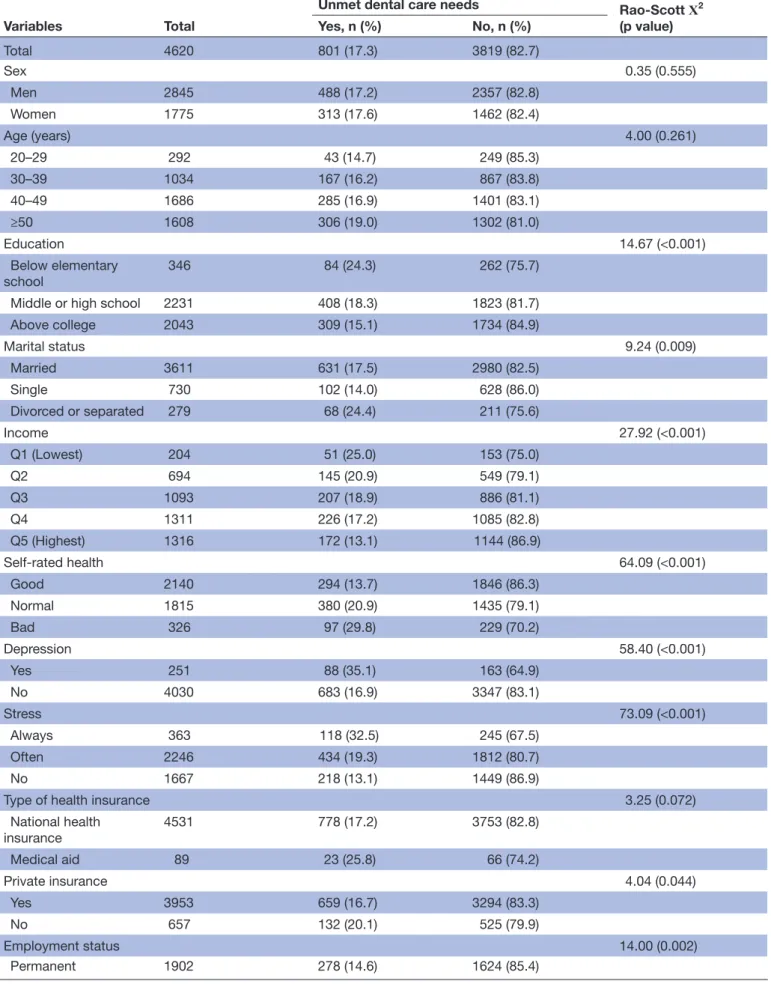
Table 1 General characteristics at first follow-up (2011) of waged workers
Variables Total
Unmet dental care needs Rao-Scott Χ2
(p value) Yes, n (%) No, n (%) Total 4620 801 (17.3) 3819 (82.7) Sex 0.35 (0.555) Men 2845 488 (17.2) 2357 (82.8) Women 1775 313 (17.6) 1462 (82.4) Age (years) 4.00 (0.261) 20–29 292 43 (14.7) 249 (85.3) 30–39 1034 167 (16.2) 867 (83.8) 40–49 1686 285 (16.9) 1401 (83.1) ≥50 1608 306 (19.0) 1302 (81.0) Education 14.67 (<0.001) Below elementary school 346 84 (24.3) 262 (75.7)
Middle or high school 2231 408 (18.3) 1823 (81.7) Above college 2043 309 (15.1) 1734 (84.9) Marital status 9.24 (0.009) Married 3611 631 (17.5) 2980 (82.5) Single 730 102 (14.0) 628 (86.0) Divorced or separated 279 68 (24.4) 211 (75.6) Income 27.92 (<0.001) Q1 (Lowest) 204 51 (25.0) 153 (75.0) Q2 694 145 (20.9) 549 (79.1) Q3 1093 207 (18.9) 886 (81.1) Q4 1311 226 (17.2) 1085 (82.8) Q5 (Highest) 1316 172 (13.1) 1144 (86.9) Self-rated health 64.09 (<0.001) Good 2140 294 (13.7) 1846 (86.3) Normal 1815 380 (20.9) 1435 (79.1) Bad 326 97 (29.8) 229 (70.2) Depression 58.40 (<0.001) Yes 251 88 (35.1) 163 (64.9) No 4030 683 (16.9) 3347 (83.1) Stress 73.09 (<0.001) Always 363 118 (32.5) 245 (67.5) Often 2246 434 (19.3) 1812 (80.7) No 1667 218 (13.1) 1449 (86.9)
Type of health insurance 3.25 (0.072)
National health insurance 4531 778 (17.2) 3753 (82.8) Medical aid 89 23 (25.8) 66 (74.2) Private insurance 4.04 (0.044) Yes 3953 659 (16.7) 3294 (83.3) No 657 132 (20.1) 525 (79.9) Employment status 14.00 (0.002) Permanent 1902 278 (14.6) 1624 (85.4) Continued
on 15 May 2019 by guest. Protected by copyright.
http://bmjopen.bmj.com/
that can affect healthcare utilisation. Finally, we used type of health insurance (national health insurance, medical aid) and existence of private insurance.
statistical analysis
The overall frequency of situations where unmet dental care needs incurred, after accounting for demographic, socioeconomic and health status, was determined by Rao-Scott Χ2 test. To identify factors associated with
unmet dental care needs and, in particular, to examine the relationship between employment status and unmet dental care needs, we used the Generalized Linear Mixed Models since subjects in our study were measured repeat-edly over time. OR was calculated using the regression coefficient gained through the Generalized Linear Mixed Models, and presented with a 95% CI. SAS V.9.3 statistical package was used for data analysis.
Patient and public involvement statement
Patients or the public were not involved in this study.
results
This study utilised longitudinal data that were repeat-edly measured and constructed for 24 616 people in 2008. First-year (2010) response rate of data utilised in this study was 80.6%, and the main reasons for decreasing response rate were death, response refusal and so on. Table 1 shows general characteristics at first follow-up (2011) of waged workers. Out of 4620 respondents aged between 20 and 61 years, 17.3% said they had failed at least once to have dental treatment or check-up, despite their needs. People who had low
education, as well as the low-income group, people who were divorced, people with negative self-related health and those with depression or stress who joined private insurance scheme, precarious workers and self–employed were more likely to experience unmet dental care needs. However, no significant relationship was observed between unmet dental care needs and sex, age, disability, chronic disease and type of health insurance.
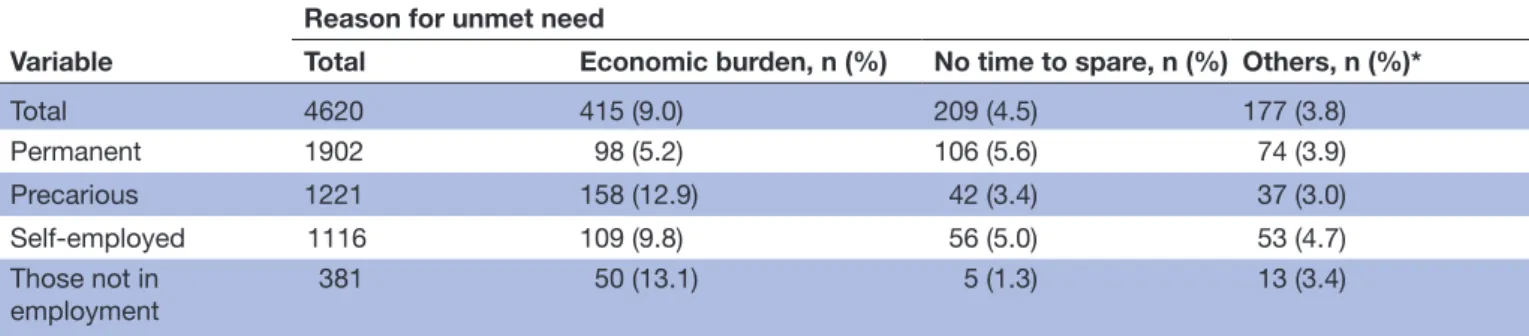
Table 2 shows self-reported reasons for unmet dental
care needs according to employment status. Precarious workers and those not in employment were more likely to experience unmet dental care needs caused by economic burden. On the other hand, permanent workers and self-employed were more likely to experience unmet dental care needs due to having no time to spare.
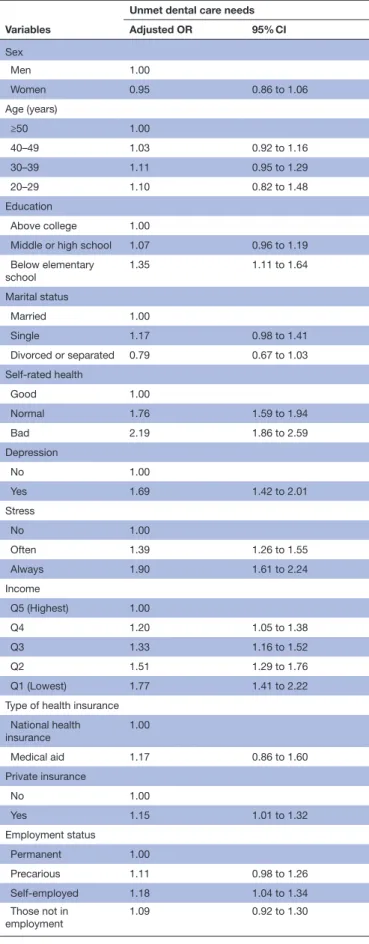
After applying multivariate models adjusted for several covariates, the results for factors associated with unmet dental care needs are shown in table 3. People who did not graduate elementary school had a higher risk of unmet dental care needs compared with those who graduated from college (OR: 1.35, 95% CI 1.11 to 1.64). Low-income group was 1.77 times more likely to expe-rience unmet dental care needs than those with higher income. People with negative self-rated health were 2.19 times more likely to experience unmet dental care needs than those with positive self-related health, and people with stress or depression were more likely to experience unmet dental care needs than those who did not have such conditions (OR: 1.90, 1.69, respectively). People who joined private insurance scheme were 1.15 times more likely to experience unmet dental care needs than
Variables Total
Unmet dental care needs Rao-Scott Χ2
(p value) Yes, n (%) No, n (%) Precarious 1221 237 (19.4) 984 (80.6) Self-employed 1116 218 (19.5) 898 (80.5) Those not in employment 381 68 (17.8) 313 (82.2) Table 1 Continued
Table 2 Self-reported reasons for unmet dental care needs according to employment status Variable
Reason for unmet need
Total Economic burden, n (%) No time to spare, n (%) Others, n (%)*
Total 4620 415 (9.0) 209 (4.5) 177 (3.8) Permanent 1902 98 (5.2) 106 (5.6) 74 (3.9) Precarious 1221 158 (12.9) 42 (3.4) 37 (3.0) Self-employed 1116 109 (9.8) 56 (5.0) 53 (4.7) Those not in employment 381 50 (13.1) 5 (1.3) 13 (3.4)
*Others: Trivial symptoms, great distance from healthcare facility, reduced mobility (difficult to visit for physical reasons), no one to babysit, lack of information as to where to go, no timely appointment, absence of a primary care physician and so on.
on 15 May 2019 by guest. Protected by copyright.
http://bmjopen.bmj.com/
those who did not join private insurance. Self-employed workers were 1.18 times more likely to experience unmet dental care needs than full-time permanent workers.
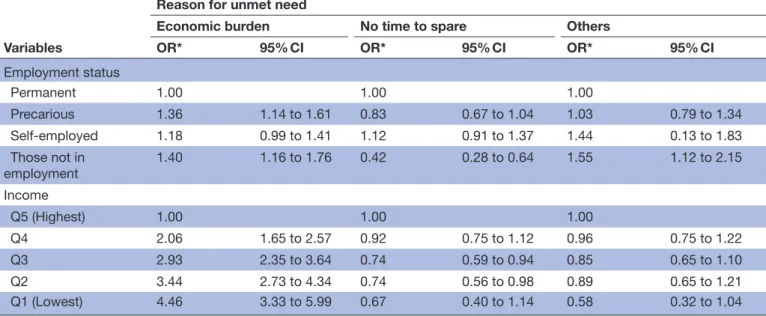
Table 4 shows the factors associated with reason for
unmet dental care needs according to employment status or income. In employment status, precarious workers and those not in employment were more likely to experience unmet dental care needs caused by economic burden, compared with permanent workers (OR: 1.36, 1.40, respectively). On the other hand, precarious workers were 0.73 times more likely to experience unmet dental care needs due to having no time to spare, compared with permanent workers. In terms of income level, low-income group were 4.46 times more likely to experience unmet dental care needs caused by economic burden than those with the highest income. Meanwhile, middle-income group was 0.74 times more likely to experience unmet dental care needs caused by having no time to spare, compared with the highest-income class.
dIsCussIOn
This study showed that 17.3% of the South Korean popu-lation experienced unmet dental care needs. This rate is about 3–4 times higher than those of European countries, meaning people in South Korea have relatively low access to dental care. The high rate results from very low health insurance coverage in dental care services. Non-insured payments, which includes costs that the government does not support such as dental care services, is higher than payments for general healthcare services. In 2010, the national health insurance coverage rate was about 62.7% in South Korea (pharmacy 71.6%, clinic 65.6%, hospital 60.5%), whereas coverage rates of dental clinics and hospitals were about 35.5% and 25.5%, respectively.14 In addition, the proportion
of non-insured payment (numerator) in OOP (denomi-nator) was about 43.2% and 64.6%, respectively, which was a much higher rate compared with other treatment services.3
Fortunately, the South Korean government has imple-mented a policy to insure dental implant treatments, which were previously not insured among senior citizens, and plans to expand coverage rate for younger people as well. Based on such improvement of benefits, we suggest consistent coverage expansion in dental care by considering the char-acteristics of treatment criteria.
We identified the factors affecting unmet dental care needs as following: education, income, self-rated health, depression, stress, private insurance and employment status. In particular, we found no interaction between employment status and income. In other words, income and employment status independently affect unmet dental needs. The significant results linking socioeco-nomic status, including education and income levels, to health status indicators, such as self-rated health, depression, and stress, were not confined to dental care outcomes. These results were similar to those of previous studies using various designs or study periods.15–23
Our research showed that people who joined private insurance scheme were 1.15 times more likely to expe-rience unmet dental care needs than those who did not join private insurance. People who had higher levels of
Table 3 Factors associated with unmet dental care needs
Variables
Unmet dental care needs Adjusted OR 95% CI Sex Men 1.00 Women 0.95 0.86 to 1.06 Age (years) ≥50 1.00 40–49 1.03 0.92 to 1.16 30–39 1.11 0.95 to 1.29 20–29 1.10 0.82 to 1.48 Education Above college 1.00
Middle or high school 1.07 0.96 to 1.19 Below elementary school 1.35 1.11 to 1.64 Marital status Married 1.00 Single 1.17 0.98 to 1.41
Divorced or separated 0.79 0.67 to 1.03 Self-rated health Good 1.00 Normal 1.76 1.59 to 1.94 Bad 2.19 1.86 to 2.59 Depression No 1.00 Yes 1.69 1.42 to 2.01 Stress No 1.00 Often 1.39 1.26 to 1.55 Always 1.90 1.61 to 2.24 Income Q5 (Highest) 1.00 Q4 1.20 1.05 to 1.38 Q3 1.33 1.16 to 1.52 Q2 1.51 1.29 to 1.76 Q1 (Lowest) 1.77 1.41 to 2.22
Type of health insurance National health
insurance 1.00
Medical aid 1.17 0.86 to 1.60
Private insurance No 1.00 Yes 1.15 1.01 to 1.32 Employment status Permanent 1.00 Precarious 1.11 0.98 to 1.26 Self-employed 1.18 1.04 to 1.34 Those not in employment 1.09 0.92 to 1.30
on 15 May 2019 by guest. Protected by copyright.
http://bmjopen.bmj.com/
income or education were more likely to join private insurance, and this phenomenon was similar to other countries that operate public healthcare systems with supportive private insurance.24 Although medical utilisa-tion of people joining private insurance was not higher compared with those not insured by private insurance, it is possible to increase unmet needs by relatively high desire for healthcare. Unmet needs related to private insurance must be examined further in future research.
We examined the difference of unmet dental care needs by employment status. Self-employed workers were 1.18 times more likely to experience unmet dental care needs than full-time permanent workers, and this phenomenon may have resulted from characteristics of self-employed workers in South Korea. A few people who failed to get a regular job opted to start their own business rather than looking for a non-regular position. Self-employed people comprise more than 30% of the entire labour market in South Korea. A substantial number of self-employed people belong to low-income class, and they are exposed to the danger of working in poverty.25
We examined the factors associated with reason for unmet dental care needs according to employment status or income. Precarious workers and those not in employment were more likely to experience unmet dental care needs caused by economic burden than permanent workers, and this result was similar compared with previous studies.26 27 Such
phenomenon is related to the fact that the monthly wages of precarious workers were about 52.2% of wages earned by full-time permanent workers. In 2015, the average monthly wage of permanent workers was about US$2300 in South Korea, whereas the monthly wage of precarious workers was about US$1200. It is a crucial issue is that the average wage of precarious workers is lower than minimum cost of living,
and this disparity may have the effect of reducing access to dental care for precarious workers and those not in employ-ment. A similar issue is that low-income group was 4.46 times more likely to experience unmet dental care needs due to economic burden than those with the highest income. Meanwhile, unmet dental care needs caused by other reasons were also significant, but in the opposite direction. For example, precarious workers and those not in employ-ment were less likely to experience unmet dental care needs caused by having no time to spare than permanent workers. This phenomenon may be due to the longer working hours of full-time permanent workers compared with precarious workers. In fact, the average working hours of precarious workers in 2013 were about 75.5% of those of permanent workers.
This study is significant in that it was the first study to examine the association of economic status on unmet dental care needs among adults in South Korea using longitudinal panel data. Although similar studies on this topic have been conducted, all of them used cross-sec-tional design, and the possible inverse causality between employment status and unmet dental care needs were not reflected. This study’s longitudinal design allowed us to assess the stability and continuity of several attributes of a sample group by repeatedly observing the same partici-pants. Another major strength of this study’s longitudinal design was that cohort effects can be avoided since we examined one group of individuals over time, rather than comparing several different groups that represent different ages and generations.
Our study also had some limitations. First, we used self-re-ported questionnaires to identify subjects’ experience of unmet dental care needs. Nevertheless, some studies using subjective and objective methods tended to give reasonably
Table 4 Factors associated with reason for unmet dental care needs according to employment status or income
Variables
Reason for unmet need
Economic burden No time to spare Others
OR* 95% CI OR* 95% CI OR* 95% CI
Employment status
Permanent 1.00 1.00 1.00
Precarious 1.36 1.14 to 1.61 0.83 0.67 to 1.04 1.03 0.79 to 1.34 Self-employed 1.18 0.99 to 1.41 1.12 0.91 to 1.37 1.44 0.13 to 1.83 Those not in
employment 1.40 1.16 to 1.76 0.42 0.28 to 0.64 1.55 1.12 to 2.15 Income
Q5 (Highest) 1.00 1.00 1.00
Q4 2.06 1.65 to 2.57 0.92 0.75 to 1.12 0.96 0.75 to 1.22
Q3 2.93 2.35 to 3.64 0.74 0.59 to 0.94 0.85 0.65 to 1.10
Q2 3.44 2.73 to 4.34 0.74 0.56 to 0.98 0.89 0.65 to 1.21
Q1 (Lowest) 4.46 3.33 to 5.99 0.67 0.40 to 1.14 0.58 0.32 to 1.04
*Adjusted for age, sex, education, marital status, disability, chronic disease, depression, stress, self-rated health, type of health insurance, private insurance.
on 15 May 2019 by guest. Protected by copyright.
http://bmjopen.bmj.com/
consistent results.28 In addition, the follow-up period in
the current study was relatively short compared with other studies. Second, we did not control severity of patient’s dental status in our research. Although severity of dental status may affect the subject’s access to medical care, we did not consider this factor in our model. Third, temporal bias could exist in our study results.
COnClusIOns
Our research showed that precarious workers and those not in employment were more likely to experience unmet dental care needs due to economic burden than full-time permanent workers. In addition, low-income group were more likely to experience unmet dental care needs caused by economic burden than those with the highest income. This disparity indicates that certain people are more likely to face barriers in obtaining the health services they need. Given the insecure employment status of low-income people, meeting their needs for healthcare may be an important thing to consider.
Author affiliations
1Department of Health Administration, Dongseo University, Busan, South Korea 2College of Pharmacy, Yonsei Institute of Pharmaceutical Sciences, Yonsei University,
Incheon, South Korea
3Department of Preventive Medicine and Public Health, Ajou University School of
Medicine, Suwon, South Korea
4HIRA Research Institute, Health Insurance Review and Assessment Service, Wonju,
South Korea
5Department of Public Health, Graduate School, Yonsei University, Seoul, South
Korea
6Department of Preventive Medicine, Yonsei University College of Medicine, Seoul,
South Korea
Acknowledgements The quality of English in this paper has been checked by at least two professional editors, both of whom are native English speakers. Contributors JWC, YC, HJL, YJJ and E-CP designed the study concept, wrote the protocol and collected the data. T-HL, HJL and YJJ conducted the analyses. All authors helped to draft the manuscript, read and approve the final manuscript. All authors had full access to all data (including statistical reports and tables) in the study and can take responsibility for the integrity of the data and the accuracy of the data analysis. JWC and E-CP are the study guarantors.
Funding The authors have not declared a specific grant for this research from any funding agency in the public, commercial or not-for-profit sectors.
Competing interests None declared. Patient consent for publication Not required.
ethics approval This study received ethical approval from the institutional review boardof Yonsei University Graduate School of Public Health.
Provenance and peer review Not commissioned; externally peer reviewed. data sharing statement No additional data are available.
Open access This is an open access article distributed in accordance with the Creative Commons Attribution Non Commercial (CC BY-NC 4.0) license, which permits others to distribute, remix, adapt, build upon this work non-commercially, and license their derivative works on different terms, provided the original work is properly cited, appropriate credit is given, any changes made indicated, and the use is non-commercial. See: http:// creativecommons. org/ licenses/ by- nc/ 4. 0/.
reFerenCes
1. Choi JW, Choi JW, Kim JH, et al. Association between chronic disease and catastrophic health expenditure in Korea. BMC Health Serv Res 2015;15:p. 26.
2. OECD. Health at a glance 2013: OECD indicators. Organization for Economic Cooperation and Development 2013.
3. Kang J-H, Kim C-W, Kim C-S, et al. Unmet dental care needs according to employment status. Journal of Korean Academy of Oral Health 2015;39:56–62.
4. Malecki K, Wisk LE, Walsh M, et al. Oral health equity and unmet dental care needs in a population-based sample: findings from the Survey of the Health of Wisconsin. Am J Public Health 2015;105 Suppl 3(Suppl 3):S466–S474.
5. Calzón Fernández S, Fernández Ajuria A, Martín JJ, et al. The impact of the economic crisis on unmet dental care needs in Spain. J Epidemiol Community Health 2015;69:880–5.
6. Calvasina P, Muntaner C, Quiñonez C. Factors associated with unmet dental care needs in Canadian immigrants: an analysis of the longitudinal survey of immigrants to Canada. BMC Oral Health
2014;14:145.
7. Statistics. EH. Eurostat [Internet]. 2014 http:// epp. eurostat. ec. europa. eu/ portal/ page/ portal/ health/ health_ care/ data/ database.
8. Jang Y, Yoon H, Park NS, et al. Dental care utilization and unmet dental needs in older Korean Americans. J Aging Health
2014;26:1047–59.
9. Singhal A, Chattopadhyay A, Garcia AI, et al. Disparities in unmet dental need and dental care received by pregnant women in Maryland. Matern Child Health J 2014;18:1658–66.
10. Heaton LJ, Mancl LA, Grembowski D, et al. Unmet dental need in community-dwelling adults with mental illness: results from the 2007 Medical Expenditure Panel Survey. J Am Dent Assoc
2013;144:e16–23.
11. Ahn E, Hwang J-M, Shin M-S. Dental Utilization Associated Factors among Elderly. Journal of dental hygiene science 2015;15:60–6. 12. Jeon JE, Chung WG, Kim NH. The reason of unmet dental need
related socioeconomic status in Korea: Using the 4th Korea National Health and Nutritional Examination Survey. Journal of Korean Academy of Oral Health 2012;36:73–81.
13. Choi JH, Kang S, You CH, et al. The Determinants of Choosing Traditional Korean Medicine or Conventional Medicine: Findings from the Korea Health Panel. Evid Based Complement Alternat Med
2015;2015:1–9.
14. Lee KE. A comparison study between nations for dental health coverage system. Seoul University, Seoul 2014.
15. Kim J, Kim TH, Park EC, et al. Factors influencing unmet need for health care services in Korea. Asia Pac J Public Health 2015;27:NP25 55–NP2569.
16. Miller JE, Nugent CN, Gaboda D, et al. Reasons for unmet need for child and family health services among children with special health care needs with and without medical homes. PLoS One
2013;8:e82570.
17. Heo J, Oh J, Kim J, et al. Poverty in the midst of plenty: unmet needs and distribution of health care resources in South Korea. PLoS One
2012;7:e51004.
18. Hwang B, Chun SM, Park JH, et al. Unmet healthcare needs in people with disabilities: comparison with the general population in Korea. Ann Rehabil Med 2011;35:627–35.
19. Yamada T, Chen CC, Murata C, et al. Access disparity and health inequality of the elderly: unmet needs and delayed healthcare. Int J Environ Res Public Health 2015;12:1745–72.
20. Kim SH, Lee CY. [Analysis of factors affecting unmet healthcare needs of married immigrant women]. J Korean Acad Nurs
2013;43:770–80.
21. Ahn YH, Kim NH, Kim CB, et al. Factors affecting unmet healthcare needs of older people in Korea. Int Nurs Rev 2013;60:510–9. 22. Mago A, Thyvalikakath TP. Impact of mood disorders on oral
health-care utilization among middle-aged and older adults. Community Dent Oral Epidemiol 2014;42:451–9.
23. Somkotra T, Detsomboonrat P. Is there equity in oral healthcare utilization: experience after achieving Universal Coverage.
Community Dent Oral Epidemiol 2009;37:85–96.
24. Buchmueller TC, Couffinhal A, Grignon M, et al. Access to physician services: does supplemental insurance matter? evidence from France. Health Econ 2004;13:669–87.
25. Lee SY, Kim CW, Kang JH, et al. Unmet healthcare needs depending on employment status. Health Policy
2015;119:899–906.
26. Jeon JE, Jeong WG, Kim NH. Determinants for dental service utilization among Koreans. Journal of Korean Academy of Oral Health 2011;35:441–9.
27. Rosen EB, Tomar SL. Perceived oral health status and unmet dental needs among adults in Union County. Todays FDA 2008;20:16–19. 28. Kang MY, Yoon CG, Yoon JH. Influence of illness and unhealthy
behavior on health-related early retirement in Korea: Results from a longitudinal study in Korea. J Occup Health 2015;57:28–38.
on 15 May 2019 by guest. Protected by copyright.
http://bmjopen.bmj.com/