RESEARCH BRIEF YONGSEUNG SHIN
KEI RESEARCH BRIEFS
This study aims to provide validity of regulating indoor Radon levels by estimating the risk reduction effect and the health benefit
of introducing indoor air quality regulations by considering Radon exposure scenarios in different living environments in Korea
and to propose a Radon management method compatible with Korea’s current circumstances.
Estimation of the Risk Reduction and
Health Benefit of Regulating Radon
Level in Indoor Air Quality
Radon, a natural radioactive material similar to Uranium and Radium, is a major carcinogen threatening public health which we are routinely exposed to in our living environment. The World Health Organization and the U.S. Environmental Protection Agency defined Radon as a major cause of lung cancer following cigarette smoking, and recommend managing Radon levels in indoor air. The public’s concerns on hazard associated with exposure to Ra-don have recently increased with media outlets warning its risk, leading to calls for the government to take systematic and active measures. As such, there is a need to establish and reinforce a more proactive and systematic indoor air quality management policy, one which includes management standard on residential spaces, in order to reduce the risk of exposure to Radon and ulti-mately to protect public health. This study aims to provide validity of regulating indoor Radon levels by esti-mating the risk reduction effect and the health benefit of introducing indoor air quality regulations by considering Radon exposure scenarios in different living environments in Korea and to propose a Radon management method compatible with Korea’s current cir-cumstances.
A review on the current status and level of indoor Radon management in Korea and other nations found that advanced countries have conducted nationwide survey on indoor Radon, based on which Radon management measures and standards were formulated and implemented. On the contrary, indoor Radon management standards are stip-ulated only for multi-use facilities and schools in Korea and not for residential spaces, resulting in insufficient manage-ment of indoor Radon in residential houses. (Unit: Persons/year)
1,368
1,968
MALE1,652
316
FEMALE83.94
%16.06
% TOTAL POPULATION69.51
%TABLE 1 Excess deaths from lung cancer caused by exposure to indoor Radon calculated by facility type
Rn
Rn
Rn
Rn
Rn
Rn
Rn
12.6%
1,968
personsEstimated excess deaths from lung cancer caused by exposure to indoor
Radon stood at 1,968 persons per year, accounting for 12.6% of total
lung cancer mortality.
294
10
11
1
156
111
17
DETACHED HOUSES MULTIPLEX HOUSES APARTMENT HOUSES7.93
%5.64
%0.86
% OFFICES14.94
%1,662
166
122
18
0.51
%0.56
%0.05
%84.45
%8.43
%6.20
%0.91
%9
8
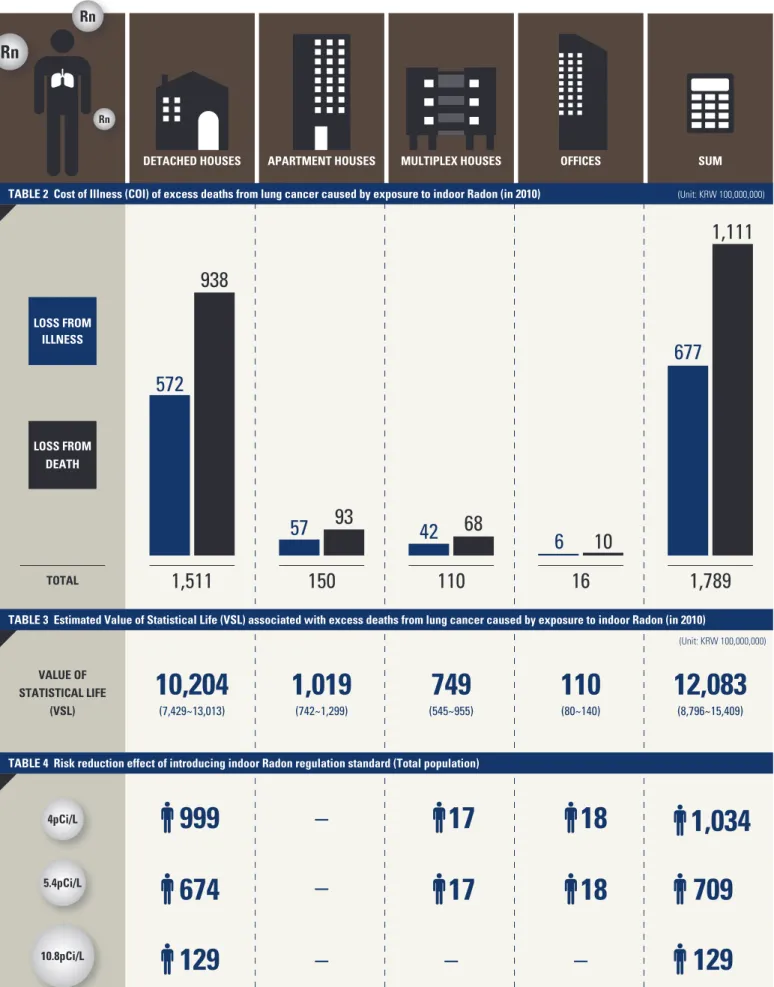
Based on the domestic exposure scenario, we calculated the excess deaths from lung cancer caused by exposure to indoor Radon (in 2010) and estimated that the excess deaths from lung cancer caused by exposure to indoor Radon stood at 1,968 persons per year, which accounts for 12.6% of total lung cancer mortality. The proportion of excess deaths in houses was 99.1% with 1950 deaths and overwhelmed those in offices and multi-use facilities of 18 deaths (0.91%) and 0 deaths (0.00%) respectively. The biggest share of excess deaths from lung cancer in houses occurred in detached houses with 1,662 deaths (84.45%), followed by 166 deaths in apart-ment houses (8.43%) and 122 deaths in multiplex houses (6.20%). We estimated the socioeconomic costs associated with excess deaths from lung cancer caused by exposure to indoor Radon and calculated the Cost of Illness (COI) as 178.9 billion won per year and the Value of Statistical Life (VSL) as 1,208 billion won per year (ranging between 880 billion won and 1,541 billion won per year).
Under the assumption that indoor Radon management standards are applied to hous-es, we estimated the effect of risk reduc-tion and health benefit were estimated by
facility and standard level. Presuming that three standard levels of 4 pCi/L, 5.4 pCi/ L and 10.8 pCi/L are applied to all types of residential buildings including detached and multi-unit houses, the risk reduction effect or reduction in excessive deaths from lung cancer was estimated to stand at 1,016 persons, 691 persons and 129 persons per year respectively. Converted to medical costs, they were 92.3 billion won, 62.8 billion won and 11.7 billion won per year respectively while the Values of Statistical Life were calculated as 623.8 billion won, 424.2 billion won and 79.2 billion won per year, respectively.
11
10
RESEARCH BRIEF KEI RESEARCH BRIEFS
YONGSEUNG SHIN TOTAL VALUE OF STATISTICAL LIFE (VSL)
938
1,511
572
93
150
57
68
110
42
10
16
6
1,111
1,789
677
Rn
Rn Rn SUM OFFICES APARTMENT HOUSESDETACHED HOUSES MULTIPLEX HOUSES TABLE 2 Cost of Illness (COI) of excess deaths from lung cancer caused by exposure to indoor Radon (in 2010)
(Unit: KRW 100,000,000)
12,083
(8,796~15,409)
10,204
(7,429~13,013)
TABLE 3 Estimated Value of Statistical Life (VSL) associated with excess deaths from lung cancer caused by exposure to indoor Radon (in 2010)
1,019
(742~1,299)110
(80~140)749
(545~955)TABLE 4 Risk reduction effect of introducing indoor Radon regulation standard (Total population)
4pCi/L 10.8pCi/L
999
–
5.4pCi/L674
–
709
129
129
–
–
–
1,034
17
17
18
18
Scenario 1 Multi-use facilities Scenario 2 Scenario 2-1 Scenario 2-2 Residential houses Detached houses Multi-unit housesStandard level of 4pCi/L —
6,133
(4,465~7,822)
104
(75~133)6,238
(4,541~7,955)Standard level of 5.4pCi/L —
4,138
(3,012~5,277)
104
(75~133)4,242
(3,088~5,410)Standard level of 10.8pCi/L —
792
(576~1,010)
—
792
(576~1,010)
TABLE 5 Estimated Value of Statistical Life (VSL) of reduced premature deaths caused by indoor Radon calculated by regulation scenario (in 2010)
(Unit: KRW 100,000,000) LOSS FROM ILLNESS LOSS FROM DEATH