363 Open Access
Characteristics, Outcomes and Predictors of Long-Term Mortality
for Patients Hospitalized for Acute Heart Failure:
A Report From the Korean Heart Failure Registry
Dong-Ju Choi, MD1,14, Seongwoo Han, MD2, Eun-Seok Jeon, MD3, Myeong-Chan Cho, MD4, Jae-Joong Kim, MD5,
Byung-Su Yoo, MD6, Mi-Seung Shin, MD7, In-Whan Seong, MD8, Youngkeun Ahn, MD9, Seok-Min Kang, MD10,
Yung-Jo Kim, MD11, Hyung Seop Kim, MD12, Shung Chull Chae, MD13, Byung-Hee Oh, MD14,
Myung-Mook Lee, MD15, and Kyu-Hyung Ryu16 on behalf of the KorHF Registry
1Department of Internal Medicine, Seoul National University College of Medicine, Bundang Hospital, Seongnam, 2Department of Internal
Medicine, Korea University College of Medicine, Seoul, 3Department of Internal Medicine, Sungkyunkwan University College of Medicine,
Samsung Medical Center, Seoul, 4Department of Internal Medicine, Chungbuk National University College of Medicine, Cheongju, 5Department of Internal Medicine, University of Ulsan College of Medicine, Asan Medical Center, Seoul, 6Department of Internal Medicine,
Yonsei University Wonju Christian Hospital, Wonju, 7Department of Internal Medicine, Gachon University Gil Hospital, Incheon, 8Department of Internal Medicine, Chungnam National University College of Medicine, Daejoen, 9Department of Internal Medicine,
Chonnam National University College of Medicine, Gwangju, 10Department of Internal Medicine, Yonsei University Severance Hospital, Seoul, 11Department of Internal Medicine, Yeungnam University College of Medicine, Daegu, 12Department of Internal Medicine, Keimyung University
College of Medicine, Daegu, 13Department of Internal Medicine, Kyungpook National University College of Medicine, Daegu, 14Department of
Internal Medicine, Seoul National University College of Medicine, Seoul, 15Department of Internal Medicine, Dongguk University
College of Medicine, Ilsan Hosptial, Goyang, 16Department of Internal Medicine, Konkuk University Medical Center, Seoul, Korea ABSTRACT
Background and Objectives: Acute heart failure (AHF) is associated with a poor prognosis and it requires repeated hospital-izations. However, there are few studies on the characteristics, treatment and prognostic factors of AHF. The aims of this study were to describe the clinical characteristics, management and outcomes of the patients hospitalized for AHF in Korea. Sub-jects and Methods: We analyzed the clinical data of 3,200 hospitalization episodes that were recorded between June 2004 and April 2009 from the Korean Heart Failure (KorHF) Registry database. The mean age was 67.6±14.3 years and 50% of the patients were female. Results: Twenty-nine point six percent (29.6%) of the patients had a history of previous HF and 52.3% of the patients had ischemic heart disease. Left ventricular ejection fraction (LVEF) was reported for 89% of the patients. The mean LVEF was 38.5±15.7% and 26.1% of the patients had preserved systolic function (LVEF ≥50%), which was more preva-lent in the females (34.0% vs. 18.4%, respectively, p<0.001). At discharge, 58.6% of the patients received beta-blockers (BB), 53.7% received either angiotensin converting enzyme-inhibitors or angiotensin receptor blockers (ACEi/ARB), and 58.4% re-ceived both BB and ACEi/ARB. The 1-, 2-, 3- and 4-year mortality rates were 15%, 21%, 26% and 30%, respectively. Multivari-ate analysis revealed that advanced age {hazard ratio: 1.023 (95% confidence interval: 1.004-1.042); p=0.020}, a previous history of heart failure {1.735 (1.150-2.618); p=0.009}, anemia {1.973 (1.271-3.063); p=0.002}, hyponatremia {1.861 (1.184-2.926); p= 0.007}, a high level of serum N-terminal pro-B-type natriuretic peptide (NT-proBNP) {3.152 (1.450-6.849); p=0.004} and the use of BB at discharge {0.599 (0.360-0.997); p=0.490} were significantly associated with total death. Conclusion: We pres-ent here the characteristics and prognosis of an unselected population of AHF patipres-ents in Korea. The long-term mortality rate was comparable to that reported in other countries. The independent clinical risk factors included age, a previous history of
heart failure, anemia, hyponatremia, a high NT-proBNP level and taking BB at discharge. (Korean Circ J 2011;41:363-371)
KEY WORDS: Heart failure; Registries; Outcome.
Received: November 4, 2010 / Revision Received: January 14, 2011 / Accepted: February 3, 2011
Correspondence: Kyu-Hyung Ryu, MD, Department of Internal Medicine, Konkuk University Medical Center, 27-2 Hwayang-dong, Gwangjin-gu, Seoul 143-729, Korea
Tel: 82-2-2030-5030, Fax: 82-2-2030-6069,E-mail: [email protected] • The authors have no financial conflicts of interest.
cc This is an Open Access article distributed under the terms of the Creative Commons Attribution Non-Commercial License (http://creativecommons.org/licens-es/by-nc/3.0) which permits unrestricted non-commercial use, distribution, and reproduction in any medium, provided the original work is properly cited.
Introduction
Acute Heart failure (AHF) is one of the most common con-ditions encountered in emergency care and AHF is associated with hospitalization and a poor prognosis.1) Even though the
prevalence of AHF is increasing and its clinical outcome is fa-tal at its worst, there is limited data on its epidemiology,
treat-ment and prognosis.2) Many hospital-based and
community-based registries have elucidated the clinical characteristics, th-erapeutic modalities and outcomes of patients with heart fail-ure.3)4) However, there have been no large-scale observational
studies to evaluate the clinical features of Korean patients with AHF.
Several markers of a poor prognosis have been described for patients with heart failure. The widely recognized risk factors include age, ischemic heart disease, a reduced left ventricular ejection fraction (LVEF) and renal dysfunction.5) In addition,
anemia, hyponatremia, male gender and diabetes have been associated with a poor prognosis.6)7) The values of these
prog-nostic factors in AHF patients are less well documented. The Korean Heart Failure (KorHF) Registry is a nationwide ob-servational, prospective, multi-centre study on AHF. It is the fi-rst multi-center registry of consecutive AHF patients accord-ing to the Korean AHF criteria. Our objectives were to inves-tigate the etiology, clinical characteristics, treatment modali-ties, morbidity, mortality and prognostic markers of AHF.
Subjects and Methods
Criteria and enrolment
Between June 2004 and April 2009, the data on the clinical status and in-hospital outcomes of patients was obtained fol-lowing a review of the registry data from 24 hospitals in Korea. The participating centers were evenly located nationwide in proportion to the population they serve. Heart failure was diagnosed on admission according to the Framingham cri-teria.7) The institutional review board or ethics committee at
each participating hospital approved the study protocol, and the patients gave their written informed consent prior to st-udy entry.
Data collection
The patient demographic and baseline characteristics, the underlying diseases, the clinical presentation, treatments and outcomes from the initial presentation through hospitaliza-tion and at discharge were recorded. The data was entered into the KorHF Registry database via a Web-based electronic data capture system that included an electronic case report form. The diagnosis of heart failure was required to be con-firmed at the time of a patient’s discharge. Morbidity and the in-hospital and long-term mortality were also documented. Data collection and audition were performed by the KorHF
Registry Steering Committee at The Korean Society of Heart Failure.
Etiology of heart failure
We attempted to determine the etiology of heart failure and identify the demographic characteristics, clinical variables and biochemical markers that had prognostic impact. We com-pared the long-term mortality in relation to age, gender, the body mass index (BMI) and the previous medical history. A history of hypertension, dyslipidemia and/or diabetes melli-tus was recorded if documented by the physician in the ad-mitting notes, and if the clinical diagnoses and criteria con-formed to the Framingham’s criteria. The use of beta-blockers (BB), angiotensin converting enzyme-inhibitors (ACEi) and/ or angiotensin receptor blockers (ARB) at discharge was as-sessed for their impact on the prognosis. We further evaluated the effect of the left ventricular systolic function on survival, the clinical presentation and the cause of heart failure. The bio-chemical variables included in the analysis were anemia (blo-od hemoglobin <12.0 g/dL), hyponatremia (s(blo-odium <135 mmol/ L), azotemia (serum creatinine ≥2.0 mg/dL), hypocholester-olemia (cholesterol <160 mg/dL) and the N-terminal pro-B-type natriuretic peptide (NT-proBNP) level at admission (over 1,000 pg/mL).
Follow-up information
Research coordinators guided by documented definitions used standardized report forms to collect the follow-up events until October 2009. The medical records were reviewed wh-enever possible when patients required repeat hospitaliza-tion. In addition to patient telephone interviews, the referring physicians and institutions were contacted when necessary for additional information. We obtained information on patient survival and hospital readmission for heart failure. Events related to heart failure were defined as admission for heart failure deterioration, transplantation or all-cause death.
Statistical analysis
The continuous variables are expressed as means±standard deviation (SD). Group comparisons were based on the Stu-dent’s t-test or the χ2 test as appropriate. Survival function
esti-mates were derived using the Kaplan-Meier method, and dif-ferences were tested using the log-rank test. Predictors of sur-vival were identified using univariate and multivariate Cox proportional hazard regression analyses.
The candidate independent variables included age, gender, a previous diagnosis of heart failure, the systolic blood pres-sure, the heart rate, the BMI, anemia, the ejection fraction and the systolic heart failure medications at discharge. The entry criterion for the multivariate analysis was a p<0.05, which was considered statistically significant. The results are pre-sented as means, SD, percentages {95% confidence interval
(CI)} and hazard ratios (95% CI) where appropriate. All the analyses were conducted using the Statistical Package for the Social Sciences (SPSS) 15.0 statistical software (SPSS Inc.).
Results
The KorHF Registry database included 3,200 admission episodes for heart failure at 24 centers. The mean observa-tional period was 1.7 years (from 0.1 to 4.9 years) from June of 2004 to April of 2009, and the follow-up rate was 81%.
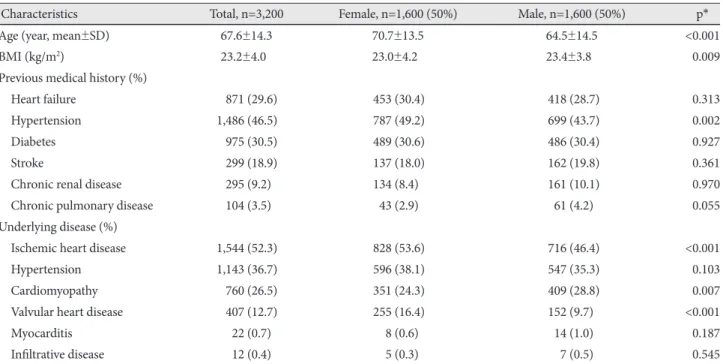
Demographic and clinical characteristics
The patient demographics and the characteristics of the past medical history for the patient episodes of heart failure are sum-marized in Table 1. Among the 3,200 patients, 1,612 (50.4%) were over 70 years old. The average age was 67.6±14.3 years old and the women were significantly older than the men (mean age: 70.7±13.5 vs. 64.5±14.5 years, p<0.0001) and the women had a lower BMI. Twenty-nine point six percent (29.6%) of the patients had a prior history of heart failure. In addi-tion, 46.5% of the patients had a history of hypertension, and a history of diabetes, stroke and chronic renal disease was present in 30.5%, 18.9% and 9.2%, respectively. The underly-ing causes of heart failure were as follows: ischemic heart disease (52.3%), myocardial infarction or coronary heart dise-ase in 1,194 patients (77.3%), valvular heart disedise-ase (12.7%) and cardiomyopathy (26.5%). Idiopathic dilated cardiomy-opathy was present in 747 patients (87.9%). However, the oth-er clinical features woth-ere similar between the two groups, ex-cept for a higher prevalence of ischemic heart disease and val-vular heart disease as the underlying disease in the female
patients.
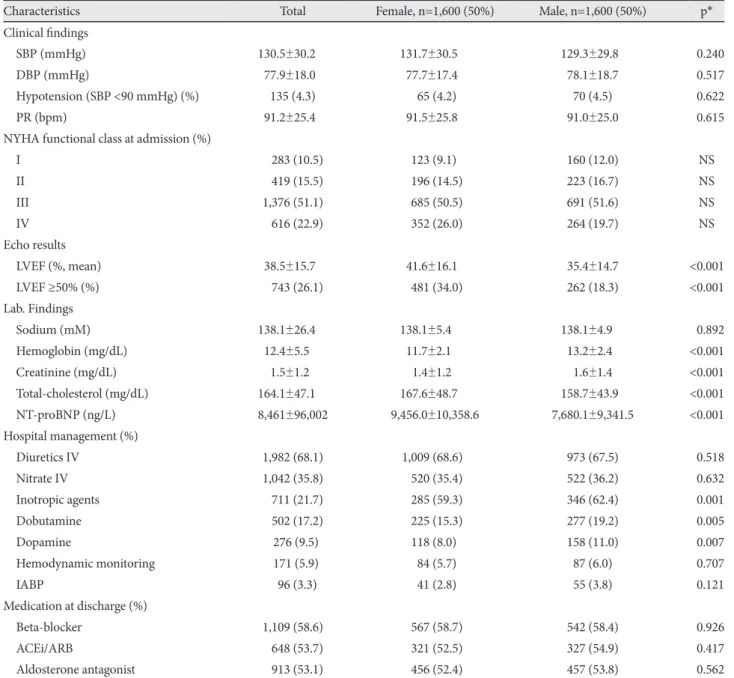
The clinical characteristics of the patients at presentation are shown in Table 2. Acute episodes of heart failure were gen-erally associated with dyspnea. Upon admission, 22.9% of the patients experienced dyspnea at rest (NYHA functional class IV criteria), whereas 10.5% of patients experienced other sym-ptoms of heart failure (NYHA class I). However, 15.5% and 51.1% of the patients had symptoms of NYHA class II and III, respectively. The dyspneoic symptoms and blood pressure levels were similar in both gender groups. Hypotension (sys-tolic BP <90 mmHg) was identified in 4.3% of the admissions and the rate was similar for females and males.
The laboratory findings of the patients at presentation are summarized in Table 2 and 3. The abnormal blood chemis-try and the markers presented with AHF on admission were as follows: hyponatremia (18.0%, a level of creatinine <135 mM), anemia (41.4%, a level of hemoglobin <12 mg/dL), azotemia (14.9%, a level of creatinine ≥2.0 mg/dL) and hy-pocholesterolemia (51.5%, a level of total cholesterol <160 mg/dL).
We identified LVEF in 2,843 (88.8%) patients in the pres-ent study: the mean LVEF was 38.5±15.7%, and preserved systolic function, which was defined as a LVEF >50%, was evident in 743 patients (26.1%). The female patients pre-sented with a higher LVEF (female vs. male: 41.6±16.1% vs. 35.4±14.7%, respectively, p<0.001) and a higher prevalence of heart failure with preserved systolic function (34.0% vs. 18.3%, respectively, p<0.001).
Intravenous diuretic infusions/boluses were given to 68.6% of the patients, and 35.8% received intravenous nitrates. Ino-tropic treatment was used in 21.7% of the patients, and 22.4%
Table 1. Demographic and clinical features
Characteristics Total, n=3,200 Female, n=1,600 (50%) Male, n=1,600 (50%) p*
Age (year, mean±SD) 67.6±14.3 70.7±13.5 64.5±14.5 <0.001
BMI (kg/m2) 23.2±4.00 23.0±4.20 23.4±3.80 0.009
Previous medical history (%)
Heart failure 871 (29.6) 453 (30.4) 418 (28.7) 0.313
Hypertension 1,486 (46.5) 787 (49.2) 699 (43.7) 0.002
Diabetes 975 (30.5) 489 (30.6) 486 (30.4) 0.927
Stroke 299 (18.9) 137 (18.0) 162 (19.8) 0.361
Chronic renal disease 295 (9.2)0 134 (8.4)0 161 (10.1) 0.970
Chronic pulmonary disease 104 (3.5)0 43 (2.9)0 61 (4.2)0 0.055
Underlying disease (%)
Ischemic heart disease 1,544 (52.3) 828 (53.6) 716 (46.4) <0.001
Hypertension 1,143 (36.7) 596 (38.1) 547 (35.3) 0.103
Cardiomyopathy 760 (26.5) 351 (24.3) 409 (28.8) 0.007
Valvular heart disease 407 (12.7) 255 (16.4) 152 (9.7)0 <0.001
Myocarditis 22 (0.7)0 8 (0.6)0 14 (1.0)0 0.187
Infiltrative disease 12 (0.4)0 5 (0.3)0 7 (0.5)0 0.545
of these patients received two or more inotropes. Dobuta-mine (17.2%) and dopaDobuta-mine (9.5%) were the most common-ly administered inotropes. Few patients received noradrena-line (0.9%) or mirlinone (0.2%). Inotropic agents were used more frequently in the males than in the females (59.3% vs. 62.4%, respectively, p=0.001). For critical care, 1,330 patients (37.7%) stayed at intensive care units during hospitalization, and 247 patients (7.1%) received mechanical ventilator assist-ance. Hemodialysis was performed in 4.1% of the patients. He-modynamic monitoring was performed in 5.9% of the pa-tients and intraaortic balloon pump was used in 3.3% of the patients.
Either ACEi or angiotensin-II receptor blockers (ARB)
were prescribed at discharge for 53.7% of the patients. BBs and spironolactone were administered to 58.6% and 53.1% of the patients, respectively. One of both, BBs or ACEi/ARB, was prescribed to 58.4% of the patients. There was no differ-ence in discharge medication between the two gender gr-oups (Table 2).
Clinical outcomes and predictors
Of the 3,200 consecutive admitted patients with heart fail-ure, 2,973 (92.9%) of them were discharged alive. During the follow-up period (mean±SD: 1.7±1.2 years), 625 patients (19.5%) died. The mortality rate during hospitalization was 6.4%. The cumulative survival rates for the study patients
af-Table 2. Clinical presentation and the hospital course
Characteristics Total Female, n=1,600 (50%) Male, n=1,600 (50%) p*
Clinical findings
SBP (mmHg) 130.5±30.200 131.7±30.500 129.3±29.80 0.240
DBP (mmHg) 77.9±18.00 77.7±17.40 78.1±18.7 0.517
Hypotension (SBP <90 mmHg) (%) 135 (4.3) 65 (4.2)0 70 (4.5) 0.622
PR (bpm) 91.2±25.40 91.5±25.80 91.0±25.0 0.615
NYHA functional class at admission (%)
I 0,283 (10.5) 123 (9.1)0 160 (12.0) NS II 0,419 (15.5) 196 (14.5) 223 (16.7) NS III 1,376 (51.1) 685 (50.5) 691 (51.6) NS IV 0,616 (22.9) 352 (26.0) 264 (19.7) NS Echo results LVEF (%, mean) 38.5±15.70 41.6±16.10 35.4±14.7 <0.001 LVEF ≥50% (%) 0,743 (26.1) 481 (34.0) 262 (18.3) <0.001 Lab. Findings Sodium (mM) 138.1±26.400 138.1±5.4000 138.1±4.900 0.892 Hemoglobin (mg/dL) 12.4±5.500 11.7±2.100 13.2±2.40 <0.001 Creatinine (mg/dL) 1.5±1.20 1.4±1.20 1.6±1.4 <0.001 Total-cholesterol (mg/dL) 164.1±47.100 167.6±48.700 158.7±43.90 <0.001 NT-proBNP (ng/L) 8,461±96,002 9,456.0±10,358.6 7,680.1±9,341.5 <0.001 Hospital management (%) Diuretics IV 1,982 (68.1) 1,009 (68.6) 973 (67.5) 0.518 Nitrate IV 1,042 (35.8) 520 (35.4) 522 (36.2) 0.632 Inotropic agents 0,711 (21.7) 285 (59.3) 346 (62.4) 0.001 Dobutamine 0,502 (17.2) 225 (15.3) 277 (19.2) 0.005 Dopamine 0276 (9.5) 118 (8.0)0 158 (11.0) 0.007 Hemodynamic monitoring 0171 (5.9) 84 (5.7)0 87 (6.0) 0.707 IABP 0,96 (3.3) 41 (2.8)0 55 (3.8) 0.121 Medication at discharge (%) Beta-blocker 1,109 (58.6) 567 (58.7) 542 (58.4) 0.926 ACEi/ARB 0,648 (53.7) 321 (52.5) 327 (54.9) 0.417 Aldosterone antagonist 0,913 (53.1) 456 (52.4) 457 (53.8) 0.562
*Comparison between the female and male group. SBP: systolic blood pressure, DBP: diastolic blood pressure, PR: pulse rate, NYHA: New York Heart Association, LVEF: left ventricular ejection fraction, NT-proBNP: N-terminal pro-B-type natriuretic peptide, IABP: intraaortic balloon pump, ACEi: angiotensin converting enzyme-inhibitors, ARB: angiotensin receptor blocker
ter discharge at 1, 2, 3 and 4 years were 85%, 79%, 74% and 70%, respectively, which were similar between both gender groups (Fig. 1). The event-free survival rates at 1, 2, 3 and 4
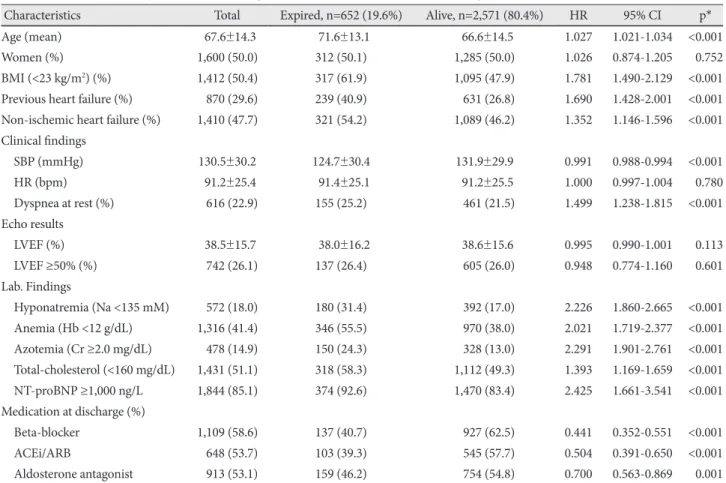
years were 67%, 56%, 47% and 41%, respectively. Heart tr-ansplantation was performed in 0.9% (31 patients) of the pa-tients and 24.6% (866 papa-tients) were re-hospitalized. The de-mographic and clinical variables associated with all cause mortality are summarized in Table 3.
Univariate analysis for the current risk variables showed that an advanced age, a low BMI (<23 kg/m2, median value),
a prior history of heart failure, a non-ischemic origin of heart failure, low blood pressure, dyspnea at rest on admission (NY-HA functional class IV), hyponatremia (<135 mM), anemia (hemoglobin <12 g/dL), azotemia (creatinine >2.0 mg/dL), low cholesterol (total cholesterol <160 mg/dL) and a high pl-asma NT-proBNP level (≥1,000 ng/dL) tended to be associ-ated with an increase in subsequent all-cause mortality, while a prescription of BB and/or ACEi/ARB was related with bet-ter clinical outcomes (Table 4).
On the basis of data gathered from all the patient episodes with AHF, multivariate analysis identified an advanced age, previous heart failure, anemia, hyponatremia and a high NT-proBNP level showed a tendency of increased subsequ-ent all-cause mortality, but a prescription of BB at discharge was associated with improved clinical outcomes. The multiva-riate odds ratios (ORs) and corresponding 95% CIs for
all-Fig. 1. The five-year follow-up results according to different gen-der. The five-year survival rate was 61% and 69% for the male (red line) and female (blue line), respectively.
1.0 0.9 0.8 0.7 0.6 0.5 Duration (years) Cu m ul at iv e s ur vi va l 0 1 2 3 4 Female Male
Table 3. Clinical factors and predictors for the long-term clinical outcomes on univariate analysis
Characteristics Total Expired, n=652 (19.6%) Alive, n=2,571 (80.4%) HR 95% CI p* Age (mean) 067.6±14.3 071.6±13.1 066.6±14.5 1.027 1.021-1.034 <0.001 Women (%) 1,600 (50.0) 312 (50.1) 1,285 (50.0) 1.026 0.874-1.205 0.752 BMI (<23 kg/m2) (%) 1,412 (50.4) 317 (61.9) 1,095 (47.9) 1.781 1.490-2.129 <0.001 Previous heart failure (%) 870 (29.6) 239 (40.9) 631 (26.8) 1.690 1.428-2.001 <0.001 Non-ischemic heart failure (%) 1,410 (47.7) 321 (54.2) 1,089 (46.2) 1.352 1.146-1.596 <0.001 Clinical findings SBP (mmHg) 130.5±30.2 124.7±30.4 131.9±29.9 0.991 0.988-0.994 <0.001 HR (bpm) 091.2±25.4 091.4±25.1 091.2±25.5 1.000 0.997-1.004 0.780 Dyspnea at rest (%) 616 (22.9) 155 (25.2) 461 (21.5) 1.499 1.238-1.815 <0.001 Echo results LVEF (%) 038.5±15.7 038.0±16.2 038.6±15.6 0.995 0.990-1.001 0.113 LVEF ≥50% (%) 742 (26.1) 137 (26.4) 605 (26.0) 0.948 0.774-1.160 0.601 Lab. Findings Hyponatremia (Na <135 mM) 572 (18.0) 180 (31.4) 392 (17.0) 2.226 1.860-2.665 <0.001 Anemia (Hb <12 g/dL) 1,316 (41.4) 346 (55.5) 970 (38.0) 2.021 1.719-2.377 <0.001 Azotemia (Cr ≥2.0 mg/dL) 478 (14.9) 150 (24.3) 328 (13.0) 2.291 1.901-2.761 <0.001 Total-cholesterol (<160 mg/dL) 1,431 (51.1) 318 (58.3) 1,112 (49.3) 1.393 1.169-1.659 <0.001 NT-proBNP ≥1,000 ng/L 1,844 (85.1) 374 (92.6) 1,470 (83.4) 2.425 1.661-3.541 <0.001 Medication at discharge (%) Beta-blocker 1,109 (58.6) 137 (40.7) 927 (62.5) 0.441 0.352-0.551 <0.001 ACEi/ARB 648 (53.7) 103 (39.3) 545 (57.7) 0.504 0.391-0.650 <0.001 Aldosterone antagonist 913 (53.1) 159 (46.2) 754 (54.8) 0.700 0.563-0.869 0.001 *Comparison between the expired and alive groups. HR: hazard ratio, CI: confidence interval, BMI: body mass index, SBP: systolic blood pre-ssure, LVEF: left ventricular ejection fraction, NT-proBNP: N-terminal pro-B-type natriuretic peptide, ACEi: angiotensin converting enzyme-inhibitors, ARB: angiotensin receptor blocker
Male Female
cause death are reported for each mortality risk factor iden-tified by the Cox Regression model (Table 4). An older age, a lower BMI, lower systolic BP, low hemoglobin, low sodium, elevated creatinine, the presence of dyspnea at rest and the absence of chronic BB use may be considered as the risk fac-tors of mortality.
The KorHF Registry is a national observational, prospec-tive, multi-centre study and it yields new important informa-tion on the actualities of AHF patients in Korea. It is the first population study of the consecutive AHF patients, as charac-terized according to the Framingham criteria, in 24 medical centers in Korea.
Discussion
The age of the patients in our study was high (older than 65 year-old) and the women were older than the men, which is consistent with the findings of previous studies.1-8) The
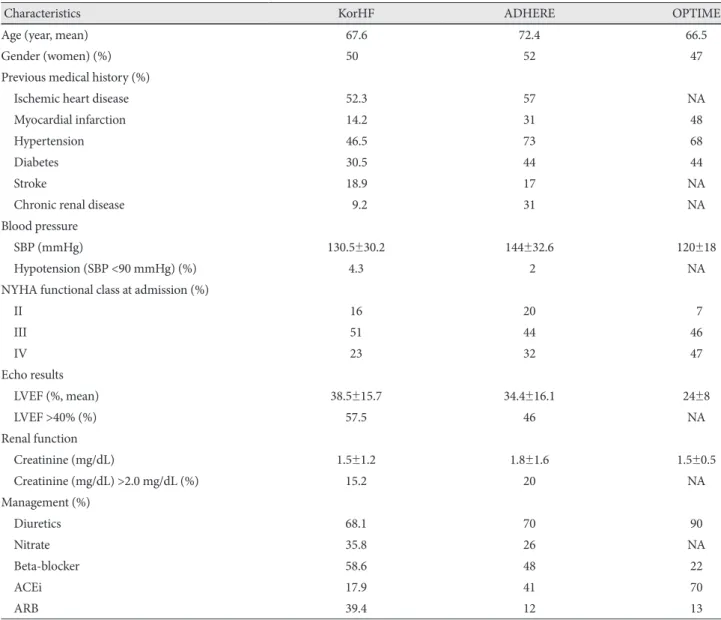
pati-ents with a prior heart failure history constituted 29.6% of all the patients, which was comparable to that of the Japanese data from the Heart Institute of Japan-Department of Cardio-logy (HIJC) registry (33.5%),9) but this was much lower than
that 75.6% from the American the Acute Decompensated He-art Failure National Registry (ADHERE) registry.10) This
dis-crepancy may result from ethnic differences or the methods of registration. The patients of the KorHFR were consecu-tively enrolled if they were admitted with a diagnosis of heart failure, while the patients of ADHERE were retrospectively enrolled.11)
The predominant cause of heart failure was ischemic heart disease. In this study population 52.3% of the patients expe-rienced heart failure secondary to ischemic heart disease, which is considerably lower than the 60-75% reported in the clinical trials of Western patients.8) Race and ethnic variations
may account for the differences in the causes of heart failure because the prevalence of ischemic heart disease was also low in the studies held in Japan.12) Thus, applying the guidelines
derived from the study populations containing a higher pro-portion of patients with ischemic heart disease than the
Ko-rean population should be carefully considered.
A preserved LVEF is a common finding in patients with AHF and in elderly heart failure patients.2)13) Among the
pa-tients with information on their LVEF, 26.1% had preserved systolic function, which was defined as an LVEF over 50%. However, transient systolic heart failure cannot be excluded. Echocardiography was not performed in 19.8% of the pa-tients. The prevalence of heart failure with preserved systolic function is comparable to that of other studies based on reg-istry data.
Although numerous randomized controlled trials have shown that ACEis, ARBs and BBs improved the survival of patients with heart failure, the proportions of our patients ac-tually receiving these drugs in the present study were 58.6%, 53.7% and 58.4%, respectively. These basic agents for the tr-eatment of heart failure are highly prescribed in Korea, and this is comparable to other countries.9)14) During the hospital
stay, BB, ACEi/ARB, furosemide, digoxin, spironolactone, aspirin and oral anticoagulants were frequently initiated to the AHF patients. Surprisingly, only the use of BBs at dischar-ge affected the long-term prognosis, while ACEi/ARBs and aldosterone antagonist did not. This appears to suggest that AHF and chronic heart failure are two distinct conditions. BB and ACEi/ARB therapy were more commonly prescribed to our patients than that to the patients included in other studies, and these drugs were more often taken by the patients than that in a recent survey.15) The use of ARBs was considerably
higher that that in a recent survey (Table 5). Diuretics were used by 68.1% of the patients in our study. Many patients re-ceived treatment for their precipitating factor and they obvi-ously did not have significant fluid overload. Spironolactone was frequently used since 53.1% of patients with heart failure were discharged with this medication. Inotropes are needed by AHF patients to support and stabilize the hemodynamics if the basic treatment modalities are inadequate. The use of inotropes in our study was comparable to that of other stud-ies.16) Interestingly, dopamine was used in our study twice as
often as dobutamine.
Previous studies have demonstrated that advanced age, low blood pressure, NYHA associated LV dysfunction and diabet-es were associated with a poor prognosis for patients with he-art failure. In addition, several factors such as BNP, C-reac-tive protein (CRP), impaired renal function and anemia have emerged as new predictors associated with a poor prognosis in heart failure patients.17) The present study evaluated both
new (anemia, renal insufficiency, hyponatremia, BNP and CRP) and known prognostic factors for heart failure and we revealed that anemia, hyponatremia and natreuretic peptide were related to the long-term mortality rate. We identified se-veral demographic and clinical variables as significant pre-dictors of poor survival on the univariate analysis. Patients with older age, a lower BMI less than 23 kg/m2, previous he-Table 4. Clinical predictors of the clinical outcome on multivariate
analysis
Characteristics of the patients HR 95% CI p* Age (mean) 1.023 1.004-1.042 0.020 Previous heart failure 1.735 1.150-2.618 0.009 Anemia (Hb <12 mg/dL) 1.973 1.271-3.063 0.002 Hyponatremia (Na <135 mM) 1.861 1.184-2.926 0.007 NT-proBNP ≥1,000 ng/L 3.152 1.450-6.849 0.004 Beta-blocker at discharge 0.599 0.360-0.997 0.049 *Comparison between the expired and alive groups. HR: hazard ra-tio, CI: confidence interval, NT-proBNP: N-terminal pro-B-type na-triuretic peptide
art failure, lower BP and dyspnea at rest showed poorer clini-cal outcomes, while heart rate, gender and preserved LV func-tion did not affect this. However, only age and previous heart failure were risk factors of a poor prognosis of AHF. Since the women were significantly older than men, male gender emerged as a prognostic risk factor only after correcting for age. The reported association between a previous history of heart failure and a worse prognosis appears meaningful, al-though it is contrary to a previous study.18) Among the
bioche-mical variables, we found hyponatremia, anemia, renal dys-function and a high NT-proBNP level in AHF patients were as-sociated with a poor prognosis. Mortality did not change with a declining LVEF in our study, and a LVEF <50% was not independently associated with any outcome.19) We also found
a relationship between higher systolic blood pressure at
ad-mission and better survival on the univariate analysis, but not on the multivariate analysis (Table 3 and 4). In contrast to the recently reported association between blood pressure and the clinical outcome,20) low blood pressure was not a predictor of
mortality in our patients. The same as in previous reports, ch-ronic heart failure, anemia, hyponatraemia, and azotemia em-erged as predictors of mortality in our population.21) The
ad-mission NT-proBNP level was also predictive of the long-term outcome on multivariable analysis. Indeed, a previous study that evaluated the serial or pre-discharge natriuretic pep-tide measurements in AHF patients revealed that the pre-discharge natriuretic peptide measurement had better prog-nostic significance than the admission natriuretic peptide levels.22) However, our findings are representative of the value
of a point measurement of NT-proBNP in an unselected
pop-Table 5. Comparisons of the acute heart failure trials and the KorHF
Characteristics KorHF ADHERE OPTIME
Age (year, mean) 67.6 72.4 66.5
Gender (women) (%) 50.0 52 47
Previous medical history (%)
Ischemic heart disease 52.3 57 NA
Myocardial infarction 14.2 31 48
Hypertension 46.5 73 68
Diabetes 30.5 44 44
Stroke 18.9 17 NA
Chronic renal disease 9.2 31 NA
Blood pressure
SBP (mmHg) 130.5±30.2 144±32.6 120±18
Hypotension (SBP <90 mmHg) (%) 4.3 02 NA
NYHA functional class at admission (%)
II 16 20 07 III 51 44 46 IV 23 32 47 Echo results LVEF (%, mean) 38.5±15.7 34.4±16.1 24±8 LVEF >40% (%) 57.5 46 NA Renal function Creatinine (mg/dL) 1.5±1.2 1.8±1.6 1.5±0.5 Creatinine (mg/dL) >2.0 mg/dL (%) 15.2 20 NA Management (%) Diuretics 68.1 70 90 Nitrate 35.8 26 NA Beta-blocker 58.6 48 22 ACEi 17.9 41 70 ARB 39.4 12 13
*Comparison between the expired and alive groups. KorHF: Korean Heart Failure, ADHERE: the Acute Decompensated Heart Failure Na-tional Registry, OPTIME: the Outcomes of a Prospective Trial of Intravenous Milrinone for Excerbations of Chronic Heart Failure study, SBP: systolic blood pressure, DBP: diastolic blood pressure, NYHA: New York Heart Association, LVEF: left ventricular ejection fraction, ACEi: angiotensin converting enzyme-inhibitors, ARB: angiotensin receptor blocker
ulation hospitalized for AHF.
This report describes the first population date of all the con-secutive AHF patients who were characterized according to the Framingham criteria and who were from a wide range of hospitals in Korea. In contrast to our registry, the patients in the randomized clinical trials were younger, the proportion of women was smaller than that in real-life and moderate-to-severe renal dysfunction and significant anemia were the com-mon exclusion criteria.9)12)22) The all-cause mortality at 12
months and over the long-term in our study were better than that described in the previously published reports.2) Owing
to the lack of results of long-term follow-up in the ADHERE and OPTIME-HF, no comparison can be drawn on the long-term prognosis. However, the in-hospital and 1-year mortality data are similar.10)23) Also, the long-term prognosis was
simi-lar to the Japanese heart failure registries, that is, the
HIJC-HF and JCARD-CARE.9)24) This large-scale, prospective
co-hort study of the KorHF registry with long-term follow-up indicated that patients with heart failure in Korea have clini-cal features that are compatible with those in other countries
Conclusion
The KorHF Registry is a large multi-centre study that in-cluded a broad spectrum of patients with AHF. This study determined the actual nationwide status of heart failure in Korea. The registry contains multiple demographic and clini-cal variables of a large consecutive group of patients admit-ted to university hospitals. As a whole, the long-term mor-tality was high and the independent clinical predictors in-cluded age, a previous history of heart failure, anemia, hypo-natremia, a high NT-proBNP level and pre-discharge use of BB. This data is vital for evaluating the impact of the advanc-es in diagnostics and therapy on the natural history of heart failure in Korea so as to develop improved therapeutic strat-egies. Further studies are surely warranted to improve heart doctors’ adherence to the diagnostic and therapeutic strate-gies described in the recently published guidelines.
Acknowledgments
This study was performed with the support of The Korean Society of Circulation in celebration of its 50th Anniversary.
The authors express their sincere gratitude to the secretarial staff and physicians at the 24 participating University and medical centers for their support of this study: The Catholic University of Korea Seoul St. Mary’s Hospital, Chungnam National University Hospital, Chungbuk National University Hospital, Chonnam National University Hospital, Ewha Wom-ans University Hospital, Eulji University Daejeon Hospital, Gachon Uni-versity Gil Hospital, Hallym UniUni-versity Sacred Heart Hosptial, Hanyang University Guri Hospital, Jeju National University Hospital, Konkuk Uni-versity Medical Center, Keimyung UniUni-versity Hosptial, Korea UniUni-versity Guro Hospital, Kyungpook National University Hospital, Sungkyunkwan University Samsung Medical Center, Seoul National University Bundang Hospital, Seoul National University Hosptial, Ulsan University Asan Medical Center, Wonkwang University Hosptial, Yonsei University Won-ju Christian Hospital, Yeungnam University Hospital, Yonsei University Severance Hospital, Dongguk University Ilsan Hosptial, Soonchunhyang
University Cheonan Hospital and Inje University Busan Paik Hospital. REFERENCES
1) Jessup M, Brozena S. Heart failure. N Engl J Med 2003;348:2007-18. 2) Levy D, Kenchaiah S, Larson MG, et al. Long-term trends in the incid-ence of and survival with heart failure. N Engl J Med 2002;347: 1397-402.
3) Studies of left ventricular dysfunction (SOLVD): rationale, design and methods: two trials that evaluate the effect of enalapril in patients with reduced ejection fraction. Am J Cardiol 1990;66:315-22. 4) Franciosa JA, Abraham WT, Fowler M, et al. Rationale, design, and
methods for a Coreg (carvedilol) Heart Failure Registry (COHERE): COHERE Participant Physicians. J Card Fail 2000;6:264-71. 5) Pocock SJ, Wang D, Pfeffer MA, et al. Predictors of mortality and
morbidity in patients with chronic heart failure. Eur Heart J 2006; 27:65-75.
6) Dickstein K, Cohen-Solal A, Filippatos G, et al. ESC guidelines for the diagnosis and treatment of acute and chronic heart failure 2008: the Task Force for the diagnosis and treatment of acute and chronic heart failure 2008 of the European Society of Cardiology: developed in collaboration with the Heart Failure Association of the ESC (HFA) and endorsed by the European Society of Intensive Care Medicine (ESICM). Eur Heart J 2008;29:2388-442.
7) Ho KK, Anderson KM, Kannel WB, Grossman W, Levy D. Survival after the onset of congestive heart failure in Framingham Heart Study subjects. Circulation 1993;88:107-15.
8) Mosterd A, Cost B, Hoes AW, et al. The prognosis of heart failure in the general population: the Rotterdam Study. Eur Heart J 2001;22: 1318-27.
9) Kawashiro N, Kasanuki H, Ogawa H, Matsuda N, Hagiwara N. Clinical characteristics and outcome of hospitalized patients with congestive heart failure: results of the HIJC-HF registry. Circ J 2008;72:2015-20.
10) Fonarow GC, Heywood JT, Heidenreich PA, Lopatin M, Yancy CW. Temporal trends in clinical characteristics, treatments, and outcomes for heart failure hospitalizations, 2002 to 2004: findings from Acute Decompensated Heart Failure National Registry (ADHERE). Am Heart J 2007;153:1021-8.
11) Fonarow GC, Corday E. Overview of acutely decompensated conges-tive heart failure (ADHF): a report from the ADHERE registry. Heart Fail Rev 2004;9:179-85.
12) Echols MR, Felker GM, Thomas KL, et al. Racial differences in the characteristics of patients admitted for acute decompensated heart failure and their relation to outcomes: results from the OPTIME-CHF trial. J Card Fail 2006;12:684-8.
13) Massie BM, Shah NB. Evolving trends in the epidemiologic factors of heart failure: rationale for preventive strategies and comprehensive disease management. Am Heart J 1997;133:703-12.
14) Adams KF Jr, Fonarow GC, Emerman CL, et al. Characteristics and outcomes of patients hospitalized for heart failure in the United St-ates: rationale, design, and preliminary observations from the first 100,000 cases in the Acute Decompensated Heart Failure National Registry (ADHERE). Am Heart J 2005;149:209-16.
15) Komajda M, Follath F, Swedberg K, et al. The EuroHeart Failure Sur-vey programme: a surSur-vey on the quality of care among patients with heart failure in Europe: part 2: treatment. Eur Heart J 2003;24:464-74. 16) Cleland JG, Swedberg K, Follath F, et al. The EuroHeart Failure
survey programme: a survey on the quality of care among patients with heart failure in Europe: part 1: patient characteristics and diagnosis. Eur Heart J 2003;24:442-63.
17) McClellan WM, Flanders WD, Langston RD, Jurkovitz C, Presley R. Anemia and renal insufficiency are independent risk factors for death among patients with congestive heart failure admitted to community hospitals: a population-based study. J Am Soc Nephrol 2002;13: 1928-36.
pre-sentation, one-year mortality and prognostic factors. Eur J Heart Fail 2005;7:662-70.
19) McAlister FA, Ezekowitz J, Tonelli M, Armstrong PW. Renal insuffi-ciency and heart failure: prognostic and therapeutic implications from a prospective cohort study. Circulation 2004;109:1004-9. 20) Tavazzi L, Maggioni AP, Lucci D, et al. Nationwide survey on acute
heart failure in cardiology ward services in Italy. Eur Heart J 2006; 27:1207-15.
21) Kearney MT, Fox KA, Lee AJ, et al. Predicting death due to progres-sive heart failure in patients with mild-to-moderate chronic heart failure. J Am Coll Cardiol 2002;40:1801-8.
22) Logeart D, Thabut G, Jourdain P, et al. Predischarge B-type
natri-uretic peptide assay for identifying patients at high risk of re-admis-sion after decompensated heart failure. J Am Coll Cardiol 2004;43: 635-41.
23) Fonarow GC, Abraham WT, Albert NM, et al. Factors identified as precipitating hospital admissions for heart failure and clinical out-comes: findings from OPTIMIZE-HF. Arch Intern Med 2008;168: 847-54.
24) Tsuchihashi-Makaya M, Hamaguchi S, Kinugawa S, et al. Charac-teristics and outcomes of hospitalized patients with heart failure and reduced vs preserved ejection fraction: report from the Japanese Cardiac Registry of Heart Failure in Cardiology (JCARE-CARD). Circ J 2009;73:1893-900.