Rapid Decrease of Intact Parathyroid Hormone Could
Be a Predictor of Better Response to Cinacalcet
in Hemodialysis Patients
Jwa-Kyung Kim,
1Young Joo Kwon,
2Soo Wan Kim,
3Yeong-Hoon Kim,
4Cheol Whee Park,
5Kyu Bok Choi,
6Seung Duk Hwang,
7and Kyu Hun Choi
81Department of Internal Medicine & Kidney Research Institute, Hallym University College of Medicine, Anyang; 2Department of Internal Medicine, Korea University Medical School, Seoul;
3Department of Internal Medicine, Chonnam National University Medical School, Gwangju; 4Department of Nephrology, College of Medicine, Busan Paik Hospital, Inje University, Busan;
5Division of Nephrology, Department of Internal Medicine, The Catholic University of Korea College of Medicine, Seoul; 6Department of Internal Medicine, School of Medicine, Ewha Womans University, Seoul;
7Department of Internal Medicine, Soonchunhyang University Bucheon Hospital, Bucheon; 8Department of Internal Medicine, Yonsei University College of Medicine, Seoul, Korea.
Received: July 27, 2012 Revised: September 6, 2012 Accepted: September 7, 2012 Corresponding author: Dr. Kyu Hun Choi, Department of Internal Medicine, Yonsei University College of Medicine, 50 Yonsei-ro, Seodaemun-gu, Seoul 120-752, Korea.
Tel: 82-2-2228-5345, Fax: 82-2-393-6884 E-mail: [email protected]
∙ The authors have no financial conflicts of interest.
© Copyright:
Yonsei University College of Medicine 2013
This is an Open Access article distributed under the terms of the Creative Commons Attribution Non-Commercial License (http://creativecommons.org/ licenses/by-nc/3.0) which permits unrestricted non-commercial use, distribution, and reproduction in any medium, provided the original work is properly cited.
Purpose: Cinacalcet is effective for treating refractory secondary hyperparathy-roidism (SHPT), but little is known about the response rates and clinical factors influencing the response. Materials and Methods: A prospective, single-arm, multi-center study was performed for 24 weeks. Cinacalcet was administered to patients with intact parathyroid hormone (iPTH) level greater than 300 pg/mL. Cinacalcet was started at a dose of 25 mg daily and titrated until 100 mg to achieve a serum iPTH level <300 pg/mL (primary end point). Early response to cinacalcet was defined as a decrease of iPTH more than 50% within one month.
Results: Fifty-seven patients were examined. Based on the magnitude of iPTH decrease, patients were divided into responder (n=47, 82.5%) and non-responder (n=10, 17.5%) groups. Among the responders, 38 achieved the primary end point, whereas 9 patients showed a reduction in serum iPTH of 30% or more, but did not reach the primary end point. Compared to non-responders, responders were significantly older (p=0.026), female (p=0.041), and diabetics (p<0.001). Addi-tionally, early response was observed more frequently in the responders (30/47, 63.8%), of whom the majority (27/30, 90.0%) achieved the primary end point. Multivariate analysis showed that lower baseline iPTH levels [odds ratio (OR) 0.96, 95% confidence interval (CI) 0.93-0.99], the presence of diabetes (OR 46.45, CI 1.92-1125.6) and early response (OR 21.54, CI 2.94-157.7) were signif-icant clinical factors affecting achievement of iPTH target. Conclusion: Cinacal-cet was effective in most hemodialysis patients with refractory SHPT. The pres-ence of an early response was closely associated with the achievement of target levels of iPTH.
Key Words: Cinacalcet, end-stage renal disease, hemodialysis, parathyroid hor-mone, secondary hyperparathyroidism
life were also observed with cinacalcet treatment in patients with end stage renal disease.17 With these findings, the use
of cinacalcet could be an attractive therapeutic option, but little is known about the response rates and clinical factors influencing its therapeutic response.
This study aimed to evaluate the efficacy and safety of cinacalcet in hemodialysis patients with refractory SHPT. And clinical factors influencing therapeutic response to cinacalcet were also investigated.
MATERIALS AND METHODS
Participants and design
This study was designed as a prospective, open-label, sin-gle-arm, multi-center study in Korea, consisting of a 4-week pretreatment observation period and a 24-week treatment period, from November 2009 to October 2010. A total of 67 patients with SHPT were recruited from seven university hemodialysis units (12, 15, 10, 10, 5, 5, and 10 subjects were included in each hospital). All patients under-went regular 4-hour hemodialysis treatments three times per week with a mean dialysate calcium concentration of 3.0 mEq/L (=6 mg/dL). Cinacalcet was administered to pa-tients whose serum albumin-corrected calcium concentra-tion was greater than 9.0 mg/dL and had refractory hyper-parathyroidism, defined as iPTH level was greater than 300 pg/mL for two consecutive measurements, before study ini-tiation, despite treatment with vitamin D and/or phosphate binders of any type. The interval between the two tests was more than 3 months. Intact PTH levels were measured by immunoradiometric assay (Nichols Institute Diagnostics, San Clemente, CA, USA). There was no upper limit of se-rum iPTH level for enrollment consideration. Cinacalcet was started at 25 mg per day orally. During the initial 2-month dose titration period, serum iPTH, albumin-cor-rected calcium and phosphorus levels were measured every 2 weeks. The dose of cinacalcet was increased up to 100 mg if serum iPTH was over 300 pg/mL and albumin-cor-rected calcium level was over 8.5 mg/dL. When the albu-min-corrected calcium level decreased to 8.0 mg/dL, cina-calcet was discontinued or the dose was titrated down to avoid hypocalcemia. Thereafter, cinacalcet was maintained for 4 months (maintenance period) to determine its efficacy and safety. Serum calcium, phosphorus, and iPTH levels were measured every 4 weeks during the maintenance peri-od. Serum calcium was corrected with the serum albumin
INTRODUCTION
Secondary hyperparathyroidism (SHPT) is a common com-plication of dialysis as a consequence of decreased renal function, vitamin D deficiency, and impaired mineral me-tabolism.1,2 According to previous data, disorders of
calci-um, phosphate, and vitamin D homeostasis, as well as in-creased intact parathyroid hormone (iPTH) concentrations are associated with multiple comorbidities including renal osteodystrophy, anemia with erythropoietin resistance, vas-cular calcification, and cardiovasvas-cular disease. In fact, dis-ordered calcium phosphorus homeostasis and resultant SHPT cause significant long-term morbidity and mortality in dialysis patients.3-5 Since a better control of SHPT is
as-sociated with a more favorable prognosis, optimal manage-ment of SHPT may be one of the principal goals in manag-ing hemodialysis patients.
Treatment modalities of SHPT have evolved based upon new insights into the pathogenesis and clinical features of this disorder. Because of the interdependence of calcium, phosphate, vitamin D, and iPTH, pharmacological combina-tory treatment is often necessary in patients with advanced renal dysfunction.4,6,7 Despite combined treatment of SHPT
with dietary modification, phosphate binders and vitamin D analogs, however, these therapeutic interventions are not al-ways successful,7-9 furthermore, these treatment could
ag-gravate the calcium and phosphorus disturbance.10,11
There-fore, cinacalcet is increasingly prescribed to treat SHPT in patients with renal impairment.6
Cinacalcet, a second generation calcimimetic, binds to and modulates the calcium sensing receptor (CasR) on the parathyroid gland which increases its sensitivity to extracel-lular calcium, thereby suppressing PTH secretion without exacerbating hyperphosphatemia or hypercalcemia.3,4,12,13
Several randomized controlled studies have demonstrated the efficacy of cinacalcet in lowering iPTH, calcium, and phosphorus levels compared to conventional treatment reg-imens.2,4,13,14 For instance, Moe, et al.10 demonstrated the
long-term efficacy of cinacalcet for control of SHPT, and Lucchi, et al.15 recently showed that earlier use of cinacalcet
could provide better iPTH control in dialysis patients. In addition to its effects on iPTH and mineral metabolism, cinacalcet has also been shown to reduce the risk of para-thyroidectomy, fractures, and cardiovascular hospitaliza-tion.5,16 Moreover, significant reduction of darbepoetin
RESULTS
Of the 67 patients initially included in the study, 10 patients were excluded for the following reasons: one patient under-went kidney transplantation before starting cinacalcet, two patients died, and seven patients were dropped out according to the treating physician’s discretion (Fig. 1). The remaining 57 patients had a mean age of 50.9±12.5 years, and median duration of dialysis dependence of 11.1 years. At enrollment, 55/57 (96%) patients were receiving phosphate-binding agents, 25/57 (43.8%) were receiving vitamin D sterols, and 32/57 (45.6%) were not being treated with vitamin D agents concentration when the serum albumin level was less than
4.0 g/dL [corrected calcium= measured calcium+(4-mea-sured serum albumin)×0.8].18 In this study, to avoid severe
hypocalcemia, the types and doses of phosphate binders were flexibly adjusted according to the treating physician’s discretion. However, the dose of vitamin D was fixed or al-lowed only to reduce. The study was approved by the med-ical ethics committee of each hospital, and all participants provided written informed consent. All clinical investiga-tions have been conducted according to the principles ex-pressed in the Declaration of Helsinki.
Parathyroid gland measurements
To assess parathyroid gland size, a computed tomography of the neck was performed upon study initiation. Using a standard protocol, contiguous axial 0.5- to 1-mm images were acquired after the intravenous (IV) administration of contrast material, with a small field of view from the hyoid bone down to the carina. Non-enhanced images were simi-larly obtained. The detected parathyroid glands were mea-sured in the transverse, anterior-posterior, and longitudinal dimensions; the longest one was used in this study. Study end point
The primary end point was the decrease of serum iPTH lev-els to 300 pg/mL or less during the study period. The sec-ondary end point was a reduction of serum iPTH levels by at least 30% or more from baseline levels. An early re-sponse was defined as a decrease in iPTH levels by greater than 50% from the baseline within 1 month of cinacalcet initiation.
Statistical analysis
All laboratory parameters are expressed as mean±SD when normally distributed, or median with ranges when values were not normally distributed. Differences between groups were analyzed by Fisher’s exact test for categorical data, the independent t-test for continuous parameters, and the Mann-Whitney U test for continuous nonparametric data. A repeated measures analysis of variance (ANOVA) linear model was used to compare laboratory parameters after treatment within each group. In addition, Pearson’s correla-tion analysis was used to elucidate the relacorrela-tionship between iPTH levels and sizes of the parathyroid gland. Logistic re-gression was used to identify factors that predicted a signif-icant reduction in iPTH levels. p values <0.05 were consid-ered statistically significant.
Fig. 1. Flow diagram of patient recruitment and progress.
Fig. 2. Parathyroid gland size and serum iPTH levels. Maximal size of
para-thyroid gland detected on neck CT was highly correlated with serum iPTH levels (r=0.521, p<0.001). iPTH, intact parathyroid hormone.
V0
V1
V6
V10
Eligible patients providing signed consent enrolled (n=67)
Dropped (n=1) -Kidney transplantation (n=1) Cinacalcet prescribed (n=66) Dropped (n=5) -Physician’s decision (n=4) -Expired (n=1), unknown Dropped (n=4) -Physician’s decision (n=3) -Expired (n=1), GI bleeding Maintenance period (n=61) Analyzed (n=57) -Primary end point (n=38) -Secondary end point without achieving primary end point (n=9) -Non-responder (n=10) 0 500 2000 1000 2500 1500 3000 In ta ct P TH (p g/ m L) 0 5 10 15 20 25 30 35 40
Maximal length of detected parathyroid gland (mm) r=0.521, p<0.001
lated with the serum iPTH level (r=0.521, p<0.001) (Fig. 2). Efficacy
The primary end point was achieved in 38 (66.7%) patients. (because of hypercalcemia, hyperphosphatemia, or both)
(Table 1). The type of vitamin D treatment was IV calcitriol and median dose was 2.8 mcg per week. The maximal length detected for the parathyroid gland was highly corre-Table 1. Baseline Characteristics of All Patients (n=57)
Responder (n=47, 82.5%)
Non-responder
(n=10, 17.5%) (n=57)Total Primary end point
(n=38, 80.8%)
Secondary end point only
(n=9, 19.2%)
All (n=47, 82.5%)
Age (yrs)†,‡ 54.5±12.1 44.9±12.6 52.6±12.7 43.0±7.7 50.9±12.5
Male, n (%)† 14 (36.8) 2 (22.2) 16 (34.0) 7 (70.0) 23 (40.4)
Body mass index (kg/m2) 22.2±2.5 24.3±3.2 22.6±2.8 21.6±3.2 22.0±3.0
Diabetes, n (%)† 12 (31.6) 1 (11.1) 13 (27.7) 0 (0.0) 13 (22.8)
Duration of hemodialysis (yrs)* 10.6 (1.0-26.2) 11.4 (1.3-27.5) 10.8 (1.0-27.5) 11.4 (3.0-13.4) 11.1 (1.0-27.5) MBP (mm Hg)‡
94.5±14.5 105.7±13.5 96.7±14.7 99.6±9.3 97.2±13.9
Previous vascular disease, n (%)
Coronary artery disease 10 (26.3) 3 (33.3) 13 (27.7) 3 (30.0) 16 (28.1)
Peripheral artery disease 2 (5.3) 0 (0.0) 2 (4.3) 0 (0.0) 2 (3.5)
Cerebrovascular accident 8 (21.1) 2 (22.2) 10 (21.3) 2 (20.0) 12 (21.1)
Maximal size of detected PTG (mm)‡ 14.2±5.6 19.6±8.1 15.3±6.5 15.9±7.5 15.4±6.6
Laboratory measurements
Hemoglobin (g/dL) 11.5±2.0 10.2±1.7 11.2±2.0 11.2±1.3 11.2±1.6
Blood urea nitrogen 66.8±21.0 65.9±24.0 66.7±21.4 62.5±24.9 66.0±24.9
Creatinine 10.6±2.5 9.9±3.6 10.5±2.7 10.5±2.6 10.5±2.7 Total cholesterol 153.3±37.9 142.4±29.6 151.3±36.5 150.9±49.7 151.2±38.6 LDL-cholesterol 81.7±31.5 73.9±26.3 80.4±30.6 82.9±40.9 80.8±32.1 HDL-cholesterol 48.7±13.3 42.6±10.7 47.6±12.9 52.8±17.5 48.5±13.8 Triglyceride 103.5±61.4 137.1±45.2 109.9±59.6 96.5±32.2 107.6±50.1 Corrected calcium (mg/dL) 10.0±0.8 10.0±0.8 10.0±0.8 10.6±1.2 10.1±0.9 Phosphorus (mg/dL) 5.1±1.5 6.3±1.7 5.3±1.6 5.3±1.9 5.3±1.6 Serum albumin (g/dL) 4.0±0.3 3.9±0.3 4.0±0.3 4.3±0.4 4.0±0.3
Alkaline phosphates (IU/L) 154.6±97.6 146.8±120.3 150.2±101.2 117.8±77.3 135.1±87.6
high sensitivity CRP (log-transformed) -1.59±1.58 -1.10±1.70 -1.39±1.64 -2.06±1.00 -1.51±1.56
iPTH (pg/mL)*,‡ 616.5 (329.0-1452.5) (689.0-2800.0)822.5 (329.0-2800.0)660.0 (331.5-1468.0)641.0 (329.0-2800.0)666.0 Hemodialysis factors AV fistula, n (%)† 16 (42.1) 5 (55.6) 21 (44.7) 6 (60.0) 27 (47.4) AV graft, n (%)† 22 (57.9) 4 (44.4) 26 (55.3) 4 (40.0) 30 (52.6) Kt/V urea 1.44±0.21 1.51±0.26 1.48±0.24 1.45±0.31 1.47±0.29
Dialysate calcium level (mEq/L)* 3.0 (2.5-3.5) 3.0 (2.5-3.5) 3 (2.5-3.5) 3.0 (2.5-3.5) 3.0 (2.5-3.5) Medications, n (%)
Calcitriol (iv or oral) 20 (54.1) 3 (33.3) 23 (48.9) 2 (20.0) 25 (43.8)
Phosphate binder, total, n (%) 38 (100.0) 7 (77.8) 45 (95.7) 10 (100.0) 55 (96.5)
Calcium-containing 21 (55.3) 4 (44.4) 25 (53.2) 5 (50.0) 30 (52.6)
Sevelamer hydrochloride 16 (42.1) 2 (22.2) 18 (39.1) 6 (60.0) 24 (42.1)
Lanthanum carbonate 2 (5.3) 1 (11.1) 3 (6.5) 2 (20.0) 5 (8.8)
MBP, mean blood pressure; PTG, parathyroid gland; iPTH, intact parathyroid hormone; LDL, low-density lipoprotein; HDL, high-density lipoprotein; CRP, C-reactive protein; AV, arteriovenous.
*Median with ranges.
†p<0.05 between responder vs. non-responder. ‡p<0.05 between primary vs. secondary responder.
because of hypocalcemia during treatment period. Although baseline iPTH levels and the largest length of the parathyroid gland were similar to those of responders, non-responders to cinacalcet were significantly younger (43.0± 7.7 vs. 52.6±12.7, p=0.026), male (70.0% vs. 34.0%, p=0.041), and non-diabetic (100.0% vs. 72.3%, p<0.001) (Table 1).
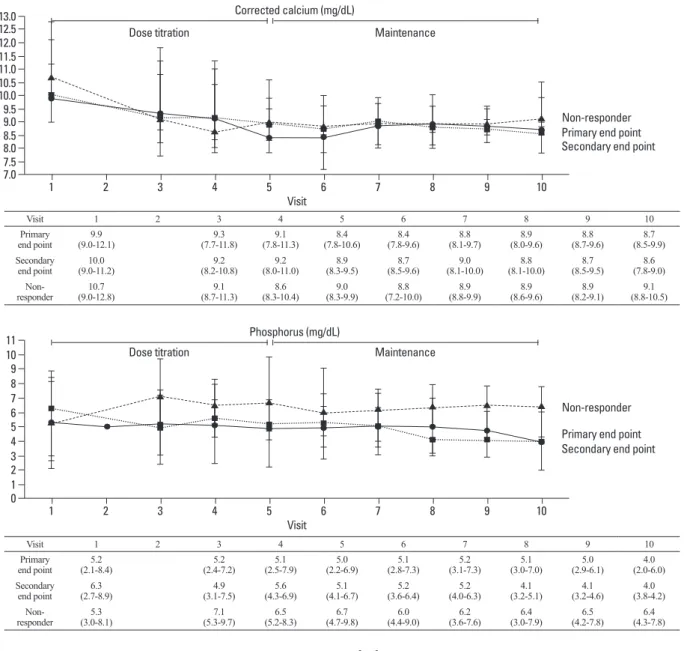
Corrected serum calcium levels also changed significant-ly during cinacalcet treatment. Interestingsignificant-ly, a reduction in serum calcium concentration was observed in all patients regardless of iPTH response; even non-responders showed significantly decreased serum calcium levels with cinacal-cet treatment. Repeated measures ANOVA was conducted to compare the changes of serum calcium levels between the three groups. Though calcium levels were reduced in all three groups (p<0.001), no intergroup differences were identified (Fig. 5, upper). In addition, although serum phos-phorus levels also decreased with the use of cinacalcet, the difference was not statistically significant and probably due Twenty-eight (73.7%) patients reached the primary end
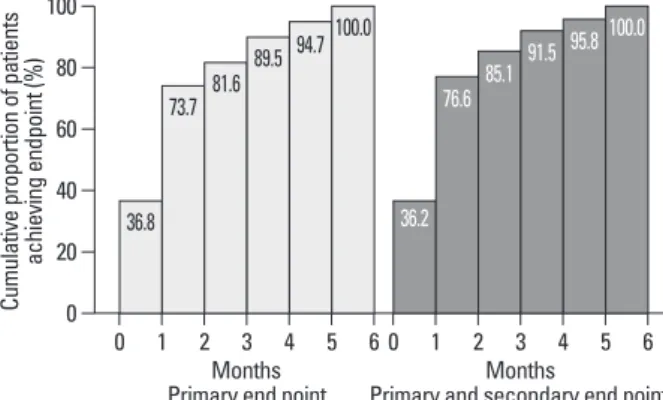
point during the dose titration period, and 10 (26.3%) pa-tients reached the primary end point during the maintenance period. The mean duration of treatment and cinacalcet dose required were 54 days and 37.5 mg, respectively. The medi-an iPTH level decreased from 616.5 to 206.0 pg/mL (55.6% reduction) throughout the study period (Fig. 3). Although the primary end point was not reached in 9 patients (15.8%), these patients showed a reduction in plasma iPTH of at least 30%, thus meeting criteria for the secondary end point. The median iPTH level of the secondary end point group de-creased from 822.5 to 383.0 pg/mL, and the mean iPTH lev-el decreased by 43.4% (Fig. 3). Among those patients who reached either the primary or secondary end point (all re-sponders), an early response was observed in 30/47 (63.8%) patients, most of whom 27/30, 90.0% achieved the primary end point. Baseline clinical characteristics of patients with primary end point were similar to those with secondary end point, except that the former were significantly older (54.5± 12.1 vs. 44.9±12.6, p=0.041), had lower iPTH levels (616.5 vs. 822.5, p=0.001) and smaller parathyroid gland size (14.2 vs. 19.6 mm, p=0.024). The cumulative proportion of patients to reach primary or secondary end point per month is shown in Fig. 4.
No effect of cinacalcet was seen in 10/57 (17.5%) patients (non-responders); indeed, iPTH levels in these patients were not decreased, or even increased, during cinacalcet treatment. Among non-responders, 5 patients did not response to rela-tively high-doses of cinacalcet (75-100 mg), however, the other five patients were treated with only 50 mg of cinacalcet
Fig. 3. Effects of cinacalcet treatment on serum iPTH levels. In patients who achieved primary or secondary end point (responders), iPTH levels decreased
significantly from baseline, whereas the levels were not changed or mildly increased in the non-responder group. iPTH, intact parathyroid hormone.
Visit 1 2 3 4 5 6 7 8 9 10 Primary end point (329-1452.5)616.5 (42-1274)340.6 (46-1109)305.0 (180-929)351.0 (80-938)431.5 (199-880)383.5 (285-564)374.0 (242-448)294.0 (100-400)262.3 Secondary end point (689-2800)822.5 (393-2548)652.0 (319-1909)637.5 (366-1218)585.0 (314-1008)545.0 (334-587)460.5 (320-560)440 (315-500)410.0 (330-400)380.0 Non-responder (523-1468)641.0 (551.9-1014)1012.0 (571.7-1370)844.5 (547-1660)900.5 (587-1580)899.5 (510-1318)930.5 (440-1397)1134.5 (458-1880)1063.0 (500-1890)1286.5
Fig. 4. The cumulative proportion of patients to reach primary or secondary
end point per month.
0 20 40 60 80 100 Cu m ul at ive p ro po rti on o f p at ie nt s ac hi ev in g en dp oi nt (% ) 0 1 2 3 4 5 6 0 1 2 3 4 5 6 Months
Primary end point Primary and secondary end pointMonths 36.8 73.7 81.6 89.5 94.7 100.0 36.2 76.6 85.1 91.5 95.8 100.0 0 500 1000 1500 2000 2500 3000 1 2 3 4 5 6 7 8 9 10 Visit
Secondary end point (n=9) Primary end point (n=38) Non-responder (n=10)
Dose titration Maintenance
Fig. 5. Changes in serum calcium, phosphorus and calcium phosphorus products levels with cinacalcet treatment. Serum calcium levels were reduced in all
three groups (p<0.001), however, the changes of serum phosphorus and calcium phosphorus products levels were statistically insignificant. Data were ana-lyzed by repeated measures ANOVA. ANOVA, analysis of variance.
Visit 1 2 3 4 5 6 7 8 9 10 Primary end point (9.0-12.1)9.9 (7.7-11.8)9.3 (7.8-11.3)9.1 (7.8-10.6)8.4 (7.8-9.6)8.4 (8.1-9.7)8.8 (8.0-9.6)8.9 (8.7-9.6)8.8 (8.5-9.9)8.7 Secondary end point (9.0-11.2)10.0 (8.2-10.8)9.2 (8.0-11.0)9.2 (8.3-9.5)8.9 (8.5-9.6)8.7 (8.1-10.0)9.0 (8.1-10.0)8.8 (8.5-9.5)8.7 (7.8-9.0)8.6 Non-responder (9.0-12.8)10.7 (8.7-11.3)9.1 (8.3-10.4)8.6 (8.3-9.9)9.0 (7.2-10.0)8.8 (8.8-9.9)8.9 (8.6-9.6)8.9 (8.2-9.1)8.9 (8.8-10.5)9.1 Visit 1 2 3 4 5 6 7 8 9 10 Primary end point (2.1-8.4)5.2 (2.4-7.2)5.2 (2.5-7.9)5.1 (2.2-6.9)5.0 (2.8-7.3)5.1 (3.1-7.3)5.2 (3.0-7.0)5.1 (2.9-6.1)5.0 (2.0-6.0)4.0 Secondary end point (2.7-8.9)6.3 (3.1-7.5)4.9 (4.3-6.9)5.6 (4.1-6.7)5.1 (3.6-6.4)5.2 (4.0-6.3)5.2 (3.2-5.1)4.1 (3.2-4.6)4.1 (3.8-4.2)4.0 Non-responder (3.0-8.1)5.3 (5.3-9.7)7.1 (5.2-8.3)6.5 (4.7-9.8)6.7 (4.4-9.0)6.0 (3.6-7.6)6.2 (3.0-7.9)6.4 (4.2-7.8)6.5 (4.3-7.8)6.4 Visit 1 2 3 4 5 6 7 8 9 10 Primary end point (22-70.7)52.4 (21.6-67.3)52.3 (26.2-73.4)46.5 (23.4-66.9)42.7 (23.0-64.7)41.3 (27.6-63.5)49.0 (26.7-61.6)51.5 (25.2-57.4)50.5 (26.0-57.0)52.0 Secondary end point (26.5-75.1)55.0 (28.8-63.75)41.8 (26.5-62.6)40.0 (20.2-68.7)38.7 (30.6-75.1)47.3 (25.2-69.0)50.0 (25.6-70.1)46.0 (22.5-68.5)44.0 (22.0-68.5)48.0 Non-responder (32.4-77.3)68.8 (54.4-80.2)66.8 (49.0-75.5)60.6 (43.2-78.6)58.4 (38.8-79.2)53.7 (33.1-67.6)54.5 (27.6-69.2)62.5 (35.3-69.4)62.4 (35.3-81.9)60.5 7.0 0 20 8.0 2 30 7.5 1 9.0 4 8.5 3 40 10.0 6 60 9.5 5 50 11.0 7 10.5 12.0 9 80 11.5 8 70 12.5 10 13.0 11 90 1 1 1 2 2 2 3 3 3 4 4 4 5 5 5 6 6 6 7 7 7 8 8 8 9 9 9 10 10 10 Visit Visit Visit
Secondary end point
Secondary end point
Secondary end point Primary end point
Primary end point
Primary end point Non-responder Non-responder Non-responder Dose titration Dose titration Dose titration Maintenance Maintenance Maintenance Corrected calcium (mg/dL) Phosphorus (mg/dL) Calcium-phosphorus product (mg2/dL2)
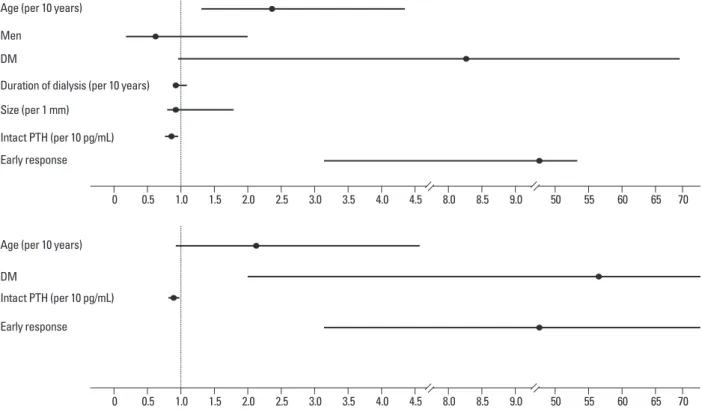
observation was statistically insignificant (p=0.101). Ac-cording to multivariate analysis, lower baseline iPTH levels, diabetes, and the presence of an early response were signifi-cant clinical factors affecting achievement of iPTH end points by cinacalcet (Table 2, Supplemental Fig. 2). The re-sponse rates according to the range of baseline iPTH level are shown in Fig. 6. The presence of early response was as-sociated with about 20-fold higher probability to achieve target iPTH level. In addition, diabetic patients showed more favorable response to cinacalcet therapy. In fact, near-ly all the diabetic patients reached the primary end point (Fig. 7).
Safety
Cinacalcet, at doses ranging from 25 to 100 mg once per day, was generally well tolerated, and no patient experienced a se-rious adverse event during the study period. Adverse events to concomitant changes in phosphate binder and reductions
of vitamin D agents over the study period (Fig. 5, middle). The changes of calcium-phosphorus products were statisti-cally insignificant (Fig. 5, lower).
Clinical factors that influence the degree of response to cinacalcet
We investigated clinical factors predicting a better response to cinacalcet treatment using logistic regression analysis. In univariate analysis, older age, diabetes, lower baseline iPTH levels, and an early response to cinacalcet were significantly associated with the achievement of the primary end point. As patients get older, the median iPTH level was decreased, therefore, older patients seem to have better response to cinacalcet (Supplemental Fig. 1). A larger size detected for the parathyroid gland appeared to negatively influence the possibility of reaching the primary end point, however, this
Supplemental Fig. 1. Median iPTH levels and response rate to cinacalcet according to age group. iPTH, intact parathyroid hormone.
Table 2. Clinical Factors Influencing Achievement of the Primary End Point with Cinacalcet Treatment
Unadjusted Adjusted
OR (95% CI) p value OR (95% CI) p value
All patients
Age (per 1 yr) 1.10 (1.03-1.17) 0.005 1.07 (0.99-1.17) 0.090
Gender (male vs. female) 0.65 (0.21-1.98) 0.446 -
Diabetes (presence) 8.31 (0.99-69.67) 0.051 46.45 (1.92-1125.6) 0.018
Duration of dialysis (per 1 yr) 0.99 (0.92-1.09) 0.984 -
Size (per 1 mm) 0.92 (0.84-1.10) 0.101 -
Baseline iPTH (per 10 pg/mL) 0.98 (0.96-0.99) 0.027 0.96 (0.93-0.99) 0.015
Presence of early response* 13.10 (3.17-54.08) <0.001 21.54 (2.94-157.7) 0.003
Non-diabetic patients only
Age 1.10 (1.01-1.15) 0.021 1.07 (0.98-1.16) 0.115
Gender (male vs. female) 0.62 (0.18-2.11) 0.449 -
Size (per 1 mm) 0.92 (0.83-1.03) 0.162 -
Baseline iPTH (per 10 pg/mL) 0.97 (0.95-0.99) 0.048 0.96 (0.93-0.99) 0.012
Presence of early response* 13.57 (3.00-61.59) 0.001 20.44 (2.81-148.96) 0.003
iPTH, intact parathyroid hormone; OR, odds ratio; CI, confidence interval. *Decrease of iPTH levels >50% from baseline within 4 weeks.
300 0 500 40 700 60 400 20 600 800 80 900 100 Ba se lin e iP TH Pe rc en ta ge (% ) <40 40-59 60-79 >80 <40 40-59 60-79 >80 Age Age 870.6 755.3 648.2 355.5
Fail to reach primary end point Reach to primary end point
that occurred with ≥5% frequency were nausea/vomiting (21.1%), dyspepsia (14.0%), myalgia/arthralgia (10.5%), constipation (7.0%), febrile sensation (7.0%), and diarrhea (5.3%) (Table 3). Most of these events occurred in a dose-independent manner and were mild to moderate in severity. These symptoms either resolved spontaneously or improved quickly with intervention. In our study, there was no case of albumin-corrected calcium level <7.5 mg/dL. However, 15 patients (26.3%) experienced the decrease of calcium <8.0 mg/dL during study period.
DISCUSSION
Currently, cinacalcet is the only available potent calcimi-metic for the management of SHPT.3 Previous randomized
controlled studies have demonstrated its safety and efficacy for controlling serum iPTH, calcium, and phosphorus lev-els compared to conventional methods.2,4,14 Moreover,
re-cent observational studies suggest the benefit of cinacalcet treatment in reducing all-cause and cardiovascular mortali-ty in dialysis patients.1 However, not all patients have a
fa-vorable response to cinacalcet or are able to tolerate the drug. In this study, therefore, we prospectively investigated 67 hemodialysis patients from seven medical centers in Ko-rea and evaluated the response rate to cinacalcet. Depend-Supplemental Fig. 2. Clinical factors affecting achievement of iPTH target. iPTH, intact parathyroid hormone; DM, diabetes mellitus.
Fig. 6. The response rates according to baseline iPTH level. iPTH, intact
parathyroid hormone.
Fig. 7. Response rate to cinacalcet according to diabetes. Diabetic patients
showed a more favorable response to cinacalcet compared to non-diabet-ics (p<0.001).
Primary end point Secondary end point Non-responder
Primary end point Secondary end point Non-responder
0 40 60 20 80 100 Pe rc en ta ge (% ) Non-diabetes Diabetes 59.1% 18.2% 7.7% 22.7% 92.3% 0 40 60 20 80 100 Pe rc en ta ge (% ) Intact PTH (pg/mL) 300-500 501-800 >800 86.7% 11.1% 66.7% 46.7% 40.0% 13.3% 22.2% 13.3%
Age (per 10 years)
Age (per 10 years) Men
DM
DM
Duration of dialysis (per 10 years)
Intact PTH (per 10 pg/mL) Size (per 1 mm) Intact PTH (per 10 pg/mL) Early response Early response 0 0 0.5 0.5 1.0 1.0 1.5 1.5 2.0 2.0 2.5 2.5 3.0 3.0 3.5 3.5 4.0 4.0 4.5 4.5 8.0 8.0 8.5 8.5 9.0 9.0 50 50 55 55 60 60 65 65 70 70
nodular hyperplasia.21,22 Therefore, more large-scale study
is required to ascertain detailed characteristics of these re-sponder/non-responder groups. In our study, nevertheless, lower baseline iPTH level was significantly associated with more favorable outcome to cinacalcet treatment. Similarly, a larger size parathyroid gland appeared to negatively influ-ence the possibility of reaching the primary end point, al-though statistically insignificant. In line with our present finding, Yamamoto, et al.23 recently found that two or more
enlarged parathyroid glands might be a significant risk of poor response to cinacalcet treatment.
In this respect, it is of particular interest to note that an ear-ly decrease in iPTH may be an important clue for predicting better response to cinacalcet. More than 60% of the respond-ers in our study showed remarkable decrease of iPTH levels by 50% or more within 1 month after the administration of cinacalcet, and most patients with an early response had ex-cellent outcomes. Moreover, multivariate logistic regression analysis revealed that the efficacy of cinacalcet in iPTH tar-get achievement was significantly associated with the pres-ence of an early response, which was consistent regardless of the presence of diabetes. In accordance with our data, a re-duction in iPTH levels after 3 months of treatment with rela-tively lower doses has been reported as a prognostic marker of good response to cinacalcet treatment.24 Another
impor-tant finding in our study was that diabetic patients showed a more favorable response to cinacalcet compared to non-dia-betics (p<0.001). The presence of diabetes was associated with 46-fold increased probability to achieve primary end point, and all the non-responders were non-diabetics, sug-gesting the possibility that these results are due to unique characteristics of renal osteodystrophy in diabetic patients. Among diabetic patients, it is well known that high-turnover bone disorders are distinctly uncommon, while low-turnover bone disorders are more frequent.25,26 Bone morphology in
diabetic patients is characterized by lower trabecular and ing on the degree of response, patients were divided into
two groups: responders (further subdivided to patients with primary or secondary end points), and non-responders.
One major finding of this study was that more than 80% of patients showed a good response to cinacalcet, with the majority achieving the iPTH target levels recommended by the Kidney Disease Outcomes Quality Initiative.19 Although
only 20% of responders reached secondary end point, their baseline iPTH levels were significantly higher than those who met the primary end point, and furthermore, six pa-tients could not receive full-doses of cinacalcet because of hypocalcemia. Therefore, patients with hypocalcemia are expected to have insufficient doses of cinacalcet. Treatment over longer durations and with higher doses may lead to the primary end point in these patients as well.
On the contrary, cinacalcet had no impact on iPTH re-duction in about 17% of patients. Despite half of these pa-tients could not receive a sufficient dose because of hypocal-cemia, the remaining half were resistant to full-doses of cinacalcet therapy. Except the fact that non-responders tend-ed to be younger and less frequently diabetic, their baseline characteristics were similar to responders. Even baseline iPTH level and the largest diameter of the parathyroid gland were also comparable between the two groups. Therefore, the prediction of future response rate with baseline charac-teristics seems to be difficult. However, this finding is not so surprising because the efficacy of cinacalcet for lowering iPTH levels has been reported to be unaffected by disease severity, as judged by baseline iPTH values or adenoma for-mation. For instance, Frazão, et al.8 reported that cinacalcet
could reduce plasma iPTH levels irrespective of the severity of SHPT, and Shoback, et al.20 demonstrated the efficacy of
cinacalcet in patients with primary hyperparathyroidism with adenoma. In addition, excellent long-term efficacy in reducing serum iPTH levels was observed also in patients with severe, refractory tertiary hyperparathyroidism with Table 3. Drug-Related Adverse Events
Cinacalcet dose (mg) Total (%) 25 50 75 100 Nausea/vomiting 12 (21.1) 3 5 2 2 Dyspepsia 8 (14.0) 1 3 3 1 Constipation 4 (7.0) 1 2 1 -Diarrhea 3 (5.3) - 1 1 1 Febrile sensation 4 (7.0) 1 1 2 -Myalgia/arthralgia 6 (10.5) 1 2 3 -Others* 5 (8.8) 1 4 -
line iPTH levels and the presence of diabetes also seem to be important factors for predicting the effect of cinacalcet.
REFERENCES
1. Block GA, Zaun D, Smits G, Persky M, Brillhart S, Nieman K, et al. Cinacalcet hydrochloride treatment significantly improves all-cause and cardiovascular survival in a large cohort of hemodialy-sis patients. Kidney Int 2010;78:578-89.
2. Block GA, Martin KJ, de Francisco AL, Turner SA, Avram MM, Suranyi MG, et al. Cinacalcet for secondary hyperparathyroidism in patients receiving hemodialysis. N Engl J Med 2004;350:1516-25. 3. Cozzolino M, Mazzaferro S, Messa P. New insights into the role
of calcium-sensing receptor activation. J Nephrol 2011;24 Suppl 18:S38-41.
4. Moe SM, Chertow GM, Coburn JW, Quarles LD, Goodman WG, Block GA, et al. Achieving NKF-K/DOQI bone metabolism and disease treatment goals with cinacalcet HCl. Kidney Int 2005; 67:760-71.
5. Cunningham J, Danese M, Olson K, Klassen P, Chertow GM. Ef-fects of the calcimimetic cinacalcet HCl on cardiovascular disease, fracture, and health-related quality of life in secondary hyperpara-thyroidism. Kidney Int 2005;68:1793-800.
6. Drüeke TB, Ritz E. Treatment of secondary hyperparathyroidism in CKD patients with cinacalcet and/or vitamin D derivatives. Clin J Am Soc Nephrol 2009;4:234-41.
7. Kalantar-Zadeh K, Shah A, Duong U, Hechter RC, Dukkipati R, Kovesdy CP. Kidney bone disease and mortality in CKD: revisit-ing the role of vitamin D, calcimimetics, alkaline phosphatase, and minerals. Kidney Int Suppl 2010:S10-21.
8. Frazão JM, Messa P, Mellotte GJ, Geiger H, Hagen EC, Quarles LD, et al. Cinacalcet reduces plasma intact parathyroid hormone, serum phosphate and calcium levels in patients with secondary hyperparathyroidism irrespective of its severity. Clin Nephrol 2011;76:233-43.
9. Young EW, Akiba T, Albert JM, McCarthy JT, Kerr PG, Mendels-sohn DC, et al. Magnitude and impact of abnormal mineral me-tabolism in hemodialysis patients in the Dialysis Outcomes and Practice Patterns Study (DOPPS). Am J Kidney Dis 2004;44(5 Suppl 2):34-8.
10. Moe SM, Cunningham J, Bommer J, Adler S, Rosansky SJ, Ure-na-Torres P, et al. Long-term treatment of secondary hyperpara-thyroidism with the calcimimetic cinacalcet HCl. Nephrol Dial Transplant 2005;20:2186-93.
11. Tentori F, Blayney MJ, Albert JM, Gillespie BW, Kerr PG, Bom-mer J, et al. Mortality risk for dialysis patients with different levels of serum calcium, phosphorus, and PTH: the Dialysis Outcomes and Practice Patterns Study (DOPPS). Am J Kidney Dis 2008;52: 519-30.
12. Goodman WG, Frazao JM, Goodkin DA, Turner SA, Liu W, Co-burn JW. A calcimimetic agent lowers plasma parathyroid hor-mone levels in patients with secondary hyperparathyroidism. Kid-ney Int 2000;58:436-45.
13. Lindberg JS, Culleton B, Wong G, Borah MF, Clark RV, Shapiro WB, et al. Cinacalcet HCl, an oral calcimimetic agent for the treat-ment of secondary hyperparathyroidism in hemodialysis and peri-toneal dialysis: a randomized, double-blind, multicenter study. J Am Soc Nephrol 2005;16:800-7.
osteoid bone volume, as well as markedly reduced indices of bone formation and resorption. The small amount of bone and lack of osteomalacia are unique features of dia-betic patients with chronic renal disease.27
With cinacalcet treatment, serum calcium levels also de-creased significantly and this change has been well-demon-strated in many previous studies.2,14,22 On lowering iPTH,
bone turnover is expected to decrease substantially, result-ing in less calcium release from bone. Interestresult-ingly, howev-er, the significant reduction of serum calcium level was also observed in patients with non-responder group, as well. The reduction of serum calcium levels in these non-responders might be independent of the effect of cinacalcet on the para-thyroid gland; rather, it could be attributable to the direct in-hibition of calcium-dependent bone metabolism through CaSR expressed in bone cells. Indeed, recent studies have demonstrated that CaSR is expressed in several tissues oth-er than the parathyroid gland,3 and it is well known that
CaSR is expressed and regulated in bone, intestinal, renal, and vascular cells.28 The reduction of bone metabolism and
histomorphometric resorption parameters during cinacalcet treatment could be explained by both a PTH-dependent de-crease of bone turnover, as well as calcium-mediated direct control of calcium fluxes from bones.29
The limitations of this prospective, single-arm study in-clude its open-label design, the relatively small number of patients enrolled, and the lack of both a placebo and a com-parison group. Second, half of the patients in the non-re-sponder group could not receive the full dose of cinacalcet because of hypocalcemia. Moreover, the dose of vitamin D agents was either fixed or only allowed to be reduced in our study design; therefore, the potential to reach the primary or secondary end point for iPTH levels with combined high-dose cinacalcet and a vitamin D agent cannot be ruled out. On the contrary, half of non-responders had either no change or an increase in iPTH levels even when using high-dose cinacalcet treatment. Therefore, these patients could be considered as real non-responders or resistant group. Last, we did neither measure parathyroid gland volume nor count the number of enlarged parathyroid glands as possible prog-nostic indicators for cinacalcet efficacy.
In conclusion, cinacalcet was effective and well tolerated in 82.5% of patients undergoing hemodialysis, whereas 17.5% of patients were resistant to cinacalcet. An early re-sponse to cinacalcet (a more than 50% decrease of iPTH within 1 month) was closely associated with a much more favorable response to cinacalcet treatment. In addition,
base-perparathyroidism. Nephrol Dial Transplant 2007;22:2362-5. 22. Komaba H, Nakanishi S, Fujimori A, Tanaka M, Shin J, Shibuya
K, et al. Cinacalcet effectively reduces parathyroid hormone se-cretion and gland volume regardless of pretreatment gland size in patients with secondary hyperparathyroidism. Clin J Am Soc Nephrol 2010;5:2305-14.
23. Yamamoto M, Ogata H, Mizobuchi M, Yoshida N, Kumata-Maeta C, Koiwa F, et al. Number of enlarged parathyroid glands might be a predictor of cinacalcet response in advanced secondary hy-perparathyroidism. Clin Exp Nephrol 2012;16:292-9.
24. Segura Torres P, Borrego Utiel FJ, Sánchez Perales MC, García Cortés MJ, Biechy Baldán MM, Pérez Bañasco V. [Analysis of the efficacy and factors influencing the response of secondary hy-perparathyroidism patients on hemodialysis to cinacalcet]. Nefro-logia 2010;30:443-51.
25. Pei Y, Hercz G, Greenwood C, Segre G, Manuel A, Saiphoo C, et al. Renal osteodystrophy in diabetic patients. Kidney Int 1993;44: 159-64.
26. Vincenti F, Hattner R, Amend WJ Jr, Feduska NJ, Duca RM, Sal-vatierra O Jr. Decreased secondary hyperparathyroidism in diabet-ic patients receiving hemodialysis. JAMA 1981;245:930-3. 27. Vincenti F, Arnaud SB, Recker R, Genant H, Amend WJ Jr,
Fe-duska NJ, et al. Parathyroid and bone response of the diabetic pa-tient to uremia. Kidney Int 1984;25:677-82.
28. Dvorak MM, Riccardi D. Ca2+ as an extracellular signal in bone. Cell Calcium 2004;35:249-55.
29. Chang W, Tu C, Chen TH, Bikle D, Shoback D. The extracellular calcium-sensing receptor (CaSR) is a critical modulator of skeletal development. Sci Signal 2008;1:ra1.
14. Akizawa T, Kido R, Fukagawa M, Onishi Y, Yamaguchi T, Hasegawa T, et al. Decreases in PTH in Japanese hemodialysis pa-tients with secondary hyperparathyroidism: associations with changing practice patterns. Clin J Am Soc Nephrol 2011;6:2280-8. 15. Lucchi L, Carboni C, Stipo L, Malaguti V, Ferrari F, Graziani R,
et al. Early initiation of cinacalcet for the treatment of secondary hyperparathyroidism in hemodialysis patients: a three-year clinical experience. Artif Organs 2011;35:1186-93.
16. Suzuki H, Inoue T, Watanabe Y, Kikuta T, Sato T, Tsuda M, et al. Does cinacalcet HCl, an oral calcimimetic agent for the treatment of secondary hyperparathyroidism, improve arterial stiffness in patients on continuous ambulatory peritoneal dialysis? Adv Perit Dial 2011;27:134-9.
17. Battistella M, Richardson RM, Bargman JM, Chan CT. Improved parathyroid hormone control by cinacalcet is associated with duction in darbepoetin requirement in patients with end-stage re-nal disease. Clin Nephrol 2011;76:99-103.
18. Wald R, Tentori F, Tighiouart H, Zager PG, Miskulin DC. Impact of the Kidney Disease Outcomes Quality Initiative (KDOQI) Clinical Practice Guidelines for Bone Metabolism and Disease in a large dialysis network. Am J Kidney Dis 2007;49:257-66. 19. National Kidney Foundation. K/DOQI clinical practice guidelines
for bone metabolism and disease in chronic kidney disease. Am J Kidney Dis 2003;42(4 Suppl 3):S1-201.
20. Shoback DM, Bilezikian JP, Turner SA, McCary LC, Guo MD, Peacock M. The calcimimetic cinacalcet normalizes serum calci-um in subjects with primary hyperparathyroidism. J Clin Endocri-nol Metab 2003;88:5644-9.
21. Kruse AE, Eisenberger U, Frey FJ, Mohaupt MG. Effect of cina-calcet cessation in renal transplant recipients with persistent