Study on Model for Human Resources Development Strategy in the Nuclear Field
Eui-Jin LeeNuclear Training Center, Korea Atomic Energy Research Institute, P.O. Box 105, Yuseong, Daejeon 305-600, [email protected].
1. Introduction
Qualified manpower is an essential for the successful implementation of a national long-term nuclear development program as well as the associated R&D programs. Such manpower could only be developed systematically under a well-established national model and strategy, which addresses the demand for human resources, number of personnel and timing, and the education and training. To discuss a model for human resources development, it is suggested to consider the following: (1) approach to the Human Resources Development (HRD) Model, (2) HRD policy targets, (3) estimation of the manpower requirement, (4) organizational coordination frameworks for the HRD, (5) promotion of HRD in the action plan.
2. Approaches to the HRD Model
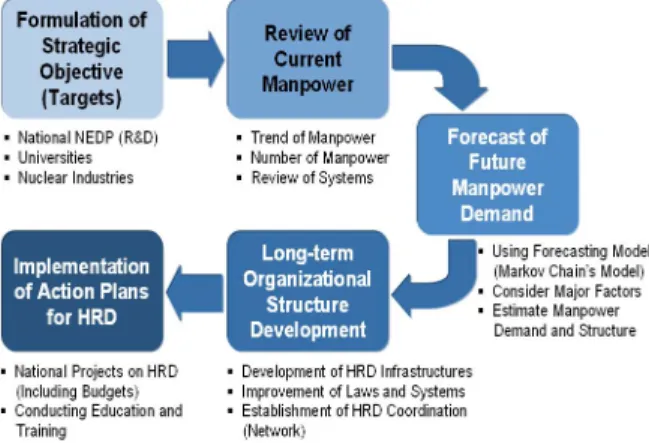
Approach to the HRD planning model could consist of the formulation of strategic objectives and targets, review of the current manpower and an estimation of future manpower, long-term organizational structure development, and the implementation of action plans for HRD [1].
Figure 1. Model for HRD Planning
2.1 The Government policy targets for HRD
The first step of HRD is to identify the strategic objectives and targets. The following are the Korean Government policy targets for HRD [2.3]:
- Support for nuclear education programs at universities
-
Maintaining qualified nuclear personnel at nuclear industries- Encouraging a global competitiveness of the nuclear manpower
2.2 Review of Current Manpower
As shown in Table 1, there were about 38,000 nuclear personnel engaged in nuclear industries, R&D institutes and radioisotope related organizations in 2002. However, it is recognized that the first generation of the nuclear workforce is getting older and being retired and less of youth are studying nuclear science and engineering. Therefore, the Korean Government has established a promotion program on nuclear human resources development which targets university education, nuclear industries’ manpower, etc, as mentioned the above [2].
Table 1. Model for HRD Planning
2.3 Estimation of Future Manpower
Estimation of the future manpower means to forecast the future manpower demand, which is required for the long-term nuclear development program. In order to have a view of the future manpower demand and structure, it is sometime introduced as a stochastic model for the manpower estimation. For example, the Markov chains model for manpower planning, which is shown below, could be one of the useful tools for the estimation of the future manpower demand and structure [1,3,4,5].
n(T) = n(T-1) {P + W’ r’} + M(T) r
n(T), n(T-1): expected stock at time T, T-1 P : transition matrix,
W’: wastage vector, r’: recruitment vector
M((T) : manpower gap between time T and T-1
S tatu s of Nu c l e ar M an pow e r -5,000 10,000 15,000 20,000 25,000 30,000 35,000 40,000 1999 2000 2001 2002 Total Nuclear Industries RI Users
Transactions of the Korean Nuclear Society Autumn Meeting Busan, Korea, October 27-28, 2005
(created seats) r: recruitment vector for M(T) n(t) = n(p1 + p2 + p3 +p4) p11 p12 p13 p14 p21 p22 p23 p24 p31 p33 p33 p34 p41 p42 p43 p44 + w’1 (r’1 r’2 r’3 r’4) + M(r1 r2 r3 r4) w’2 w’3 w’4
2.4 Organizational Coordination Framework for HRD There are many nuclear related organizations, which coordinate with each other continuously for the sustainable development of nuclear energy. The Government, utility, nuclear industries, regulatory authority, and R&D institutes are manpower demand organizations. Universities and training organizations as well as societies and associations are providing education and training programs upon a request from the above organizations. Therefore, it is quite valuable to build a national network for human resources development among related organizations. In the case of Korea, the Korean Network of Nuclear Education and Training has been established for this cooperation purpose [4,5,6].
2.5 Action Plans for HRD
Promotion of human resources development conducting action plans for HRD under the support of the national projects, which also means financial support for the manpower development. Figure 2 shows the Korean projects for nuclear manpower development, which are currently being implemented for university students, young researchers as an example [7].
Figure 2. Korean Projects for Nuclear Manpower Development
3. Conclusion
For the study of human resources development in the nuclear field, the formulation of targets, which means key personnel, should be reviewed systematically. It is also necessary to review current manpower and its related system to find where are strengths, weakness and concern. Estimation of the future manpower means to forecast the future manpower demand, which is required for the long-term nuclear development program. For example, the Markov chains model for manpower planning could be one of the useful tools for the estimation of the future manpower demand and structure. Upon the results from future manpower demands, it will be necessary to promote organizational structure development. Finally the Government will make action plans for the implementation and support of human resources development with the national level that means financial supports.
REFERENCES
[1] Eui-Jin Lee, Case study on manpower planning model using the Markov Chains, Feb. 1992, Chungnam National University
[2] Nuclear White Books 2003, Ministry of Science and technology, ROK
[3] Eui-Jin Lee, Nuclear human resources development, Sep. 2003, KHNP
[4] Eui-Jin Lee and Kong-Won Han, Korean efforts for education and training network, 1st ANENT
Coordination Committee Meeting, Feb. 2004, [5] Report of the 1st Coordination Committee Meeting on ANENT, Feb. 2004, IAEA
[6] Eui-Jin Lee, Study on the establishment of nuclear education and training network based on the nuclear knowledge management, May 2004, Korea Nuclear Society
[7] 2004 Nuclear Energy Yearbook, Korea Atomic Industry Forum