HM09
119
-Effect of quenching wheel speed on the magnetic
properties of melt-spun NdFeM (M=B, Ti)
Sol Jung1*, Haein Choi-Yim1,2
1Department of physics, Sookmyung Women’s University, Seoul 04310, Republic of Korea 2Department of applied physics, Sookmyung Women’s University, Seoul 04310, Republic of Korea
1. Introduction
In last 60 years, the magnetically compounds composed of rare earth and 3d elements have been developed as high performance permanent magnets such as SmCo5, Sm2Co17 and Nd2Fe14B. In the 1960s, SmCo5 compound
appeared as the first rare earth high-performance magnets. This magnet has magnetic properties such as a large uniaxial magnetocrystalline anisotropy, a relatively high saturation magnetization, a high Currie temperature and very hihg maximum energy product. Subsequently, the Nd2Fe14B compound was produced either by
powdering/sintering in 1984 and the maximum energy product of this compound reached 36.25 MGOe. This Nd2Fe14B magnet has been rapidly developed and then the magnet which has the maximum energy product value
of 59.25 MGOe was produced. This magnet is the best permanent magnet in the present industry. Recently, permanent magnets are essential components in the many industries because of their ability to provide a magnetic flux and the magnetically hard alloys of nanocomposites with rare earth elements especially have attracted rapidly increasing interest. Nanocomposite magnets consisting of a soft magnetic α–Fe or Fe3B phase exchange-coupled
to a hard magnetic Nd2Fe14B phase have been extensively studied due to their remanence enhancement effect,
high energy product, and low cast. In this paper, we simultaneously investigate the hard magnetically compound and nanocomposite in one type compound by changing quenching wheel speed. We produce the NeFe-based compounds with various quenching wheel speed in order to study a transition from soft phase to hard phase.
2. Experiment
In order to ensure a homogeneous composition, ingots of NdFeM (M=B, Ti) were repeatedly melted and solidified under Ar atmosphere four times. These alloys were fabricated by melt spinning onto a cupper wheel at speed of 800 ~ 3000 rpm for rapid solidification. Melt spinning was carried out in an chamber with highly purified Ar atmosphere. The microstructure of the samples were characterized by XRD. The hysteresis loops was obtained a VSM due to study magnetic properties.
3. Result and discussion
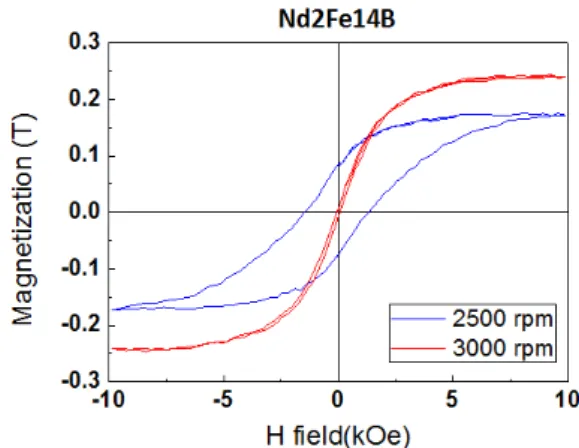
Figure 1 and 2 display the XRD patterns and hysteresis loops of Nd2Fe14B powders for wheel speed values
of 2500 and 3000 rpm, respectively. 2500 rpm sample shows only Nd2Fe14B phase, small coercivity and high
saturation magnetization. The XRD pattern of 3000 rpm sample exhibits Nd2Fe17 and Fe phases, 3000 rpm sample
120
-Fig. 1. XRD patterns of Nd2Fe14B powders Fig. 2. Hysteresis loops of Nd2Fe14B powders
4. References
[1] K. J. Strnat, G. Hoffer, J. Olson, W. Ostertag, and J. Becker, J. Appl. Phys. 38, 1001 (1967). [2] R. K. Mishra, G. Thomsa, T. Yoneyama, A. Fukuno, and T. Ojima, J. Appl. Phys. 53, 2517 (1981). [3] M. Sagawa, S. Fujimura, M. Togawa, and Y. Matuura, J. Appl. Phys. 55, 2083 (1984).
[4] J. J. Croat, J. F. Herbst, R. W. Lee, and F. E. Pinkerton, J. Appl. Phys. 55, 2078 (1984). [5] K. J. Strnat, Ferromagnetic Materials vol 4, 131-120 (1988).
[6] S. Sugimoto, J. Phys. D: Appl. Phys. 44, 064001 (2011).
[7] X. H. Cui, Z. W. Liu, X. C. Zhong, H. Y. Yu and D. C. Zeng, J. Appl. Phys. 111, 07B508 (2012). [8] S. Liu, B. Gu, H. Bi, Z. Tian, G. Xie, Y. Zhu and Y. Du, J. Appl. Phys. 92, 7514 (2002).