Visualization of Moderator Circulation with 1/8 scaled HU-KINS for Calandria
Tank of CANDU6
Dae Kun Cho a, Nam Seok Kima , Jae Young Leea , Man Woong Kimb
a: School of Mechanical and Control System Eng. Handong Global Univ., Buk-gu, Pohang, Gyung-buk, [email protected] b: Korea Institute of Nuclear Safety. Yoo-Sung, Dae Jun, Korea
1. Introduction
The moderator cooling capability of Calandria tank is important during the hypothetical incident of CANDU reactor. Even though the loss of ECCS cooling, the heat of the nuclear fuel can be cooled by the heat transfer path through the contacting location between the pressure tube and Calandria tube. The moderator cooling system removes the heat from the fuel so it pays an ultimate heat sink for the nuclear safety. Therefore, the understanding and estimating the thermal hydraulic conditions of the circulating moderator in the Calandria is of importance. However, the three dimensional nature and complexity of the Calandria tubes make it difficult to analyze. Recent progress in the the three dimensional computational fluid dynamics including the model of turbulent flow stimulate the studies on this subject. For the design or safety analysis purpose, the mesh generation and furnishing proper physical models are imperative and the experimental validation should be performed.
However, the experimental facilities have been constructed in the scaled way by the Canadian research groups, AECL and COG. Two facilities: SPEL (1/10 scale by Koroyannaski, 1983) and STERN (1/4 scale by Hadaller, 1990) have been producing experimental data such as the local temperatures and velocities. Several papers has been published to report their CFD codes can be available for the CANDU analysis by comparing the calculations with the experimental results of those facilities.
However, as noted by Lee et al. the previous experimental facilities were not scaled properly both in the sense of the force balance between buoyancy force and the jet inertia force. Also, the power density of the moderator was not scaled properly. Therefore, it cannot be said that the observations through SPEL and STERN may have a certain discrepancy from the real CANDU-6 plant. Lee et al (2003) developed the scaling laws for the CANDU-6 and design a 1/8 scale experimental facility named as HU-KINS. In the present paper, the
final construction of the HUKINS will be explained and the preliminary experimental results will be discussed. For this purpose, CFX-5, a three dimensional CFD code, is employed for the evaluation of scaling. In the present study, we adopt the real mesh strategy rather than the porous media approximation. The effort to make the realistic analysis will improve capability of analysis
2. Methods and Results 2.1 Scaling Laws
Three scaling parameters were employed to make sure the conservation of the mass, heat, and momentum in the Calandria tanks :
* * * 2 * ( ) cal Q q D L ′′′ = (1) 2 cal in g TD Ar U β∆ = (2) Re in cal in U D ρ µ = (3)
They will determine the design parameters such as the geometry, temperature difference, and the inlet velocity of the moderator.
2.2 HU-KINS
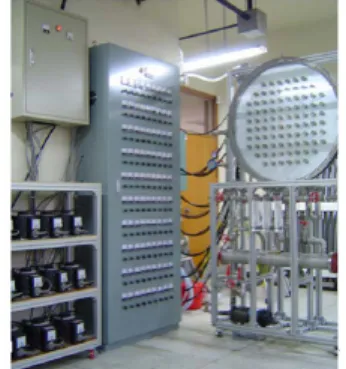
The design inputs were the power scaling of 1/10000, the diameter scaling of 1/8. The scaling was made in both global scaling and local scaling as noted by Lee and No (1990). Power density and Archimedes number were made in the Xerox scaling so that the HU-KINS made difference from the previous SPEL and STERN. As shown in Fig. 1, the HUKINS has three major units: Calandira , cooling units, power control unit and power supply unit. Calandria is made of glass to visualize all details of the flow structure and temperature field.
Fig. 1 Total system of HUKINS
Transactions of the Korean Nuclear Society Autumn Meeting Busan, Korea, October 27-28, 2005
Fig. 2(a) depicted the inlet nozzle which is scaled according the the jet velocity and mass flow rate. The jet velocity is the key factor in the inertia force which is sophisticated balance with the buoyancy force. There are 80 heaters mimic the 380 calandria tubes of CANDU. The power of each heater is controlled by the variable resistance in the control unit. Therefore, HUKINS is capable of simulating the power excursion transient also.
Fig. 2 (a) inlet nozzle design and (b) the calandria tubes in the calandria tank
2.3 Preliminary Calculation results
Before performing experimental works, we evaluate the HUKINS and CANDU-6 using CFX-5. The calculated results will be also used to compare the experimental data also. As shown in Fig. 3, the real mesh considering all calandria tubes were generated for both HU-KINS and CANDU-6. It is different from the previous porous media approximation.
(a) (b)
Fig.3 The mesh generated for the analysis of (a)HU-KINS and (b)CANDU-6
It is generally accepted that the circulating flow pattern in CANDU-6 is the mixed flow regime in which the jet inertia and buoyancy make a antisymmertic balance so that one side jet circulate over the top part and the other side jet circulates down near the inlet nozzle. Therefore the hot region is formed near the left bottom of the calandria. Fig. 4 illustrated the temperature field and stream lines. HUKINS represents the distribution of CANDU-6 reasonably.
Fig. 4 The temperature and streamline profile of (a) HU-KINS and (a)CANDU-6
Also it was found that the hot regions are varied in axial direction for the mixed flow region as shown in Fig. 5.
Fig.5 The axial variation of hot region in the CANDU-6
3. Conclusion
In the present study, the 1/8 scaled calandria tank for the moderator cooling system analysis is designed according to the scaling laws and constructed. The designing parameters were determined by the input of power, diameter of calandria tank, the temperature difference between inlet and outlet. The scaling laws determined the length of the calandria, the inlet velocity of moderator jet, and the inlet nozzle geometry. The local scaling was made for the calandria tubes with the 1/4 scale for the easiness of the sensor mounting. Total 80 heaters were furnished and controlled by the variable resistance. Also, the developed designing and CANDU-6 were compared by the CFX simulation with the real mesh consideration of the calandria tubes. The simulation results confirmed that the scaled facility HU-KINS mocked up CANDU-6 reasonably so that the steady analysis and transient analysis using HU-KINS can be useful for the CANDU-6 analysis.
Acknowledgement
The work is supported by the Ministry of Science and Technology in Korean Government in the program of BAERI and the program of middle and long term development of nuclear technology.
REFERENCES
[1] Hadaller G. I., Fortman R. A., Moderator Temperature Distribution Experiments, COG R&D Commercial, Mach., 1990
[2] Lee J.Y., No H.C., Dynamic Scaling Method for Testing the Performance of the Water Level Controller of Nuclear Steam Generators, Nucelar Engineering and Design, 122, pp313 ~ 327, 1990
[3] Ishii M., Revankar S.T., Scientific Design of Purdue University Multi-Dimensional Integral Test Assembly (PUMA) for GE SBWR, NUREG/CR-6390, 1994