© Korean Powder Metallurgy Institute 955
-1. Introduction
Metal-doped TiO2 is commonly investigated as diluted
magnetic semiconductor (DMS) materials and photo-catalyst, because it shows much higher Curie temperature than room temperature, and strong stability in UV light [1-2]. The anatase phase has been used as a photocatalyst of photo-decomposition and solar energy conversion because of its high photoactivity [3-4]. However, the anatase TiO2
phase with band gap energy of 3.23 eV requires light below 388 nm to create an electron hole pair. It is out of the visual light range (400-800 nm) of solar radiation. In order to improve photocatalytic effect, both reducing particle size for large specific surface area and extending the absorption threshold of TiO2 to visible light are very important factors.
The threshold of TiO2 can be shifted to visible light range,
as the transition metal ions such as Fe, Ni, V, Cr and Co are doped to the surface of TiO2 [3]. These transition metal
oxides can be used to introduce magnetism into an oxide semiconductor host [4]. Fe has been most widely examined among these elements.[1] Based on the magnetic properties of transition metals, it appears that, similar to Co, Fe and Ni could be promising dopant for an oxide host in order to obtain high temperature ferromagnetism. So far, no one concentrates on the relation between magnetic behavior and photocatalytic effect. In this study, both the magnetic properties and photocatalytic yield for nanocrytalline Fe-doped TiO2 have been investigated.
2. Experimental and Results
Nanocrystalline Fe-doped TiO2 powders were prepared
by mechanical alloying (MA). Starting materials were a meta-stable intermediate phase TiO(OH)2 and nano FeCl3
powder. The mixed powder was milled up to 12 h by planetary ball mill with 450 rpm. The chemical compositions for Ni in the powders are 1, 4 and 8 wt %. Structural and morphological properties were characterized by X-ray diffraction (XRD), transmission electron microscopy (TEM). The visible light reaction was studied by UV-Vis absorbance. The magnetic properties were measured by vibrating sample magnetometer (VSM)
A meta-stable intermediate phase, TiO(OH)2 was selected
as the starting powder for MA instead of a stable TiO2 phase,
in order to get a effective doping effect. The X-ray patterns showed three phase of TiO2 such as rutile, anatase and
brookite. XRD analysis of the samples confirmed that anatase was the main phase, with the nickel not having an accelerating effect on the anatase-rutile phase transformation of the titanium dioxide [1]. In the case of the Fe-doped powders, no diffraction peak for elemental Fe was detected for the 8 wt.% Fe addition. TEM analyses were carried out to clarify morphologies and position of Fe within the mechanically alloyed powders. In the case of pure TiO2(P-25 commericial powder), only spherical
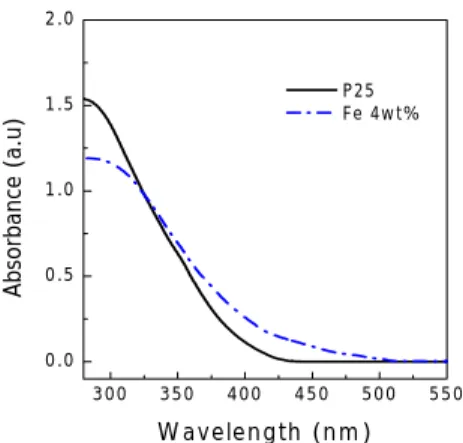
particles were observed, and the average grain size was in the range of 20-50 nm. The Fe-doped powder consisted of spherical particles and the average grain size was less than 10 nm. Fig. 1 shows typical UV-Vis curves for P25 and Fe-doped powder. UV-Vis absorption showed that the UV absorption for the Fe-doped powders shifted to a longer wavelength (red shift) and the photo-efficiency was enhanced. It is likely that the white TiO2 powder changed to
yellow due to the red shift by the Fe addition. The band gap energy (Eg) of P25 obtained by extrapolating the absorption
2006 POWDER METALLURGY World Congress
PA02-W-04
Magnetic and Photo-catalytic Properties of Nanocrystalline Fe Doped TiO
2Powder Synthesized by Mechanical Alloying
Y. R. Uhm1,a, S. H. Woo1,b, M. K. Lee1,c, and C. K. Rhee1,d 1
Nuclear Nano Materials Development LAB., Korea Atomic Energy Research Institute (KAERI), Daejeon 305-300, Korea
a
[email protected], [email protected], [email protected], [email protected]
Abstract
Fe-doped TiO2 nanopowders were prepared by mechanical alloying (MA) varying Fe contents up to 8.0 wt.%. The UV-vis
absorption showed that the UV absorption for the Fe-doped powder shifted to a longer wavelength (red shift). The absorption threshold depends on the concentration of nano-size Fe dopant. As the Fe concentration increased up to 4 wt.%, the UV-vis absorption and the magnetization were increased. The benefical effect of Fe doping for photocatalysis and ferromagnetism had the critical dopant concentration of 4 wt.%. Based on the UV absorption and magnetization, the
dopant level is localized to the valence band of TiO2.
© Korean Powder Metallurgy Institute 956 -edge onto the energy axis was 3.00 eV (410 nm). In the case of the Fe-doped powders, the UV absorbance at the wavelength of 450 nm increased as the Fe content increased up to 4 wt.%. 300 350 400 450 500 550 0.0 0.5 1.0 1.5 2.0 Ab so rb ance (a. u) W avelength (nm ) P25 Fe 4w t%
Fig. 1. UV-Vis spectra for P25 and 4 wt.% of Fe doped TiO2.
Fig. 2(a) and 2(b) represent Mössbauer spectra for 4 and 8 wt. % of Fe-doped TiO2. Mössbauer spectra of the
mechanically alloyed Fe- 4wt.% doped TiO2 sample is
interpreted one set of sextet Lorentzians line and one quadrupole line. The small amount of ferromagnetic phase exists in Fe- 4wt.% doped TiO2. The one quadrupole line of
spectrum indicates superparamagnrtic phase of immiscible iron particle with small size of nanocrystalline. The magnetic hyperfine field is about 330 kOe. Mössbauer spectra of the mechanically alloyed Fe-8wt.% doped TiO2
sample is interpreted one quadrupole line. This corresponds to paramagnetic phase [5]. The magnetization process greatly depends on the 3d-metal concentration and on the particle size of alloy after MA synthesis. During MA, the exchange interaction between the Fe atoms becomes weak as the Fe atoms diffuse into the matrix of titanium dioxide. From the TEM images, it can be easily recognized that the particle sizes of Fe is less than superparamagnetic limit [7-8]. This phase affects irreversible magnetization. However, The Fe dopants are positioned at large host of TiO2 matrix. It contributes to ferromagnetic behavior. The
paramagnetic phase corresponds to the smaller size of few nano meters [5]. This structure may affect valence band of TiO2. Magnetic properties were characterized by using a
VSM. Ferromagnetic behaviors of the magnetic hysterisis loops were observed at room temperature. Magnetic properties were characterized by using a VSM. Ferromagnetic behaviors of the magnetic hysterisis loops were observed at room temperature. The coercive force changed from 3.6 kOe to 3.2 Oe for Fe-concentration of 1 and 4 wt.%. The values of magnetization were 0.6 and 0.8 emu/g for 1 and 4 wt.%, respectively. Magnetizations for 1 and 4 wt.% of Fe show ferromagnetic behavior at room
temperature. However, the remanence field (Mr), squreness,
in M-H loops is very low value. It means irreversible magnetization due to paramagnetic phase. It recognizes that 1 and 4 wt.% of Fe-doped TiO2 include both ferromagnetic
and paramagnetic phase. We could not obtain the M-H loop for 8 wt.% Fe under the low and high applied field. There is a critical limit of Fe concentration to get ferromagnetic phase. 1.5 1.0 0.5 0.0 -12 -8 -4 0 4 8 12 8 6 4 2 0
(a) 4 wt.%-doped TiO2
A b s o rp ti o n (% ) (b) 8 wt.%-doped TiO2 VELOCITY(mm/s)
Fig. 2. Mössbauer spectra for (a) 4 wt.%, and (b) 8 wt.% of Fe doped TiO2
3. Summary
The simple MA method using meta-stable TiO(OH)2 was
selected in order to get a effective doping effect. The size of Fe-dopant determined magnetic phase and UV-Vis curves. The increasing dopant from 0 up to 4 wt. % of Fe show increasing not only ferromagnetic behaviour, but also the red shift of the UV-vis absorption.
4. References
1. D.H. Kim, H. S. Hong, S. J. Kim, J. S. Song and K. S. Lee: J. Alloy. Comp., 375, 259(2004).
2. N. H. Hong, J. Sakai, and W. Prellier: J. Magn. Magn. Mater., 281, 347(2004).
3. E. Piera, M. I. Tejedor, M. E. Zorn and M. A. Anderson: Appl. Catal. B, 46, 671(2003).
4. W. Huang, X. Tang, I. Felner, Y. Koltypin, and A. Gedanken: Mater. Resear. Bull., 37, 1721(2002).
5. Y. R. Uhm, W. W. Kim, and C. K. Rhee: Phys. Sol. Stat. A, 201, 1802(2004).