RELIABILITY TEST DESIGN Of REMANUFACTURED STEERING GEAR
OIL SEAL
Alisher Gafurov
1, Jung Do-Hyun
2, Song Hyun-Seok
2 Korea Automotive Technology Institute1,2,3Email: [email protected], [email protected], [email protected]
Abstract
This paper describes a reliability/durability test of the remanufactured steering gear units. There used to be government restrictions to remanufacture certain types of automotive components regarding safety of passengers. Nevertheless, scientific approach to sustainability and remanufacturing process provided solid evidence of highly beneficial sides of reusing the products. Failure mode analysis of the steering gear unit is performed and main failure is found out. The unit is remanufactured by fixing the failure and its quality is assessed through designing a new sequence of loading events. Oil leakage is witnessed as a possible failure and its volume is measured. Conclusions based on laboratory condition durability test are given at the end.
1. Introduction
There are various product recovery operations in automotive sector, including recycling, repair, reconditioning and remanufacturing. Remanufacturing is defined as the transformation of an end-of-life product into a product with an “as good as new” condition. Remanufacturing as a product recovery operation is extensive and includes product disassembly, cleaning and identification of parts, parts recovery and product re-assembly. Material recycling only occurs when parts and components cannot be reworked.
The automotive sector is one of the first industries to practice remanufacturing, however, the historic rationale behind remanufacturing is manifold and does not originate from one particular source. Compared to the manufacturing and distribution of new vehicles, automotive remanufacturing has remained largely invisible (Waters, 1984). Only recently is remanufacturing gaining scientific significance in a variety of industry sectors, such as photocopier (Kerr and Ryan, 2001), cellular telephone (Guide and Van Wassenhove, 2003) or single-use camera remanufacturing (Guide and Van Wassenhove, 2002). According to statistics there are 480 thousand people participating in the remanufacturing industry, 338 thousand of which are in automotive field in USA.
Most research results proved that remanufacturing in environmentally efficient and profitable (Ferrer and Ayres, 2000; Ferrer and Whybark, 2000; Guide, 1997). Robert Lund is the pioneer of remanufacturing industry, and he has made obvious contributions on this field. He believes that remanufacturing is the recycling at components level, it retains the value-added in the components (Lund and Skeels, 1983). Some researchers reported that remanufacturing an engine can save 55 kg steels, 8.3 kg aluminum and 113 kWh electric powers and reduce emissions of 565 kg CO2, 6.09 kg CO, 1.01 kg NOx, 3.985 kg SOx and 288.725 kg solid waste (Yang and Chen,2005). The demand for
remanufactured products will increase in the coming years as the end consumers become more aware of climate change and its impact. To develop the remanufacturing industry involves all kinds of aspects, such as politics, economics, social consciousness, etc.
Some governments has been prohibiting the reuse and remanufacturing of important end-of-life components, such as the engine, transmission, steering gear, front/rear axles and the vehicle frame, etc. due to consideration of transportation safety and environmental protection (Zhang, et.al., 2010). However, recently those barriers were lifted off, because these components have high value-added.
This paper will focus on developing and performing reliability/durability tests of remanufactured ball and nut type steering gear assembly. In the following sections brief information about the steering gear assembly, field data acquisition, designing of durability test procedure and the sample test results are given with conclusions.
2. Methodology
2.1
Ball and Nut Type Steering Gear
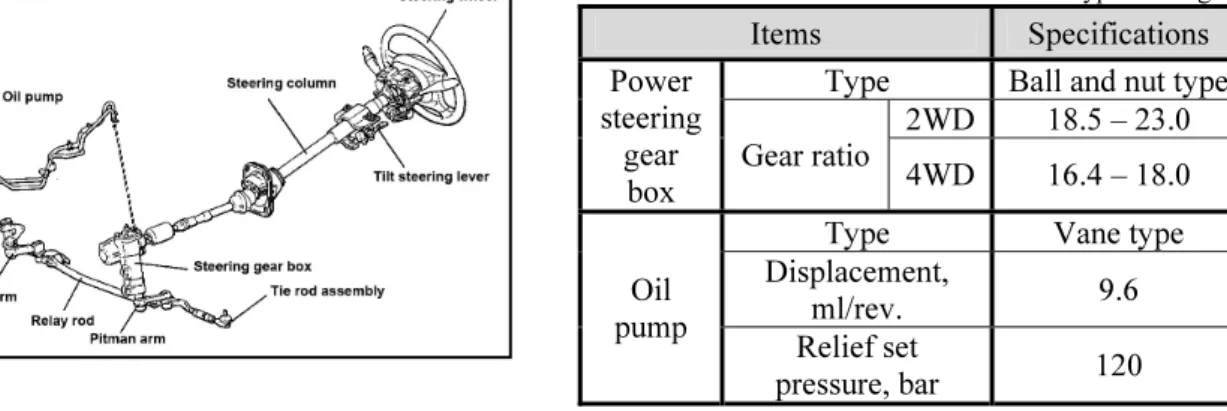
Engine speed-responsive hydraulic power steering has been used (Fig. 1). The steering column in all vehicles has a shock absorber mechanism and a tilt steering mechanism. A vane-type oil pump with a fluid flow control system has been included. The steering gear and linkage is ball and nut type. Brief technical characteristics of the unit are given in Table 1.
Table 1. Technical characteristics: bolt and nut type steering.
Items
Specifications
Power
steering
gear
box
Type
Ball and nut type
Gear ratio
2WD 18.5
–
23.0
4WD 16.4
–
18.0
Oil
pump
Type Vane
type
Displacement,
ml/rev.
9.6
Relief set
pressure, bar
120
Figure 1. Construction diagram
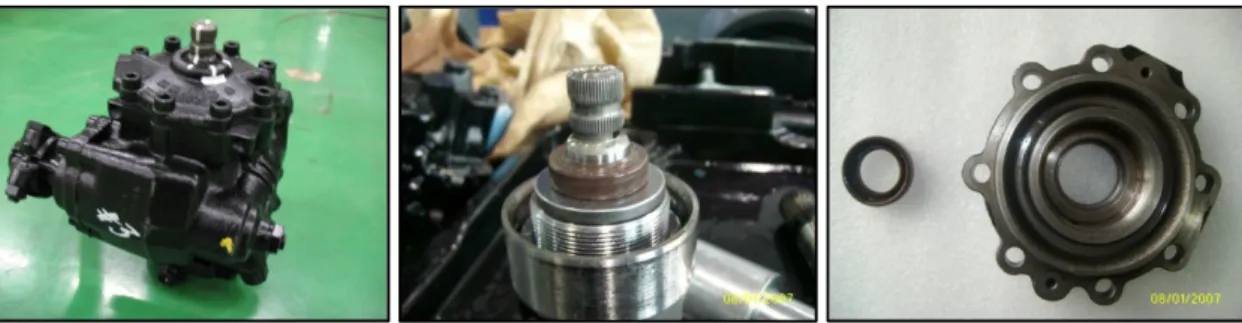
Disassembling of the used steering gear unit for failure analysis revealed that majority of failure is
related to oil seals (Fig. 2). The other mechanical parts were intact. Therefore, remanufacturing of this unit
is very simple and effective, requiring just oil seal replacement.
Figure 2. Ball and nut type steering gear Failure Mode Analysis
2.2
Instrumentation and Road Load Data Acquisition
Input loads to the steering gear assembly are induced from the road surface through tires and tie-rods. Loads are measured on tie-rods attached with full-bridge strain gages (Fig. 3). Pattern of the bridge is formed to cancel bending and torsion loads, so only uniaxial tension-compression forces are measured. Then, sensitivity of the transducer is calculated by calibration (Fig. 4).
Figure 3. Sensor attached tie-rods: RH and LH Figure 4. Calibration plot: Force vs. Voltage
2.3
Mission Profiling
Mission profiling comprises several measured events that are assumed typical of various real-life situations: examples include climb, decent, various maneuvers like parking, accidental side impact, pot-holes, repair road, rough road, highway, etc. Representative data is measured or calculated for all events likely in the service of the component.
In our case of road testing, several events were recorded and indicated from R1 to R11. These events are combined and test sequence is built. Hydraulic power assist line pressure monitoring was performed. The highest pressure is witnessed on R9 event, which is parking mode.
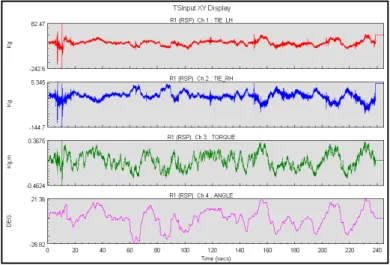
Time history data is edited and analyzed for damage content (Fig. 5). There are four available channels: Tie-rod forces from right and left tire, steering angle and steering torque. Three channels are controlled except steering torque. The torque signal channel is only monitored for correlation with field load response.
The target mileage for the remanufactured steering gear unit was defined as equal to 60,000 km of driving by a customer. This is equal to three years of warranty period. Based on measured data and damage analysis a one cycle test schedule is developed. Newly developed sequence cycle is multiplied by a factor that gives an equivalent damage to 60,000 km of real road driving. In order to ensure the reliability with high confidence level of the remanufactured steering gear, so called abusive mode is also applied. That means after completing the test for target mileage, a Parking mode only was again tested as many repetitions as it is in the complete test sequence.
Figure 5. Recorded time history data, which is used as drive signal in test bench
2.4
Test Procedure
Test process is performed in six steps: - Step 1: Record road data;
- Step2: Process road data; o Transfer; o Analyze; o Edit.
- Step 3: Measure system FRF;
o Generate a random noise drive signal, use the random signal to drive the system of interest and measure the response.
- Step 4: Estimate the initial drive signal;
o During this step, we use the system model measured in Step 3 and the desired response time history from Step 2 to create an estimate of the initial drive signal.
- Step 5: Perform iterations;
o Because the system is nonlinear and may have some inherent cross coupling, iteration is performed until a suitable drive signal is achieved.
- Step 6: Perform durability test;
o Once suitable drive signals are derived, we will use them as command input to our controller to execute durability tests.
3. Result Analyses
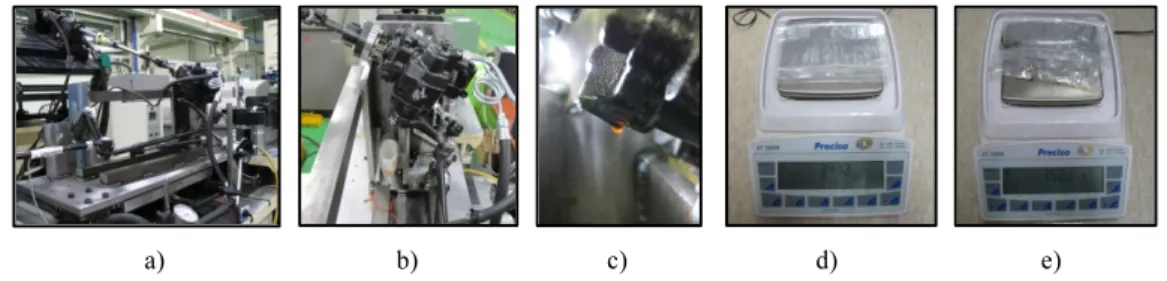
Total three samples are tested. During test process a response signals from test bench are monitored for deviation from acceptable margins. If that happens the system stops testing and visual inspection of the sample is made for failure occurrence. Since the oil seal is the only replaced part, primary inspection was for oil leakage. Small amount of oil leakage was observed after certain test time. In order to measure the amount of oil leaking from steering gear unit, some simple device is utilized (Fig. 6).
a) b) c) d) e)
Figure 6. Tested ball and nut steering gear assembly: a) Sample mounted in test bench; b) leaked oil collection; c) oil leaking location; d) weight measurement before oil leak; e) leaked oil weight
A transparent plastic bag was placed under the oil leaking spot. Its weight is measured before and after the oil collection. Measured data shows that leakage volume is about 0.109 gram, which is very little and considered as within the acceptable range. No other oil spots were detected on the sample and around the sample fixing area.
All the samples mechanically and functionally were intact after the test (Fig. 7). Only some oil spots could be found around the pinion shaft.
Figure 7. Sample inspection after test
4. Conclusions
Remanufacturing of automotive parts is beneficial economically and environmentally friendly process due to high value-added components. The number of remanufactured components is increasing by advancing the government regulations on transportation safety and lifting off the restriction to reuse the safety components. Until recently the steering gear assembly also was in the list of prohibited-to-reuse products. Scientific and standardized approach ensured reliable quality assessment.
In this study a ball and nut type remanufactured steering gear unit is tested for reliability/durability. Test procedure is performed on laboratory test bench based on real road data loads. Measurement is performed using instrumented tie-rods in the vehicle. Time history data is transferred, analyzed and edited. Damage content is calculated and a new procedure is designed to perform laboratory based durability test. A sequence of time history events are determined to inflict maximum possible damage to the steering unit from realistic driving conditions. Total 60,000 km target mileage decided as a warranty period by a remanufacturing company. It is equivalent to 3 years of vehicles’ life time.
Mostly failed component was oil seal and therefore more attention was paid to oil leaking failure during testing. Very little amount of oil leakage is witnessed but the volume of 0.109 gram is well below critical level. So, remanufactured steering gear units are confirmed as reliable.