
INTRODUCTION
Peptide receptors are used as targets for the imaging and targeted radionuclide therapy for cancer. The receptors of the Bombesin (BBS) family are very suitable as a target because they are overexpressed in a variety of human cancers. In particular, the gastrin releasing peptide receptor (GRPR) has been identified in prostate and breast cancers, gastrointesti-nal stromal tumors, and peritumoral vessels in ovarian can-cer (Gugger and Reubi 1999; Markwalder and Reubi 1999; Reubi et al. 2004; Fleischmann et al. 2007; Abiraj et al. 2011). A lot of bombesin (BBS) analogues have been label-ed with various radionuclides such as 99mTc, 111In, 90Y, 64Cu,
177Lu, 68Ga, or 18F for a diagnosis and treatment of GRPR positive prostate tumor (Smith et al. 2003; Okarvi 2004; Smith et al. 2005; Mu et al. 2010), however, none of them seem to have provided a breakthrough in clinical applica-tions thus far.
Recently, 177Lu-AMBA, which is 177Lu-labeled DOTA-conjugated BBS7-14, was studied in clinical phase I and showed several side effects including abdominal cramps, diarrhea, and nausea (Bodei and Nunn 2007). Additionally, agonists of the BBS family showed their mitogenic properties (Casanueva et al. 1996). Thus, a lot of reports have hypoth-esized that these side effects may be absent when using BBS antagonists (Abd-Elgaliel et al. 2008; Cescato et al. 2008; Mansi et al. 2009; Abiraj et al. 2011; Mansi et al. 2011), and the antagonistic properties of the peptide sequence, Gln-Trp-Ala-Val-N methyl Gly-His-Statine-Leu-NH2was reported
─ ─ 127 ──
Synthesis, Radiolabeling and Gastrin Releasing Peptide Receptor
Binding Affinity of a Novel Bombesin Antagonist-Based Peptide,
DOTA-Ala(SO
3H)-Aminooctanoyl-Gln-Trp-Ala-Val-N methyl
Gly-His-Statine-Leu-NH
2Jae Cheong Lim*, Sang Mu Choi, Eun Ha Cho and Jin Joo Kim Radioisotope Research Division, Department of Research Reactor Utilization,
Korea Atomic Energy Research Institute, Daejeon 305-353, Korea
Abstract -- Bombesin receptors are overexpressed in many kinds of human tumors. In particular, the gastrin releasing peptide receptor (GRPR) which is also called bombesin receptor subtype 2, has been identified in prostate cancer. In the present study, we developed a bombesin antagonist-based 177Lu-labeled peptide, 177Lu-DOTA-Ala(SO
3H)-Aminooctanoyl-Gln-Trp-Ala-Val-N methyl Gly-His-Statine-Leu-NH2(DOTA-sBBNA). DOTA-sBBNA was prepared using a solid phase synthe-sis method. It was labeled with 177Lu by a high radiolabeling yield (¤¤98%), and its Log P value was -- 2.05. The radiolabeled peptide was highly stable in serum incubation at 37��C for 48 hr. A competitive displacement of 125I-[Tyr4]-Bombesin on the PC-3 human prostate carcinoma cells revealed that the IC50value of the peptide was 6.76 nM indicating a highly nanomolar binding affinity for GRPR. These results suggest that 177Lu-DOTA-sBBNA can be a potential candidate for targeting prostate cancer, and further studies to evaluate its biological characteristics are needed.
Key words : 177Lu, Bombesin, Antagonist, Gatrin releasing peptide receptor, Tumor targeting
* Corresponding author: Jae Cheong Lim, Tel. +82-42-868-8344, Fax. +82-42-868-8448, E-mail. [email protected]
affinity and stability. Among them, the DOTA is able to strongly chelate many radionuclides such as 68Ga, 111In, 149Pm, 212Pb, 90Y, and 177Lu (Ruegg 1990; Depalatis 1995;
Pippin 1995; Kukis 1998; Kwekkeboom 1999). In particular,
177Lu emits medium and lower-energy β-rays (497 keV), and
thus 177Lu is considered a suitable radionuclide for treating small tumors or metastatic deposits. In addition, 177Lu emits
γ-rays (113 and 208 keV, 6% and 11%), which allows scinti-graphic imaging and dosimetry (Miao et al. 2005).
The present study describes the synthesis, radiolabeling, and in vitro competitive binding of a novel BBN-related pep-tide antagonist, 177Lu-DOTA-Ala(SO
3 H)-Aminooctanoyl-Gln-Trp-Ala-Val-N methyl Gly-His-Statine-Leu-NH2(177 Lu-DOTA-sBBNA) to evaluate its possibility for the targeting of GRPR over-expressing tumors.
MATERIALS AND METHODS
1. MaterialsAll chemicals were of analytical grade purchased from a chemical company, and used without further purification. Automated solid-phase synthesis was accomplished through the use of a Multiple Biomolecular Synthesizer (Peptron, Daejeon, Republic of Korea). Analytical and preparative RP-HPLC was performed on a SHIMAZU prominence RP-HPLC using a Shiseido capcell pak 18C column. A wavelength of 220 nm was used for UV detection for analytical RP-HPLC. The LC/MS was performed using an HP 1100 series. 177Lu was purchased from Perkin-Elmer (Massachusetts, USA) and the radioactivity was measured using an ionizing cham-ber (Atomlab 200, Bio-dex, New York, USA). The radiola-beling yield and radiochemical purity (RCP) were determined using a gamma detector-equipped HPLC analyzer (Waters, Milford, USA).
2. Preparation of chelator conjugated peptides The peptide was prepared through the use of an automated Multiple Biomolecular Synthesizer (Peptron, Daejeon,
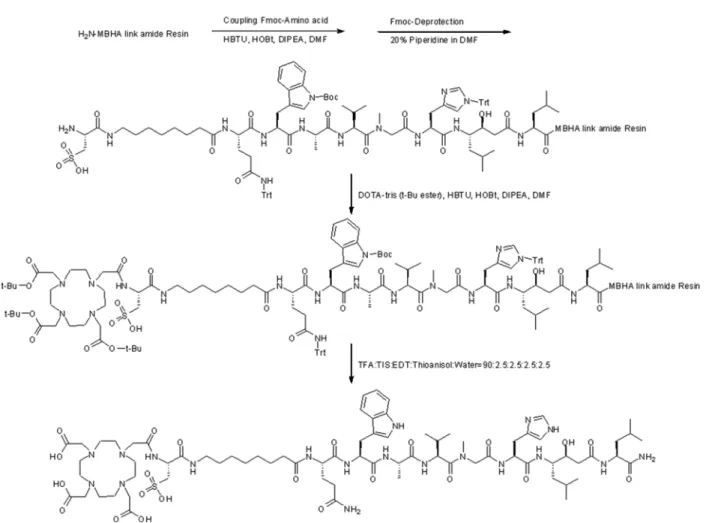
Re-thesis. After removing the Fmoc protecting group from resin-bounded Fmoc-Leu-OH under a standard cleavage condition (20% Piperidine in N,N-Dimethylformamide), the linear sequence peptide was prepared through the sequential coupl-ing of Fmoc-Statine-OH, Fmoc-His(Trt)-OH, Fmoc-N methyl Gly-OH, Fmoc-Val-OH, Fmoc-Ala-OH, Fmoc-Trp(tBoc)-OH, Fmoc-Gln(Trt)-Fmoc-Trp(tBoc)-OH, Fmoc-8 aminooctanoic acid, and Fmoc-Ala(SO3H). DOTA(OtBu)3was introduced into the peptide by applying HBTU, HOBt, DIPEA and DMF as an activating reagent to ensure efficient coupling. The resulting peptide was cleaved from the polymeric support by treatment with a mixture solvent of 90% TFA containing 2.5% triiso-propylsilane (TIS), 2.5% ethanedithiol (EDT), 2.5% thioani-sole, and 2.5% deionized water (TFA : TIS : EDT : Thioani-sole : H2O==90 : 2.5 : 2.5 : 2.5 : 2.5). The crude product was purified by Shimadzu HPLC equipped with a Capcell pak 18C column on a binary gradient system at a flow rate of 1.0 ml min-1using an elution solvent of 0.1% trifluroacetic acid (TFA) in water (A) and 0.1% TFA in acetonitrile (B) with a gradient elution profile of (B) 0~10% in 2 min; 10~40% in 10 min; and 40~70% in 2 min. The molecular mass was analyzed on an LC-MS.
3 Radiochemistry of 177Lu-DOTA-sBBNA 1) Preparation of 177Lu-DOTA-sBBNA
Peptide was dissolved in a 50 mM sodium acetate buffer (pH==5.5) to give a concentration of 10-6mole ml-1. 37 MBq of a 177Lu solution diluted in a 0.05 N HCl was injected into 1×10⁻⁸mole of a peptide solution vial to give a final volume of 1 ml, and heated at 90�C for 30 min. The radiolabeling yield and radiochemical purity/stability of the radiolabeled compound were analyzed through a Waters Chromatograph equipped with an X-Terra 18C column. The column was eluted with a binary gradient system with a flow rate of 1.0 ml min-1using an elution solvent of 0.1% TFA in 5% ace-tonitrile and 0.1% TFA in 95% aceace-tonitrile. The gradient elution profile based on the solution of 0.1% TFA in 95% acetonitrile is as follows: 0%, 5 min; 0~100%, 9 min; 100%, 6 min; 100%, and 2 min with 100% of 0.1% TFA in 5%
acetonitrile.
2) Determination of Log P value
37 KBq of 177Lu-DOTA-sBBNA was dissolved in an equal
volume mixture of 1-octanol and a PBS buffer (1 ml : 1 ml). After stirring vigorously for ~20 min, the mixture was cen-trifuged at a speed of 8,000 rpm for 5 min. 100μl of samples from both 1-octanol and PBS layers were transferred and the radioactivity was measured using a Wallac 1470 Wizard automated gamma counter (PerkinElmer Life Science). Par-tition coefficients were measured three different times. The log P values were reported as the average of three indepen-dent measurements.
3) In vitro stability assay
The serum stability was evaluated as described by Nguyen et al. with some modification (Leonard et al. 2010). 177
Lu-DOTA-sBBNA was added to 200μl of PBS and 25% human
serum in PBS, and incubated at 37�C for 2 days. 100μl ali-quots of the incubations were taken for the following time periods: 1 and 2 days. The aliquots were mixed with 40μl of 15% trichloroacetic acid (TCA) and incubated at 4�C for at least 15 min to precipitate the serum proteins. 5μl of 1 M NaOH was supplemented to the TCA to prevent peptide pre-cipitation. The supernatant was collected for each sample after centrifugation at 13,000 rpm for 10 min and analyzed by HPLC analysis, as described above.
4) Urinary metabolites of 177Lu-DOTA-sBBNA
7.4 MBq of 177Lu-DOTA-sBBNA was injected into Balb/c
nude mice through the tail vein (n==4). After administration,
the urinary samples were collected at 2 hr after injection using metabolic cages. 200μl of radioactive metabolites in urine were mixed with 40μl of 15% trichloroacetic acid (TCA) and incubated at 4�C for 15 min to precipitate serum proteins. 5μl of 1 M NaOH was supplemented to the TCA to
Fig. 1. Solid phase synthesis route and their formula of DOTA-sBBNA. A final sequence of DOTA-sBBNA was DOTA-Ala (SO3 H)-Aminooc-tanoyl-Gln-Trp-Ala-Val-N methyl Gly-His-Statine-Leu-Met-NH2.
1) Cell culture
The GRPR-over-expressing PC-3 prostate carcinoma cells were obtained from the American Type Culture Collection (ATCC) and grown in 100 mm culture dishes (Corning, Corn-ing, NY, USA). The cells were cultured in RPMI-1640 (LONZA, Walkersville, MD, USA), supplemented with 10% fetal bovine serum, 100 units ml-1penicillin, and 100 g ml-1streptomycin (Sigma, Milan, Italy) in an atmosphere of 5% CO2in air at 37�C for up to approximately a 90%
confluence.
2) Competitive binding assay
The IC50values of the peptide was determined using
pre-viously described methods with some modifications (Yubin Miao 2008). 1×10⁵PC-3 cells were placed in 12-well plates,
and grown for 24 h at 37�C. After replacing the culture media with a FBS free-RPMI-1640, the cells were incubated at 37�C for 1 hr with 20,000 cpm of 125I-[Tyr4]-BBS
(Perkin-Elmer, USA) in the presence of increasing concentrations of the peptide (10-6~10-12M) in a 1 ml binding buffer. The reaction media were collected. Cells were then washed twice with a cold PBS and solubilized with 1 N NaOH for 5 min. The activity was then determined in a gamma-counter. The IC50value for the peptide was calculated through a non-linear
regression analysis using the GraphPad Prism5 computer fitting program.
RESULTS AND DISCUSSION
The DOTA-sBBNA was synthesized through a solid phase peptide synthesis in accordance with the Fmoc strategy. Fig. 1 shows the scheme of the synthesis and the final structural formula.
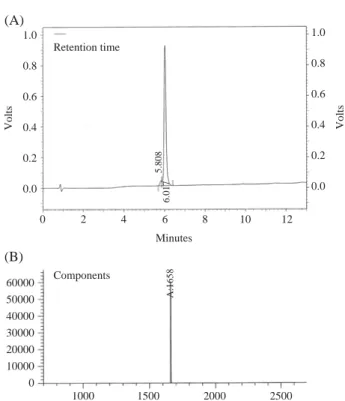
The retention time of the analytical HPLC for DOTA-sBBNA was found to be 6.02 min, and the chemical purity was over 98% (Fig. 2A). Fig. 2B shows that the measured ion peak [M++1 (m/z)] was found at 1658, which is consistent
with the proposed formula (Calculated==1657.40). The final
peptide sequence of DOTA-sBBNA was DOTA-Ala(SO3
H)-Aminooctanoyl-Gln-Trp-Ala-Val-N methyl Gly-His-Statine-Leu-NH2.
For 177Lu radiolabeling, the peptides were mixed with a 177Lu solution and heated at 90�C for 30 min as described in
the methods. A gamma detector-equipped HPLC analyzer was used to evaluate the labeling yield of the peptides, and the results are shown in Fig. 3. A high labeling yield (¤98%) was achieved, and used directly without further purification.
Volts 0.4 Volts 0.2 0.0 0.4 0.2 0.0 60000 50000 40000 30000 20000 10000 0 0 2 4 6 8 10 12 Minutes 1000 1500 2000 2500 5.808 A:1658 Components 6.017 (B)
Fig. 2. HPLC analysis (A) and LC/MS profiles (B) of
DOTA-sBBNA. The crude product was purified by Shimadzu HPLC equipp-ed with a Capcell pak 18C column and the molecular mass was analyzed on LC-MS. A purity of the peptide was over 98%, and a final MS data of the peptide was equal to the calculated value of the proposed formula.
mV 500.00 400.00 300.00 200.00 100.00 0.00 2.00 4.00 6.00 8.00 10.00 12.00 14.00 16.00 18.00 20.00 22.00 Minutes
Fig. 3. Typical profiles of 177Lu-DOTA-sBBNA determined by HPLC analysis using a 18C column. Radiochemical purity of the peptides was over 98% and further purification was not needed. Retention time : 11.29 min.
Because a DOTA chelator can be radiolabeled with a lot of radionuclides such as 68Ga, 90Y, 177Lu, and 111In, it is
encour-aged to apply the peptide for the imaging and treatment with other radionuclides (Lim et al. 2012).
The Log P value of the 177Lu-DOTA-sBBNA was
deter-mined through a shake flask method. This value was found to be -2.05. Increasing the hydrophilicity as well as the
overall charge of the bombesin analog may lead to derivatives with improved sensitivity, specificity, and pharmacokinetics for the optimal targeting of GRPR-positive tumors. Log P value of 18F-BAY 86-4367 was -3.9 indicating highly
hy-drophilic, and it showed more specific and effective GRPR-based targeting in vivo. In addition, rapid tumor targeting and fast renal excretion (~70%) and hepatobiliary excretion (~10%) were identified in PC-3 xenograft models (Honer et al. 2011). Christian et al. also demonstrated that an introduc-tion of hydrophilic triazole coupled glucose into the 99mTc
labeled BBS analogue resulted in a reduction of the abdomi-nal accumulation and an improvement of the tumor-to-back-ground ratios (Schweinsberg et al. 2008). The hydrophilicity of the peptide plays an important role in the targeting affin-ity in vitro as well as in the biodistribution in vivo. Although several reports suggest that higher hydrophilicity is advan-tageous for targeting GRPR, the injected radiolabeled pep-tide might excreted too rapid to be accumulated in the
tar-geted organ. Additionally, an unwanted radiation dose might be delivered to the kidneys because hydrophilic compounds are likely to be retained there.
The 177Lu-DOTA-sBBNA did not show any degradation in
either PBS or human serum up to 48 hr (Fig. 4A, B). Michael et al. reported the stability of the bombesin antagonist-based peptide, 18F-BAY 86-4367. The 18F-labeled peptide was
sta-ble for 2 hours both in PBS and human plasma. It is encour-aged to apply radionuclide therapy because the higher serum stability can make a higher accumulation of the radiolabeled peptide in the targeted organ and deliver more radiation dose to the organ.
18F-BAY 86-4367 was unstable in murine plasma and 1
polar metabolite was detected in just 15 minutes after an injection of the radiolabeled peptide. Additionally, all of the parent compounds were degraded, and 3 main metabolites were detected in murine urine. Although it is a little unstable in mice in vivo, 18F-BAY 86-4367 clearly visualized PC-3
xenografted prostate tumor. The in vivo stability of 177
Lu-DOTA-sBBNA was also analyzed in murine urine by radio-HPLC (Fig. 4D). At 15 minutes after an injection of the radiolabeled peptide into nude mice, urine samples were collected for HPLC analysis. Similar to the 18F-BAY
86-4367, 3 radiometabolites could be detected in the urine (Fig. 4B). Because HPLC conditions for analysis of the samples
mV mV mV mV 500.00 400.00 300.00 200.00 100.00 0.00 800.00 600.00 400.00 200.00 0.00 600.00 500.00 400.00 300.00 200.00 100.00 0.00 1000.00 800.00 600.00 400.00 200.00 0.00 2.00 4.00 6.00 8.00 10.00 12.00 14.00 16.00 18.00 20.00 22.00 Minutes 2.00 4.00 6.00 8.00 10.00 12.00 14.00 16.00 18.00 20.00 22.00 Minutes 2.00 4.00 6.00 8.00 10.00 12.00 14.00 16.00 18.00 20.00 22.00 Minutes 2.00 4.00 6.00 8.00 10.00 12.00 14.00 16.00 18.00 20.00 22.00 Minutes (A) (C) (B) (D)
Fig. 4. In vitro stability of 177Lu-DOTA-sBBNA in PBS (A) and human serum (B). Stock solution (C) and in vivo metabolism of radiolabeled peptide in murine urine (D). The radiolabeled peptide was stable both in PBS and human serum for 48 hr. It was unstable in murine in vivo, and 3 main metabolites were detected in murine urine at 15 minutes after an injection of the radiolabeled peptide.
were different, the peaks of the metabolites were detected at different retention times. However, all metabolites of 18
F-BAY 86-4367 and 177Lu-DOTA-sBBNA were more
hydro-philic than the parent radiolabeled peptide, and the number of main metabolites were 3, respectively (Honer et al. 2011). As 2 peptides shared the same targeting sequence and a peak of 177Lu was not detected in urine, it seems that the targeting
sequence of the antagonist can be degraded in vivo and more studies to identify its cleavage sites are needed to improve the in vivo stability.
Compared with the reference peptide 18F-BAY 86-4367
(IC50==0.94 nM), DOTA-sBBNA still retained reasonable
affinity to the GRPR (IC50==6.76 nM), as shown in Fig. 5.
The main differences between two radiolabeled peptides are the chelator and linker moiety. The insertion of more hydro-philic moiety, Ala(SO3H) into its linker made the binding
affinity higher in the case of 18F-BAY 86-4367 (Honer et
al. 2011). Because the hydrophilicity of the 177
Lu-DOTA-sBBNA is still much lower than 18F-BAY 86-4367, an
inser-tion of more Ala(SO3H) or hydrophilic carbohydrate into
the linker might make its binding affinity higher.
Another BBS antagonist using a DOTA chelator is DOTA-AR, and its targeting sequence was D
-Phe-Gln-Trp-Ala-Val-Gly-His-Sta-Leu-NH2. Although IC50of it was 18 nM, which
was lower than DOTA-sBBNA, 10.56±0.70%ID g-1of the peptide was accumulated in PC-3 xenografted tumor at 1 hr p.i.. NODAGA-AR even showed a lower binding affinity (IC50==25 nM), but it was labeled with 68Ga and successfully
increase of its IC50(7.7 nM). Radiolabeled RM2 showed a
high accumulation in PC-3 tumors, which was 15.2±4.8
%ID g-1at 1 h p.i. (Mansi et al. 2011). Therefore, the strategy to modify a linker moiety chemically might be effective, and the targeting affinity of DOTA-sBBNA can be improved by a change in its linker moiety. In addition, Renzo et al. report-ed that the Desmobesin showreport-ed the highest PC-3 tumor accu-mulation in vivo. BBS antagonist sequence, [D-Phe6,
Leu-NHEt13, des-Met14] bombesin
6-14was used for targeting
GRPR, and 24.61±1.98%ID g-1was accumulated in a PC-3 tumor at 1 hr p.i. (Cescato et al. 2008). Further studies to improve the binding affinity should consider the targeting moiety used in Desmobesin.
A series of results suggest that 177Lu-DOTA-sBBNA has
a promising characteristic as a modality to treat the GRPR-over-expressing tumors. 177Lu-DOTA-sBBNA can deliver a
sufficient radiation dose to the targeted organ owing to its high serum stability and binding affinity. Therefore, we plan to evaluate its pharmacokinetic characteristics and therapeu-tic efficacy in the next study.
CONCLUSION
In conclusion, a novel GRPR-binding peptide antagonist,
177Lu-DOTA-Ala(SO
3
H)-Aminooctanoyl-Gln-Trp-Ala-Val-N methyl Gly-His-Statine-Leu-H)-Aminooctanoyl-Gln-Trp-Ala-Val-NH2, is a promising candidate
for the targeting of GRPR-over-expressing tumors, and fur-ther investigations to evaluate its pharmacokinetic charac-teristics and therapeutic efficacy are needed.
ACKNOWLEDGEMENTS
This study was supported by the KAERI Major Project, Development of Radioisotope Production and Application Technology based on Research Reactor (525140-13).
REFERENCES
Abd-Elgaliel WR, Gallazzi F, Garrison JC, Rold TL, Sieckman
Bound
[
0
-11 -10 -9 -8 -7 -6 -5
Concentration (Log[M])
Fig. 5. Competitive binding of 125I-[Tyr4]-Bombesin on PC-3 cells by a treatment of DOTA-sBBNA. Results expressed as a percentage of binding are mean±SD in triplicate. 1×10⁵PC-3 cells were in-cubated at 37�C for 1 hr with 20,000 cpm of 125I-[Tyr4]-Bombesin (Perkin-Elmer, USA) in the presence of increasing concentrations of the peptide (10-6~10-12M) in a 1 ml binding buffer. The IC
50of
DOTA-sBBNA was 6.76 nM indicating higly nanomolar binding affinity for the GRPR.
GL, Figueroa SD, Hoffman TJ and Lever SZ. 2008. Design, synthesis, and biological evaluation of an antagonist-bom-besin analogue as targeting vector. Bioconjug. Chem. 19(10): 2040-2048.
Abiraj K, Mansi R, Tamma ML, Fani M, Forrer F, Nicolas G, Cescato R, Reubi JC and Maecke HR. 2011. Bombesin antagonist-based radioligands for translational nuclear im-aging of gastrin-releasing peptide receptor-positive tumors.
J. Nucl. Med. 52(12):1970-1978.
Bodei L and Nunn A. 2007. 177Lu-AMBA bombesin analogue
in hormone refractory prostate cancer patients patients : A phase i escalation study with single-cycle administrations [abstract]. Eur. J. Nucl. Med. Mol. Imaging 34(suppl 2): S221.
Casanueva FF, Perez FR, Casabiell X, Camina JP, Cai RZ and Schally AV. 1996. Correlation between the effects of bom-besin antagonists on cell proliferation and intracellular cal-cium concentration in swiss 3t3 and ht-29 cell lines. Proc.
Natl. Acad. Sci. U.S.A. 93(4):1406-1411.
Cescato R, Maina T, Nock B, Nikolopoulou A, Charalambidis D, Piccand V and Reubi JC. 2008. Bombesin receptor antag-onists may be preferable to agantag-onists for tumor targeting. J.
Nucl. Med. 49(2):318-326.
Depalatis FK, Cheng RC and Kotite NJ. 1995. Lysine reduces renal accumulation of radioactivity associated with injection of the [177
Lu]-[2-(4-aminophenyl)ethyl]-1,4,7,10-tetraaza-cyclododecane-1,4,7,10-tetraacetic acid-cc49 Fab radioim-munoconjugate. Cancer Res. 55:5288-5295.
Fleischmann A, Waser B and Reubi JC. 2007. Overexpression of gastrin-releasing peptide receptors in tumor-associated blood vessels of human ovarian neoplasms. Cell Oncol.
29(5):421-433.
Gugger M and Reubi JC. 1999. Gastrin-releasing peptide recep-tors in non-neoplastic and neoplastic human breast. Am. J.
Pathol. 155(6):2067-2076.
Honer M, Mu L, Stellfeld T, Graham K, Martic M, Fischer CR, Lehmann L, Schubiger PA, Ametamey SM, Dinkelborg L, Srinivasan A and Borkowski S. 2011. 18F-labeled bombesin
analog for specific and effective targeting of prostate tumors expressing gastrin-releasing peptide receptors. J. Nucl. Med.
52(2):270-278.
Kukis DS, Denardo GL, O’donnell RT and Meares CF. 1998. Optimized conditions for chelation of 90Y-dota
immuno-conjugates. J. Nucl. Med. 39:2105-2110.
Kwekkeboom KP, Bakker WH, Macke HR and Krenning EP. 1999. Comparison of 111In-dota-tyr3-octreotide and 111
In-DOTA-octreotide in the same patients: Biodistribution, kinetics, organ and tumor uptake. J. Nucl. Med. 40:762-767. Leonard N, Nicole Perry, Leonie DB, Sebastian AJ and Hans
JV. 2010. Serum stabilities of short tryptophan- and
argi-nine-rich antimicrobial peptide analogs. Plus One 5(9):1-8. Lim JC, Hong YD, Kim JJ, Choi SM, Baek HS and Choi SJ.
2012. Synthesis and biological evaluation of a novel 177
Lu-DOTA-[gly3-cyclized (dap4, d-phe7, asp10)-arg11
]alpha-msh3-13analogue for melanocortin-1 receptor-positive
tumor targeting. Cancer Biother Radiopharm 27(8):464-472.
Mansi R, Wang X, Forrer F, Kneifel S, Tamma ML, Waser B, Cescato R, Reubi JC and Maecke HR. 2009. Evaluation of a 1,4,7,10-tetraazacyclododecane-1,4,7,10-tetraacetic acid-conjugated bombesin-based radioantagonist for the labeling with single-photon emission computed tomography, positron emission tomography, and therapeutic radionuclides. Clin.
Cancer Res. 15(16):5240-5249.
Mansi R, Wang X, Forrer F, Waser B, Cescato R, Graham K, Borkowski S, Reubi JC and Maecke HR. 2011. Develop-ment of a potent dota-conjugated bombesin antagonist for targeting grpr-positive tumours. Eur. J. Nucl. Med. Mol.
Imaging 38(1):97-107.
Markwalder R and Reubi JC. 1999. Gastrin-releasing peptide receptors in the human prostate: Relation to neoplastic trans-formation. Cancer Res. 59(5): 1152-1159.
Miao Y, Hoffman TJ and Quinn TP. 2005. Tumor-targeting properties of 90Y and 177Lu-labeled alpha-melanocyte
stim-ulating hormone peptide analogues in a murine melanoma model. Nucl. Med. Biol. 32(5):485-493.
Mu L, Honer M, Becaud J, Martic M, Schubiger PA, Ametamey SM, Stellfeld T, Graham K, Borkowski S, Lehmann L, Dinkelborg L and Srinivasan A. 2010. In vitro and in vivo characterization of novel 18F- labeled bombesin analogues
for targeting grpr-positive tumors. Bioconjug. Chem. 21(10): 1864-1871.
Okarvi SM. 2004. Peptide-based radiopharmaceuticals: Future tools for diagnostic imaging of cancers and other diseases.
Med. Res. Rev. 24(3):357-397.
Pippin MT and Brechbiel MW. 1995. Lead (ii) complexes of 1,4,7,10-tetraazacyclododecane-n,n′,n′′,n′′′-tetraacetate: Solution chemistry and application to tumor localization with 203pb labeled monoclonal antibodies. Inorg. Chem. Acta. 239:43-51.
Reubi JC, Korner M, Waser B, Mazzucchelli L and Guillou L. 2004. High expression of peptide receptors as a novel tar-get in gastrointestinal stromal tumours. Eur. J. Nucl. Med.
Mol. Imaging 31(6):803-810.
Ruegg CL, Brechbiel MW, Mirzadeh S, Gansow OA and Strand M. 1990. Improved in vivo stability and tumor targeting of bismuth-labeled antibody. Cancer Res. 50:4221-4226. Schweinsberg C, Maes V, Brans L, Blauenstein P, Tourwe DA,
Schubiger PA, Schibli R and Garcia G. 2008. Novel glycat-ed [99mTc(CO)3]-labeled bombesin analogues for improved
peptide conjugates for targeting of the bombesin receptor superfamily subtypes. Nucl. Med. Biol. 32(7):733-740.
Manuscript Received: November 6, 2013 Revised: November 18, 2013 Revision Accepted: November 20, 2013

![Fig. 5. Competitive binding of 125 I-[Tyr 4 ]-Bombesin on PC-3 cells by a treatment of DOTA-sBBNA](https://thumb-ap.123doks.com/thumbv2/123dokinfo/4671400.640/6.892.83.429.100.351/fig-competitive-binding-bombesin-cells-treatment-dota-sbbna.webp)
![OPEN BID INVITATION [SECURITY SERVICE]](data:image/gif;base64,R0lGODlhAQABAIAAAP///wAAACH5BAEAAAAALAAAAAABAAEAAAICRAEAOw==)