저작자표시 2.0 대한민국 이용자는 아래의 조건을 따르는 경우에 한하여 자유롭게 l 이 저작물을 복제, 배포, 전송, 전시, 공연 및 방송할 수 있습니다. l 이차적 저작물을 작성할 수 있습니다. l 이 저작물을 영리 목적으로 이용할 수 있습니다. 다음과 같은 조건을 따라야 합니다: l 귀하는, 이 저작물의 재이용이나 배포의 경우, 이 저작물에 적용된 이용허락조건 을 명확하게 나타내어야 합니다. l 저작권자로부터 별도의 허가를 받으면 이러한 조건들은 적용되지 않습니다. 저작권법에 따른 이용자의 권리는 위의 내용에 의하여 영향을 받지 않습니다. 이것은 이용허락규약(Legal Code)을 이해하기 쉽게 요약한 것입니다. Disclaimer 저작자표시. 귀하는 원저작자를 표시하여야 합니다.
2012 년 8 월
석사학위논문
A Study on the Current Status of
Management Accounting and Development
Suggestions in Vietnam Enterprises
조선대학교 대학원
회계학과
A Study on the Current Status of
Management Accounting and Development
Suggestions in Vietnam Enterprises
2012 년 8 월 24 일
조선대학교 대학원
회계학과
A Study on the Current Status of
Management Accounting and Development
Suggestions in Vietnam Enterprises
베트남 기업의 관리회계 현황과 발전방안에 관한 연구
지도교수 조승제
이 논문을 경영학 석사학위신청 논문으로 제출함
2012 년 4 월
조선대학교 대학원
회계학과
Nguyen Thi Huyen 의 석사학위
논문을 인준함
위 원 장 조선대학교 교 수
박 길 영
(인)
위 원 조선대학교 교 수 김 승 용 (인)
위 원 조선대학교 교 수 조 승 제 (인)
2012 년 5 월
조선대학교 대학원
- i -
CONTENTS
List of Tables ... iii
List of Figures... iv
국문초록 ... v
Chapter 1: Introduction and Purpose of the Study ... 1
1. Introduction ... 1
2. Purpose of The Study ... 9
3. Research Method and Range ... 10
Chapter 2: Current Status of Management Accounting in General Vietnam Enterprises ... 11
1. History and Development of Management Accounting in Vietnam ... 11
1.1 The History and Development of Vietnam Accounting ... 11
1.2 The History and Development of Management Accounting ... 15
2. Management Accounting in General Vietnam Enterprises ... 20
2.1. Management Accounting Practice in General Vietnam Enterprises ... 22
2.1.1. Manufacture Enterprises... 22
2.1.2. Trade Enterprises ... 26
2.1.3. Service Enterprises ... 29
2.2. General Evaluation about Management Accounting Application in General Vietnam Enterprises ... 31
2.2.1. Perception of Management Accounting ... 31
- ii -
2.2.3. Contents ... 32
2.2.4. Estimate ... 35
2.2.5. Relationship in Information Supplication between Enterprises Departments ... 36
2.2.6. Research Method ... 36
Chapter 3: Some Suggestions for Development of Management Accounting Practice in Vietnam Enterprises ... 37
1. Government ... 37
2. Enterprises ... 37
2.1. Management Accounting Understanding ... 38
2.2. Mode of Operation ... 39
2.3. Management Accounting Implement ... 39
2.4. Management Report System ... 40
2.5. Establish Connection among Department ... 40
2.6. Estimate Making ... 41 3. Qualifying Accountants ... 41 Chapter 4: Conclusion ... 43 References ... 44 Abstract ... 46 Acknowledgement ... 48
- iii -
List of Tables
Table 1. Inflation rate 2011 per month ... 3
Table 2. Competitiveness of Vietnam and other South East of Asia countries ... 6
Table 3. Twenty six Vietnam accounting standards ... 13
Table 4. Evolvement outline of management accounting ... 16
- iv -
List of Figures
Figure 1. Economic growth rate and Vietnam per capita income from 2005 to 2011 ... 2
Figure 2. Registered and disbursed FDI ... 5
Figure 3. Process of management organization ... 21
- v -
국문초록
베트남 기업의 관리회계 현황과 발전방안에 관한 연구
Nguyen Thi Huyen
Advisor: Prof. Jo, Seung - Je, Ph.D. Department of Accounting,
Graduate School of Chosun University
오늘날 기업은 예전보다 더 빠르게 변화하고 있다. 과학기술, 의사소통, 경제적인 상황, 그리고 법적 환경에서의 변화는 회사와 그들의 관리 회계사에 새로운 방법으로 영향을 주고 있다. 관리 회계사는 기업 의사결정의 모든 단계에서 경영을 지원해야 한다. 회계전문가로서 그들은 지능적이어야 하고, 최근의 새로운 개발까지 잘 준비 되어야 하고, 그리고 그들의 새로운 기업 운영에 있어서 모든 나라들의 풍습과 관례에 익숙해져야 한다 (Hansen & Mowen). 선진국에서 관리회계는 전형적인 시스템과 함께 정식적인 직장이 되어왔다. 2003 년에 관리회계 전문용어는 2003 년 6 월 17 일에 공표된 베트남 회계법에 정식적으로 나타났다. 국제적인 경제에서 통합 프로세스는 베트남 기업의 관리회계 응용과 최적화에 관한 필요성이 증가한다.
- vi - 그러나, 정부로부터의 불충분한 지원뿐만 아니라 기업의 관리회계에 관한 불완전한인식은 효과적인 도구의 사용으로부터 베트남 기업을 막고 있어, 전세계적으로 경쟁하는 맥락에서 좋지 않은 상태로 이끈다. 이러한 연구에서, 관리회계를 포함하고 있는 베트남 회계 시스템의 발전은 1985 년부터 지금까지 역사적인 개념아래에서 고려되어야 한다. 특히, 베트남에서 인터넷, 직접 인터뷰, 경제적, 그리고 회계 저널과 같은 정보의 여러 가지 근원을 통하여 주의 깊게 모은 관리회계 응용의 최근 현실은 개선을 위해 확실한 제안을 생각해내기 위해 분석 되어진다
1
CHAPTER 1
INTRODUCTION AND PURPOSE OF THE STUDY
1. Introduction
Sharing with the worldwide difficulty in the last year, Vietnam economy also experienced lots of challenges such as high inflation, low growth rate, reduced internal investment due to currency tightening, standstill in foreign investment. However, Government and enterprises still got encouraging results in economic development such as Gross Domestic Product (GDP) index, total retail sales and total export in 2011 all increased by 5.89%, 24.2% and 33.3% year on year, respectively1.
Gross Domestic Product (GDP) of 2011 increased by 5.89% (Figure 1), which are lower than 6.78% of 2010, are encouraging in the difficult context of the world in general. Especially, GDP increase occurred in three groups:
Group of agriculture and forestry overcame many challenges to obtain positive results (overall product value increased by 5.2%) which contributed to decrease in jobless rate and domestic stability. In 2011, agriculture supported the growth of industry as well as service and plays an important role in keeping stability of Consumer Price Index (CPI).
Group of industry and manufacturing was the largest proportion of GDP with an increase of 6.4% that still served as motivation for economic growth.
Group of service is the second proportion of GDP which rose by 6.4% year on year.
1
Phuong Loan – Some outstanding issues in Vietnam economy in 2011 “Information of Central Institute for Economic Management - Vietnam Economic Portal” 6-19
2
Figure 1: Economic growth rate and Vietnam per capita income from 2005 to 2011
Note: GDP growth rate in %; per capita income in USD (Source: Vietnam General Directorate of Statistics)
In spite of increasing GDP, per capita income (1.290 USD/year) is still lower than that in other ASEAN countries. Vietnam, as one of the largest rice exporter in the world, has a quite strong agriculture which accounts for the major proportion of the economy. However, the agriculture alone is unable to generate a break-through step, just support other economic branches. According to Ministry of Agriculture and Rural Development, rice export in 2011 reached 7.3 million tons (compare to 6.8 million tons in 2010) with turnover of more than $3.5 billion. The rice price maintained at high rate (505 USD/ton, 8.1% higher than that in 2010). These impressive figures promoted Vietnam to reach the top of rice exporting nations in the world. Total turnover of agriculture, forestry and aquiculture reach nearly $24 billion.
3
Rubber and coffee: Total export of coffee in 2011 reached nearly 1.2 million tons, equivalent to $ 2.5 billion. Rubber, one of the staples of Vietnam industrial plants, also reached the turnover of $2.7 billion.
2011 total export turnover reached $96.3 billion, which increased by 33.3% compared to that in 2010. This contributed to reduce the trade gap in 20112.
Current Difficulties of Vietnam Economy.
Although Vietnam obtained several encouraging economic indexes, there were many remaining difficulties such us:
GDP: Vietnam’s GDP growth rate was lower than some other countries’ in the region such as
China, Cambodia, Laos and Indonesia3.
Inflation: according to Vietnam General Department of Statistics, inflation rate in 2011 was
maintaining at high value (increased by 18.13% compared to 2010 December). With Resolution No.11/NQ-CP dated February 24, 2011 of the Government on major solutions for controlling inflation stabilizing the macro economy and ensuring social security, the inflation however decreased gradually (table 1).
Table 1: Inflation rate 2011 per month
Month 1 2 3 4 5 6 7 8 9 10 11 12 Inflation 1,74 2,09 2,17 3,32 2,21 1,09 1,17 0,93 0,82 0,36 0,39 0,53
(Source: Vietnam General Directorate of Statistics)
Risks in Banking System Action: credit risks and bad debts increased due largely to loss-making
enterprises; liquidity risk and interest rate risk…
Cycle of Interest Rates - Exchange Rates – Inflation
2
The office of Ministry of Agriculture and Rural Development “Agriculture 2011: The records for Export and production” http://www.omard.gov.vn//Tin-tuc/15789/Nong-nghiep-2011--Nhieu-ky-luc-ve-san-xuat-va-xuat/7905.html.
4
Exchange Rates: Tension on the exchange rate and foreign currency shortages still
recurred. In parallel with tightening of dollars buying and selling activities on the free market, State Bank fixed the ceiling interest rate for foreign currency at 2% and increased compulsory proportion for foreign currency reserve.
Interest Rates: high interest rate is now a horror for enterprises and investors in Vietnam.
In the difficult context of capital in enterprises as well as capital-attracting strategy of banks, a large number of trading banks pushed interest rate up to 19% that resulted in increased interest rate of 25% per year for enterprises. State Bank was forced to fix ceiling interest rate at 14% which reduced interest rate from trading banks. But must-pay interest rate of enterprises was still kept at 19 to 22%. To the end of 2011 September, there were 49,000 enterprises that stopped working, stop paying taxes or were dissolved, bankrupt. 5800 enterprises were officially bankrupt because they were unable to afford the payments and unable to access capital. About 50% of small and medium enterprises, and more than half of trade villages across the nation were almost paralyzed because of high interest rates and difficulties in accessing bank loans
Inflation: Inflation is the source of cycle of interest rates - exchange rates – inflation.
High inflation results in high interest rates and subsequently devalues domestic currency. This increases production costs and starts a new inflationary process. The recent policies of Government were short term methods, not comprehensive and not strong enough to solve the problems. High inflation, trade deficit, budget deficits heavy, weak currency... which have taken place for years lead to the cycle of stagnation, decline in growth and increasing inflation.
Stock and gold market: the decline of stock market and instability of gold market also contributed to Vietnam economy’s difficulties. The number of loss-making stock company, which was 20 in 2010, increased sharply to 70 in 2011. Stock indexes in HOSE and HNX market often dropped to new bottom line
Foreign Direct Investment (FDI): the really significant reduce in registered FDI capital flow
showed challenges to the Vietnam attraction. The main cause was due to lacking competitiveness in economy such as decrease in cheap labors, the shortage of supporting industries.
5
Figure 2: Registered and disbursed FDI
(Source: Vietnam General Directorate of Statistics – FDI in billion USD)
The figure showed the registered and disbursed FDI was cleared decreased along time that indicate the poor ability in competiveness in the international market.
Competitiveness of Vietnam
According to the 2011-2012 report about global competitive ability from World Economic Forum (WEF), Vietnam dropped 6 places compared to 2010-2011 period, to 65th among 142 nations in ranking. Vietnam was reduced in 10 out of 12 main indexes of competitiveness, including high inflation, budget deficit, backward infrastructure, low education quality, high corruption.
6
With 65th position of 2011 compared to other Southeast Asian countries that were evaluated in the ranking, such as: Singapore, Malaysia, Indonesia, and Brunei, the space between Vietnam and these countries was increasing (Table 2)4.
Table 2: Competitiveness of Vietnam and other South East of Asia countries in 2011
Number Countries Competitive Position
1 Singapore 2 2 Malaysia 21 3 Brunei 28 4 Thailand 39 5 Indonesia 46 6 Vietnam 65 7 Philippine 75 8 Cambodia 97
(Source: World Economic Forum-2012)
In today’s context of rapid changes, Vietnam must continuously reinvent itself to ensure its sustainability in this competitive global economy. Vietnam must be able to compete internationally as well as domestically in order to further sustain economic growth and to ensure an efficient and competitive capital market.
4
Xavier Sala-i-Martin Columbia University, chief Advisor of the Centre for Global
Competitiveness and Performance - world Economic Forum “The Global Competitiveness Report
7
Vietnam Enterprises
To Dec. 31, 2011, there were 622,977 enterprises existing in document. But the number of working enterprises was much lower than that, about more 290,000. Only in 2011, the number of newly registered enterprises was 77,547 enterprises with $25 million of total registered capital. At the same time, 7,611 enterprises were dissolved – comprised 10% of newly registered enterprises5. The elongated circle of inflation-interest caused elongated macroscopic instability that leaded to serious difficulties for enterprises and people. In detail, high inflation caused high interest rate resulted in increased input cost. Consequently, product and service cost price was pushed up. Meanwhile, people’s consumption was decreased because of decreasing inflation. Finally, enterprises were forced to cut down production scope.
Perhaps the most problematic issue of Vietnam enterprises was capital deficit and inaccessibility of loan. Director of Vietnam Economic Institute Dr. Tran Dinh Thien said: “It is right that enterprises find difficult in capital accessibility and the banking system appears weak in liquidity. Although inflation has decreased that resulted in reduced interest rate expectation and easier approach for capital, but the liquidity has not been improved in reality. In the meanwhile, many enterprises are able to approach the capital but not able to process it because enterprises with bad debt and elongated capital circle could not borrow anymore. It means that the bank does not dare to give a loan in one hand; enterprises that cannot sell the products also have no need for loan on the other hand. Therefore, the current solution must include macroscopic stability of economy in order to recover growth condition for enterprises. In the meanwhile, inflation should be controlled tightly to decrease interest rate so that enterprises could access the capital”6.
5
Thu Phuong “The difficult of Vietnam Companies” Vietnam Economic Forum Online :
http://vef.vn/2012-03-15-da-co-tren-79-000-doanh-nghiep-giai-the 6
Chien Thang “ Vietnam Enterprises” – Saigon Economic Times Online:
8
In addition to difficulty of the whole economy, enterprise’s ability in organization of management also took a charge in dissolution. The number of dissolved enterprises might have been much lower if enterprise managers regularly updated business information from internal or external sources and chose an appropriate and punctual decision.
Management Accounting is a field of accounting that provides economic and financial information for managers and internal users. Management accounting refers to the: “process of identification, measurement, accumulation, analysis, preparation, interpretation, and communication of financial information used by management to plan, evaluate, and control within an organization and to assure appropriate use of and accountability for its recourses. Management accounting also comprises the preparation of financial reports for nonmanagement groups such as shareholders, creditors, regulatory agencies, and tax authorities”7
In the context of increasing fierce competition between the countries, Government should have new strategic changes to not only avoid being reduced but also improve nation’s competitiveness. In upcoming time, Vietnam must promote current potential of economy in parallel with solving difficulties such as: limiting inflation, promoting economic growth rate, attracting foreign investment…This requires a great effort from Government, system of Vietnam enterprises and other organizations. Promulgated strategies should be based on a series of processes from investigating, planning to decision making. Meanwhile, managers can get information from various departments, including management accounting. A stability and development of an economy requires the power from all sides, all economic components as well as all economic units. Among these, the enterprise system plays an increasingly important role in economy. As enterprises create products, services and consequently create jobs for labors … in the domestic as well as international market. In the Global integration context, the improvement of competiveness is an imperative demand of Vietnam enterprises. The fierce competition in the
7
Cecily A.Raiborn-LOYOLA UNIVERSITY-NEW ORLEARNS Fesse T.Barfield- LOYOLA UNIVERSITY-NEW ORLEARNS Michael R.Kinney-TEXAS A&M UNIVERSITY: Managerial Accounting-Second Edition: 5-6
9
internal and international market puts a strong stress on managers. To complete economic targets such as integrating in international market, increasing profits, attracting foreign and domestic investment… the managers have to figure out plans, make an accurate decision, implement plans and estimate all processes in their company. In the process, information about management accounting is critical for the managers to manage their enterprises. A manager cannot plan without making decisions. Managers must choose among competing objectives and methods then carry out the chosen objectives. Only one of numerous competing plans can be chosen. Similar comments can be made concerning the control function. A major role of the management accounting information system is to supply information for decision making.
2. Purpose of the Study
Management Accounting information system allow managers to evaluate the soundness of decisions designed to improve productivity, lower costs, increase market share, increase competitiveness, and improve profitability. For example, Huffman Corporation, a manufacturer of machine tools, tracks cycle-time changes for producing its products. The cycle time for producing the latest version of its computerized grinding machine dropped from 2,400 hours to 800 hours within a five-year period. These productivity gains have created a 35 percent compound growth rate in earnings8.
Through investigating the application state of management accounting in Vietnam enterprises, this writing tries to understand awareness of managers and accountants about management accounting. Additionally, weak and strong points in management accounting operation in Vietnam enterprises are also analyzed and evaluated with comments. Some suggestions and recommendation are also made to give any useful contribution to the process in application and optimization of management accounting knowledge in Vietnam enterprises.
8Steve Liesman, “High-Tech Devices Speed Manufacturing and May Play Larger Role in Economy,”
Wall Street Journal Interactive Edition (February 15, 2001). Access the referenced article in the chapter
10
3. Research Method and Range
In this paper, the current status of management accounting practices in various types of enterprise in Vietnam would be considered in order to figure out comments and evaluations for future development.
Information is collected from various sources including specialized journals, books, accounting and economic websites, the interviews from accountants, chief accountants as well as accounting consultants working for Vietnam enterprises. Statistics was also used in data collection and analysis.
11
CHAPTER 2
CURRENT STATUS OF MAGEMENT ACCOUNTING IN
GENERAL VIETNAM ENTERPRISES
1. History and Development of Management Accounting in Vietnam
1.1 The History and Development of Vietnam Accounting
Development of Vietnam Accounting can be divided into four periods
Before 1954
o In the feudal era, accounting is simply to take a list about assets, which help the owner can know about his asset state.
o When the French invaded Vietnam, they built factories, plantations and used accountants. By that way, accounting was immigrated into Vietnam. However, Vietnam accounting was still at low level at that time.
The Period 1954-1975
Vietnam was split into two regions by the war. The Northern applied Soviet’s accounting system whereas the Southern was influenced by America’s.
The Period 1976-1994
After unification, Vietnam’s accounting system mimicked Soviet’s in centralized planning. During this period, accounting only played a passive role in reporting completion of plans assigned by Government.
1995 to Date
: This is the renovation period towards the opening economy. During this period, accounting also has had a significant development.12
The appearance and development of the market economy with requirement in punctual supply of accounting information has put accounting in an important rank of enterprise financial system. Accounting is now a tool for management as well as a basis for economic decisions. Also, Government use accounting to implement its function of economic management.
During this period, accounting has been admitted as an independent job via the development of three distinct systems: Government auditing, independent auditing and internal auditing; foundation of Vietnam Accounting Association; foundation of Chief Accountant Club. Moreover, the system of accounting laws was gradually improved towards international rules. Accounting Law 2003, which includes auditing norms, enterprise accounting standards, accounting system of Government budget…, is known as an open, developed and clear code. Accounting information, together with the promulgation of new reporting forms, has recently not only served as tool for tax calculation but also served a great variety of subjects. Tax accounting has thus been separated as an independent part.
In general, Vietnam auditing and accounting has been improved endlessly in quality. It is nowadays defined as an important branch of the economy
The increasing quality of auditing and accounting officers accompanies development of accounting method from manual to computer-based accounting. In addition, the teaching of management accounting and business analysis, which has been lectured in universities for recent years, has contributed to improve the quality of accountants, auditors as well as contributed to raise the role of accounting in serving development of enterprises in particular and Vietnam market economy in general
Decision No 1141-TC/QD/CDKT on November 01, 1995 was the first writing about rules of Vietnam accounting system, which built a foundation of Vietnam accounting system. Accounting law No. 03/2003/QH11 dated on Jun 17, 2003 of the National Assembly on Accounting marked a first step forward of Vietnam accounting system.
13
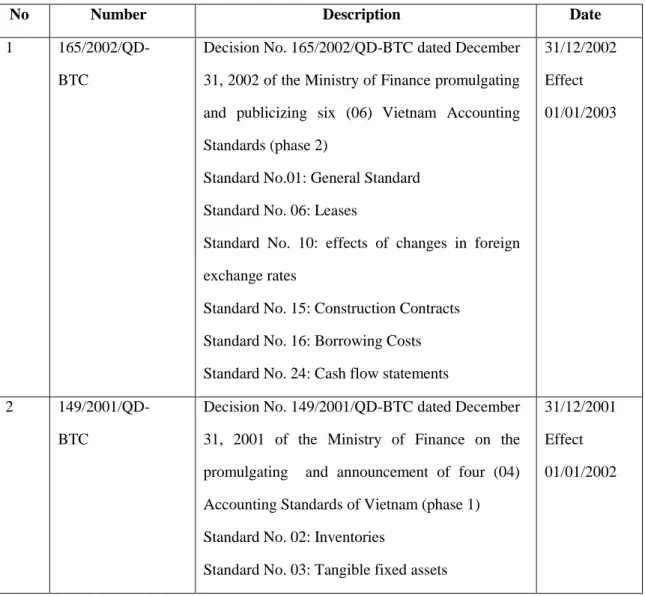
During WTO integration, Vietnam Government undertakes to promote improvement of Vietnam accounting system, including an engagement of completing a system of accounting norms that fits international rules. In the context, Ministry of Finance has investigated and promulgated step by step the Vietnam Accounting System (VAS). From 2001 to now, Vietnam has processed 5 stages with 26 standards. VAS generated a legal foundation for accounting, created an equal economy, cleaned up financial relationships and especially made international community recognize Vietnam’s integration
Table 3: Twenty six Vietnam Accounting Standards
No Number Description Date
1 165/2002/QD-BTC
Decision No. 165/2002/QD-BTC dated December 31, 2002 of the Ministry of Finance promulgating and publicizing six (06) Vietnam Accounting Standards (phase 2)
Standard No.01: General Standard Standard No. 06: Leases
Standard No. 10: effects of changes in foreign exchange rates
Standard No. 15: Construction Contracts Standard No. 16: Borrowing Costs Standard No. 24: Cash flow statements
31/12/2002 Effect 01/01/2003
2 149/2001/QD-BTC
Decision No. 149/2001/QD-BTC dated December 31, 2001 of the Ministry of Finance on the promulgating and announcement of four (04) Accounting Standards of Vietnam (phase 1) Standard No. 02: Inventories
Standard No. 03: Tangible fixed assets
31/12/2001 Effect 01/01/2002
14
Standard No. 04: Intangible fixed assets Standard No. 14: Turnover and other incomes 3
234/2003/QD-BTC
Decision No. 234/2003/QD-BTC dated December 30, 2003 of the Ministry of Finance on the issuance and publication of six Vietnam Standards on Accounting (Batch 3)
Standard No. 05: Investment Property
Standard No. 07: Accounting for investment in associates
Standard No. 08: Financial reporting of interest in joint ventures
Standard No. 21: Presentation of financial statements
Standard No. 25: Consolidated financial statement and accounting for investments in subsidiaries
Standard No. 26: Related parties transactions
30/12/2003 Effect 15/02/2004
4 100/2005/QD-BTC
Decision No. 100/2005/QD-BTC dated December 28, 2005 of the Ministry of Finance on the issuance and publication of four Vietnam Standards on Accounting (Batch 5)
Standard No. 10: Business Combination
Standard No. 18: Provisions, contingent assets and liabilities
Standard No. 19: Insurance Contract Standard No. 30: Earing per share
28/12/2005 Effect 05/02/2006
15
5 12/2005/QD-BTC Decision No. 12/2005/QD-BTC dated February 15, 2005 of the Ministry of Finance on the issuance and publication of six Vietnam Standards on Accounting (Batch 4)
Standard No. 17: Income Taxes
Standard No. 22: Disclosures in financial statements of banks and similar financial institutions
Standard No. 23: Events after balance sheet date Standard No. 27: Interim financial reporting Standard No. 28: Segment reporting
Standard No. 29: changes in accounting policies, accounting estimates and errors
15/02/2005 Effect 23/03/2005
(Source: Luatvietnam.vn)
Nowadays, Vietnam large-extent enterprises and organization are applying accounting system according to Decision No. 15/2006/QD-BTC dated March 20, 2006 of the Ministry of Finance on issuance Enterprise Accounting Regime, whereas middle and small businesses are using the one according to Decision No.48/2006/QD-BTC dated September 14, 2006 of the Ministry of Finance on issuance the Accounting Regime for small and Middle Enterprises.
The Vietnam accounting system has been built properly and consistently with international accounting standards in order to promote the integration process into the global economy.
1.2 The History and Development of Management Accounting in Vietnam.
Appearing since 19th century, management accounting was introduced into the curriculum of Master of Business Administration (MBA) students at both Harvard University and
16
MIT directly after World War II9. However, Vietnam enterprises have still paid inadequate attentions to the management accounting system. Term “Management Accounting” has just been accepted formally in Accounting Rules issued on June 17, 2003. So far, management accounting has not been considered as a formal system. In Vietnam, there have been no professional and experienced consultants for management accounting system. For enterprises, the management accounting seems still being a strange term.
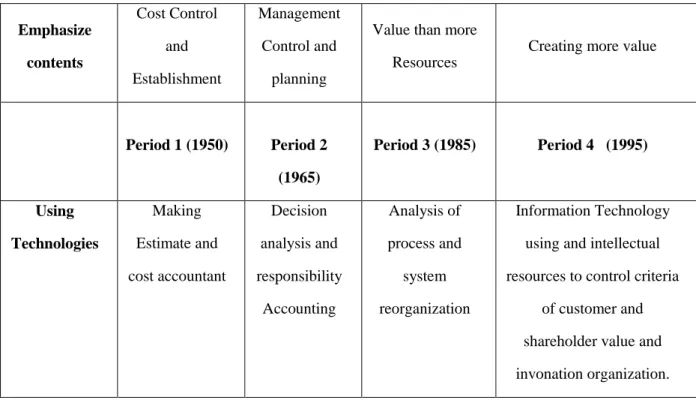
Development of management accounting system is shown in table 4.
Table 4: Evolvement outline of Management Accounting
Emphasize contents Cost Control and Establishment Management Control and planning
Value than more Resources
Creating more value
Period 1 (1950) Period 2 (1965) Period 3 (1985) Period 4 (1995) Using Technologies Making Estimate and cost accountant Decision analysis and responsibility Accounting Analysis of process and system reorganization Information Technology using and intellectual resources to control criteria
of customer and shareholder value and invonation organization. At the first stage, management accounting was considered as a technical action to gain the organization’s aims. Next stage, management accounting played a role as management action, but only was limited in executives who supported information for senior managers’ actions in planning and controlling. At stage 3 and 4, management accounting composed the management
9
The history and Development of Management Accounting
17
action. The target of management accounting is now to create further values for enterprises via using the best power. The values including:
- Added products, services of businesses for customers; - Value for shares of the business on stock markets.
To serve the manager’s target, a variety of tools are developed in modern management accounting including market-exploiting tools, tools for strategic planning, result-evaluating tools, tools of intellectual management and development.
Therefore, management accounting in developed nations has grown beyond its original form as a budget-estimating system. Late of 20 century, management accounting had huge steps to be an essential part of enterprise management. Modern management accounting is now developing in strategic way with strong support from informatics.
In the consistence with general development, management accounting in Vietnam appeared as budget estimating system and cost management at first. The planning method that was still simple and inaccurate started to be formed after 1985. In company with the development of private business, the need to planning of enterprises has also increased. There were several different planning methods existed among enterprises. Basically, planning methods are divided into two different ways:
- The first way relies on the growth. Enterprises often rely on the past development and figures to estimate the future implement. This method is now popular due to its easy-to-apply properties and relative accuracy. The manufacturers usually use this method.
- Whereas the second way focuses on the enterprises’ aim. The enterprises set a future target then make a plan to achieve it. This method is popular in service enterprises.
Almost enterprises do not focus on combination between two methods because of its complication in data process as well as poor informatics condition.
Management and cost monitoring system was also formed in order to meet the management needs of enterprises in company with planning system (forecasting unit). However, cost monitoring was limited within the estimation of some costly expenses such as: advertisement
18
cost, transport cost, salary … (selling cost); training cost, reception cost … (business management cost).
Through many years development, management accounting in Vietnam has served in planning and cost management, not yet created the extra value for enterprises. In general, the prevalent misunderstanding in contents and methods of management accounting has made many enterprises find difficult to apply. Subsequently, there have been no professional and experienced consultants in running management accounting system in Vietnam so far.
In June 12, 2006, circular 53/2006/TT-BTC of the Ministry of Finance was issued to guiding application of management accounting for enterprises.
General Major Contents of Circular 53/2006/TT-BTC
Management accounting includes collecting, processing, analyzing and providing financial, economic information based on management requests and financial decisions from internal accounting unit. (Accounting Law, Clause 3, Article 4).
Management accounting provides information of internal businesses of enterprise such as: expenditure for each department, each product; analyzing implement state; planning about sales, expense, profits; managing assets, material, debt and capital; analyzing the relation between expenditure and profit; choosing appropriate information for long term and short term decision making; … for purpose of economic management, detection and decision. Management accounting belongs to enterprises; the Government only gives instructions about principles and methods of management accounting.
The enterprise leaders and managers, who administer business, are the objects for management accounting information.
Enterprises are not required to disclose information about management accounting except otherwise provided by law.
Principles for management accounting establishment:
19
- The establishment can follow internal rules of enterprises targeting typical requirements for management
- Enterprises have full authority to decide application of accounting documents, organizing accounting system, details of the accounts, designing management accounting reports necessary for enterprises’ management accounting
- Enterprises can use all information, data from financial accounting for co-ordination with and serving management accounting
Tasks of management accounting in enterprises:
- To collect, analyze accounting information, data relied on management accounting extent; - To examine, monitor norms, standards and cost estimates;
- To provide information in management accounting forms to satisfy the need of internal management;
- To analyze information to serve the need of planning and decision making of enterprises leaders.
Basic Contents, Scope, Period of Management Accounting
Major contents of management accounting in enterprises comprise: - Management accounting of product cost and price; - Management accounting of selling and business results; - Analysis of relation between cost, volume and profits - Choosing appropriate information for decision making; - Estimating budget for production and business;
- Management accounting some other categories: o Management accounting of fixed asset; o Inventory management accounting ; o Labor and salary management accounting ; o Debt management accounting.
20
Additional to the major contents, enterprises are able to implement other contents in order to meet management requirements of enterprises.
Management Accounting Scope: is not limited and is decided by needs of enterprises about
management accounting information in all processes of production management, business, planning, monitoring, organizing, decision making and ability to organize the accounting management of each business.
Accounting Period: is often defined as month, quarter, and year like financial year. Enterprises
are allowed to decide a distinct accounting period (days, weeks or any period of time) that depend on their own requirements.
However, this circular, which stopped at perspective view, has not been a detail decision or a general implement guide. Therefore, Vietnam enterprises do not have clear understanding to apply it properly. At first, management accounting was introduced into Vietnam as the form of planning (budget estimation) and cost management.
In the large context of open economy, it is difficult for managers with their only experience to control and evaluate action of all departments in enterprise. Enterprises should diversify their products, broaden the range of activities to limit risks and create competitive power to foreign businesses. To avoid losing, Vietnam enterprises should right now head a long-term strategy of development and center management accounting as an essential tool in order to implement professional management.
2. Management Accounting in General Vietnam Enterprises.
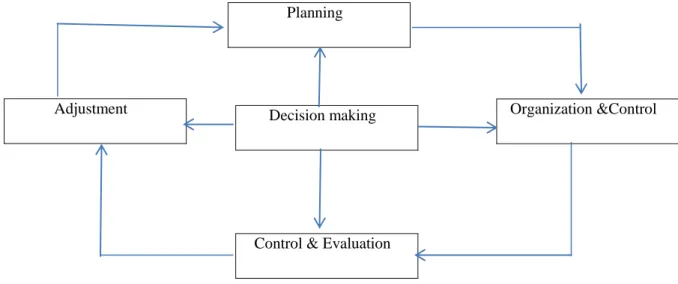
Success of an enterprise depends largely on the managers. Their management ability plays a decisive role in capita development. In general, management process is conducted as follows:
21
Figure 3. Process of Management Organization
Planning
The management process always targets the given aims: profits, growth, and quality and market share. It is time to see how management accounting supports the management process and how enterprise managers use it to run their business.
In general, enterprises management accounting system in their own way to meet their specific aims. The management accounting officers with their specialized knowledge interpreted the financial report’s facts and figures into meaningful messages by which managers can make punctual and appropriate decisions.
In Vietnam, enterprise management accounting system often exists in large companies, corporations or companies with foreign investment. Also, applied management accounting system is mainly mimicked foreign investors. In the small and middle enterprises, management accounting is conducted by financial accounting department under the order from directors or related managers.
Decision making
Adjustment Organization &Control
22
2.1 Management Accounting Practice in General Vietnam Enterprises.
2.1.1 Manufacture Enterprises
.The costing management accounting and cost are the most important parts of management accounting, and of course it was developed first in manufacture enterprises where costing and pricing are indispensable.
Manufacturers must design a detail data about product cost price at first. Product cost price comprises many categories of costing so it is essential for related department to tract the net cost of the each category during producing. The tracking reports are the basis for operating decisions in order to make an on-time adjustment in price ensuring product’s competitiveness. Managers implement the studies, trials then design a production process, finally calculate product price cost. However, workers directly perform manufacturing; they directly convert the planning and procedures into detail products. Consequently, worker should be considered as an important object to get management accounting information. However, this concept is hardly appriciated in Vietnam enterprises because of traditional thought and Estern customs in Vietnam culture.
The following are some examples about application practice of management accounting in Vietnam enterprises.
Foodinco Investment and Trading Joint Stock Group
Head office: 58 Bach Dang Street, Hai Chau District, Da Nang City, Vietnam Tel: (0511) 3822646, 3822418, 3810555
Fax: (0511) 3822459
Website: http://www.foodinco.vn ; http://www.foodinco.com.vn
Chater Capital: 9.000.000USD
Currently, FOODINCO has 16 units, branches directed under in the North-Central-South and 3 oversea branches (Laos, Ghana, and Ukraine)
Business Scope
23
- Construction of civil, industrial, transportation-irrigation works as well as construction of transformers 500 kV, transmission lines and power supply networks
- Manufacturing, trading, processing and import-export activities in food and agricultural-foresty produces, materials, fertilizers, steel, resins, chemicals, transportation’s machineries and equipments, construction materials, etc...
- Overseas and inland shipping agency and transportation, stevedore services - Investment in farming and plantation of staple and industrial crops in P.D.R. Laos
The organization of management accounting
Business characteristic effected organization of MA in FOODINCO:
Management accounting role is taken by the financial accounting department, in which the managerial accountant is combined with the general accountant. Managers do not directly monitor the production, the production units themselves calculate the product costing along the production norms without stress on improving. This clearly results in passive behaviors in finding new method to get better outputs and reduce costing as well. Consequently, products lack competitiveness and successful opportunity in the market is reduced.
It is diversified and many field business company, large scale (both domestic and foreign), the payments and debts problem were effected to the operation processes In the context of abundantly accrual debt, if managers only rely on financial accountant’s report which just tracking and update figures but lacking analysis, they are unable to understand actual state of each customer with any bad debt. Therefore it might be too late for managers to make appropriate adjustments in case of occurring bad debt. Company’s information was established quite fully, but just figures and estimates without analysis.
Currently, FOODINCO has done some work contents of management accounting as: Organization of management accounting books, making reports of management accounting and estimating. Enterprise have used financial accounting software that supports the management report, the reports should be made more quickly. However, FOODINCO not held its own management accounting, management accounting information primarily from information of the
24
array of financial accounting, but not yet combined with other departments. Accountant must to assume both financial and management accounting, there was be work overlapping efficiency is not high. About management accounting report: Report forms depend on the accounting software program should not express the autonomy and flexibility when need information. Moreover, the report forms just stop at providing information about the data, not just out and analyze some necessary information such as: risks, opportunities, and economic development potential…reflected in accounting numbers. The estimation was only established in terms of value and that isn’t association with other departments, so the information of estimation is limit.
Following is a Detailed Case of Management Accounting in a Newspaper Publisher:
Dat Viet Newspaper publishes mainly the daily newspaper and online press. The headquarter locates in Hanoi (Capital of Vietnam), representative branches present in Da Nang city (Middle of Vietnam) and Ho Chi Minh city (Southern of Vietnam). The accounting organization and system is table in accordance with Vietnam laws and regulations of the business, but don’t organize management accounting system. So, management accounting reports were made by finance accounting department. Editor-in-chief had a plan to broaden business by opening news representative offices in Hue city (Middle of Vietnam) and Can Tho city (due south of Vietnam). To make a decision, a mission for accounting department was to give appropriate information about financial state. At that time, monthly capital for Company action was constant, so the break-even point was considered to estimate plan.
Cost: was calculated based on using cost categories such as: office renting cost, labor, equipment, and other cost.
Sales: was based on previous selling data from accounting department and selling estimate from business department.
Whole data with detailed analysis was transfer to the Editor-in-chief. In 2009, two new offices were opened.
However, Company had got a financial trouble caused by a huge expense that was unable to compensate with sales. In addition, debt for providers increased quickly, while sales from the
25
two new offices did not achieve as expected. Major causes were identified: marketing result at two sites was poor, product quality was not as good as competitors but product cost was higher than competitor’s. If there was a good combination between information sources about accounting, market, competitors, the company might had been able to avoid the mistake.
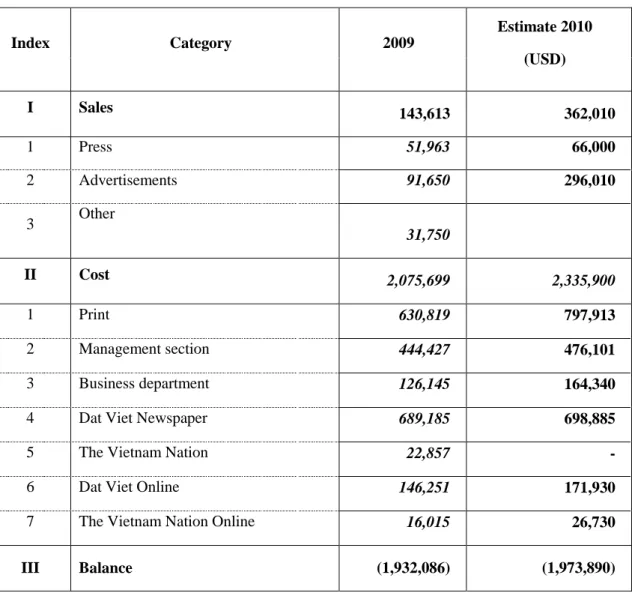
The company implemented management reports in monthly, quarterly, and yearly but just in expenditure estimating form(table 5).
Table 5: Business result in 2009 and estimate for 2010
Index Category 2009 Estimate 2010 (USD) I Sales 143,613 362,010 1 Press 51,963 66,000 2 Advertisements 91,650 296,010 3 Other 31,750 II Cost 2,075,699 2,335,900 1 Print 630,819 797,913 2 Management section 444,427 476,101 3 Business department 126,145 164,340
4 Dat Viet Newspaper 689,185 698,885
5 The Vietnam Nation 22,857 -
6 Dat Viet Online 146,251 171,930
7 The Vietnam Nation Online 16,015 26,730 III Balance (1,932,086) (1,973,890)
26
The company relied on net sales and costs of previous year to estimate future time din months, quarter and year for next year financial preparation. Information was summarized according to management objectives such as: Print, management section, Business Department cost. Management data however depended so much on financial accounting system that resulted in slow and inflexible flow of information. In this case, management accounting only stopped at planning. It was not appropriate and inefficient when the managers used this data to make investment decision for 2010.
2.1.2 Trade Enterprises.
For trading companies, selling and inventory management plays an important role. If managers rely on inventory management accounting information to make plan of stocking for upcoming business period, inventory amount would be decreased and inventory costing is also reduced. Like other enterprise forms, management accountants of trading companies have to update regularly the selling price to stand ahead in competition. As in addition to trade name and after-sales service, price is a decisive factor for customers to buy a product. All information such as changing in price, foreign currency exchange rate… therefore needs updating by management accounting unit in order to report punctually to managers.
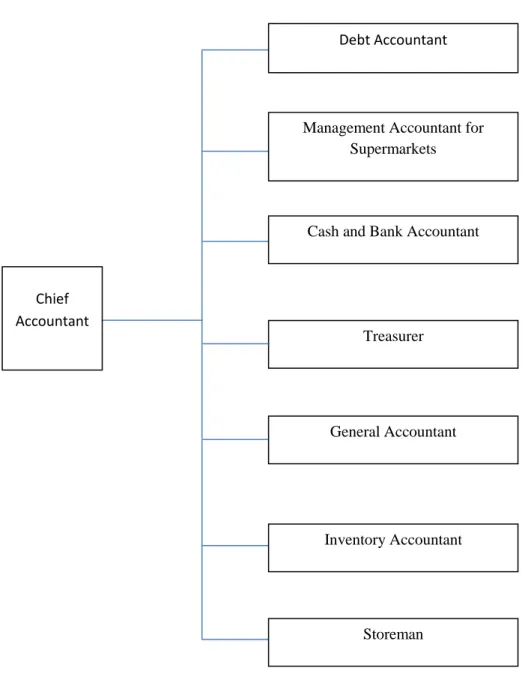
Medicare Ltd., established in 1991 in Ho Chi Minh City, possessed a series of retail system to business health-caring product, beauty and personal caring system.
27
Figure 4: Accounting system
In this accounting mode, chief accountant takes charge of all financial activities in company. This is a complete system for financial accounting but not for management accounting
Debt Accountant
Management Accountant for Supermarkets Cash and Bank Accountant
Treasurer General Accountant Inventory Accountant Storeman Chief Accountant
28
because of lacking an officer who specializes in management accounting. Apparently, managers do not take enough care about management accounting.
However there is no presence of management accounting department in company. Detailed reports on sales, costs are made by financial accounting department. In addition, when managers want to make a business decision, information basis is supplied by financial accounting department.
The company is now using two separated accounting software SALOMON IV 4.5 and ADVANCE RETAIL.
- SALOMON IV 4.5 is an international, professional ERP10
method applied for small and medium businesses in many countries in the world. Due to saving costing, the company only buys some modules that serve some accounting work including: payment management – AP module; main book management – GL module, cash management – CA module. Consequently, the software is unable to serve as an optimized ERP method.
- ADVANCE RETAILis a tool for retail business. The company uses this software to make order forms, to track and to check input material stocking; to monitor selling via money-calculating machine system POS (Point of Sales), to control retail sales from supermarket systems, to adjust inventories.
10
ERP: Enterprise Resource Planning – Enterprise Resource Planning (ERP) is the latest high end software solution, Information Technology has lent to the world of business application. An ERP software solution seeks to streamline and integrate operations, processes and information flows in an enterprise, to synergize the resources of an organization namely men, material, money and machine. In other words, ERP systems integrate all data and processes of an organization into a unified system. A typical ERP will use multiple components of computer software and hardware to achieve the integration. A key ingredient of most ERP systems is the use of a unified database to store data for the various system modules
29
The company is now using two software sets in separate. SALOMON IV 4.5 functions as a financial tool while ADVANCE RETAIL plays a role as a tool for selling and accounting support. In case of combination, these two software sets might support a powerful tool for management accounting work. Apparently, the company is omitting a valuable tool from lack of interest in management accounting
2.1.3 Service Enterprises
A successful manager is the man who is able to analyze and combine information from various sources in the most appropriate way. Among various types of information, management accounting information emerges as one of the most important parts that any manager needs to understand it.
Viettel group11, one of two major enterprises in Vietnam telecom industry, is ranked at 24/772 telecom service supply in the world by Wireless Intelligence organization. In 2011, Viettel reached profits of near $1 bilion. The success of Viettel firstly comes not only from the appropriate motto “customer is first” but also from the profession in accounting operation. Viettel accounting system comprises financial accounting system and management accounting system. Based on enterprise’s objectives, management accounting department combines with others in order to collect and analyze information about various aspects such as: internal problems, competitor’s policies, relationship of sales-volume-profits… that is solid basis for managers to be able to make appropriate strategies for short-term as well as long-term business.
11Viettel Group is one of the world’s fastest growing telecom operators owning the largest telecom
network in Indochina featuring 56,000 GSM Stations (2G BTS and 3G Node B) and 200,000 km of fiber optical cable. Viettel’s global operations cover 6 countries with a total population of approximately 170 million people, including Vietnam, Cambodia, Laos, Haiti, Mozambique and Peru.
30
With the guideline “customer is first”, Viettel has built a series of policy that centers customer’s comfortable feelings such as focusing on after-sales service, changing calculation, create various service set suitable for different groups of customer… These generated successfully a friendly and honest image of company to customers
A combination between the internal stability based on efficient management accounting system and optimized policies about customer caring raises Viettel to become one of the most successful enterprises in Vietnam. Clearly, Viettel is a wonderful model about successful application of management accounting in business.
Another example that should be covered here is about Vietnam Price JSC, an electronic trading company, which established in 2007. Major services include banner advertisement, guarantee spaces, VIP spaces, SEO (Search Engine Optimization), and other online services. Management accounting work is performed by board of directors, not by an independent management accounting department. All related accounting information is reported by financial accounting department. Again, with the motto “Customer is God”, managers intentionally make decisions focused on customer’s sastifiction. On the other hand, manager also center on development of human resource and create the most comfortable working environment for labours. Today, Vietnam Price JSC is one of the largest companies in online trading in Vietnam (website: http://www.vatgia.com).
However, these examples belong to the minority of Vietnam enterprise that apply professionally and successfully management accounting concept. The most of small and medium enterprises hardly use management accounting knowledge in business. Instead, management reports are performed by financial accountants who extract data from financial accounting software and subsequently customize upon the manager’s request.
31
2.2. General Evaluation about Management Accounting Application in
General Vietnam Enterprises
2.2.1 Perception of Management Accounting
About the role of management accounting in business, most of the enterprises agree that management accounting is primary resource to provide the essential information for managers in the process of analysis, information processing, project choice, and business decision making. However, that opinion is only popular in the chief accountants or the operators, managers, but not accountants. Specially, there are accountants with the opinion that: “Management accounting is unnecessary because there is financial accounting”. Moreover, a number of chief accountants think that production cost management accounting does not support much for administrators to control and reduce costs as well as to determine the most beneficial price.
Enterprises are different in products, production processes; labor conditions and material resource, there have different perceptions about decisive determinants of management accounting. Through surveys, 100% respondents said the most important factor is the board must to take the lead in the role and content perception of management accounting. In addition, businesses also say that there are many other factors which decide production and management accounting. Without this factor, the enterprise may be unnecessary to build management accounting12. That opinion, with a economic system, there are 93% small and middle enterprises, how is develop? And when give a position in the international market.
2.2.2 Modes of Management Accounting
Currently, management accounting in Vietnam is performed in two major forms: (1) a specialized unit takes charge of every work of management accounting or (2) no independent
12
Minh Tam - The Journal of Science of Vietnam National University, Hanoi: Business and economic 26, 2010: 245-255
32
management accounting department is formed, management accounting is performed as combination with financial accounting at accounting department.
In the first form, the independent unit performes all processes of management accounting such as costing, sales, product costing, profits management. This department also collects and analyzes internal and external information (product price costing, human resource, tradename as internal information and competitors, suppliers, clients as external information) to report and consult managers about business decision making. Because of the specialization, information is supported with high accuracy and punctuality. However, this mode almost applied in large enterprises and corporations
.
Second, combining model between management accounting and finance accounting, management accounting informations will be made upon request of the board of directors. With the model, the accounting department can only make good financial and accounting action, but it is difficult to achieve good management accounting field, because accountant is inability to perform management or have knowledge but not enough time to do the both. The Small and medium enterprises often apply this model, in here the managers have to guide and orient for accounting deparment to apply. Thus, if managers have not knowledge about management accounting but orient follow experience of yourself, that decisions just waiting to change their luck, or success or failure. That is one reason why there are many small and medium enterprises is shut down and bankrupt.
2.2.3 Contents
Contents: For the enterprises which have their management system relied on the base of the
partial specialization, management-controlled each activity, the contents of its management
accounting (MA) are organized towards supplying the quantitative information related to
financial and economic situation from each specialized part in order to use for serving formation, implementation, inspection and decision controlled by manager by unit. For the enterprises which
33
have the management system relied on the base of the process from each activity (included the all steps and departments as: product research and development, production, services, design, process of production, marketing, distribution, following distribution of services), the content of MA are built towards providing the quantitative information related to financial and economic situation from each activity in order to use for serving formation, organization, coordinated implementation, and effective evaluation from each processing group.
The Cost
Most enterprises only use cost classification along the categories in financial report. This method is relatively clear, plain and easy to implement.
For manufatures, production cost comprises direct material cost, direct labor cost and common production cost. The others that classify costs based on cost’s behavior (fixed cost, variable cost, mixed cost) or manager’s aims are unable to build a cost-volume-profit business model. There are many businesses that apply cost classification based on variable and fixed cost such as Kim Son Ltd., Chau A Linh Ltd., Hien Linh Construction Ltd., Electronics and Telecommunications Technology JSC, Takasima Construction investment and trade mark development JSC … They are however limited to common production costs. Also, Construction and Industrial Instruments Corporation JSC only uses cost’s behavior classification while CTC JSC classifies cost based on selling costs, business management costs. In these cases, enterprises are unable to identify exactly breakeven point. In this context, some enterprises are aware to apply the classification based on cost behavior (e.g. Construction and Material Trading JSC).
In Son Ha JSC, the management accounting department also classifies costs based on business aims that help managers to have basis for appropriate decision making. In addition, hidden costs, opportunity costs are sometimes considered when choosing business plan at several enterprises such as Construction and Material Trading JSC, COVICO Company… Generally,
34
aim-based classification method is the most difficult but it support managers most in cost controlling to achieve business aims13.
For trade and service enterprise cost management and control according to the items business characteristic of each company, for example, costs and sales for each group of goods, services, management costs for each branch,…
Period, Account of Using: Management accounting organized is responsible for providing
information quickly and in time. Period of Management accounting is per month, quarter, and year. So the short management accounting goes on managers could be satisfied. And account of management accounting: Almost, enterprises do not use the management accounting account system for the independent management accounting but still use the currently finance accounting account and particularly detail their properties in comparison with Finance Accounting.
Report Systems
Currently, Management accounting does not have a general provision regarding the form and contents of the report, whose business depend on production characteristics of their business that make the enterprise’s own regulations. Large companies, corporations, and other organization with foreign element have unified management software, but the most small and medium enterprises apply financial accounting software. Therefore, the management accounting information is not flexible. Mainly, Focus for financial reports to achieve the best financial reporting, reduce the tax payable, and deal with the audit firm.
13
The current status of expense and pricing management in several production enterprises in Hanoi – Nguyen Thi Minh Tam: Faculty of finance and Banking, University of Economic and Business, Vietnam National University, Ha noi, 144 Xuan thuy, Cau Giay, Ha noi, Vietnam
35
2.2.4 Estimate
Cost norms (standard costs) for a product unit, a performance, an action… are made by combining between accounting unit and experienced officers. Almost enterprises have specific rules about norms for a relation unit.
It seems that the business cost estimate does not gain enough interests from enterprises in Vietnam. Business budget estimate is usually built for a year then divided into quarters, months. The popular estimates comprise general production cost, selling cost, business management cost.
For manufactures, the cost and product price estimates are even ignored at some companies or the cost and product price estimate is built in case of manager’s requirement. The cost estimate at a unique performance makes enterprises find difficult to be aware of their cost, profit if any change in production. Building cost estimate at a certain level of production leads identifying cost price of a product at a certain level. This makes enterprise managers to determine competitive price or tender price at any time in business. Estimates play an important role in helping enterprises evaluate the net achieves in order to make appropriate adjustments. Management system and cost monitoring system are thus formed to satisfy the need of enterprises in company with planning system (estimates). Because general production cost is a complicate and sensitive category of cost price, it is tightly managed by enterprises in order to reduce product cost price. However, other categories of cost are still not taken into account except to several costly and high-proportion sections such as advertisement costs, transport costs, salary, reception costs, training costs…
For Trade and service enterprises, almost enterprises control and estimate the sales and business management, because it is basic information for building of price policy, but it only operated in internal information in company. Price policy is usually built for six months or a year, if there is variable from outside such as: inflation, increase price of material… increase sale price of goods and services, while there are many companies have signed contracts with a period price, and of course will lose opportunities for above variation.
36
2.2.5 Relationship in Information Supply between Enterprise Departments
In a market economy with lots of competitors, enterprises must have fast and accurate information to make decisions in time and avoid missing any opportunities in business. Many enterprises in fact take care about building an internal information system, but they find trouble to organize it. The current information system of enterprises is not able to meet the need of information for cost management. Generally, information supply and analysis are still not consistent and not punctual due to the lack of an independently organized management accounting department. There no tight combination among departments in implement of a business strategy. On the contrary, their action is still passively based on orders or requests from managers. Information is therefore not supplied punctually and appropriately.
2.2.6 Research Method
Almost enterprises gather information in management accounting from economic magazines or internet source such as in accounting field and. Yet, there are not many websites posted the necessary information, or even some of the contents are identical with another (webketoan.com, tapchiketoan.com, …). Furthermore, some enterprises actively give a chance to accountant- responsible worker to attend into the training courses for improving the skills of management accounting. Some enterprises search information via their clients and contacts and businesses with partners. This suggests that businesses have recognized the importance of Management accounting, and look forward to building management accounting system in the enterprises.