- 17 - [Original Article] Received August 16, 2018 Revised October 25, 2018 Accepted November 30, 2018 †Corresponding author ([email protected]) ORCID Eunah Yoh http://orcid.org/0000-0003-2894-0283
Teasing from Parents and Siblings about Appearance
Affecting Body Satisfaction and Self-Esteem of Middle
School Students
Eunah Yoh
Dept. of Fashion Marketing, Keimyung University, Korea
Abstract
In this study, it is explored whether teasing from parents and siblings about appearance of children affects body satisfaction and self-esteem of middle school students. A total of 594 adolescents participated in the survey and the causal model was tested with the data. In results, parents’ and siblings’ teasing was significantly correlated. Parents’ and siblings’ teasing significantly affected body satisfaction that showed a significant impact on self-esteem. In the mean comparison by gender, female adolescents suffered more from parents’ as well as siblings’ teasing on appearance than did male adolescents. Female adolescents indicated lower body satisfaction than male adolescents whereas no gender difference was found in self-esteem. In the multiple-model comparison, both the parents’ and siblings’ teasing about appearance affected body satisfaction of female adolescents while only siblings’ teasing affected body satisfaction of male adolescents. The results indicate that female adolescents are more likely to be exposed to parents’ and siblings’ teasing about appearance at home than male adolescents, resulting in negative body satisfaction that is influencing self-esteem. The finding could be used as a basis for family education, calling for an attention to this issue.
Keywords: appearance, body satisfaction, family, self-esteem, teasing
I. Introduction
Social support is essential for people to fulfill their desires for social recognition and to become better adapted to society (Chai & Lee, 2011). In the case of adolescents, sources of social support tend to be limited to their parents, friends, and teachers (Koh, 2006). Social support from these people help adolescents to feel respected and to endure difficulties that they may encounter in their lives (Koh, 2006). Adolescents grow and progress with social support from family members. As adolescents start to build more in-depth relationships with significant others, they develop a sense of closeness, pleasure, psychological stability, and sociality (Chung, 2005). Among significant others, family members have seldom been considered as influencers on adolescents’ body satisfaction in prior research.
Appearance significantly affects impression formation of people. Sometimes,
appearance takes priority over a person’s capability in personal evaluations. Adolescents are significantly affected by others as they form their self-concepts and as they experience physical changes during puberty (Harter, 1999). According to the ‘2016 Youth Discrimination Status Research’ conducted with 10,450 adolescents by the National Youth Policy Institute, South Korean adolescents perceive discrimination in their daily lives primarily due to their appearance and academic abilities (Kim, 2017). Specifically, out of all age groups of adolescents, middle school students reported feeling discrimination most seriously due to appearance. Richards, Casper, and Larson (1990) also found that 12-15-year-old adolescents in middle school are more easily dissatisfied with their bodies, resulting in a negative effect on their self-esteem and their relationships with others, compared to older groups of adolescents. Research has shown that it is in these years in which negative emotions grow and self-esteem decreases without social support from significant others (Kong, 2009; Oh & Kim, 2011).
In prior studies supporting the positive relationship between body satisfaction and social support, body satisfaction was greater as social support was more readily perceived (Jeon, 2006; Song, 2009). Adolescents who are highly satisfied with their bodies are likely to receive positive attention from others, resulting in an increase of self-esteem. In the previous exploratory findings, self-evaluations on one’s weight among female students in middle school directly affect self-evaluations of their appearance which in turn crucially influence their self-esteem (Lee, 2012).
Family members are an important reference group affecting all aspects of the lives of adolescents. Family members, as the most proximate relationships for adolescents in society, deliver, translate, and mediate socio-cultural messages about body image to adolescents (Haworth-Hoeppner, 2000). In an exploratory study about South Korean adolescents, the effect of family support on satisfaction with appearance was found, while the effect of teacher and friend supports were not confirmed (Oh & Kim, 2011). As more parents have a tendency to have only a few children, they are likely to pay more attention to and exert an influence on diverse aspects of their children’s development.
Ata, Ludden, and Laily (2007) claimed that criticism, more than support, from family members severely influence body image among adolescents. Body satisfaction among adolescents decreases if there is a lack of positive feedback or they are exposed to teasing at home related to their appearance. Teasing among family members has often been considered insignificant so only a few studies have been devoted to this issue. However, teasing on appearance occurs very often and repeatedly at home. Teasing on appearance leads to body dissatisfaction and eating disorders (Eisenberg, Neumark-Sztainer, & Story, 2003). Family teasing on appearance was also found to negatively affect body satisfaction and self-esteem (Keery, Boutelle, Van den Berg, & Thompson, 2005). Besides of a few studies, little attention was paid on the issue of family teasing. There has been no study focusing on this issue with Korean samples. In the following research, a causal relationship among family members’ teasing about appearance, body satisfaction, and self-esteem is explored with South Korean middle school adolescents. Furthermore, gender differences in the relationships among research variables are explored. The results may provide a basic source of information for educating families to help strengthen positive emotions of adolescents through positive communication within the family about appearance, calling more attentions to this issue.
II. Literature Review
1. Teasing about AppearanceAdolescence is a transitional stage of physical and psychological development and is usually associated with the teenage years (“Adolescence”, n.d.). During this period, adolescents build their own self-concepts and self-identity (Kim & Choi, 2005). As adolescents perceive the distance between the ideal-self and the real-self, they feel an anxiety about their appearance and a need for acceptance from others to relieve their anxiety (Jeon & Han, 1998). If adolescents are often exposed to negative responses regarding their appearance, they are likely to have negative emotions (Lee, 2009).
Parents’ evaluations of physical appearance of their children are closely tied to the relationship between parents and children (Kang, 2003). Parents have a propensity to more positively think the body image of their children than do children. Geller, Srikameswaran, Zaitsoff, Cockell, and Poole (2003) found that children’s body images assessed by parents were more positive than those reported by themselves. Consequently, parents may more easily criticize their children’s bodies since they may not know how sensitive their children are to talking directly about their bodies, nor how negatively they think about their own bodies (Park, 2008). As family members’ criticism is often given to children, children’s positive body image decreases (Park, 2008). Conversely, body satisfaction increases as parents respect their children in terms of their own opinions of their appearance (Han & Lee, 2008).
Eisenberg et al. (2003) stated that parents and siblings often tease their children and siblings about their appearance, evoking negative emotions for the recipients. According to their survey conducted with 4,746 adolescents in the US, 28.7% of female adolescents and 16.1% of male adolescents were suffering from family members’ teasing about their body weight, causing body dissatisfaction and low self-esteem. This result called attention to the issue of teasing among family members, which had not been seriously considered as an important factor before. Another empirical study supports the claim that teasing from family members about children’s appearance negatively affects body satisfaction and self-esteem of children (Keery et al., 2005).
According to a study exploring female university students’ recollections of their adolescence (Rieves & Cash, 1996), 19% of respondents were negatively affected by comparisons made with their (self-described) better looking siblings, while 18% of respondents were positively affected by comparisons with their (self-described) worse looking siblings. Jones, Vigfusdottir, and Lee (2004) stated that teasing and criticism of appearance among family members often take place, resulting in higher dissatisfaction in recipients’ appearance. Gender did not play a role in terms of the frequency of parents’ criticism about their children’s appearance (Phares, Steinberg, & Thompson, 2004). However, there is research (Schwartz, Phares, Tantleff-Dunn, & Thompson, 1999) that has found that fathers have a tendency to more negatively respond to their sons’ than their daughters’ appearance. Usually, parents’ criticism about their children’s body directly and indirectly reinforces siblings’ criticism (Keery et al., 2005), making teasing among family members to likely become more severe as time goes on. Research hypotheses based on the literature are as follows:
H1: Body satisfaction will be lower as the level of parents’ teasing about their appearance is higher. H2: Body satisfaction will be lower as the level of siblings’ teasing about their appearance is higher.
2. Effect of Body Satisfaction on Self-Esteem
Body satisfaction, which is the level of satisfaction of diverse body parts, differs from socio-cultural standards of a given time period (Jeon, 2006). Since adolescents have strong desires to obtain others’ recognition through their appearance rather than internal characteristics, they are much more interested in their appearance (Shin & Cheon, 2008). People tend to have a low level of body satisfaction during their adolescence (Lee, 2005). Wilkosz, Chen, Kenndey, and Rankin (2011) found that 24% of female adolescents and 22% of male adolescents are dissatisfied with their bodies. Adolescents have a tendency to have positive relationships with friends and teachers if adolescents perceive that their bodies are attractive (Jovanovic, Lerner, & Lerner, 1989). People live with confidence and initiative when they have a high level of body satisfaction, whereas people tend to be inactive in personal relationships when having a low level of body satisfaction (Jo, 2011).
Self-esteem, which is an evaluation of one’s own values, reflects how favorably and respectfully an individual perceives him- or herself (Rosenberg, 2016). People who have a high level of self-esteem are likely to solve diverse problems more actively and have positive emotions about themselves, whereas people who have a low level of self-esteem tend to have difficulty being energetically involved with activities and building positive relationships with others (Richter & Ridout, 2011). Adolescents develop their self-esteem through positive relationships with others (Elias, 1989). When having positive attitudes toward and being satisfied with their bodies, people have a higher level of self-esteem; if they are not satisfied with their bodies, they have a low level of self-esteem. In a study focusing on elementary school students, satisfaction with appearance significantly affected self-esteem (Jo, 2011). Empirical findings have also shown that satisfaction with appearance affected self-esteem of adolescents (Choi, 2015; Son & Moon, 2010). The hypothesis based on this literature is as follows:
H3: Self-esteem will be lower as body satisfaction is lower.
3. Gender Difference in Relationships among Research Variables
Criterion for the ideal body type is formed through the socialization process, including internalizing aesthetic values in society. Social values about and responses toward appearance can differ by gender (Sung & Park, 2009). Female adolescents usually have lower satisfaction with their bodies than male adolescents since females have a higher standard for the ideal body type than males do. Shin and Cheon (2008) reported through a survey with 469 middle school students that female adolescents have a higher interest in their appearance while having a lower body satisfaction than male adolescents do. Kantanista, Osinski, Borowiec, Tomczak, and Krol-Zielinska (2015) also reported through a survey with more than 1500 adolescents between the ages of 14 and 16 that females indicated a more negative body image than males did. Generally, males tend to perceive their bodies through focusing on functional aspects, whereas females tend to perceive their bodies through focusing on aesthetic aspects. Therefore, females may be more dissatisfied with their bodies that do not reach the ideal beauty standard set by society (Lim, 2002). In addition, there is research (Lubans & Cliff, 2011) which explains that an increase in fatty tissue and BMI (Body Mass Index) leads to a negative body image. In order to reduce dissatisfaction with one’s body image, female adolescents tend to value and consider weight loss and plastic surgery procedures more than male adolescents do (Kim, 2014).
Furthermore, female adolescents feel more pressure from family members regarding their appearance than male adolescents do. Eisenberg et al. (2003) found that 14.1% of female adolescents reported their experiences of family members teasing about their appearance, whereas only 6.5% of male adolescents reported such experiences in a survey. Traditionally, norms and expectations for favorable appearance were stricter for women than for men; therefore, females are socialized to seek and maintain a more favorable body type (McKinley & Hyde, 1996). Family members’ teasing about appearance may lead to a decrease in body satisfaction. Eisenberg et al. (2003) also found that middle school students who suffer from more teasing about their weight tend to have low self-esteem.
Prior findings of gender difference in the relationship between body satisfaction and self-esteem were inconsistent. In a study, a positive relationship between satisfaction with appearance and self-esteem was stronger in male adolescents than in female adolescents (Chung & Lee, 2011). On the other hand, Park (2008) found that the correlation between body image and self-esteem was stronger for female adolescents than male adolescents. Other than these studies, there has been little effort to discover gender relationships in the causal relationships among family members’ teasing about appearance, body satisfaction, and self-esteem of adolescents. It will be explored whether there is a gender difference in the causal relationships among research variables. The hypothesis based on this literature is as follows:
H4: There is a gender difference in the causal relationships among family members’ teasing, body satisfaction, and self-esteem.
III. Research Method
Students who agreed to participate in a survey from a middle school in Daegu, South Korea, were recruited with permission from the school administrator. Only students who have siblings participated in the survey. In total, 594 students (190 males and 404 females) completed a questionnaire. Middle school students were considered the appropriate age group for this study since they tend to be much more interested in their appearance and have abilities to assess their own body satisfaction and self-esteem than members of other age groups (Shin & Cheon, 2008).
Referring to Eisenberg et al. (2003), parents’ teasing about appearance was assessed by three items (“My parents often comment and tease about my appearance”, “My parents often point out the negative aspects of my appearance”, and “My parents often offensively comment on my appearance”). Siblings’ teasing about appearance was also assessed by three items (“My siblings often comment and tease about my appearance”, “My siblings often point out the negative aspects of my appearance”, and “My siblings often offensively comment on my appearance”). Self-esteem was assessed with 10 items from Rosenberg (2016). Body satisfaction was assessed with six items (“How much are you satisfied with your face, body shape, waist, thigh, height, and obesity?”), referring to Garner, Olmstead, and Polivy (1983). These items were measured on a 6-point Likert scale, from ‘very unlikely (1)’ to ‘very likely (6)’. In addition, demographic factors such as gender, the social economic status level of the household, and the academic achievement level were assessed with nominal scales. For analysis, descriptive statistics, t-tests, exploratory and confirmatory factor analyses, and structural equation modeling with AMOS were used.
Regarding demographic characteristics of respondents, there were more females (68%) than males (32%). The first-grade students comprised 43.4% (N=258) of all middle school students surveyed, the second-grade students
comprised 48.8% (N=290), and the third-grade students comprised 7.7% (N=46). Social economic status of the students’ households was categorized as low (N=34, 5.7%), middle (N=478, 80.5%), and high (N=82, 13.8%). Academic achievement level was categorized as low (N=127, 21.4%), middle (N=337, 56.7%), and high (N=130, 21.9%). There was no gender difference in social economic status or academic achievement.
IV. Results
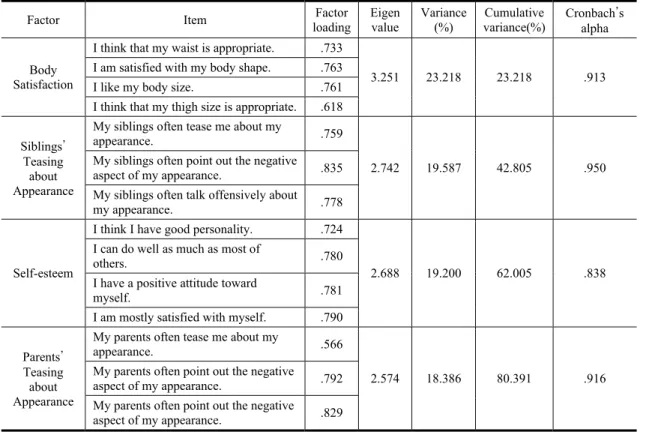
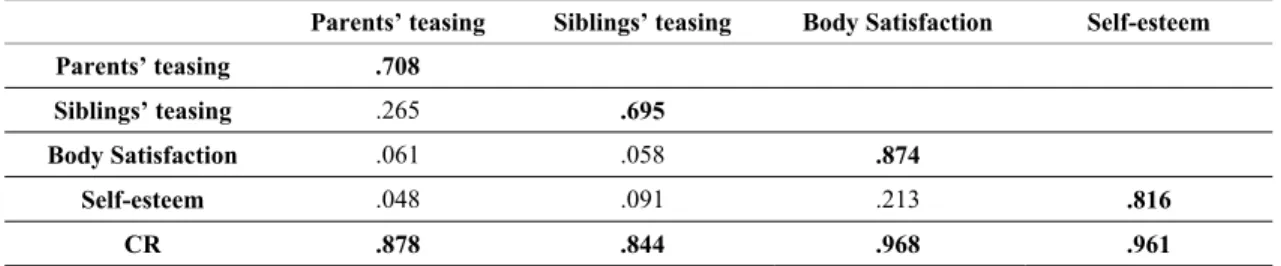
1. Exploratory Factor Analysis and Gender Differences in MeansThe results of exploratory factor analysis generated four factors: parents’ teasing about appearance, siblings’ teasing about appearance, body satisfaction, and self-esteem. Factor loadings were between .618 and .835 while eigen values were between 2.574 and 3.251. Cronbach’s alphas exceeded .80 for four factors. (Table 1) Confirmatory factor analysis was conducted before the model test (Table 2). Model test results had the Q value (CMIN/DF) at nearly 3, while CFI and IFI were above .90 and RMSEA was below 1.0. CR values of all the paths were above 2.0, confirming the appropriate fit of the model. In order to check discriminant validity of measures, AVE was calculated. The AVE scores exceeding squared correlations confirmed validity of the measures. (Table 3)
Table 1. Exploratory factor analysis results
Factor Item loadingFactor Eigenvalue Variance(%) variance(%)Cumulative Cronbach’s alpha
Body Satisfaction
I think that my waist is appropriate. .733
3.251 23.218 23.218 .913 I am satisfied with my body shape. .763
I like my body size. .761 I think that my thigh size is appropriate. .618
Siblings’ Teasing about Appearance
My siblings often tease me about my
appearance. .759
2.742 19.587 42.805 .950 My siblings often point out the negative
aspect of my appearance. .835 My siblings often talk offensively about
my appearance. .778
Self-esteem
I think I have good personality. .724
2.688 19.200 62.005 .838 I can do well as much as most of
others. .780
I have a positive attitude toward
myself. .781
I am mostly satisfied with myself. .790
Parents’ Teasing about Appearance
My parents often tease me about my
appearance. .566
2.574 18.386 80.391 .916 My parents often point out the negative
aspect of my appearance. .792 My parents often point out the negative aspect of my appearance. .829
Table 2. Confirmatory factor analysis results
Path Standard estimate Standard error (p-value) C.R. Fit Parents’ Teasing1 ← Parents’ Teasing .885 - -
χ2=219.105 df=71 CMIN/df=3.086 IFI=.977 TLI=.971 CFI=.977 RMSEA=.059 Parents’ Teasing2 ← Parents’ Teasing .899 .036 30.070***(.000)
Parents’ Teasing3 ← Parents’ Teasing .873 .036 28.798***(.000)
Siblings’ Teasing1 ← Siblings’ Teasing .960 - - Siblings’ Teasing2 ← Siblings’ Teasing .942 .019 48.077*** (.000)
Siblings’ Teasing3 ← Siblings’ Teasing .899 .026 40.614*** (.000)
Body Satisfaction1 ← Body Satisfaction .698 - - Body Satisfaction2 ← Body Satisfaction .932 .066 21.313*** (.000)
Body Satisfaction3 ← Body Satisfaction .934 .065 21.354*** (.000)
Body Satisfaction4 ← Body Satisfaction .833 .066 19.260*** (.000)
Self-esteem1 ← Self-esteem .938 - - Self-esteem2 ← Self-esteem .880 .034 28.205*** (.000)
Self-esteem3 ← Self-esteem .604 .040 16.434*** (.000)
Self-esteem4 ← Self-esteem .550 .039 14.533*** (.000)
Table 3. AVE and squared correlations of research variables
Parents’ teasing Siblings’ teasing Body Satisfaction Self-esteem
Parents’ teasing .708
Siblings’ teasing .265 .695
Body Satisfaction .061 .058 .874
Self-esteem .048 .091 .213 .816
CR .878 .844 .968 .961
AVE values were indicated in diagonal lines.
Squared correlations between variables were indicated under diagonal lines.
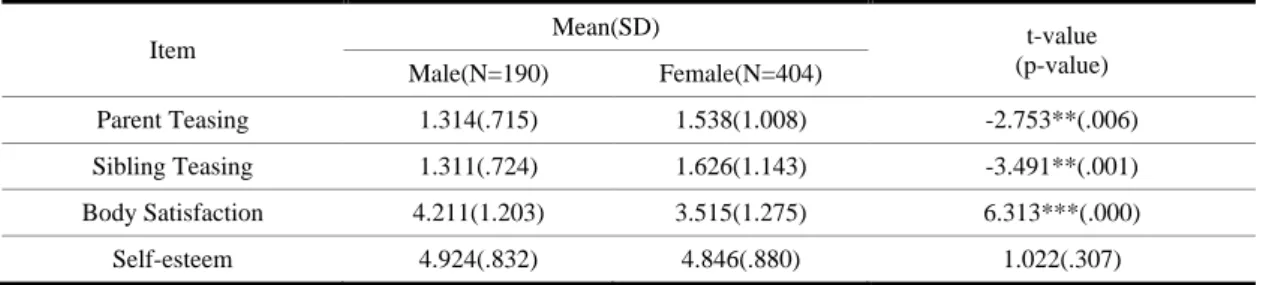
Before testing the research hypotheses, gender differences in the mean of research variables were examined (Table 4). Female students suffered more from parents’ (p<.01) and siblings’ (p<.01) teasing about appearance than male students did. It is consistent with prior findings that female students perceive more family pressure about appearance than male students do (Kim, 2014). In addition, female adolescents showed lower body satisfaction than male adolescents did (p<.001). This result is consistent with prior research (Kantanista et al., 2015), finding that female adolescents have a more negative body image than male adolescents do. There was no gender difference regarding self-esteem, which is not consistent with previous findings that female students showed higher self-esteem than did male students did (Kim, Kim, & Kim, 2002; Kling, Hyde, Showers, & Buswell, 1999).
Table 4. Gender differences in research variables
Item Mean(SD) t-value
(p-value) Male(N=190) Female(N=404) Parent Teasing 1.314(.715) 1.538(1.008) -2.753**(.006) Sibling Teasing 1.311(.724) 1.626(1.143) -3.491**(.001) Body Satisfaction 4.211(1.203) 3.515(1.275) 6.313***(.000) Self-esteem 4.924(.832) 4.846(.880) 1.022(.307)
2. Test of Research Hypotheses
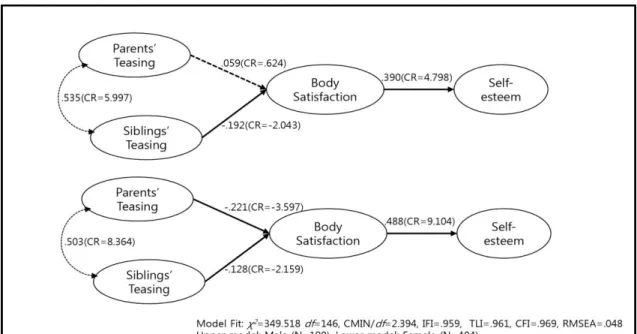
Structural equation modeling was conducted using AMOS to test research hypotheses (Figure 2). Parents’ teasing and sibling’s teasing about children’s appearance showed significant correlations, consistent with previous findings on middle school students in the US (Schaefer & Blodgett Salafia, 2014). In the causal relationships, both the parents’ teasing (p<.01) and siblings’ teasing (p<.01) about appearance of middle school students negatively affected their body satisfaction (p<.01). Body satisfaction positively affected their self-esteem (p<.001). Based on these results, hypotheses 1, 2, and 3 were accepted (Figure 1).
Figure 1. Causal relationships among research variables
In the next step, multi-group comparison analysis was conducted to explore gender difference in the relationships among research variables. For the male model, parents’ teasing about appearance did not affect body satisfaction, whereas the path was significant for the female model. All other paths were significant for both male and female models. Critical ratios for difference values indicated there was a statistically significant difference in the relationship of parents’ teasing and body satisfaction. Through these results, hypothesis 4 was partially supported. In summary, teasing from parents and siblings lessen children’s body satisfaction, resulting in lower self-esteem. However, in the case of male students, there is a smaller effect of parents’ teasing about appearance on their body satisfaction than there is for female students. In reflection of the prior findings that male students feel less pressure from parents about their appearance than females do, they maybe affected more by siblings or friends’ responses and feedback regarding this issue. Although there was a study finding stronger relationships between body image and self-esteem for female
than male adolescents (Park, 2008), there was no gender difference in the relationship between body satisfaction and self-esteem in this study. The relationship was equally significant among both male and female adolescents.
Figure 2. Gender differences in causal relationships
V. Conclusion and Discussion
In this study, the relationships among family members’ teasing about appearance, body satisfaction, and self-esteem of adolescents is explored. Important findings are summarized in the following with implications and suggestions. First, the correlation between parents’ teasing and siblings’ teasing was significant. It indicates that if parents often tease children’s appearance at home, other family members such as siblings may also be more easily involved with the teasing. This result is consistent with prior research (Keery et al., 2005) confirming that family members’ criticism directly and indirectly reinforces siblings’ criticism. Based on this result, it should be noted that parents’ and siblings’ teasing are not independent of one another, and that they can be repeatedly copied and imitated by other family members at home. It can put severe pressure and stress on the children and make them feel isolated at home. Therefore, parents should be very careful in making negative comments on appearance of their children and this issue should be addressed within family education.
Second, gender differences were found in the mean comparison of research variables. Female adolescents perceived that they were more exposed to both parents’ and siblings’ teasing than male adolescents did. This result is consistent with prior findings that female students perceive more family pressure about their appearance than male students do (Kim, 2014). Male adolescents showed higher body satisfaction than female adolescents did, which is consistent with prior findings (Kantanista et al., 2015; Lim, 2002). There is no gender difference in self-esteem in this
study, which is inconsistent with previous research finding lower self-esteem among female adolescents than male adolescents (Kim et al., 2002; Kling et al., 1999).
Third, causal relationships among the research variables indicated a negative relationship between family members’ teasing and body satisfaction and a positive relationship between body satisfaction and self-esteem. Adolescents who suffer from more parents’ and siblings’ teasing about their appearance are likely to have lower satisfaction with their bodies. The results are consistent with the literature (Eisenberg et al., 2003; Keery et al., 2005). Adolescents who are less satisfied with their bodies are likely to have lower self-esteem. These results are also consistent with the prior findings (Jo, 2011; Park & Choi, 2008).
Fourth, a gender difference in the causal relationship was found in a path between parents’ teasing and body satisfaction. Male adolescents seem not to care much about their parents’ teasing about their appearance. Rather, male adolescents respond more seriously to their siblings’ teasing, resulting in negative body satisfaction. This research was the first attempt to explore the effect of teasing about appearance given by family members on children’s socio-psychological aspects using South Korean adolescent samples. Hence, these findings are beneficial in providing a basis for derivative research on this issue. Although we have strong societal norms about negative words and their negative impacts on relationships, there has been little interest researching undesirable communication among family members (Eisenberg et al., 2003). Research findings could be used to plan educational programs for families. The findings would help build a consensus on the importance of positive communication among family members, specifically when commenting on adolescents’ appearance. Appropriate advice and support with favorable words among family members would help adolescents to develop stronger satisfaction with their bodies and maintain their self-esteem.
This study has some limitations. First, a survey was conducted with only one middle school, so applicability of results may be restricted. If data were to be collected from diverse middle and high school students, the results could be more widely applicable. Second, a survey method for only the adolescents was adopted as the research method in this study. If surveys with parents and siblings are paralleled with the survey with children, the results could be more valid. In future studies, other research methods including in-depth interviews can be combined to generate richer insights. Also, other research variables of social psychology or family communication can be combined to extend the research model to generate more diverse implications.
References
Adolescence. (n.d.). In Wikepedia. Retrieved October 10, 2018, from https://en.wikipedia.org/wiki/Adolescence. Ata, R. N., Ludden, A. B., & Laily, M. M. (2007). The effects of gender and family, friend, and media influences on
eating behaviors and body image during adolescence. Journal of Youth Adolescence, 36(8), 1024-1037. doi:10.1007/s10964-006-9159-x
Chai, S. M., & Lee, Y. S. (2011). Influence of emotion, ego strength, and social support on school adjustment of the divorced-family adolescents. The Journal of Play Therapy, 15(1), 1-16.
Choi, M. J. (2015). Differences in middle school students’ self-esteem, interpersonal relations, and depression by
Chung, S. M. (2005). The effect of social supports and self-concept perceived by children on the social competence (Unpublished master’s thesis). Sookmyung Women’s University, Seoul, Korea.
Chung, I. J., & Lee, J. Y. (2011). The impact of obesity and satisfaction with appearance on self-esteem in adolescence focusing on the moderating effect of gender. Mental Health & Social Work, 38, 60-80.
Eisenberg, M. E., Neumark-Sztainer, D., & Story, M. (2003). Associations of weight-based teasing and emotional sell-being among adolescents. Archives of Pediatrics Adolescents Medicine, 157(8), 733-738. doi:10.1001/archpedi.157.8.733 Elias, M. J. (1989). School as a source of stress to children: An analysis of casual and amelioractive influences.
Journal of School Behavior, 28, 120-130.
Garner, D. M., Olmstead, M. P., & Polivy, J. (1983). Development and validation of a multidimensional eating disorder inventory for anorexia nervosa and bulimia. International Journal of Eating Disorders, 2(2), 15-34. doi:10.1002/1098-108X(198321)2:2<15::AID-EAT2260020203>3.0.CO;2-6
Geller, J., Srikameswaran, S., Zaitsoff, S. L., Cockell, S. J., & Poole, G. D. (2003). Mothers’ and fathers’ perceptions of their adolescent daughters’ shape, weight, and body esteem: Are they accurate? Journal of Youth and
Adolescence, 32(2), 81-87. doi:10.1023/A:1021801616575
Han, M-S., & Lee, Y-J. (2008). The appearance satisfaction according to parents’ appearance-related parenting style and undergraduate children’s self-esteem. Journal of Korean Home Economics Education Association, 19(4), 247-256.
Harter, S. (1999). The construction of the self: A developmental perspective. New York: Guilford.
Haworth-Hoeppner, S. (2000). The critical shapes of body image: The role of culture and family in the production of eating disorders. Journal of Marriage and the Family, 62(1), 212-227. doi:10.1111/j.1741-3737.2000.00212.x Jeon, J. S. (2006). Relationships among appearance satisfaction, indirectly perceived social support, and self-efficacy
(Unpublished master’s thesis). Seogang Womans University, Seoul, Korea.
Jeon, Y-S., & Han, M-S. (1998). A study on self-image and clothing purchasing behavior of adolescence. The
Research Journal of the Costume Culture, 6(1), 94-109.
Jo, M-R. (2011). Analysis of the difference of elementary students’ appearance satisfaction on peer relationship and
self-esteem (Unpublished master’s thesis). Kyung Hee University, Seoul, Korea.
Jones, D. C., Vigfusdottir, T. H., & Lee, Y. (2004). Body image and the appearance culture among adolescent girls and boys: An examination of friend conversations, peer criticism, appearance magazines, and the internalization of appearance ideals. Journal of Adolescence Research, 19(3), 323-339. doi:10.1177/0743558403258847 Jovanovic, J., Lerner, R. M., & Lerner, J. V. (1989). Objective and subjective attractiveness and early adolescent
adjustment. Journal of Adolescence, 12(2), 225-229. doi:10.1016/0140-1971(89)90011-0
Kang, S. Y. (2003). Appearance complex and body-image (Unpublished master’s thesis). The Catholic University of Korea, Seoul, Korea.
Kantanista, A., Osinski, W., Borowiec, J., Tomczak, M., & Krol-Zielinska, M. (2015). Body image, BMI, and physical activity in girls and boys aged 14-16 years. Body Image, 15, 40-43. doi:10.1016/j.bodyim.2015.05.001 Keery, H., Boutelle, K., Van den Berg., P., & Thompson, K. J. (2005). The impact of appearance-related teasing by
family members. Journal of Adolescent Health, 37(2), 120-127. doi:10.1016/j.jadohealth.2004.08.015
Kim, A. Y. (2017, 2, 21). Discrimination by academic performance is severe as grades are higher Retrieved August 3, 2018, from http://www.naeil.com/news_view/?id_art=228298
Kim, N-Y., & Choi, H-S. (2005). A study 2nd proposal on the sizing system for middle-school girls’ clothing. Journal
of the Korean Society of Costume, 55(6), 67-81.
Kim, O-S., Kim, S-W., & Kim, A-J. (2002). BMI, weight control behavior, and self-esteem in high school adolescents. The Journal of Korean Academic Society of Adult Nursing, 14(1), 53-61.
Kim, Y. (2014). A study on social pressures and appearance management attitude(1): Testing the gender differences using latent means analysis. Journal of the Korea Society of Beauty and Art, 15(1), 53-66.
Kling, K. C., Hyde, J., Showers, C. J., & Buswell, B. N. (1999). Gender differences in self-esteem: A meta-analysis.
Psychological Bulletin, 123, 470-500. doi:10.1037/0033-2909.125.4.470
Koh, Y. S. (2006). The mediating effect of internal-external control in the relationship between social support and
school adjustment: Focusing on one-parent family (Unpublished master’s thesis). Ewha Womans University,
Seoul, Korea.
Kong, Y. K. (2009). The effects of appearance satisfaction and social support on psychological well-being: The
effects of rejection sensitivity of as mediator (Unpublished master’s thesis). Hanyang University, Seoul, Korea.
Lee, J. A. (2005). Sociocultural influences on body-appearance satisfaction of 4th, 6th and 8th grade (Unpublished
master’s thesis). Seoul Women’s University, Seoul, Korea.
Lee, M-H. (2009). A study on the relationship between interest in appearance, appearance satisfaction and life satisfaction in adolescents. Journal of the Korean Society of Costume, 59(8), 97-109.
Lee, S. K. (2012). The effects of obesity criticism from others on appearance evaluation, self-esteem and clothing attitude in a girl’s junior high school.
Korean Journal of Youth Studies, 19(2), 155-178.
Lim, S. J. (2002). Self-concept of perception of appearance of students (Unpublished master’s thesis). Ewha Womans University, Seoul, Korea.
Lubans, D. R., & Cliff, D. P. (2011). Muscular fitness, body composition and physical self-perception in adolescent. Journal of
Science and Medicine and Sport/Sports Medicine Australia, 14(3), 216-221. doi:10.1016/j.jsams.2010.10.003
McKinley,N.M., & Hyde, J. S. (1996). The objectified body consciousness scale: Development and validation,
Psychology of Women Quarterly, 20, 181-215. doi:10.1111/j.1471-6402.1996.tb00467.x
Oh, K. W., & Kim, H. (2011). The effect of social support for adolescents on self-management, appearance satisfaction and fashion opinion leadership. Journal of the Korean Home Economics Association, 49(1), 71-79. doi: 10.6115/khea.2011.49.10.071
Park, W. C. (2008). The effects of adolescents’ body mass index, self-esteem, family criticism and media exposure on
their body image (Unpublished master’s thesis). Yonsei University, Seoul, Korea.
Park, J., & Choi, T. (2008). The effect of body image on self-esteem in adolescents. Korean Journal of Play Therapy,
11(1), 117-129.
Phares, V., Steinberg, A. R., & Thompson, J. K. (2004). Gender differences in peer and parental influences: Body image disturbance, self-worth, and psychological functioning in preadolescent children. Journal of Youth and
Adolescence, 33(5), 421-429. doi:10.1023/B:JOYO.0000037634.18749.20
Richards, M. H., Casper, R. C., & Larson, R. W. (1990). Weight and eating concerns among pre- and young adolescent boys and girls. Journal of Adolescent Health Care, 11, 203-209.
Richter, A., & Ridout, N. (2011). Self-esteem moderates affective reactions to briefly presented emotional faces.
Journal of Research in Personality, 45(3), 328-331. doi:10.1016/j.jrp.2011.02.008
Rieves, L., & Cash, T. F. (1996). Social developmental factors and women’s body-image attitudes. Journal of Social
Behavior and Personality, 11, 63-78.
Rosenberg, M. (2016). Society and adolescent self-image. Princeton, NJ: Princeton University Press.
Schaefer, M. K., & Blodgett Salafia, E. H. (2014). The connection of teasing by parents, siblings, and peers with girls’ body dissatisfaction and boys’ drive for muscularity: The role of social comparison as a mediator. Eating
Behaviors, 15(4), 599-608. doi:10.1016/j.eatbeh.2014.08.018
Schwartz, D. J., Phares, V., Tantleff-Dunn, S., & Thompson, J. K. (1999). Body image, psychological functioning, and parental feedback regarding physical appearance. International Eating Disorder, 25(3), 339-343. doi:10.1002/(SICI)1098-108X(199904)25:3<339::AID-EAT13>3.0.CO;2-V
Shin, H., & Cheon, H. (2008). The effect of body satisfaction, appearance interests, and appearance complex on appearance management behavior among the middle school students. Consumer Policy and Education Review,
4(2), 1-17.
Son, W-S., & Moon, I-O. (2010). The relations of self-body evaluation, self-esteem, and health behavior of junior high school girls: In partial areas of Seoul. The Journal of Korean Society for School Health Education, 11(2), 29-42.
Song, Y-S. (2009). The relations between adolescents’ attitude toward appearance and perceived social support and
school life adjustment (Unpublished master’s thesis). Ewha Womans University, Seoul, Korea.
Sung, Y. S., & Park, E. A. (2009). Power of a beauty. Seoul: Soulmate.
Wilkosz, M., Chen, J., Kenndey, C., & Rankin, S. (2011). Body dissatisfaction in California adolescents. Journal of