http://dx.doi.org/10.5012/bkcs.2014.35.12.3453
Facile Synthesis of Natural Moracin Compounds using Pd(OAc)
2/P(
tBu)
3-HBF
4as
a Sonogashira Coupling Reagent
Jae Jun Lee, So-Ra Yun, and Jong-Gab Jun*Department of Chemistry and Institute of Applied Chemistry, Hallym University, Chuncheon 200-702, Korea
*E-mail: [email protected]
Received May 20, 2014, Accepted August 7, 2014
An efficient and practical synthesis of natural moracins, which have diverse range of biological properties including anticancer, antioxidant, and antibacterial activities, has been achieved using Pd(OAc)2/P(tBu)3-HBF4
as a Sonogashira coupling reagent which solved the unreactive problems in case of higher electron density of haloaryl compounds in the reaction. Lowering electron density of halophenol with acetylation and changing Sonogashira coupling reagent from PdCl2(PPh3)2 to Pd(OAc)2/P(tBu)3-HBF4 smoothly produce the benzofuran structures in the syntheses of moracins M, N and S. The electron deficient halobenzaldehyde, however, easily forms the benzofuran using original Sonogashira conditions, and utilized for the first synthesis of moracin Y. Key Words : Moracin, Sonogashira reaction, Benzofuran, Pd(OAc)2/P(tBu)3-HBF4, Morus alba Linn
Introduction
Moracins are active components of mulberry (Morus alba Linn.), and isolated and identified of the structures as many as A through Z.1 Most of them show important biological
effects including antioxidant,2 anti-inflammatory,3 anticancer,4
asthma,5 anxiolytic,6 analgesic,7 hyperlipidemic8 and
anti-bacterial activities.9 Among them, moracin M (1) shows the
most simple 2-arylbenzofuran structure and several syn-thetic reports with activity studies since the isolation from the heartwood of Morus laevigata in 1975.10 Direct lithiation
methods developed by Widdowson11 or Watanabe12 for
moracin M synthesis encountered problems, such as
com-mercially not available starting materials or a low overall yield (7%), respectively. Recently, Cossio et al. reported an interesting strategy for moracin M synthesis which showed the benzofuran formation using one-pot reaction between phenol and α-bromoacetophenone in the presence of Al2O3.13
However, the benzofuran formation reaction showed only 26% yield with a low total yield. There were no reports for moracin M synthesis14 by using Sonogashira coupling
reaction which is often used for benzofuran ring formation.15
Results and Discussion
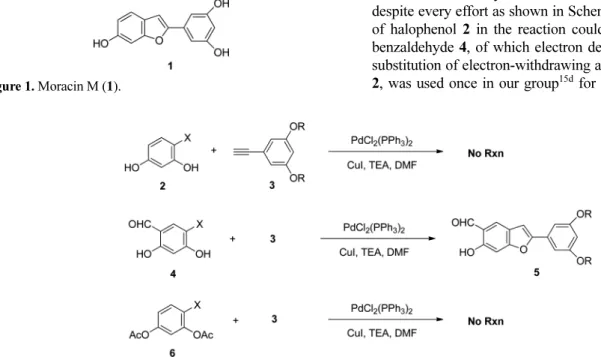
We applied the Sonogashira coupling reaction of halore-sorcinol 2 with aryl acetylene 3 using PdCl2(PPh3)2
condi-tion for moracin M synthesis. However, no reaccondi-tion occurred despite every effort as shown in Scheme 1. Electron density of halophenol 2 in the reaction could be important. Halo-benzaldehyde 4, of which electron density was lowered by substitution of electron-withdrawing aldehyde comparing to 2, was used once in our group15d for XH-14 synthesis, and
Figure 1. Moracin M (1).
successfully applied with Sonogashira reagent to yield the expected benzofuran 5. Acetylated haloresorcinol 6 for decreasing the electron density of 2, however, did not give the expected benzofuran using original Sonogashira condi-tion, and we assumed that the chloride anion produced from the reaction could be used as a nucleophile causing deacet-ylation to increase the electron density again and prohibit the coupling reaction.
Fu16 introduced air-stable trialkylphosphonium salt and
Kotschy17 used this catalyst with Pd(OAc)
2 for benzofuran
ring formation. Fagnou also introduced the optimal metal-ligand combination using Pd(OAc)2 with P(tBu)3-HBF4 to
solve a cross-coupling problem.18 Using bulky phosphine
ligands exhibiting a large cone angle (known as Tolman angle)19 has been known to accelerate the reductive
elimina-tion step in palladium catalysed coupling cycle (oxidative addition-transmetallation-reductive elimination) due to a decreased distance between the two R groups as shown in Figure 2. Changing the ligand from PPh3 to P(tBu)3 increase
the cone angle between two PL3 from 145o to 182o in
Pd-acetylene complex, and decrease the angle between two R groups which accelerate the reductive elimination step in the reaction pathway.
Sonogashira coupling of diacetylated bromoresorcinol 6a with aryl acetylide 7 using Pd(OAc)2/P(tBu)3-HBF4, CuI and
DIPA gave 63% yield of coupled product 8, which was then deacetylated in basic condition to give the benzofuran 9 (Scheme 2). Demethylation of 9 using BBr3 produced the
moracin M in 25% yield as same as literature.13 The
inter-mediate benzofuran 9 was utilized for the first synthesis of moracin N (13) which was isolated from mulberry20 and
showed tyrosinase inhibitory activity21 and better antifungal
activity22 than moracin M. Propargylation of 9 with
3-chloro-3-methylbutyne and following reduction using Lindlar catalyst gave the prenyl ether 11. Water-accelerated [3,3]-sigmatropic rearrangement23 of 11 produced
5-propenyl-benzofuran 12 in 47% yield regioselectively, and followed demethylation of 12 using BBr3 gave the moracin N in 21%
yield.
Moracin S (19), which is the regioisomer of moracin N, was isolated from black mulberry1b and showed similar
antioxidant activity as vitamin E,1b however, no other reports
on activity and synthesis are noticed. First total synthesis of moracin S is achieved using modified Sonogashira coupling reaction as shown in Scheme 3. Regioselective acetylation of 2a with Ac2O in acidic condition gave 40% yield of 6b
which was then propargylated to 14 in 65% yield and followed reduction with Lindlar catalyst produced 15 in 75% yield. Coupling reaction of 15 with aryl acetylide 7 using the modified Sonogashira reagent gave 16 in 56% yield and followed water-accelerated [3,3]-sigmatropic rear-rangement produced the benzofuran 17 in one-step. Deacet-ylation of 17 with KOH and followed demethDeacet-ylation using BBr3 produced the moracin S in 26% yield.
Moracin Y was extracted from mulberry leaves and only one bioactivity has been known.1a Benzofuran 5a containing
Figure 2. Tolman angle of Pd-acetylene complex.
electron withdrawing aldehyde, which was prepared in Scheme 1 using original Sonogashira coupling condition, is utilized for the first synthesis of moracin Y (21) as shown in Scheme 4. Benzaldehyde 20 was iodinated with ICl and coupled with aryl acetylide 7a to give the benzofuran 5a, which was then deprotected with TBAF to produce the moracin Y with overall 23% yield in 3 steps.
In conclusion, efficient and practical syntheses of moracins M, N, and S have been achieved using Pd(OAc)2/P(tBu)3
-HBF4 and the spectral data of the synthetic moracins N, S
and Y are well matched with the literatures.20,1b,1a
Experimental
All chemicals were purchased from Sigma-Aldrich Chemicals and were used without further purification unless noted otherwise. NMR spectra were recorded at Varian Mercury-300 MHz FT-NMR and 75 MHz for 13C, with the
chemical shift (δ) reported in parts per million (ppm) relative to TMS and the coupling constants (J ) quoted in Hz. CDCl3
was used as a solvent and an internal standard. Mass spectra were recorded using a JMS-700 (JEOL) spectrometer. Melt-ing points were measured on a MEL-TEMP II apparatus and were uncorrected. Thin-layer chromatography (TLC) was
performed on DC-Plastikfolien 60, F254 (Merck, layer
thick-ness 0.2 mm) plastic-backed silica gel plates and visualized by UV light (254 nm) or staining with p-anisaldehyde.
1,3-Diacetoxy-4-bromobenzene (6a). To a stirred solu-tion 4-bromoresorcinol (2a) (0.50 g, 2.61 mmol) in THF (10 mL) was added triethylamine (0.74 mL, 5.31 mmol) under nitrogen atmosphere and stirred for 0.5 h at rt. AcCl (0.37 mL, 5.31 mmol) in THF (3 mL) was added slowly to this reaction mixture and stirred for 3 h at rt. The reaction mixture was extracted with EtOAc, washed with brine, dried over anhydrous MgSO4, concentrated in vacuo, and purified
by silica gel flash column chromatography (EtOAc/hexane = 1/10) to give a clean liquid. Yield: 0.69 g (98%); Rf 0.44
(EtOAc/hexane = 1/3); 1H NMR (300 MHz, CDCl 3) δ 7.57 (1H, d, J = 8.4 Hz), 6.97 (1H, d, J = 0.9 Hz), 6.92 (1H, dd, J = 8.4, 0.9 Hz), 2.35 (3H, s), 2.29 (3H, s); 13C NMR (75 MHz, CDCl3) δ 168.51, 167.96, 150.05, 148.36, 133.20, 120.55, 117.49, 112.74, 21.17, 20.87. 1-(2,4-Diacetoxyphenyl)-2-(3,5-dimethoxyphenyl)acet-ylene (8). To 6a (0.68 g, 2.53 mmol) were added Pd(OAc)2
(30 mg, 0.12 mmol), CuI (30 mg, 0.12 mmol), P(tBu)3-HBF4
(40 mg, 0.19 mmol) and 1-ethynyl-3,5-dimethoxybenzene 7 (0.52 g, 3.22 mmol) under nitrogen atmosphere and stirred for 3 d at 40oC. The reaction mixture was dissolved with
Scheme 3. Synthesis of moracin S.
ether, filtered with Celite® 545, concentrated in vacuo,
ex-tracted with ether, washed with brine, dried over MgSO4 and
purified by silica gel flash column chromatography (EtOAc/ hexane = 1/6) to give the product as white solid. Yield: 0.57 g (63%); Rf 0.29 (EtOAc/hexane = 1/3); mp 178-180 oC; 1H NMR (300 MHz, CDCl3) δ 7.54 (1H, d, J = 8.4 Hz), 7.01 (1H, dd, J = 8.4, 2.4 Hz), 6.96 (1H, d, J = 2.4 Hz), 6.62 (2H, d, J = 2.7 Hz), 6.46 (1H, t, J = 2.7 Hz), 3.79 (6H, s), 2.36 (3H, s), 2.30 (3H, s); 13C NMR (75 MHz, CDCl 3) δ 168.50, 168.90, 151.84, 150.75, 133.15, 123.94, 119.17, 116.11, 114.72, 109.30, 101.79, 94.09, 83.10, 55.47, 21.14, 20.93. 2-(3,5-Dimethoxyphenyl)-6-hydroxybenzofuran (9). To a stirred solution of 8 (0.51 g, 1.44 mmol) in MeOH (5 mL) was added slowly KOH (0.28 g, 5.04 mmol) in H2O (2 mL)
under nitrogen atmosphere and refluxed for 5 h. The reaction was quenched with 1 N HCl, concentrated in vacuo, ex-tracted with CH2Cl2, washed with brine, dried over Na2SO4
and purified by silica gel flash column chromatography (EtOAc/hexane = 1/6) to give a yellow solid. Yield: 0.21 g (54%); Rf 0.39 (EtOAc/hexane = 1/2); mp 218-221 oC; 1H NMR (300 MHz, CDCl3) δ 7.38 (1H, d, J = 8.3 Hz), 7.00 (1H, d, J = 1.8 Hz), 6.95 (2H, d, J = 2.4 Hz), 6.92 (1H, s), 6.77 (1H, dd, J = 2.4, 8.3 Hz), 6.43 (1H, t, J = 1.8 Hz), 3.86 (6H, s); 13C NMR (75 MHz, CDCl 3) δ 170.96, 161.03, 156.94, 153.14, 135.36, 133.21, 132.36, 109.72, 106.54, 103.67, 100.96 99.10, 55.66. 6-Hydroxy-2-(3,5-dihydroxyphenyl)benzofuran; Moracin M (1). Procedure followed as reported.13 Yield: (25%); Rf
0.53 (EtOAc/hexane = 1/1); mp 260-263 oC (lit.10 mp
259-262 oC; lit.;11a1H NMR (300 MHz, methanol-d
4) δ 7.30 (1H, d, J = 8.4 Hz), 7.09 (1H, s), 6.95 (1H, d, J = 2.4 Hz), 6.68 (2H, d, J = 2.1 Hz), 6.55 (1H, dd, J = 8.4, 2.4 Hz), 6.22 (1H, t, J = 2.1 Hz); 13C NMR (75 MHz, methanol-d 4) δ 160.1, 157.4, 157.0, 156.3, 134.0, 123.2, 122.2, 113.4, 104.1, 103.7, 102.4, 98.6. HRMS (EI): m/z [M]+ calcd for C
14H10O4:
242.0579; found: 242.0580.
2-(3,5-Dimethoxyphenyl)-6-(1,1-dimethylprop-2-ynyl-oxy)benzofuran (10). To 9 (75 mg, 0.31 mmol) was added diisopropylethylamine (0.07 mL, 0.40 mmol) and stirred for 0.5 h at 0 oC. Cupper (II) chloride dihydrate (0.50 mg, 0.003
mmol) and 3-chloro-3-methylbutyne (0.04 mL, 0.34 mmol) was added slowly to this reaction mixture and stirred for 5 h at 0 oC. The reaction mixture was concentrated in vacuo,
extracted with CH2Cl2, washed with brine, dried over MgSO4
and purified by silica gel flash column chromatography (EtOAc/hexane = 1/8) to give a brown liquid. Yield: 81 mg (78%); Rf 0.60 (EtOAc/hexane = 1/3); 1H NMR (300 MHz, CDCl3) δ 7.71 (1H, d, J = 9.3 Hz), 7.24 (1H, s), 6.87 (1H, d, J = 2.1 Hz), 6.62 (1H, dd, J = 9.3, 2.1 Hz), 6.40 (2H, d, J = 1.5 Hz), 6.35 (1H, t, J = 1.5 Hz), 3.74 (6H, s), 2.66 (1H, s), 1.71 (6H, s); 13C NMR (75 MHz, CDCl 3) δ 164.75, 162.52, 160.76, 136.37, 131.49, 113.56, 111.13, 110.99, 107.35, 106.31, 98.82, 95.54, 84.53, 75.16, 72.31, 55.36. 2-(3,5-Dimethoxyphenyl)-6-(1,1-dimethylprop-2-enyl-oxy)benzofuran (11). To 10 (80 mg, 0.24 mmol) were added 5% mol Pd-CaCO3 (5 mg), quinoline (1 mL, 0.01
stirred for 4 h at rt. The reaction mixture was dissolved with MeOH, filtered with Celite® 545, concentrated in vacuo,
extracted with CH2Cl2, dried over Na2SO4 and purified by
silica gel flash column chromatography (EtOAc/hexane = 1/ 6) to give a brown liquid. Yield: 77 mg (96%); Rf 0.71
(EtOAc/hexane = 1/3); 1H NMR (300 MHz, CDCl 3) δ 7.65 (1H, d, J = 8.4 Hz), 7.24 (1H, s), 6.53 (1H, d, J = 2.4 Hz), 6.44 (1H, dd, J = 8.4, 2.4 Hz), 6.40 (2H, d, J = 1.8 Hz), 6.35 (1H, t, J = 1.8 Hz), 6.14 (1H, dd, J = 16.5, 10.5 Hz), 5.27 (1H, d, J = 16.5 Hz), 5.20 (1H, d, J = 10.5 Hz), 3.76 (6H, s), 1.26 (6H, s); 13C NMR (75 MHz, CDCl 3) δ 165.08, 163.87, 161.05, 159.25, 143.55, 136.78, 131.71, 114.50, 113.32, 111.65, 107.65, 106.54, 99.11, 81.12, 55.67, 27.63. 6-Hydroxy-2-(3,5-dimethoxyphenyl)-5-(3-methylbut-2-enyl)benzofuran (12). 11 (70 mg, 0.23 mmol) was dissolv-ed in EtOH-H2O (4:1 v/v, 4 mL) in a 35-mL Ace pressure
tube with PTFE bushes and an FETFE O-ring seal. The tube was then placed in an electric furnace at 80 oC for 8 h. When
the tube had cooled to rt, the screw-cap was loosened. The reaction mixture was concentrated in vacuo, extracted with EtOAc-acetone (2:1), dried over MgSO4 and purified by
silica gel flash column chromatography (Acetone/hexane = 1/2) to give a yellow-green solid. Yield: 32 mg (47%); Rf
0.21 (EtOAc/hexane = 1/2); mp 232-234 oC; 1H NMR (300 MHz, CDCl3) δ 7.15 (1H, s), 6.91 (1H, s), 6.84 (1H, s), 6.59 (2H, d, J = 2.1 Hz), 6.31 (1H, t, J = 2.1 Hz), 1.61 (1H, s); 13C NMR (75 MHz, CDCl3) δ 162.53, 155.49, 155.00, 154.83, 131.11, 129.31, 125.44, 123.47, 122.82, 121.83, 105.43, 103.25, 99.80, 55.63, 27.00, 25.49, 17.64. 6-Hydroxy-2-(3,5-dihydroxyphenyl)-5-(3-methylbut-2-enyl)benzofuran (13); Moracin N. To a stirred solution of 12 (21 mg, 0.06 mmol) in CH2Cl2 (1 mL) was added slowly
BBr3 solution (0.25 mL, 0.25 mmol) (1 M in CH2Cl2) under
nitrogen atmosphere and stirred for 1 h at −78 oC. Then the
mixture was stirred for 19 h at 0 oC. MeOH was added to the
reaction mixture and concentrated in vacuo, extracted with CH2Cl2, washed with brine, dried over Na2SO4 and
evapo-rated to dryness.The crude was recrystallized from EtOAc-hexane to give the product as a brown solid.20 Yield: 4 mg
(21%); Rf 0.57 (EtOAc/hexane = 1/1); mp 220-221 oC (lit.20b mp 187-188 oC); 1H NMR (300 MHz, Methanol-d 4) δ 7.24 (1H, s), 7.05 (2H, s), 6.79 (2H, d, J = 2.1 Hz), 6.41 (1H, t, J = 2.4 Hz), 5.27 (1H, t, J = 6.9 Hz), 3.77 (1H, d, J = 7.4 Hz), 1.78 (6H, s); 13C NMR (75 MHz, Methanol-d 4) δ 166.65, 156.96, 150.25, 150.13, 134.01, 131.09, 130.55, 129.55, 128.54, 127.37, 105.35, 104.55, 104.18, 100.32, 29.34, 26.13, 18.25. HRMS (EI) calcd for C19H18O4 M+ 310.1205,
found 310.1207.
5-Acetoxy-2-bromophenol (6b). Sulfuric acid (1 drop) was added to acetic anhydride (0.5 mL, 5.28 mmol) in one neck flask at rt and then cooled to −20 oC. After stirring for
10 min at −20 oC, 4-bromo resorcinol (2a) (1 g, 5.28 mmol)
in THF was added and the resulting mixture was stirred for 7 h at this temperature. After completion of the reaction, H2O
was added. The reaction mixture was extracted with EtOAc, washed with brine, dried over anhydrous MgSO4,
concent-chromatography (EtOAc/hexane = 1/8) to give a clean liquid. Yield: 0.48 g (40%); Rf 0.31 (EtOAc/hexane = 1/3); 1H NMR (300 MHz, CDCl3) δ 7.29 (1H, d, J = 8.4 Hz), 7.07 (1H, dd, J = 8.4, 3 Hz), 6.89 (1H, d, J = 3 Hz), 2.19 (3H, s); 13C NMR (75 MHz, CDCl3) δ 166.31, 150.26, 149.16, 132.37, 118.65, 110.82, 108.14, 21.02. 4-Acetoxy-1-bromo-2-(1,1-dimethylprop-2-ynyloxy)benz-ene (14). 1,8-Diazabicycloundec-7-4-Acetoxy-1-bromo-2-(1,1-dimethylprop-2-ynyloxy)benz-ene (0.32 mL, 2.07 mmol) was added to 6b (0.41 g, 1.71 mmol) and stirred for 0.5 h at 0 oC. Cupper (II) chloride dihydrate (3 mg, 0.02 mmol) and
3-chloro-3-methylbutyne (0.21 mL, 1.81 mmol) was added slowly to this reaction mixture and stirred for 5 h at 0 oC.
The reaction mixture was concentrated in vacuo, extracted with CH2Cl2, washed with brine, dried over MgSO4 and
purified by silica gel flash column chromatography (EtOAc/ hexane = 1/8) to give a brown liquid. Yield: 0.33 g (65%); Rf
0.75 (EtOAc/hexane = 1/3); 1H NMR (300 MHz, CDCl 3) δ 7.09 (1H, d, J = 8.4 Hz), 6.87 (1H, dd, J = 8.4, 3 Hz), 6.78 (1H, d, J = 3 Hz), 2. 12 (1H, s), 1.78 (3H, s), 1.19 (6H, s); 13C NMR (75 MHz, CDCl 3) δ 168.40, 157.76, 149.69, 133.93, 119.40, 112.97, 110.23, 84.87, 74.82, 72.45, 29.56, 21.02. 4-Acetoxy-1-bromo-2-(1,1-dimethylprop-2-enyloxy)benz-ene (15). To 14 (0.30 g, 1.03 mmol) were added 5% mol Pd-CaCO3 (15 mg) and quinoline (0.01 mL, 0.01 mmol) in
EtOH (2 mL) under hydrogen atmosphere and stirred for 4 h at rt. The reaction mixture was dissolved with MeOH, filtered with Celite® 545, concentrated in vacuo, extracted
with CH2Cl2, dried over Na2SO4 and purified by silica gel
flash column chromatography (EtOAc/hexane = 1/6) to give a brown liquid. Yield: 0.29 g (75%); Rf 0.81 (EtOAc/hexane
= 1/3); 1H NMR (300 MHz, CDCl 3) δ 7.29 (1H, d, J = 8.7 Hz), 7.00 (1H, dd, J = 8.7, 3 Hz), 6.65 (1H, d, J = 3 Hz), 6.08 (1H, dd, J = 10.8, 10.8 Hz), 4.99 (2H, dd, J = 10.8, 10.8 Hz), 2.32 (3H, s), 1.28 (6H, s); 13C NMR (75 MHz, CDCl 3) δ 168.40, 157.65, 149.88, 143.41, 134.11, 119.41, 114.42, 111.14, 107.74, 81.17, 27.07, 21.02. 1-(4-Acetoxy-2-(1,1-dimethylprop-2-enyloxy)phenyl)-2-(3,5-dimethoxyphenyl)acetylene (16). To a stirred solu-tion of 15 (0.25 g, 0.83 mmol) in diisopropylamine (5 mL) were added slowly Pd(OAc)2 (10 mg, 0.41 mmol), CuI (8
mg, 0.41 mmol), P(tBu)3-HBF4 (12 mg, 0.06 mmol) and
1-ethynyl-3,5-dimethoxybenzene 7 (0.18 g, 1.08 mmol) under nitrogen atmosphere and stirred for 3 d at 40oC. The
reac-tion mixture was dissolved with ether, filtered with Celite®
545, concentrated in vacuo at 80oC, extracted with ether,
washed with brine, dried over MgSO4 and purified by silica
gel flash column chromatography (EtOAc/hexane = 1/6) to give a white solid. Yield: 0.18 g (56%); Rf 0.43 (EtOAc/
hexane = 1/3); mp 197-198 oC; 1H NMR (300 MHz, CDCl 3) δ 7.25 (1H, d, J = 8.9 Hz), 6.82 (1H, dd, J = 8.9, 2.8 Hz), 6.74 (1H, d, J = 2.8 Hz), 6.69 (2H, d, J = 2.3 Hz), 6.36 (1H, t, J = 2.3 Hz), 6.03 (1H, dd, J = 10.4, 10.4 Hz), 4.91 (2H, dd, J = 10.4, 10.4 Hz), 3.43 (6H, s), 2.24 (3H, s), 1.38 (6H, s); 13C NMR (75 MHz, CDCl 3) δ 168.40, 163.97, 163.04, 149.72, 143.41, 134.76, 127.14, 117.37, 115.37, 114.42, 110.10, 108.02, 100.93, 98.38, 92.63, 82.43, 55.31, 27.53, 21.78. 6-Acetoxy-2-(3,5-dimethoxyphenyl)-7-(3-methylbut-2-enyl)benzofuran (17). 16 (0.17 g, 0.47 mmol) was dis-solved in EtOH-H2O (4:1 v/v, 4 mL) in a 35-mL Ace
pressure tube with PTFE bushes and an FETFE O-ring seal. The tube was then placed in an electric furnace at 100 oC for
9 h. When the tube had cooled to rt, the screw-cap was loosened. The reaction mixture was concentrated in vacuo, extracted with EtOAc-acetone (2:1), dried over MgSO4 and
purified by silica gel flash column chromatography (Acetone/ hexane = 1/2) to give a green solid product. Yield: 55 mg (31%); Rf 0.61 (EtOAc/hexane = 1/2); mp 195-198 oC; 1H NMR (300 MHz, CDCl3) δ 7.35 (1H, d, J = 8.7 Hz), 7.29 (1H, s), 7.06 (1H, d, J = 2.7 Hz), 6.37 (2H, d, J = 2.4 Hz), 6.30 (1H, t, J = 2.4 Hz), 5.24 (1H, m), 3.64 (6H, s), 3.51 (2H, d, J = 7.4 Hz), 2.35 (3H, s), 1.84 (6H, s); 13C NMR (75 MHz, CDCl3) δ 169.07, 161.33, 155.78, 154.53, 153.55, 130.71, 128.65, 125.21, 124.12, 121.25, 119.36, 112.32, 105.37, 105.11, 99.83, 55.67, 25.53, 20.11, 20.02, 18.36. 6-Hydroxy-2-(3,5-dimethoxyphenyl)-7-(3-methylbut-2-enyl)benzofuran (18). To a stirred solution of 17 (55 mg, 0.14 mmol) in MeOH (5 mL) was added slowly KOH (16 mg, 0.29 mmol) in H2O (2 mL) under nitrogen atmosphere
and refluxed for 5 h. The reaction was quenched with 1N HCl, concentrated in vacuo, extracted with CH2Cl2, washed
with brine, dried over Na2SO4 and purified by silica gel flash
column chromatography (EtOAc/hexane = 1/6) to give a yellow solid. Yield: 25 mg (51%); Rf 0.84 (EtOAc/hexane =
1/1); mp 242-244 oC; 1H NMR (300 MHz, CDCl 3) δ 7.31 (1H, d, J = 8.9 Hz), 7.23 (1H, s), 6.82 (1H, d, J = 8.9 Hz), 6.75 (2H, d, J = 2.4 Hz), 6.41 (1H, t, J = 2.4 Hz), 5.22 (1H, m), 3.41 (6H, s), 3.35 (2H, d, J = 7.1 Hz), 1.72 (6H, s); 13C NMR (75 MHz, CDCl3) δ 172.52, 156.22, 155.64, 150.65, 135.29, 128.51, 122.21, 121.42, 119.26, 117.32, 108.12, 105.21, 103.67, 97.51, 53.55, 25.60, 20.73, 17.47. 6-Hydroxy-2-(3,5-dihydroxyphenyl)-7-(3-methylbut-2-enyl)benzofuran (19); Moracin S. To a stirred solution of 18 (20 mg, 0.059 mmol) in CH2Cl2 (1 mL) was added slowly
BBr3 solution (0.23 mL, 0.23 mmol) (1 M in CH2Cl2) under
nitrogen atmosphere and stirred for 1 h at −78 oC. Then the
mixture was stirred for 19 h at 0 oC. MeOH was added to the
reaction and concentrated in vacuo, extracted with CH2Cl2,
washed with brine, dried over Na2SO4 and evaporated to
dryness.The crude product was recrystallized from EtOAc-hexane to give the product as orange solid. Yield: 4.7 mg (26%); Rf 0.63 (EtOAc/hexane = 1/1); mp 217-220 oC.1b; 1H NMR (300 MHz, methanol-d4) δ 7.27 (1H, d, J = 8.4 Hz), 7.12 (1H, s), 6.85 (1H, d, J = 8.4 Hz), 6.72 (2H, d, J = 2.1 Hz), 6.39 (1H, t, J = 2.1 Hz), 5.05 (1H, m), 3.66 (2H, d, J = 7.2 Hz), 1.90 (6H, s); 13C NMR (75 MHz, methanol-d 4) δ 160.12, 156.11, 155.02, 152.21, 133.41, 133.11, 124.43, 123.71, 119.01, 113.34, 113.12, 104.01, 103.74, 103.18, 26.54, 24.01, 17.96. HRMS (EI) calcd for C19H18O4 M+
310.1205, found 310.1207.
2,4-Dihydroxy-5-iodobenzaldehyde (4a). To a stirred solution of 2,4-dihydroxybenzaldehyde (20) (1.50 g, 10.9 mmol) in AcOH (7.5 mL) was added slowly ICl (17.32 mL, 17.31 mmol) in CH2Cl2 under nitrogen atmosphere and
stirred for 5 h at rt. The reaction was quenched with sodium thiosulfate-H2O (4:1) resulted solid product and the solid
was filtered and washed with water resulted the product as brown solid. Yield: 2.87 g (51%); Rf 0.63 (EtOAc/hexane =
1/2); mp 167-170 oC; 1H NMR (300 MHz, acetone-d 6) δ 9.67 (1H, s), 7.95 (1H, s), 6.36 (1H, s); 13C NMR (75 MHz, acetone-d6) δ 193.02, 157.65, 156.77, 143.92, 117.75, 102.05, 70.61. 6-Hydroxy-2-(3-hydroxy-5-( tert-butyldimethylsilyl)oxy-phenyl)benzofuran-5carbaldehyde (5a). To a stirred solu-tion of 4a (0.1 g, 0.37 mmol) in DMF (2 mL) were added slowly PdCl2(PPh3)2 (13 mg, 0.02 mmol), CuI (1.4 mg, 0.01
mmol), TEA (0.10 mL, 0.76 mmol) and ((5-ethynyl-1,3-phenylene)bis(oxy))bis(tert-butyldimethylsilane) 7 (0.52 g, 3.22 mmol) under nitrogen atmosphere and stirred for 2 d at 70oC. The reaction mixture was dissolved with ether,
filtered with Celite® 545, concentrated in vacuo at 80oC,
extracted with ether, washed with brine, dried over MgSO4.
The crude product was recrystallized from acetone-hexane and brown solid. Yield: 73 mg (50%); Rf 0.38 (EtOAc/hexane
= 1/3); mp 246-248 oC; 1H NMR (300 MHz, acetone-d 6) δ 10.99 (1H, s), 9.79 (1H, s), 7.78 (1H, s), 7.03 (1H, s), 6.83 (1H, s), 6.68 (2H, d, J = 1.8 Hz), 6.17 (1H, t, J = 1.8 Hz), 0.78 (18H, s), 0.03 (12H, s); 13C NMR (75 MHz, acetone-d 6) δ 196.88, 160.36, 159.67, 157.40, 156.92, 131.60, 127.80, 123.05, 118.85, 108.24, 108.10, 105.37, 101.92, 98.87, 30.09, 25.52, −4.70. 6-Hydroxy-2-(3,5-dihydroxyphenyl)benzofuran-5carb-aldehyde (21); Moracin Y. To a stirred solution of 5a (34 mg, 0.07 mmol) in THF (1 mL) was added slowly TBAF (0.1 mL, 0.28 mmol) under nitrogen atmosphere and was stirred for 5 h at rt. After completion of the reaction, solvent was removed in vacuo, Acetone was added to the crude and filtered the solid TBAF. The filtrate was concentrated and addition of ether-MeOH to the crude offered the solid product moracin Y as yellow solid.1a Yield: 17 mg (90%); R
f 0.32 (EtOAc/hexane = 1/1); mp 235-238 oC; 1H NMR (300 MHz, methanol-d4) δ 10.23 (1H, s), 7.72 (1H, s), 6.85 (1H, s), 6.73 (1H, s), 6.65 (2H, d, J = 2.1 Hz), 6.19 (1H, t, J = 2.1 Hz); 13C NMR (75 MHz, Methanol-d 4) δ 193.70, 169.51, 161.71, 159.56, 155.79, 131.88, 122.12, 121.50, 120.03, 103.21, 102.71, 101.08, 100.62. HRMS (EI) calcd for C15H10O5
M+ 270.0528, found 270.0529.
Acknowledgments. This research was financially sup-ported by the Ministry of Education, Science Technology (MEST) and Korea Institute for Advancement of Techno-logy (KIAT) through the Human Resource Training Project for Regional Innovation (2012H1B8A2026036), and by Priority Research Centers Program through the National
Research Foundation of Korea (NRF) funded by the Ministry of Education, Science and Technology (NRF-2009-0094071).
References
1. (a) Yang, Y.; Gong, T.; Liu, C.; Chen, R.-Y. Chem. Pharm. Bull. 2010, 58, 257-260. (b) Kapache, G. D. W. F.; Fozing, C. D.; Donfack, J. H.; Fotso, G. W.; Amadou, D.; Tchana, A. N.; Bezabih, M.; Moundipa, P. F.; Ngadjui, B. T.; Abegaz, B. M. Phytochemistry 2009, 70, 216-221 and references cited therein.
2. Naowaboot, J.; Pannangpetch, P.; Kukongviriyapan, V.; Kongyingyoes, B.; Kukongviriyapan, U. Plant Food Human Nut. 2009, 64, 116-121.
3. Ahn, K.-S.; Sim, W.-S.; Kim, I.-H. Planta Med. 1996, 62, 7-9. 4. Khyade, V. B.; Khyade, V. V.; Khyade, S. V. IOSR J. Environ. Sci.
Toxicol. Food Tech. 2013, 4, 96-104.
5. Chen, S.-K.; Zhao, P.; Shao, Y.-X..; Li, Z.; Zhang, C.; Liu, P.; He, X.; Luo, H.-B.; Hu, X. Bioorg. Med. Chem. Lett. 2012, 22, 3261-3264.
6. Yadav, A. V.; Kawale, L. A.; Nade, V. S. Indian J. Pharm. 2008, 40, 32-36.
7. Aditya, R. S. J.; Ramesh, C. K.; Basavaraj, P.; Jamuna, K. S. RJPBCS 2013, 4, 822.
8. Zeni, A. L. B.; Dall'Molin, M. Rev. Bras. Farmacogn. Braz. J. Pharm. 2010, 20, 130-133.
9. Yang, Z.-G.; Matsuzaki, K.; Takamatsu, S.; Kitanaka, S. Molecules 2011, 16, 6010-6022.
10. Deshpande, V. H.; Spinivasan, R.; Rama Rao, A. V. Indian J. Chem. 1975, 13, 453-457.
11. (a) Clough, J. M.; Mann, I. S.; Widdowson, D. A. Tetrahedron Lett. 1987, 28, 2645-2648. (b) Mann, I. S.; Widdowson, D. A. Clough, J. M. Tetrahedron 1991, 47, 7981-7990.
12. Watanabe, M.; Kawanishi, K.; Furukawa, S. Chem. Pharm. Bull. 1991, 39, 579-583.
13. Arias, L.; Vara, Y.; Cossio, F. P. J. Org. Chem. 2012, 77, 266-275. 14. (a) Kinoshita, T.; Ichinose, K. Heterocycles 2005, 65, 1641-1654. (b) Celaje, J. A.; Zhang, D.; Guerrero, A. M.; Selke, M. Org. Lett. 2011, 13, 4846-4849.
15. (a) Hiroya, K.; Suzuki, N.; Yasuhara, A.; Egawa, Y.; Kasano, A.; Sakamoto, T. J. Chem. Soc. Perkin Trans. 1 2000, 4339-4346. (b) Yue, D.; Yao, T.; Larock, R. J. Org. Chem. 2005, 70, 10292-10296. (c) Carril, M.; Correa, A.; Bolm, C. Angew. Chem. Int. Ed. 2008, 47, 4862-4865. (d) Bang, H. B.; Han, S. Y.; Choi, D. H.; Hwang, J. W.; Jun, J.-G. ARKIVOC 2009, (ii), 112-125.
16. Netherton, M. R.; Fu, G. C. Org. Lett. 2001, 3, 4295-4298. 17. Novak, Z.; Timari, G.; Kotschy, A. Tetrahedron 2003, 59,
7509-7513.
18. Campeau, L.-C.; Rousseaux, S.; Fagnou, K. J. Am. Chem. Soc. 2005, 127, 18020-18021.
19. Tolman, C. A. Chem. Rev. 1977, 77, 313-348.
20. (a) Matsuyama, S.; Kuwahara, Y.; Suzuki, T. Agric. Biol. Chem. 1991, 55, 1409-1410. (b) Matsuyama, S.; Kuwahara, Y.; Nakamura, S.; Suzuki, T. Agric. Biol. Chem. 1991, 55, 1339-1341.
21. Yang, Z.; Wang, Y.; Wang, Y.; Zang, Y. Food Chem. 2012, 131, 617-625.
22. Royer, M.; Rodrigues, A. M. S.; Herbette, G.; Beauchene, J.; Chevalier, M.; Herault, B.; Thibaut, B.; Stien, D. Int. Biodeterior. Biodegrad. 2012, 70, 55-59.