http://dx.doi.org/10.5012/bkcs.2014.35.12.3618
Expeditious Synthesis of Natural Benzofuran, Eupomatenoid-6 by
Umpolung of α-Aminophosphonates
Kongara Damodar and Jong-Gab Jun*
Department of Chemistry and Institute of Natural Medicine, Hallym University, Chuncheon 200-702, Korea *E-mail: [email protected]
Received September 5, 2014, Accepted September 25, 2014
Simple and practical synthesis of natural benzofuran derivative eupomatenoid-6 via Horner-Emmons type condensation as the key step is described. The umpolung property of aldehyde derivative, α-aminophosphonate was efficiently employed in this reaction. α-Aminophosphonate of anisaldehyde subjected to Horner-Emmons type condensation with 5-bromo-2-methoxybenzaldehyde to yield the deoxybenzoin, which was further methylated and then underwent tandem demethylation-cyclodehydration to afford the benzofuran scaffold in excellent yield. Finally Suzuki coupling with propenyl boronic acid afforded eupomatenoid-6 with an overall yield of 56.8%.
Key Words : α-Aminophosphonate, Kebachnik-Fields reaction, Horner-Emmons type condensation, Suzuki coupling, Eupomatenoid-6
Introduction
Substituted benzofurans are attractive targets of organic synthesis because of their physiological, pharmacological and therapeutic properties.1 For example, a variety of benzo-furan derivatives have been investigated as antifungal agents,2 estrogen receptor (ER) ligands,3 selective ligands for the dopamine D3 receptor subtype,4 H3 receptor anta-gonists5 and metalloproteinase-13 inhibitors.6 2-Arylbenzo-[b]furan nucleus is widely exists in natural products such as phytoalexins and neolignans.7 Their broad range of bio-logical and pharmacobio-logical properties have generated extensive and enduring efforts toward the synthesis of these important heterocyclic compounds. Synthetic methods to construct 2-arylbenzo[b]furans include the palladium-cata-lyzed cross coupling cyclization of alkynes and o-halo-phenols,8 cyclization of vinylic phenols through McMurry coupling,9 [3,3]-sigmatropic rearrangement of oxime-ethers10 and palladium-catalyzed enolate arylation.11 Recently, Dong et al. reported the rhodium-catalyzed coupling of vinyl-phenols and nonchelating aldehydes.12 Another approach from 2-methoxychalcone epoxides has also been reported.13
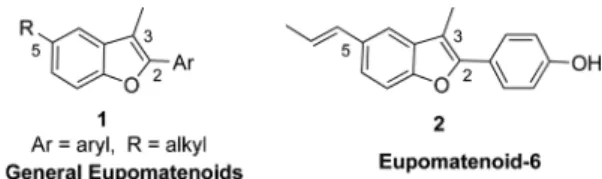
Eupomatenoids are distinct class of neolignans, isolated originally from two plant species which belong to the angio-sperm family Eupomatiaceae.14 Structurally, the eupomatenoids (1) (Fig. 1) are characterized by a 2,3,5-substitution pattern with an aryl substituent in the 2-position, a methyl sub-stituent in the 3-position and a C3-substituent R in the 5-position. They exhibit antitumor, insecticidal, antimicrobial and antioxidant properties.15 Thus much efforts have been directed for the synthesis of this important scaffold.11-13,16 Few groups reported the synthesis of eupomatenoid-6.10,11,13,16 Although many synthetic methods have been reported in the literature,procedures for the construction of benzofuran motif via the formation of 2-alkoxydeoxybenzoin are highly
desirable.
In continuation of our work17 on the synthesis of bioactive natural products, herein we wish to describe a simple and practical synthesis of eupomatenoid-6 (2) via Horner-Emmons type condensation as the key step.
Results and Discussion
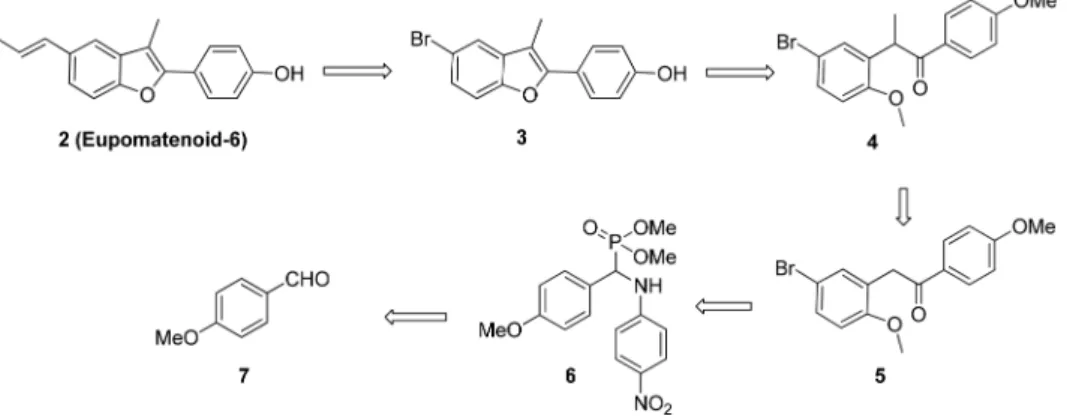
Our retrosynthetic approach to eupomatenoid-6 (2) is out-lined in Scheme 1. The natural product would be envisioned to arise from benzofuran 3. Compound 3 would be generated by the BBr3 mediated demethylation-cyclodehydration of the corresponding intermediate 4 which in turn can be obtained from the key intermediate, 2-methoxydeoxyben-zoin 5 by methylation. 2-Methoxydeoxyben2-methoxydeoxyben-zoin 5 would be resulted by the Horner-Emmons type condensation between α-aminophosphonate 6 of commercial 4-methoxybenz-aldehyde (7) and 5-bromo-2-methoxybenz4-methoxybenz-aldehyde (8).
The synthesis of eupomatenoid-6 (2) was initiated by the Kebachnik-Fields reaction of 4-methoxybenzaldehyde (7), 4-nitroaniline (9) and dimethylphosphite (Scheme 2). By using a slight modification to the literature procedure,18 the α-aminophosphonate 6 was obtained in 93% yield. Utilization of α-aminophosphonates as carbanion precursors for the construction of carbon-carbon bond formation are highly appreciated.19 Construction of benzofuran motif by employ-ing umpolung property of α-aminophosphonate (aldehyde
Figure 1. General structure of eupomatenoids (1) and eupomate-noid-6 (2).
derivative) is very limited in the literature. Previously, only one method was reported in the literature by Seemuth and
Zimmer in which they utilized diphenyl 1-(4-nitroanilino)-1-arylmethanephosphonates as carbanion precursors for the synthesis of 2-methoxydeoxybenzoins by employing LDA as base at −78oC.20 Umpolung chemistry has been a focus of research in organic synthesis because of its usefulness and unusual reactivity. Modification to the reported method which will allow the reaction at ambient temperature with improved yields is highly desirable. Herein, the umpolung property of the aldehyde 7 in the α-aminophosphonate 6 was efficiently employed in reaction with 5-bromo-2-methoxy-benzaldehyde to yield the key intermediate, 2-methoxyde-oxybenzoin 5. Horner-Emmons type condensation between compound 6 and compound 8 gave enamine intermediate which was then directly converted to compound 5 by addi-tion of hydrochloric acid. We checked various condiaddi-tions to afford the compound 5 and finally obtained 71% yield using cesium carbonate as base (Table 1, entry 5). α-Aminopho-sphonate of 4-methoxybenzaldehyde (7), aniline and di-phenyl phosphite yielded the product 5 only 18% (Table 1, entry 6) whereas with the α-aminophosphonate of 4-meth-oxybenzaldehyde (7), 4-nitroaniline and diphenyl phosphite the product 5 was formed in 29% yield (Table 1, entry 7).
Scheme 1. Retrosynthesis of eupomatenoid-6.
Table 1. Optimization of Horner-Emmons type condensationa
Entry Condition Yieldb (%)
1 Cs2CO3 (1.2 eq), THF/IPA (4:1), rt, overnight 53 2 NaH (1.4 eq), THF, 0 oC ~ rt, overnight 31 3 tBuOK (1.5 eq), THF, 0 oC ~ rt, 6.5 h 39
4 Cs2CO3 (1.3 eq), THF/IPA (4:1), rt, overnight 44 5 Cs2CO3 (1.4 eq), THF/IPA (4:1), rt, 48 h 71 6c Cs2CO3 (1.4 eq), THF/IPA (4:1), rt, 48 h 18
7d Cs2CO3 (1.4 eq), THF/IPA (4:1), rt, 48 h 29 aCompound 8 (1.0 eq), compound 6 (1.1 eq) was used. bYields of pure
compound after column chromatography. cα-Aminophosphonate
obtain-ed from diphenylphosphite, 4-methoxybenzaldehyde (7) and aniline was used. dα-Aminophosphonate obtained from diphenylphosphite,
4-meth-oxybenzaldehyde (7) and 4-nitroaniline was used.
Scheme 2. Reagents and conditions: (a) dimethylphosphite, InCl3 (10 mol %), THF, reflux, 4 h, 93% (b) (i) 5-bromo-2-methoxybenz-aldehyde (8), Cs2CO3, THF/IPA (4:1), rt, 48 h (ii) con. HCl, MeOH, 60 oC, 3 h, 71% (c) MeI, tBuOK, THF, 0 oC ~ rt, 2 h , 98% (d) (i) 1.0 M BBr3 in CH2Cl2, rt, 36 h. (ii) H2O, reflux, 2 h, 91.5% (e) trans-propenyl boronic acid, CsF, Pd(PPh3)4 (3 mol %), DME, 85 oC, 6 h, 96%.
From these experiment we can come to know that replace-ment of diphenyl phosphite (entry 6) with dimethyl phos-phite (entry 5) offered the minimal steric hindrance and the product was obtained in good yield. Increased acidity of benzylic proton using 4-nitroaniline (entry 5) facilitated the reaction more ease than with aniline (entry 7).
The compound 5 was then treated with methyl iodide in the presence of potassium tert-butoxide (tBuOK) to give the compound 4 in 98% yield. When O-demethylation of compound 4 was carried out using excess of BBr3 (10.0 eq.) in CH2Cl2 at room temperature for 36 h a spontaneous tandem intramolecular cyclization took place as envisaged to furnish compound 3 in 91.5% yield. We checked the same reaction for 24 h and 48 h to achieve quantitative yield but we got the compound 3 only in 76% and 71% yields respec-tively. Compound 3 was then subjected to Suzuki coupling with propenyl boronic acid in sealed tube to give eupomate-noid-6 in 96% yield. The product gave identical spectral data to that in the literature.10,14,21
In conclusion, we have established a practical and improv-ed method for the synthesis of eupomatenoid-6 with an overall yield of 56.8% from commercially available starting materials. We feel that the present synthetic route is readily accessible for the construction of different benzofuran natural products and their analogues.
Experimental
All chemicals were purchased from Sigma-Aldrich Chemicals and were used without further purification unless noted otherwise. 1H NMR spectra were recorded at Varian Mercury-300 MHz FT-NMR and 75 MHz for 13C, with the chemical shift (δ) reported in parts per million (ppm) relative to TMS and the coupling constants (J ) quoted in Hz. CDCl3 was used as a solvent and an internal standard. Mass spectra were recorded using a EI-5977E (Agilent) spectrometer for EIMS and JMS-700 (JEOL) for HRMS. Melting points were mea-sured on a MEL-TEMP II apparatus and were uncorrected. Thin-layer chromatography (TLC) was performed on DC-Plastikfolien 60, F254 (Merck, layer thickness 0.2 mm) plastic-backed silica gel plates and visualized by UV light (254 nm) or staining with p-anisaldehyde.
Dimethyl ((4-Methoxyphenyl)((4-nitrophenyl)amino)-methyl)phosphonate (6). To a mixture of 4-methoxybenz-aldehyde (0.24 mL, 2.0 mmol), 4-nitroaniline (276.0 mg, 2.0 mmol) and dimethylphosphite (0.24 mL, 2.0 mmol) in THF (8 mL), was added indium(III) chloride (44 mg, 0.2 mmol) under nitrogen atmosphere and the mixture was refluxed for 4 h. The reaction mixture was then cooled to room temper-ature, diluted with water and extracted with EtOAc (3 × 30 mL). The combined organic layer was washed with brine (2 × 50 mL), dried over anhydrous Na2SO4 and concentrated in vacuo. The crude product was purified by column chromato-graphy (MeOH/CH2Cl2= 1/100 to 1/50) to afford the product as pale yellow solid. Yield : 681 mg (93%); Rf 0.45 (MeOH/ CH2Cl2= 1/20); mp 153-155 oC. 1H NMR (300 MHz, CDCl3) δ 8.00 (2H, d, J = 9.3 Hz), 7.35 (2H, dd, J = 8.1, 1.8 Hz), 6.90 (2H, d, J = 9.0 Hz), 6.56 (2H, d, J = 9.0 Hz), 5.58 (1H, t, J = 8.1 Hz), 4.77 (1H, dd, J = 23.7, 7.5 Hz), 3.78 (3H, s), 3.76 (3H, J = 11.1 Hz), 3.46 (3H, d, J = 10.5 Hz); 13C NMR (75 MHz, CDCl3) δ 159.6 (d, J = 11.4 Hz), 151.6 (d, J = 54.6 Hz), 138.8, 128.8 (d, J = 21.6 Hz), 125.9 (d, J = 26.1 Hz), 125.8, 114.4 (d, J = 9.0 Hz), 112.3, 55.4 (d, J = 62.7 Hz), 54.2 (d, J = 27.3 Hz), 53.6 (d, J = 28.5 Hz), 53.4. EIMS m/z 366 (M+), 257 (Base), 211. 2-(5-Bromo-2,4-dimethoxyphenyl)-1-(4-methoxyphen-yl)ethanone (5). To a stirred solution of 6 (562 mg, 1.5 mmol) and 5-bromo-2-methoxybenzaldehyde (300 mg, 1.40 mmol) in THF/IPA (4/1; 15 mL) was added cesium carbo-nate (636 mg, 1.95 mmol) and the reaction mixture was stirred at 25 oC for 48 h. MeOH (3 mL) and conc. HCl (1.5 mL) were added and stirred the mixture at 60 oC for 3 h. H2O (25 mL) was added to the mixture and extracted with CH2Cl2 (3 × 75 mL). The combined organic layer was wash-ed with brine (2 × 50 mL), driwash-ed over anhydrous Na2SO4 and concentrated in vacuo. The crude was purified by column chromatography (EtOAc/hexane = 1/10 to 3/20) to afford the product as white solid. Yield: 332 mg (71%); Rf 0.53 (EtOAc/hexane = 1/3); mp 118-120 oC (lit.13 mp 117-118 oC). 1H NMR (300 MHz, CDCl 3) δ 7.99 (2H, d, J = 8.7 Hz), 7.32 (1H, dd, J = 8.1, 2.4 Hz), 7.26 (1H, d, J = 8.7 Hz), 6.92 (2H, d, J = 8.7 Hz), 6.74 (1H, d, J = 8.7 Hz), 4.18 (2H, s), 3.86 (3H, s), 3.75 (3H, s); 13C NMR (75 MHz, CDCl3) δ 195.4, 163.3, 156.2, 133.6, 130.8, 130.6, 129.7, 126.2, 113.6, 112.7, 112.1, 55.7, 55.5, 39.3. EIMS m/z 334 (M+), 336 (M+2), 135 (Base). 2-(5-Bromo-2,4-dimethoxyphenyl)-1-(4-methoxyphen-yl)propan-1-one (4). To a suspension of potassium tert-butoxide (128.6 mg, 1.15 mmol) in tetrahydrofuran (THF) (3 mL) was added deoxybenzoin 5 (320 mg, 0.96 mmol) in THF (3 mL) slowly at 0oC. After stiring for 5 min., iodo-methane solution in THF (2 mL) was added gradually. The reaction mixture was then allowed to warm to 25 oC. After stirring for 2 h at 25 oC, the reaction mixture was slowly quenched with 2 N HCl and extracted with EtOAc (2 × 50 mL). Combined organic layer was washed with brine (2 × 50 mL), dried over anhydrous Na2SO4 and concentraed in vacuo. The crude was purified on a short column (EtOAc/hexane = 1/5) to yield the pure compound as colorless liquid. Yield: 327 mg (98%); Rf 0.64 (EtOAc/hexane = 1/3). 1H NMR (300 MHz, CDCl3) δ 7.92 (2H, d, J = 8.4 Hz), 7.24 (2H, d, J = 3.3 Hz), 6.84 (2H, d, J = 8.4 Hz), 6.72 (1H, d, J = 8.4 Hz), 5.00 (1H, q, J = 6.9 Hz), 3.84 (3H, s), 3.82 (3H, s), 1.42 (3H, d, J = 6.9 Hz); 13C NMR (75 MHz, CDCl3) δ 198.5, 162.6, 154.3, 132.1, 130.2, 130.1, 130.0, 113.1, 112.8, 111.9, 55.3, 54.9, 39.1, 17.3. EIMS m/z 348 (M+), 350 (M+2), 135 (Base). 4-(5-Bromo-3-methylbenzofuran-2-yl)phenol (3). To a stirred solution of 2-methoxydeoxybenzoin 4 (166.0 mg, 0.48 mmol) in CH2Cl2 (10 mL) was added 1.0 M BBr3/ CH2Cl2 (4.75 mL, 4.75 mmol) at room temperature under nitrogen atmosphere. The mixture was stirred for 36 h, then water (15 mL) was added and CH2Cl2 was evapoarted at reduced pressure. The mixture was then refluxed for 2 h. After cooling to room temperature extracted with EtOAc (2
× 40 mL). Combined organic layer was washed with brine (2 × 50 mL), dried over anhydrous Na2SO4 and concentraed in vacuo. The crude product was purified by column chromato-graphy (EtOAc/hexane = 1/2) to afford the product as colorless solid. Yield: 126 mg (91.5%); Rf 0.48 (EtOAc/ hexane = 1/3); mp 151-153 oC (lit.16c mp 157-159 oC; lit.13 mp 155-156 oC). 1H NMR (300 MHz, CDCl3) δ 7.66 (2H, d, J = 8.7 Hz), 7.60 (1H, s), 7.32 (2H, d, J = 2.7 Hz), 6.93 (2H, d, J = 9.0 Hz), 4.99 (1H, s), 2.39 (3H, s); 13C NMR (75 MHz, CDCl3) δ 155.7, 152.4, 152.1, 133.4, 128.6, 126.8, 123.9, 121.9, 115.8, 115.5, 112.4, 109.4, 9.6. EIMS m/z 302 (M+), 304 (M+ 2), 135 (Base). (E)-4-(3-Methyl-5-(prop-1-en-1-yl)benzofuran-2-yl)phenol (eupomatenoid-6) (2). To a stirred mixture of benzofuran 3 (80 mg, 0.28 mmol), powdered CsF (168 mg, 1.11 mmol) and trans-propenylboronic acid (71 mg, 0.83 mmol) in DME (1.25 mL) in sealed tude was added Pd(PPh3)4 (9.6 mg, 0.03 mmol) at room temperature. The reaction mixture was stirred for 6 h at 85oC. After cooling to room temperature, the reaction mass was concentrated in vacuo. The crude was purified by column chromatography (EtOAc/hexane = 1/5) to afford the product as colorless solid. The spectroscopic data were identical with those previously reported.14,16 Yield: 70 mg (96%); Rf 0.43 (EtOAc/hexane = 1/4); mp 145-147 oC (lit.16c mp 147.5-148 oC; lit.16a mp 147.5-149 oC; lit.14a mp 148-150 oC). 1H NMR (300 MHz, CDCl3) δ 7.66 (2H, dd, J = 6.9, 2.1 Hz), 7.41 (1H, d, J = 1.5 Hz), 7.34 (1H, d, J = 8.4 Hz), 7.27 (1H, d, 1.5 Hz), 6.92 (2H, d, J = 9.0 Hz), 6.50 (1H, dd, J = 15.6, 1.2 Hz), 6.22 (1H, m), 4.91 (1H, s), 2.42 (3H, s), 1.90 (3H, dd, J = 6.9, 2.1 Hz); 13C NMR (75 MHz, CDCl3) δ 155.3, 153.0, 151.2, 132.7, 131.6, 131.4, 128.4, 124.5, 124.3, 122.3, 116.2, 115.7, 110.8, 110.0, 18.8, 9.7. EIMS m/z 264 (M+), 223 (Base), 165. HRMS (EI) calcd for C18H16O2 M+ 264.1150, found 264.1150.
Acknowledgments. This research was financially sup-ported by Priority Research Centers Program through the National Research Foundation of Korea (NRF) funded by the Ministry of Education, Science and Technology (NRF-2009-0094071), and by the Ministry of Education, Science Technology (MEST) and Korea Institute for Advancement of Technology (KIAT) through the Human Resource Train-ing Project for Regional Innovation (2012H1B8A2026036).
References and Notes
1. (a) Dean, F. M.; Sargent, M. V.; Donnely, D. M. X.; Meegan, M. J. In Comprehensive Heterocyclic Chemistry; Katrizky, A., Rees, C. W., Bird, C. W., Cheeseman, G. W. H., Eds.; Pergamon: Oxford; 1984; Vol. 4, pp 531-712. (b) Röhrkasten, R. In Houben–Weyl Methoden der Organischen Chemie; 4. Aufl., Vol. E6b1, Kreher, R. P., Ed.; Thieme: Stuttgart; 1994, pp 33-162. (c) Dell, C. B. In Science of Synthesis, Houben–Weyl Methods of Molecular Trans-formations; Thomas, E. J., Ed.; Thieme: Stuttgart; 2000; Vol. 10, pp 11-86.
2. (a) Kawasaki, K.; Masubuchi, M.; Morikami, K.; Sogabe, S.; Aoyama, T.; Ebiike, H.; Niizuma, S.; Hayase, M.; Fujii, T.; Sakata, K.; Shidoh, H.; Stiratori, Y.; Aoki, Y.; Ohtsuka, T.; Stimma, N. Bioorg. Med. Chem. Lett. 2003, 13, 87-91. (b) Khan, M. W.;
Alam, M. J.; Rashid, M. A.; Chowdhury, R. Bioorg. Med. Chem. 2005, 13, 4796-4805.
3. (a) Crenshaw, R. R.; Jeffries, A. T.; Luke, G. M.; Cheney, L. C.; Bialy, G. J. Med. Chem. 1971, 14, 1185-1190. (b) Halabalaki, M.; Aligiannis, N.; Papoutsi, Z.; Mitakou, S.; Moutsatsou, P.; Sekeris, C.; Skaltsounis, A.-L. J. Nat. Prod. 2000, 63, 1672-1674. (c) Von Angerer, E.; Biberger, C.; Leitchtl, S. Ann. N.Y. Acad. Sci. 1995, 761, 176-191. (d) Teo, C. C.; Kon, O. L.; Sim, K. Y.; Ng, S. C. J. Med. Chem. 1992, 35, 1330-1339.
4. Hocke, C.; Prante, O.; Lober, S.; Hubener, H.; Gmeiner, P.; Kuwert, T. Bioorg. Med. Chem. Lett. 2004, 14, 3963-3966. 5. (a) Cowart, M.; Pratt, J. K.; Stewart, A. O.; Bennani, Y. L.;
Esbenshade, T. A.; Hancock, A. A. Bioorg. Med. Chem. Lett. 2004, 14, 689-693. (b) Gfesser, G. A.; Faghih, R.; Bennani, Y. L.; Curtis, M. P.; Esbenshade, T. A.; Hancock, A. A.; Cowart, M. D. Bioorg. Med. Chem. Lett. 2005, 15, 2559-2563.
6. Hu, Y.; Xiang, J. S.; Di Grandi, M. J.; Du, X.; Ipek, M.; Laakso, L. M.; Li, J.; Li, W.; Rush, T. S.; Schmid, J.; Skotnicki, J. S.; Tam, S.; Thomason, J. R.; Wang, Q.; Levin, J. I. Bioorg. Med. Chem. 2005, 13, 6629-6644.
7. (a) Ward, R. S. Nat. Prod. Rep. 1997, 14, 43-74. (b) Adams, M.; Pacher, T.; Greger, H.; Bauer, R. J. Nat. Prod. 2005, 68, 83-85. 8. (a) Okuro, K.; Furuune, M.; Enna, M.; Miura, M.; Nomura, M. J.
Org. Chem. 1993, 58, 4716-4721. (b) Bates, C. G.; Saejueng, P.; Murphy, J. M.; Venkataraman, D. Org. Lett. 2002, 4, 4727-4729. (c) Bernini, R.; Cacchi, S.; Salve, H. D.; Fabrizi, G. Synthesis 2007, 873-882. (d) Fiandanese, V.; Bottalico, D. G.; Marchese, A. P. Tetrahedron 2008, 64, 53-60. (e) Liu, J.; Chen, W.; Ji, Y.; Wang, L. Adv. Synth. Catal. 2012, 354, 1585-1592. (f) Leibeling, M.; Pawliczek, M.; Kratzert, D.; Stalke, D.; Werz, D. B. Org. Lett. 2012, 14, 346-349. (g) Saha, D.; Dey, R.; Ranu, B. C. Eur. J. Org. Chem. 2010, 31, 6067-6071. (h) Zanardi, A.; Mata, J. A.; Peris, E. Organometallics 2009, 28, 4335-4339. (i) Lingam, V. S.; Vinodkumar, R.; Mukkanti, K.; Thomas, A.; Gopalan, B. Tetrahedron Lett. 2008, 49, 4260-4264. (j) Csékei, M.; Novak, Z.; Kotschy, A. Tetrahedron 2008, 64, 8992-8996.
9. Duan, X. F.; Zeng, J.; Zhang, Z. B.; Zi, G. F. J. Org. Chem. 2007, 72, 10283-10286.
10. Miyata, O.; Takeda, N.; Naito, T. Org. Lett. 2004, 6, 1761-1763. 11. Eidamshaus, C.; Burch, J. D. Org. Lett. 2008, 10, 4211-4214. 12. Murphy, S. K.; Bruch, A.; Dong, V. M. Angew. Chem. Int. Ed.
2014, 53, 2455-2499.
13. Ruan, L.; Shi, M.; Mao, S.; Yu, L.; Yang, F.; Tang, J. Tetrahedron 2014, 70, 1065-1070.
14. (a) Bowden, B. F.; Ritchie, E.; Taylor, W. C. Austr. J. Chem. 1972, 25, 2659-2669. (b) Picker, K.; Ritchie, E.; Taylor, W. C. Austr. J. Chem. 1973, 26, 1111-1119. (c) Read, R. W.; Taylor, W. C. Austr. J. Chem. 1979, 32, 2317-2321. (d) Carroll, A. R.; Taylor, W. C. Austr. J. Chem. 1991, 44, 1615-1626. (e) Carroll, A. R.; Taylor, W. C. Austr. J. Chem. 1991, 44, 627-1633.
15. (a) Chauret, D. C.; Bernard, C. B.; Arnason, J. T.; Durst, T.; Krishnamurty, H. G.; Sanchez-Vindas, P.; Moreno, N.; San Roman, L.; Poveda, L. J. Nat. Prod. 1996, 59, 152-155. (b) Tsai, I.-L.; Hsieh, C.-F.; Duh, C.-Y. Phytochemistry 1988, 27, 1371-1374. (c) Carini, M.; Aldini, G.; Orioli, M.; Facino, R. M. Planta Med. 2002, 68, 193-197. (d) Freixa, B.; Vila, R.; Ferro, E. A.; Adzet, T.; CaCigueral, S. Planta Med. 2001, 67, 873-875.
16. (a) McKittrick, B. A.; Stevenson, R. J. Chem. Soc. Perkin Trans. 1 1983, 475-483. (b) Watanabe, M.; Date, M.; Kawanishi, K.; Hori, T.; Furukawa, S. Chem. Pharm. Bull. 1991, 39, 41-48. (c) Bach, T.; Bartels, M. Tetrahedron Lett. 2002, 43, 9125-9127.
17. (a) Kim, S.-J.; Kim, C. G.; Yun, S.-R.; Kim, J.-K.; Jun, J.-G. Bioorg. Med. Chem. Lett. 2014, 24, 181-185. (b) Lee, N. L.; Lee, J. J.; Kim, J.-K.; Jun, J.-G. Bull. Korean Chem. Soc. 2012, 33, 1907-1912. (c) Jeon, J.-H.; Kim, M. R.; Jun, J.-G. Synthesis 2011, 370-373.
18. (a) Ranu, B. C.; Hajra, A.; Jana, U. Org. Lett. 1999, 1, 1141-1143. (b) Hazeri, N.; Maghsoodlou, M. T.; Habibi-Khorassani, S. M.;
Aboonajmi, J.; Lashkari, M.; Sajadikhah, S. S. Res. Chem. Intermed. 2014, 40, 1781-1788.
19. (a) Journet, M.; Cai, D.; Larsen, R. D.; Reider, P. J. Tetrahedron Lett. 1998, 39, 1717-1720. (b) Jin, C. H.; Krishnaiah, M.; Sreenu, D.; Subramanyam, V. B.; Rao, K. S.; Mohan, A. V. N.; Park,
C.-Y.; Son, J.-C.-Y.; Sheen, Y. C.-Y.; Kim, D.-K. Bioorg. Med. Chem. Lett. 2011, 21, 6049-6053.
20. Seemuth, P. D.; Zimmer, H. J. Org. Chem. 1978, 43, 3063-3065. 21. Takeda, N.; Miyata, O.; Naito, T. Eur. J. Org. Chem. 2007, 9,