This is an Open Access article distributed under the terms of the Creative Commons Attribution License (http://creativecommons.org/licenses/by/4.0) which permits unrestricted use, distribution, and reproduction in any medium, provided the original work is properly cited.
Copyright © 2021 Korean Society of Women Health Nursing
Introduction
Aromatase inhibitors (AIs) have been used as the first choice of adjuvant endocrine therapy for postmenopausal women over the last 15 years since they are more effective than tamoxifen for postmenopausal breast cancer, and AI prescriptions account for 64% of endocrine therapy among women with invasive breast Korean J Women Health Nurs 2021;27(1):49-57
https://doi.org/10.4069/kjwhn.2021.01.19 Received: October 10, 2020 Revised: January 17, 2021 Accepted: January 19, 2021 Corresponding author: Sue Kim
College of Nursing, Yonsei University, 50-1 Yonsei-ro, Seodaemun-gu, Seoul 03722, Korea Tel: +82-2228-3276
E-mail: [email protected]
This article is based on the master’s thesis of the first author (Young Kyung Seo) from Yonsei University.
What influences aromatase inhibitor continuation intention
among breast cancer survivors?
Young Kyung Seo
1, Jeongok Park
2, Jin-Hee Park
3, Sue Kim
2 1College of Nursing, Yonsei University, Seoul, Korea2College of Nursing, Mo-Im Kim Nursing Research Institute, Yonsei University, Seoul, Korea 3College of Nursing, Research Institute of Nursing Science, Ajou University, Suwon, Korea
Purpose: Aromatase inhibitors (AIs) are widely prescribed for postmenopausal women with breast cancer and are known to cause musculoskeletal pain. This study aimed to identify factors associated with AI continuation intention among breast cancer survivors (BCS).
Methods: A cross-sectional survey was conducted on 123 BCS (stages I–III), who had been taking AIs for at least 6 weeks. Participants were recruited from a cancer center in Goyang, Korea, from September to November 2019. Descriptive statistics, Welch analysis of variance, Pearson correlation coefficients, and simple linear regression were used for the analysis.
Results: Beliefs about endocrine therapy was a significant predictor of AI continuation intention (β=.66, p<.001). The majority of participants (87.0%) reported experiencing musculoskeletal pain
since taking AIs and the score for the worst pain severity within 24 hours was 5.08±2.80 out of 10. Musculoskeletal pain, however, was not associated with AI continuation intention. Fear of cancer re-currence (FCR) was clinically significant (≥13) for 74.0% of the respondents (mean, 17.62±7.14). Musculoskeletal pain severity and pain interference were significantly associated with FCR (r=.21,
p<.05; r=.35, p<.01, respectively). Pain interference was significantly associated with beliefs about
endocrine therapy (r=–.18, p<.05).
Conclusion: AI continuation intention can be modified by reinforcing patients’ beliefs about endo-crine therapy. Musculoskeletal pain may have a negative effect on beliefs about endoendo-crine therapy and increase FCR among BCS. Thus, awareness of musculoskeletal pain during AI therapy should be raised and further research is required to develop multidisciplinary pain management strategies and clinical guidelines to reinforce beliefs about endocrine therapy.
Keywords: Aromatase inhibitor; Breast cancer; Medication adherence; Musculoskeletal pain
cancer [1]. After menopause, estrogen production by the ova-ries terminates and estrogen is synthesized by aromatase in pe-ripheral tissues. Hence, suppression of estrogen is more effec-tively achieved by using AIs, as they primarily block most of the production of estrogen.
To take full advantage of endocrine therapy, it is important to take the medication regularly throughout the recommended
pe-riod [2]. However, issues with endocrine therapy adherence re-main an unsolved problem. Breast cancer survivors (BCS) make a decision to continue or discontinue AI therapy every day and can reverse their decision at any time. Beryl and colleagues ob-served adjuvant endocrine therapy adherence among 35 BCS for 280 ± 96 days. None of the patients started and continued medication based on a concrete decision, and only four patients were still taking the medication, without any reservations, at the final interview. Moreover, 68% of them stated that their decision could change at any time regardless of whether they were taking the medication [3]. This implies that assessing AI continuation intention is as important for maximizing AI adherence as assess-ing adherence itself. AI continuation intention refers to an inten-tion to continue AI therapy and is conceptually mirrored by dis-continuation intention, such as “uncertainty about persisting” [4] or “thought about stopping endocrine therapy” [5]. Since intention to take medication is a known predictor of medication adherence [6], it is expected that AI discontinuation can be pre-vented or altered by modifying or reinforcing intention during the decision-making process.
Newly developed or aggravated musculoskeletal pain, a major ad-verse effect of AI, is frequently reported as a cause of patient-driven AI discontinuation, unlike tamoxifen [7,8]. According to Lombard et al. [8], 82% of BCS taking AI as adjuvant endocrine therapy re-ported AI-associated musculoskeletal pain and 68% of nonadherent participants discontinued AI due to musculoskeletal pain. In Korea, a retrospective medical record study reported AI-associated arthral-gia in 23% of BCS [9]. However, its relation to patient-driven dis-continuation was not evaluated. Studies on AI adherence and AI-as-sociated musculoskeletal pain have mainly been conducted in the United States, Europe, and Australia. Since musculoskeletal pain has been blamed for AI discontinuation, international research
Summary statement
• What is already known about this topic?
Newly developed or aggravated musculoskeletal pain since taking aromatase inhibitors (AIs) is known to be the main cause of nonadherence of AIs in breast cancer survivors.
• What this paper adds
While musculoskeletal pain was common and had negative effects on daily life, beliefs about endocrine therapy, and increased fear of cancer recurrence, it did not affect AI continuation intention. Beliefs about endocrine therapy was the only significant predictor of AI continuation intention.
• Implications for practice, education, and/or policy
Nurses should regularly assess musculoskeletal pain and beliefs about endocrine therapy in patients taking AI and provide emo-tional support in addition to pain management.
assessing the prevalence and risk factors of musculoskeletal pain has been actively conducted and is expanding to include the de-velopment of interventions to alleviate pain and improve the AI continuation rate [10]. Nevertheless, research on the self-re-ported incidence of musculoskeletal pain and its relation to AI continuation intention has not yet been conducted in Korea.
In addition to adverse effects, previous studies have found that endocrine therapy continuation was also associated with fear of cancer recurrence (FCR) [4] and beliefs about endocrine therapy [4,11,12]. Pain is known to amplify FCR in BCS [13] and a study conducted with breast cancer patients undergoing AI therapy showed that FCR was higher in patients who experi-enced musculoskeletal pain than in those who did not [14]. However, the relationship of pain to AI continuation was not evaluated. FCR plays a role in maintaining endocrine therapy among BCS with weak beliefs about endocrine therapy [4]. Be-liefs about endocrine therapy has been reported to be the most powerful and important factor affecting the continuation of en-docrine therapy [12] but can be negated by the adverse effects of endocrine therapy [4,11,15]. However, previous studies re-garding beliefs about endocrine therapy were predominantly conducted among BCS taking tamoxifen and included only a small proportion of patients taking AIs. Thus, the roles of beliefs about endocrine therapy and FCR among patients receiving AI therapy have yet to be elucidated.
Therefore, this study aimed to identify (1) whether AI con-tinuation intention differed according to whether patients expe-rienced newly developed or aggravated musculoskeletal pain since taking AIs; (2) the relationships among the main variables; and (3) factors associated with AI continuation intention.
Methods
Ethics statement: This study was approved by the Institutional Review Board of Korea National Cancer Center (No. NCC2019-0235). Informed consent was obtained from the participants. Design and participants
This cross-sectional correlational research was conducted at a cancer center located in Goyang, Gyeonggi Province, Korea, from September 16 to November 14, 2019. The participants were recruited via convenience sampling among patients visiting the outpatient clinic of the center for breast cancer. Based on the findings of a previous study that AI-associated musculoskeletal pain started after 6 weeks on average [16], the inclusion criteria were as follows: (1) stage I–III breast cancer; (2) completed surgery, adjuvant chemotherapy, and radiation therapy; and (3) at least 6 weeks on AI medication [16]. BCS who were treated for other cancers and metastatic breast cancer (stage IV) were excluded to rule out other causes of musculoskeletal pain. The sample size needed for multiple linear regression, calculated us-ing G*Power 3.1.9.2 (α error probability = .05, statistical pow-er= 90%, effect size= .15 [17], and four predictors: pain severity [7,11], pain interference [11,18], FCR [4], and beliefs about endocrine therapy [4,12]), based on the literature was at least 108. Considering a 20% dropout rate, questionnaires were dis-tributed to 129 BCS and 123 completed questionnaires without missing information were included in the analyses.
Assessment tools
A self-reported questionnaire including AI continuation inten-tion, musculoskeletal pain, FCR, beliefs about endocrine thera-py, and general characteristics was used. Permission to use each assessment tool was obtained from both the developers and the authors of adapted/translated versions by e-mail.
Aromatase inhibitor continuation intention
A five-item measure of intentions to take cardiac medication [6] was modified to evaluate AI continuation intention, with per-mission from the developer. For example, the item “I plan to take regular medication in the future” was modified to “I plan to continue endocrine therapy in the future.” The five items evalu-ated intentional plan to take medication, intention to make an effort to take the medication, intention to persist and adhere with the medication, and the perceived possibility of taking the medication. Each item is rated on a 5-point scale (1–5), with a possible total score ranging from 5 to 25, and higher scores
indi-cate greater intention. Cronbach’s α was .88 at the time of devel-opment [6] and .98 in this study.
Musculoskeletal pain
Musculoskeletal pain was evaluated with the Korean version [19] of the Brief Pain Inventory-Short Form (BPI-SF) [20]. Pain severity (four items) and pain interference (seven items) are rated on an 11-point scale (0–10), with a higher score indi-cating more severe pain and pain interference. Cronbach’s α was .80 to .92 at the time of development [20] and was .89 for pain severity and .94 for pain interference in this study.
Fear of cancer recurrence
FCR was evaluated with the Fear of Cancer Recurrence Inven-tory-Short Form (FCRI-SF) [21] Korean version [22], which consists of nine items rated on a 5-point scale (0–4), with a pos-sible total score range of 0 to 36 and a higher score indicating a greater FCR. A cutoff score of 13 or higher is considered clini-cally significant [21]. Cronbach’s α was .89 at the time of devel-opment [23], .77 in a study with a Korean population [22], and .83 in this study.
Beliefs about endocrine therapy
The 22-item Endocrine Therapy Beliefs Scale [24], which was developed in Korean, was used to measure the cognitive re-sponse to endocrine therapy. It consists of four subcategories: perceived control (11 items), perceived concerns (four items), perceived benefits and trust (five items), and perceived logic (two items). Each item is rated on a 4-point scale (1–4), with a possible total score range of 22 to 88, and a higher score indi-cates a stronger beliefs about endocrine therapy. Cronbach’s α was .91 at the time of development [24] and .90 in this study.
General characteristics
A short questionnaire was developed to collect information about demographic and disease-related characteristics relevant for AI adherence [4,12]. General characteristics included age, cancer stage, breast cancer treatment, time since menopause, body mass index, and history of musculoskeletal disease. Data analyses
The data were analyzed using IBM SPSS ver. 25.0 (IBM Corp., Armonk, NY, USA). Differences in AI continuation intention according to musculoskeletal pain were examined using Welch analysis of variance. Correlations among variables were examined using Pearson correlation coefficients, and regression analysis was done to identify factors influencing AI continuation intention.
Results
General characteristics
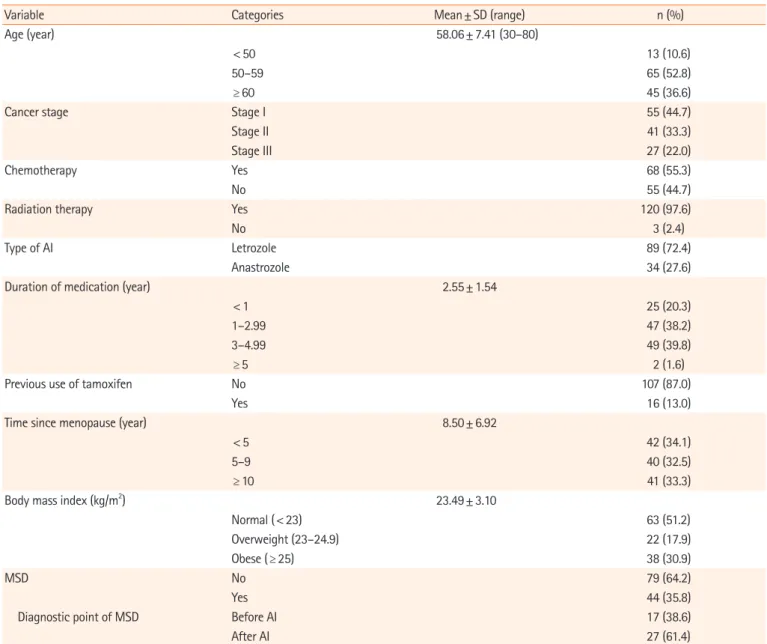
The demographic and clinical characteristics of the 123 respon-dents are shown in Table 1. The mean age of the participants was 58.06 ± 7.41 years, and they ranged in age from 30 to 80 years old. Among AI medications, letrozole (n= 89, 72.4%) was prescribed twice as often as anastrozole (n= 34, 27.6%), reflect-ing clinical practice. The mean duration of AI medication was 2.55 ± 1.54 years and two participants had been taking AI for longer than 5 years. More than one-third of participants (n= 44, 35.8%) had been diagnosed with musculoskeletal diseases and 27 of them (61.4%) reported that the diagnosis was made after
initiating AI medication.
Aromatase inhibitor continuation intention
The mean score of AI continuation intention was 22.28± 4.34, which is interpreted as high (Table 2).
Musculoskeletal pain, fear of cancer recurrence, and beliefs about endocrine therapy
In total, 107 participants (87.0%) reported that they experi-enced newly developed or aggravated musculoskeletal pain after the commencement of AI. The score for the worst pain within 24 hours was 5.08± 2.80, indicating moderate pain requiring ac-tive pain management, and the mean score for the worst, the
Table 1. General characteristics of the participants (N=123)
Variable Categories Mean± SD (range) n (%)
Age (year) 58.06± 7.41 (30–80)
< 50 13 (10.6)
50–59 65 (52.8)
≥ 60 45 (36.6)
Cancer stage Stage I 55 (44.7)
Stage II 41 (33.3)
Stage III 27 (22.0)
Chemotherapy Yes 68 (55.3)
No 55 (44.7)
Radiation therapy Yes 120 (97.6)
No 3 (2.4)
Type of AI Letrozole 89 (72.4)
Anastrozole 34 (27.6)
Duration of medication (year) 2.55± 1.54
< 1 25 (20.3)
1–2.99 47 (38.2)
3–4.99 49 (39.8)
≥ 5 2 (1.6)
Previous use of tamoxifen No 107 (87.0)
Yes 16 (13.0)
Time since menopause (year) 8.50± 6.92
< 5 42 (34.1)
5–9 40 (32.5)
≥ 10 41 (33.3)
Body mass index (kg/m2) 23.49± 3.10
Normal (< 23) 63 (51.2)
Overweight (23–24.9) 22 (17.9)
Obese (≥ 25) 38 (30.9)
MSD No 79 (64.2)
Yes 44 (35.8)
Diagnostic point of MSD Before AI 17 (38.6)
After AI 27 (61.4)
least, the average, and present pain was 3.29± 2.12, indicating mild pain. Musculoskeletal pain was most commonly reported as interfering with mood (4.39± 2.90), sleep (4.26± 3.32), and general activities (4.11± 3.28) (Table 2).
The mean score for FCR was 17.62± 7.14, and 74.0% of par-ticipants had clinically significant FCR (≥ 13). The mean score for beliefs about endocrine therapy was 67.54± 9.49, which is interpreted as high (Table 2).
Aromatase inhibitor continuation intention according to musculoskeletal pain
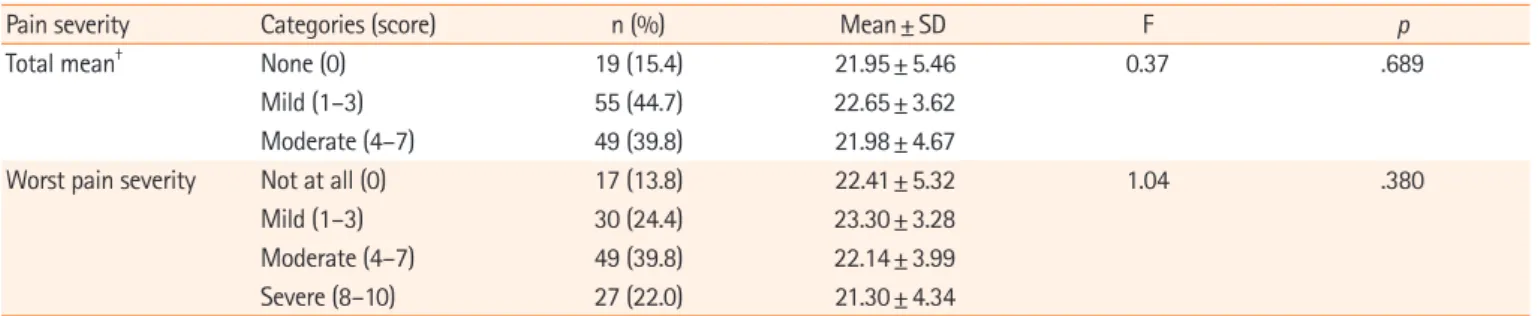
To evaluate the difference in AI continuation intention according to pain severity, the mean scores for the worst, the least, the average, and present pain were classified into three groups; none (score of 0), mild (1–3), and moderate (4–7). There was no mean score greater than 7. The scores for the worst pain within 24 hours were classified into four groups—none (score of 0), mild (1–3), moderate (4–7), and severe (8–10) [25]—because AI continuation intention may be most strongly affected by the worst pain, and the use of a single item for the worst pain severity is also supported by the BPI user guide [26]. The analysis showed that there were no significant dif-ferences in AI continuation intention between the groups (Table 3).
Relationships among aromatase inhibitor continuation intention, musculoskeletal pain, fear of cancer recurrence, and beliefs about endocrine therapy
The correlations among variables are shown in Table 4. A mod-erate correlation was found between AI continuation intention and beliefs about endocrine therapy (r= .66, p<.01). FCR had a
weak relationship with both pain severity (r= .21, p<.05) and
pain interference (r= .35, p<.01). Beliefs about endocrine
ther-apy had a weak relationship with pain interference (r = – .18,
p<.05)
Beliefs about endocrine therapy as a factor influencing aromatase inhibitor continuation intention
Beliefs about endocrine therapy was the only factor that influ-enced AI continuation intention. The regression model was sta-tistically significant (F= 95.66, p<.001), explaining 44% of AI
continuation intention (Table 5). The Durbin-Watson value was 2.027, implying independence of the residual without auto-correlation. The normality of residuals was examined using a histogram and a normal probability plot.
Discussion
Beliefs about endocrine therapy was the only factor with a
statis-Table 2. Aromatase inhibitor continuation intention, musculoskeletal pain, fear of cancer recurrence, and beliefs about endocrine therapy (N=123)
Variable Possible score Mean± SD n (%) Range
AI continuation intention 5–25 22.28± 4.34 123 (100) 5–25
Musculoskeletal pain
Pain severity† 0.25–10 3.29± 2.12 107 (87.0) 0.50–7.00
Worst pain during the last 24 hours 1–10 5.08± 2.80 1–10
Average pain 0–10 3.96± 2.36 1–8
Least pain during the last 24 hours 0–10 2.17± 1.91 0–6
Present pain 0–10 1.93± 2.57 0–9 Pain interference‡ 0.14–10 3.82± 2.66 107 (87.0) 0.14–9.29 Mood 0–10 4.39± 2.90 0–10 Sleep 0–10 4.26± 3.32 0–10 General activities 0–10 4.11± 3.28 0–10 Usual work 0–10 4.06± 3.21 0–10 Enjoyment of life 0–10 3.81± 3.29 0–10 Walking ability 0–10 3.38± 3.15 0–10 Interpersonal relationships 0–10 2.75± 3.24 0–10
Fear of cancer recurrence 0–36 17.62± 7.14 123 (100) 4–35
Clinical level (≥ 13) 13–36 91 (74.0)
Nonclinical level 0–12 32 (26.0)
Beliefs about endocrine therapy 22–88 67.54± 9.49 38–88
†Pain severity=(worst+least+average+present pain)/4; ‡Pain interference=sum of seven-item scores/7.
tically significant effect on AI continuation intention in this study of BCS who reported newly developed or aggravated musculo-skeletal pain since taking AI. This result is comparable to results of previous studies, conducted among BCS either taking AI or tamoxifen, according to which beliefs about endocrine therapy was the most powerful factor affecting medication adherence [4,12] and was associated with intention to take endocrine thera-py [27]. It is also consistent with the finding of a qualitative study that breast cancer patients continuously reassess the necessity of endocrine therapy, its risks, and other options during endocrine therapy, and if they become doubtful about it efficacy they are likely to make a decision to stop taking the medication [3]. The findings of this study thus underscore the need to develop inter-ventions for maintaining and reinforcing beliefs about endocrine therapy during the period which it is prescribed, which is usually 5 years. Further studies that can identify intervention time points, methods, and screening techniques for vulnerable popu-lations will also be beneficial.
The majority of the participants (87%) experienced newly developed or aggravated musculoskeletal pain after taking AI, which is a higher proportion than found in a previous study (73.7%) [28], and the worst pain severity within 24 hours was 5.08± 2.80, suggesting the need for active pain control manage-ment. Musculoskeletal pain severity showed a significant posi-tive correlation with pain interference and FCR. Thus, a multi-disciplinary approach is needed for pain management for newly
developed or aggravated musculoskeletal pain after taking AI. Nevertheless, no significant relationship was found between musculoskeletal pain and AI continuation intention, unlike pre-vious studies conducted in other countries [7,8,18]. In a study done in the USA, musculoskeletal symptoms were highly asso-ciated with early discontinuation of AI (hazard ratio, 4.39; 95% CI, 2.4–8.02; p<.0001) [18] and in a study done in Australia, 68% of BCS reported AI discontinuation due to AI-related mus-culoskeletal pain [8]. In addition, a prior study done in the USA reported that a moderate or higher worst pain score (> 4 on the BPI) was a predictor of premature discontinuation of AIs [7]. The reason for this discrepancy may be related to the high levels of AI continuation intention in the present study, the difficulty in making direct comparisons due to prior studies’ focus on continuation behaviors rather than intention, and the discrepan-cy between intention and behavior. In a previous study conduct-ed to identify prconduct-edictors of thoughts about stopping endocrine treatment (either tamoxifen or AIs), 30% of the participants
re-Table 3. Differences in aromatase inhibitor continuation intention according to pain severity (N=123)
Pain severity Categories (score) n (%) Mean± SD F p
Total mean† None (0) 19 (15.4) 21.95± 5.46 0.37 .689
Mild (1–3) 55 (44.7) 22.65± 3.62
Moderate (4–7) 49 (39.8) 21.98± 4.67
Worst pain severity Not at all (0) 17 (13.8) 22.41± 5.32 1.04 .380
Mild (1–3) 30 (24.4) 23.30± 3.28
Moderate (4–7) 49 (39.8) 22.14± 3.99
Severe (8–10) 27 (22.0) 21.30± 4.34
Number of severe pain category (score≥7) in total mean pain is zero.
†Total mean=(worst+least+average+present pain)/4.
Table 4. Correlations among study variables (N=123)
Variable Pain severity Pain interference Fear of cancer recurrence Beliefs about endocrine therapy
Pain severity 1
Pain interference .48** 1
Fear of cancer recurrence .21* .35** 1
Beliefs about endocrine therapy –.05 –.18* .09 1
AI continuation intention –.03 –.04 .01 .66**
AI: Aromatase inhibitor. *p<.05, **p<.01.
Table 5. Factors influencing aromatase inhibitor continuation intention (N=123)
Variable Model
B SE β t p
(constant) 1.73 2.12 .82 .42
Beliefs about endocrine therapy .31 .03 .66 9.78 < .001 F (p)= 95.66 (< .001), R2= .437, adjusted R2= .442
ported that they considered discontinuing endocrine therapy in addition to the 36% of participants who had already stopped en-docrine therapy, and symptom severity was most strongly asso-ciated with these thoughts [5]. A direct comparison is difficult because different measurement tools were used and 39% of par-ticipants in the previous study were premenopausal women, which may affect symptom severity. However, the intention to continue AIs among those who either discontinued or consid-ered stopping endocrine therapy in that study [5] was presum-ably lower than this study’s level of 22.28± 4.34. Although pre-vious studies [7,18] of AI (non)adherence focused on behavior rather than intention, an accurate identification of BCS who are indecisive about AI continuation would be helpful for prevent-ing premature discontinuation and encouragprevent-ing BCS to com-plete the therapy during the recommended period. Thus, fur-ther research should develop valid tools evaluating intention to continue endocrine therapy and seek to identify vulnerable populations. In addition, the discrepancy between intention and behavior may be relevant. In this study, AI continuation inten-tion was measured instead of adherence (i.e., a behavioral vari-able), considering the lack of reliability and evidence regarding self-reported measures of medication adherence [29]. Although intention to take medication is a predictor of medication adher-ence [6], actual behavior can differ. Thus, other factors should be considered when using intention as a predictor of behavior, and further studies with a longitudinal design are required to evaluate the predictive power of intention on adherence in the context of endocrine therapy with AI.
A significant issue is that 74.0% of participants reported clini-cally significant FCR ( ≥ 13) and the average FCR score (17.62± 7.14) was also higher than the result of a previous study conducted among patients taking AIs (14.8) [14]. Despite the moderate pain severity, the finding of a high degree of FCR in this study is worthy of notice. FCR also had a weak relationship with pain severity and pain interference. This result implies that strategies to deal with FCR should be included in developing multidisciplinary nursing interventions for BCS. Although FCR in this study was higher than found in a previous study, it had no effect on AI continuation intention, which may be related to the high level of beliefs about endocrine therapy found in this study. Since it has been noted that FCR plays a role in endocrine thera-py continuation among BCS with low levels of beliefs about en-docrine therapy [4], further research should explore this inter-play.
This cross-sectional study has several limitations. First, gener-alizability is limited as participants were recruited via conve-nience sampling from a single institution. Second, the
discrep-ancy between AI continuation intention and AI adherence be-havior was not evaluated. Although intentions explain bebe-haviors to some extent, the predictability of actual AI continuation was not evaluated, as AI-taking behavior was not the focus of this study. Third, measurement issues may need to be considered, as the BPI-SF was not specifically developed to assess AI-related musculoskeletal pain and BCS often experience upper body dis-comfort and neuropathy after surgery, chemotherapy, and radia-tion therapy. While the researcher emphasized the aim of assess-ing newly developed or aggravated musculoskeletal pain after taking AI to improve the accuracy of the assessments, it is possi-ble that the measurements may have only partially captured the actual pain that BCS experienced.
Despite the limitations, this study is meaningful from two perspectives. The findings present the current status of AI-relat-ed musculoskeletal pain, as self-reportAI-relat-ed by Korean BCS; to our knowledge, this is a novel contribution. Second, the evaluation of the relationship of musculoskeletal pain to AI continuation intention in a Korean population is also significant, since data indicating low AI adherence have been published from other countries, but the relevance of those findings to nursing practice in Korea has not been clear. This study’s finding can improve clinicians’ understanding of musculoskeletal pain during AI therapy and can be used to develop nursing interventions for musculoskeletal pain management and improving endocrine therapy continuation intention.
In conclusion, beliefs about endocrine therapy was a signifi-cant predictor of AI continuation intention, whereas musculo-skeletal pain during AI therapy did not negatively affect AI con-tinuation intention. The incidence of the pain and the pain se-verity, however, was high enough to require active pain manage-ment in this sample of BCS. Pain also had a moderate positive relationship with pain interference, and had a positive, albeit weak, relationship with FCR. Thus, there is a need to raise awareness and educate patients about the incidence and the se-verity of AI-related musculoskeletal pain and its impact, through educational programs or by distributing educational resources. Nursing interventions that support and reinforce beliefs about endocrine therapy are needed, and incorporating multidisci-plinary pain management may be beneficial.
ORCID
Young Kyung Seo, https://orcid.org/0000-0002-4058-5969 Jeongok Park, https://orcid.org/0000-0003-4978-817X Jin-Hee Park, https://orcid.org/0000-0002-0069-7819 Sue Kim, https://orcid.org/0000-0003-3785-2445
Authors’ contributions
Conceptualization: Seo YK, Kim S; Formal analysis: Seo YK, Kim S; Writing-original draft: Seo YK; Writing-review & edit-ing: all authors.
Conflict of interest
Sue Kim has been editor-in-chief of the Korean Journal of Wom-en Health Nursing since January 2020. She was not involved in the review process of this manuscript. Otherwise, there was no conflict of interest.
Funding
None.Data availability
Please contact the corresponding author for data availability.
Acknowledgments
None.
References
1. Emanuel G, Henson KE, Broggio J, Charman J, Horgan K, Dodwell D, et al. Endocrine therapy in the years following a diagnosis of breast cancer: a proof of concept study using the primary care prescription database linked to cancer registra-tion data. Cancer Epidemiol. 2019;61:185-189. https://doi. org/10.1016/j.canep.2019.04.012
2. Xing P, Dong H, Liu Q, Yao F, Xu Y, Chen B, et al. Impact of persistence on survival of patients with breast cancer treated with endocrine therapy in Northeast China: a prospective study. Oncotarget. 2017;8(60):102499-102510. https://doi. org/10.18632/oncotarget.18454
3. Beryl LL, Rendle KA, Halley MC, Gillespie KA, May SG, Glover J, et al. Mapping the decision-making process for ad-juvant endocrine therapy for breast cancer: the role of deci-sional resolve. Med Decis Making. 2017;37(1):79-90. https:// doi.org/10.1177/0272989X16640488
4. Lambert LK, Balneaves LG, Howard AF, Chia SK, Gotay CC. Understanding adjuvant endocrine therapy persistence in breast Cancer survivors. BMC Cancer. 2018;18(1):732. https:// doi.org/10.1186/s12885-018-4644-7
5. Corter AL, Broom R, Porter D, Harvey V, Findlay M. Pre-dicting nonadherence to adjuvant endocrine therapy in women with early stage breast cancer. Psychooncology. 2018; 27(9):2096-2103. https://doi.org/10.1002/pon.4771
6. Pakpour AH, Gellert P, Asefzadeh S, Updegraff JA, Molloy GJ, Sniehotta FF. Intention and planning predicting medication adherence following coronary artery bypass graft surgery. J Psychosom Res. 2014;77(4):287-295. https://doi.org/10.1016/j. jpsychores.2014.07.001
7. Chim K, Xie SX, Stricker CT, Li QS, Gross R, Farrar JT, et al. Joint pain severity predicts premature discontinuation of aro-matase inhibitors in breast cancer survivors. BMC Cancer. 2013;13:401. https://doi.org/10.1186/1471-2407-13-401 8. Lombard JM, Zdenkowski N, Wells K, Beckmore C, Reaby L,
Forbes JF, et al. Aromatase inhibitor induced musculoskeletal syndrome: a significant problem with limited treatment op-tions. Support Care Cancer. 2016;24(5):2139-2146. https:// doi.org/10.1007/s00520-015-3001-5
9. Park JY, Lee SK, Bae SY, Kim J, Kim MK, Kil WH, et al. Aro-matase inhibitor-associated musculoskeletal symptoms: inci-dence and associated factors. J Korean Surg Soc. 2013;85(5): 205-211. https://doi.org/10.4174/jkss.2013.85.5.205
10. Kim TH, Kang JW, Lee TH. Therapeutic options for aro-matase inhibitor-associated arthralgia in breast cancer survi-vors: A systematic review of systematic reviews, evidence mapping, and network meta-analysis. Maturitas. 2018;118:29-37. https://doi.org/10.1016/j.maturitas.2018.09.005
11. Cahir C, Dombrowski SU, Kelly CM, Kennedy MJ, Bennett K, Sharp L. Women’s experiences of hormonal therapy for breast cancer: exploring influences on medication-taking behaviour. Support Care Cancer. 2015;23(11):3115-3130. https://doi. org/10.1007/s00520-015-2685-x
12. Lee JY, Min YH. Relationships between determinants of adju-vant endocrine therapy adherence in breast cancer. BMC Womens Health. 2018;18(1):48. https://doi.org/10.1186/s12905-018-0522-3
13. Hall DL, Lennes IT, Pirl WF, Friedman ER, Park ER. Fear of recurrence or progression as a link between somatic symp-toms and perceived stress among cancer survivors. Support Care Cancer. 2017;25(5):1401-1407. https://doi.org/10.1007/ s00520-016-3533-3
14. Lopez C, Charles C, Rouby P, Boinon D, Laurent S, Rey A, et al. Relations between arthralgia and fear of recurrence: results of a cross-sectional study of breast cancer patients treated with adjuvant aromatase inhibitors therapy. Support Care Cancer. 2015;23(12):3581-3588. https://doi.org/10.1007/s005 20-015-2722-9
15. Salgado TM, Davis EJ, Farris KB, Fawaz S, Batra P, Henry NL. Identifying socio-demographic and clinical characteristics associated with medication beliefs about aromatase inhibitors among postmenopausal women with breast cancer. Breast Cancer Res Treat. 2017;163(2):311-319. https://doi.org/10. 1007/s10549-017-4177-9
16. Castel LD, Hartmann KE, Mayer IA, Saville BR, Alvarez J, Boom-ershine CS, et al. Time course of arthralgia among women initiat-ing aromatase inhibitor therapy and a postmenopausal compari-son group in a prospective cohort. Cancer. 2013;119(13):2375-2382. https://doi.org/10.1002/cncr.28016
17. Lee YH, Jeong IS. Factors influencing medication adherence to oral anticancer drugs. Asian Oncol Nurs. 2013;13(4):201-209. https://doi.org/10.5388/aon.213.13.4.201
18. Kadakia KC, Snyder CF, Kidwell KM, Seewald NJ, Flockhart DA, Skaar TC, et al. Patient-reported outcomes and early discon-tinuation in aromatase inhibitor-treated postmenopausal women with early stage breast cancer. Oncologist. 2016;21(5):539-546. https://doi.org/10.1634/theoncologist.2015-0349
19. Yun YH, Mendoza TR, Heo DS, Yoo T, Heo BY, Park HA, et al. Development of a cancer pain assessment tool in Korea: a validation study of a Korean version of the brief pain inven-tory. Oncology. 2004;66(6):439-444. https://doi.org/10.1159/ 000079497
20. Cleeland CS, Ryan KM. Pain assessment: global use of the Brief Pain Inventory. Ann Acad Med Singap. 1994;23(2):129-138.
21. Simard S, Savard J. Screening and comorbidity of clinical levels of fear of cancer recurrence. J Cancer Surviv. 2015;9(3):481-491. https://doi.org/10.1007/s11764-015-0424-4
22. Shin J, Goo A, Ko H, Kim JH, Lim SU, Lee HK, Simard S, et al. Validation study for the korean version of Fear of Cancer
Recurrence Inventory. J Korean Med Sci. 2017;32(11):1792-1799. https://doi.org/10.3346/jkms.2017.32.11.1792
23. Simard S, Savard J. Fear of Cancer Recurrence Inventory: devel-opment and initial validation of a multidimensional measure of fear of cancer recurrence. Support Care Cancer. 2009;17(3):241-251. https://doi.org/10.1007/s00520-008-0444-y
24. Kim SH. Development of an adjuvant endocrine therapy be-liefs scale for breast cancer survivors [dissertation]. Seoul: Yonsei University; 2019 . 215p.
25. Shim HY, Park M, Kim HJ, Kyung HS, Shin JY. Physical ac-tivity status by pain severity in patients with knee osteoarthri-tis: a nationwide study in Korea. BMC Musculoskelet Disord. 2018;19(1):380. https://doi.org/10.1186/s12891-018-2301-6 26. Cleeland CS. The brief pain inventory user guide. Houston
(TX): MD Anderson Cancer Center; 2009.
27. Heisig SR, Shedden-Mora MC, von Blanckenburg P, Rief W, Witzel I, Albert US, et al. What do women with breast cancer expect from their treatment? Correlates of negative treatment expectations about endocrine therapy. Psychooncology. 2016;25(12):1485-1492. https://doi.org/10.1002/pon.4089 28. Boonstra A, van Zadelhoff J, Timmer-Bonte A, Ottevanger PB,
Beurskens CH, van Laarhoven HW. Arthralgia during aro-matase inhibitor treatment in early breast cancer patients: prev-alence, impact, and recognition by healthcare providers. Cancer Nurs. 2013;36(1):52-59. https://doi.org/10.1097/NCC.0b013e-31824a7e18
29. de Mendoza AH, Cabling M, Dilawari A, Turner JW, Fernán-dez N, Henderson A, et al. Providers’ perspectives on adher-ence to hormonal therapy in breast cancer survivors. is there a role for the Digital Health Feedback System? Health Technol (Berl). 2019;9(2):175-184. https://doi.org/10.1007/s12553-018-0267-x