Extension of Proxy Mobile IPv6 with Bicasting for Support of Multi-homing and
Mobility in Wireless Networks
Ji In Kim
School of Electrical Engineering and Computer Science Kyungpook National University
Daegu, Korea [email protected]
Seok Joo Koh
School of Electrical Engineering and Computer Science Kyungpook National University
Daegu, Korea [email protected]
Abstract—This paper proposes an extension of Proxy Mobile
IPv6 (PMIPv6) with bicasting for multi-homing and mobility support. In the proposed scheme, the Local Mobility Anchor (LMA) extends its Binding Cache Entry (BCE) for support of multiple bindings, and a mobile node (MN) performs the binding update to LMA. To support the handover, the LMA begins the bicasting of data packets to the New-Mobile Access Gateway (N-MAG) as well as Previous-Mobile Access Gateway (P-MAG). The proposed scheme is compared with the existing PMIPv6 handover by ns-2 simulations. From the numerical analysis, we can see that the proposed scheme can reduce the possible packet losses and handover latency, compared to the existing scheme, during handover in the multi-homing environment.
Keywords-PMIPv6; multi-homing; bicasting; handover;
I. INTRODUCTION
The Mobile IPv6 (MIPv6) can be used to support the IP handover in mobile networks [1]. However, there are still a lot of challenging issues to be addressed in MIPv6. One of them is how to reduce the modification of mobile node (MN). For example, to perform the mobility management signaling, each MN should be equipped with the MIPv6 functionality. Such a protocol is referred to ‘host-based mobility’ protocol.
In the wireless network environment, however, it is not effective that each MN performs the MIPv6 due to scarce resources in wireless networks such as network bandwidth or MN power. Above all, it is not easy for MN to implement any mobility software such as MIPv6.
Recently, the Proxy Mobile IPv6 (PMIPv6) protocol was standardized for network-based IP mobility in the Internet Engineering Task Force (IETF) [2]. In PMIPv6, the mobile agent located in the network will perform the mobility signaling instead of MN, and will keep track of movement of MN.
It is noted that the PMIPv6 is used mainly for binding update of locations of MNs. A recent work has been made on the PMIPv6 handover. However, there are still lots of issues that need to be solved in the perspective of seamless handover.
On the other hand, one of the primary issues for mobile networking is the multi-homing, in which MN has multiple
network interfaces, e.g., WLAN and 3G network. However, it is noted that the current PMIPv6 was originally designed without consideration of multi-homing.
This paper proposes an extensive handover scheme of PMIPv6 with bicasting for multi-homing and mobility support, in which the PMIPv6 Local Mobility Anchor (LMA) will update its binding cache entry (BCE) and bicast the data packets both to the Previous-Mobile Access Gateway (P-MAG) and New-Mobile Access Gateway (N-MAG) toward MN, when MN is in the handover region.
This paper is organized as follows. Section II describes the related works on PMIPv6 handover and multi-homing. In Section III, we present the proposed scheme of PMIPv6 with bicasting for multi-homing and mobility support. In Section IV, the proposed scheme is analyzed and compared with the existing schemes. Section V concludes this paper.
II. REALTED WORKS
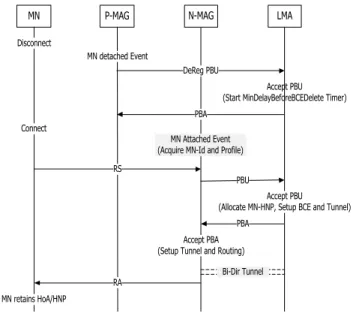
Fig. 1 shows the basic operations of PMIPv6, in which MN moves from P-MAG to N-MAG.
MN P-MAG LMA
Disconnect
DeReg PBU
Accept PBU (Start MinDelayBeforeBCEDelete Timer) PBA RA MN retains HoA/HNP N-MAG Connect MN Attached Event (Acquire MN-Id and Profile)
Accept PBU (Allocate MN-HNP, Setup BCE and Tunnel)
PBA Accept PBA (Setup Tunnel and Routing)
PBU
Bi-Dir Tunnel RS
MN detached Event
Figure 1. PMIPv6 handover operation
2011 Workshops of International Conference on Advanced Information Networking and Applications
978-0-7695-4338-3/11 $26.00 © 2011 IEEE DOI 10.1109/WAINA.2011.96
When MN changes its point of attachment, the P-MAG will detect the MN’s detachment and will perform the Proxy Biding Update (PBU) operations with the LMA to remove the binding and routing states associated with MN.
Upon receiving this PBU (DeReg PBU) request, the LMA will identify the corresponding BCE entry and accept the request. After that, it expects to receive the PBU message of the N-MAG for some time. In this period, a certain amount of handover latency occurs. During this handover period, some packet losses may occur. Accordingly, it is not easy to achieve seamless handover.
In the multi-homing environments, it is assumed that the home network prefix of each interface is established when the mobility session is first created for a given interface [3]. Accordingly, it is impossible to create multiple binding entries to a given interface in PMIPv6. To solve this problem, we will extend the binding cache entry of LMA, so as to bind a home network prefix to several proxy-CoAs related to the same MN [4].
III. PMIPV6 WITH BICASTING
To describe the proposed scheme, we will extend the PMIPv6 handover scheme and the binding cache entry of LMA, which can be used to reduce the packet loss and handover latency during handover in the mobile and multi-homing networks.
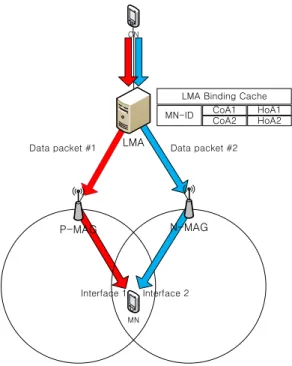
Fig. 2 shows the reference network configuration and the extension of binding cache entry in the proposed scheme.
ͺΟΥΖΣΗΒΔΖ͑͢ ͺΟΥΖΣΗΒΔΖ͑ͣ ;Ϳ Ϳ͞;Ͳ ͵ΒΥΒ͑ΡΒΔΜΖΥ͔͑͢ ͽ;Ͳ ͞;Ͳ ͵ΒΥΒ͑ΡΒΔΜΖΥ͔͑ͣ ʹͿ ͽ;Ͳ͑ͳΚΟΕΚΟΘ͑ʹΒΔΙΖ ;Ϳ͞ͺ͵ ʹΠͲ͢ ʹΠͲͣ ΠͲ͢ ΠͲͣ
Figure 2. PMIPv6 with Bicasting and BCE Extension for multi-homing support
In this figure, MN moves from the P-MAG region to the N-MAG region. We suppose that there is an overlapping region between MAGs. When MN is in the overlapping
region, the multi-homing MN has the two network interfaces, interface 1 (IF1) to P-MAG and interface 2 (IF2) to N-MAG. Let us assume that IF1 of MN (P-MAG) first turns on, and the LMA assigns the home network prefix 1 to IF1. The MN initiates communications with Correspondent Node (CN), and sends and receives the data packets destined to Home Network Prefix 1 (HNP1) via IF1. Then, the IF2 detects N-MAG, and the IF2 becomes available to N-MAG.
After that, the LMA will begin the bicasting of data packets to N-MAG as well as P-MAG through the two interfaces. The bicasting will be performed to minimize the possibility of packet losses and handover latency during handover, because MN can receive the data packet from any of the P-MAG and N-MAG.
Fig. 3 shows the operations of the proposed scheme.
MN P-MAG N-MAG LMA
PBA(Bicasting Ack)
MN-MAG connection establishment Handover Init Link-layer signaling PBU(Bicasting Init) Disconnect Connect Bi-Dir Tunnel Data packets Data packets PBU (de-registation) Bi-Dir Tunnel Accept PBU (Delete HNP1 to IF1 in BCE) ~~~~
~~~~
PBA (Bicasting Stop) Data packets Data packets
Handover Init Ack
Accept PBU (Allocate HNP1 to IF2 in BCE)
Figure 3. PMIPv6 with Bicasting Operation
First, when MN moves to the bicasting region, it detects that a handover is imminent, and thus it performs the link-layer signaling. The P-MAG sends Handover Init (HI) message to N-MAG, where HI messages includes the MN’s IP addresses that are Proxy-CoA (P-CoA), Home address (MN-HoA), LMA address (LMAA), MN’s Identifier, and HNP. When the N-MAG receives HI message, it should examine whether a tunnel to LMA exists or not. If the tunnel has not been established, it should establish the tunnel with LMA.
To establish the tunnel, the N-MAG sends a PBU (with Bicasting Init) message to LMA, which includes MN-Identifier, MN-HoA, and HNP.
When LMA receives the PBU (Bicasting Init) message, it creates a new binding cache entry or modifies the existing binding cache entry [5,6]. If the LMA successfully processes the PBU (Bicasting Init), it sets the tunnel with N-MAG to send and receive the data packets. After successful establishment of the tunnel, the LMA sends a PBA
(Bicasting Ack) message to indicate whether or not the PBU (Bicasting Init) message was processed successfully. If there is a failure, the PBA (Bicasting Ack) message indicates the failure. Otherwise, N-MAG creates a tunnel to LMA and ensures that the data packets with the destination address as Proxy CoA are copied and forwarded to LMA over the tunnel. It also creates a host route for forwarding packets to the MN.
When MN connects to the new link, it establishes a physical link connection with N-MAG (for example, radio channel assignment), which in turn triggers the establishment of a link-layer connection with the N-MAG. An IP layer connection setup may be performed at this time. This step can be a substitute for Unsolicited Neighbor Advertisement (UNA) in [7]. The more details are all access technology specific and thus outside the scope of this paper.
Then, the N-MAG sends a Handover ACK message back to the P-MAG to indicate whether the handover procedure was successfully done or not. The N-MAG sends a PBU (De-registration) message to LMA. This message includes MN-identifier and P-CoA of N-MAG. On reception of this PBU message, the LMA deletes the HNP1 of IF1 in the binding cache entry, and stop the bicasting (i.e., release the tunnel between LMA and P-MAG). In response to PBU (De-registration) message, the LMA sends PBA (Bicasting Stop) message to P-MAG. By this, the bicasting operations are completed.
IV. PERFORMANCE ANALYSIS
In this section, we analyze the performance of the existing PMIPv6 handover and the proposed handover scheme. First, let us compare the features of the candidate schemes, PMIP, PMIP-M (PMIP with multi-homing), and the proposed PMIP with bicasting and multi-homing.
The normal PMIPv6 induces the handover latency that consists of Movement Detection (MD) delay and Proxy Binding Update (PBU) delay. However, the PMIPv6 with multi-homing (PMIP-M) gives less handover delay and packet loss than PMIPv6, since the multi-homing MN has several HNPs each interfaces. Finally, the proposed scheme can reduce the handover latency much more, since it uses multiple interfaces and bicasting of data packets to the old and new MAGs toward MN.
Note that in the proposed scheme MN will not release the connection to P-MAG before the handover completion. Thus, the proposed scheme prevents the packet loss that may occur due to a wrong prediction of MN’s movement or handover.
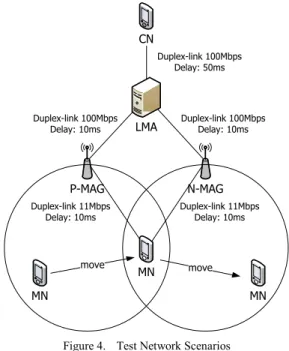
Now, we describe the experimental result for PMIPv6 and proposed scheme using the Network Simulator-2 (NS-2) [8]. In simulation, we consider the MN moves from P-MAG domain to N-MAG domain.
In the test network, MN is initially connected to P-MAG. After 10 seconds in the experiment, we enforced the MN to perform L2 handover to N-MAG. In the proposed scheme, P-MAG detects the MN’s movement at 9.5s, and N-MAG detects the handover completion at 11s. We use the IEEE 802.21 Media Independent Handover (MIH) [9] so as to implement the link-layer triggers from access network.
N-MAG P-MAG MN LMA CN Duplex-link 100Mbps Delay: 50ms Duplex-link 100Mbps Delay: 10ms Duplex-link 100Mbps Delay: 10ms Duplex-link 11Mbps Delay: 10ms Duplex-link 11Mbps Delay: 10ms MN MN move move
Figure 4. Test Network Scenarios
As shown the figure, the wired link between CN and LMA is configured with a network bandwidth of 100 Mbps and link delay of 50ms, and the wired links between LAM and MAGs have the bandwidth of 100 Mbps and transmission delay of 10ms. On the other hand, the wireless links between MAGs and MN are configured with the bandwidth of 11 Mbps and link delay of 10ms. During the simulation, CN transmits CBR packets with UDP packet size of 1,000 bytes at a transmission rate of 100 packets per second.
Fig. 5 shows the simulation results, in which the handover delays and packet losses are depicted for the three schemes.
Figure 5. Trace of Data Packets Transmitted during Simulation From the figure, we can see that the PMIPv6 handover incurs more packet losses and larger handover delays than the other handover scheme using bicasting, PMIPv6-M and proposed scheme. On the other hand, the proposed scheme provides lower handover delays and packet losses.
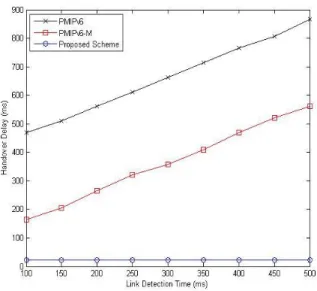
Figure 6. Comparison of Handover Delays during Handover Fig. 6 compares the handover delays of the three handover schemes for different link detection times. In the figure, we can see that as the link detection time increases, the handover delays get larger for PMIPv6 and PMIPv6-M schemes. On the other hand, the proposed scheme gives almost zero handover latency, even though the link detection time is large. This is because the proposed scheme predicts the handover and bicasts the data packet in advance.
Figure 7. Comparison of Packet Losses during Handover
Fig. 7 shows the number of data packets that have been lost during handover. From the figure, we can see the existing handover schemes (PMIPv6 and PMIPv6-M) incur some packet losses, ant the amount of lost packets get larger, as the link detection time increases. In the meantime, the proposed scheme gives almost zero packet loss.
V. CONCLUSIONS
This paper proposed an extension handover scheme of the PMIPv6 with bicasting for multi-homing and mobility, in which the PMIPv6 binding update is performed in advance and then LMA performs the bicasting of data packets to the N-MAG as well as P-MAG. The LMA is extended to support the multiple Binding Cache Entry (BCE).
From the experimental results, it is shown that the proposed scheme can give smaller handover latency than PMIPv6. This is because the proposed scheme receives the data packet from both P-MAG and N-MAG during handover through any of the multiple interfaces.
ACKNOWLEDGMENT
This research was supported by the IT R&D program of MKE/KEIT(10035245: Study on Architecture of Future Internet to Support Mobile Environments and Network Diversity) and the ITRC program of MKE/NIPA(NIPA-2010-C1090-1021-0002).
REFERENCES
[1] D. Johnson, C. Perkins, J. Arkko, “Mobility Support in IPv6”, IETF RFC 3775, June 2004.
[2] S. Gundavelli, K. Leung, V. Devarapalli, K. Chowdhury, B. Patil, “Proxy Mobile IPv6”, IETF RFC 5213, August 2008.
[3] M. Jeyatharan, C. Ng, “Multihoming Problem Statement in NetLMM”, IETF Internet Draft draft-jeyatharan-netext-multihoming-ps-02, March 2010.
[4] M. Hui, H. Deng, “PMIPv6 Multihoming Extension and Synchronization in LMA and MAG”, IETF Internet Draft draft-hui-netext-multihoming-01, March 2010.
[5] M.S. Bargh, B. Hulsebosch, H. Eertink, G. Hedijenk, J. Idserda, J. Laganier, A. R. Prasad, A. Zugenmaier, “Reducing handover latency in future IP-based wireless networks: Proxy Mobile IPv6 with Simultaneous Bindings”, WoWMoM 2008, June 2008.
[6] M. Liebsch, A. Muhanna, O. Blume, “Transient Binding for Proxy Mobile IPv6”, IETF Internet Draft draft-ietf-mipshop-transient-bce-pmipv6-06, July 2010.
[7] R. Koodli, Ed., “Mobile IPv6 Fast Handovers”, IETF RFC 5568, July 2009.
[8] NS-2 Network Simulator, http://www.isi.edu/nsnam/ns [9] IEEE 802.21, Media Independent Handover Services