ICCAS2005 June 2-5, KINTEX, Gyeonggi-Do, Korea
Design of observer for a class of Lipschitz nonlinear systems
H.-L. Choi and J.-T. LimDepartment of Electrical Engineering, KAIST, Daejeon, 305-701, Korea (Tel: +82-42-869-3441; Fax: +82-42-869-3410; Email: [email protected])
Abstract: The problem of observer design for a class of Lipschitz nonlinear systems is considered. We propose a new observer design method which takes into account the structure of perturbed nonlinear terms with a scaling factor ². An example is provided to demonstrate the usefulness of our result over the existing method.
Keywords: Nonlinear observer design; exponential stability 1. Introduction
The observer design for nonlinear systems has received much attention [1]-[5]. In particular, for Lipschitz nonlinear sys-tems, the optimal design method of the observer gain L is proposed [4] for the purpose of maximizing the allow-able Lipschitz constant (denoted as γ) imposed on the per-turbed nonlinear terms. This result is later extended to sys-tems where the reduced-order observer exists with the same bound on the Lipschitz constant [5]. However, the obtained bound on γ is usually small because they try to maximize
γ < 1/(2λmax(P )) where the positive definite matrix P is a
unique solution of the Lyapunov equation [4]-[5].
In this paper, we propose a new observer design method which takes into account the structure of perturbed nonlinear terms with a scaling factor ². We show that for a certain class of Lipschitz nonlinear systems, the conservative bound on γ can be much relaxed. Moreover, we show that the scaling factor ² can be properly tuned from low-gain to high-gain depending on the nature of the perturbed terms. This is a different result from [1]-[3] where only the design of high-gain observer is addressed.
Throughout the paper, the Euclidean 2-norm is used. Oth-erwise, it will be specifically denoted by subscript.
2. Review
In this section, we review the recent result on designing the observer for Lipschitz nonlinear systems [4] The system un-der consiun-deration in [4] is
˙x = Ax + Φ(x, u)
y = Cx (1)
where x ∈ Rn, u ∈ R and y ∈ R are the state, the input, and
the output respectively. Moreover, the system satisfies that (i) (A, C) is observable; (ii) kΦ(x, u) − Φ(ˆx, u)k ≤ γkx − ˆxk.
The observer is in the form of
˙ˆx = Aˆx + Φ(ˆx, u) + L(y − C ˆx) (2) Theorem 1: [4] For (1), the observer given by (2) is asymp-totically stable if L is chosen such that (i) A − LC is stable; (ii) min
w∈R+σmin(A − LC − jwI) > γ.
This paper is supported by the Satellite Technology Research Center, KAIST.
Observation: Theorem 1 provides the sufficient condition on
the Lipschitz constant γ, which guarantees the asymptotic stability of the observer for a general Lipschitz nonlinear system (1). However, the obtained bound on γ by Theorem 1 is usually small (i.e. γ < 1). In the following, we show that for a certain class of Lipschitz nonlinear systems, the conservativeness in obtaining the bound on γ can be much relaxed.
3. Main Results
We consider a class of Lipschitz nonlinear systems given by ˙x = Ax + Φ(x, u)
y = Cx (3)
where x ∈ Rn, u ∈ R and y ∈ R are the state, the input,
and the output, respectively. Moreover, the perturbed non-linear term is Φ(x, u) = [φ1(x, u), · · · , φn(x, u)]T∈ Rn. The
system matrices are
A = 0 1 0 · · · 0 0 0 1 · · · 0 .. . ... ... . .. ... 0 0 0 · · · 1 0 0 0 · · · 0 , C = h 1 0 · · · 0 0 i
For a nonlinear term Φ(x, u), we assume that there exists a function γ(²) ≥ 0 such that for any ² > 0
kE(²) (Φ(x, u) − Φ(ˆx, u)) k ≤ γ(²)kE(²) (x − ˆx) k (4) where E(²) = diag[1, ², · · · , ²n−1].
Our nonlinear observer is
˙ˆx = Aˆx + L(²)(y − C ˆx) + Φ(ˆx, u) (5) where L(²) = [l1
², · · · , ln
²n]T with ² > 0. Observer design procedure:
(i) Obtain a function γ(²) that satisfies (4).
(ii) Select L = [l1, · · · , ln]T such that AL := A − LC is
Hurwitz.
(iii) Obtain the solution P of the Lyapunov equation ATLP + P AL= −I.
(iv) Select ² such that ²−1− ργ(²) > 0 where ρ = 2kP k.
Theorem 2: For (3), the observer given by (5) is exponen-tially stable if there exist L and ² such that AL is Hurwitz
and ²−1− ργ(²) > 0.
Proof: Define e := x − ˆx. By subtracting (5) from (3), the
error dynamics is
˙e = AL(²)e + Φ(x, u) − Φ(ˆx, u) (6) where AL(²) = A − L(²)C.
Since AL is Hurwitz, we have a Lyapunov equation ATLP + P AL = −I. With the matrix E(²) as
de-fined above, we have the following equalities: ²AL(²) = E(²)−1ALE(²), AT
L(²)P (²) + P (²)AL(²) = −²−1E2(²), and P (²) = E(²)P E(²). Now we set a Lyapunov function
V (e) = eTP (²)e. Then, along the trajectory of (6),
˙
V (e) = −²−1kE(²)ek2+ 2eTE(²)P E(²) (Φ(x, u) − Φ(ˆx, u)) ≤ −²−1kE(²)ek2
+2kP kkE(²)ekkE(²) (Φ(x, u) − Φ(ˆx, u)) k (7) Here, from (4), we have kE(²) (Φ(x, u) − Φ(ˆx, u)) k ≤ γ(²)kE(²)ek. This leads to
˙
V (e) ≤ −N kE(²)ek2, N = ²−1− ργ(²) > 0 (8)
Also, note that
λmin(P )kE(²)ek2≤ V (e) ≤ λmax(P )kE(²)ek2 (9)
From (8) and (9),
V (e) ≤ V (e(0))e−λmax(P )N t (10)
Then, using (9) and (10),
λmin(P )kE(²)ek2≤ V (e) ≤ λmax(P )kE(²)e(0)k2e− N λmax(P )t (11) which leads to kE(²)ek ≤ kE(²)e(0)k s λmax(P ) λmin(P )e − N 2λmax(P )t (12)
Thus, the state e converges to zero exponentially. ¤ The significance of Theorem 2 over Theorem 1 becomes clear if we consider the following two cases which represent the models of several practical systems [3]:
(a) (Triangular-Type Lipschitz Term): For i = 1, · · · , n,
there exists a constant γ ≥ 0 such that |φi(x, u) − φi(ˆx, u)| ≤ γ(|x1− ˆx1| + · · · + |xi− ˆxi|).
(b) (Feedforward-Type Lipshitz Term): For i = 1, · · · , n−2,
there exists a constant γ ≥ 0 such that |φi(x, u) − φi(ˆx, u)| ≤ γ(|xi+2− ˆxi+2|+· · ·+|xn− ˆxn|) with φn−1(x, u) = φn(x, u) =
0.
Theorem 3: Suppose that either the condition (a) or (b) is satisfied. Then, for (3), the observer given by (5) is expo-nentially stable for any finite constant γ.
Proof: Since ALcan be made Hurwitz by L, we only need to show that there exist some ² such that ²−1− ργ(²) > 0. Note
that for vectors X ∈ Rn and Y ∈ Rn, if kXk
1 ≤ γkY k1
holds, then kXk ≤ √nγkY k holds. With this property,
under the condition (a), it is easy to obtain that γ(²) =
√
nγ(1 + ² + · · · + ²n−1). Thus, for any finite constant γ,
there exists ²∗ such that ²−1− ργ(²) > 0 for 0 < ² < ²∗.
Similarly, under the condition (b), it is easy to obtain that
γ(²) =√nγ(²−2+· · ·+²−(n−1)). Thus, for any finite constant γ, there exists ²∗such that ²−1− ργ(²) > 0 for ²∗< ² < ∞.
¤
Under the condition (a), the proposed observer becomes a high-gain observer as studied in [1]-[3]. However, under the condition (b), it becomes a ‘low-gain’ observer, which has not been addressed in [1]-[3].
4. Illustrative example The example used in [4] is A =
" 0 1 1 −1 # and C = h 0 1 i
. In [4], the obtained bound on γ is 0.49. If Φ(x, u) = [−10sat(x1), x2sin u]T, the observer design
method in [4] is not applicable. To apply our method, we rename the states such as z1 = x2 and z2 = x1. Then, we
have ˙z = " 0 1 0 0 # z + " z1sin u − z1 −10sat(z2) # y = h 1 0 i z (13)
Now, we design a nonlinear observer by the proposed method.
(i) In view of (4), we have |φ1(z, u) − φ1(ˆz, u)| ≤ |z1− ˆz1|
and |φ2(z, u) − φ2(ˆz, u)| ≤ 10|z2 − ˆz2|. Thus, we obtain γ(²) = 10√2 = 14.1421.
(ii) Select L = [−4, −4]T (all eigenvalues of A
Lat −2). (iii) The solution of Lyapunov equation is P = "
0.1562 0.1250 0.1250 1.1250
# .
(iv) We have ρ = 2kP k = 2.2817. Thus, the range of ² is
0 < ² < ²∗:= 1/(ργ(²)) = 0.0310. We select ² = 0.03.
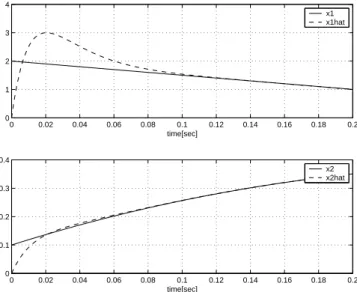
The simulation is performed with u = 0. The initial con-ditions are set as x1(0) = 2, x2(0) = 0.1, ˆx1(0) = 0, and
ˆ
x2(0) = 0. In Fig. 1, it is shown that the proposed observer
dominates the nonlinear terms and achieves the exponential tracking of the real state.
5. Conclusions
We have presented the new result on designing an observer for a class of Lipschitz nonlinear systems. Utilizing the scal-ing factor coupled with the structure of Lipschitz nonlinear terms, we obtain a much relaxed bound on the Lipschitz constant γ over the existing method.
References
[1] A. N. Atassi and H. K. Khalil, “Separation results for the stabilization of nonlinear systems using different high-gain observer designs,” Sys. & Contr. Lett., vol. 39, no. 3, pp. 183-191, 2000.
[2] N. H. Jo and J. H. Seo, “Input output linearization approach to state observer design for nonlinear system,”
IEEE Trans. Automat. Contr., vol. 45, no. 12, pp.
2388-2393, 2000. 2100
[3] H. K. Khalil, Nonlinear systems, 3rd Ed. Prentice Hall, 2002.
[4] R. Rajamani, “Observers for Lipschitz nonlinear sys-tems,” IEEE Trans. Automat. Contr., vol. 43, no. 3, pp. 397-401, 1998.
[5] F. Zhu and Z. Han, “A note on observers for Lipschitz nonlinear systems,” IEEE Trans. Automat. Contr., vol. 47, no. 10, pp. 1751-1754, 2002. 0 0.02 0.04 0.06 0.08 0.1 0.12 0.14 0.16 0.18 0.2 0 1 2 3 4 time[sec] x1 x1hat 0 0.02 0.04 0.06 0.08 0.1 0.12 0.14 0.16 0.18 0.2 0 0.1 0.2 0.3 0.4 time[sec] x2 x2hat
Fig. 1. Observer performance: real state and its estimate.