P1-34 / Y.-H. Seo
IMID 2009 DIGEST •
Abstract
New polyesters with bent-shaped mesogens were synthesized varying the central unit with 1,6- and 2,3-naphthylenes, and introducing the dodecamethylene flexible spacer. The mesogenic properties of the polymers were characterized by FT-IR spectroscopy, DSC, polarizing optical microscopy.
1. Introduction
Thermotropic liquid crystals are commonly composed of linear molecules, because their structural linearities can give an advantage in the formation of mesophases. However, since Niori et al.[1] observed
the first obvious example of ferroelectricity in a smectic phase formed by achiral bent-shaped molecules, unconventional liquid crystals with bent-shaped structures have been reported by a number of research groups[2]. The bent-shaped mesogens are the first ferroelectric and antiferroelectric liquid crystals realized without introducing chirality[3]. It was known that even when the bent-shaped mesogens do not contain achiral unit, their tilted smectic mesophases can show the chirality due to decrease of molecular symmetry and the ferroelectricity due to spontaneous polari-zation. Since this discovery, a number of achiral bent-shaped compounds have been studied extensively in order to investigate the relationship between the structure and property. However, research on bent-shaped liquid crystal polymers is still limited. A few bent-shaped liquid crystal polymers have been reported. In this study, we have synthesized two bent-shaped liquid crystal polymers containing a naphthylene central core, all ester linking groups and
the dodecamethylene flexible spacer, and their mesomorphic properties were investigated.
2. Experimental
Synthesis. Synthetic route of polymers is shown in
Scheme 1. Since the synthetic procedures used to prepare the polymers were essentially same, one representative polymer is given in the following. All spectral data of the other compounds ate also included.
Synthesis of 1,6-bis(4-(phenylmethyloxy)benzoyl-oxy) naphthylene. 4-Benzyloxybenzoic acid (2.28g,
10.00mmol) was dissolved in 50 ml of chloroform and 4-dimethylaminopyridine (DMAP) (0.13g, 1.00mmol), N, N’-dicyclohexyl-carbodiimide (DCC) (2.06g, 10.00mmol) and 1,6-dihydroxy naphthalene (0.80g , 5.00mmol) were added. The mixture was stirred at room temperature for 24 hours. After the reaction, the formed precipitated N, N’-dicyclohexylurea was filtered off, and the filtrate was diluted with chloroform (50ml). This solution was washed with 5% aqueous acetic acid (3×100ml) and water (3×100ml), and then dried over anhydrous Na2SO4. After the
solvent was evaporated, the residue was purified by column chromatography on silica gel using ethyl acetate in chloroform (2:98, v/v) as eluent. Removal of solvent from the eluate afforded a white solid. This solid was recrystallized from a mixture of chloroform and acetonitrile (4:6, v/v). Yield: 34.9%. FT-IR (KBr Pellet, cm-1): 3150 (Aromatic C-H stretch), 2850,
3000 (Aliphatic C-H stretch), 1750 (Conj. C=O stretch), 1610 (Aromatic C=C stretch), 1260 (C-O-C symmetry stretch), 1100 (C-O-C asymmetry stretch).
1H NMR (S = CDCl
3, δ in ppm): 8.22 (d, 5H, Ar-H),
7.45-7.72 (s, 10H, Ar-H), 7.39 (m, 2H, Ar-H), 7.09 (d,
Synthesis and Properties of Polyesters with Bent-Shaped
Mesogens Containing Naphthalene Central Unit
Young-Ho Seo, E-Joon Choi
*Department of Polymer Science and Engineering, Kumoh National
Institute of Technology
Phone: +82-54-478-7684 , E-mail: [email protected]
P1-34 / Y.-H. Seo
• IMID 2009 DIGEST
6H, Ar-H), 7.01 (m, 1H, Ar-H), 5.20 (s, 4H, Ar-CH2
-O).
Synthesis of 2,3-bis(4-(phenylmethyloxy)benzoyl-oxy) naphthylene. Yield: 42.0%. FT-IR (KBr Pellet,
cm-1): 3050-3150 (Aromatic C-H stretch), 2850
(Aliphatic C-H stretch), 1740 (Conj. C=O stretch), 1590 (Aromatic C=C stretch), 1259 (C-O-C symmetry stretch), 1080 (C-O-C asymmetry stretch). 1H NMR
(S = CDCl3, δ in ppm): 8.03 (d, 4H, Ar-H), 7.58 (m, 2H, H), 7.19 (s, 10H, H), 6.84-6.92 (d, 8H, Ar-H), 5.20 (s, 4H, Ar-CH2-O).
Synthesis of 1,6-bis(4-(hydroxy)benzoyloxy) naphthylene.
1,6-bis(4-(phenylmethyloxy)benzoyl-oxy) naphthylene (1.10g, 1.70mmol) was dissolved in 1,4-dioxane (50ml), and 10% Pd-C catalyst (1.20g) was added. The mixture was stirred at 50℃ in an atmosphere of hydrogen till the required quantity of hydrogen was absorbed. The mixture was hot filtered and the filtrate was concentrated using a rotatory evaporator. The crude product of solid residue was reprecipitated using a mixture of 1,4-dioxane and petroleum ether. Yield: 88.3%; FT-IR (KBr Pellet, cm-1); 3350 (OH), 3050 (Aromatic C-H stretch), 2900 (Aliphatic C-H stretch), 1750 (Conj. C=O stretch), 1600 (Aromatic C=C stretch), 1350 (C-O stretch); 1H NMR (S = Acetone-d, δ in ppm); 8.03 (d, 4H, Ar-H), 7.83 (d, 1H, Ar-H), 7.45 (m, 2H, Ar-H), 7.12 (m, 2H, Ar-H) 6.88-7.03 (m, 5H, Ar-H), 4.6 (s, 2H, OH).
Synthesis of 2,3-bis(4-(hydroxy)benzoyloxy) naphthylene. Yield: 73.1%; FT-IR (KBr Pellet, cm-1);
3406 (OH), 3050 (Aromatic C-H stretch), 2850 (Aliphatic C-H stretch), 1690 (Conj. C=O stretch), 1610 (Aromatic C=C stretch), 1259 (C-O stretch); 1H
NMR (S = Acetone-d, δ in ppm); 7.97 (d, 4H, Ar-H), 7.45 (m, 2H, Ar-H), 7.12 (d, 2H, Ar-H), 6.85 (t, 6H, Ar-H).
Synthesis of 1,12-bis(4-(hydroxycarbonyl)phenoxy) dodecane. 4-hydroxybenzoic acid (1.93g. 14mmol)
was dissolved in DMF (150ml), and K2CO3 (3.86g)
was added. The mixture was stirred at 50℃. After 30min 1,12-dibromododecane (2g, 6.28mmol) was added and the mixture was stirred at 130℃ for 8 h. After reaction this solution was precipitated in excess distilled water. The precipitate was collected by filteration and recrystallized from acetic acid. Yield: 91.4%; FT-IR (KBr Pellet, cm-1); 2300-3300 (COOH), 2850 (Aliphatic C-H stretch), 1690 (Conj. C=O stretch), 1610 (Aromatic C=C stretch), 1259 (C-O stretch); 1H NMR (S = DMSO-d
6, δ in ppm); 8.02 (d,
4H, H), 6.98 (d, 4H, H), 3.94 (t, 4H, Ar-OCH2CH2), 1.71 (m, 4H, OCH2CH2CH2), 1.29 (m,
16H, Ar-OCH2CH2(CH2)2).
Polymerization of polymer 4a.
1,12-bis(4-(hydroxyl-carbonyl)phenoxy) dodecane (1.105g, 2.498mmol) was dissolved in thionyl chloride, and anhydrous pyridine was added dropwise under a nitrogen atmosphere. The mixture was heated to 60℃ and stirred for 6h. After reaction, excess thionyl chloride was distilled off and further flushed with nitrogen to remove any trace of thionyl chloride. The acid chloride formed was dissolved in tetrachloro-ethane, and solution of pyridine and 1,6-bis(4-(hydroxy)benzoyloxy) naph-thylene was added. The polymerization was continued for 24 h at 80°C. Then reaction mixture was poured into an excess of methanol. The precipitated solid was washed thoroughly with hot acetone and dried overnight at 70°C under vacuum. Yield: 60%; FT-IR (KBr Pellet, cm-1); 2850 (Aliphatic C-H stretch), 1690
(Conj. C=O stretch), 1610 (Aromatic C=C stretch), 1259 (C-O stretch).
Polymerization of polymer 4b. Yield: 58.2%; FT-IR
(KBr Pellet, cm-1); 2850 (Aliphatic C-H stretch), 1690
(Conj. C=O stretch), 1610 (Aromatic C=C stretch), 1259 (C-O stretch). CH2(CH2)10CH2 Br Br K2CO3/ EtOH + CH2(CH2)10CH2 C O OH O C O HO O C O OH HO + Ar OH HO DCC/DMAP/CHCl3 Ar O O OCH2 H2CO H2/10% Pd-C/1,4-Dioxane O O Ar O O O O OH HO HO C O OCH2 CH2(CH2)10CH2 O ArO O O O O O O O O * 4a : Ar = (1) Pyridine/SOCl2 (2) Pyridine/TCE + 4b : Ar = (1,6) (2,3) 2 2
P1-34 / Y.-H. Seo
IMID 2009 DIGEST •
Characterization. IR spectra were obtained by Jasco
300E FT/IR. The phase transition temperatures were determined by DSC (NETZSCH DSC 200 F3), which were performed in a N2 atmosphere, and the heating
and cooling rates were 10℃/min. Optical textures were observed by the polarizing optical microscope (POM) equipped with a camera and thermo-controller (Mettler FP82HT)
3. Results and discussion
Solution viscosity numbers and thermal transition temperatures such as glass transition temperature (Tg)
and melting temperature (Tm) of the polymers are
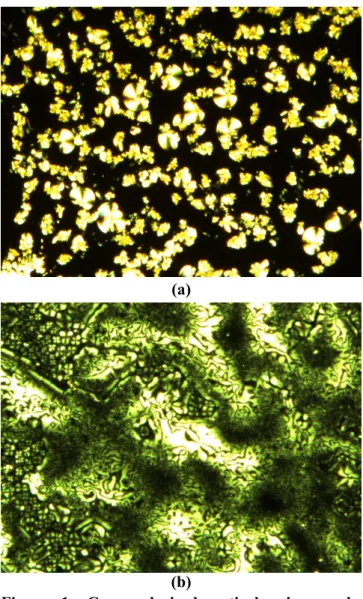
shown in Table 1. Two polymers were dissolve in mixed solvent of phenol/p-chlorophenol/TCE = 25/40/35 (w/w/w). Theirs inherent viscosity was measured on 0.5g/dl solution in phenol/p-chlorophenol/TCE mixture at 30 . On the DSC ℃ heating scan, all polymers show glass transition and two endothermic peaks, corresponding to melting, isotropization. Using POM, we could confirm the thermal sequence determined by DSC on heating and cooling cycles. On heating, polymer 4a shows the optical texture of the smectic X phase (Figure 1(a)). In Figure 1(b), polymer 4b shows a threaded texture on cooling from the isotropic liquid, and further cooling led to the formation of homeotropic texture. But this transition was not shown in the DSC thermogram.
Table 1. Inherent viscosities and transition
temperatures of polymers. aInherent viscosity was
measured on 0.5g/dl solution in phenol/p-chlorophenol/TCE(25/40/35=w/w/w) mixture at 30℃.
(a)
(b)
Figure 1. Cross-polarized optical micrographs (magnification of x100): (a) Smectic X phase of polymer 4a at 210℃, and (b) nematic phase of polymer 4b at 260℃.
4. Summary
Two bent-shaped liquid crystal polymers with the naphthalene central core, all-ester linking groups, and the dodecamethylene flexible spacer have been synthesized and characterized. The molecular structures of polymers were identified by FT/IR spectroscopy. The polymer 4a with asymmetric naphthylene central core with the bending angle of 120° could form a Smectic X phase, and the polymer 4b with symmetric naphthylene central core with the bending angle of 60° could perhaps form a nematic phase.
P1-34 / Y.-H. Seo
• IMID 2009 DIGEST
Acknowledgements
This work was supported by the Korea Science and Engineering Foundation (KOSEF) grant funded by the Korea government (MEST) (No. R01-2008-000-11521-0)
5. References
1. Niori, T., Sekine, T., Watanabe, J., Furukawa, T., Takezoe, H., J. Mater. Chem, 6, 1231 (1996). 2. R. Amaranatha Reddy, and B. K. Sadashiva, Liq.
Cryst., 27, 1613 (2000).
3. H. Takezoe, and Y. Takanishi, Jpn. J. Appl. Phys.,
45, 597-625 (2006)
4. E-J. Choi, X. Cui, W.-C. Zin, C.-W. Ohk, T.-K. Lim, and J.-H. Lee, ChemPhysChem, 8, 1919 (2007).
5. E-J. Choi, J.-C. Ahn, L.-C. Chien, C.-K. Lee, W.-C. Zin, D.-C. Kim, and S.-T. Shin, Macromolecules,
37(1), 71-78 (2004).
6. X. Chen, K. K. Tenneti, C. Y. Li, Y. Bai, X. Wan, X. Fan, Q.-F. Zhou, L. Rong, and B. S. Hsiao,