© Korean Powder Metallurgy Institute 1159
-1. Introduction
Molybdenum and its alloy are promising candidates for high-temperature structural materials such as plasma facing components, aerospace applications and so on. However, the effective application development and the practical use of these metals have not been performed enough because of its high intergranular failure susceptibility by the recrystallization at more than 1173 K.
A small amount of carbon addition is one of the effective methods for the strengthening of the grain boundaries in molybdenum [1,2]. In the present study, our attention was paid to gas carburization by which carbon potential was easily controllable. However, the effect of gas carburization on the strengthening of molybdenum has not been sufficiently investigated. The purposes of this paper are to investigate gas carburization behavior in mixed gases of argon and carbon monoxide and to examine the influence of α–Mo2C layer formed by gas carburization on strength.
2. Experimental and Results
Pure molybdenum sheets with a thickness of 1mm were used as the starting materials. Rectangular specimens with dimensions of 2.5w×20l×1.0t mm were cut out from the
sheets. After mechanical and electrolytic polishing, these specimens were recrystallized at 1773 K for 1 h under a vacuum of about 2.5×10⁻⁴ Pa. Carburization was performed
at 1273 K to 1873 K for 1 h to 16 h in flowing mixed gases of argon and carbon monoxide. The surfaces of the carburized specimens were examined by X-ray diffraction
analysis. Static three-point bend tests were performed at 77 K. Fracture surfaces of carburized specimens were studied by scanning electron microscopy (SEM).
For specimens carburized at 1473 K for 16 h under different concentration of carbon monoxide, the thickness of α–Mo2C layer and the fracture strength were measured.
The thickness of carbide layer increased gradually with increasing concentration of carbon monoxide, resulting in significant decrease in fracture strength. This is because that the brittle carbide layer had formed on the specimen surface. From these results, the gas carburization was performed under a condition of 2% carbon monoxide to investigate grain boundary strengthening effect.
Fig.1 (a) shows XRD patterns of specimens carburized for 1 h. The intensity of the peak of α-Mo2C is decreased
with increasing temperature. Fig.1 (b) shows XRD patterns of specimens carburized for 16h. It is found that α-Mo2C
detected at 1473 K disappeared at 1673 K. Thus, α-Mo2C
was stable at temperatures less than 1673 K under the condition of 2% carbon monoxide.
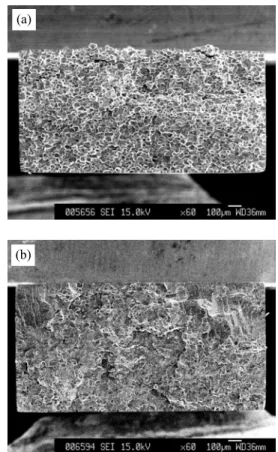
A fracture surface of recrystallized pure molybdenum is shown in Fig.2 (a). In recrystallized pure molybdenum, strength of grain boundaries are lower than that of grain itself. Therefore, the crack propagated along the grain boundary. In molybdenum carburized at 1673 K for 16 h, on the other hand, transgranular fracture mode (shown in Fig.2 (b)) was observed as a result of grain boundary streng-thening due to segregation of carbon on grain boundaries. Fracture strengths of specimens before and after carburization were 930 MPa and 1490 MPa respectively. After removing surface carbide layer, all the specimens showed strengths more than 1400 MPa. The region
2006 POWDER METALLURGY World Congress
PC08-W-06
Carbon Monoxide Gas Carburization Behavior of Molybdenum Materials
Koji Hieda1,a, Masahiro Nagae1,b, Tetsuo Yoshio1,c Jun Takada2,d, Yutaka Hiraoka3,e and Tomohiro Takida4 1
Graduate School of Environmental Science, Okayama University, Okayama 700-8530, Japan
2
Graduate School of Natural Science and Technology, Okayama University, Okayama 700-8530, Japan
3
Faculty of Science, Okayama University of Science, Okayama 700-0005, Japan
4
A.L.M.T. TECH Inc., 2 Iwase-koshi-cho, Toyama 931-8543, Japan
a
[email protected] [email protected] [email protected]
d
[email protected] [email protected] Abstract
For pure Molybdenum carburized in mixed gases of argon and carbon monoxide, microstructural observations were carried out. X-ray diffraction analysis for carburized specimens revealed that brittle α-Mo2C layer hardly formed in the case of low
carbon monoxide concentration. Fracture strength of the specimen carburized at 1673 K for 16 h is about 550 MPa higher than that of the un-carburized specimen. SEM observation revealed that with increasing carburizing temperature, the region demonstrating a transgranular fracture mode progressed towards the center of specimen. This result means that the grain boundaries were strengthened by the grain boundary diffusion of carbon and the strength of grain boundaries exceeded that of grain itself.
© Korean Powder Metallurgy Institute 1160 -Fig. 1. XRD patterns of specimens carburized for 1 h (a)
and 16 h (b).
demonstrating the transgranular fracture mode progressed towards the center of specimen. In the case of carburization at 1673 K for 1 h, transgranular fracture mode was observed in the whole fracture surface. From these results, it was concluded that a short time carburizing at the high temperature was more effective for strengthening molyb-denum.
3. Summary
As for the gas carburization, thin α-Mo2C layer formed on
the specimen surface decreased fracture strength substantially. The formation of the carbide layer could be suppressed by carburizing at 1673 K or more. After dilute carbon monoxide gas carburization, grain boundaries were strengthened due to the grain boundary segregation of carbon, resulting in an increase in fracture strength of the recrystallized pure molybdenum.
Fig. 2. SEM micrographs of the fracture surfaces of recrystallized pure molybdenum (a) and carburized at 1673 K for 16 h (b).
4. References
1. Y. Hiraoka, M. Okada and R. Watanabe, J. Less-Common Met., 75, 31(1980).
2. S. Suzuki, H. Matsui and H. Kimura, Mater. Sci. Eng., 47, 209(1981). 2θ (degree) Intensity (arb.units) 30 40 50 60 70 80 1473 K 1673 K (b) Mo α-Mo2C Intensity (arb.units) 30 40 50 60 70 80 2θ (degree) (a) Mo α-Mo 2C 1873 K 1673 K 1473 K 1273 K (a) (b)