Vol. 24, No. 1, 49-67, March, 2021 ⓒ 2021 Korean Society of Mathematical Education
49
A Study on the Aspects of Social Justice in Korean
Elementary Mathematics Textbooks
Yejin Lee(Teacher)
1, Mangoo Park(Professor)
2**1Jamjeon Elementary School, [email protected]
2 Seoul National University of Education, [email protected]
(Received March 5, 2021; Revised March 24, 2021; Accepted March 29, 2021)
In this study, the researchers analyzed the 2015 revised 3rd~6th grade Korean mathematics textbooks from the aspects of social justice in mathematics education. For this study, the researchers constructed a textbook analysis framework for social justice subjects, which categorized by social issues, economy education, democratic education, personality education, safety education, environmental education, and career education. As a result, the 2015 revised elementary mathematics textbooks were reflected the subject matter of social justice in the order of social issues, economic education and democratic education, personality education and environmental education, safety education and career education. Also, the subject of social justice appears in all 3rd~6th grade mathematics textbooks, but it is not explicitly dealt with by combining it with mathematical content. The researchers suggested that mathematics lessons should be developed including social justice issues aligned with elementary mathematics contents.
Keywords: 2015 revised math textbook, social justice, mathematics classes, elementary schools
MESC Classification: A40 MSC2010 Classification:97D20
I. INTRODUCTION
In modern society, mathematics plays a role as a “gatekeeper”to become economic, educational, and social opportunities (D'Ambrosio, 1990; Moses & Cobb, 2001; Stinson, 2004). NCTM (1989) argued that the ability to do mathematics provides more opportunities in a rapidly changing future society. According to Kwon Oh-nam (2000), the need for
This paper is revised from the first author's thesis. ** Corresponding Author: [email protected]
mathematical abilities in terms of social needs and individual occupations is gradually increasing. In modern society, the importance of mathematics is gradually increasing, and it is a prerequisite for school education that everyone has fair opportunities for mathematics education. In other words, mathematics is a right for social equality before it is a discipline (Moses & Cobb, 2001). As mathematics education for social justice emerges as a hot subject in Korea, interest in mathematics education for social justice is increasing. However, attempts to integrate social justice issues with subject content are still insignificant. In the name of restructuring the curriculum, the integration among subjects was left to the autonomy of teachers, and the integrated curriculum among subjects is not continued after the integrated curriculum in the first and second grades of elementary school. There have been several case studies related to mathematics education for social justice. McNutt (2018) claims technology has two aspects in a digital age. That is. technology can help produce the change that we need to create a vibrant future. On the other hand, technology is new threats that previous generations have not had to deal with by taking away workers' jobs by replacing the jobs of traditional workers. Eunjoo Lee (2019) analyzed the possibility of how mathematics classes for social justice can be applied to the field by dealing with how the subject matter of social justice is reflected in the middle and high school textbooks. However, the analysis of the subject matter of social justice reflected in Korean elementary school textbooks has not been performed. Therefore, the researchers conducted a study on how the subject matter of social justice is reflected in the 2015 revisedKorean elementary school mathematics textbooks. This study will serve as a cornerstone in the development of mathematics lessons based on the recommendations of social justice in mathematics eduication.
II. THEORETICAL BACKGROUND
According to Freire (1970), mathematics education for social justice refers to mathematics education that enables students to use mathematics to change the unfair problems occurring in the current situation and to read and write the world through mathematics. Recently, researches combining mathematics education and social justice education have been actively conducted. One of them is Jurdak, Vithal, De Freitas, Gates, & Kollosche (2016). They argue that equal access and participation should be made in the quality of mathematics education, and raise problems with mathematics education that contributes to an unfair role in providing future opportunities, and explore the subjectivity of mathematics education. Finally, they trace the concept of activism in mathematics education and find the economic factors hidden in mathematical achievement.
analysis of palestine's mathematics textbooks. In this study, Palestine’s 6th grade geometric and measurement units were analyzed, and as a result, epistemological components, personal components, and social components frequently appeared in order. Among
epistemological values, ‘discrimination and rationality’was the highest,
‘importance’among social values, and ‘open mindedness’among individual values. He argued that various values are hidden in school textbooks, and that those values have various effects on students' learning.
McNutt (2018) and many authors of the book have examined how changes in organizations, change in methodology, and changes in every aspect of society. They especially examined how new technologies change the world. With the development of technology, we live in a world where there are serious threats to social justice. They recommended that we should prepare to deal with these challenges. However, if we use technology in a more effective manner, it will can contribute to a better life for all.
In Korea, Eunjoo Lee (2019) analyzed all areas of Korean mathematics textbooks for the 1st grade of middle and high schools in the 2015 revised curriculum. She used the classification criteria by dividing it into social issues, economic education, democratic education, personality education, and humanistic education, and the description method divided into simple referring, conceptualization and generalization, reality reflection, cause, and solution. As a result, ‘social issues’in middle school and ‘economic education’in high school were most often reflected, and in ‘probability and statistics’area in middle school, and ‘letter and expression’area in high school. In addition, the conceptualization and generalized description method was the most in middle school, and the simple referring was the most in high school. Through this, it was found that the subject matter of social justice was less reflected in the high school textbooks than in the middle school textbooks, and the diversity was low, and that the description method in the middle school and high school textbooks was merely focused on some part.
Through mathematics education for social justice, students learn the subject of social and economic justice (Osler, 2007). Students experience the role of social participants in the process of thinking about social and economic problems through mathematical structures and presenting mathematical solutions. In this process, students realize the seriousness of social justice issues as citizens and develop a sense of subjectivity to participate in them. Also, mathematics education for social justice is deeply related to students' mathematical literacy (Osler, 2007). According to OECD (2013), mathematical literacy refers to an individual's capacity to formulate, employ and interpret mathematics in a variety of contexts. Mathematical literacy refers to mathematical reasoning and the use of facts and tools to describe, explain, and predict mathematical concepts, procedures and phenomena. Cultivating this mathematical literacy helps us to recognize the role of mathematics in the world and to make sound judgments and decisions as constructive,
socially engaged and speculative citizens. In addition, mathematical literacy leads to a process of reflection and reflection on humans and society (D'Ambrosio, 1976). Osler (2007) argues that mathematical literacy is directly related to the rights of citizens, and in order to develop mathematical literacy such as problem-solving ability, reasoning ability, critical thinking ability, knowledge and information use ability, and mathematical sense, students are taught mathematics for social justice. You say you should receive. Mathematics education for social justice should be systematically and directly provided to students through mathematics textbooks, and when this process is accomplished, the goal of mathematics education for social justice will be achieved.
III. METHODS
In this study, the 2015 revised 3rd~6th grade Korean mathematics textbooks were analyzed. The reason for excluding textbooks for the first and second grades is that in the first and second grades of elementary school, the curriculum itself is centered around integration, and it was judged that it was not suitable for the learner level to apply social justice. The following <Table 1> presents the analysis framework related to social justice for analyzing 2015 Korean mathematics textbooks. As for the analysis frame, the analysis frame for the middle and high school qualification textbook presented by Eunjoo Lee (2019) was modified and used to suit the level of the elementary school. After receiving the analysis of four mathematics experts, the analysis frame was modified as follows. Recognizing the importance of ‘environmental education’ and ‘career education’, ‘environmental education’ was newly organized as one of the main categories, and ‘technology development’ and ‘Information-oriented society’ were unified into latter one in the subcategory. Contents that are not easily handled in the elementary school curriculum such as ‘economic indicators, indices, and taxes’ were excluded. In addition, the category of ‘personality education’ was broadened more comprehensively by adding ‘consideration for others’ as a sub category, and the category ‘humanism education’ was revised to ‘safety education’ and changed to a sub category called ‘safety accident prevention’. As a result, the analysis frame was revised into 7 main categories and 17 subcategories.
Table 1. Textbook analysis framework for social justice subjects
Main Category Sub Category
Social Issues
·Living healthy
·Aging, Low birth, Population change ·Technological development, Using robots ·Globalization, Multiculturalism ·Information-oriented society Economy Education ·Rational consumption ·Savings, Expenditure
·Optimization, Maximum profit, Minimum distance Democratic
Education
·Elections and Voting ·Fair distribution
Personality Education ·Sharing, Service for the underprivileged ·Consideration for others
Safety Education ·Safety accident prevention Environmental
Education
·Environmental pollution ·Environmental conservation Career
Education ·Desired job ·Job experience
Next, in order to analyze how the subject matters related to social justice are reflected in Korean mathematics textbooks, the analysis was divided into ‘Simple referring’,
‘Conceptualization’, ‘Reality reflection’, ‘Cause’, and ‘Solution’by referring to Kim
Yu-jin (2006) 's analysis table on the description of social inequality phenomenon. The following <Table 2> combines the textbook analysis framework for social justice subjects and the description methods of social justice subjects.
Table 2. Analytical framework for description methods of social justice subjects
Description method Si m p l e R e fer r in g C on cep t u a l i -z a t i on 1 . R ea l i t y R e fl e ct i on 2 . C a u se Sol u t i on
There are five categories of description methods: ‘Simple referring’,
‘Conceptualization’, ‘Reality reflection’, ‘Cause’, and ‘Solution.’ ‘Simple referring’is a
case where it is judged that mathematics classes for social justice are possible because the subject matter appears directly or indirectly. In the case of ‘simple referring’, the subject matter is reflected at the most basic level, so it can be considered that it is also used in other description methods. In addition, 'Simple referring' is a description method in which the degree of reflection of the subject matter of social justice is the weakest, so it can be regarded as a subject containing the potential possibility of taking mathematics classes for social justice. Therefore, it is the case that most actively demands the role of a teacher for
the mathematics class for social justice, and for successful class, additional materials must be provided and new activities must be organized.
'Conceptualization' is a description method in which terms related to the subject of social justice are defined and the terms or concepts are explained. It can be seen that the degree of reflection is stronger than that of 'simple referring', and teachers can draw attention to social justice issues by explaining terms and concepts to students. In this description method, additional materials should be prepared in order to explicitly reveal the problem of social justice, and a teacher's induction questioning is needed to draw out students' thoughts.
'Reality reflection' is a case in which the subject matter of social justice is revealed relatively explicitly, and belongs to the category in which the degree of reflection of the subject matter of social justice is stronger than that of 'simple referring' and 'conceptualization'. The actual situation or situation regarding the subject of social justice is presented in the textbook, and students grasp the related situation and recognize the problem. In this case, without additional data, teachers can ask related questions or students directly raise questions, and they can naturally enter the crossroads of mathematics classes for social justice.
'Cause' is a case in which the fundamental reason for an unfair social problem is presented. Like the case of 'Reality reflection', the degree of reflection of the subject matter of social justice is stronger than 'simple referring' and 'conceptualization'. The description method of 'cause' is usually used for a problem identified as being recognized by the student, and is generally used in combination with other description methods.
'Solution' is a case in which a solution to the unfair problem of society is proposed. The 'solution' is a form that actively reflects the subject matter than other description methods in that it urges students to directly solve the unfair problems in society, and thus the degree of reflection is also strong. It can be seen that the expected effect of the class is that the ‘solution’description method shown in the textbooks does not end with simply presenting a theoretical solution to the students, but leads to the students' lives, leading to a change in behavior in the future.
IV. RESULTS
1. RESULTS OF TEXTBOOK ANALYSIS OF SOCIAL JUSTICE SUBJECTS
BY GRADES
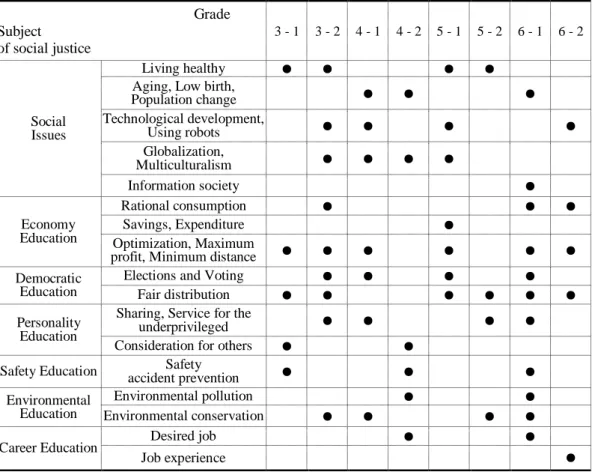
The following <Table 3> is the result of analyzing the 2015 revised Korean mathematics textbooks according to the analysis frame related to social justice presented
in <Table 1>. The mark ● represents material related to social justice appeared. As a result
of analyzing textbooks for the 3rd~6th graders, social issues were 29.63% (16 of 54) in social issues, economic education, democratic education, personality education, safety education, environmental education, career education were 18.52% (10 of 54) in economic education, democratic education was 18.52% (10 of 54), personality education was 11.11% (6 of 54), safety education was 5.56% (3 of 54), environmental education accounted for 11.11% (6 of 54), and career education was 5.56% (3 of 54). In this study, the goal was to find out whether the subject matter of social justice was reflected in the unit, and it was determined that there was a logical uncertainty in counting the number of duplicates just because the subject matter of social justice appeared twice in one textbook problem situation.
Table 3. Results of analysis of social justice subject by grade Grade Subject of social justice 3 - 1 3 - 2 4 - 1 4 - 2 5 - 1 5 - 2 6 - 1 6 - 2 Social Issues Living healthy ● ● ● ● Aging, Low birth,
Population change ● ● ● Technological development, Using robots ● ● ● ● Globalization, Multiculturalism ● ● ● ● Information society ● Economy Education Rational consumption ● ● ● Savings, Expenditure ● Optimization, Maximum
profit, Minimum distance ● ● ● ● ● ● Democratic
Education
Elections and Voting ● ● ● ● Fair distribution ● ● ● ● ● ● Personality
Education
Sharing, Service for the
underprivileged ● ● ● ● Consideration for others ● ●
Safety Education accident prevention Safety ● ● ● Environmental
Education
Environmental pollution ● ● Environmental conservation ● ● ● ●
Career Education Desired job ● ●
Job experience ●
1) Living Healthy
The subject 'Living healthy' appeared in textbooks for 3rd grade and the textbooks for 5th grade. In ‘Addition and subtraction' in the first semester of 3rd grade, the content of
the calories of food appeared. In ‘Multiplication' in the second semester of 3rd
grade, you can find the number of skipping a rope in a month, 'Arrangement of Materials', the content to complete the picture graph by looking at the number of jumps was presented. In 'Mixed Calculation of Natural number' in the first semester of 5th grade, you can calculate the calories of snacks eaten at lunch, 'Rules and Responses', a table and a formula were presented showing the correspondence between the time spent skipping the rope and the amount of calories burned. In ‘Range of Numbers and Estimating’in the second semester of 5th grade, rounding was introduced by looking at the number recorded in the pedometer in the walking exercise program and making the number of steps rounded up. ‘Average and Possibility', the average of calories was used to calculate the amount of calories consumed during the day.
2) Aging, Low Birth, and Population Change
The subject ‘Aging, Low birth, and Population change’ appeared in the first semester of 4th and 6th graders. In ‘Big Number’in the first semester of 4th grade, we studied how to read using units of 100,000, 1 million, and 10 million while looking at the estimated number of populations by country in 2030. ‘Line Graph’, the current status of the decrease in the number of students in schools was presented and the contents of the population change were presented. In ‘Ratio’in the first semester of 6th
grade,, we compared the ratio of the population to the area of Seoul and Gangwon-do to show the phenomenon of population concentration in cities. In ‘Various graphs’in the first semester of 6th grade, the number of elementary school students by region in Korea was presented, dealing with social problems in which the population is concentrated in a specific region.
3) Technological Development and Using Robots
The subject ‘Technological development and Using robots’ appeared in the second semester of the 3rd grade, the first semester of the fourth year, the first semester of the 5th year, and the second semester of the sixth year. In ‘Multiplication’in the second semester of 3rd grade, a maglev train appeared as the subject of the problem, and students used multiplication to find the number of seats. The problem of finding the km that goes in 1 hour was presented, and in 'Rules and Response' in the first semester of 5th grade, the correspondence relationship between the number of drones and the number of wings was expressed as an equation, and the contents to guess the rules of the robot were presented. In 'Division of the fraction' in the second semester of 6th grade, a problem of finding the charging time of an electric vehicle battery appeared.
4) Globalization and Multiculturalism
3rd year, the first semester of the 4th and 5th graders. In 'Fractions and Small Numbers' in the first semester of 3rd grade, solving the problem of a dietitian teacher trying to find out Korean food that foreign students like and Korean food that school students like was presented as a problem situation. ‘Big number’and ‘Bar graph’, the subject matter was reflected in the entire unit. In 'Big Number', information on the entrance fee to the World Cultural Experience Center, visitors to the World Cultural Experience Center, the number of foreigners living in Korea, the amount of exports, a comparison of the number of mobile phone subscribers in various countries in the world in 2016, and the number of populations in various countries in the world were mentioned. ‘Bar graph' shows Korean athletes who participated in the previous Olympics, the number of gold medals in the Olympic Games, the number of medals won by Korea from the Seoul Olympics to the Rio de Janeiro Olympics, and the number of gold medals won by country. In ‘Addition and subtraction of
decimals’in the second semester of 4th grade, a new world record was presented, and the difference between the records was calculated using subtraction of decimals, and ‘Line
graph’and ‘Factors and multiples’in the first semester of 5th grade, the Pyeongchang Winter Olympics appeared as the subject.
5) Information Society
The subject of ‘Information society’ appeared in the first semester of 6th
grade. In ‘Several graphs,’one of the problems of the 'information society' by looking at a table showing the number of game hours per day of 6th graders on various graphs, and representing the contents of the band graph and what they learned with the band graph in relation to their lives. It is interpreted that lessons on cyber addiction can be conducted.
6) Rational Consumption
The ‘Rational consumption’ appeared in the second and sixth grades of the third year. In 'Multiplication' in the second semester of 3rd grade, a book bazaar and an affordable marketplace appeared as a problem, and 'Intake and Weight', a shopping plan was set up to investigate the weight and weight of the items to be bought. In 'Ratio' in the first semester of 6th grade, a modest market was applied as a problem to the entire unit, except for some tea periods, and ‘Cuboid's volume and surface area', a box contest problem was presented in which as little wrapping paper as possible among the boxes to hold the product was presented. In ‘Division of decimals’in the second semester of the 6th
grade, there was a problem of finding out which stores are cheaper when they buy the same amount of grape drinks.
7) Savings and Expenditure
In ‘Reduction of a fraction and reduction to a common denominator’in the first semester of 5th grade, a comparison of the savings of two students appeared.
8) Optimization, Maximum Profit, and Minimum Distance
‘Optimization, Maximum profit, and MIinimum distance’ appeared in the first semester of from 3rd to 6th grades. In 'Addition and Subtraction' in the first semester of 3rd grade, the problem of finding the shortest distance in the situation where the departure and destination are determined was presented, and 'Length and Time', the problem of choosing an appropriate itinerary for a given time appeared, and the material of 'optimization' and 'minimum distance' was reflected by comparing the athlete's scorecard to determine the sport to practice and finding a short trail. I could find it. In ‘Fraction' in the second semester of 3rd grade, the contents of selecting an optimized support to prevent crops from collapsing by finding a longer support were presented, and 'View the world by math' in the first semester of 4th grade explains why the number of flights varies by city, and in ‘Factors and
multiples’in the first semester of 4th grade, finding the minimum number of piles is required to install a fence. In ‘Addition and subtraction of fractions’, finding the distance closer to the new road, 'Perimeter and Area of a Polygon', the contents of searching for the largest rectangle when the perimeter is constant appeared. In ‘Cuboid's volume and surface area' in the first semester of 6th grade, the content of a contest to make a product box with as little packaging as possible from a pharmaceutical company appeared, and the material of 'maximum profit' was applied. Also, in 'Cylinder, Cone, and Sphere' in the second semester of 6th grade, when the radius and height of the bottom of the cylinder were different, the height of the box appeared and interpreted as reflecting the material of 'optimization'.
9) Elections and Voting
‘Election and voting’appeared in the second semester of third year, the first semester of 4th year, the first semester of the 5th year, and the first semester of 6th year. In 'Organization
of Data' in the second semester of 3rd grade, the subject matter of 'election/voting' is reflected in the whole, so that various data are presented in tables and graphs. In 'Bar Graph' in the first semester of 4th grade, there was a table showing the Olympic Games the students wanted to play in a bar graph, and comparing the records to determine the archery representative, surveying the Olympic Games that you want to experience, and displaying them in a table and a bar graph. The story of the selection of Olympic venues, voted by members of the International Olympic Committee, appeared. ‘Reduction of a fraction and
reduction to a common denominator’in the first semester of 5th grade indicate the drinks that 5th grade students like, as a picture graph of the foods that students like, and see the bar graph of the experiential learning place that the students in the training class want to go to, and appear as sentences with fractions. Contents such as betting appeared, and in ‘Ratio',
in the 6th grade first semester, students are asked to find out the percentage of each candidate's vote from the student council president's vote. ‘Various Graphs’showed the contents of reading newspaper articles about the sport that 6th graders like most, finding the proportions, and determining which graph should be used.
10) Fair Distribution
The 'Fair distribution' appeared in all the 3rd, 5th and 6th graders. Since ‘distribution’means ‘to divide’, all textbooks related to division were analyzed to reflect the subject of ‘fair distribution’. In addition, when introducing the concept of ‘fraction’or when using division among mixed calculations of natural numbers, when the concept of average, ratio, ratio, proportional expression, and proportional distribution was used, the material ‘distribution’was analyzed. Although the meaning of 'share equally' in mathematics is clearly different from 'fair distribution' in morality, the reason for interpreting that the subject matter is reflected is that fairness is included in the wide range of the process, and it is sufficient through relevant questions or additional data provision. This is because it was determined that classes on 'fair distribution' could be held.
As a result of analyzing according to these criteria, ‘Division’and ‘Fractions and
decimals' in the first semester of 3rd grade appears when comparing the size of fractions when introducing fractions. ‘Division’in the second semester of 3rd
appears when comparing fractions. The concept of a factor is used in 'Divisors and Multiples' in 'fraction' in the first semester of 5th grade using division for mixed calculations in 'Mixed calculation
of natural numbers.' The concept of division is used in 'Rules and Correspondence', in the
second semester of 5th grade and the concept of average is used in 'Mean and Possibility', and the concept of division is used in ‘Division of fractions' and ‘Division of decimals' in the first semester of 6th grade. Ratio is used in 'Rational Ratio', in the second semester of 6th grade and the concept of division is used in 'Division of Fractions' using the ratio in
'Proportional Formula and Proportional Distribution'. We analyzed that the 'Fair distribution' material was reflected when determining the location of the starting line for a
fair game in 'Width of the circle'.
11) Sharing and Service for the Underprivileged
The subject of ‘Sharing and Service for the underprivileged’appeared in the second semester of 3rd year, the first semester of 4th year, the second semester of 5th year, and the first semester of 6th year. In the second semester of 3rd grade, ‘Multiplication’is a situation where people buy rice to neighbors by collecting money sold at a bargain market. In the ‘Big Number’, the amount of money donated by international children's sponsorship groups, the money raised by the global community love-sharing campaign is counted. In the ‘Range
into bills were suggested. Also, in ‘Multiplication and division' and 'Ratio' in the first semester 4th and 6th grades, there was a problem situation of an affordable marketplace throughout the unit.
12) Consideration for Others
‘Consideration for others’ appeared in the first semester of 3rd
year and the second semester of 4th year. In 'Length and Time' in the first semester of 3rd year, the contents of 'promise and practice caring activities that can be done in a few seconds' were presented, providing a sense of time while also providing caring activities. In 'Addition and
Subtraction of Fractions' in the second semester of 4th year, a story of a good brother was presented, and a problem situation emerged in which one could think about a caring mind.
13) Safety Accident Prevention
'Safety accident prevention' appeared in the first semester of 3rd grade, the second semester of 4th grade, and the first semester of 6th grade. In 'Addition and Subtraction of
Fractions' in the first semester of 3rd year, finding the number of life jackets is used. In 'Triangles' in the second semester of 4th year, a triangular shape to make a sturdy tower is used. and in ‘Various graphs’ in the first semester of 6th
year, data related to the places where child safety accidents often occur and the rules necessary for safe school life are presented .
14) Environmental Pollution
The subject of ‘Environmental pollution’is presented in the second semester of 4th
grade and first semester of 6th grade. In the second semester of 4th grade, the trend of the change in Korea's highest temperature was presented in the ‘Line Graph’, and the data on the GHG emission line was presented in ‘View the World by Math’. In 'Various graphs’in the first semester of 6th grade, a comparison between the average ultra-fine dust concentration and ultra-fine dust composition in March by region, the fine dust concentration by major cities in the world, the average monthly fine dust concentration in Korea, and the amount of fine dust emissions appeared
15) Environmental Conservation
The subject ‘Environmental conservation’ presented in the second semester of 3rd
year, the first semester of 4th year, the second semester of 5th year, and the first semester of 6th year. In 'Multiplication’in the second semester of 3rd grade, except for some pages, subjects were applied to the entire unit. Find the number of trees you have prepared for a tree planting event, find the amount of water you can save when brushing your teeth, find the number of milk cartons you have collected over the course of a month, find the number of all recycled bottles per semester, find the number of trees you can plant in the desert, and
use the basket. It turned out to be a problem situation, such as finding a carbon footprint that decreases when it occurs. In 'Multiplication and Division' in the first semester of 4th grade, the problem of finding the amount of water 10 Koreans use per day, finding the amount of water saved when washing hands, finding the amount of water saved through water conservation practices, and finding the number of trees needed to make a textbook. In the second semester of 5th grade, in ‘View the World by Math’data on water consumption per person was presented, and in the first semester of the 6th grade, ‘Ratio’, the ratio of the collection of empty bottles to the amount of shipments of store bottles and household bottles was expressed as an environmental report, and it was reflected by comparing and calculating the increase rate of the empty bottle deposit.
16) Desired Job
The subject matter of the ‘Desired job’ appeared in the second semester of 4th
year and the first semester of 6th year. In ‘Line Graph’in the second semester of 4th grade, the change in height of student whose dream is a figure skating player, was presented as a line graph. In ‘Various graphs,’survey data for the future hopes of 6th
grade students were presented.
17) Job Experience
The subject 'Job experience' appeared in the second semester of 6th grade, and was reflected in the whole chapter of 'Proportional Formula and Proportional Distribution'. Finding the cost of mixing water and waste cooking oil to make soap through a career experience as an environmentalist, comparing the length of pictures on a camera screen and a computer screen in a career experience as a photographer, Problems such as finding the number of pieces, finding the time to charge an electric vehicle in an electric vehicle expert job experience, and breaking bread in a baker's job experience emerged.
2. RESULTS OF TEXTBOOK ANALYSIS OF SOCIAL JUSTICE
SUBJECT BY DESCRIPTIONS
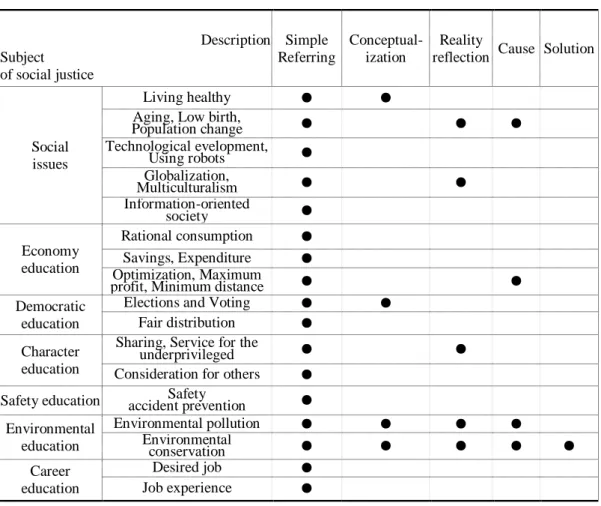
The following <Table 4> shows the result of analyzing the 2015 revised Korean mathematics textbooks according to the analysis framework of the description method of social justice-related subject matter. As a result of analyzing from 3rd to 6th grade mathematics textbooks, the 'Simple referring' description method accounted for 54.84% (17 of 31), and the 'Conceptualization' description method accounted for 12.9% (4 of 31). The 'Reality-reflection' accounted for 16.12% (5 of 31), the ‘Cause’ accounted for 12.9% (4 of 31), and the ‘Solution’ accounted for 3.22% (1 of 31). Analysis of the description method was also aimed at finding out how the subject matter of the social justice was described, so the number of occurrences of the subject matter was not counted. The
proportion of the description method is expressed by converting the amount occupied by the description method to percent in <Table 4>, and is not based on the total number of appearances in the textbooks.
Table 4. Results of analysis social justice subject by descriptions
Description Subject of social justice Simple Referring Conceptual- ization Reality
reflection Cause Solution
Social issues
Living healthy ● ●
Aging, Low birth,
Population change ● ● ● Technological evelopment, Using robots ● Globalization, Multiculturalism ● ● Information-oriented society ● Economy education Rational consumption ● Savings, Expenditure ● Optimization, Maximum
profit, Minimum distance ● ●
Democratic education
Elections and Voting ● ●
Fair distribution ● Character
education
Sharing, Service for the
underprivileged ● ●
Consideration for others ● Safety education accident prevention Safety ●
Environmental education Environmental pollution ● ● ● ● Environmental conservation ● ● ● ● ● Career education Desired job ● Job experience ● 1) Simple Referring
It was found that ‘Simple referring’is the most common description method in the textbooks and applied to all material analysis frames.
2) Conceptualization
‘Conceptualization’ was applied to the subjects of ‘healthy living’ in the ‘social
issues’category and ‘environmental pollution’ in the ‘environmental education’category.
In the first semester of 3rd grade, in order to live a healthy life in 'Addition and Subtraction', you calculate the calories of food you eat as a snack and make an exercise plan. At this
time, the concept of calories is presented to 3rd grade students by saying 'calories are the
amount of energy.' It is presented with a suitable amount of calories as 2,000 kcal. It also
appears in 'Mixed calculation of natural numbers'. 'Bar graph’in the first semester of 4th grade shows the story of the selection of the Olympic venue and a generalized story of the selection method.
3) Reality Reflection
‘Reality reflection’ appeared in 'Aging, Low Birth, Population Change' and 'Environmental Education' among the categories of 'social issues'. ‘Big Number’in the first semester of 4th grade presents the actual conditions of the estimated population by country in 2030, the number of mobile phone subscribers in various countries in the world in 2016, and the number of populations in various countries in the world. In 'Multiplication and
Division', while learning (three digits) ×(two digits), it is suggested that 'one person in our country uses 282 liters of water a day', and the height of a textbook that can be made into
a tree of 30 years old. For ‘Bar Graph’, actual data such as the number of Korean athletes participating in the previous Olympics, the number of medals won by Korea from the Seoul Olympics to the Rio de Janeiro Olympics, and the number of gold medals won by countries in the 2016 Olympics are presented.
In ‘Addition and Subtraction of a Small Number’in the second semester of 4th
grade, a new world record for men's high jump was presented, and in ‘Line graph,’a question of comparing the world record with that of student was presented. data showing the number of days snowed in the area where the PyeongChang Olympics was held by year was presented, and the change in the number of registered athletes by year in the Olympics was directly investigated through the 'Sports Support Portal' website.
The task to be done was also presented. In addition, the current state data was actively used in class through activities that show the change of Korea's highest temperature by year and show it in a line graph. In ‘Ratio' in the first semester of 6th
grade, actual data on the 'population' and 'area' in Seoul and Gangwon-do were presented, and the ratio to the area was compared. In 'Various graphs', data on the number of volunteers by field in 2012 and 2017, data on the analysis of ultra-fine dust concentration and ultra-fine dust composition in March by region, fine dust concentration by major cities in the world, and average fine dust concentration by month in Korea, and fine dust. A graph showing the amount of emissions was presented, and data on the number of elementary schools in each region were presented, and it was shown in tables and graphs.
4) Cause
‘Cause’appeared in 'Optimization, maximum profit, minimum distance' and 'Environmental education'. The ‘Cause’description was used in the first semester of 4th
grade in ‘Seeing the World with Math’to explain the reasons why the number of flight flights varies by city. Most of the ‘Cause’description methods were used together with ‘conceptualization’, ‘real situation’, and ‘solution’.
5) Solution
‘Solution’appeared in the subject of ‘environmental education,’In ‘Multiplication’in the second semester of 3rd grade, one student indirectly suggests an solution, saying, ‘If you turn off water when brushing your teeth, one person can save 9 cups of water.’In 'Multiplication and Division' in the first semester of 4th grade, the textbook author proposed the problem, 'Let's use multiplication to solve real-life problems'. Try to find the amount of water. This will serve as an opportunity for students to think about ways to naturally solve social problems in the form of improvement measures included in the problem.
6) Conceptualization and Reality Reflection
The description method was also used in a mixed manner. In ‘Ratio' in the first semester of 6th grade, the descriptions of 'Conceptualization' and 'Reality reflection' are used together. An explanation of the deposit for empty bottles appears while showing and comparing the percentage of empty bottles collected as a percentage. In order to save resources and protect the environment, there is a system in which the deposit is returned when empty bottles are returned, he explains about the deposit system for empty bottles. It also describes the current status data that the deposit for empty bottles has increased from 50 won to 130 won since 2017.
7) Cause and Reality Reflection
‘Cause’and ‘Reality reflection’were used in combination. In the ‘Line Graph’, we present a line graph in which the number of local populations and the number of elementary school students in the area are declining, present the actual state of population decline, and suggest a decrease in the total population as the cause of the decrease in the number of students. In addition, the textbook content is structured to investigate the cause of the decrease in the number of students.
8) Cause and Solution
The 'Cause' description method was mainly used in combination with other description methods, but in many cases it was used together with the 'solution' description method. The description method of 'cause' and 'solution' is ‘multiplication.’Due to the severe yellow dust, a sand breeze blowing from the desert was suggested as the cause of the yellow dust, and related problems were given as ‘planting trees in the desert’was suggested as a solution.
9) Reality Reflection and Solution
In the second semester of 5th grade, the actual data on water consumption per person per day was presented, and students were asked to find out the amount used for each and then to think directly about the solution through an activity to think about where they can save. I did. It can be seen that improvement measures are indirectly suggested in that water conservation methods that are selected from the water use items presented in the textbooks.
10) Conceptualization, Cause, and Reality Reflection
The cases in which the ‘conceptualization’, ‘cause’, and ‘real situation’description methods were used together appeared in the second semester of the fourth year in ‘See the
world through mathematics.' Data on GHG emissions per capita in Korea were presented
in a table, the concept of GHG was explained, and ‘the use of fossil fuels’was suggested as the cause of global warming.
11) Cause, Reality Reflection, and Solution
Cases in which the ‘cause’, ‘real situation’, and ‘solution’were used together appeared in the first semester of 6th grade. In 'Ratio' in the first semester of 6th grade, the actual condition of the release of bottles and collection of empty bottles was presented, and the decomposition period of landfilled waste over 100 years and the remaining years of use of the landfill that was insufficient compared to that year were presented as the cause. A solution was proposed to increase the reuse rate of bottles for saving our environment.
12) Conceptualization, Cause, Reality Reflection, and Solution
If the ‘conceptualization’, ‘cause’, ‘actual situation’, and ‘solution’description methods are all used. In ‘Multiplication' in the second semester of 3rd
year, the concept of 'carbon footprint' was defined. 'Carbon dioxide' was suggested as the cause of global warming. It also emphasizes the fact that the glaciers in which polar bears live was decreasing and the improvement 'Let's use a shopping cart when shopping' was improved. A plan was presented and related problems were emerged.
V. CONCLUSIONS AND DISCISSIONS
Social justice is always an important issues throughout the human history. Thus, every subject has to include social justice social justice in its content. In this study, we analyzed how social justice is reflected in the Korean elementary mathematics textbooks. In the 2015 revised elementary mathematics textbooks, social issues were reflected in the order of social issues, economic education and democratic education, personality education and
environmental education, safety education and career education. If we look closely at the subcategories, materials related to 'optimization, maximum profit, and minimum distance' of economic education and 'fair distribution' of democratic education mostly appeared in a total of six textbooks from 3rd to 6th grades. Is a social issue of 'Living healthy’, 'Technological development and using robots', 'Globalization, Multiculturalism', 'Elections and voting' of democratic education, 'sharing and volunteering for the underprivileged' of personality education, and 'Environmental conservation' of environmental education appeared second most in a total of four textbooks. The description method was reflected in the subject areas of social justice in the order of 'Simple referring', 'Reality reflection', 'Conceptualization', 'Cause', and ‘Solution’. In addition, those description styles were used in a mixed manner.
As a result of the textbook analysis, the subject matter of social justice appears in all the from 3rd to 6th grade textbooks, but it is not explicitly fused with mathematics. In the case of mathematics textbooks in Korea, although not many, relatively various social justice materials were used. However, the purpose of the subject of social justice was limited only to the acquisition and use of mathematical knowledge. It is said that the opportunities for students to think critically and discuss social issues using mathematics are not sufficiently provided in mathematics classes. As a result of analyzing textbooks, even though mathematics education for social justice is partially documented in the current curriculum, the materials presented in the textbooks are insufficient. Also, the roles of teacher is very important to make a successful lesson for social justice in mathematics education. Also, in the description method, only the ‘simple referring’description method is applied evenly to all subjects, and other description methods are used only in some chapters. It can be concluded that the conditions for the integration of mathematics and social justice education in the current curriculum are not sufficient, and thus the only approach through the teacher's restructuring of the curriculum is the only way to achieve the integrated class. We need a new attempt to employ an interdisciplinary approach across the mathematics curriculum, which has traditionally been teaching just ‘math’ to students. We researchers suggest that an articulated integrated curriculum that includes mathematical content and social justice subjects should be developed at the national level before requiring teachers' autonomous restructuring the curriculum.
REFERENCES
Daher, D. (2021). Values in the geometry and measurement unit of the Palestinian Grade six mathematics book. Journal of Beliefs & Values, DOI: https://doi.org/10.1080/13617672. 2021.1878722
D'Ambrosio, U. (1976). Objectives and goals of mathematics education. Proceeding of the 3rd International Congress of Mathematics Education. Karlsruhe, Germany(Paris: LINES CO, 1979). D'Ambrosio, U. (1990). The role of mathematics education in building a democratic and just society.
For the Learning of Mathematics, 10(3), 20-23.
Freire, P. (1970). Pedagogy of the oppressed (Myra Bergman Ramos, trans.). New York: Continuum Publishing Company.
Gwon, O. N. (2000). Challenges and prospects of mathematics education for gender equality. Communications of Mathematical Education,10(1), 417-440.
Jurdak, M., Vithal, R., De Freitas, E., Gates, P., & Kollosche, D. (2016). Social and political dimensions of mathematics education: Current thinking. Springer Nature.
Kim, Y. J. (2006). Analysis of textbooks on social inequality. Master's thesis, Sungshin Women's University, Seoul.
Lee, E. J. (2019). A study on the textbook analysis of contents of mathematics for social justice in the curriculum of 2015. Master's thesis, Ewha Womans University, Seoul.
McNutt, J. G.(ed.) (2018). Technology, activism, and social justice in a digital age. New York:
Oxford University Press.
Moses, R. P., & Cobb, C. E. (2001). Radical equations: Math literacy and civil rights. Boston, MA: Beacon Press.
National Council of Teachers of Mathematics (1989). Curriculum and evaluation standards for school mathematics(Translated by Gu, G. J., Oh, B. S., & Ryu, H. C.): Seoul: Kyungmoonsa. OECD. (2013). PISA 2012 assessment and analytical framework: Mathematics, reading, science,
problem solving and financial literacy. OECD Publishing, Paris, 25.
Osler, J. (2007). A guide for integrating issues of social and economic justice into mathematics curriculum. Retrieved from http://www.radicalmath.org/docs/SJMathGuide.pdf
Stinson, D. W. (2004). Mathematics as ‘gate-keeper’: Three theoretical perspectives that aim toward empowering all children with a key to the gate. The Mathematics Educator, 14(1), 8–18.