Multi-illumination digital holographic microscopy
Anh-Hoang Phan, Nam Kim, Jae-Hyeung ParkDepartment of Computer and Communication Engineering, Chungbuk National University Email: [email protected]
Abstract: In this paper, we use multi-point sources to illuminate the sample in digital holographic microscopy. The resolution of digital holographic microscopy is enhanced without shifting the CCD camera. The specimen is illuminated from many directions by using multi-point sources which are easily created by a lens-array. The high frequency information of specimen can be captured at a fixed position of CCD camera. All information is then synthesized to increase the resolution.
Digital holography has many advantages in comparison with the conventional hologram. Digital holographic microscopy is an interesting application of the digital holography. 3D structure of the microscopy specimen can be captured and reconstructed by a digital holographic microscopy [1]. One problem is the resolution limitation of the reconstruction. The size and the resolution of the captured holography are limited by the CCD, which finally restricts the reconstruction resolution. In order to increase the resolution of hologram, several synthesis methods have been proposed. Lluis M. L. et al [2], and Jurgen H. Massig [3] presented the synthetic aperture method by moving the CCD camera to enhance the resolution of the reconstructed image in digital on-axis and digital off-axis hologram. Jianglei Di et al [4] used a linear CCD camera scanning to capture high frequency component of the object. M. Paturzo et al [5] used a two-dimensional dynamic phase grating, which was controlled electrically, to re-direct the high frequency component to CCD camera. Vicente Mico et al used a complex system of mirror or grating to create a tilted beam illumination to capture more information of specimen. However, these previous methods require mechanical motion or complex system configurations.
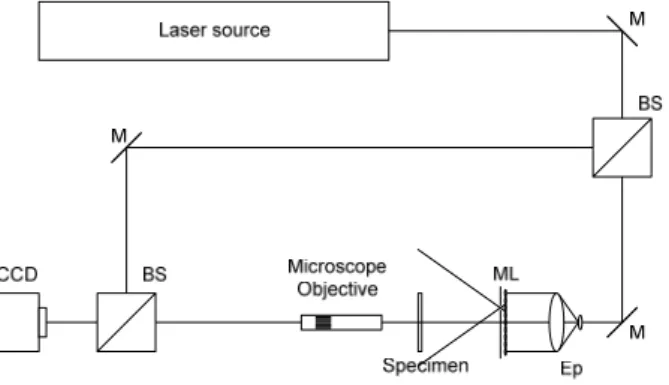
Fig. 1. Setup configuration for multi-illumination digital holographic microscopy
In this paper, we present a simple way to capture more information of the object by using multi-point light sources which are created by a lens array. The use of the lens array makes the overall system simple and compact. First of all, the polarizing beam splitter (PBS) splits the coherent beam from the 532nm laser source to two beams, one is reference beam and the other is object beam. The object beam is then expanded and passes through a lens array to create the multi-point light sources. We use a movable aperture to select a point source that illuminates the specimen. By moving the aperture, the specimen is illuminated from many directions. The specimen is magnified by an objective lens. After objective lens, the other beam splitter (BS) is used to combine the reference beam and object beam. In reference beam
part, we use a phase-shifting system to control the phase of the reference beam (Fig. 1). The multiple holograms are captured by a CCD camera sequentially with different point light sources, synthesized together, and then reconstructed by computer using phase-shifting method [7]. By the proposed method, the resolution can be enhanced by 9 times (3x3) in comparison with the resolution of the conventional methods.
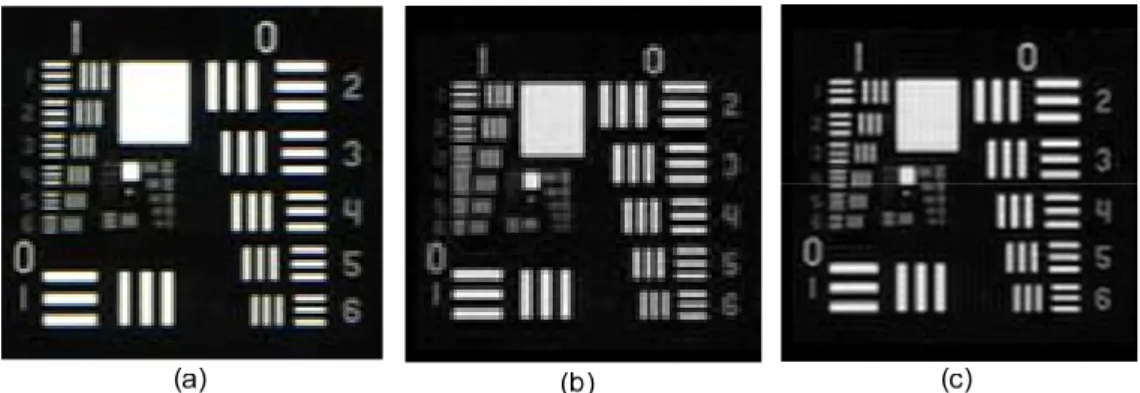
Fig. 2. Multi-illumination digital holographic microscopy simulation result: (a) – Original resolution test target, (b) – single reconstruction, (c) – nine-hologram combined reconstruction
Figure 2 shows the simulation result for multi-illumination digital holographic microscopy. It shows that the reconstructed image from nine-hologram (Fig. 2.c) has more details and is clearer than the reconstructed image from single-center hologram (Fig. 2.b).
We proposed a method to enhance the resolution in digital holographic microscopy. This method is very compact and easy to control. The lens array creates multiple point light sources, while the aperture placed at the focal plan of the lens array selects only one of them to illuminate the specimen. The configuration does not require accurate micro-mechanical movement. The resolution of the synthesized hologram is 3x3 times larger than conventional method.
Acknowledgement
This work was supported by the Korea Research Foundation Grant funded by the Korean Government (Ministry of Education, Science and Technology)" (The Regional Research Universities Program/ Chungbuk BIT Research-Oriented University Consortium)
References
1. Jorge Garcia-Sucerquia et al., “Digital in-line holographic microscopy,” Appl. Opt., vol. 45, no. 5, pp. 836-850, 2006.
2. Lluis M. L. and Bahram J., “Synthetic aperture single-exposure on-axis digital holography,” Opt. Express., vol. 16, no. 1, pp. 161-169, 2008
3. Jurgen H. Massig, “Digital off-axis holography with a synthetic aperture,” Opt. Lett., vol. 21, no. 24, pp. 2179-2181, 2002.
4. Jianglei Di et al, “High resolution digital holographic microscopy with a wide field of view based on a synthtic aperture technique and use of linear CCD scanning,” Appl. Opt., vol. 47, No. 30, pp. 5654-5659, 2008.
5. M. Paturzo et al, “Super-resolution in digital holography by a two-dimensional dynamic phase grating,” Opt. Express., vol. 16, no. 21, pp. 17107-17118, 2008
6. Vicente Mico et al, “Superresolution digital holographic microscopy for three-dimensional samples,” Opt. Express., vol.
16, no. 23, pp. 19260-19270, 2008
7. Ichirou Yamaguchi and Tong Zhang, “phase-shifting digital holography,” Opt. Lett., vol. 22, no. 16, pp. 1268-1270, 1997.