Bull. Mar. Sci. Inst 제주대 해양과학연구논문집, 40: 29-36, 2016 Jeju Nat. Univ., 40: 29-36, 2016
유수중에 설치한 대나무통발에 대한 물고기의
유영행동에 관한 연구
강겅범
·
김석종‘
제주대학교 해양과학연구소A study on the swinitning behavior of fish to the bamboo pots
in water flow
Kyoung-Bum Kang and Suk-Jong Khn*
Marine Science institute, Jeju National University, 63333, Korea
The aim of this experiment was to investigate the fish behavior of set up pots on the water flow. The box and cylinder pots were made of an iron frame and had dimensions of L : 0.40xW: 0.40x H: 0.22 m and D : 0.4OxH : 0.22 m, respectively. In addition, sidewalls of pots were employed bamboo stick. Measurements of flow speed around trap were taken at points located in the rear area of the trap, which had dimensions of 1.5 m length x 1.0 m breadth. A total of 91 measurement points were located at the intersections of a grid that was formed by 小irteen lines running downstream and seven lines running across the flow with an electromagnetic current meter. The fish species used in this study was Goldfish Carassius auratus langsdorzfi. The fish behavior was recorded by video camera (Sony, FWR-CX700V), which placed at 2 m above the experimental tank. The duration of the observation for each experiment was 5 minutes, and each experiment was repeated ten times. A comparison of results of the fish swimming speed toward the entrance pot under conditions. In the water flow condition, the swimming speed of fish was 0.16 BL/s, which is faster than the value of 0.06 BL/s in the still water condition. the value of the fish swimming speed of set up cylinder- and box- pots were obtained 0.23 BL/s and 0.27 BL/s with water flow condition. We conclude that pots in water flow could be easily utilized to access the entrance traps.
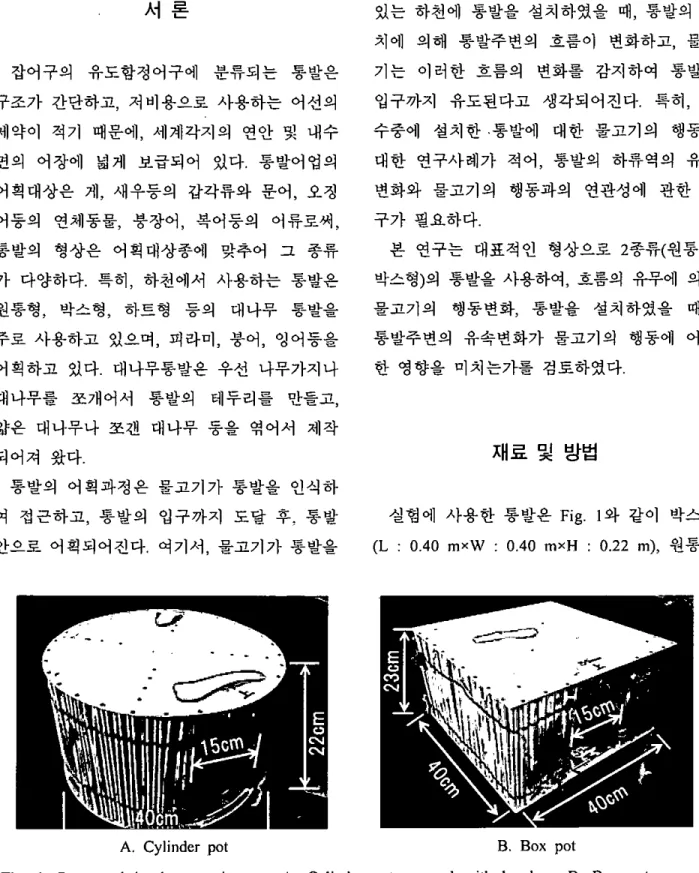
강경범 · 김석종 서 론 잡에구의 유도항정어구에 분류되는 통발은 구조가 간단하고, 저비용으로 사용하는 어선의 제약이 척기 때문에, 세계각지의 연안 및 내수 먼의 어장에 넓게 보급되어 있다. 통발에업의 어획대상은 게, 새우등의 갑각류와 문어, 오징 어등의 연체동물, 붕장어, 복어등의 어류로씨, 통발의 형상은 어획대상종에 맞추어 그 종류 가 다양하다. 특히, 하천에서 사용하는 통발은 원통형, 박스형, 하트형 등의 대나무 통발을 주로 사용하고 있으며, 피라미, 붕어, 잉어등을 어획하고 있다. 대나무통발은 우선 나무가지나 대나무를 쪼개어서 통발의 테두리를 만들고, 얇은 대나무나 쪼갠 대나무 등을 엮어서 제작 되어져 왔다. 통발의 어획과정은 물고기가 통발을 인식하 여 접근하고, 통발의 입구까지 도달 후, 통발 안으로 어획되어진다. 여기서, 물고기가 통발을 인식하여 접근하는 것을 주목해 보면, 흐름이 있는 하천에 통발을 설치하였을 때, 통발의 샬 치에 의해 통발주변의 흐름이 변화하고, 물고 기는 이러한 흐름의 변화를 감지하여 통발의 입구까지 유도된다고 생각되어진다. 특히, 유 수중에 설치한 ,통발에 대한 물고기의 행동에 대한 연구사례가 적어, 통발의 하류역의 유속 변화와 물고기의 행동과의 연관성에 관한 연 구가 필요하다. 본 연구는 대표적인 형상으로 2종류(원통형, 박스형)의 통발을 사용하여, 흐름의 유무에 의한 물고기의 행동변화, 통발을 샬치하였을 때의 통발주변의 유속변화가 물고기의 행동에 어떠 한 영향을 미치는가를 검토하였다. 재료 및 방법 실험에 사용한 통발은 Fig. I와 같이 박스형 (L : 0.40 mxW : 0.40 mxFl ; 0.22 m), 원통형
A. Cylinder pot B. Box pot
Fig. 1. Pots used in the experiment : A. Cylinder pot covered with bamboo, B. Box pot covered with bamboo stick.
ㅌ 낭래 ㅇ Measuring Snge (.2 x 1:m) Over flow 2qbmbdhSit eIdofrdmaghetiO curren`t meter ND 」Converter = .J ' (2OHz, 20s)
쟈
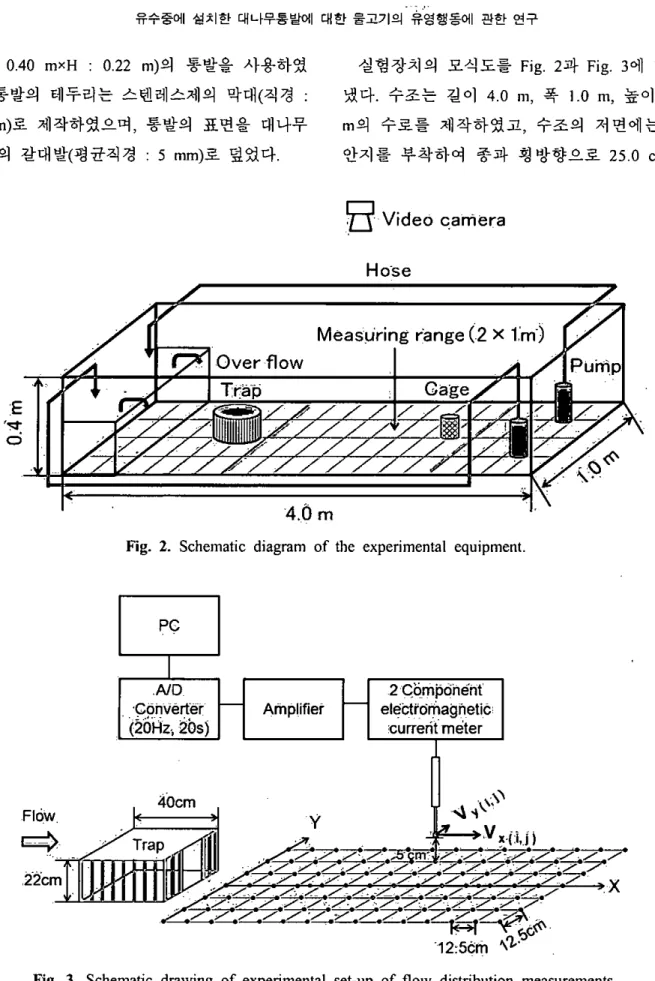
Flow ㄷ큭튕 22cm 》,/x.(i, 유수중에 설치한 대나무통밭에 대한 뭍고기의 유영행동에 관한 연구 (D : 0.40 mxH : 0.22 m)의 통발을 사용하였 실험장치의 모식도를 Fig. 2과 Fig. 3에 나타 고, 통발의 테두리는 스텐레스제의 막대(직경 : 냈다. 수조는 길이 4.0 m, 폭 】.Om, 높이 0.4 5mm)로 제작하였으며, 통발의 표면을 대나무 m의 수로를 제작하였고, 수조의 저면에는 방 제품의 갈대발(평균직경 : 5mm)로 덮었다. 안지를 부착하여 종과 횡방향으로 25.0 cm의묘
Video car era Hose4끄 'ㄲ
Fig. 2. Schematic diagram of the experimental equipment.
『 12:5drh 嘴〃
강경범 · 김석증 눈금을 그렸다. 수조의 내부에는 얼정한 흐름 을 발생시키기 위하여 우선, 수로의 상단부에 는 칸막이를 장착하였고, 수조의 하단부에는 2 개의 수중펌프를 양방에 설치하였으며, 하류의 물이 상부에 순환할 수 있도록 호스로 연갈하 였다. 이후, 수조의 수심은 10 cm가 되도록 물 을 공급하였고, 하단부의 펌프에 의해 공급된 물이 OVER FLOW(수조 위로 흘러넘치는 물) 를 일으키도록 하였다. 촬영범위는 수조의 중 앙부의 L 2.0 m )< W 1.0 m로 하였다. 실험에 사용한 공시어는 일본 가고시마현의 하천에 있어서의 어획대상어종인 붕어(Goldfish, Carassius auratus langsdorff1)로서, 가고시마현 키 리시마시 텐마천에서 채포했다. 실험에는 쳬장 7.4-14.0 cm의 I0마리를 사용했다. 유속측정은 대나무통발을 설치하지 않았을 때, 원통형 통발 과 박스형 통발을 설치하였을 때의 3가지 경우 에 대하여 행하였다. 유속측정에는 2성분유속계 (ACM 250-A, ALEC Electronics, 정밀도 : 0.5 cm/s)를 사용하여, 수조의 종방향 12.5 cm간격으 로 15점, 횡방향 12.5 cm간격으로 7점의 유속을 측정했다. 각 측정점에 있어서는 측정간격은 20 HZ, 측정시간은 20초로 하였다. 측정한 유속은 등고선소프트(Sufer version 10)을 사용하여 2 cm 간격으로 등유속선도를 그렸다. 물고기의 행동 관찰은 통발을 설치하지 않았을 때의 정수와 유 수증의 경우, 유수중의 원통형과 박스형 통발을 설치한 경우에 대하여 행하였다. 각각의 실험에 는 1마리의 물고기를 케이지(Cage)에 넣어서 5 분간 안정시킨 후, 비디오카메라로 5분간 촬영 하였다. 통발을 설치한 경우에는 물고기가 통발 속으로 들어간 시점에 촬영을 종료하였다. 촬영 한 영상은 동영상분석소프트(PV STUDIO 2D)를 사용하여, 공시어의 위치는 두부의 xcy촤표치 로 α5초 간격으로 추출했다. 얻은 x,Y의 좌표 치를 기준으로 각 시간에 있어서의 유영거리를 구하여, 유영속도를 산출하였다.
결과 및 고찰
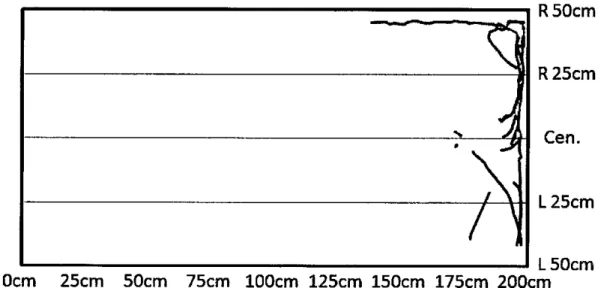
1. 대나무 통발의 하류역의 유속분포와 물고기의 유영행동 x,Y의 좌표치의 유속측정의 결과로부터 얻 은 데이터를 사용하여 등유속선도를 그렸고, 0.5초 간격으로 추출한 공시어의 유영궤적을 겹 쳐서 각 경우에 대하여 Fig. 4-Fig. 7에 보였다. 정수일 때, 케이지에서 해방 후부터 α5초 간격 으로 좌표치를 플롯한 물고기의 유영궤적은 케 이지로부터 해방 직후 물고가가 수조의 좌·우 측방향으로 유영하였고, 이후 하류부의 수조벽 과 그물막부근에서 느리게 유영하는 경향을 보 였다. 그러나, 해방 직후부터 촬영종료까지 조l 혀 움칙이지 않은 경우도 2마리 보였다(Fig.. 4) 유수중의 경우에는 정수일 때와 같이 물고기는 하류부의 수조벽과 그물막을 지나서 느리게 헤 엄치는 경우가 많았다. 그러나, 물고기가 수조 의 벽을 지나 하류부까지 유영한 경우와 수조 의 하단부의 좌우측으로부터 중앙부까지 유영 한후 상류부의 우측을 지나 좌측으로 유영하는 경우가 있었다. 이때, 물고기는 수조의 상단부 의 좌측에 있는 유속이 〕0 cm/s이하의 감속역을 향하여 유영하였대(Fig. 5),
, Cen./
/ 「’"“「 유수중에 설치한 대나무통발에 대한 물고기의 유영행동에 관한 연구 R 50cm R 25cm L 50cm 0cm 25cm 50cm 75cm 100cm 125cm 150cm 175cm 200cmFig. 4. The tracks of fish swimming in flow distribution areas of not set up pot under no flow condition. RSOcm R25cm Ce n. L 25cm L5Ocm 0cm 25cm 50cm 75cm 100cm 125cm 150cm 175cm 200cm
Flow speed:
■■■·
■·
■.奐;븟薑:贅
0 2 4 6 8 10 12 14 16 18 20 22 24 26(cm/s) Fig. 5. The tracks of fish swimming in flow distribution areas of not set up pot underflow condition.
Flow
원통형통발을 설치하였을 때의 유영궤적은 유수중과 같이 물고기가 수조의 벽을 따라서 상류부까지 유영한 경우와 케이지로부터 해방 직후 통발의 입구를 향해 유영하여 입롱하는 경우가 있었다.(Fig. 6) 박스형통발을 설치하였 을 때의 물고기의 유영퀘적은 물고기가 수조의 벽을 따라서 중앙부까지 유영한 후, 상류부에 서는 물고기가 통발에 접촉하는 경우와 케이L 50cm 0cm 25cm 50cm 75cm 100cm 125cm 150cm 175cm 200cm RSOcm R 25cm Cen. L 25cm
Flow
강경범
.김석종
Flow speedS
0 2 4 6 8 10 12 14 16 18 20 22 24 26(cm/s) Fig. 6. The tracks of fish swimming in flow distribution areas of set up cylinder pot underflow condition. 티
ow
[큭>
Trap
L 50cm 0cm 25cm 50cm 75cm 100cm 125cm 150cm 175cm 200cmFlow speedS
■■■■..驪
0 2 4 6 8 10 12 14 16 18 20 22 24 26{cm/s) Fig. 7. The tracks of fish swimming in flow distribution areas of set up box pot underflow condition.
지로부터 해방 후 통발의 입구를 향해 직선적으
2.물고기의 유영속도 변화
로 유영하여 입롱하는 경우가 관찰됐대
(Fig. 7)각 경우의 물고기의 유영속도를 비 교하여
Fig. 8에 보였다. 정수와 유수중에 의한 물고기의
RSOcm R 25cm Cen. L25cm유수중0ㅔ 설치한 대나무통발0ㅔ 대한 물고기의‘유영행동에 관한 연구
1끄
No trap No trap Cylinder Box Fig. 8. Comparision of fish swimming speed under
experimnent condition. 평균유영속도를 비교해 보면, 유수중에는 0.16 BL/s이였고, 정수에는 α06 BL/s로, 유수중에서 의 유영속도가 정수중의 유영속도보다 2.8배 빨랐다. 또한, 유수중일 때 통발의 유무에 의 한 물고기의 평균유영속도를 보먼, 원통형 통 발에서는 α23 BL/s, 박스형통발에서는 0.27 BL/s로, 통발을 설치하였을 때의 유영속도가 약 1.6ㅂㅐ 빨랐다. 흐름의 유무, 퉁발의 설치유 무에 대하여 유의수준 5%의 범위아서T-감점을 한 갈과, 유수중과 정수의 물고기의 유영속도 의 차이를 보였고, 유수중에서의 통발을 설치 하였을 때와 통발을 설치하지 않을 때의 물고 기의 유영속도의 차이를 보였다. 본 연구에서는 통발을 설치할 경우에는 물 고기의 유영속도가 증가하는 것으로 나타났으 나, 원통형과 박스형 통발에 대한 유영행동의 차이, 통발의 하류역의 유속분포의 차이가 물 고기의 행동에 영향을 미치는 것으로 판단되 므로, 주후 이에 대한 연구가 필요하다고 사료 된다. 참고문헌
An Yl and Park IV'. 2005. Octopus fisheries in the coastal waters of Gangneung - I Pot fishery.
.ㅈ Kor. Soc. Fish. Tech., ㅖ ; 27 1-278.
Bae BS, An HC, Park SW, Park HH and Chun YY. 2009. Catch characteristics of shrimp trap by submerged time. z Kor. Soc. Fis八 Tech., 45 : 201-210.
Bae BS, An FIG, Jeong EC, Park HH, Park SW and Park CD. 2010. Fishing power estimation of biodegradable traps in the East Sea. J. Kor. Soc. Fish. Tech., 46 : 292-30 1.
Fuwa 5, Kawano K, Sugimoto Y, Ishzaki M and Imai T. 1997. Shapes of entrance in basket traps and fishing mechanisms. Mem. Fac. Fish. Kagoshiman Univ., 46 : 21-30.
Fuwa 5, Ishizaki M, Kawano K. 2000. Fluid dynamic resistance and flow distribution about a heart-shaped bamboo trap. in : Arimoto T, Haluan J (eds). Proceedings of '/?α 3rd 7冊β International Seminar Sustainable Fishing Technol갱〕/ r" Asia To wards the 2JSt Centut3` TL/F-.JSPS International project. Tokyo University of Fisheries, Tokyo, 130-135.
Inoue M, Ning WG and Arimoto T. 1982. Upstream movement of freshwater fishes under bright and dark condisitons, 48 : 1697-1701. Jang Di, Kim DA and Ko KS. 1997. Modification
of fishing baskets for crap, Chaiybdis japonica. BulL korean fish. Soc. Tech., 33 : 90-96.
8 6 4 2 。 o o 0 o 。 띠놉 m ∼ 召 Uα 恥 ㄷ ∼ㅌ E 동띠 No flow Flow
강경범 · 김석종
Kim DA and Ko KS. Fishing mechanism of pots and their modification.2. Behavior of crab, Charybdis japonica, to net pots. 1987. Bull.
korean β緻. Soc., 20 : 348-3 54.
Kim DA and Ko KS. Fishing mechanism of pots and their modification. 1990. 4. An experiment for modifying the pot for crap, Charybdis .
/α/’〃衍Ca. 及ill. korean fish. Soc., 23 : 310-314. Kim DA and Ko KS. 1990. Fishing mechanism
of pots and their modification. 5. An experiment for modifying the pot for conger eel, Astroconger myriaster. Bull. korean fish. Soc., 23 : 315-322.
Lee Jil, Kwon BG, Lee CW, Kim HS, Jeong SB, Cho YB, Yoo JB, Kim SH and Kim BY. 2005. Improvement of gill net and trap net fishing for the resource management in the southern sea of Korea. Mesh selectivity of spring frame trap for conger eel, Conger myriaster. BulL korean fish. Soc. Tech., 41 : 27-34.
Li Y, Yamamoto K, Hirashi T, Nashimoto K. 2003. Stability of fish traps for catching arabesque greening used in Matsuniae, Hokkaido. Fisheries Engineering, 39 : 219-225.
Shin JK, Cha BJ, Park HH, Hho SK, Kim HY, Jeong EC, Kim YB and Kim BY. 2008. Comparison of fishing efficiency on octopus traps to reduce bycatch in the East Sea. J. 兀or. Soc. Fish. Tech., 44 : 1-9.
Sugimoto Y., Fuwa S. Ishizaki M and Imai T. 1996. Entrance shape of fish trap and fishing
e什iciency. Nippon Suisan Gakkaishi, 62 : 5 1-56. Vazquez Archdale M, Anraku K, Yamamoto T and Higashitani N. 2003. Behavior of the Japanese rock crab 'Ishigani' Chatybdis japonica towards two collapsible baited pots: Evaluation of capture e什ectiveness. Fisheries Science., 69 : 785-791.
Yamaguchi Y, Nishinokubi H and Yamane T. 2001. Relationship between current conditions and catch of Golden Cuttlefish sepia esculenta in Shimabara sound, 67 : 438-443.