2019 ⦽ǎႊᔍᖒ⠱ʑྜྷ⦺⫭ ⇹ĥ⦺ᚁݡ⫭ םྙ᧞Ḳ
361
Development of De-burring Machine in Hot Cell
Y.M. Jung*, G. S. Kim, Y.G. Jin, and G. S. Heo
Korea Atomic Energy Research Institute, 111, Daedeok-daero 989beon-gil, Yuseong-gu, Daejeon, Republic of Korea *
1. Introduction
The IMEF(Irradiated Material Examinations Facility) has been conducting PIE(Post-Irradiation Examinations) on irradiated materials used in the HANARO research reactor and NPP reactors. The main goal of the facility is to support the PIE data and also the inventory report should be kept for the testing and stored materials in a hot cell. The M5 hot cell in IMEF have carried out many mechanical tests such as impact test, tensile test, and fracture toughness test for irradiated specimens. Prior to the mechanical test, the cutting of the specimens is required, which results in burrs. If these burrs are not removed, they can affect the results of mechanical test and accumulate in hot cell, increasing radiation level in hot cell. Eventually, workers are exposed to more radiation. Therefore, it was necessary to develop the equipment that can remove burrs efficiently and quickly for irradiated specimens.
2. Methods and Results
2.1 PrincipleThe media pin which has a magnetic material and the specimen are put in the working container, then the electron base under the working container is rotated. As a result, an electromagnetic force is generated in the working container, and the media pin is rotated to grind the specimen. Eventually, the burr on the surface of specimen is removed without change the dimension and shape.
2.2 Results
The de-burring machine is divided to four parts. A body of de-burring device including an electronic base, a control box which can control a setting pint,
media pins to remove burr and a working container. At first, the de-burring machine didn't have remote control in the hot cell so we had carried out improving the remote control of the de-burring machine.
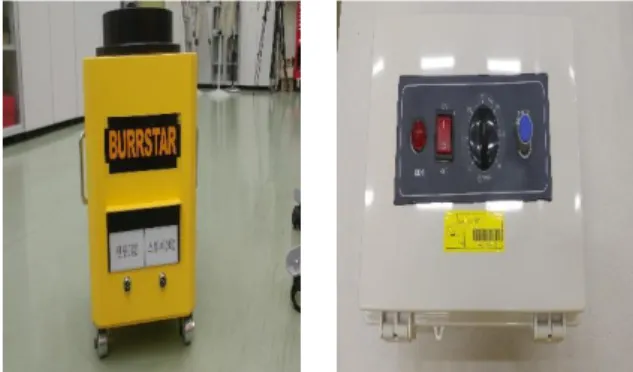
First, we set the wheels under the de-burring machine and made it possible to move in the hot cell freely (Fig. 1.). Device which can move freely can help to utilization of space in hot cell.
Second, handles were attached to both side for easy handling with a manipulator.
Third, the controller that was attached to the body of de-burring machine was removed and re-manufactured the new control box (Fig. 2.). All cable (power, communication) were extended by 8m to can be operated outside the hot cell (operating area).
Fourth, we made a working container (Fig. 3.). The existing container was made of plastic so it was not appropriate in the radiological environment. Therefore, the working container was re-manufactured using acrylic which has a radiation resistant relatively.
Fifth, we made a media pin and a collector of media pins (Fig. 4.). The diameter of pin is 0.7 mm and the length is 5 mm. And an apparatus was needed to apparatus to control the radioactive media pins by processing the irradiated materials. We made a collector using a syringe and magnet, this collector can easily collect only the media pins.
336622
2019 ⦽ǎႊᔍᖒ⠱ʑྜྷ⦺⫭⇹ĥ⦺ᚁݡ⫭םྙ᧞ḲFig. 3. Working container. Fig. 4. Media pin and a collector.
2.3 Application
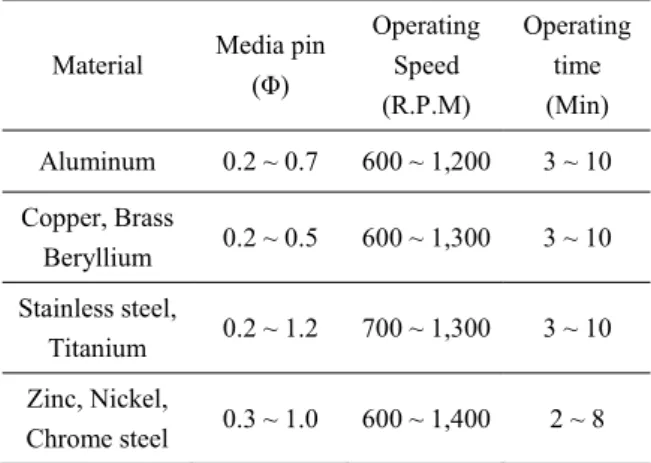
Table 1. De-burring condition according to material
Material Media pin ĭ Operating Speed (R.P.M) Operating time (Min) Aluminum 0.2 ~ 0.7 600 ~ 1,200 3 ~ 10 Copper, Brass Beryllium 0.2 ~ 0.5 600 ~ 1,300 3 ~ 10 Stainless steel, Titanium 0.2 ~ 1.2 700 ~ 1,300 3 ~ 10 Zinc, Nickel, Chrome steel 0.3 ~ 1.0 600 ~ 1,400 2 ~ 8
Table 2. Operating conditions for de-burring machine. Operating
conditions Remarks
Media pin
(g) 300
- Depends on type, size, and weight of specimen. - No bunching and sticking of
pins.
- The height is 0.5~1 cm from the bottom of the working container.
Operating time (Min)
5 ~ 10
- Depends on the size and condition of the initial burr. - Depends on removal amount
of the burr and the purpose.
Operating speed (R.P.M) 1,000 ~ 1,500
- The media pin and the specimen rotate together until they are vortex. - Evenly rotate - Depends on the size of
specimen
The de-burring machine is suitable for removing the burrs of fine holes, inner corner and small sized specimen. Even after the work, the quality is homogeneous and there is no dimensional change and shape deformation. De-burring machine is
capable of dry operation and it can minimize the generation of radioactive waste because there is a wastewater. In addition, the operating time is very short (3~10 min), easy to use and can be operated by even unskilled operator.
Most of specimens to be de-burred in M5 cell are expected to be Zircaloy cladding and PTS tube. The standard operating conditions are shown in Table 2.
4. Conclusion
De-burring machine was introduced to remove the burr of irradiated materials in a hot cell. The burrs of irradiated specimens were successfully removed and result is shown in Fig. 5.
Fig. 5. Comparison between before and after de-burring.
REFERENCES
[1] Peter Sachnik, Sheikh Enamul Hoque, Wolfram Volk, Burr-free cutting edges by notch-shear cutting, Journal of Materials Processing Tech. 249(2017), p.229-245