Invited Paper
Status of Czech Low and Intermediate Radioactive Waste Management
in the Context of European Development
Radek Trtílek, Vaclava Havlova*, Josef Podlaha, Karel Svoboda, and Tomas Otcovský UJV Rez, a. s., Hlavní 130, Řež, 250 68 Husinec, Czech Republic
(Received January 15, 2021 / Revised February 10, 2021 / Approved February 22, 2021)
The article summarises the status and competence of UJV Rez, a. s. (up to 2012, the Nuclear Research Institute Rez, Czech Republic) in the field of radioactive waste (RAW) management as a company managing of 95% of institutional radioactive wastes in Czech Republic. UJV Rez a. s. has been one of the Czech Republic’s key research and engineering institutions in the field of nuclear energy production since 1955. The company processes and conditions prior to storage 95% of so-called institutional RAW and is the principal partner of the state with respect to the research support of the Czech deep geological repository development project. UJV Rez a. s. boasts its own accredited radiochemical analytical test laboratory, unique of its kind in the Czech Republic. Of equal importance is UJV Rez’s active participation in a range of international organisa-tions and associaorganisa-tions and its involvement in wide range of international projects, and so as European projects. One of them is EU funded project PREDIS: Pre-disposal management of radioactive wastes, that has started at September 2020, focused on the field of low level radioactive waste (LLW) and intermediate level radioactive waste (ILW) pre-disposal.
*Corresponding Author.
Vaclava Havlova, UJV Rez, a. s., E-mail: [email protected], Tel: +420-724-081-997
ORCID
Radek Trtílek http://orcid.org/0000-0003-2180-8829 Josef Podlaha http://orcid.org/0000-0001-9675-6248 Tomas Otcovský http://orcid.org/0000-0001-8468-3782
Vaclava Havlova http://orcid.org/0000-0003-0424-3862 Karel Svoboda http://orcid.org/0000-0002-4832-4229 Keywords: Bitumen, Concrete, Conditioning, Pre-disposal, Radioactive waste, Radioactive waste management
1. Introduction
UJV Rez, a. s. (formerly the Nuclear Research Insti-tute Rez, Czech Republic) has, for more than six decades, constituted the Czech Republic’s most important research and engineering organisation in terms of the support of the peaceful use of nuclear energy and ionising radiation. From the beginning, research concerned with radiochemistry and radioactive waste (RAW) management issues have made up an integral part of the company’s support activities.
1.1 Brief history
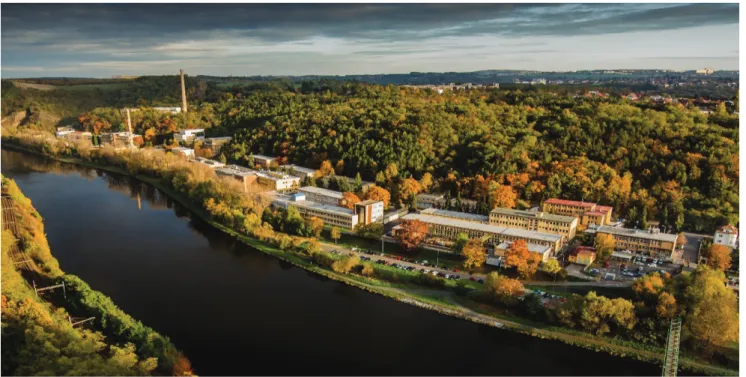
The Nuclear Physics Institute was established in 1955. This was an era that had yet to witness the deployment of satellites and space exploration and, for strategic reasons, a location in the deep valley of the Vltava River was chosen around 14 km upstream of the Prague for the construction of the facility (see Fig. 1). Today, it is hard to believe that within two years a VVR-S nuclear research reactor with a
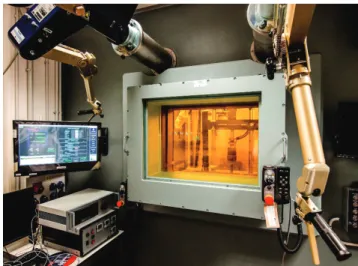
thermal output of 2 MW was designed, constructed and, in 1957, commissioned. The reactor was completely rebuilt in 1987-1989 and transformed into the LVR-15 research re-actor with a thermal output of 10 MW that is still in use today (Fig. 2). The reactor is used for the research of mate-rials, corrosion testing, the testing of the chemical regimes of power reactors, irradiation services, neutron activation analysis and the production of semiconductors. One of the facility’s most important activities in recent years concerns the production of radiopharmaceuticals and the irradiation of uranium targets to produce 99Mo/99Tc diagnostic radio-nuclide generator.
A second experimental reactor, of the heavy-water TR-0 type with zero output, was commissioned in 1972 and, following reconstruction in 1982-1983, was converted to the light-water LR-0 type with a maximum thermal output of 5 kW. This reactor is used for the modelling of neutron fields and the testing of power reactor fuel and fuel batches. Under the name Nuclear Research Institute Rez, UJV became known in 1970 when it focused on applied research
Radek Trtílek et al. : Status of Czech Low and Intermediate Radioactive Waste Management in the Context of European Development
and engineering support of the Czechoslovak nuclear pro-gramme.
In 1992, the Institute was transformed into the legal sta-tus of the Nuclear Research Institute Rez joint stock com-pany (a. s.), the shareholders of which are nuclear operators ČEZ, a. s. and Slovenské elektrárne (SE, a. s.), nuclear man-ufacturer Skoda JS, a. s., and the municipality of Husinec. In 2012, the name of the company was changed to “UJV Rez, a. s.” (i.e. the abbreviated form of the previous name).
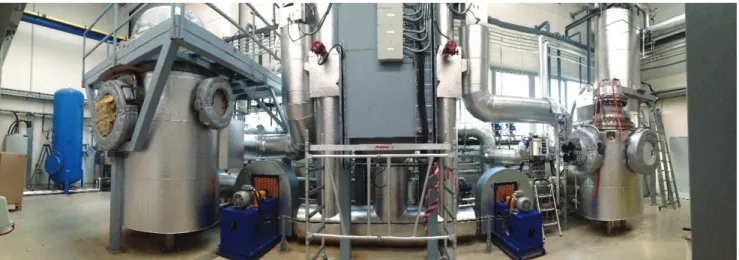
Two of the most significant events in the recent history of UJV Rez consisted of the acquisition in 2002 of ENER-GOPROJEKT PRAHA a. s., the main designer of all the thermal and nuclear power plants constructed in the former Czechoslovakia and, in the period 2011–2017, the con-struction of the “Sustainable Energy” (SUSEN, see e.g. Fig. 3 and 4) infrastructure of the “Research and Development for Innovation” operational programme of the European Commission and the Ministry of Education of the Czech Republic at UJV Rez’s subsidiary company Research Cen-tre Rez, s.r.o. (CVR) .
1.2 UJV Rez today
UJV Rez has a stable and consistent history. The com-pany has more than 750 employees, over 60% of whom
are engaged in research and engineering professions. The average employee age stood at 44.3-year-old and more than 60% of the company’s workforce had received a university education.
While most of the business activities of UJV Rez are conducted in the Czech Republic, the company continues to expand its operations in Slovakia, other EU and Eastern European countries and Asia. Involvement in foreign proj-ects currently represents almost a quarter of the company’s annual turnover.
The UJV Rez and its subsidiary company Research Centre Rez, s.r.o. (CVR) boast an extensive research and technical infrastructure including nuclear research reactors, a cyclotron, hot and semi-hot chambers, gamma irradiators, experimental loops, structural material diagnostics labora-tories, four accredited test laboratories for the determina-tion of mechanical and other material properties, radiadetermina-tion chemistry and radiochemical analytics, three positron emis-sion tomography (PET) medical diagnostic centres, labo-ratories for the research of processes underway and condi-tions within deep geological repositories, the Radioactive Waste (RAW) Management Centre, etc.
UJV Rez also utilises the latest available software tools for the 3D-database design as well as for modelling purposes and the determination of complex calculations
(concerning, for example, thermomechanical, thermohy-draulic and strength processes, rapid process dynamics, the design and optimisation of nuclear fuel batches, determin-istic and probabildetermin-istic safety analysis, shielding design and related calculations, the dissemination of radionuclides in the environment, etc.).
UJV Rez is closely involved in international coopera-tion both through its membership of a number of major or-ganisations (e.g. SNETP and NUGENIA), on the basis of bilateral or multilateral agreements (e.g. CEA, GRS, EPRI, SSTC NRS, US-DOE) and through its participation in vari-ous international projects (e.g. IAEA, OECD-NEA, EUR-ATOM, Horizon 2020). Through international cooperation and research as well as commercial projects UJV Rez cur-rently enjoys links with 33 countries worldwide.
1.3 UJV Rez products and services
Currently, UJV Rez provides engineering and research services in the following areas:
– Technical and engineering support for the safe opera-tion of nuclear power plants (safety, reliability, fuel cycle, operational and maintenance support, ageing management and life-time assessment)
– Project and related energy services (design and license
documentation, supervision, conceptual analysis and expert assessment)
– Development and production of PET radiopharma-ceuticals and the operation of PET centres
– Radioactive waste management and related engineer-ing services
– Research and development related to the above areas and further focusing on:
‧ Construction and sorption materials
‧ Hydrogen technology and hydrogen mobility ‧ Networks and systems employing renewable energy
sources
‧ Generation IV reactors.
1.4 Research and development
As an important institution in terms of both domestic and European research, UJV Rez focuses on projects com-missioned by operators and producers of equipment used in the energy sector and nuclear and conventional power plants as well as projects concerned with the processing and disposal of radioactive waste and diagnostic radiophar-maceuticals for positron emission tomography (PET) use. UJV Rez is today involved in a total of fifty-six grant pro-grammes and projects.
Radek Trtílek et al. : Status of Czech Low and Intermediate Radioactive Waste Management in the Context of European Development
1.4.1 International projects
UJV Rez is the Czech Republic’s most important par-ticipant organisation in EU-commissioned nuclear fission projects (EURATOM) and, in 2017, the company enjoyed active participation in three projects conducted under the EU’s 7th Framework Programme, i.e. Severe Accident Facilities for European Safety Targets (SAFEST), CAr-bon-14 Source Term (CAST) and Preparation for the ES-NII programme of the Horizon 2020 programme (ESES-NII plus).
As part of the Horizon 2020 programme, UJV Rez par-ticipated in a bunch of individual projects since 2015. Re-search continued into cement materials and their function in engineered barriers (CEBAMA; [1], [2]), strategies for reactor melt-down retention in the case of a severe accident (IVMR; [3]) and the development of the heat removal of supercritical CO2 (sCO2 HeRo) as well as issues concern-ing the tools and methodology for the management of the ageing of cables in power plants (TaM Cables; [4], [5]) and the European Joint Radiation Protection Integration Pro-gramme (CONCERT). Moreover, UJV Rez is also actively involved in the Visegrad Initiative for Nuclear Cooperation (VINCO) and a range of other programmes.
In addition, UJV Rez also participated in IAEA and OECD/NEA projects focused on enhancing the safety of nuclear power plants employing VVER-type reactors.
1.4.2 Domestic projects
In 2017, UJV Rez was involved in thirty-seven proj-ects and grant programmes supported by the Technology Agency of the Czech Republic (TACR), the Ministry of In-dustry and Trade and the Ministry of the Interior as well as a number of commercial projects.
2. Radioactive waste (RAW) management
Radiochemistry and issues surrounding radioac-tive waste management have formed an integral part ofUJV Rez’s activities since its establishment as a research institute. Today, the company’s Radioactive Waste & De-commissioning division is responsible for both the business and technical issues involved in this area [6].
The original field of research upon which today’s di-vision continues to build was radiochemistry. The founda-tions were laid in 1952, i.e. prior to the establishment of the institute that is today known as UJV Rez. It was the third most important field (in addition to nuclear physics and nu-clear power) to be developed at the Rez facility. Naturally, the nature and content of the various related activities have changed over time with the advent of new technologies, the development of nuclear power and, above all, the construc-tion and operaconstruc-tion of nuclear power plants.
In accordance with the applicable legislation and au-thorisation, UJV Rez is currently the only company in the Czech Republic able to cover the complete chain of RAW management from its detection to its safe storage/disposal (except the nuclear power plant fuel cycle) [7].
The services offered by the RAW & Decommissioning division with respect to the management of RAW include:
– The detection, identification and characterisation of RAW, including methods for the detection of aban-doned or orphan sources of ionising radiation, – The collection, classification, storage, transport,
treat-ment and conditioning of institutional RAW (transport to the repository for disposal),
– Support for RAW processing and treatment technolo-gies,
– The development and support of the operation of RAW repositories,
– The accredited measurement of the content of radio-nuclide and nuclear material.
UJV Rez also provides services concerning the decom-missioning of workplaces with sources of ionising radiation and support for the decommissioning of nuclear facilities.
Since 2007, UJV Rez specialists have been pro-viding engineering and maintenance services for the
transport of spent nuclear fuel from research reactors in the international context.
2.1 Institutional RAW management
Currently, UJV Rez processes for safe disposal almost 95% of the so-called institutional RAW (solid and liquid) generated in the Czech Republic in the industry, medical and other sectors. However, it is perhaps only fair to add that around 60% of such waste is produced by UJV Rez itself (see Table 1).
Typical examples of institutional waste consist of old fire alarms (that contain 241Am), diagnostic medicine waste contaminated with 99Tc (solid, biological) and various io-dine isotopes, i.e. 123I, 131I, and 125I (liquid), irradiators that employ the 3H radionuclide for the excitation of phospho-rescence and various closed radionuclide sources that are used as sensors and detectors or as calibration standards, etc. UJV Rez processes waste for around 45 regular cus-tomers, i.e. RAW producers.
Waste generated by the UJV Group of companies origi-nates mainly from the operation of its research reactors and consists of e.g. refrigerant cleaning materials, discarded waste following repairs and maintenance and contaminated protective equipment. Historical RAW created via the re-mediation of the ecological liabilities of the former nuclear
research institute makes up a special waste group [6]. The acceptance of RAW from its producers and its pro-cessing and handover for storage or disposal is provided for by the RAW Management Centre, which is equipped with the technology that enables the fragmentation, decontami-nation, processing and treatment of the waste. For example, it has a two-stage evaporation station for the thickening of liquid RAW, a solid waste press, an ultrasonic decon-tamination vessel, high-pressure blasting chambers for fragmentation and abrasive blasting, cementation lines, etc. The Centre also has the full range of handling and transport
equipment along with waste transport containers. The Cen-tre was completely reconstructed in 2011–2014.
2.2 Seizure of orphan or abandoned sources
The division is also responsible for the detection of orphan and abandoned sources of ionising radiation (so-called seizures) based on long-term contracts with SURAO (waste management organisation) and operators of commu-nal damps and scrap yards. The usual scenario for this ser-vice is the removal of the seizure and the tracing and iden-tification of the source, the securing of the capture pending the decision to trace the originator (or not), its processing and handing over for storage/disposal. Around twenty such procedures are conducted annually. Typical captures
Producer RAW form unit 2014 2015 2016 2017 2018
UJV Rez solid
m3
25.2 20.3 24.4 41.4 18.9
liquid 60.3 9.9 8.0 9.2 9.44
External producers solid 16.3 9.7 9.7 21.0 20.66
liquid 4.23 14.4 23.9 14.0 5.42
Remediation of environmental damage
solid 55.8 63.9 98.1 36.2 84.42
liquid 2.95 4.3 9.2 3.0 3.0
Total RAW accepted for processing 164.8 122.5 173.3 124.8 141.84
Storage containers* solidified package 639 479 547 418 717
* Usually 200 L drums, but in some cases non-standard waste packages [7] Table 1. Volume of RAW accepted for processing and transferred for storage
Radek Trtílek et al. : Status of Czech Low and Intermediate Radioactive Waste Management in the Context of European Development
include waste from medical facilities, usually originating from the patient, or discarded instruments in which 226Ra containing paint has been used for luminescence.
2.3 Development and engineering support in the field of RAW
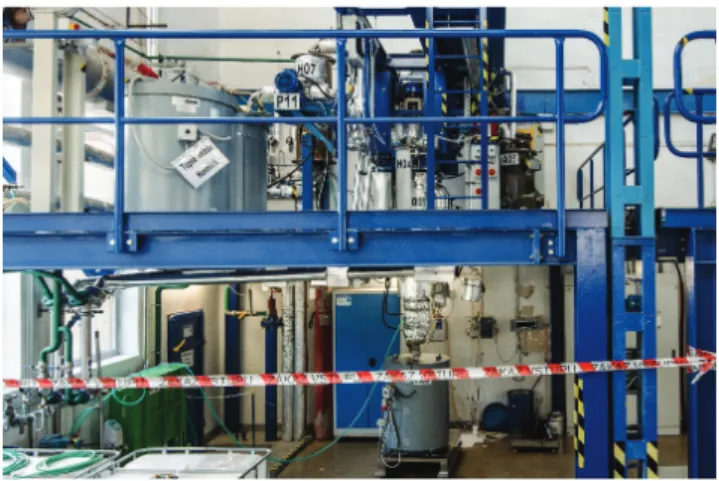
UJV Rez also addresses minor projects, though no less important in terms of maintaining and expanding overall knowledge, and contracts for research and engineering ser-vices concerned with radioactive waste management issues. The company has a permanent contract for the testing of the “liquid waste-bitumen matrix” system in order to verify compliance with waste acceptance conditions prior to the processing of the radioactive concentrate batches at nuclear power plants, in connection with which the company’s frobit experimental line (completely modernised in 2017, see Fig. 5) serves to simulate the conditions of the processing facili-ties of both of the Czech Republic’s nuclear power plants [8]. Further contracts include the laboratory optimisation of the formula for the solidification of liquid and semi-liquid RAW (sludges, ion exchangers and concentrates) based on geopolymers, cement or mixed geo-cement matrices. The optimisation process is conducted in cooperation with
Chemcomex a. s. [9]. The Mochovce nuclear power plant waste matrix was optimised in 2011–2012, followed by that
of the Dukovany nuclear power plant from 2013–2014 and that of the Paks NPP (Hungary) in 2016–2017. Together with Chemcomex a. s. and based on previous optimisation and licencing verification experience, two contracts were awarded to UJV Rez for the consolidation of ion exchang-ers and sludges in ALUSIL matrices at the Dukovany nu-clear power plant [9].
Considering R&D, the most complex challenge ad-dressed by the company in recent years consisted of the “R&D of the RAW technology and management system of new nuclear sources” project (Ministry of Industry and Trade project no. FR-TI3/245) that was addressed in 2011– 2015. The project included the development of a filling simulator for the Dukovany RAW repository, technology for the processing and treatment of RAW (the optimisation of existing matrices–the so-called pure bitumen matrix, and the development of new matrices–geo-cement and polysi-loxane matrices), the design of a system for management very low-level waste (VLLW), the development of ad-vanced decontamination methods and new methodologies for the characterisation of radioactive materials [10].
Two of the most important projects currently under-way are the “Knowledge Base for the Decommissioning of Nuclear Energy Facilities” project (Ministry of Indus-try and Trade application no. CZ.01.1.02/0.0/0.0/15_019/ 0004507 in co-operation with the Technical University of Liberec; 2016–2020) and “A Recyclable Decontamination Medium for the Decommissioning of Nuclear Facilities” project (Ministry of Industry and Trade no. FV10023, in co-operation with the Czech Technical University-Faculty of Nuclear Sciences and Physical Engineering and Chemco-mex a.s.; 2016–2020; [11]). The main objectives of the first project are the development of a sampling probe for the col-lection of primary circuit piping material for the analysis, and design of a technological procedure for the processing of sorption materials from the cleaning of decontamination media during the decontamination of the primary circuits of nuclear power plants. The main aim of the second proj-ect involves the development of an original (patentable)
decontamination medium designed specifically for WWER (VVER) nuclear power plant primary circuit materials.
Engineering support also includes the provision of ex-pert consultation services, examples of which include in-put for a background study for the updating of the Czech National SNF and RAW Management Concept (2011–2012 for SURAO) and cost analyses for the back-end of the fuel cycle for SE, a.s. (Slovakia) (2010, 2014–2015).
2.4 Decommissioning issues (remediation of radiological liabilities)
The decommissioning of nuclear facilities with ionising radiation sources makes up a special area in terms of radio-active waste management. The objective of the decommis-sioning process is to remove the facility or site from the scope of the Atomic Act.
The provided services include the drafting of the docu-mentation required to launch the decommissioning process, the development and design of decontamination and frag-mentation techniques and procedures, special manipulators and other equipment, the processing and treatment of pri-mary and secondary origin RAW and radiation protection management. With respect to the international environment, UJV Rez specialises in the collection and characterisation of materials, radiochemical analysis and radiation monitoring.
The practical application of the decommissioning pro-cess is illustrated by the long-term ongoing Remediation of Ecological Liabilities incurred at UJV Rez prior to Privati-sation project. Further examples are provided by the reme-diation of a needle production line containing 226Ra at the Richard repository (2004) and the remediation of nuclear medicine facilities. The Radioactive Waste and Decommis-sioning division has accumulated considerable experience of such work at UJV Rez itself through the dismantling of the reactor vessel (see Fig. 6) and other parts of the origi-nal VVR-S reactor (modernised in 1988–1990), the re-moval and treatment of liquid and various types of solid RAW from underground storage tanks, the remediation of a
closed facility for working with alpha nuclides, and the just finished removal and processing of around 50 m3 of waste contaminated with 239Pu and 241Am.
Moreover, specialists from UJV Rez gained valuable experience via the decontamination of metal parts (pipes, tanks, fittings, etc.) by means of abrasive blasting with iron pellets in a special blasting chamber. Official monitoring by the specialist company NUVIA a. s. suggests that around 95% of the resulting material can be released directly into the environment.
2.5 European and international context
It is important that the nuclear community takes effi-cient management of waste streams as a top priority. In ad-dition, as more legacy waste sites are being cleaned and the nuclear power plants around Europe moves towards decommissioning, the volumes of radioactive wastes to process prior to permanent geological disposal is increas-ing with time.
The project “PREDIS: Pre-Disposal Management of Radioactive Waste” (see https://predis-h2020.eu/) develops and improves safer treatment and conditioning methodolo-gies and processes for wastes, for which no adequate or
Fig. 6. Dismantling of the reactor vessel from the original VVR-S research reactor at Rez.
Radek Trtílek et al. : Status of Czech Low and Intermediate Radioactive Waste Management in the Context of European Development
industrially mature solutions are currently available. The project addresses innovation and top-edge technologies for better handling of LLW and ILW radioactive wastes, with a focus on treatment of metallic materials, liquid organic waste and solid organic waste which can result from nuclear power plant operation, decommissioning and other industrial pro-cesses. The project also addresses digitalization solutions for improved safety and efficiency in handling and assessing ce-mented-waste packages in extended interim surface storage. An example of this is digital twins and the use of artificial intelligence for big data mining from non-destructive evalu-ation methods. Through all of these pre-disposal treatment activities, waste acceptance criteria are a critical parameter for optimizing the safe and efficient handling and minimisa-tion of wastes over the whole life cycle, from cradle to grave. For the first results see e.g. the publication [12].
PREDIS will produce tools guiding decision-making on the added value of the developed technologies and their impact on the design, safety, environmental impact and economics of pre-disposal waste management and future disposal. It is anticipated that the project results are close to implementation by the end user community, which is ensured through their active involvement with the part-ners and the co-funding structure of this EC project. The project’s Strategic Research Agenda will highlight needs for future technology development, investments and needs also from the perspectives of competence development and preservation of knowledge.
With 47 partners from 17 countries across Europe, in-cluding UJV in 4 work packages, the 4 year, 24 million-euro project, which started 1 September 2020, should make great strides in the best practices and new technologies ready for global markets.
3. Conclusions
UJV Rez a. s. is a stable and reliable company that pro-vides unique research, application and engineering services
in the field of the support of the use of nuclear energy and ionising radiation sources. The company’s technical infra-structure, knowledge base and experience as well as the skills of its employees are unique in comparison to many much larger countries than the Czech Republic and, in cer-tain areas, the level of knowledge and skills and the techni-cal infrastructure are comparable to similar companies in superpower countries.
UJV Rez forms one of the fundamental pillars that pro-vide the Czech Republic with both a significant degree of independence with respect to the safe use of nuclear energy and a guarantee of its further development as the core el-ement of a balanced energy mix. This also applies to the field of radioactive waste management. Much of the experi-ence gained by UJV Rez has been successfully transferred to foreign markets and international cooperation, including the latest EU project PREDIS as an example of top edge development in the field of LLW and ILW pre-disposal management.
For information of EU project PREDIS, see https://pre-dis-h2020.eu/. PREDIS project has received funding from the Euratom research and training programme 2014–2018 under grant agreement No. 945098.
REFERENCES
[1] T. Vehmas, V. Montoya, M. Cruz Alonso, R. Vašíček, E. Rastrick, S. Gaboreau, P. Večerník, M. Leivo, E. Holta, N. Fink, N.A. Mouhebb, J. Svoboda, D. Read, R. Červinka, R.Vasconcelos, and C. Corkhillh “Character-ization of Cebama Low-pH Reference Concrete and As-sessment of its Alteration with Representative Waters in Radioactive Waste Repositories”, Appl. Geochem., 121, 104703 (2020).
[2] T. Rosendorf, E. Hofmanová, D. Vopálka, A. Vetešník, and R. Červinka, “Comparative Study of HTO Diffu-sion on Individual and Coupled Systems of Compacted Bentonite and Fresh Ordinary Portland Cement Past”,
Appl. Geochem., 97, 102-108 (2018).
[3] Institute de Radioprotection et de Sûreté Nucleaire (IRSN). In-Vessel Melt Retention Severe Accident Management Strategy for Existing and Future NPPs, H2020-EUROATOM IRVM Project Periodic Report, 232 (2018).
[4] Z. Cibulková, A. Vykydalová, V. Plaček, and P. Šimon, “Influence of Gamma Radiation and Temperature on the Ageing of EVA Cable Insulation Studied by DSC”, Thermochim. Acta, 668, 28-32 (2018).
[5] G. Przybytniak, J. Boguski, V. Placek, L.Verardi, D. Fabiani, E. Linde, and U.W. Gedde, “Inverse Effect in Simultaneous Thermal and Radiation Aging of EVA In-sulation”, Express Polym. Lett., 9(4), 384-393 (2015). [6] R. Trtílek. Radioactive Management and Disposal.
Course Handbook, UJV Report, 28, CZ.1.07/1.3.04/ 03.0027 (2012).
[7] R. Trtílek, V. Havlová, J. Podlaha, T. Otcovský, K. Pr-chal, M. Touš, and H. Vojtěchová. Study Supporting Update of the Concept of RAW and SF Management in the Czech Republic (in Czech), UJV Report, 176, UJV-14853 (2020).
[8] P. Sázavský. Methods of Radioactive Waste Manage-ment. Course Handbook, UJV Report, 27, CZ.1.07/ 1.3.04/03.0027 (2012).
[9] Š. Svoboda, “An Innovative Method for the Solidifica-tion of Radioactive Sludge”, Waste Forum, 10, 30-32 (2014).
[10] J. Lengyel, J. Slezakova, J. Matecha, P. Kovarik, and J. Krmela. Research and Development of Technolo-gies and RW Management System in Connection of Potential New Nuclear Sources, UJV Report, 30, UJV-13792-CH (2011).
[11] M. Němec, R. Trtílek, L. Grič, and J. Šrank. Research and Development of Recyclable Decontamination Me-dia for Nuclear Facility Decommissioning, UJV Re-port, 43, UJV-14897 (2020).
[12] C. Reeb, C. Pierlot, C. Davy, and D. Lambertin, “In-Corporation of Organic Liquids into Geopolymer
Ma-terials-A Review of Processing, Properties and Appli-cations”, Ceram. Int., 47(6), 7369-7385 (2021).