Rational Design of 1-D Co
3
O
4
Nanofibers@Low content
Graphene Composite Anode for
High Performance Li-Ion Batteries
Su-Ho Cho, Ji-Won Jung, Chanhoon Kim & Il-Doo Kim
Cobalt oxide that has high energy density, is the next-generation candidate as the anode material for LIBs. However, the practical use of Co3O4 as anode material has been hindered by limitations,
especially, low electrical conductivity and pulverization from large volume change upon cycling. These features lead to hindrance to its electrochemical properties for lithium-ion batteries. To improve electrochemical properties, we synthesized one-dimensional (1-D) Co3O4 nanofibers (NFs) overed with
reduced graphene oxide (rGO) sheets by electrostatic self-assembly (Co3O4 NFs@rGO). The flexible
graphene oxide sheets not only prevent volume changes of active materials upon cycling as a clamping layer but also provide efficient electrical pathways by three-dimensional (3-D) network architecture. When applied as an anode for LIBs, the Co3O4 NFs@rGO exhibits superior electrochemical performance:
(i) high reversible capacity (615 mAh g−1 and 92% capacity retention after 400 cycles at 4.0 A g−1) and
(ii) excellent rate capability. Herein, we highlighted that the enhanced conversion reaction of the Co3O4 NFs@rGO is attributed to effective combination of 1-D nanostructure and low content of rGO
(~3.5 wt%) in hybrid composite.
Lithium-ion batteries (LIBs) have been widely used as the energy source of various devices including porta-ble electronics, electric vehicles (EVs) and energy storage system (ESS) due to their high power, energy density and clean system1–3. However, the performance of LIBs is still falling short of the level required for large-scale
applications. It pushes the engineers to develop high capacity electrode materials, especially anode, for replacing commercial anode material (e.g. graphite with low specific capacity of 372 mAh g−1). Transition metal oxides
(TMOs) introduced by Tarascon’s group are next-generation anode materials thanks to their high theoretical capacity based on conversion reaction4–7. Among them, cobalt oxide (Co
3O4) is an emerging candidate because
of its high theoretical capacity (890 mAh g−1), based on the conversion reaction. Typically, during discharge
process, Co3O4 can react with 8 moles of lithium ions (Li+) and 8 moles of electrons and form cobalt (Co) metal
nanograins which is distributed in lithium oxide (Li2O) matrix. The conversion reaction of Co3O4 is represented
in the following equation.
+ ++ − +
Co O3 4 8Li 8e 3Co 4Li O2
With many Li+ transport and electron transfer, higher theoretical capacity can be obtained from Co
3O4 compared
to other carbonaceous materials.
Nevertheless, practical use of Co3O4 has been frustrated by the following main challenges: large volume
changes of Co3O4 (~300%) upon cycling, low electrical conductivity of Co3O4, and formation of insulative
Li2O matrix due to the conversion reaction. In order to address these issues, researchers have often employed
nano-engineering to develop Co3O4/carbon nanocomposites such as Co3O4 nanoparticles (NPs)/graphene8,
Co3O4 NPs/carbon tube9 and Co3O4 nanowires (NWs)/graphene frame10. Much research has shown that the
graphene greatly provides facile passage for electrons and flexible clamping component for Co3O411–13. However,
Co3O4/graphene composites developed so far require large amount of graphene for stable cycling in LIBs, which Department of Materials Science and Engineering, Korea Advanced Institute of Science and Technology (KAIST), 291 Daehak-ro, Yuseong-gu, Daejeon 34141, Republic of Korea. Correspondence and requests for materials should be addressed to I.-D.K. (email: [email protected])
Received: 09 November 2016 Accepted: 06 February 2017 Published: 27 March 2017
OPEN
OPEN
www.nature.com/scientificreports/
sacrifices the actual capacity of Co3O4. Thus, we suggested desirable design for hybrid nanocomposite
architec-ture of Co3O4 and graphene.
One-dimensional (1-D) NFs, in common with other nanostructures, have large electrode/electrolyte interface area with volume-strain relaxation which can prevent the volume expansion during charge/discharge process. Moreover, these NFs have larger electrochemical active area because they are less likely to undergo aggregation than nanoparticles14–17. In general, large amount of graphene is required to cover nanoparticles with large specific
surface area. Meanwhile, it is possible to coat entire surfaces of NFs with very low-content of graphene.
In this work, the hybrid Co3O4 NFs@rGO offer significant benefits that are enumerated briefly as follows: 1-D
reinforcement scaffold of the Co3O4 NFs for fast Li+ diffusion, large area for electrode/electrolyte interface,
con-tinuous electric contact and volume accommodation, and flexible yet robust graphene sheets directly coated on the Co3O4 NFs for highly electrically conductive networks before and after conversion reactions. Small amount of
the rGO greatly improved the performance of nanocomposite, synergistic effect of which on conversion reaction is emphasized.
Results
Synthesis of 1-D Co
3O
4NFs and Co
3O
4NFs@rGO.
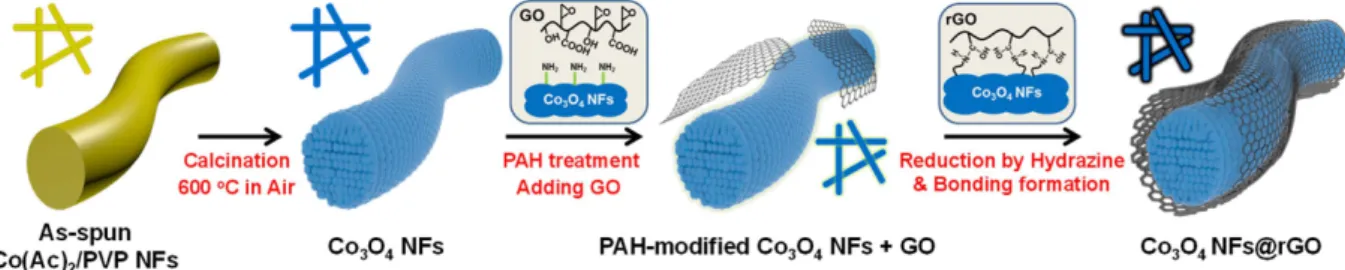
As shown in Fig. 1, the 1-D Co3O4 NFs werefabri-cated via electrospinning method. As-spun Co precursor/polymer composite NFs (as-spun Co(Ac)2/PVP NFs)
were achieved after the electrospinning. In subsequent calcination step at 600 °C in air, residual solvent and pol-ymer were burned out and Co precursor was oxidized to Co3O4, resulting in the formation of 1-D Co3O4 NFs.
Finally, to cover the surface of the Co3O4 NFs with highly conducting graphene sheets, we employed
chemi-cal solution method based on electrostatic interaction and chemichemi-cal bonds18. The as-prepared Co
3O4 NFs were
placed in poly(allylamine hydrochloride) solution (PAH solution), where hydroxyl group (-OH) on Co3O4 NFs
was modified to amine group (-NH2). These amine groups on the PAH-modified Co3O4 NFs have the electrostatic
attraction with the epoxy groups of graphene oxide (GO), and ring opening reaction between the PAH-modified Co3O4 NFs and GO occurs. After reduction of the GO with hydrazine, strong chemical bonds between the Co3O4
NFs and reduced GO (rGO) were generated, leading to the rGO sheets wrapped Co3O4 NFs (Co3O4 NFs@rGO).
Characteristics of Co
3O
4NFs and Co
3O
4@rGO NFs.
Morphological features of the Co3O4 NFs@rGOare represented in Fig. 2. The as-spun Co(Ac)2/PVP NFs with smooth and uniform surface were observed in
Fig. 2a. During subsequent calcination changing the as-spun NFs into the Co3O4 NFs, the oxidation with
shrink-age by burning of residual solvent and polymer was taken place. The calcined Co3O4 NFs were formed in a
diameter of 150 to 200 nm (Fig. 2b). After graphene wrapping process, it is clearly observed that the rGO layers are homogeneously coated on the surface of the Co3O4 NFs (Fig. 2c). The internal morphology and phase of the
Co3O4 NFs and the Co3O4 NFs@rGO were confirmed by transmission electron microscopy (TEM) (Fig. 2d–f
and Fig. S1, see Supplementary Information). The high-resolution TEM (HRTEM) images of the Co3O4 NFs@
rGO is shown in Fig. 2e,f, showing that polycrystalline Co3O4 grains connected together were uniformly covered
by the ultrathin rGO sheets (~3 nm) (Fig. 2d,e). The lattice fringe of the Co3O4 in the Co3O4 NFs@rGO is 4.66 Å,
which is well matched with the spacing of Co3O4 (111) planes (JCPDS PDF#43-1467) (Fig. 2f). The scanning
TEM-energy dispersive spectroscopic (STEM-EDS) mapping analysis for the Co3O4 NFs@rGO confirms
homo-geneous atomic distribution of Co and C in the 1-D scaffold (Fig. 2g,h).
To check exact content of carbon in the Co3O4 NFs@rGO, we conducted element analysis (EA). From the
EA results, the concentration of carbon was measured to be only 3.56 wt% (Table S1). This value indicates very small amount of carbon in the Co3O4 NFs@rGO. Even using minimum amount of carbon to anode, rGO directly
coated on Co3O4 NFs enhances the electrical conductivity and provides high capacity for the Co3O4 NFs. X-ray
diffraction (XRD) patterns show that the Co3O4 NFs and the Co3O4 NFs@rGO have the single phase spinel crystal
structure for Co3O4 phase (Fig. 2i). The XRD patterns exhibit additional peaks at 2θ = 31.3°, 36.8°, 38.5°, 44.8°,
55.7°, 59.4° and 65.2°, which are attributed to scattering from the (220), (311), (222), (400), (422), (511) and (440) lattice planes of cubic spinel Fd-3m Co3O4 phase (JCPDS PDF#43-1467), respectively. Moreover, any peak change
was not observed in the Co3O4 NFs@rGO, indicating that the crystal structure of the Co3O4 NFs is not affected
during chemical-solution based graphene wrapping process.
In order to investigate the characteristics of two-dimensional (2-D) graphene layer, Raman spectroscopy anal-ysis was performed. In Raman spectra, five characteristic bands at 195, 478, 517, 618, and 687 cm−1 are discovered
in common with three samples (the Co3O4 NFs, PAH-treated Co3O4 NFs and the Co3O4 NFs@rGO) (Fig. 3).
The band at 195 cm−1 (F
2g) exhibits CoO6 scissoring vibration and other bands at 478, 517, 618 and 687 cm−1 are
assigned to Eg, 2F2g and A1g, that exhibit Co-O symmetric stretching vibration, respectively19. In the Co3O4 NFs@ Figure 1. The schematic illustration of synthesis for the Co3O4 NFs and the Co3O4 NFs@rGO.
Figure 2. SEM images of (a) the as-spun NFs, (b) the Co3O4 NFs, and (c) the Co3O4 NFs@rGO. (d–f) HRTEM
images of the Co3O4 NFs@rGO. (g) STEM image of the Co3O4 NFs@rGO. (h) EDS-mapping image for atomic
distribution of Co and C analyzed from the STEM image in (g). (i) XRD patterns of the Co3O4 NFs@rGO, the
Co3O4 NFs and JCPDS #42-1467.
www.nature.com/scientificreports/
rGO, two specific bands were detected at 1356 and 1590 cm−1, which correspond to the D and G band,
respec-tively, confirming that the rGO sheets were formed in the Co3O4 NFs@rGO20. Also, the Raman analysis clearly
shows that any structural changes of the Co3O4 NFs did not occur during graphene wrapping step through any
changes in peaks of Co3O4.
Electrochemical reaction with Li
+of the Co
3
O
4NFs and Co
3O
4NFs@rGO.
Theelectrochem-ical performances of the Co3O4 NFs and the Co3O4 NFs@rGO were investigated to check their potential as
high-performance anode materials for LIBs. For the electrochemical data, all capacities in this work were based on the weight of all active materials including rGO. The cyclic voltammetric (CV) curves and galvanostatic charge-discharge curves of the Co3O4 NFs and the Co3O4 NFs@rGO are shown in Fig. 4. In Fig. 4a,b the CV
graphs show large cathodic peaks at 0.86 V for the Co3O4 NFs and 0.72 V for the Co3O4 NFs@rGO in first cycle.
These peaks are attributed to the formation of solid-electrolyte interphase (SEI) layer on the surface of active materials. After the 1st cycle, large cathodic peak at 1.2 V is ascribed to the reduction of Co3O4 by the conversion
reaction. The anodic peaks are observed at 2.0 V for both of electrodes, which is ascribed to the oxidation from Co metal nanograins to Co3O421,22. These reaction peaks were well-matched with potentials represented with the
plateaus in charge-discharge curves (Fig. 4c,d). The charge-discharge behaviors in the formation cycle, 1st, 10th and 20th cycle for the Co3O4 NFs and the Co3O4 NFs@rGO were observed with voltage window between 0.01
and 3.0 V at current densities of 0.1 A g−1 for formation cycle and 1.0 A g−1 after formation cycle. The discharge
capacity in formation cycle of the Co3O4 NFs@rGO shows higher capacity of 1474 mAh g−1, than the Co3O4 NFs
(1202 mAh g−1). The irreversible capacity losses of both the Co
3O4 NFs and the Co3O4 NFs@rGO were estimated
to be 25% of the initial discharge capacity.
Discussion
In general, Co3O4 converts to the Co metal nanograins dispersed in Li2O matrix after conversion reaction with
8 moles of Li+ per one mole of Co
3O4. To investigate stability of the the Co3O4 NFs and the Co3O4 NFs@rGO
toward such severe reaction with Li+, cycling performances and rate-capability were evaluated (Fig. 5a–c). In
Fig. 5a, the Co3O4 NFs show the discharge capacity of 639.4 mAh g−1 in first cycle at a current density of 1.0 A g−1,
whereas the discharge capacity of the Co3O4 NFs@rGO is 933.6 mAh g−1 at the same current. For understanding
of how the 1-D nanostructures influence their cyclability, we compared the zero-dimensional (0-D) Co3O4 NPs
(control sample) with the 1-D Co3O4 NFs and the 1-D Co3O4 NFs@rGO (Fig. S3,SI). Both of the Co3O4 NFs and
the Co3O4 NFs@rGO show high capacities that could be maintained up to 200th cycle, whereas the Co3O4 NPs Figure 4. Cyclic voltammetric curves of (a) the Co3O4 NFs and (b) the Co3O4 NFs@rGO tested at a scan rate
0.1 mV s−1. Galvanostatic charge-discharge curves of (c) the Co
3O4 NFs and (d) the Co3O4 NFs@rGO at a
were rapidly degraded within 30 cycles. Furthermore, after 200th cycle, the Co3O4 NFs and the Co3O4 NFs@
rGO have 924.2 mAh g−1 and 1370.8 mAh g−1 at a current density of 1.0 A g−1, respectively. Figure 5b shows rate
capabilities of the Co3O4 NFs and the Co3O4 NFs@rGO between 0.1 and 2.0 A g−1. At all of current densities,
the Co3O4 NFs@rGO show much higher capacities than pristine Co3O4 NFs. In addition, the Co3O4 NFs@rGO
exhibit high electrochemical performance that shows first discharge capacity of 669 mAh g−1 and 400th discharge
capacity of 615 mAh g−1 (cycle retention of 92%) at a high current density of 4.0 A g−1 (Fig. 5c). It is noticeable
that a low amount of rGO (~3.5 wt% in composite) is enough to improve electrochemical performance along with 1-D structural effect in a complementary manner. This amount of carbon is overwhelmingly lower than previously reported values (Table S2).
In Fig. 5, the Co3O4 NFs and the Co3O4 NFs@rGO tend to increase the capacity as the cycle progresses. Such
increase in capacity of the Co3O4 NFs may be due to an activated formation of gel-like polymeric film on Co metal
surface23. Interestingly, as shown in Fig. 5, the capacity of Co
3O4 NFs@rGO has been increased through the
graphene wrapping process, and also its capacity is higher than the theoretical capacity of Co3O4 NFs@rGO
= × + × = −×
C C mass percentage of Co O C mass percentage of rGO g
( theoretical Co O3 4 ( 3 4) graphite ( ) 890 mAh 1
. wt + mAh g− × . wt = . mAh g−
96 44 % 372 1 3 56 % 871 56 1). These extra capacities can be explained by the
interfacial Li+ storage that represents the formation of gel-like polymeric film and the pseudo-capacitive property
on Co metal grains. The gel-like polymeric film is the reversible product from the side reaction of electrolyte decomposition on the surface of Co metal grain at low voltage during discharge process, and this film provides extra capacity for lithium storage24,25. In addition, the Co metal grain which came from conversion reaction can
allow extra Li+ adsorption site by metallic pseudo-capacitive property26–28. In consideration of such extra charge,
unlike the pristine Co3O4 NFs, the Co3O4 NFs@rGO provide the fast electron pathway to form negatively charged
Co metal grains for effective Li+ adsorption on their surface. Figure 6a shows the differential capacity plots for
Co3O4 NFs and Co3O4 NFs@rGO after 20th cycle at a current density of 1.0 A g−1. The broad cathodic peak at
around 2.2 V is caused by Li+ insertion to Co
3O4NFs, which corresponds to region I in Fig. 6b,c. The peak at
1.23 V is the reduction of Co3O4 to Co metal nanograins (conversion reaction). These peaks are positioned at
same potential for both samples, because the plateau appears at the same voltage in Fig. 6b,c. In Fig. 6b,c there are the regions I and II that are related to Li+ insertion and conversion of Co
3O4 with Li+ and the region III is relevant
to the interfacial Li+ storage ability of active materials occurred in solid-liquid interface with Li+ adsorption29–31.
Furthermore, the dQ/dV value of Co3O4 NFs@rGO at 1.23 V is twice that of Co3O4 NFs. The broad cathodic peak
at around 1.0 V is caused by the interfacial lithium ion storage of electrolyte decomposition on Co metal nano-grain and pseudo-capacitive property of metal nano-grains. For the peak at around 1.0 V, the dQ/dV value of Co3O4
NFs@rGO is 1.5 times higher compared with the Co3O4 NFs. Based on these results, the Co3O4 NFs@rGO Figure 5. Electrochemical performances of the Co3O4 NFs and the Co3O4 NFs@rGO . (a) cycle
performances of the Co3O4 NFs and the Co3O4 NFs@rGO at a current density of 1.0 A g−1; (b) rate capabilities
of the Co3O4 NFs and the Co3O4 NFs@rGO at various current densities between 0.1 and 2.0 A g−1; (c) cycle
www.nature.com/scientificreports/
proceed the same reaction compared to Co3O4 NFs, but the rGO layers promote the degree of Li+ interfacial
storage reaction in all cases of Li+ insertion, conversion, and interfacial adsorption.
To further understand the effect of graphene layer wrapping, ex-situ SEM analysis for the Co3O4 NFs@rGO
and the Co3O4 NFs were carried out after 100th cycle (Fig. 7a,b). The surface state of the delithiated-Co3O4 NFs@
rGO was observed, indicating that the nanocomposite structure could be intactly preserved with formation of stable SEI layer (Fig. 7a), whereas the SEI layer of the Co3O4 NFs was conspicuously and irregularly generated
(Fig. 7b). To further investigate resistance in the nanocomposites, electrochemical impedance spectroscopy (EIS) measurement was conducted. Figure 7c shows the Nyquist plots of the Co3O4 NFs and the Co3O4 NFs@rGO
after the 100th cycle and the equivalent model corresponding to the EIS model. The impedance values of each impedance component calculated from the EIS data are represented in Table S3. RE, RSEI, RCT-1, RCT-2 and RP are
the ohmic resistance of the cell, the SEI resistance, the charge transfer resistances, and the phase transformation resistance, respectively. In the case of the Co3O4 NFs@rGO, the SEI resistance was reduced by 37.7%, compared
to the Co3O4 NFs. Also, the charge transfer resistance of Co3O4 NFs@rGO (18.26 Ω) is much smaller than that of
Co3O4 NFs (68.68 Ω). Therefore, it is believed that the low-content rGO layer on Co3O4 NFs is significantly
bene-ficial to enable smaller polarization for LIBs. Here, we proposed the simple reaction models during discharge pro-cess for the Co3O4 NFs@rGO and the Co3O4 NFs (Fig. 7d,e). In the case of the Co3O4 NFs surrounded by SEI and
super P (carbon additive), electrons may not efficiently transfer between electrode materials (Fig. 7e). Meanwhile, for the Co3O4 NFs@rGO, the 2-D rGO layers not only greatly suppress the formation of insulating SEI layer,
but also give facile passage for electron. More importantly, after the lithiation, the rGO can be more effective electron bridge between the discharge products (Co NPs in Li2O matrix) (Fig. 7d). From the point of view of the
Li+ interfacial storage, the Co
3O4 NFs@rGO is much suitable compared to Co3O4 NFs without such conducting
route. These envisioned mechanisms can be supported by higher capacity of the Co3O4 NFs@rGO than that of the
Co3O4 NFs in Fig. 5a,b. Based on the data above and our interpretation, it can be thought that combination of 1-D
nanostructure and rGO-wrapping is appropriate for desirably designed electrode architecture, strategy of which will be an explicit direction for conversion-based LIBs.
In summary, we designed the ultra-thin rGO layer wrapped 1-D Co3O4 NFs as high performance anode for
LIBs, which were simply synthesized via an electrospinning and subsequent self-assembly wrapping of graphene sheets on Co3O4 NFs. 1-D nanostructure of Co3O4 NFs not only overcome the alleviation of pulverization upon
cycling, but also provide the fast Li+ diffusion and continuous electric contact. Moreover, the rGO layer, which
exists as small percentage of carbon within Co3O4, provides high electric conductivity to Co3O4 NFs for high
specific capacity, rendering favorable conversion reaction and Li+ interfacial storage. The Li anode electrode with
Co3O4 NFs@rGO delivered a relatively high reversible capacity of 615 mAh g−1 with stable capacity retention of Figure 6. (a) The differential capacity (dQ/dV) vs. potential (V) profiles after 20th cycle at a current density of
1.0 A g−1; Galvanostatic charge-discharge curves of (b) the Co
3O4 NFs and (c) the Co3O4 NFs@rGO after 20th
92% after 400th cycle at the high current density of 4.0 A g−1. Through above results, the reduced graphene oxide
sheets wrapped Co3O4 NFs were suggested as high performance anode for LIBs.
Methods
Materials.
Cobalt (ii) acetate tetrahydrate (Co(OAc)2·4H2O, Sigma-Aldrich), polyvinylpyrrolidone(PVP, Mw~1,300,000, Sigma-Aldrich), N,N-dimethylformaimde (DMF, 99.8%, Sigma-Aldrich), GO solution (2 ml mg−1, Sigma-Aldrich) and poly(allylamine hydrochloride) (PAH, M
w~900,000, Sigma-Aldrich) were
pre-pared for synthesis of Co3O4 NFs@rGO. Super P (Alfa Aesar), carboxymethylcellulose sodium salt (CMC,
Sigma-Aldrich) and poly(acrylic acid) solution (PAA solution, Sigma-Aldrich, 35 wt.% in H2O) were purchased for the
electrochemical measurements.
Synthesis of Co
3O
4NFs.
The Co3O4 NFs were prepared by an electrospinning process and subsequentcalcination. 1.5 g of Co(OAc)2·4H2O and 0.5 g of PVP were dissolved in 4 g of DMF. Electrospinning solution was
stirred at 500 rpm for 24 h. The solution was transferred into a plastic syringe equipped with stainless needle. The needle gauge was 25 G. The distance between tip of needle and collector was maintained to 15 cm. The applied voltage on the needle tip was DC 15.0 kV. The solution was pulled out with the flow rate of 25 μ l min−1. After
elec-trospinning, collected as-spun Co(Ac)2/PVP NFs were heated at 600 °C with heating rate of 5 °C min−1 for 1 h in
air atmosphere for removing polymer and crystallizing Co-precursor to Co3O4.
PAH functionalization and graphene wrapping.
For graphene wrapping, firstly, 0.25 g PAH was dis-solved in 50 ml of distilled water. Then, 0.1 g of the Co3O4 NFs was added in PAH solution. The surface of theCo3O4 NFs was modified to amine group by PAH. After magnetic stirring for 2 h, the PAH-treated Co3O4 NFs
were washed three times with distilled water. After that, the PAH-teated Co3O4 NFs were dried at 50 °C for
over-night. For preparing graphene solution, GO was dissolved in distilled water up to 66.3 μ g ml−1. Sequentially, the
PAH-treated Co3O4 NFs were added into the GO solution, and the mixed solution was stirred at 200 rpm for 12 h. Figure 7. Ex-situ scanning electron microscopy images of (a) the Co3O4 NFs@rGO and (b) the Co3O4 NFs
after 100th cycle at a current density of 1.0 A g−1; (c) Nyquist plots of Co
3O4 NFs and Co3O4 NFs@rGO after the
100th discharge, presented with fitted curves; The illustration of expected mechanism for electron transfer on (d) Co3O4 NFs@rGO and (e) Co3O4 NFs.
www.nature.com/scientificreports/
After electrostatic assembly between the PAH-treated Co3O4 NFs and the GO, to reduce the GO, 0.5 g of
hydra-zine monohydrate was added into the solution and stirred at 200 rpm for 2 h. Finally, several washing and drying steps were conducted.
Material characterization.
The morphologies of the Co3O4 NFs and the Co3O4 NFs@rGO were confirmedvia scanning electron microscopy (SEM, XL-30 SFEG, Philips). The field emission transmission electron
micro-scope (FE-TEM, Tecnai G2 F30 S-Twin, FEI, Netherlands) was used to check the lattice spacing of Co3O4 and the
thickness of graphene layer. The energy-dispersive spectrometry (EDS) mapping of scanning transmission elec-tron microscope (STEM) shows the distribution of carbon, cobalt and oxygen atoms on NFs. The x-ray diffraction (XRD) pattern of Co3O4 NFs and Co3O4 NFs@rGO was carried out using X-Ray diffraction-meter
(D/MAX-2500, Rigaku, Japan). The range of measured X-ray diffraction angle was 2θ = 20–70° using Cu-Kα (λ = 1.54 Å ) radiation. The amount of carbon component of the Co3O4 NFs@rGO was analyzed by element analyzer (FLASH
2000 series, Thermo Scientific). To investigate the graphene sheets, Raman spectroscopy (Aramis, Horiba Jobin Yvon, France) was used.
Electrochemical measurements.
To measure electrochemical performance, active materials were mixed with Super P and binders. The binders were used with CMC solution and PAA solution. The ratio of active material (Co3O4 NFs or Co3O4 NFs@rGO), super P, CMC solution and PAA solution was 75:15:5:5 in weight.Mixed slurry was coated on Cu-foil with a thickness of 90 μ m. Sequentially, the coated Cu-foil was dried at 50 °C for 20 min for removing solvents. For evaporation of moisture and activation of binder, the coated Cu-foil was dried in vacuum oven at 150 °C for 2 h. The obtained anode was assembled to CR2032 coin-type cell in an argon gas filled glove box. The lithium metal was used as counter electrode. The other components of coin cell were Celgard
®
2400 as separator, 1.3 M of LiPF6 dissolved in EC/DEC = 3/7 (v/v) + 10.0 wt% FEC as electrolyte whereEC is ethylene carbonate, DEC is diethyl carbonate, and FEC is fluoroethylene carbonate. Loading mass of active material on Cu-foil was 0.88 ± 0.01 mg cm−2. Current-Voltage curve was measured at Wonatech WBCS3000 in
the voltage window of 0.01–3.0 V and a scan rate of 0.5 mV s−1. Galvanostatic charge/discharge process was
car-ried out by Maccor series 4000 in the voltage window of 0.01–3.0 V. Electrochemical impedance spectroscopy (EIS) was performed to investigate the impedance change after 100th cycle with one channel potentiostat (ZIVE SP1 potentiostat, Wonatech, Korea) by applying a sine wave of 10 mV in the frequency range of 105–0.01 Hz.
References
1. Armand, M. & Tarascon, J.-M. Building better batteries. Nature 451, 652–657 (2008).
2. Goodenough, J. B. & Park, K. S. The Li-ion rechargeable battery: A perspective. J. Am. Chem. Soc. 135, 1167–1176 (2013). 3. Palacín, M. R. Recent advances in rechargeable battery materials: a chemist’s perspective. Chem. Soc. Rev. 38, 2565–2575 (2009). 4. Tarascon, J.-M., Poizot, P., Laruelle, S., Grugeon, S. & Dupont, L. Nano-sized transition-metal oxides as negative-electrode materials
for lithium-ion batteries. Nature 407, 496–499 (2000).
5. Reddy, M. V., Rao, G. V. S. & Chowdari, B. V. R. Metal Oxides and Oxysalts as Anode Materials for Li Ion Batteries. Chem. Rev. 113, 5364–5457 (2013).
6. Cabana, J., Monconduit, L., Larcher, D. & Palacín, M. R. Beyond intercalation-based Li-ion batteries: The state of the art and challenges of electrode materials reacting through conversion reactions. Adv. Mater. 22, 170–192 (2010).
7. Ryu, W.-H., Shin, J., Jung, J.-W. & Kim, I.-D. Cobalt(ii) monoxide nanoparticles embedded in porous carbon nanofibers as a highly reversible conversion reaction anode for Li-ion batteries. J. Mater. Chem. A 1, 3239–3243 (2013).
8. Ren, L. et al. 3D hierarchical porous graphene aerogel with tunable meso-pores on graphene nanosheets for high-performance energy storage. Sci. Rep. 5, 14229, 10.1038/srep14229 (2015).
9. Park, J. et al. Three-dimensional aligned mesoporous carbon nanotubes filled with Co3O4 nanoparticles for Li-ion battery anode
applications. Electrochim. Acta 105, 110–114 (2013).
10. Yao, X. et al. Synergistic Effect of Mesoporous Co3O4 Nanowires Confined by N-Doped Graphene Aerogel for Enhanced Lithium
Storage. Small 28, 3849–3860 (2016).
11. Li, L. et al. Co3O4 mesoporous nanostructures@graphene membrane as an integrated anode for long-life lithium-ion batteries. J.
Power Sources 255, 52–58 (2014).
12. Li, B. et al. Co3O4@graphene composites as anode materials for high-performance lithium ion batteries. Inorg. Chem. 50, 1628–1632
(2011).
13. Wu, Z. S. et al. Graphene anchored with Co3O4 nanoparticles as anode of lithium ion batteries with enhanced reversible capacity and
cyclic performance. ACS Nano 4, 3187–3194 (2010).
14. Stankovich, S. et al. Graphene-based composite materials. Nature 442, 282–286 (2006).
15. Raccichini, R., Varzi, A., Passerini, S. & Scrosati, B. The role of graphene for electrochemical energy storage. Nat. Mater. 14, 271–9 (2015).
16. Jung, J. W., Ryu, W. H., Shin, J., Park, K. & Kim, I. D. Glassy Metal Alloy Nanofiber Anodes Employing Graphene Wrapping Layer: Toward Ultralong-Cycle-Life Lithium-Ion Batteries. ACS Nano 9, 6717–6727 (2015).
17. Shin, J., Park, K., Ryu, W.-H., Jung, J.-W. & Kim, I.-D. Graphene wrapping as a protective clamping layer anchored to carbon nanofibers encapsulating Si nanoparticles for a Li-ion battery anode. Nanoscale 6, 12718–12726 (2014).
18. Zhou, W. et al. A general strategy toward graphene@metal oxide core–shell nanostructures for high-performance lithium storage. Energy Environ. Sci. 4, 4954–4961 (2011).
19. Jiang, J. & Li, L. Synthesis of sphere-like Co3O4 nanocrystals via a simple polyol route. Mater. Lett. 61, 4894–4896 (2007).
20. Claramunt, S. et al. The importance of interbands on the interpretation of the raman spectrum of graphene oxide. J. Phys. Chem. C
119, 10123–10129 (2015).
21. Huang, G. et al. Metal Organic Frameworks Route to in situ Insertion of Multiwalled Carbon Nanotubes in Co3O4 Polyhedra as
Anode Materials for Lithium-Ion Batteries. ACS Nano 9, 1592–1599 (2015).
22. Geng, H. et al. Porous cubes constructed by cobalt oxide nanocrystals with graphene sheet coatings for enhanced lithium storage properties. Nanoscale 8, 7688–7694 (2016).
23. Grugeon, S., Laruelle, S., Dupont, L. & Tarascon, J.-M. An update on the reactivity of nanoparticles co-based compounds towards Li. Solid State Sci. 5, 895–904 (2003).
24. Laruelle, S. et al. On the Origin of the Extra Electrochemical Capacity Displayed by MO/Li Cells at Low Potential. J. Electrochem. Soc. 149, A627–A634 (2002).
Acknowledgements
This work was supported by Korea CCS R&D Center(KCRC) grant funded by the Korea government (Ministry of Science, ICT & Future Planning) (No. NRF-2014M1A8A1049303), Wearable Platform Materials Technology Center (WMC) funded by a National Research Foundation of Korea (NRF) Grant of the Korean Government (MSIP) (NRF-2016R1A5A1009926), End-Run grant from KAIST funded by the Korea government in 2016 (Ministry of Science, ICT & Future Planning) (N011160058), and Korea Institute of Machinery & Materials (KIMM) and the National Research Council of Science and Technology (NST), Republic of Korea.
Author Contributions
S.H.C. and J.W.J. contributed to implement the concept. S.H.C. performed nearly all parts of the experimental system and carried out the measurements and characterizations, and C.H.K. assisted with experimental system and J.W.J. provide research advice. S.H.C., J.W.J. and C.H.K. wrote the text of the entire manuscript and prepared all figures. I.D.K. supervised the project and led the effort to completion. All authors reviewed the manuscript.
Additional Information
Supplementary information accompanies this paper at http://www.nature.com/srep Competing Interests: The authors declare no competing financial interests.
How to cite this article: Cho, S.-H. et al. Rational Design of 1-D Co3O4 Nanofibers@Low content Graphene
Composite Anode for High Performance Li-Ion Batteries. Sci. Rep. 7, 45105; doi: 10.1038/srep45105 (2017).
Publisher's note: Springer Nature remains neutral with regard to jurisdictional claims in published maps and
institutional affiliations.
This work is licensed under a Creative Commons Attribution 4.0 International License. The images or other third party material in this article are included in the article’s Creative Commons license, unless indicated otherwise in the credit line; if the material is not included under the Creative Commons license, users will need to obtain permission from the license holder to reproduce the material. To view a copy of this license, visit http://creativecommons.org/licenses/by/4.0/