INTRODUCTION
Swine production has increased on robust global demand with accordance to the intensive growth of husbandry indus-try. Specifically, swine production has been obvious in Asia. For instance, China consumes one half of pigs generated in the world. South Asia became one of the biggest exporters because of continuous demand of red meats in the developed countries. According to the Food and Agricultural Organiza-tion, swine produced in Korea was 9,880,630 head in 2010 (FAO 2010). Considering population in Korea was approx. 49,000,000 in 2010, swine wastewater has been highlighted as one of high-strength organic wastewaters in Korea (Statics Korea 2010). Organic matter and nutrient in swine wastewater are required to be treated before released into the water
sys-tems because of the ammonia toxicity and deterioration of environmental quality caused by high organic loading (Park et al. 2011). Generally, swine manure requires long hydraulic retention time (HRT) to stabilize organic matter in a continu-ously stirred tank reactor due to the high-strength of organic loading and solids (Chynoweth et al. 1999). Andreadakis (1992) stated that approximately 40% of total organic matter is non-biodegradable in swine waste. However, several inves-tigators showed that swine wastewater can be successfully treated using high-rate anaerobic processes such as an anae-robic filter, an upflow anaeanae-robic sludge blanket, an anaeanae-robic baffled reactor, and a static granule bed reactor (Yang and Chou 1985; Lo et al. 1994; Lim and Fox 2011a, b). Nitrogen in swine wastewater commonly occurs in ammonium because the ionic fraction of ammonia is predominant at pH 7. Alth-ough ammonium is less toxic than free ammonia in aqueous phase, it must be removed to prevent the inhibition of human health or the ecosystems. In addition, the effluent phospho-rus contained in swine wastewater should be stringently
res-─ ─ 75 ──
Removal of Organic Matter and Nutrient in Swine Wastewater
Using a Membrane System
Seung Joo Lim, Sun Kyong Kim, Yong-gu Lee and Tak-Hyun Kim*
Research Division for Industry & Environment, Korea Atomic Energy Research Institute, 1266 Shinjeong, Jeongeup 580-185, Korea
Abstract -- Swine wastewater was treated using a unique sequence of ion exchange membrane bed system (IEBR). Organic matter and nutrient in swine wastewater was pre-treated by electron beam irradiation. The optimal dose for solubilization of organic matter in swine wastewater ranged from 20 kGy to 75 kGy. The carbohydrates, proteins, and lipids were investigated as the solubilized organic fraction of swine wastewater and proteins and lipids mainly contained of the solubilized organic matter. The solubilization of organic matter in swine wastewater was affected by the com-bination effect of temperature and a dose. The average chemical oxygen demand (COD) removal efficiency under room temperature conditions was 67.1%, while that under psychrophilic conditions was 54.6%. For removal of ammonia, the removal efficiency decreased from 63.6% at 23��C to 33.5% 16.8��C. On the other hand, the removal of phosphorus was not a function of temperature. Struvite was one of main mechanisms in anaerobic condition.
Key words : Electron beam, Irradiation, Swine wastewater, Organic matter, Nitrogen, Phosphorus
* Corresponding author: Tak-Hyun Kim, Tel. +82-63-570-3343, Fax. +82-63-570-3348, E-mail. [email protected]
trained because it mainly causes eutrophication in fresh/coas-tal waters (Luo et al. 2002). The actual nutrient in swine waste-water considerably differs from a particular operation of manure collection, housing, and humidity. For instance, there is a considerable loss of nitrogen to air, a potential run-off, or leaching to ground water when manure is exposed to an open lot (Zhang and Felmann 1997).
Several investigators stated that biological processes can be feasible to treat swine waste because of low cost (Lim et al. in press; Lucas et al. 2010). On the other hand, advanced oxidation processes (AOPs) using radicals, ozone, and irra-diation can be alternative for mineralize refractory solving nortorious problems. Ye et al. (2009) reported the deodori-nization of swine wastewater using horseradish peroxidase and peroxides. Getoff (2002) stated that “The radiation chem-istry helps to solve environmental problems very efficiently, especially in the degradation of water pollutants”. Several investigators reported that the solubility and biodegradibility of organic matter were enhanced after the electron beam irradiation. Park et al. (2009) showed the enhancement of gas production and biodegradability of sewage sludge using electron beam irradiation. In this study, temperature decreased from room temperature conditions to psychrophilic tempera-ture conditions during the study period. Swine wastewater was biologically treated after the pre-treated by electron beam irradiation. The combined effects of temperature and dose on organic matter and nutrient removal were
investi-gated using an ion exchange biological reactor (IEBR), which was developed by Park et al. (2011).
MATERIALS AND METHODS
1. Configuration of the IEBR
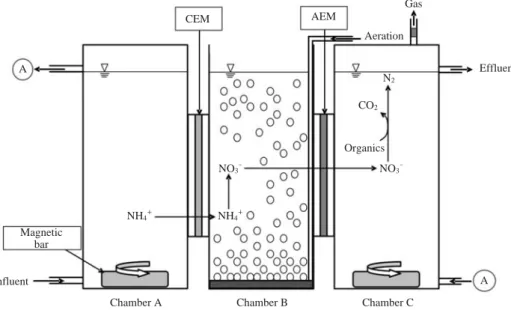
A schematic diagram of the IEBR used in this study is shown in Fig. 1. This system consisted of three chambers, which separated by a cation exchange membrane (CEM; ASTOM Co., Tokyo, Japan) and an anion exchange mem-brane (AEM; ASTOM Co., Tokyo, Japan). The active volume of each chamber was 2 l. The dimension of each membrane installed in this system was 100 mm×16.80 mm. A CEM and an AEM used in this study was specified to design ex-changing monovalent cations or monovalent anions. The influent flowed into chamber A followed by chamber C, whereas chamber B was hydraulically closed. The degree of ammonium transportation was determined by the ammo-nium flux via a CEM between chamber A and chamber B. The transportation of nitrate was performed caused by the concentration gradient via an AEM between chamber B and chamber C (Park et al. 2009, 2011). While both chamber A and C were stirred using magnetic bars, chamber B was con-tinuously aerated with air. The air flow rate was 5 l min-1. Each chamber was considered as a continuous stirred tank reactor due to the completely mixing conditions. Monovalent
Fig. 1. A schematic diagram of the IEBR.
Chamber A Influent Magnetic bar CEM A A NH4++ NH4++ NO3-- NO3- -N2 CO2 AEM Gas Effluent Organics Aeration Chamber B Chamber C
cations including ammonium in swine wastewater were ion-exchanged between chamber A and chamber B via a CEM. The ion-exchanged ammonium was nitrified to nitrate. The inoculated activated sludge for chamber B was taken from a livestock WWTP located at Gongju, Korea. Activated sludge was washed three times with purified water. The washed activated sludge with 50 mM phosphate buffer solution was inoculated to chamber B. The concentration of inoculated activated sludge at chamber B was 3240±20 mg l-1. The pH of chamber B was adjusted to 7.0 to 7.5 using 1.0 N NaOH or 1.0 N H2SO4. Monovalent anions such as nitrite and nitrate
in chamber B were ion-exchanged between chambers B and C via an AEM due to the concentration gradient. NaHCO3
were added to study nitrification (2.0 g l-1). Also, the concen-tration of dissolved oxygen (DO) was monitored. Organic matter (electron donor) in swine wastewater flowed into chamber C and was used for denitrification.
2. Characteristics of swine wastewater
The concentration of swine wastewater is commonly affect-ed by several parameters such as pig age and the diet of hogs, temperature, humidity of a building, housing or confinement, waste removal, and pre-processing (Andreadakis 1992; USDA 1992; Zhang and Felmann 1997; Day and Funk 1998). Among parameters, dilution, storage, and separation play important roles in determining the characteristics of swine wastewater (Chynoweth et al. 1999). Swine wastewater is solid waste
which has some liquid, while municipal or industrial waste-water is usually liquid waste which has some solids (Andrea-dakis 1992). Total solids (TS) of swine excrete is approxi-mately 10% and it is usually diluted with urine. It is neces-sary that, in order to obtain a representative sample, swine wastewater be sampled at a livestock WWTP. The swine wastewater used in this study was collected from a livestock WWTP located at Gongju, Korea. The collected sample was stored at 4�C until use. The characteristics of swine waste-water used in this study are shown in Table 1. The COD/N ratio of swine wastewater was 6.54. US EPA (1993) recom-mended that greater than 6 of COD/N ratio enhances the denitrification efficiency.
3. Operating condition of the IEBR
The IEBR was operated for 110 days at a room temperature. The nominal HRT in the IEBR was 10±0.03 days. In order
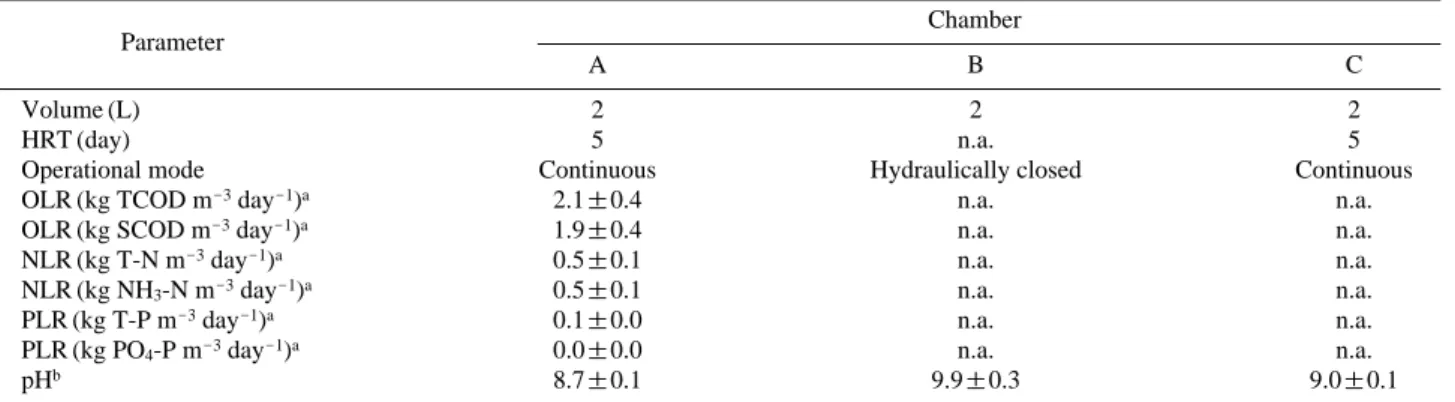
to compare the solubilization of influent, the swine wastewater was irradiated by electron beam. The doses used in this study were 20, 50, 75, and 100 kGy, respectively. Electron beam radiation was carried out by an electron accelerator (1 MeV, 40 kW; ELV-4, EB-Tech Co., Korea). The absorbed dose was measured with dichromate solution according to the method described by Han et al. (2002). The operating condition in the IEBR is shown in Table 2. Since chamber B was hydrauli-cally closed the inoculation of activated sludge was neces-sity. The average concentration of mixed liquor suspended sludge (MLSS) at chamber B during the study period was 2950±20 mg l-1. Sodium bicarbonate was periodically added at chamber B to prevent the inhibition of nitrification. Organic matter and the ion-exchanged nitrate were simulta-neously removed at anoxic chamber C. As shown in Table 2, the organic loading rate (OLR), nitrogen loading rate (NLR), and phosphorus loading rate (PLR) at chamber A were approx-imately 2.1 kg TCOD m-3day-1and 0.5 kg T-N m-3day-1, and 0.1 kg T-P m-3day-1irrespectively.
4. Analytical methods
The pH, ORP, DO, temperature, and flow rate were mea-sured daily. The pH and ORP were meamea-sured using a pH/ORP meter (Orion 3 Star, Thermo Fisher Scientific Inc., Beverly, MA, USA) equipped with a pH probe (Orion 8157 BNUMD pH/ATC Triodes, Thermo Fisher Scientific Inc., Beverly, Table 1. Characteristics of swine wastewater used in this study
Parameter Value (Ave.±Std.)a
pH 8.6~9.1 (8.7±0.1) ORP (mV) -402.0~-20.9 (-162.8±184.7) DO (mg l-1) 0.6~1.6 (0.4±0.6) Alkalinity (mg CaCO3l-1) 7603.6~9200.0 (8410.7±706.2) TCOD (mg l-1) 7893.0~10074.0 (8898.9±766.5) SCOD (mg l-1) 7293.0~9553.0 (8151.1±690.9) Carbohydrates (mg l-1) 346.2~541.2 (464.3±77.7) Proteins (mg l-1) 1576.3~4134.2 (3520.0±1091.8) Lipids (mg l-1) 1100.0~3630.0 (2370.0±959.6) TS (mg l-1) 11860.0~9440.0 (11024.0±754.2) VS (mg l-1) 7580.0~5980.0 (6467.1±494.2) T-N (mg l-1) 2582.0~2005.0 (2302.5±177.5) NH3-N (mg l-1) 2399.0~1565.0 (216.86.0±268.3) NO2-N (mg l-1) 0.0~31.2 (16.7±16.8.9) NO3-N (mg l-1) 0.0~3.5 (1.1±1.6) T-P (mg l-1) 200.0~415.0 (245.9±58.2) PO4-P (mg l-1) 0.0~33.9 (9.0±16.6)
MA, USA) or an ORP probe (Orion 9179 BNMD, Thermo Fisher Scientific Inc., Beverly, MA, USA). The DO concen-tration was measured using a pH/DO meter (Orion 4 Star, Thermo Fisher Scientific Inc., Beverly, MA, USA) equipped with a DO probe (Orion 081010MD, Thermo Fisher Scien-tific Inc., Beverly, MA, USA). Samples for COD, solids, nitrogen, and phosphorus were taken biweekly. After the quasi steady-state was reached, each sample was obtained. All analyses were done according to Standard Methods for the Examination of Water and Wastewater (APHA 1998). Carbohydrates were measured by Bubois method (Bubois et al. 1956), proteins by the Layne method (1957), and lipids by the Bligh method (Bligh and Dyer 1959). Ions were mea-sured with an ion chromatography (ICS-2000, Dionex Co., Sunnyvale, USA) equipped with a cation exchange column (IonPac CS18 Cation-Exchange Column, Dionex Co., Sunny-vale, USA) and an anion exchange column (IonPac AS18 Anion-Exchange Column, Dionex Co., Sunnyvale, USA). Crystals formed at chamber A or chamber C were character-ized by scanning electron microscopy (SEM; JSM-6390, JEOL, Japan).
RESULTS AND DISCUSSION
1. Removal of organic matter
The variation of TCOD removal at different doses is shown in Fig. 2. The average TCOD removal efficiencies at a dose of 0 kGy, 20 kGy, 50 kGy, 75 kGy, and 100 kGy were 67.1%, 61.0%, 58.7%, 59.3%, and 40.9%, respectively. It seems that removal of organic matter was not a function of electron beam ptreatment. However, at a dose of 0 kGy, the TCOD
re-moval efficiency at 16.8.0±2.8�C was comparable to that at 23.0±2.3�C. The average TCOD removal efficiency at a dose of 0 kGy under room temperature conditions (23.0�C) was 67.1%, whereas that under psychrophilic conditions (16.3�C) was 54.1%. With increasing dose, the influent TCOD concentration increased. On the other hand, the effluent con-centration (TCOD concon-centration at chamber C) did not signi-ficantly fluctuated because the effluent TCOD concentra-tion was highly dependent upon the MLSS concentraconcentra-tion at chamber C. Such the SCOD concentration was (data not shown). This implies that swine wastewater was oxidized by several radicals and partly transformed to biodegradable organic matter (Auslender et al. 2002; Getoff 2002; Kim et al. 2007). Wagner et al. (2009) reported that 19~72% of
TCOD removal efficiency in swine wastewater to produce hydrogen using a microbial electrolysis cell. Park et al. (2011) Fig. 2. Variation of COD removal at different doses (sqare: 0 kGy
at 23.0±2.3�C, cross: 0 kGy at 16.8.0±2.8�C). COD removal (%) 80 60 40 20 0 0 30 60 90 120 150
Elapsed time (day)
Temperature 0 kGy 20 kGy
50 kGy 75 kGy 100 kGy 0 kGy
Table 2. Operating condition of the IEBR during the study period
Parameter Chamber
A B C
Volume (L) 2 2 2
HRT (day) 5 n.a. 5
Operational mode Continuous Hydraulically closed Continuous
OLR (kg TCOD m-3day-1)a 2.1±0.4 n.a. n.a.
OLR (kg SCOD m-3day-1)a 1.9±0.4 n.a. n.a.
NLR (kg T-N m-3day-1)a 0.5±0.1 n.a. n.a.
NLR (kg NH3-N m-3day-1)a 0.5±0.1 n.a. n.a.
PLR (kg T-P m-3day-1)a 0.1±0.0 n.a. n.a.
PLR (kg PO4-P m-3day-1)a 0.0±0.0 n.a. n.a.
pHb 8.7±0.1 9.9±0.3 9.0±0.1
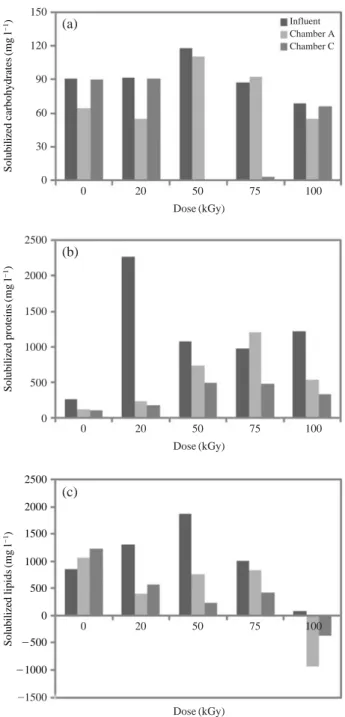
showed that 99.5% of SCOD was removed from acetate using the IEBR. Acetate is a well-known substrate that one of the most easily biodegradable organic matter (carbon source). However, swine wastewater generally requires long HRT to be sufficiently treated since swine manure consists of recalcitrant organic matter such as cellulose or lignin (Shin et al. 2005; Lim and Fox 2011a, b). Some of transformed organic matter were solubilized and supplied for electron donors. The degree of solubilization of carbohydrates, proteins,
and lipids in swine wastewater is shown in Fig. 3. The sol-ubilization of organic matter in the influent/at each chamber can be defined as the following equation.
Solubilization of a substance (mg l-1) =
=concentration-before-concentration_after (1)
where, concentration-before: influent concentration of a
substance before electron beam irradiation or influent con-centration at each chamber (mg l-1)
concentration_after: effluent concentration of a substance
after electron beam irradiation or effluent concentration at each chamber (mg l-1)
As shown in Fig. 3, most organic matter was solubilized by electron beam irradiation. Subsequently, the biodegradable organic matter such as short chain fatty acids was used as electron donor for denitrification. As shown in Fig. 3, while the amount of solubilized carbohydrates in the influent was small, those of proteins and lipids were high. This is because the initial carbohydrates concentration was relatively low and because carbohydrates in swine wastewater usually contains of refractory organic matter (Andreadakis 1992). The optimal dose for solubilization of organic matter in swine wastewater (influent) ranged from 20 kGy to 75 kGy.
2. Characteristics of nutrient removal in the IEBR
The average ammonia removal efficiency during the study period is shown in Fig. 4. Removal of ammonia was signi-ficantly affected by temperature and solubilized organic mat-ter. Ammonium in swine wastewater is usually removed via
Fig. 3. Solubilization of organic matter in swine wastewater different doses ((a) carbohydrates, (b) proteins, (c) lipids).
Solubilized carbohydrates (mg l -1) Solubilized proteins (mg l -1) Solubilized lipids (mg l -1) 2500 2000 1500 1000 500 0 -500 -1000 -1500 2500 2000 1500 1000 500 0 150 120 90 60 30 0 0 20 50 75 100 Dose (kGy) 0 20 50 75 100 Dose (kGy) 0 20 50 75 100 Dose (kGy) (a) (b) (c) Influent Chamber A Chamber C
Fig. 4. Variation of ammonia removal at different doses (sqare: 0
kGy at 23.0±2.3�C, cross: 0 kGy at 16.8.0±2.8�C).
NH 3 -N removal (%) 80 60 40 20 0 0 30 60 90 120 150
Elapsed time (day)
Temperature 0 kGy 20 kGy
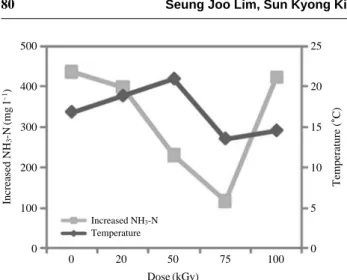
biochemical oxidation/reduction processes. In these proces-ses, many autotrophic/heterotrophic bacteria are involved. Specifically, since the activity of autotrophic bacteria enzy-mes is highly dependent upon temperature, the effect of tem-perature on ammonia removal in the IEBR was greater than that of bonding rupture by a dose (Madigan et al. 2006). Fig. 5 shows that the effects of temperature on the increment of ammonia in the influent. As shown in Fig. 5, the increase of ammonia concentration in the influent was a fuction of tem-perature, rather than a dose. This implies that the solubiliza-tion of proteins in swine wastewater was affected by the com-bination effect of temperature and a dose. The concentration of increased ammonium in the influent was high at a dose of 20 kGy and 100 kGy. This is the same result from solubi-lized proteins (Fig. 3b). On the other hand, unlike TCOD re-moval, comparing the ammonia removal efficiency at a dose of 0 kGy under room temperature conditions (23�C) to psy-chrophilic conditions (16.8�C), the ammonia removal effici-ency at psychrophilc conditions was not recovered to that at 23�C. The average ammonia removal efficiency under room temperature conditions was 63.6%, while that under psychro-philic conditions was 26.0%. It is because the activity of auto-trophs is more sensitive than that of heteroauto-trophs (US EPA 1993). Swine manure mainly contains proteins and lipids. As shown in Table 1, the average concentrations of carbohydrates, proteins and lipids were 464.3 mg l-1, 3520.0 mg l-1and 2370.0 mg l-1, respectively. Ammonium at chamber A was ion-exchanged via a CEM to chamber B and oxidized to nitrate. Subsequently, considering the pKa of ammonia at 25�C is 9.23 and the amount of ammonium for synthesizing
nitrifying bacteria is small, most oxidized nitrate was ion-exchanged via an AEM to chamber C due to the concentra-tion gradient. In other words, removal of organic matter in swine wastewater in the IEBR is highly dependent upon nitrification at chamber B and denitrification chamber C. Park et al. (2009, 2011) showed that the rate-limiting step in the IEBR is the ammonium flux via a CEM. According to their research, the ammonium flux was 0.83 mg m-2sec-1. As shown in Figs. 3 and 4, the relationship between ammonia removal efficiency and solubilized organic matter in this inves-tigation is significant at a dose rage of 20 kGy to 100 kGy. Solubilized proteins and lipids were efficiently used as elec-tron donors, not carbohydrates. It is a similar result from Fig. 5. Effects of temperature and dose on increased ammonia in
the influent. Increased NH 3 -N (mg l -1) 500 400 300 200 100 0 0 20 50 75 100 Dose (kGy) Temperature ( �C) 25 20 15 10 5 0 Increased NH3-N Temperature
Fig. 6. Variation of T-P removal at different doses (sqare: 0 kGy at 23.0±2.3�C, cross: 0 kGy at 16.8.0±2.8�C). T-P removal (%) 80 60 40 20 0 0 30 60 90 120 150
Elapsed time (day)
Fig. 7. Scanning electron micrograph of struvite crystals precipitated at a dose of 0 kGy at chamber C under psychrophilic condi-tions.
Temperature 0 kGy 20 kGy
Lim et al. (2009). This evidently supports that the optimal dose exists for oxidizing swine wastewater. The T-P removal efficiency during the study period is shown in Fig. 6. The T-P removal efficiency under room temperature conditions was 38.4~56.5 (45.1±5.1%). Unlike the ammonia removal
efficiency, the T-P removal at psychrophilic conditions (16.8
�C) was 58.2%. Nonetheless, the concentration of phosphorus was not increased significantly (data not shown). Hanhoun et al. (2011) presented that pKsp of struvite ranged 13.29 at
15�C to 13.00 at 30�C. This implies that removal of phos-phorus in the IEBR was not significantly affected by tempera-ture. A CEM/an AEM and sludege had contained white crystals, indicating the struvite formed during the study period. Struvite is one of phosphate removal mechanisms in anaerobic/anoxic reactor. Fig. 7 shows the SEM of struvite crystals precipitated at a dose of 0 kGy at chamber C under psychrophilic conditions.
CONCLUSION
The results of this research have yielded the following conclusions.
∙The optimal dose for solubilization of organic matter in
swine wastewater ranged from 20 kGy to 75 kGy.
∙The solubilization of organic matter in swine wastewater
was affected by the combination effect of temperature and a dose.
∙Removal of nitrogen removal was significantly affected by
temperature. On the other hand, the removal efficiencies of organic matter and phosphorus at a dose of 0 kGy under psychrophilic conditions were comparable to those under room temperature conditions.
ACKNOWLEDGMENT
This research was supported by the Nuclear R&D Program and Basic Science Research Program through the National Research Foundation of Korea (NRF) funded by the Ministry of Education, Science and Technology.
REFERENCES
Andreadakis AD. 1992. Anaerobic digestion of piggery wastes.
Water Sci. Technol. 25:9-16.
APHA. 1998. Standard Methods for the Examination of Water and Wastewater. 20th ed. APHA, Washington D.C. Auslender VL, Ryazantsev AA and Spiridonov GA. 2002. The
use of electron beam for solution of some ecological pro-blems in pulp and paper industry. Radiat. Phys. Chem. 63: 641-645.
Bligh EG and Dyer WJ. 1959. Rapid method of total lipid extrac-tion and purificaextrac-tion. Can. J. Biochem. Phys. 37:911-917. Bubois M, Gilles KA, Hamilton JK, Rebers PA and Smith F.
1956. Colorimetric method for determination of sugars and related substances. Anal. Chem. 28:350-356.
Chynoweth DP, Wilkie AC and Owens JM. 1999. Anaerobic treatment of piggery slurry-review. Asian Austral. J. Anim.
12:607-628.
Day DL and Funk TL. 1998. Processing manure: physical, chem-ical and biologchem-ical treatment. In Animal waste utilization: effective use of manure as a soil resource. Ann Arbor Press, Chelsea.
FAO. 2010. FAOSATA: Live animals. Available at: http://fao-stat.fao.org/site/573/defaulf.aspx#ancor.
Getoff N. 2002. Factors influencing the efficiency of radiation-induced degradation of water pollutants. Radiat. Phys. Chem.
65:437-446.
Han B, Kim J, Kim Y, Chung W, Makarov IE, Ponomarev AV and Pikaev AK. 2002. Combined electron-beam and biolog-ical treatment of dying complex wastewater. Pilot plant experiments. Radiat. Phys. Chem. 64:53-59.
Hanhoun M, Montastruc L, Azzaro-Pantel C, Biscans B, Frèche M and Pibouleau L. 2011. Temperature impact assessment on struvite soluvility product: A thermodynamic modeling approach. Chem. Eng. J. 167:50-58.
Kim TH, Lee JK and Lee MJ. 2007. Biodegradability enhance-ment of textile wastewater by electron beam irradiation.
Radiat. Phys. Chem. 76:1037-1041.
Layne E. 1957. Spectrophotometric and turbidimetric methods for measuring proteins. Method Enzyhol. 3:447-455. Lim SJ and Fox P. 2011a. A kinetic evaluation of anaerobic
treatment of swine wastewater at two temperatures in a temperate climate zone. Bioresource Technol. 102:3724-3729.
Lim SJ and Fox P. 2011b. Evaluation of a static granular bed reactor using a chemical oxygen demand balance and math-ematical modeling. Bioresource Technol. 102:6399-6404. Lim SJ, Kim SH and Fox P. 2009. Biological nutrient and
organic removal from meat packing wastewater with a uni-que seuni-quence of suspended growth and fixed-film reactors.
Water Sci. Technol. 60:3189-3197.
Lim SJ, Kim TH, Kim TH and Shin IH. in press. Deterioration of denitrification by oxygen and cost evaluation of electron
donor in an uncovered pre-denitrification process. Korean
J. Chem. Eng.
Lo KV, Liao PH and Gao YC. 1994. Anaerobic treatment of swine wastewater using hybrid UASB reactors. Bioresource
Technol. 47:153-157.
Lucas MS, Peres JA and Puma GL. 2010. Treatment of winery wastewater by ozone-based advanced oxidation processes
(O3, O3/UV and O3/UV/H2O2) in a pilot-scale bubble column
reactor and process economics. Sep. Pur. Technol. 72:235-241.
Luo A, Zhu J and Ndegwa PM. 2002. Removal of carbon, nitro-gen, and phosphorus in pig manure by continuous and inter-mittent aeration at low redox potentials. Biosyst. Eng. 82: 209-215.
Madigan MT, Martinko JM, Dunlap PV and Clark DP. 2006. Brock biology of microorganisms. 12th ed., Pearson. New York.
Park W, Hwang MH, Kim TH, Lee MJ and Kim IS. 2009. En-hancement in characteristics of sewage sludge and anaerobic treatability by electron beam pre-treatment. Radiat. Phys.
Chem. 78:16.84-16.89.
Park W, Jang E, Lee M, Yu S and Kim T. 2011. Combination of ion exchange system and biological reactors for simulta-neous removal of ammonia and organics. J. Env. Manag.
92:1148-1153.
Park W, Nam Y, Lee M and Kim T. 2009. Simultaneous nitri-fication and denitrinitri-fication in a CEM (cation exchange mem-brane)-bounded two chamber system. Water Res.
43:3820-3826.
Shin JH, Lee SM, Jung JY, Chung YC and Noh SH. 2005. Enhanced COD and nitrogen removals for the treatment of swine wastewater by combining submerged membrane bio-reactor (MBR) and anaerobic upflow bed filter (AUBF) reactor. Process Biochem. 40:3769-3776.
Statics Korea. 2010. Statics Korea. Available at: http://www. kostat.go.kr.
US EPA. 1993. Manual: Nitrogen control. EPA/625/R-93/010, Washington, D.C.
USDA. 1992. Agricultural waste management field handbook. ASDA Soil Conservation Service.
Wagner RC, Regan JM, Oh S, Zuo Y and Logan BE. 2009. Hydrogen and methane production from swine wastewater using microbial electrolysis cells. Water Res. 43:1480-1488. Yang PY and Chou CY. 1985. Horizontal-baffled anaerobic
reactor for treating diluted swine wastewater. Agr. Wastes
14:221-239.
Ye FX, Zhu RF and Li Y. 2009. Deodorization of swine manure slurry using horseradish peroxidase and peroxides. J. Hazard.
Mat. 167:148-153.
Zhang R and Felmann DJ. 1997. Animal manure management-agriculture scoping study. The EPRI Agricultural Techno-logy Alliance, Electric Power Research Institute.
Manuscript Received: February 15, 2012 Revised: February 29, 2012 Revision Accepted: March 5, 2012