ROK Policy on North Korea and Inter-Korean Economic Cooperation:
Prospects and Analyses
Suk Lee
This paper reviews the development of the ROK policy on North Korea and its relations with inter-Korean economic cooperation over the past 15 years. It also briefly assesses the current status of inter-Korean economic cooperation and discusses its future development. In addition, the paper argues as follows. The ROK policy on North Korea consists of three parts: 1) the basic perceptions of the existing DPRK regime, 2) set of prioritized policy goals such as peace, coexistence and unification between the two Koreas and 3) various policy measures with the most important being inter-Korean economic cooperation. As a result, changes in the perceptions of the DPRK or in prioritizing policy goals on North Korea have had direct impacts on both the pattern and performance of inter-Korean economic cooperation and vice versa. It means that inter- Korean economic cooperation has been fundamentally driven by the ROK government. For future development, however, this government- led economic cooperation should be converted into a private sector-led initiative that can be relatively free from the changes in South Korea’s policy on the DPRK. This private sector-led economic cooperation will also allow the ROK government to pursue its policy on North Korea in more efficient and rational ways.
Key Words:inter-Korean economic cooperation, engagement approach on North Korea, conservative approach on North Korea, controversies on ROK policy toward North Korea, prospects of inter-Korean economic cooperation
Introduction
For the past 15 years, economic cooperation between the Republic of Korea (ROK, commonly known as South Korea) and the Democratic People’s Republic of Korea (DPRK, commonly known as North Korea)
has been defined by the ROK’s signature policy on North Korea. As much as the success and failure of inter-Korean economic cooperation have led to changes in strategy, the development of South Korea’s policy has continued to revolve around inter-Korean economic cooperation.
In that sense, debates on South Korea’s policy toward the North have also developed based on the general impacts and implications of inter-Korean economic cooperation and inter-Korean relations.
In retrospect, the ROK policy on North Korea between the late 1990s and the mid 2000s aimed to bring about fundamental changes to the confrontational status-quo of inter-Korean relations so that a common goal for peace and prosperity could be achieved. Thus, the catalyst for change was found in inter-Korean economic cooperation, which was still in its embryonic stage. Nevertheless, there was a strong conviction that expanding inter-Korean economic cooperation would open up the possibility of peace on the Korean peninsula, transformation of the DPRK for the better, and eventually unify two Koreas. Based on this understanding, inter-Korean economic cooper- ation developed quickly, which made bilateral relations closer and friendlier.
In contrast, South Korea’s policy since the late 2000s has pivoted toward a principled approach. In light of the DPRK’s continued nuclear and missile programs along with the military clashes in the West Sea, establishing a principled approach that can rectify the unbalanced inter- Korean relations has become significantly important. Such principles, in turn, were sought within inter-Korean economic cooperation because they were part of an aspect of inter-Korean relations in which both the cause and the remedy were believed to be found. As a result, more restrictive measures on inter-Korean economic cooperation were implemented under this principled approach. It has made inter-Korean economic cooperation significantly weaker in comparison to the past.
However, South Korea has not abandoned such principles due to a reformed conviction that both inter-Korean economic cooperation and inter-Korean relations cannot properly develop or prosper without upholding such principles, which have often been neglected.
Then, why was inter-Korean economic cooperation so important
for South Korea’s policy on North Korea during the past 15 years?
Why did the ROK policy have to endure such dramatic ups and downs in different periods of time? The purpose of this paper is to discuss the development and future of inter-Korean economic cooperation by addressing these questions. In doing so, Section 2 examines inter- Korean economic cooperation from the late 1990s to the mid-2000s by focusing on its relations with South Korea’s policy on the North in addition to the practical accomplishments and controversies that followed as a consequence.1Section 3 provides a brief assessment of the inter-Korean economic cooperation from the mid-2000s to the present, and Section 4 discusses which inter-Korean economic cooperation would be most appropriate for South Korea’s future policy on North Korea. Finally, Section 5 concludes by summarizing the discussions above.
Engagement Approach and Inter-Korean Economic Cooperation between 1998 and 2007
In the late 1990s, inter-Korean economic cooperation emerged as an important aspect of the ROK’s policy on North Korea. At that time, South Korean policy was in a paradigm shift, and inter-Korean economic cooperation was considered to be a key ingredient that would bring about overall change to this policy. The Kim Dae-jung administration, which took office in 1998, had a different view on the DPRK than its predecessors. This new perspective led the administration to attempt a transformation of South Korea’s policy on North Korea under a new structure that was centered around inter-Korean economic cooperation.
1. Since the late 1990s, there have been three different administrations in the ROK. Each were headed by Presidents Kim Dae-jung, Roh Moo-hyun and currently Lee Myung-bak. For convenience, this paper consolidates the Kim Dae-jung and Roh Moo-hyun administrations under a single era, although some differences between the two are recognized. In fact, this paper assumes that the two shared virtually identical policy directions and guiding principles in approaching the DPRK despite such differences.
Paradigm of Engagement Approach
From the Kim Dae-jung administration’s standpoint, the existence of the DPRK was to be recognized as a reality. In other words, the anticipation for the regime’s impending collapse due to its economic hardship and political isolation was no longer perceived as a reasonable viewpoint.
Rather, the fact that the regime withstood the extreme economic crisis and famine in the mid-1990s and continued to maintain effective control over the entire region suggested that the ROK must reconsider its fatalistic expectations for the DPRK. As such, the Kim Dae-jung admin- istration believed that it was necessary and appropriate for the ROK to engage the current DPRK regime. Up to that point, bilateral relations were not particularly on friendly terms, and the DPRK had been highly critical of the ROK’s engagement policy. Nevertheless, the adminis- tration was positive about its engagement policy because there were sufficient reasons to believe that the DPRK could not and would not strongly deny this approach. For example, the ROK was capable of providing the DPRK with enough external economic assistance, which in turn was quite important in ensuring that the current DPRK regime survived. Therefore, if the ROK attempted to embark on an engagement policy based on a “well designed economic assistance package,” it would be difficult for Pyongyang to stubbornly refuse the gesture, as it had been in the past.2
2. The engagement approach, originally initiated by the Kim Dae-jung adminis- tration, dominated South Korea’s policy on the DPRK during both the Kim Dae-jung and Roh Moo-hyun administrations. To the South Korean public, it is simply and widely known as the so-called “Sunshine Policy” in which deepen economic ties with the North will bring about peace, reconciliation and the eventual unification of the two Koreas. From the policy standpoint, however, it is a rather complex system composed of new policy objectives, measures, roles of relevant players as well as new perceptions and concepts on the DPRK and inter-Korean relations. Indeed, this resulted in a major overhaul of the ROK policy on North Korea between 1998 and 2007, which influenced all aspects of bilateral relations including political, military, social, cultural and economic ties. Note, however, that this paper does not discuss the engagement approach, per se. Rather, it only examines the relations between inter-Korean economic cooperation and the ROK policy on the DPRK under the
Such perceptions have drastically changed South Korea’s policy on North Korea in the late 1990s. Above all, the policy objectives have changed. Once the current DPRK regime was recognized as a reality, unification as the immediate policy goal and work toward its realiza- tion have become less important than properly managing the “DPRK risk” by seeking peace and coexistence with Pyongyang. Of course, that did not necessarily mean unification was entirely excluded from South Korea’s policy agenda. Instead, it was a shift in priorities toward a peaceful relationship with the DPRK through rapprochement and cooperation. And ultimately, the decrease in the socio-economic gap between the South and North by inducing gradual changes to the DPRK was considered more important and realistic. That is, if the imminent goal of the ROK policy on North Korea was to achieve peaceful coexistence between the two Koreas, then the ultimate, long- term goal was unification with a gradually changing DPRK, which will induce a peaceful coexistence.
Role of Inter-Korean Economic Cooperation
Engagement through inter-Korean economic cooperation was then considered a policy instrument utilized to achieve the underlying objectives of the ROK policy on North Korea. As mentioned earlier, the economic benefits from such cooperation were not something that the DPRK could easily refuse. Moreover, inter-Korean economic cooperation was perceived to be the most viable method to promote peaceful coexistence and induce change in the DPRK, alleviating the socio-economic gap between the South and the North and leading to unification. If the DPRK wished to gain economic benefits through inter-Korean cooperation, then it needed to adopt voluntary measures that can alleviate political and military tensions with the ROK and engagement approach. Hence, it focuses on the economic characteristics or economic interpretation of the engagement approach. For such characteristics or interpretations, see Lee (2010; 2007).
seek changes, given its contact with the market economy. If the DPRK succeeded in making progress, then the vast gap between the South and North would narrow as well. Based on these assumptions, South Korea’s policy on North Korea in the late 1990s effectively turned into an inter-Korean economic cooperation policy.
Furthermore, inter-Korean economic cooperation proceeded in a manner that was centered around the following concepts. First, the idea that an improvement in economic relation between the two Koreas could induce positive externalities in South Korea was put forward as inter-Korean economic cooperation was expected to accomplish peace, gradual change in the DPRK as well as diminish the wealth gap between the two Koreas, which would ultimately contribute to unification. Second, inter-Korean economic cooperation was considered a semi-public good for the ROK because it would boost not only commercial profits but also the public welfare of the whole society. Third, as long as inter-Korean economic cooperation shared characteristics for the semi-public good, then equilibrium for cooperation, which is determined by the market, would always remain lower than the socially optimal level. Hence, the government should provide policy assistance so that inter-Korean economic cooperation can reach the socially desired optimum level. In other words, govern- ment support is necessary in order to guarantee the success of inter- Korean economic cooperation. Fourth, inter-Korean economic cooper- ation was to be recognized as separate from political inter-Korean relations. This was put forth in recognition of the fact that positive externalities would emerge only in the long-term, while political and military relations could quickly improve or deteriorate in the short- term under various factors. If inter-Korean economic cooperation is influenced by such aspects, then it will not be feasible to carry out the policy in North Korea based on this approach. Therefore, separating politics from economic affairs was considered to be the most effective remedy, which meant that economic cooperation would continue despite short-term fluctuations in the other aspects of inter-Korean
relations.
Due to this understanding, inter-Korean economic cooperation of the late 1990s continued to expand while political or military tensions intensified, including the North Korean nuclear problem that generated international concerns. Consequently, the idea that inter-Korean economic cooperation has many benefits gradually permeated South Korean politics.
Economic Outcomes of the Engagement Approach
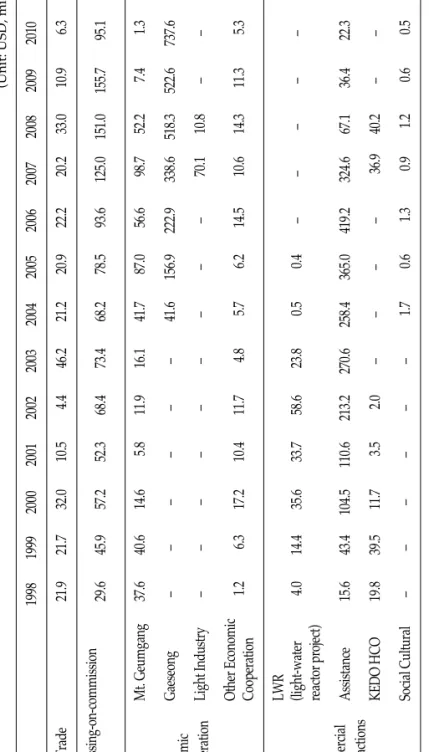
The outcome of this policy was a dramatic increase in South Korea’s economic activities relavent to the DPRK. As observed in Table 1, inter-Korean trade increased by more than six times between 1998 and 2007. As a result, the trade volume between the South and the North amounted to 1.8 billion US dollars in 2007, which was about one third of the entire DPRK trade volume. Moreover, the two Koreas developed various economic cooperation projects, including the Mt.
Geumgang tourist complex and the Kaesong Industrial Complex (KIC), through both government and private channels. This rendered inter-Korean economic cooperation as the most complex and varied economic venture for the DPRK. Along with the growth in inter-Korean trade, the ROK also provided large-scale humanitarian assistance on a nearly regular basis. For instance, the ROK government provided 300,000-500,000 MT of food and fertilizer to the DPRK every year in the early and mid-2000s. In addition, the ROK government supported domestic non-governmental organizations (NGOs) by providing aid to match the funds of their humanitarian projects for the DPRK. Such government initiatives have encouraged people in South Korea to become more active in humanitarian aid projects for the DPRK.
Table 1.Inter-Korean Trade between 1998-2011 (1) ROK Exports to the DPRK (Unit: USD, millions) 19981999200020012002200320042005200620072008200920102011 Gen. Trade21.921.732.010.54.446.221.220.922.220.233.010.96.3– Processing-on-commission Trade29.645.957.252.368.473.468.278.593.6125.0151.0155.795.1– Economic Mt. Geumgang37.640.614.65.811.916.141.787.056.698.752.27.41.30.8 CooperationGaeseong––––––41.6156.9222.9338.6518.3522.6737.6788.7 Light Industry–––––––––70.110.8––– Other Economic Cooperation1.26.317.210.411.74.85.76.214.510.614.311.35.30.0 Non-LWR commercial (light-water 4.014.435.633.758.623.80.50.4–––––– Transactionsreactor project) Assistance15.643.4104.5110.6213.2270.6258.4365.0419.2324.667.136.422.310.6 KEDO HCO19.839.511.73.52.0––––36.940.2––– Social Cultural––––––1.70.61.30.91.20.60.50.1 Total129.7211.8272.8226.8370.2435.0439.0715.5830.21,025.6888.1744.8868.3800.2 Source: Ministry of Unification (MOU).Economic Cooperation Non- commercial Transactions
(2) ROK Imports from the DPRK (Unit: USD, millions) 19981999200020012002200320042005200620072008200920102011 Gen. Trade50.867.778.6100.9167.4177.4150.1188.9282.0441.2366.4245.2111.60.2 Processing-on-commission Trade41.453.772.072.6102.8111.6107.7131.2159.4204.5257.3254.0222.53.7 Economic Mt. Geumgang0.10.11.62.20.0–0.10.10.115.811.51.31.40.0 CooperationGaeseong––––––0.119.875.9101.2290.1417.9705.3908.9 Light Industry–––––––––1.21.2––– Other Economic Cooperation––0.20.51.40.20.00.01.01.35.615.72.9– Non-LWR commercial (light-water ––––0.00.0–0.0–––––– Transactionsreactor project) Assistance–––––––0.10.00.0–0.0–0.8 KEDO HCO–––––––––––––– Social Cultural–––––––0.21.10.00.10.00.20.0 Total92.3121.6152.4176.2271.6289.3258.0340.3519.5765.3932.2934.31,043.9913.7 Source: MOU.Economic Cooperation Non- commercial Transactions
(3) Total Inter-Korean Trade (Unit: USD, millions) 19981999200020012002200320042005200620072008200920102011 Gen. Trade72.789.4110.5111.4171.8223.7171.3209.8304.1461.4399.4256.1117.90.2 Processing-on-commission Trade71.099.6129.2124.9171.2185.0176.0209.7253.0329.5408.3409.7317.63.7 Mt. Geumgang37.740.716.28.011.916.141.887.156.7114.563.78.72.70.8 Gaeseong––––––41.7176.7298.8439.8808.4940.61,442.81,697.6 Light Industry–––––––––71.412.1––– Other Economic Cooperation1.26.317.410.913.15.05.86.215.511.919.927.08.20.0 LWR (light-water 4.014.435.633.758.623.80.50.4–––––– reactor project) Assistance15.643.4104.5110.6213.2270.6258.4365.0419.3324.667.136.422.311.4 KEDO HCO19.839.511.73.52.0––––36.940.2––– Social Cultural––––––1.70.82.40.91.20.60.70.1 Total221.9333.4425.1403.0641.7724.2697.01,055.81,349.71,790.91,820.41,679.11,912.21,713.9 Source: MOU.Economic Cooperation Non- commercial Transactions
The significance of inter-Korean trade has become even clearer when seen from the perspective of the DPRK economy itself. According to Table 2, the DPRK’s external trade since the 2000s has started to grow rapidly, mainly through trade with China and the ROK. For example, the proportion of trade with China and the ROK amounted to about 42% and 38% of the DPRK’s total trade volume in 2007, respectively. Almost 80% of the DPRK’s trade came from China and the ROK during that year. Considering that trade with the ROK consisted of less than 5% of the DPRK’s total trade volume in the early 1990s, it is easy to see how quickly inter-Korean trade has expanded.
The rapid increase in inter-Korean trade since the late 1990s also played a critical role in expanding trade between the DPRK and Table 2. DPRK Trade by Major Trading Partners
(Unit: USD, millions) 1990 1995 2000 2001 2002 2003 2004 2005 2006 2007 2008 2009 2010 2011 1. Export 1,745 959 718 822 1,008 1,066 1,278 1,338 1,467 1,683 2,062 1,997 2,557 3,702 China 125 64 37 167 271 395 586 499 468 582 754 793 1,188 2,464 ROK 12 223 152 176 272 289 258 340 520 765 932 934 1,044 914
Japan 301 340 257 226 234 174 163 131 78 0 0 0 0 0
2. Import 2,438 1,380 1,680 1,842 1,894 2,049 2,276 2,718 2,879 3,055 3,574 3,095 3,528 4,328 China 358 486 451 571 467 628 800 1,081 1,232 1,392 2,033 1,888 2,278 3,165 ROK 1 64 273 227 370 435 439 715 830 1,033 888 744 868 800
Japan 176 255 207 249 135 92 89 63 44 9 8 3 0 0
3. Total Trade 4,183 2,339 2,398 2,664 2,902 3,115 3,554 4,057 4,346 4,738 5,636 5,092 6,085 8,031 China 483 550 488 737 738 1,023 1,385 1,580 1,700 1,974 2,787 2,681 3,466 5,629 ROK 13 287 425 403 642 724 697 1,056 1,350 1,798 1,820 1,679 1,912 1,714 Japan 477 595 464 475 370 265 253 194 122 9 8 3 0 0 Note: DPRK’s total trade volume was compiled by adding KOTRA figures on the DPRK and inter-Korean trade volume.
Source: Korea Trade and Investment Promotion Agency (KOTRA), “Foreign Trade of the DPRK,” each Vol.; Korea International Trade Association (KITA) Statistics Database (http://stat.kita.net).
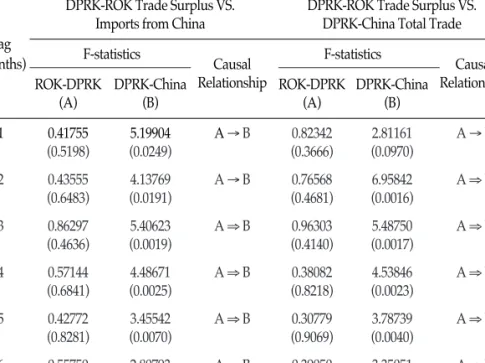
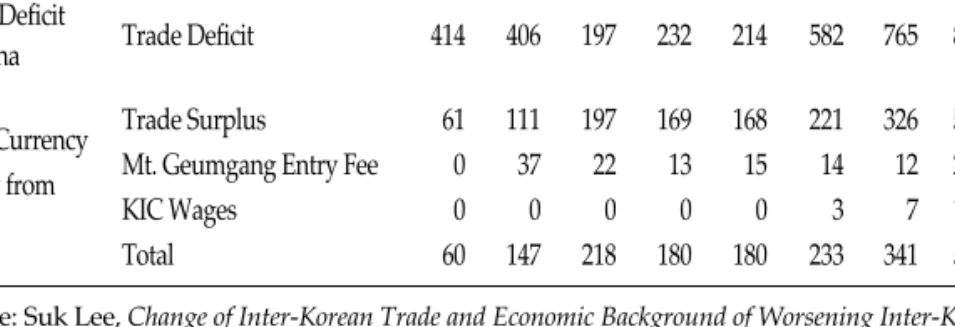
China.3During this period, the DPRK was virtually importing almost all necessary materials from China. As a consequence, its trade deficit with China also continued to expand. If the DPRK was financially unable to resolve this deficit, then DPRK-China trade would not have been able to grow so quickly. However, note that the DPRK financed the deficit by using inter-Korean trade. As seen in Table 3, the DPRK obtained large amounts of hard currency through inter-Korean trade during the mid-2000s. Not only did the DPRK enjoy a constant trade surplus from inter-Korean trade, but it also benefited from economic cooperation projects, such as Mt. Geumgang and the KIC, which constantly provided hard currency. In turn, such hard currency has enabled the DPRK to sustain its trade deficit with China. This can be shown by analyzing the correlation between the amount of hard currency earned through inter-Korean trade and the size of the DPRK-China trade over time. As seen in Table 4, the Granger Causality Tests on the two variables suggest that the DPRK trade surplus from inter- Korean trade influenced the size of the DPRK-China trade, not vice versa. This means that the DPRK used money earned from its trade with the ROK to resolve its trade deficit with China.
3. DPRK foreign trade, especially its trade with China, has been one of the most important economic issue and has been heavily discussed. Up to this point, the dramatic increase in DPRK-China trade has puzzled many DPRK watchers despite the fact that the DPRK trade deficit with China has continuously increased to a level that it could not easily finance. A variety of hypotheses have been proposed to understand this situation, including those arguing that the DPRK has been involved in many illegal trading, such as arms export, and that China has perhaps provided significant economic assistance. For examples, see Graham (2007). Unfortunately, however, it is not entirely clear how the DPRK has managed to finance such deficits. Nevertheless, there is one thing for certain. As Lee (2009) pointed out, the DPRK earned a significant amount of hard currency through inter-Korean trade in the 2000s, and this currency has helped the DPRK finance its trade deficit with China. Based on such finding, this paper argues that inter-Korean trade played an important role in expanding the DPRK’s trade with China and other countries until the mid and late 2000s. However, it does not necessarily mean that inter-Korean trade was the only means in which the DPRK could increase its trade with China and other countries.
Table 3. DPRK Trade Deficit to China and Hard Currency Inflow from Inter-Korean Trade
(Unit: USD, millions) 2000 2001 2002 2003 2004 2005 2006 2007 Trade Deficit
Trade Deficit 414 406 197 232 214 582 765 811.0 to China
Hard Currency Trade Surplus 61 111 197 169 168 221 326 500.0 Inflow from Mt. Geumgang Entry Fee 0 37 22 13 15 14 12 20.3
ROK KIC Wages 0 0 0 0 0 3 7 13.9
Total 60 147 218 180 180 233 341 534.2
Source: Suk Lee, Change of Inter-Korean Trade and Economic Background of Worsening Inter-Korean Relation(Seoul: Korea Development Institute, 2009).
Table 4. Granger Causality Tests, DPRK Surplus from Inter-Korean Trade vs. its Trade with China
DPRK-ROK Trade Surplus VS. DPRK-ROK Trade Surplus VS.
Lag
Imports from China DPRK-China Total Trade
(Months) F-statistics F-statistics
ROK-DPRK DPRK-China
Causal
ROK-DPRK DPRK-China
Causal
(A) (B)
Relationship
(A) (B)
Relationship
1 0.41755 5.19904 A →B 0.82342 2.81161 A →B
(0.5198) (0.0249) (0.3666) (0.0970)
2 0.43555 4.13769 A →B 0.76568 6.95842 A ⇒B
(0.6483) (0.0191) (0.4681) (0.0016)
3 0.86297 5.40623 A ⇒B 0.96303 5.48750 A ⇒B
(0.4636) (0.0019) (0.4140) (0.0017)
4 0.57144 4.48671 A ⇒B 0.38082 4.53846 A ⇒B
(0.6841) (0.0025) (0.8218) (0.0023)
5 0.42772 3.45542 A ⇒B 0.30779 3.78739 A ⇒B
(0.8281) (0.0070) (0.9069) (0.0040)
6 0.55750 2.80793 A →B 0.39050 3.35051 A ⇒B
(0.7627) (0.0159) (0.8830) (0.0055)
Source: Suk Lee, Change of Inter-Korean Trade and Economic Background of Worsening Inter-Korean Relation(Seoul: KDI, 2009).
Emerging Controversies
Despite the ups and downs in inter-Korean relations, trade between the ROK and the DPRK has constantly expanded since the 1990s and reached a level, in which it consisted of more than one third of the entire DPRK trade volume by the early late 2000s. Hence, it may be possible to claim that South Korea’s policy on North Korea in the late 1990s was a great success, given that it aimed to expand inter-Korean economic cooperation as quickly as possible. Ironically, however, the ROK has relentlessly faced internal conflicts over such an assessment.
There are at least three reasons for this phenomenon.4
First, whether inter-Korean economic cooperation truly had posi- tive externalities, such as improving peace on the Korean peninsula and changing the DPRK for the better, has been increasingly questioned.
Indeed, the ROK has witnessed the DPRK’s military provocations as well as its developing nuclear weapons and long range missiles capabilities, even though inter-Korean economic cooperation has provided significant economic assistance. As a result, controversies have emerged as to whether such positive externalities really do exist, and skepticism has quickly grown. Second, such skepticism has fueled another controversy over the level of government support for inter-Korean economic cooperation. If there were no such positive externalities, then it would be hardly justified to allow the govern- ment to spend taxpayers’ money. In other words, it would be more reasonable to leave inter-Korean economic cooperation to the market mechanisms, as with any other economic activity. If the government intervenes, then it would set the level of inter-Korean economic cooperation at a level that is higher than the socially optimal level,
4. The controversies over the engagement policy were mainly initiated by politicians, rather than economists in academic societies. Hence, they were largely carried out in public media with political words and phrases, not with conceptual words in academic papers. Perhaps “Per-Ju-Gi” (giving too much) can symbolize these words and phrases. Given the characteristics, this paper focuses on the logical structure of the controversies as much as possible. For this logical structure, refer to Lee (2010).
which is determined by the market. Such an unnecessary interven- tion will create inefficiencies and revert the process into an entirely government-led project. Third, the idea of separating politics and the economy with regards to inter-Korean economic cooperation became increasingly controversial. During this period, the DPRK did not end its military provocation, but the ROK continued to increase economic assistance to the North. Naturally, it raised questions over whether a separation of economic assistance would be wise and even sustainable.
Likewise, people have argued that increasing pressure on the DPRK by decreasing or even cutting off economic support would be a more realistic approach.
In light of these controversies, the assessment on the rapid expan- sion of inter-Korean economic cooperation since the late 1990s have become polarized. There are naturally positive assessments, which suggest that inter-Korean relations have indeed improved as economic cooperation paved the road toward peace and rapprochement. On the other hand, however, there are negative assessments as well.
They argue that excessive government intervention in inter-Korean economic cooperation failed to address the “truthful inter-Korean rela- tionship” while burdening South Korean society. Such polarized per- spectives are prevalent in all aspects of the ROK policy on the North, including the government’s food aid program. For example, one side has argued that the annual shipment of food from the South has not only helped the starving people in the DPRK, but it has also led to positive outcomes, such as regular family reunions and high- level government dialogues between the two Koreas. Concurrently, however, the other side has emphasized that the government solely focused on providing aid as demanded by the DPRK and neglected to monitor the distribution process. Subsequently, it has been argued that humanitarian assistance did not properly reach those in need and instead, was spent on strengthening the DPRK regime’s ability to maintain its socialist system.
Conservative Approach and Inter-Korean Economic Cooperation between 2008 and the Present
Such controversies over inter-Korean economic cooperation have strongly affected South Korea’s policy on North Korea under the Lee Myung-bak administration. Indeed, the administration was critical of the former policy and took a different approach toward inter-Korean economic cooperation. As a result, inter-Korean economic cooperation since the late 2000s has unfolded in an entirely different manner in comparison to the past.
Conservative Approach: Paradigm Shift
Strictly speaking, it is difficult to ascertain exactly how the Lee Myung- bak administration’s policy on the DPRK was from previous policies.
This is partially attributed to the fact that the administration did not clearly reveal its views on the DPRK, its policy objectives and its policy instruments, such as the inter-Korean economic cooperation. Moreover, the Lee Myung-bak administration borrowed most of its terminology and paradigm from the previous policies on North Korea. For instance, the administration’s stated policy objective on North Korea was to promote peace and coexistence between the two Koreas in addition to its long-term goal for unification in a gradual and peaceful manner. Of course, there was a tendency to emphasize that the “ROK is prepared” for an impending unification as well as a contingency plan in a potential crisis. However, these aspects were rather a com- plementary addition to the previous policies instead of an outright paradigm shift. In fact, it is still unclear whether the Lee Myung-bak administration perceived a different paradigm for its policy on North Korea.
However, as far as inter-Korean economic cooperation is concerned, the Lee Myung-bak administration has had quite a different attitude from that of the previous two administrations. This attitude has been often called a “Principled North Korea Policy” in which “(flexible)
reciprocity” and “normality” is given a stronger emphasis. To elaborate, the Lee Myung-bak administration did not consider the strict separa- tion of politics and economy to be realistic or wise. As the ROK is a democratic country in which public opinion matters, it would be difficult to continue providing economic assistance when the DPRK continued its military provocations. Nor would it be strategically wise to give the impression that “the ROK will provide the necessary economic assistance no matter the circumstances, even when faced with military provocations.” Hence, the Lee Myung-bak administration saw that inter-Korean economic cooperation would not be completely independent from the short-term ups and downs in bilateral relations.
If necessary, the ROK would be prepared to use inter-Korean economic relation as leverage that conforms to the status-quo in order to promote significant changes in inter-Korean relations.
In addition, the Lee Myung-bak administration stressed the impor- tance of normality with respect to inter-Korean economic cooperation.
This meant that each program was to be achieved in accordance to its original purpose. For instance, food aid from the ROK’s perspective is essentially a humanitarian assistance program. Therefore, if the aid is to be meaningful, then food should be directed to those who are in dire need, which can only be induced by a certain level of monitoring. If such monitoring is not possible, then providing food to the DPRK will not be appropriate under humanitarian purposes. However, previous food aid to the DPRK served other purposes, such as eliciting inter- Korean ministerial dialogues, family reunions and greater flexibility in managing inter-Korean relations, when they were provided. That resulted in neglecting the importance of a sufficient monitoring regime.
From the Lee Myung-bak administration’s standpoint, such negligent policy is not ideal for humanitarian purposes.
Changes to the Inter-Korean Economic Cooperation and its Results The Lee Myung-bak administration’s attitude changed the pattern of inter-Korean economic cooperation in the late 2000s. For example,
immediately after the administration came to power, it attempted to change the way in which food aid was provided to the DPRK. Thus far, within the customary process, the ROK will first publicly express its intention to provide aid, which would then be accepted by the DPRK. In addition, while the ROK was inclined to consider food aid as a humanitarian effort, the DPRK had a tendency to perceive it as a token of appreciation in resolving issues, such as holding inter-Korean dialogues or family reunions. The food aid was generally provided as loans rather than grants, and the monitoring issue was not discussed as seriously as other international humanitarian food aid programs.
However, the Lee Myung-bak administration started to define food aid as a purely humanitarian effort. As a consequence, it argued that the DPRK should make requests first and explain its needs to the ROK in order to receive assistance, which follows international practice.
The administration also seemed to believe that this was the proper way to renew the monitoring issue. However, the DPRK ignored such arguments and consequently, the ROK food assistance program came to a grinding halt.
The suspension of the food aid programs obviously compelled North Korea to refuse all official inter-Korean dialogues, since food aid was considered a token of appreciation for such activities from the DPRK standpoint. The suspension not only affected government level interactions, but also brought about negative repercussions on a private level. The overall level of government support the ROK government bestowed upon the DPRK under the inter-Korean economic cooperation project shrank altogether. To make matters worse, a South Korean tourist was shot and killed at the Mt. Geumgang tourist complex in 2008, forcing the Lee Myung-bak administration to shut down the tourism program. This quickly threatened the overall inter-Korean economic cooperation, which in turn further worsened the situation.
It is clear that the receding inter-Korean economic cooperation has negatively affected the DPRK economy. As previously mentioned, the DPRK has imported goods from China with the hard currency earned from the ROK since the mid-2000s. However, Figure 1 suggests
that the amount of the hard currency from the South has rapidly decreased since the Lee Myung-bak administration took office in 2008.
This not only demonstrates a contraction in the inter-Korean economic cooperation, but also indicates that there is a liquidity problem in the DPRK’s economy and overall external economic relation.
Confronted by such difficulties, North Korea adopted a strategy to push inter-Korean relations into crisis. The regime made public threats to suspend all inter-Korean economic cooperation projects, including the KIC, since 2009 and eventually conducted military provocations, such as the sinking of the Cheonancorvette and the bombardment of the Yeonpyeong Island in 2010. By stressing the importance of reciprocity in inter-Korean economic cooperation, the Lee Myung-bak administration was forced to adopt corresponding actions which resulted in the May 24 measures, which suspended all inter-Korean economic cooperation activities with the exception of the KIC.
To summarize, inter-Korean economic cooperation during the Lee Myung-bak administration developed in the following chain of events:
Figure 1. DPRK Commercial Trade Surplus in Inter-Korean Trade
(Unit: USD, millions)
Note: DPRK Commercial Trade Surplus = Trade Surplus from General Trade + Processing- on-commission Trade.
Source: MOU.
a) the changes caused by the administration’s effort to restore normality in inter-Korean economic relations, including the food aid program, b) refusal and shutdown of government communication channels by the DPRK, c) shutdown of the inter-Korean economic cooperation at the government level, d) contraction of private-level inter-Korean economic cooperation in light of increased risks, such as the shooting of the Mt.
Geumgang tourist, e) decrease of the hard currency inflow into the DPRK and internal political and military repercussions, f) imposition of ROK economic sanctions onto the DPRK following the Cheonan and Yeonpyeong incidents and g) suspension of all inter-Korean economic cooperation with the exception of the KIC. As the consequence, all inter-Korean economic cooperation activities, excluding the KIC, have been effectively suspended since 2011.
New Controversies
The once rapidly expanding inter-Korean economic cooperation, which consisted of about 40% of the entire DPRK trade volume, has been facing an outright suspension for 3-4 years since the Lee Myung-bak administration came to office. It is unclear whether this phenomenon was intended or was simply a coincidental outcome by an unexpected turn of events in inter-Korean relations. Even so, the fact that inter- Korean economic cooperation disappeared from the larger context of inter-Korean relations will continue to remain a grave concern for some time.5
Most of all, such concerns point out that the ROK is losing its opportunity to engage the DPRK, as inter-Korean economic coopera-
5. The inter-Korean economic cooperation under the Lee Myung-bak administra- tion has generated concerns from both conservative and progressive econo- mists with respect to its implications on the future North-South Korean rela- tions. Recently, both groups convened and seriously discussed the present and future economic cooperation, which can be reviewed in Jo (2012). To understand the current controversies surrounding the inter-Korean economic cooperation under the Lee Myung-bak administration, it would be effective to look at the results of such discussions.
tion deteriorates, which leaves the ROK with little means to address with DPRK issues. In the past, the ROK prevented crisis situations by maintaining multiple communication channels through inter-Korean economic cooperation. Now that such communication channels have been lost, any conflict between the two Koreas can easily develop into a crisis.
This will also become a burden for both the ROK and the DPRK in the future, as numerous South Korean companies that have been involved in the inter-Korean economic cooperation will lose business while the North Koreans will suffer from the loss of such support. In addition, the distance between the two Koreas continues to grow wider, while China’s increasing influence over the DPRK may nega- tively affect the possibility of unification.
The question is whether such problems have developed from the Lee Myung-bak administration’s misguided understanding and responses toward inter-Korean economic cooperation. Many South Koreans have argued that it is in fact the administration’s fault. They tend to believe that a vicious cycle between losing inter-Korean economic cooperation and the deterioration of inter-Korean relations ironically validates the positive externalities from inter-Korean economic coop- eration. In other words, the current reality shows the importance of inter-Korean economic cooperation as the quickest path toward peace between the two Koreas. They have argued that inter-Korean relations have deteriorated because the Lee Myung-bak administration over- looked such aspects of inter-Korean economic cooperation and treated it in the same manner as any other economic activity. From this stand- point, the remedy for the status quo is quite clear — restore inter-Korean economic cooperation and reengage the DPRK economically.
However, other South Koreans still believe that the Lee Myung-bak administration’s perception toward inter-Korean economic coopera- tion was not wrong. They have argued that the same controversies would only reemerge if there is an attempt to restore the previous policy on North Korea and its practices of the late 1990s and mid- 2000s. Therefore, as the Lee Myung-bak administration claims, South Korea’s policy on its Northern counterpart should be maintained in
spite of current difficulties, and such difficulties should be recognized as a symbol of the transitional phase to establish a more normal and advanced inter-Korean relations.
Prospect of Inter-Korean Economic Cooperation:
Structure and Patterns
Since the late 1990s to the present, the ROK has attempted two different approaches toward inter-Korean economic cooperation. During the earlier period, the rapid expansion of inter-Korean economic coopera- tion was sought to increase the possibility of engaging the DPRK, even at the cost of excessive government intervention. In contrast, the later period attempted to change the practices of inter-Korean economic coop- eration into a more principled process so that controversies regarding South Korea’s policy on the DPRK would be negated. However, the outcomes were not entirely satisfactory in both eras. The first failed to induce any changes in the DPRK, while inter-Korean relations con- tinued to remain unstable despite the rapid expansion of inter-Korean economic cooperation. The latter was fraught with the DPRK’s resis- tance and refusal to cooperate with the ROK that wished to establish a more normal inter-Korean economic cooperation, which led to the sus- pension of previous economic activities and further deteriorated inter- Korean relations. Then, what is the future of inter-Korean economic cooperation?
Resuming Inter-Korean Economic Cooperation
One thing for certain is that the currently suspended economic coop- eration is not sustainable. Both the ROK and the DPRK are burdened by this intermission, and the demands for resuming inter-Korean economic cooperation from both sides will grow as time goes by.
Indeed, the ROK is troubled by the fact that it has lost most of its communication channels with the DPRK as a result of the suspen- sion. Regardless of the causes, an extended period of silence between
the two Koreas would become a significant burden for the ROK, as it would prefer to have an improved relationship with the North and manage the DPRK issues in a stable manner. For the DPRK, the loss of inter-Korean economic cooperation is also heavily burden on the regime’s ability to maintain its economy, in which it would inevitably face a growing dependence on China. To counter the effect of losing inter-Korean economic cooperation, the DPRK is currently seeking greater trade relations with China. However, that will only exacer- bate its economic dependence on China, which is not a politically and economically sustainable development.
From this perspective, it appears plausible that inter-Korean eco- nomic cooperation will resume if inter-Korean relations improve.
Then, what will the future cooperation look like? The first possibility is a return to the practices of the late 1990s. Under the assumption that inter-Korean economic cooperation will induce positive externalities, such as peaceful and improved inter-Korean relations, the government will once again take the lead and actively promote economic coopera- tion. However, this will likely revive the controversies in the ROK, since past records indicate the difficulty in observing positive externalities in economic cooperation, and not to mention the consuming debates over government inefficiencies in leading the economic cooperation.
Also, it must not be forgotten that the current inter-Korean economic cooperation has been suspended as a response to the continued political and military provocation by the DPRK. Asserting that the ROK govern- ment needs to resume inter-Korean economic cooperation despite the lack of responsive measures against DPRK provocations will only kindle the so-called “South-South conflict” based on ideological infighting.
Then, how can we effectively resume and develop inter-Korean economic cooperation without such unnecessary controversies?
From Government-led Economic Cooperation to Private-led Commercial Cooperation
One way to improve future inter-Korean economic cooperation is to emphasize its original economic characteristics. As pointed out,
economic cooperation during the past 15 years placed unnecessary emphasis on externalities. Most of the debates revolved around whether or not economic cooperation could promote peace on the Korean peninsula, induce positive changes in the DPRK and alleviate the socio-economic gap between the South and North. Regardless of such considerations, inter-Korean economic cooperation is essentially a commercial activity that operates through profit motivations. In a market economy, such commercial activities are natural and most fundamentally required. As long as the ROK maintains the market economy, inter-Korean economic cooperation should also be respected and protected as a “normal and daily” economic activity. Having that said, stressing the fundamental economic characteristics of inter- Korean cooperation may help prevent unnecessary controversies in the future. In other words, as a market-oriented economy, the ROK should actively nurture and protect the natural desire to seek commer- cial profits through the inter-Korean economic cooperation, regardless of the changing political and military climate between the two Koreas.
Once the emphasis returns to commercial characteristics of the inter-Korean economic cooperation, the participants should act as the private sector while the government acts as the referee to regulate activities. An inter-Korean economic cooperation led by the private sector has two strong advantages over the previous government initiatives. First, it can prevent unnecessary quarrels, such as whether spending taxpayers’ money for inter-Korean economic cooperation is justifiable, given that it is the government that claims “positive exter- nalities” do exist. Hence, if future inter-Korean economic cooperation can essentially develop under commercial motivations, the underlying controversy over the role of the government will naturally subside.
Another advantage to an inter-Korean economic cooperation initiated by the private sector is that it is the only practical measure to resolve problems, including the current suspension. From the government’s perspective, it will be extremely difficult to resume inter-Korean eco- nomic cooperation, since the political and military provocations from the North caused the suspension. Without resolving DPRK provocation issues through either an apology or retaliatory measure, the govern-
ment-led reinstitution of the economic cooperation will risk the pos- sibility of instigating another South-South conflict. In such situations, the only feasible solution is if the private sector demands the resump- tion of inter-Korean economic cooperation under commercial motives and the ROK government accepts such demands in the interest of protecting their economic profits.
Role of the Government under a New Private Sector-led Cooperation
A private sector-led inter-Korean economic cooperation does not necessarily mean that the role of the government will be entirely disregarded. In fact, the ROK government will have to conduct two fundamental tasks for inter-Korean economic cooperation that are distinctive from the role of the private sector. First, the ROK govern- ment needs to be active in providing humanitarian assistance and projects that require non-economic motives. Since the ROK constitu- tion recognizes the North Koreans as its own citizens, the govern- ment is mandated by law to improve their well-being, which can be addressed by inter-Korean economic cooperation with non-economic motives. Second, the ROK government needs to play an active role in economic cooperation that is necessary in resolving current inter- Korean issues. For instance, if economic assistance is necessary in order to maintain family reunions, resolve kidnapped individuals or prisoners of war issues, prevent the northern Han River from floodings and such, the only actor that can carry out such activities is the government.
In that sense, future inter-Korean economic cooperation should be implemented under a division of labor between the government and the private sector. While economic cooperation will mainly develop around commercial motives led by the private sector, the government should be involved in projects that require non-economic motives throughout current inter-Korean issues, including the welfare of the North Korean people. If these separate roles are effectively carried out, then this approach may become an important solution to the longstanding debate on the “separation of politics and economy.”
Toward Practical Reciprocity between Politics and Economy
Over the past 15 years, debates on how to control the shape and the speed of inter-Korean economic cooperation in accordance to changing inter-Korean relations have persisted in the ROK. While some will argue for the “separation of politics and economy,” others will demand certain linkages between economic cooperation and inter-Korean relations on the basis of “(flexible) reciprocity between politics and economy.” In reality, policies were implemented by choosing between these two opposing views as well as compromising from time to time, depending on the situation. This, however, resulted in the constant controversy over the degree of the linkage between inter-Korean rela- tions and inter-Korean economic cooperation.
If the inter-Korean economic cooperation is better differentiated as suggested above and if the role of the government and the private sector is better defined under such differentiation, then the issue about separating politics from the economy can be resolved more efficiently. Above all, the government will have its own role to play in certain inter-Korean economic cooperation projects that can be fine- tuned in accordance to the changes in inter-Korean relations. If that aspect can be effectively differentiated from other private sector-led inter-Korean economic cooperation projects that are implemented regardless of the tumultuous inter-Korean relations, then the principles of the “separation of politics and economy” and “reciprocity” can be simultaneously satisfied to a certain extent. Suppose that the current ROK government is providing food aid to the DPRK under the fol- lowing manner. On one hand, there is X amount of food provided to the DPRK as a grant through a public-private partnership to serve a purely humanitarian purpose. On the other hand, there is also Y amount of food allocated as a grant from the government to facilitate family reunions and Z amount of food in the form of a loan to induce inter-Korean ministerial talks as a means to effectively manage inter- Korean relations. Under this structure, what can we do when the DPRK initiates political or military provocations that compel the ROK government with the need to respond? Perhaps the government
can reduce the flow of the Z amount of food, while maintaining a steady provision of X and Y since they were allocated as means to serve humanitarian purposes, including the South Korean citizens’
demand for family reunion, and not to be swayed by changing inter- Korean relations. If the ROK government adopts this system, then it will be an effective way to serve both purposes toward the continued economic cooperation and use it as a means to respond against DPRK provocations.
In short, future inter-Korean economic cooperation will not only deviate from the past 15 years, but it will also change in one way or another. Most importantly, the current suspension needs to be removed in a smart manner. However, a newly resumed economic cooperation will be better if it moves away from a government-led process because inter-Korean economic cooperation fundamentally ought to be founded on a profit-based economic activity. The ROK government should focus its efforts to nurture an environment in which inter-Korean economic cooperation can be effectively led by the private sector. However, in regard to projects that include non-economic purposes, the govern- ment should play a leading role in delivering certain public goods to the North Koreans, even while strictly restricting itself from other areas.
If the role of the government and the private sector can be effectively differentiated, then it will be possible to continuously promote inter- Korean economic cooperation through the private sector, while certain projects with non-economic functions can be controlled by the govern- ment in accordance to the status of the inter-Korean relations.
Conclusion
This paper analyzes the development of South Korea’s policy on North Korea over the past 15 years, examining how inter-Korean economic cooperation changed over different periods of time up to the Lee Myung-bak administration. It also provides a brief assessment on its current status and discussed the most appropriate forms of inter- Korean economic cooperation for the future. The main findings and
arguments of this paper can be summarized as follows.
First, South Korea experienced a paradigm shift with respect to its North Korea policy in the late 1990s, resulting in a staggering development of inter-Korean economic cooperation. The new paradigm of the policy on North Korea, often called the “Sunshine Policy,” a) called for a different way to recognize the existing DPRK, b) set priority goals to achieve peace and coexistence between the two Koreas and c) suggested inter-Korean economic cooperation as a practical means to fulfill such goals.
Second, this new paradigm for the ROK policy promoted the rapid growth of inter-Korean economic cooperation up to the mid-2000s.
By then, the absolute volume of inter-Korean trade grew by more than four times in comparison to that of the late 1990s, consisting almost 40% of the entire DPRK trade volume. Economic cooperation also diversified into various activities, including Mt. Geumgang and the KIC, while the DPRK’s hard currency earned through inter-Korean economic cooperation supported its trade with China as well as with other countries.
Third, the South Korean public had to suffer through the continued controversies over the expanding inter-Korean economic cooperation.
Such controversies included doubts over the positive external effects that economic cooperation was supposed to bring about, discussions on whether the government should be using the taxpayers’ money to support economic cooperation and questions regarding the feasibility of continuing such activities in light of DPRK provocations.
Fourth, it must be recognized that the Lee Myung-bak administra- tion’s policy toward North Korea originated from such controversies.
As a result, the administration implemented the so-called “Principled North Korea Policy” in an attempt to distinguish itself from the pre- vious administrations. The policy focused on “(flexible) reciprocity”
and “normality” of the inter-Korean economic cooperation. Through
“reciprocity” the administration sought to link economic cooperation projects with inter-Korean relations, so that they can be used as a leverage against the DPRK when necessary. Through “normality,” the administration emphasized the fact that inter-Korean economic coop-
eration should be conducted in a manner that adheres to its goals as an economic activity. In that sense, humanitarian assistance ought to be provided only under the circumstance in which it can serve its original purpose and be accompanied by a proper level of monitoring.
Fifth, the DPRK, however, refused the Lee Myung-bak adminis- tration’s policy on North Korea and inter-Korean relations severely worsened. As such, inter-Korean economic cooperation since the late 2000s saw a) a decrease in government-sanctioned economic coopera- tion, b) a decrease in economic cooperation in the private sector and c) suspension of inter-Korean economic cooperation with the exception of the KIC, in the aftermath of the Cheonan and Yeonpyeong Island incidents.
Sixth, inter-Korean economic cooperation over the past 15 was not always a success. If one can learn from past experiences, then an appropriate form of inter-Korean economic cooperation should come about under the following considerations. a) The currently suspended economic cooperation is not sustainable and therefore needs to be resumed, as the atmosphere for improved relations becomes more prevalent. b) However, the newly resumed economic cooperation should divert from a government-led process and adopt a more com- mercial form led by the private sector. c) The role of the government in inter-Korean economic cooperation will be focused on facilitating the activities conducted by the private sector, while it may take a leading role in projects that involve non-economic purposes. d) Under this construct in which the roles between the government and the private sector are properly differentiated, economic cooperation based on commercial economic activities led by the private sector will be able to continuously develop, meanwhile the government can effectively respond to the changing inter-Korean relations through non-commercial activities.
■Article Received: 11/2 ■Reviewed: 11/30 ■Revised: 12/11 ■Accepted: 12/13
Bibliography
Choi, Jinwook et al. Improvements in Inter-Korean Relations and Their Domestic Effects(in Korean). Seoul: Korea Institute for National Unification. 2003.
Choi, Soo Young. “Foreign Trade of North Korea 1946-1988.” Ph.D dissertation.
Northeastern University. 1992.
Chung, Joseph Sang-hoon. The North Korean Economy. Stanford: Hoover Institu- tion Press. 1974.
Dick K. Nanto & Emma Chanlett-Avery. “The North Korean Economy: Back- ground and Policy Analysis.” CRS Report. February 2005.
DPRK. “Core Document Forming Part of the Reports of State Parties, United Nations Human Rights Instruments.” July 2002.
______. “Implementation of the International Covenant on Economic, Social and Cultural Rights - Second Periodic Reports submitted by State Parties under Articles of 16 and 17 of the Covenant.” United Nations Economic and Social Council. 2002.
DPRK Central Bureau of Statistics. “Tabulation on the Population Census of the Democratic People’s Republic of Korea.” DPRK Central Bureau of Statistics.
1995.
Edward M. Graham. “How North Korea Finances its International Trade Deficit:
An Educated Guess.” Korea’s Economy. Korea Economic Institute. June 2007.
Eberstadt, Nicholas. “North Korea’s Interlocked Economic Crisis.” Asian Survey, Vol. 38, No. 3. March 1998.
Haggard, Stephan and Marcus Noland. “North Korea’s External Economic Rela- tions.” Peterson Institute Working Paper Series WP-07-7. August 2007.
Huh, Moon-Young et al. The Implementation System of Unification Policy(in Korean).
Seoul: Korea Institute for National Unification. 2003.
Jo, Dong-ho, ed. From Cooperation to Coevolution: Strategy of Inter-Korean Economic Cooperation(in Korean). Seoul: The East Asia Institute. 2012.
Kim, Seok Jin. “The Initial Conditions of Economic Reform in North Korea: Compar- ative Studies.” Contemporary North Korean Studies [Hyundae Bukhan Yeongu], Vol. 5, No. 2. The Institute for Far Eastern Studies (IFES), Kyungnam University. 2002.