JHEP01(2024)101
Published for SISSA by Springer
Received: September 21, 2023 Accepted:January 2, 2024 Published:January 19, 2024
Measurement of the τ lepton polarization in Z boson decays in proton-proton collisions at √
s = 13 TeV
The CMS collaboration
E-mail: [email protected]
Abstract: The polarization ofτ leptons is measured using leptonic and hadronic τ lepton decays in Z→τ+τ−events in proton-proton collisions at√
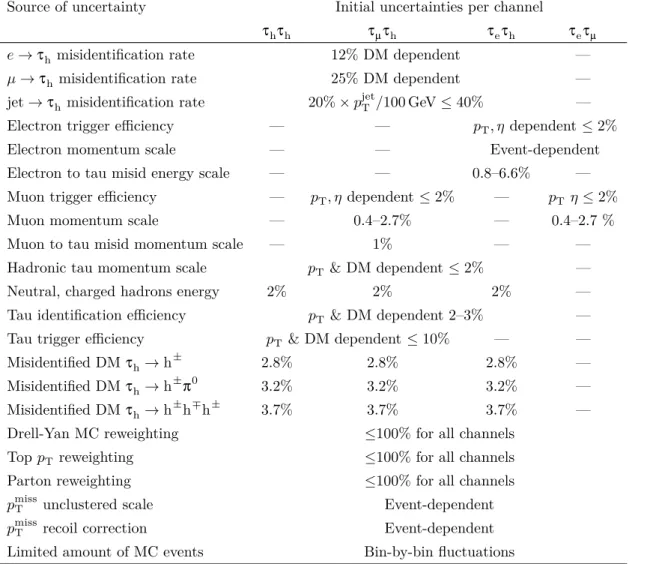
s= 13 TeV recorded by CMS at the CERN LHC with an integrated luminosity of 36.3 fb−1. The measuredτ− lepton polarization at the Z boson mass pole is Pτ(Z) =−0.144±0.006 (stat)±0.014 (syst) =−0.144±0.015, in good agreement with the measurement of the τ lepton asymmetry parameter of Aτ = 0.1439±0.0043 =−Pτ(Z) at LEP. The τ lepton polarization depends on the ratio of the vector to axial-vector couplings of theτ leptons in the neutral current expression, and thus on the effective weak mixing angle sin2θWeff, independently of the Z boson production mechanism.
The obtained value sin2θeffW = 0.2319±0.0008(stat)±0.0018(syst) = 0.2319±0.0019 is in good agreement with measurements at e+e− colliders.
Keywords: Hadron-Hadron Scattering, Tau Physics ArXiv ePrint: 2309.12408
JHEP01(2024)101
Contents
1 Introduction 1
2 The CMS detector 4
3 Data and Monte Carlo samples 4
4 Event reconstruction 5
5 Event selection and categorization 8
6 Background estimation 9
6.1 Theτeτh andτµτh final states 10
6.2 Theτhτh final state 10
7 Tau lepton spin observables 11
7.1 Decay angles 11
7.2 Optimal observables 13
7.3 Helicity correlations 14
7.4 Reconstruction ofω(h) and the choice of discriminators 15
8 Systematic uncertainties 16
9 Measurement of the τ lepton polarization 19
10 Results 23
11 Summary 28
The CMS collaboration 33
1 Introduction
Measuring standard model (SM) parameters with high precision in various processes may reveal yet unknown physics phenomena as deviations from SM predictions. One of the fundamental parameters is the effective weak mixing angle sin2θeffW, which leads to different couplings for right- and left-handed fermions in weak neutral currents. A consequence of this difference is the effective polarization of fermion-antifermion pairs in Z boson decays. Theτ− lepton polarization is defined asPτ = (σ+−σ−)/(σ++σ−), where σ+ and σ− are the cross sections for the production of τ− leptons with positive and negative helicities, respectively.
The helicity ofτ leptons from Z boson decays can be measured from energy and angular distributions of the τ lepton decay products. The polarization measures the ratio of vector to axial-vector neutral current couplings of the τ lepton, and therefore this ratio provides
JHEP01(2024)101
Z θτ
qR
qL τR−
τL+
Z θτ
qL
qR
τL+ τR−
Z θτ
qR
qL
τR+ τL−
Z θτ
qL
qR τL−
τR+
Figure 1. The four possible helicity states of incoming quarks and outgoingτ leptons. Thin arrows depict the direction of movement and the thick arrows show the spin of the particles. The angleθτis the scattering angle of theτ−lepton with respect to the quark momentum in the rest frame of the Z boson.
a further measurement of the weak mixing angle solely from τ lepton couplings as detailed in the following.
In Z →τ+τ− events, the helicity of the τ+ lepton is expected to have a sign opposite to that of the τ− helicity. The differential cross section for the process qq → Z → τ+τ− can be expressed at the lowest order [1]:
dσ
d cosθτ =F0(ˆs)(1 + cos2θτ) + 2F1(ˆs) cosθτ−λτ[F2(ˆs)(1 + cos2θτ) + 2F3(ˆs) cosθτ]. (1.1) Here θτ is the scattering angle of the τ− with respect to the quark momentum in the rest frame of the Z boson, as illustrated in figure 1. The symbol λτ denotes the sign of positive or negative helicity of the τ− lepton and ˆsis the squared center-of-mass energy of the qq pair. TheFi(ˆs) are structure functions for the initial and final fermion pairs describing the strength and shape of the Z resonance and its dependence on the vector and axial-vector neutral-current coupling constants. The total cross section is:
σ= X
λτ=±1
Z dσ
d cosθτd cosθτ. (1.2)
From the cross section in eq. (1.1), the following quantities can be determined: the asymmetry AFB of the forward-backward cross sections, the polarizationPτ of the τ− lepton, and the
JHEP01(2024)101
forward-backward polarization asymmetry ApolFB: AFB = 1
σ[σ(cosθτ >0)−σ(cosθτ <0)] = 3F1(ˆs) 4F0(ˆs), Pτ = 1
σ[σ(λτ = +1)−σ(λτ =−1)] =−F2(ˆs) F0(ˆs), ApolFB = 1
σ[Pτ(cosθτ >0)− Pτ(cosθτ <0)] =−3F3(ˆs) 4F0(ˆs),
(1.3)
where the symbols Fi correspond to the structure functions in eq. (1.1).
The cross section includes the contributions from Z boson exchange, photon exchange, and photon-Z interference. If √
ˆ
sis equal to the Z boson massMZ, the contributions from photon exchange cancel in the numerator of the asymmetries and the following holds:
AFB= 3 4AfAτ, Pτ =−Aτ, ApolFB= 3
4Af,
(1.4)
where Aτ = 2vτaτ/(vτ2+a2τ) and Af= 2vfaf/(vf2+a2f) are the asymmetry parameters defined by the effective neutral current vector and axial-vector couplings vτ and aτ for the τ lepton, andvf andaf, the parameters for the initial-state fermions, respectively. In the limit vτ ≪aτ, the polarization can be written as Pτ ≈ −2vτ/aτ, and is simply related to sin2θeffW:
Pτ =−Aτ =− 2vτaτ
vτ2+a2τ ≈ −2vτ
aτ =−2(1−4 sin2θWeff). (1.5) Hence, a measurement of the polarization Pτ can provide a precise determination of sin2θeffW using onlyτ lepton couplings. Comparison with the value of sin2θeffW measured in the process e+e−→ Z at LEP [2–5] tests the lepton universality of the weak neutral current.
Since τ leptons decay rapidly inside the detector, their polarization is measured by analyzing the energy and direction of their decay products. Observables used for this analysis are the angles and momenta of the daughter particles with respect to the boost direction of the τ lepton or intermediate particles in the decay of the τ lepton.
Measurements of the τ lepton polarization have been performed in e+e− annihilation by the four LEP experiments at center-of-mass energies near MZ [2–5], at the linear collider experiment SLD [6], and in proton-proton (pp) collisions by the ATLAS experiment at the CERN LHC at √
s = 8 TeV [7].
The measurement of the τ lepton polarization in Z boson decays was pioneered at LEP [1], where the polarization could be measured in a very small window around the Z pole and as a function of the polar emission angle cosθτ of the τ lepton with respect to the incoming electrons. A maximum likelihood fit to this angular dependence provides the best measurement of the polarization.
A complication occurs when the polarization is measured in pp collisions; in contrast to e+e−collisions, the polar emission angle θτ is not, or only very poorly, known and can not be
JHEP01(2024)101
used in the analysis. Furthermore, instead of a fixed value, measurements are always an average over a limited range of the center-of-mass energy of the dd and uu quark-antiquark pairs. The measurement is effectively an integration over the experimental width of the Z boson and a fairly wide range of its rapidity and transverse momentumpT. The ranges are determined by the parton distribution functions (PDFs) of the proton and the acceptance of the experiment.
In this paper, a measurement of the τ− lepton polarization Pτ is presented, based on Z→ττ events in pp collisions with parton-parton center-of-mass energies √
ˆ
sof 75–120 GeV.
The measurement is performed by using the following combinations of leptonic and hadronic decay modes of the τ leptons: τeτµ, τeτh, τµτh, and τhτh, where the symbol τe refers to the decay τ− → e−νeντ, the symbol τµ refers to the decay τ− → µ−νµντ, and the τh to the hadronic τ decay modes.
Following a short description of the CMS experiment in section2 and of the Data and Monte Carlo samples (section3), the event reconstruction and the event selection are detailed in sections 4 and 5, respectively. The background estimates are described in section 6, before the τ lepton spin variables are discussed in section 7. After a discussion of systematic uncertainties in section 8, the measurement of the τ− lepton polarization Pτ is described in section 9. Finally, from the measurement of Pτ, averaged over the mass range of the Z boson, the effective weak mixing angle sin2θWeff is derived and presented in section 10. The paper ends with a summary in section 11.
2 The CMS detector
The central feature of the CMS apparatus is a superconducting solenoid of 6 m internal diameter, providing a magnetic field of 3.8 T. Within the magnetic volume are a silicon pixel and strip tracker, a lead tungstate crystal electromagnetic calorimeter (ECAL), and a brass and scintillator hadron calorimeter (HCAL), each composed of a barrel and two endcap sections. Forward calorimeters extend the pseudorapidity (η) coverage provided by the barrel and endcap detectors. Muons are detected in gas-ionization chambers embedded in the steel flux-return yoke outside the solenoid. A more detailed description of the CMS detector, together with a definition of the coordinate system used and the relevant kinematical variables, are reported in ref. [8].
Events of interest are selected using a two-tiered trigger system. The first level (L1), composed of custom hardware processors, uses information from the calorimeters and muon detectors to select events at a rate of around 100 kHz within a fixed latency of 4µs [9]. The second level, known as the high-level trigger (HLT), consists of a farm of processors running a version of the full event reconstruction software optimized for fast processing, and reduces the event rate to around 1 kHz before data storage [10].
3 Data and Monte Carlo samples
This analysis is based on pp collision data at a center-of-mass energy of 13 TeV collected in the year 2016 with the CMS detector at the LHC. The analyzed data correspond to an integrated luminosity of 36.3 fb−1 [11].
JHEP01(2024)101
A Drell-Yan (DY) signal Monte Carlo (MC) sample of Z/γ∗→ττ events is generated for this analysis at next-to-leading order (NLO) in quantum chromodynamics (QCD), but at leading order (LO) for electromagnetic processes using MadGraph5_amc@nlo v2.4.2 [12], with the hadronization step simulated by pythia 8 [13]. The CUETP8M1 [14] pythia tune and pythia8 v8.226 are used. The τ polarization flag TauDecays:externalMode
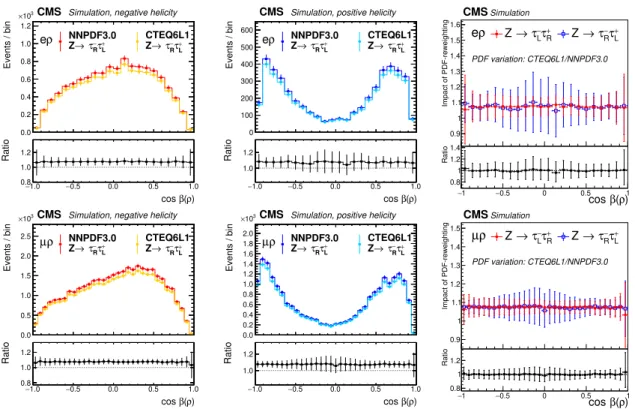
= 0 is used to ensure proper τ decay simulation by tauola 1.1.6 [15, 16] following the helicity assignment of MadGraph5_amc@nlo. The NNPDF3.0 [17] PDFs are used. A sample of about 60 million events was produced in this way and processed through the detector simulation and reconstruction chain. The simulation of the detector response is based on Geant4 [18].
Differences in the mass and pT distributions of the τ pair between data and simulations are observed and 2D weights based on these variables are derived and applied to simulated Drell-Yan events [19]. Since MadGraph5_amc@nlois NLO in QCD, additional jets are included at the matrix element level. A reweighting between 3.9 and 12.3% was applied to the distribution of the number of generated partons in the event to match the distribution of jets. The analysis is not sensitive to those additional jets.
The main background processes, such as W+jets and other Drell-Yan processes like Z/γ∗ → ee and Z/γ∗ → µµ, are generated at LO for electromagnetic processes with MadGraph5_amc@nloand interfaced with pythia 8 with the tune CUETP8M1 [14].
Backgrounds from s-channel and tW single top quark associated production are gener- ated with powheg v1.0 [20] and powheg v2.0 [21], respectively, interfaced to pythia 8 with the CUETP8M1 tune. The top quark pair production (tt) sample is produced with powheg v1.0 [22] interfaced to pythia 8 with the CUETP8M2T4 [23] tune. Diboson samples are generated with MadGraph5_amc@nlo and tune CUETP8M1, interfaced to pythia 8 and τ lepton decays are processed by tauola. Again, the NNPDF3.0 [17]
PDFs are used for the background processes.
The impact of multiple pp collisions in the same or adjacent bunch crossings (pileup) on event reconstruction [24] is accounted for in simulation by superimposing simulated minimum bias pp events on top of each process of interest. Because the distribution of the number of pileup events in the simulation is not the same as in data, the simulation is weighted to match the data.
4 Event reconstruction
The particle-flow (PF) algorithm [25] reconstructs and identifies each individual particle in an event, with an optimized combination of information from the various elements of the CMS detector. The energy of photons is obtained from the ECAL measurement. The energy of electrons is determined from a combination of the electron momentum at the primary vertex (PV) as determined by the tracker, the energy of a corresponding ECAL cluster, and the energy sum of all bremsstrahlung photons spatially compatible with originating from the electron track. The energy of muons is obtained from the curvature of the corresponding track. The energy of charged hadrons is determined from a combination of their momentum measured in the tracker and the matching ECAL and HCAL energy deposits, corrected for
JHEP01(2024)101
the response function of the calorimeters to hadronic showers. Finally, the energy of neutral hadrons is obtained correspondingly from the corrected ECAL and HCAL energies.
The PV is taken to be the vertex corresponding to the hardest scattering in the event, evaluated from the largest value of summed physics-object p2T as described in ref. [19].
For each event, hadronic jets are clustered from these reconstructed particles based on the infrared- and collinear-safe anti-kT algorithm [26,27] with a distance parameter of 0.4.
The jet momentum is determined as the vector sum of all particle momenta in the jet, and is found from simulation to be, on average, within 5-10% of the generated momentum over the entire pT spectrum and detector acceptance. Pileup interactions can lead to additional tracks and calorimetric energy depositions to the jet momentum. To mitigate this effect, charged particles identified to be originating from pileup vertices are discarded, and an offset correction is applied to correct for remaining contributions. Jet energy corrections are derived from simulation to bring the measured response of jets to that of particle level jets on average. In situ measurements of the momentum balance in dijet, photon+jet, Z+jet, and multijet events are used to account for any residual differences in the jet energy scale between data and simulation. The jet energy resolution amounts typically to 15–20% at 30 GeV, 10% at 100 GeV, and 5% at 1 TeV [28]. Additional selection criteria are applied to each jet to remove jets potentially dominated by anomalous contributions from various subdetector components or reconstruction failures.
Electrons are reconstructed within the geometric acceptance|η|<2.5. The momentum resolution for electrons with pT ≈45 GeV from Z→e+e− decays ranges from 1.6 to 5.0%.
It is generally better in the barrel region than in the endcaps, and also depends on the bremsstrahlung energy emitted by the electron before reaching the ECAL [29].
Muons are measured in the range |η|< 2.4, with detection planes made out of three types of gas-ionization detectors: drift tubes, cathode strip chambers, and resistive-plate chambers. Matching muons to tracks measured in the silicon tracker results in a relative transverse momentum resolution of 1% in the barrel and 3% in the endcaps for muons with pT up to 100 GeV [30].
The missing transverse momentum vector⃗pTmiss in the event is defined as the negative vector sum of the momenta of all reconstructed particles in an event projected onto the plane perpendicular to the beam axis. It is computed from the PF candidates weighted by their probability to originate from the PV [31]. Recoil corrections are applied to account for mis- modeling of ⃗pTmiss in the simulated samples of Drell-Yan and W+jets production. The vector
⃗
pTmiss is further modified to account for corrections to the energy scale of the reconstructed jets in the event. The pileup-per-particle identification algorithm [32] is applied to reduce the pileup dependence of the ⃗pTmiss observable. The magnitude of ⃗pTmiss is referred to aspmissT . Leptonicτ decays,τe andτµ, are identified as isolated electrons and muons. The lepton ℓ (e, µ) isolation Irel(ℓ) is defined by the following equation:
Irel(ℓ) = P
ch. hadpT+ max0, Pn. had.ET+PγET−β(PU)
pℓT . (4.1)
In this expression, Pch. hadpT is the scalar transverse momentum sum of the charged hadrons originating from the PV within a cone of size ∆R=p(∆η)2+ (∆ϕ)2 = 0.3 or 0.4 for electrons
JHEP01(2024)101
and muons, respectively, centered on the lepton. The quantities ∆η and ∆ϕmeasure the particle separation inηand of the azimutal angleϕin radians. The sumPn. had.ET+PγET in eq. (4.1) represents a similar quantity for neutral particles.
To estimate the contribution of neutral particles due to pileup the so-called effective-area method is used for identified electrons. The pileup in this method is estimated as β(PU) = ρAeff, whereρ is the event-specific average pileup energy density per unit area in the η−ϕ plane and Aeff is the effective area specific to the given type of isolation.
A different method is used for the selected muons; the contribution of photons and neutral hadrons originating from pileup verticesβ(PU) is estimated from the scalar transverse momentum sum of charged hadrons originating from pileup vertices: β(PU) = 0.5PPUpT. The sum PPUpT is multiplied by a factor of 0.5, which corresponds approximately to the ratio of neutral-to-charged hadron production, as estimated from simulation.
Lepton isolation and identification efficiencies are measured with a tag-and-probe method [33, 34] using Z → ℓ+ℓ− events in lepton pT and η bins from samples collected based on single-lepton triggers.
The reconstruction of the hadronically decayingτ leptons (τh candidates) is performed by the hadron-plus-strips algorithm (HPS) [34]. Jets are reconstructed from PF constituents with the anti-kT algorithm [26] with a distance parameter of ∆R= 0.4. They are considered as τh candidates if they comprise one or three charged hadrons with a net charge of ±1, and up to two neutral pions. Dedicated attention is given to photons originating from π0 → γγ decays likely to convert to e+e− pairs, by collecting the photon and electron constituents, called strips, in an area around the jet direction in the η−ϕplane. The size of the strip varies as a function of the pT of theτh. To further characterize the τh signature, its visible reconstructed mass is required to be compatible with that of the ρ(770) resonance for τ−→h−π0 signatures, and the a1(1260) resonance forτ− →h−π0π0 and τ−→h−h−h+ signatures, with corresponding channels for the τ+.
Energy scale corrections are computed for each decay mode using either the visible mass of bothτ leptons or the invariant mass distributions of theπ±π0,π±π0π0, andπ+π−π±systems.
The correction factors are chosen such that either the visible mass distributions of both τ leptons of the MC events match the data distribution, or the invariant mass distributions of theπ±π0,π±π0π0, andπ+π−π± systems match the shapes of the ρ and a1 resonances [34].
In this analysis, since the decay channels of the τh have different polarization sensi- tivity, it is fundamental to identify these channels correctly. To increase the purity of the reconstructed decay channels, a multi-class multivariate analysis (MVA) with a boosted decision tree algorithm (implemented using the XGBoost library) is applied in addition to the HPS algorithm. The multivariate algorithm was developed for the analysis of the charge-conjugation and parity (CP) properties of the Higgs boson in τ+τ− decays [35], which is also very sensitive to migrations between reconstructed decay modes. Based on the simulated DY signal sample, the use of the multivariate algorithm in addition to the HPS algorithm increased the purity of the τ− → π−ν and τ− → ρ−ν channels in the analysis presented here from 63 to 83% and from 63 to 77%, respectively. For reconstructed τ leptons the efficiencies for the correct decay mode identifications are 76, 82 and 94% for the decays τ− → π−ν, τ− → ρ−ν and τ− → π−π+π−ν, respectively.
JHEP01(2024)101
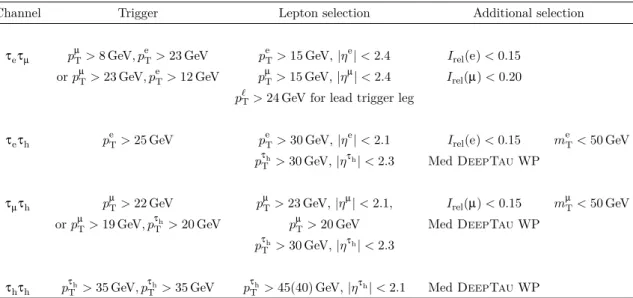
Channel Trigger Lepton selection Additional selection
τeτµ pµT>8 GeV, peT>23 GeV peT>15 GeV,|ηe|<2.4 Irel(e)<0.15 orpµT>23 GeV, peT>12 GeV pµT>15 GeV,|ηµ|<2.4 Irel(µ)<0.20
pℓT>24 GeV for lead trigger leg
τeτh peT>25 GeV peT>30 GeV,|ηe|<2.1 Irel(e)<0.15 meT<50 GeV pτTh>30 GeV,|ητh|<2.3 MedDeepTauWP
τµτh pµT>22 GeV pµT>23 GeV,|ηµ|<2.1, Irel(µ)<0.15 mµT<50 GeV orpµT>19 GeV, pτTh>20 GeV pµT>20 GeV MedDeepTauWP
pτTh>30 GeV,|ητh|<2.3
τhτh pτTh>35 GeV, pτTh>35 GeV pτTh>45(40) GeV,|ητh|<2.1 MedDeepTauWP
Table 1. Selections applied in this analysis. For the τµτh channel two triggers were used with different muon thresholds, thepTselection threshold for τhrefers to both. For the τhτhchannel, the pTselection threshold for the nonleadingτhwas lower by 5 GeV. The label Med DeepTau WP in the last column refers to the medium working point of the DeepTau discriminator against fakeτh.
TheDeepTaudiscriminator [36] is used in this analysis in order to distinguish τh from quark and gluon jets, electrons and muons. It is a deep neural network algorithm that returns three discriminants, trained to reduce misreconstruction of jets, electrons, or muons as τh candidates. The so-called Medium Working Point (Med DeepTau WP) is used for τh as referred to in table 1 of the next section.
Correction factors were measured in ref. [34] for the different working points of anti-jet, anti-electron, and anti-muon discriminators used to identify the τh. These were measured in Z → τµτh events, considering the visible mass of the muon or τ lepton candidate as observables (or alternatively the number of tracks in the signal and isolation cones).
5 Event selection and categorization
The following analysis uses selection criteria developed for the analyses of the Higgs boson in the τ+τ− decay channel [19] and its CP properties [35]; some of them are summarized in table 1.
A combination of several triggers is used to cover the different channels of the Z→τ+τ− decays and described in more detail in ref. [19]. The off-line selection thresholds in table1 are often significantly higher than the trigger threshold to ensure exactly known efficiencies.
The pseudorapidity limits come from trigger and object reconstruction constraints.
The electrons and muons in theτeτµ channel, electron, muon and τh in the τeτh,τµτh channel, respectively, and the twoτh in theτhτhchannel are required to be oppositely charged.
Theτe, τµ andτh candidates are required to have a distance of closest approach to the PV of
|dz|<0.2 cm in the direction along the beam axis and|dxy|<0.045 cm in the transverse plane.
In the τeτh channel, the trigger system requires at least one isolated electron object, whereas in the τeτµ channel, the triggers rely on the presence of both an electron and a
JHEP01(2024)101
muon, allowing lower onlinepT thresholds. In the τµτh channel, events are selected with at least one isolated muon trigger candidate, or at least one isolated muon and one τh trigger candidate, depending on the offline muon pT.
For theτhτhchannel, the trigger selects events with two τh objects using a less restrictive isolation criteria [34] than the more selective Med DeepTau WP used for the analysis listed in table 1.
Theττ final states are categorized according to the number of identified electrons and muons in the event. Events containing an electron and a muon are assigned to the τeτµ category. If at least oneτe and τh candidate is found, but no muon, the event is assigned the τeτh final state. Similarly the event is assigned to the τµτh final state if it contains at least one muon candidate, but no electron. If neither an electron nor a muon is found but at least twoτh candidates, the event is assigned to theτhτh final state. Events containing three or more electrons or muons are vetoed to suppress the contribution from other Drell-Yan events.
This ensures that the four final states are mutually exclusive and of very good purity.
Theτe,τµ, andτhcandidates corresponding to the decay of theτ lepton pair are required to be separated by ∆R >0.3 forτeτµ events and ∆R >0.5 forτeτh,τµτh, τhτhevents. Since τh candidates are wider than τℓ the required separation is slightly larger. The reconstructed leptons must correspond to the HLT candidates on which the trigger decision is made. The correspondence is ensured by requiring the selected electron or muon in the τeτh andτµτh final states to be within a distance ∆R= 0.5 from the corresponding HLT objects. The same spatial separation is applied for both τh candidates in the τhτh final state.
The transverse massmℓT is defined from the transverse momentum pℓT of the electron or muon and the missing transverse momentum:
mℓT=q2pℓTpmissT (1−cos[∆ϕ(ℓ, ⃗pTmiss)]). (5.1) Events containing a W boson are expected to have large values of mT due to the missing neutrino, hence a selection onmT less than 50 GeV is applied to reduce this background.
After the event selection described above, events are categorized according to the recon- structed decay mode of the hadronically decaying τ leptons.
6 Background estimation
The largest background comes from multijet events where one of the jets is misidentified as a τh. Based on simulation it represents about 84% of the expected background in theτhτh channel, and 16 (20%) in the τeτh (τµτh) channels. Drell-Yan events in dilepton final states may contribute if either a lepton is identified as a τh or an additional jet is misidentified as τh. These contributions are suppressed by rejecting events containing lepton pairs with same flavor and opposite electric charge and applying the DeepTau discriminants to suppress electrons and muons wrongly reconstructed as τh candidates. Whereas control samples are used in data to evaluate the multijet background, other contributions such as tt and electroweak processes (EWK: single top quark, Z +jets, and dibosons) rely on simulation.
The W+jets background is significant in the τµτh andτeτh final states (respectively about 31 and 27% of the expected background) and is evaluated from data as described below.
JHEP01(2024)101
6.1 The τeτh and τµτh final states
The QCD multijet and W+jets background estimates are obtained by applying the so-called ABCD method to four regions, delimited by the lepton (e or µ) isolation and the lepton-τh pair charge combinations, opposite-sign (OS) or same-sign (SS) pairs. The signal region A is defined by Irel(ℓ) < 0.15 and an OS pair; B by Irel(ℓ) < 0.15 and an SS pair; C by Irel(ℓ) >0.15 and an OS pair; D by Irel(ℓ) >0.15 and an SS pair. These regions receive significant contributions from W+jets events that must be evaluated simultaneously with the multijet background. Therefore, two samples are defined in which the ABCD method is used: one (low-mT) follows the signal selection criteria for which the transverse mass satisfiesmT<50 GeV; and the other (high-mT) is enriched in W+jets events by requiring mT > 70 GeV. The high-mT region enriched by W+jets is used to evaluate the W+jets background in theIrel(ℓ)<0.15 isolation regions from the ratio between high-mTand low-mT.
The number of multijet background events (QCD) in the signal region is given by:
Nlow-mQCD
T(A) =Nlow-mQCD
T(B) flow-mOS/SS
T. (6.1)
Here flow-mOS/SS
T is the ratio of the number of events for data in the C and D regions where non-QCD events were subtracted. Nlow-mQCD
T(B) is the number of events Nlow-mT(B) observed in region B, where EWK and W+jets backgrounds were subtracted:
Nlow-mQCD
T(B) =Nlow-mT(B)−Nlow-mEWKT(B)−Nlow-mW
T(B). (6.2)
Nlow-mW
T(B) is obtained from the high-mT region:
Nlow-mW
T(B) =Nhigh-mW
T(B) flow-mSS T/high-mT. (6.3)
The high-mT region is enriched in W+jets events, EWK background estimates obtained from simulation are nevertheless subtracted. The ratio flow-mSS T/high-mT is obtained from simulated W+jets events.
Similarly, the W+jets yield in the signal region A is given by:
Nlow-mW
T(A) =Nhigh-mW
T(A) flow-mOS
T/high-mT. (6.4)
To limit statistical fluctuations relaxed criteria on the muon and τh isolations (Irel(ℓ)<0.3 and medium isolation for τh) are used to obtain flow-mOS
T/high-mT. 6.2 The τhτh final state
The multijet background estimation differs for the τhτh final state since the W+jets back- ground is negligible for this final state. A sideband region is defined from which the yields and shapes are obtained. This sideband region is the same as the signal region except that the isolation requirements of the twoτh candidates are relaxed,Irel(ℓ)<0.15 for a tight and Irel(ℓ) >0.15 for a loose selection. The purpose of relaxing the criteria for both τ leptons, and not only for one, is to gain in statistical precision. The extrapolation from the sideband region to the signal region to estimate the QCD contribution NQCD is obtained by applying a so called loose-to-tight isolation scale factor, denoted ftight/looseSS :
NQCD=ftight/looseSS NlooseOS . (6.5)
JHEP01(2024)101
τL−
ντ
π− θ
τL−
ντ
ρ−/a−1 θ
τL−
θ ρ−/a−1 ντ
τR− θ
π− ντ
τR−
ρ−/a−1 θ
ντ τR−
ντ
ρ−/a−1 θ
Figure 2. Definition of the angle θ in theτ− lepton rest frame for the decays τ− →h−ν(h− = π−,ρ−,a−1), upper row for left-handed τ lepton τ−L, lower row for right-handedτ lepton τ−R. The thick arrows indicate the spin directions of the particles.
This scale factor is computed in SS events, ftight/looseSS =NtightSS /NlooseSS . The number of events measured in the three regions, namely NlooseOS , NtightSS , andNlooseSS is evaluated by removing the residual EWK backgrounds estimated by a MC simulation.
7 Tau lepton spin observables
7.1 Decay angles
The spin of the τ lepton is transferred into the total angular momentum of its decay products.
Therefore, the orientation of the spin of the τ lepton can be revealed from the angular distributions of the decay products relative to the direction of the τ lepton momentum and relative to each other.
Figure2illustrates the relation between theτ− lepton helicity and the polarization of the decay products. The first angle to consider is the angle θbetween the boost direction of the τ lepton projected onto the τ lepton rest frame and the momentum direction of the hadron.
cosθ=⃗nτ ·⃗nh± = 2E(h±)
E(τ±) −1, (7.1)
where⃗nτ and⃗nh± are unit vectors in theτ lepton rest frame pointing in theτ boost direction and along the hadron momentum, respectively. The quantities E(h±) and E(τ±) are the energies of the hadron and τ lepton in the laboratory frame, respectively. In the case of a leptonicτ− lepton decay, the vector of the hadron is replaced by the one of the lepton, but two neutrinos are emitted instead of one, leading to a more complicated situation. In the experimentally favored case where the charged lepton takes most of the τ− lepton energy, the neutrino and anti-neutrino are emitted collinear and the pair is opposite to the charged lepton, and their spins will add up to zero. The charged lepton will carry the spin of the τ− lepton, and it is preferentially emitted against the direction of τ− lepton spin.
In the decayτ−→π−ν, there is zero orbital momentum in the two-bodyτ− lepton decay and, since the pion carries no spin, angular momentum conservation requires the neutrino
JHEP01(2024)101
to carry the spin of the τ− lepton. In the τ− lepton rest frame, the neutrino and pion are emitted back-to-back. Since the neutrino is always left-handed, the π− prefers small values for the angle θin the decay of a right-handed τ− lepton (τ−R) and large values in case theτ− lepton is left-handed (τ−L). In this case, the angle θ carries full spin information.
The decay into a spin-one resonance,ρ or a1, also offers the simplicity of a two-body decay, like the τ− → π−ν decay, but with more complicated dynamics since the ρ and a1 resonances can have longitudinal and transverse polarization. Conservation of angular momentum allows the ρ and a1 helicities to be equal to λV = 0 or −1.
If theτ− lepton is in the right-handed state, the V (V = ρ,a1) resonance tends to be in a longitudinally polarized state (λV= 0). Conversely, if the τ− lepton is left-handed, the V is preferably transversely polarized (λV =−1 ). Combining the spin amplitudes for all possible configurations of the V resonance andτ− lepton helicities, one gets [37]:
1 Γ
dΓ
d cosθ ∝1 +αVλτcosθ, (7.2)
where the dilution factorαV= (|ML|2−|MT|2)/(|MT|2+|ML|2) = (m2τ−2 m2V)/(m2τ+2 m2V) is a result of the presence of the transverse amplitude MT of the V resonance in addition to the longitudinal amplitudeML. The value of the factorαVcharacterizes the sensitivity of the cosθobservable. For comparison, in the τ−lepton decay to the a1 resonance,αa1= 0.021, in the ρ meson decay,αρ = 0.46 and in the pion decay,απ= 1. Consequently, the sensitivity to the τ− lepton helicity in τ →Vνdecays is strongly reduced if only the angle θis considered.
The spin of V is transformed into the total angular momentum of the decay products and thus can be retrieved by analyzing the subsequent V decay.
There are two additional angles to be considered in the decay of τ−→ρ−ν followed by ρ−→π−π0: the angle β denotes the angle between the direction of the charged pion in the ρ meson rest frame and the direction of the ρ meson momentum, given by:
cosβ=⃗nh±·⃗nρ = mρ q
m2ρ−4m2π
Eπ−−E
π0
|pπ−−p
π0|, (7.3)
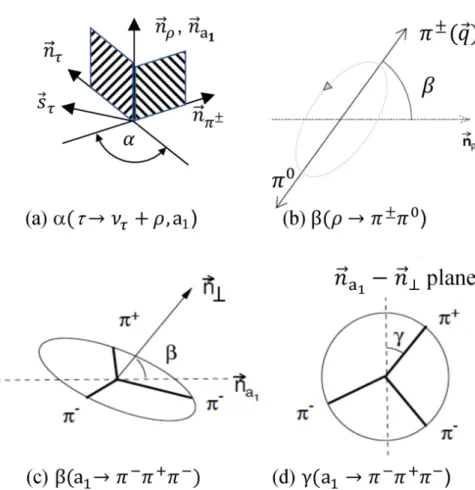
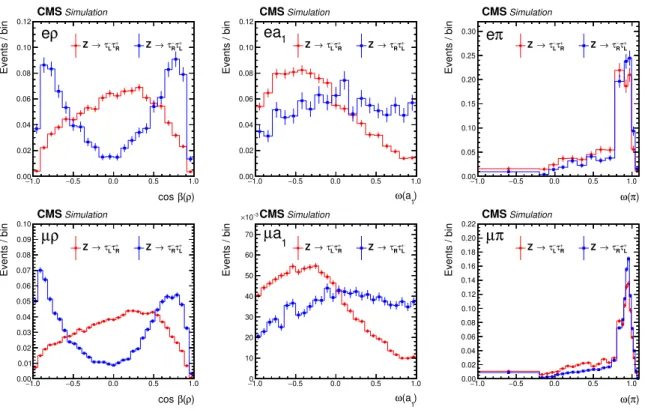
where ⃗nh± is a unit vector along the direction of the charged pion in the ρ meson rest frame and⃗nρ is the direction of the momentum of the ρ projected onto its rest frame. The rotation plane of two pions is aligned correspondingly to the spin of the ρ resonance. In the case ofλρ = 0, the angle β tends to small values, and to large values if λρ =−1. The angle β in τ− → ρ−ν is sketched in figure 3b. The expression 7.3 for this angle contains only quantities that can be measured directly and is therefore a very powerful variable to discriminate left- and right-handed helicity states.
A similar, but not identical, angleβ is constructed for the τ−→a−1ν. In this caseβ is defined as the angle between the normal to the 3π decay plane and the a1 meson momentum vector projected onto the a1 meson rest frame. The angle is shown in figure 3c.
A further angleα is defined by the two planes spanned by vectors (⃗nV, ⃗nτ) and (⃗nV, ⃗nh±), respectively:
cosα= (⃗nV×⃗nτ)·(⃗nV×⃗nh±)
|⃗nV×⃗nτ||⃗nV×⃗nh± | . (7.4)
JHEP01(2024)101
Figure 3. Definitions of (a) the angleα in both τ− → ρ−ν and τ− → a−1ν, (b) the angle β in τ− → ρ−ν,ρ− →π−π0 and (c) in τ− → a−1ν,a−1 → π−π+π−, and finally (d) the angle γ for the decay of a−1 →π−π+π−. Figures b, c, and d have been taken and refurbished from ref. [38].
Here, all vectors are defined in the resonance rest frame. The vector ⃗nV denotes the boost direction of the ρ or a1 resonance projected onto its rest frame, and⃗nτ is the boost direction of the τ− lepton in the rest frame of the meson. The vector⃗nh± denotes the momentum direction of the π− in case of τ− → ρ−ν decay and π+ in τ− → a−1ν decay. The angle α describes the correlation between the helicity of the τ lepton and the decay products of the ρ or a1 resonance. The angle α is illustrated in figure 3a.
An additional angle γ can be introduced in the τ−→a−1ν decay; the angle describes the relative orientation of the pions in the decay plane. This angle is illustrated also in figure 3d.
All spin sensitive anglesα, β, γandθcan be combined into a unique one-dimensional variable, without loss of sensitivity, as described in the next section.
7.2 Optimal observables
Optimal variables to measure the helicity of τ− leptons have been widely explored at LEP and are explained in ref. [39]. The idea is to replace the multidimensional fits over all relevant decay angles by a one dimensional fit to a unique variable ω(θ, α, β, γ, . . .), which can be derived from the squared matrix elements of the decay for positive and negative helicity. This procedure is equivalent to the use of the concept of the polarimetric vector.
JHEP01(2024)101
In general, the differential width of any decay of a polarizedτ− lepton can be described using the polarimetric vector and has the simplified form [15, 37,38]:
dΓ = |M|2
2mτ (1−hµsµ)dS, (7.5)
where dS is the element of Lorentz-invariant phase space, s is the four-vector of the spin of the τ− lepton and h is the polarimetric four-vector. In the rest frame of the τ− lepton, assuming that theτ− lepton spin is aligned with theτ− lepton momentum (all transverse τ− spin components are zero), this reads:
dΓ d cosζh ∝ 1
2(1 +Pτcosζh), (7.6)
wherePτ is theτ−lepton polarization for a givenτ− lepton decay andζh is the angle between the space-like polarimetric vector⃗hτ and⃗nτ, the direction of the τ− lepton as defined above.
The polarimetric vector⃗hτ depends on the particular final state. This vector describes how the tau decay products propagate depending on the tau spin; for τ− lepton decays into hadrons it depends on the momenta of all the hadrons in the decay chain and the decay mode of the intermediate resonance.
In the case ofτ−→π−ν, the polarimetric vector is aligned with the direction of the π− meson: ⃗hτ =⃗nπ, where ⃗nπ is a unit vector pointing along the momentum of the pion.
The situation in τ− → (ρ− → π−π0)ν and τ− → (a−1 → π−π+π−)ν decays is more complicated due to the resonance structure. The general expressions for polarimetric vectors in the decaysτ−→ρ−νandτ−→a−1νis reported in ref. [38] and references therein, including a discussion of the hadronic form factor in τ− → a−1ν decays.
We denote the optimal observable for a singleτ− lepton decay as ω(h), which is defined in ref. [39]:
ω(h) = cosζh. (7.7)
The optimal observableω(h) carries the full sensitivity and has the same unique distri- bution distinguishing left and right τ lepton helicities for all hadronic decay modes. The simple linear distribution of ω(h) (for h =π,ρ,a1) is shown in figure 5 of ref. [38]. The use of such an optimal variable simplifies the extraction of the polarization and combines all spin sensitive angles, even those with low discrimination power, into a one-dimensional quantity.
For theτ−→a−1νdecay, we use the parametrization provided by the CLEO Collabora- tion [40] for the hadronic form factor, which includes in total seven resonances that describe the intermediate states of the a−1 → π−π+π− decay. The CLEO parametrization for this decay mode is also used in thetauola [15, 16] andpythia 8 [13] Monte Carlo generators.
7.3 Helicity correlations
The sensitivity to the polarization measurement can be improved by exploiting the anti- correlation of helicity within a τ lepton pair. The method, proposed in ref. [39], defines a
JHEP01(2024)101
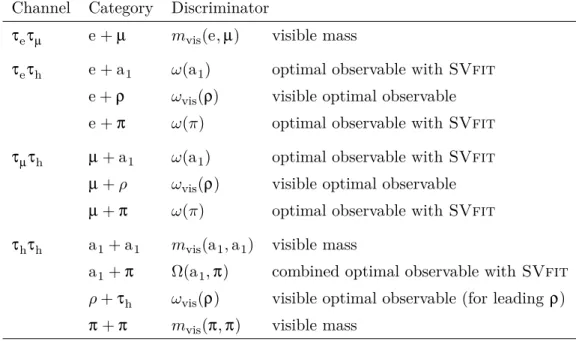
Channel Category Discriminator
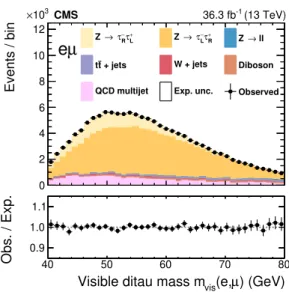
τeτµ e +µ mvis(e,µ) visible mass
τeτh e + a1 ω(a1) optimal observable with SVfit e +ρ ωvis(ρ) visible optimal observable e +π ω(π) optimal observable with SVfit τµτh µ+ a1 ω(a1) optimal observable with SVfit
µ+ρ ωvis(ρ) visible optimal observable µ+π ω(π) optimal observable with SVfit τhτh a1+ a1 mvis(a1,a1) visible mass
a1+π Ω(a1,π) combined optimal observable with SVfit ρ+τh ωvis(ρ) visible optimal observable (for leading ρ) π+π mvis(π,π) visible mass
Table 2. Final choice of discriminators in the various event categories.
new optimal observable for the τ lepton pair. Denoting ω1 and ω2 to be the observables for τ1 and τ2, one can define the variable:
Ω = ω1+ω2
1 +ω1ω2. (7.8)
Similarly to the optimal observable for a single τ decay, the distribution of Ω for aτ pair is identical for all hadronic decay modes, as shown in figure 6 in ref. [38].
7.4 Reconstruction of ω(h) and the choice of discriminators
The performance of the kinematical reconstruction of τ lepton decays and the polarization observables strongly depends on the decay mode. Therefore, sensitivity is improved by treating separately each decay mode, which results in 11 categories in the τeτµ,τeτh,τµτh, and τhτh channels. These categories are summarized in the first two columns of table 2. In the fully hadronic channel, the three combinations containing τ− →ρ−ν events are combined into one category for the choice of the optimal discriminator.
The reconstruction of the optimal observablesω(h) requires the knowledge of the rest frame of the τ lepton or of both τ leptons for the calculation of the quantity Ω. Because of the emission of the neutrino, the momentum direction of τ leptons can be measured directly only in cases where the decay vertex can be reconstructed, for example for decays like τ− →π−π+π−ν. In most other cases, the SVfit[41] algorithm for the reconstruction of the τ lepton decay is used. The SVfit algorithm has been modified for the purpose of this analysis, such that:
• the four-vector of individual τ leptons is calculated by SVfit;
• the mass of the di-τsystem is constrained to the Z boson mass to improve the resolution on the four-vectors of the twoτ leptons;
JHEP01(2024)101
The reconstructed τ− lepton four-vectors are used to boost the four-vectors of the τ− decay products to the τ− lepton rest frame and to compute the optimal observable ω(h) in the τ− lepton rest frame.
Since the performance of theSVfitalgorithm is limited, in some event categories a better sensitivity is often obtained from observables that are measured directly in the detector, e.g., the angle β in ρ decays, and the angles β and γ in τ−→a−1ν decays, as defined by eq. (7.3).
These quantities are denoted hereafter in the text as visible observables ωvis or Ωvis. In addition, it has been shown in ref. [42] that the energies of the τ lepton decay products and the acollinearity angle between the decay products of the two τ leptons in the laboratory frame also carry information about the helicity states of the τ leptons. A suitable observable, which includes both quantities, is the invariant mass of the visible decay products of both τ leptons
mvis=q2E1E2(1−cosφ(τ1vis, τ2vis