Contents lists available atScienceDirect
Physics Letters B
www.elsevier.com/locate/physletb
Search for lepton flavour violating decays of the Higgs boson to e τ and e μ in proton–proton collisions at √
s = 8 TeV
.The CMS Collaboration
CERN,Switzerland
a r t i c l e i n f o a b s t ra c t
Articlehistory:
Received13July2016
Receivedinrevisedform21August2016 Accepted14September2016
Availableonline6October2016 Editor:M.Doser
Keywords:
CMS Physics Higgs
Lepton-flavour-violation
AdirectsearchforleptonflavourviolatingdecaysoftheHiggsboson(H)intheH→eτ andH→eμ
channels is described. The data sampleused inthe search was collected inproton–proton collisions at √
s=8 TeV with the CMS detector at the LHC and corresponds to an integrated luminosity of 19.7 fb−1.Noevidence isfound for leptonflavourviolatingdecays ineitherfinal state. Upper limits onthebranchingfractions,B(H→eτ)<0.69% andB(H→eμ)<0.035%,aresetatthe95%confidence level.TheconstraintsetonB(H→eτ)isanorderofmagnitudemorestringentthantheexistingindirect limits.ThelimitsareusedtoconstrainthecorrespondingflavourviolatingYukawacouplings,absentin thestandardmodel.
©2016TheAuthor(s).PublishedbyElsevierB.V.ThisisanopenaccessarticleundertheCCBYlicense (http://creativecommons.org/licenses/by/4.0/).FundedbySCOAP3.
1. Introduction
The discovery of the Higgs boson [1–3] has generated great interest in exploring its properties. In the standard model (SM), lepton flavour violating (LFV)decays of the Higgsboson are for- bidden. Such decays can occur naturally in models with more than one Higgs boson doublet [4]. They also arise in supersym- metric models [5–11], composite Higgs models [12,13], models with flavour symmetries [14], Randall–Sundrum models [15–17], and others [18–26]. The CMS Collaboration has recently pub- lished a search in the H→
μτ
channel [27] showing an excess of data with respect to the SM background-only hypothesis at mH=125 GeV witha significanceof2.4 standarddeviations (σ
).Aconstraintisseton thebranchingfractionB(H→
μτ
)<1.51%at95%confidencelevel(CL),whilethebestfitbranchingfractionis B(H→
μτ
)=(0.84+−00..3937)%. TheATLASCollaborationfinds adevi- ationfromthebackgroundexpectationof1.3σ
significanceinthe H→μτ
channelandsets an upperlimit ofB(H→μτ
)<1.85%at 95% CL with a best fit branching fraction of B(H→
μτ
)= (0.77±0.62)% [28]. To date, no dedicated searches have been published forthe H→eμ
channel. The ATLAS Collaboration re- cently reported searches for H→eτ
and H→μτ
, finding no significant excessofeventsover thebackgroundexpectation. The searches in channels with leptonic taudecays are sensitive only to a difference between B(H→eτ
) and B(H→μτ
). These areE-mailaddress:[email protected].
combined with the searches in channels with hadronic tau de- cays to set limitsof B(H→e
τ
)<1.04%, B(H→μτ
)<1.43% at 95% CL [29]. There are alsoindirect constraints. The presence of LFV Higgs boson couplings allows,μ
→e,τ
→μ
, andτ
→e to proceed via a virtual Higgs boson [30,31]. The experimental limits on these decays have been translated into constraints on B(H→eμ
), B(H→μτ
) andB(H→eτ
) [32,33].The nullresult forμ
→eγ
[34]stronglyconstrainsB(H→eμ
)<O(10−8).How- ever, the constraintB(H→eτ
)<O(10%) ismuch lessstringent.Thiscomesfromsearchesforrare
τ
decays[35]such asτ
→eγ
, andthemeasurementoftheelectronmagneticmoment.Exclusion limitsontheelectricdipolemomentoftheelectron[36]alsopro- videcomplementaryconstraints.This letterdescribesa search for LFVdecays ofthe Higgsbo- son with mH=125 GeV, based on proton–proton collision data recorded at√
s=8 TeV withthe CMSdetectorattheCERN LHC, correspondingtoanintegratedluminosityof19.7 fb−1.Thesearch is performed in three decay channels, H→e
τ
μ, H→eτ
h, and H→eμ
, whereτ
μ andτ
h correspond to muonic and hadronic decay channels of tau leptons, respectively. The decay channel, H→eτ
e, is not considered due to the large background contri- butionfromZ→ee decays.Theexpectedfinalstatesignaturesare verysimilartotheSMH→τ
eτ
handH→τ
eτ
μdecays,studiedby CMS[37,38] andATLAS [39],butwithsome significantkinematic differences. The electron in the LFV H→eτ
decay is produced promptly, andtends to havea largermomentum than intheSM H→τ
eτ
hdecay.IntheH→eμ
channel,mHcanbemeasuredwith goodresolutionduetotheabsenceofneutrinos.http://dx.doi.org/10.1016/j.physletb.2016.09.062
0370-2693/©2016TheAuthor(s).PublishedbyElsevierB.V.ThisisanopenaccessarticleundertheCCBYlicense(http://creativecommons.org/licenses/by/4.0/).Fundedby SCOAP3.
This letter is organized as follows. After a description of the CMSdetector(Section2) andof thecollision dataandsimulated samplesused intheanalysis(Section3),theeventreconstruction isdescribed in Section 4. The eventselection andtheestimation ofthebackgroundanditscomponentsaredescribedseparatelyfor thetwoHiggsdecaymodesH→e
τ
andH→eμ
inSections5and 6.TheresultsarethenpresentedinSection7.2. TheCMSdetector
AdetaileddescriptionoftheCMSdetector,togetherwithadef- inition ofthecoordinate systemusedandthe relevantkinematic variables,canbe foundinRef.[40].Themomentaofchargedpar- ticlesaremeasuredwithasiliconpixelandstriptrackerthatcov- ersthe pseudorapidity range|
η
|<2.5, in a 3.8 Taxial magnetic field. Alead tungstate crystalelectromagnetic calorimeter (ECAL) and a brass and scintillator hadron calorimeter, both consisting of a barrel section and two endcaps, cover the pseudorapidity range|η
|<3.0.Asteelandquartz-fibre Cherenkovforwarddetec- torextendsthe calorimetriccoverage to|η
|<5.0. Theoutermost componentoftheCMSdetectoristhemuonsystem,consistingof gas-ionizationdetectorsplacedinthesteelflux-returnyokeofthe magnet to identify the muons traversing the detector. The two- levelCMStriggersystemselects eventsofinterestforpermanent storage.Thefirsttriggerlevel,composedofcustomhardwarepro- cessors,uses informationfromthe calorimetersandmuon detec- torsto selectevents inlessthan 3.2 μs. Thesoftware algorithms ofthe high-level trigger, executed ona farm of commercial pro- cessors,reducetheeventratetolessthan1 kHzusinginformation fromalldetectorsubsystems.3. Collisiondataandsimulatedevents
ThetriggersfortheH→e
τ
μ andH→eμ
analysesrequirean electronanda muoncandidate.The trigger forH→eτ
h requires asingleelectron.Moredetailsonthetriggerselectionaregivenin Sections5.1and6.1,fortheH→eτ
andH→eμ
channelsrespec- tively.Simulatedsamplesofsignalandbackgroundeventsarepro- ducedwith severalevent generators. The CMSdetector response ismodelledusingGeant4[41].TheHiggsbosonsareproducedin proton–protoncollisions predominantlybygluonfusion(GF) [42], butalsobyvectorbosonfusion(VBF)[43]andinassociationwith a W or Z boson [44]. The H→eτ
decay sample is produced withpythia8.176[45]usingtheCTEQ6Lpartondistributionfunc- tions (PDF). The H→eμ
decaysample is produced with pythia 6.426 [46] usingtheCT10 partondistributionfunctions[47].The SMHiggsbosonsamplesaregeneratedusingpowheg1.0[48–52], withCT10partondistributionfunctions,interfacedtopythia6.426.TheMadGraph5.1.3.30[53]generatorisusedforZ+jets,W+jets, topanti-topquarkpairproductiontt,anddibosonproduction,and powheg forsingle top quark production.The powheg and Mad- Graphgeneratorsareinterfacedtopythia6.426forpartonshower andhadronization.Thepythiaparametersfortheunderlyingevent descriptionare settothe Z2*tune.The Z2*tuneis derivedfrom theZ1tune [54],which usesthe CTEQ5L partondistributionset, whereasZ2*adoptsCTEQ6L.Duetothehighluminositiesattained during data-taking,manyevents havemultipleproton–protonin- teractionsper bunch crossing (pileup).All simulatedsamples are reweightedtomatchthepileupdistributionobservedindata.
4. Eventreconstruction
Datawerecollectedatanaveragepileupof21interactionsper bunch crossing. The tracking system is able to separate collision
vertices as close as 0.5 mm to each other along the beam di- rection [55]. The primary vertex, assumed to correspond to the hard-scattering process, is the vertex for which the sum of the squared transverse momentum p2T of all the associated tracks is thelargest.Thepileupinteractionsalsoaffecttheidentificationof mostofthephysicsobjects,suchasjets,andvariablessuchaslep- tonisolation.
A particle-flow (PF)algorithm [56–58] combines the informa- tion from all CMS subdetectors to identify and reconstruct the individual particles emerging from all interactions in the event:
chargedandneutralhadrons,photons,muons,andelectrons.These particles are then required to be consistent with the primary vertex and used to reconstruct jets, hadronic
τ
decays, quantify the isolation of leptons and photons and reconstruct EmissT . The missing transverse energy vector, EmissT , is defined as the nega- tive of the vector sum of the pT of all identified PF objects in theevent[59].Its magnitudeis referredto as EmissT .The variableR=
(
η
)2+(φ)2,where φ is theazimuthal co-ordinate, is usedto measurethe separationbetweenreconstructedobjects in thedetector.Electron reconstruction requires the matching of an energy clusterintheECALwithatrackinthesilicontracker[60].Electron candidates are accepted in the range |
η
|<2.5, with the excep- tion of the region 1.44<|η
|<1.56 where service infrastructure for the detector is located. Electron identification uses a multi- variate discriminant that combines observables sensitive to the amount ofbremsstrahlungalong the electron trajectory, thegeo- metricalandmomentummatchingbetweentheelectrontrajectory andassociatedclusters, andshower-shapeobservables.Additional requirementsare imposed toremove electrons produced bypho- tonconversions.The electronenergyiscorrectedforimperfection ofthereconstruction usinga regressionbasedonaboosteddeci- siontree[61].Muon candidatesare obtainedfromcombinedfitsoftracks in the tracker andmuon detectorseeded by tracksegments in the muon detector alone, including compatibility with small energy depositions in the calorimeters. Identification is based on track qualityandisolation.Themuonmomentumisestimatedwiththe combined fit. Any possible bias in the measured muon momen- tumisdeterminedfromthepositionoftheZ→
μμ
masspeakas a functionofmuonkinematic variables,andasmallcorrection is obtainedusingtheproceduredescribedinRef.[62].Hadronically decaying
τ
leptons arereconstructed andidenti- fied using an algorithm [63] that selects the decay modes with onechargedhadronanduptotwoneutralpions,orthreecharged hadrons. A photon froma neutral–pion decaycan convertin the tracker material into an electron–positron pair, which can then radiate photons. These particles give rise to severalECAL energy deposits at the sameη
value but separated in φ. They are re- constructed asseveral photons by the PF algorithm. To increase theacceptancefortheseconvertedphotons, theneutralpionsare identifiedbyclusteringthereconstructedphotonsinnarrowstrips alongtheφdirection.Thechargeofτ
hcandidatesisreconstructed by summingthechargesofallparticlesincludedintheconstruc- tionofthecandidate,exceptfortheelectrons containedinstrips.Dedicateddiscriminatorsvetoagainstelectronsandmuons.
Jetsmisidentifiedaselectrons,muonsortausaresuppressedby imposingisolationrequirements,summingtheneutralandcharged particle contributions in cones of R aboutthe lepton. The en- ergydepositedwithintheisolationconeiscontaminatedbyenergy frompileup andthe underlyingevent. The effectofpileup is re- ducedby requiring thetracks considered inthe isolation sum to be compatiblewithoriginatingfromtheproductionvertexofthe lepton.The contributionto theisolation frompileupandtheun- derlyingeventissubtractedonanevent-by-eventbasis.Inthecase
ofelectrons,thiscontributionisestimatedfromtheproductofthe measured energy density
ρ
for the event, determined using theρ
medianestimatorimplementedinFastJet[64],andan effective areacorrespondingtotheisolationcone.Inthecaseofmuonsand hadronicallydecayingτ
leptons,itisestimatedonastatisticalba- sisthroughthemodifiedβ correctiondescribedinRef.[63].Jetsarereconstructedfromalltheparticlesusingtheanti-kTjet clusteringalgorithm [65]implementedinFastJet,witha distance parameterofR=0.5.Thejetenergiesarecorrectedbysubtract- ingthecontributionofparticlescreatedinpileupinteractionsand in the underlying event[66]. Particlesfrom different pileup ver- tices can be clusteredintoa pileup jet,or significantly overlapa jet fromthe primary vertex belowthe selected jet pT threshold.
Thesejetsareidentifiedandremoved[67].
5. H→e
τ
analysis 5.1. EventselectionThe H→e
τ
h selection begins by requiring an eventrecorded withasingle electrontrigger(peT>27 GeV, |η
e|<2.5).The H→ eτ
μchannelrequiresamuon–electrontrigger(peT>17 GeV,|η
e|<2.5, pμ
T >8 GeV,|
η
μ|<2.4). Thetriggersalsoapplylooseidenti- ficationandisolationrequirementstotheleptons.A loose selection is then made for both channels. Electron, muon andhadronic tauleptoncandidates arerequired tobe iso- latedand tolie inthe pseudorapidity ranges where they can be well reconstructed; |
η
e|<1.44 or 1.57<|η
e|<2.30, |η
μ|<2.1 and|η
τh|<2.3,respectively.Leptonsarealsorequiredtobecom- patiblewiththeprimaryvertexandto beseparatedbyR>0.4 fromanyjetin theeventwith pT>30 GeV.The H→eτ
μ chan- nel then requires an electron (peT>40 GeV) and an oppositely charged muon (pμT >10 GeV) separated by R>0.1. Events in this channel with additional muons (pT>7 GeV) or electrons (pT >7 GeV) are also rejected. The H→e
τ
h channel requires an electron (peT>30 GeV) and an oppositely charged hadronic taulepton(pτhT >30 GeV). Events inthischannel withadditional muons(pT>5 GeV),electrons(pT>10 GeV),orhadronictaulep- tons(pT>20 GeV)arerejected.
Theeventsarethendividedintocategorieswithineachchannel accordingtothenumberofjetsintheevent. Jetsarerequiredto passidentificationcriteria,havepT>30 GeV,andlieintheregion
|
η
|<4.7. The 0-jet and1-jet categoriescontain events primarily producedbyGF.The2-jetcategoryisdefinedtoenrichthecontri- butionfromeventsproducedviatheVBFprocess.The main observable used to discriminate betweenthe signal and the background is the collinear mass, Mcol, which provides an estimate of MH usingthe observed decayproducts. It is con- structedusing thecollinearapproximation basedonthe observa- tionthat,sincemHMτ,the
τ
decayproductsarehighlyLorentz boostedinthedirectionoftheτ
[68].Theneutrinomomentacan be approximated to havethe same directionasthe other visible decayproductsoftheτ
(τ
vis) andthecomponentofthe EmissT in the directionofthe visibleτ
decay products isused to estimate the transverse component of the neutrino momentum (pν,estT ).
The collinear mass can then be derived from the visible mass ofthe
τ
–e system (Mvis) as Mcol=Mvis/
xvisτ , where xvisτ isthe fractionof energycarriedby the visible decayproducts ofthe
τ
(xvisτ =pτTvis/(pτvis
T +pνT,est)).
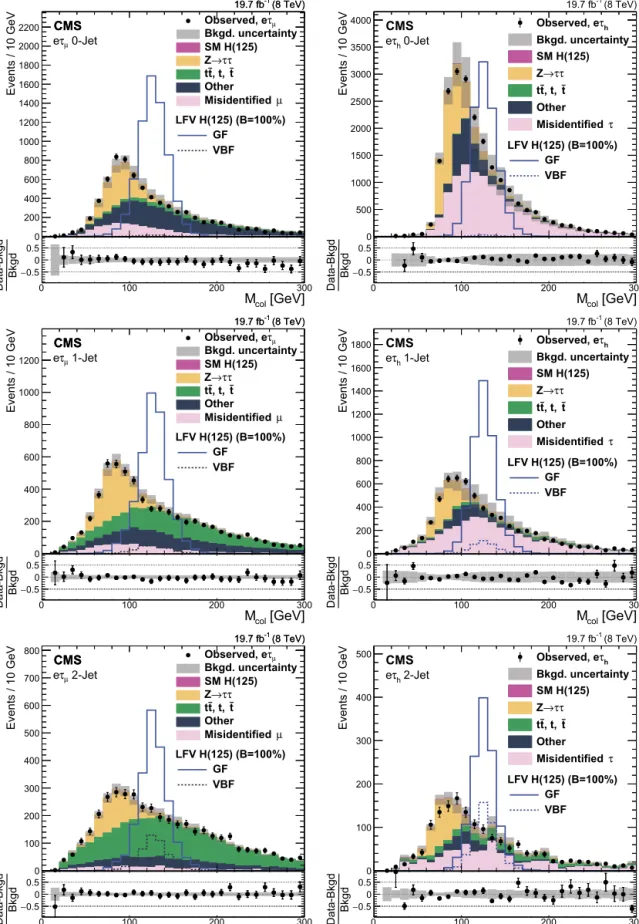
Fig. 1showstheobservedMcoldistributionandestimatedback- groundsfor each category andchannel, after the looseselection.
ThesimulatedsignalforB(H→e
τ
)=100% isshown. Theprinci- palbackgroundsareestimatedwithcollisiondatausingtechniques described in Section 5.2. There is good agreement between theobserved distributionsandthecorresponding backgroundestima- tions. The agreement is similar in all of the kinematic variables that are subsequently used to suppress backgrounds. The analy- sis is subsequentlyperformed blinded by using a fixed selection andcheckingtheagreement betweenrelevant observedandsim- ulateddistributionsoutsidethesensitiveregion100 GeV<Mcol<
150 GeV.
Next, a set of kinematic variables is defined, and the event selection criteria are set to maximise the significance S/√
S+B, whereSandBaretheexpectedsignalandbackgroundeventyields inthemasswindow100 GeV<Mcol<150 GeV.Thesignalevent yield corresponds to the SM Higgs boson production cross sec- tionatmH=125 GeV withB(H→e
τ
)=1%.Theselectioncriteria foreach categoryandchannel are giveninTable 1.The variables usedare:theleptontransversemomentapTwith=e,μ
,τ
h;az- imuthal angles between the leptons φpT1−pT2; azimuthal angle betweentheleptonandtheEmissT vectorφp
T−EmissT ;thetransverse massMT=
2pTETmiss(1−cosφp T−EmissT ).
Events inwhichatleastone ofthejetsisidentified asarising from a b quark decayare vetoed using the combined secondary vertex (CSV) b-tagging algorithm [69]. To enhance the VBF con- tribution in the 2-jet category further requirements are applied.
In the H→e
τ
h channel, events in this category are additionally required to have two jets separated by |η
|>2.3 and a dijet invariant mass Mj j>400 GeV. In the H→eτ
μ channel, the re- quirementsare|η
|>3 andMj j>200 GeV.After the full selection, a binned likelihood is used to fit the distributions of Mcol forthe signalandthe backgroundcontribu- tions. The modified-frequentistCLs method[70,71] isusedto set upperboundsonthesignal strength
μ
,ordetermineasignalsig- nificance.5.2. Backgroundprocesses
The contributions from the dominant background processes are estimatedusingcollision datawhilethe lesssignificant back- grounds are estimated usingsimulation. The largest backgrounds arefromZ→
τ τ
decaysandfromW+jets andQCDmultijetpro- duction.Inthelatter,PFobjects(predominantlyjets),aremisiden- tifiedasleptons.5.2.1. Z→
τ τ
backgroundTheZ→
τ τ
backgroundcontributionisestimatedusinganem- bedding technique [38,72]. First, a sample of Z→μμ
events is selected from collision data using the loosemuon selection. The muons are then replaced with simulatedτ
decays reconstructed withthe PFalgorithm.Thus, thekey features oftheeventtopol- ogysuchasjetmultiplicity,instrumentalsourcesof EmissT ,andthe underlying event are takendirectly fromcollision data.Only theτ
leptondecaysaresimulated.Thenormalizationofthesampleis obtainedfromsimulation.Thetechniqueisvalidatedbycomparing thecollinearmassdistributionsobtainedfromtheZ→τ τ
simula- tion andtheembedding techniqueapplied toasimulatedsample ofZ→μμ
events.Ashiftof2%inthemasspeakoftheembedded sample relativetosimulationisobserved.Thisshiftreflectsabias in theembedding technique,which doesnot take thedifferences between muonsand taus in final-state radiationof photons into account, andis corrected for. Identification and isolation correc- tions obtainedfromthecomparisonareappliedtotheembedded sample.5.2.2. Misidentifiedleptonbackground
Themisidentifiedleptonbackgroundisestimatedfromcollision data by defining a sample with the same selection as the sig-
Fig. 1.Comparisonoftheobservedcollinearmassdistributionswiththebackgroundexpectationsafterthelooseselectionrequirements.Theshadedgreybandsindicatethe totalbackgrounduncertainty.TheopenhistogramscorrespondtotheexpectedsignaldistributionsforB(H→eτ)=100%.TheleftcolumnisH→eτμandtherightcolumn isH→eτh;theupper,middleandlowerrowsarethe0-jet,1-jetand2-jetcategories,respectively.
Table 1
Eventselectioncriteriaforthe kinematicvariables afterapplyinglooseselection requirements.
Variable [GeV]
H→eτμ H→eτh
0-jet 1-jet 2-jet 0-jet 1-jet 2-jet
peT >50 >40 >40 >45 >35 >35
pμT >15 >15 >15 – – –
pτTh – – – >30 >40 >30
MTμ – <30 <40 – – –
MTτh – – – <70 – <50
[radians]
φpT,e−pT,τh – – – >2.3 – –
φp
T,μ−EmissT <0.8 <0.8 – – – –
φpT,e−pT,μ – >0.5 – – – –
Table 2
Definitionofthesamplesusedtoestimatethemisiden- tifiedlepton ()background.They are definedby the chargeofthetwoleptonsandbytheisolationrequire- mentsoneach.Thedefinitionofnot-isolateddiffersbe- tweenthetwochannels.
Region I Region II
±1 (isolated) ±1 (isolated)
∓2 (isolated) ±2 (isolated)
Region III Region IV
±1 (isolated) ±1 (isolated) ∓2 (not-isolated) ±2 (not-isolated)
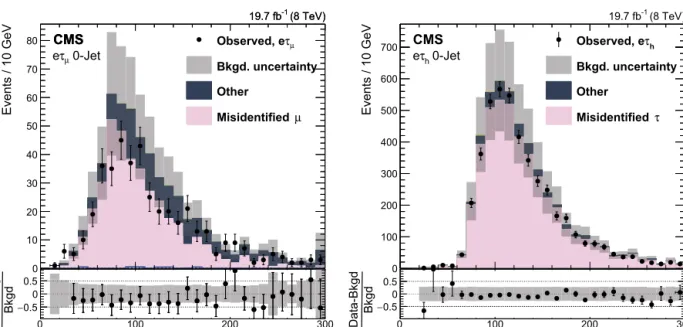
nalsample,butinvertingtheisolationrequirementsononeofthe leptons,toenrichthecontributionfromW+jets andQCD multi- jets.TheprobabilityforPFobjectstobemisidentifiedasleptonsis measuredusing anindependent collisiondataset,definedbelow, andthisprobabilityisappliedtothebackgroundenrichedsample tocomputethemisidentifiedleptonbackgroundinthesignalsam- ple.ThetechniqueisshownschematicallyinTable 2inwhichfour regionsaredefinedincludingthesignal (I)andbackground (III)en- richedregionsandtwocontrolRegions (II & IV), definedwiththe sameselectionsasRegions I & IIIrespectively,exceptwithleptons ofthesamecharge.
ThemisidentifiedelectronbackgroundisnegligibleintheH→ e
τ
μ channel duetothehigh pT electronthreshold.The misiden- tifiedmuonbackgroundisestimatedwithRegion Idefinedasthe signalselectionwithanisolatedelectronandanisolatedmuonof oppositecharge.Region IIIisdefinedasthesignalselectionexcept themuonisrequirednottobeisolated.Smallbackgroundsources ofpromptleptonsare subtractedusingsimulation.The misidenti- fiedmuonbackgroundinRegion Iisthenestimatedbymultiplying theeventyieldinRegion IIIbyafactor fμ,where fμistheratioof isolated tononisolatedmuons.It iscomputedonan independent collisiondatasampleofZ→μμ
+X events,whereXisanobject identifiedasamuon,inbinsofmuon pT andη
.Intheestimation of fμ,backgroundsourcesofthreepromptleptons,predominantly WZ and ZZ, are subtracted from the Z→μμ
+X sample using simulation. The technique is validated usinglike-sign lepton col- lision datainRegions II andIV.In Fig. 2(left) the eventyieldin Region II iscompared tothe estimatefromscaling theRegion IV samplebythemeasuredmisidentificationrate.TheRegion IIsam- ple isdominatedby misidentifiedleptons butalsoincludessmall contributionsoftrueleptonsarisingfromvectorbosondecays,es- timatedwithsimulatedsamples.IntheH→e
τ
hchanneleitherleptoncandidatecanarisefroma misidentified PFobject,predominantlyinW+jets and QCDmul- tijet events,but also from Z→ee+jets and tt production. The misidentification rates fτ and fe are defined as the fraction of looselyisolatedτ
horelectroncandidatesthatalsopassatightiso- lationrequirement. Thisismeasured inZ→ee+X collision data events,whereXisanobjectidentifiedasaτ
h ore. Themisiden- tifiedτ
h contribution is estimated with Region I defined as the signal selection. Region IIIisthe signal selectionexcepttheτ
h is requiredtohavelooseandnottightisolation.Themisidentifiedτ
h leptonbackgroundinRegion Iisthenestimatedbymultiplyingthe eventyieldinRegion IIIbyafactor fτ/(1−fτ).The sameproce- dureisusedtoestimatethemisidentifiedelectronbackgroundby defining Region Iasthesignal selectionandRegion IIIasthesig- nalselectionbutwitha looseandnottightisolatedelectron,and scaling by fe/(1− fe).To avoiddoublecounting, the eventyield in Region III,multiplied bya factor fe/(1− fe)× fτ/(1− fτ),is subtracted fromthe sumofmisidentifiedelectrons andtaus. The procedureisvalidatedwiththelike-signeτ
samples.Fig. 2(right) shows the collision data in Region II compared to the estimateFig. 2.Distributions ofmcolfor Region II. Left: H→eτμ. Right: H→eτh.
Table 3
Thesystematicuncertaintiesintheexpectedeventyieldsinpercentagefortheeτhandeτμchannels.Alluncertaintiesaretreatedascorre- latedbetweenthecategories,exceptwhentwovaluesarequoted,inwhichcasethenumberdenotedbyanasteriskistreatedasuncorrelated betweencategories.
Systematic uncertainty H→eτμ H→eτh
0-jet 1-jet 2-jet 0-jet 1-jet 2-jet
Muon trigger/ID/isolation 2 2 2 – – –
Electron trigger/ID/isolation 3 3 3 1 1 2
Efficiency ofτh – – – 6.7 6.7 6.7
Z→τ τ background 3⊕5∗ 3⊕5∗ 3⊕10∗ 3⊕5∗ 3⊕5∗ 3⊕10∗
Z→μμ,ee background 30 30 30 30 30 30
Misidentified leptons background 40 40 40 30 30 30
Pileup 2 2 10 4 4 2
WW,WZ,ZZ+jets background 15 15 15 15 15 15
tt background 10 10 10⊕10∗ 10 10 10⊕33∗
Single top quark background 25 25 25 25 25 25
b-tagging veto 3 3 3 – – –
Luminosity 2.6 2.6 2.6 2.6 2.6 2.6
Table 4
TheoreticaluncertaintiesinpercentagefortheHiggsbosonproductioncrosssectionforeach productionprocessandcategory.Alluncertaintiesaretreatedasfullycorrelatedbetweencat- egoriesexceptthosedenotedbyanegativesuperscriptwhicharefullyanticorrelateddueto themigrationofevents.
Systematic uncertainty Gluon fusion Vector boson fusion 0-jet 1-jet 2-jet 0-jet 1-jet 2-jet Parton distribution function 9.7 9.7 9.7 3.6 3.6 3.6 Renormalization/factorization scale 8 10 30− 4 1.5 2 Underlying event/parton shower 4 5− 10− 10 <1 1−
derived from Region IV. The method assumes that the misiden- tificationrateinZ→ee+X eventsisthesameasintheW+jets andQCDprocesses.Tocheckthisassumption,themisidentification ratesare alsomeasured ina collisiondatacontrol sample ofjets comingfromQCDprocessesandfoundtobeconsistent.Thissam- pleisthesameZ→ee+X sampleasabovebutwithoneofthe electroncandidatesrequiredtobenotisolatedandthe pT thresh- oldlowered.
5.2.3. Otherbackgrounds
Theleptonic decayof Wbosons fromtt pairs producesoppo- sitesigndileptons and EmissT . Thisbackground isestimatedusing simulatedtt events tocompute the Mcol distributionanda colli- siondatacontrolregionfornormalization.Thecontrolregionisthe 2-jetselectiondescribed inSection5.1,includingtheVBFrequire- ments,withtheadditionalrequirementthatatleastoneofthejets isb-taggedinordertoenhancethett contribution.Othersmaller backgrounds enter from SM Higgs boson production (H→
τ τ
), WW,WZ, ZZ+jets, Wγ
(∗)+jets processes,andsingle top quark production.Eachoftheseisestimatedusingsimulation[38].5.3.Systematicuncertainties
Systematicuncertainties are implemented asnuisance param- eters in the signal and background fit to determine the scale of their effect. Some of these nuisance parameters affect only the backgroundandsignalnormalizations,whileothersalsoaffectthe shapeofthe Mcol distributions.
5.3.1. Normalizationuncertainties
Thevaluesofthesystematicuncertaintiesimplementedasnui- sance parameters in the signal and background fit are summa- rizedin Tables 3 and 4. The uncertainties inthe muon, electron and
τ
h selection efficiencies (trigger, identification, andisolation) are estimated using collision data samples of Z→μμ
,ee,τ
μτ
h events[63,72]. The uncertainty in the Z→τ τ
background yieldcomes fromthecross sectionuncertainty measurement(3% [73]) andfrom the uncertaintyin the
τ
identification efficiency when applyingtotheembeddedtechnique(5–10%uncorrelatedbetween categories).Theuncertaintiesintheestimationofthemisidentified leptonratecomefromthedifferenceinratesmeasuredindifferent collisiondatasamples(QCDmultijetandW+jets).Thesystematic uncertaintyinthepileupmodellingisevaluatedbyvaryingtheto- tal inelastic cross section by ±5% [74]. The uncertainties in the production cross sectionsestimated from simulation are also in- cluded[38].Uncertaintiesondibosonandsingletopproductioncorrespond to the uncertainties of the respective cross section measure- ments[75,76].A10%uncertaintyfromthecrosssection measure- ment[77]isappliedtotheyieldofthett background.Inthe2-jet categoriesanadditionaluncertainty(10%forH→e
τ
μand33%for H→eτ
h)isconsideredcorrespondingtothestatisticaluncertainty ofthett backgroundyield.There areseveral theoreticaluncertainties on theHiggs boson production cross section that depend on the production mech- anism and the analysis category, as reported in Table 4. These uncertainties affect both the LFV Higgs boson andthe SM Higgs bosonbackgroundandarefullycorrelated.Theuncertaintyinthe partondistribution functionis evaluatedby comparing theyields in each category, that span the parameter range of three differ- ent PDF sets, CT10 [47], MSTW [78], NNPDF [79] following the PDF4LHC[80] recommendation.Theuncertaintyduetotherenor- malization and factorization scales,
μ
R andμ
F, is estimated by scaling up and down by a factor of two relative to their nomi- nal values(μ
R =μ
F =MH/2). The uncertaintyin the simulation of the underlying eventand partonshowers is estimated by us- ing two different pythiatunes, AUET2 andZ2*. All uncertainties aretreatedasfullycorrelatedbetweencategoriesexceptthosede- notedby anegativesuperscriptwhicharefullyanticorrelateddue tothemigrationofevents.Table 5
Systematicuncertaintiesintheshapeofthesignalandbackgrounddis- tributions,expressedinpercentage.Thesystematicuncertaintyandits implementationaredescribedinthetext.
Systematic uncertainty H→eτμ H→eτh
Z→τ τbias 2 –
Z→ee bias – 5
Jet energy scale 3–7 3–7
Jet energy resolution 1–10 1–10
Unclustered energy scale 10 10
τhenergy scale – 3
5.3.2. Mcolshapeuncertainties
Thesystematicuncertaintiesthatleadtoachangeintheshape ofthe Mcol distributionare summarizedinTable 5. A2% shiftin theMcol distributionoftheembeddedZ→
τ τ
sampleusedtoes- timatethebackgroundisobservedrelativetosimulation.Itoccurs onlyintheH→eτ
μchannelastheeffectsofbremsstrahlungfrom themuonareneglectedinthesimulation.The Mcol distributionis corrected by 2±2% for thiseffect. There is a systematic uncer- taintyof5%inZ→ee backgroundintheH→eτ
hchannel,dueto themismeasured energyof theelectron reconstructedasaτ
h.It causesashiftintheMcol distribution,estimatedbycomparingcol- lisiondatawithsimulationinacontrolregionofZ→ee eventsin whichoneofthetwoelectronsthatformtheZpeakisalsoiden- tifiedasaτ
h [63].Correctionsareappliedforthejetenergyscale andresolution[66].Theyaredeterminedwithdijetandγ
/Z+jets collisiondataandthemostsignificantuncertaintyarisesfromthe photonenergyscale.Otheruncertaintiessuchasjetfragmentation modelling, single pion response, and uncertainties in the pileup corrections are also included. The jet energy scale uncertainties (3–7%) are applied asa function of pT andη
, including all cor- relations,toalljetsintheevent,propagatedtothe EmissT ,andthe resultant Mcol distribution isusedin thefit.There isalsoan ad- ditional uncertainty to account for the unclustered energy scale uncertainty.Theunclusteredenergycomesfromjetsbelow10 GeV andPF candidatesnot within jets. It isalso propagated to ETmiss. TheseeffectscauseashiftoftheMcoldistribution.Theuncertainty inthejetenergyresolutionisusedtosmearthejetsasafunction of pT andη
andtherecomputed Mcol distribution isusedinthe fit.A3% uncertaintyintheτ
h energyscaleisestimatedby com- paring Z→τ τ
events in collision data and simulation.Potential uncertaintiesintheshapeofthemisidentifiedleptonbackgrounds arealsoconsidered.IntheH→eτ
μchannelthemisidentifiedlep- tonratesareappliedinbinsofpT andη
.IntheH→eτ
hchannel, theτ
h misidentification rate is found to be approximately inde- pendentof pT but todepend onη
.These ratesare all varied by onestandarddeviationandthedifferencesintheshapesareusedasnuisanceparametersinthefit.Finally,thedistributionsusedin thefithavestatisticaluncertaintiesineachmassbinwhichisin- cludedasanuncertaintythatisuncorrelatedbetweenthebins.
6. H→e
μ
analysis 6.1. EventselectionTo select H→e
μ
events,the trigger requirementis an elec- tronandamuonwithpTgreater than17and8 GeVrespectively.Toenhancethesignal sensitivitythe eventsample isdividedinto nine different categories according to the region of detection of the leptons andthenumberofjets, anda furthertwo categories enriched invector bosonfusionproduction.The resolutionofthe reconstructed mass of the electron muon system, Meμ, depends on whether the leptons are detected in the barrel (|
η
e|<1.48,|
η
μ|<0.80)orendcap(1.57<|η
e|<2.50,0.8<|η
μ|<2.4),while the composition and rate of backgrounds varies with the num- ber ofjets. The definitionof the categories is shownin Table 6.Thetwoleptonsarerequiredtobeisolatedinallcategories.Cate- gories0–8,whichareselectedaccordingtotheregionofdetection oftheleptonandnumberofjets,aremutuallyexclusivewithjets requiredto havepT>20 GeV.Tosuppressbackgroundswithsig- nificant EmissT ,suchasWW+jets,EmissT isrequiredtobelessthan 20, 25 or 30 GeV, depending on the category. Jets arising from b quark decays are vetoed using the CSV discriminant to signif- icantly reduce the tt background.In the VBF categories, the two highest pT jets are required to have |
η
|<4.7 and to be sepa- rated by |η
j1−η
j2|>3.0. In addition the jets are required to have |η
∗|= |η
12− ηj1+2ηj2|<2.5, where =e orμ
,η
12 de- notes the pseudorapidity of the dilepton system and j1,j2 are the two jets. The φ betweenthe dijetsystemandthe dilepton system isrequiredto be greater than2.6 rad.The VBF tight cat- egory selection further requires that both jets have pT>30 GeV and the dijetinvariant mass be Mj1j2 >500 GeV, while the VBF loosecategoryrelaxesthesecond jetrequirementto pT>20 GeV with Mj1j2>250 GeV andis exclusiveto theVBF tightcategory.The leptons inboth VBFcategoriescan bein eitherthebarrelor endcap. To avoidan eventappearing in more than one category theVBFassignmentismadefirst.Eventswithmorethantwojets arenotconsidered.Theselectionefficiency,summedoverallcate- gories,is24%(22%)fortheGF(VBF)productionmechanism.
6.2. Signalandbackgroundmodelling
The signal model is the sum of two Gaussian functions, de- termined from simulation for each category. The reconstructed
Table 6
TheH→eμeventselectioncriteriaandbackgroundmodelforeacheventcategory.Thecategoriesareprimarilydefined accordingtowhethertheleptonsaredetectedinthebarrel(B)orendcap(EC),andthenumberofjets(N-jets).Require- mentsarealsomadeon pT, ETmissandavetoonjetsarisingfromab-quarkdecay.Thebackgroundmodelfunctionand orderofthatfunctionarealsogiven.
Category Description N-jets pT
[GeV]
EmissT [GeV]
Background model
Function Order
0 eBμB 0 >25 <30 polynomial 4
1 eBμB 1 >22 <30 polynomial 4
2 eBμB 2 >25 <25 power law 1
3 eBμEC 0 >20 <30 polynomial 4
4 eBμEC 1 >22 <20 exponential 1
5 eBμEC 2 >20 <30 exponential 1
6 eECμB or EC 0 >20 <30 polynomial 4
7 eECμB or EC 1 >22 <20 power law 1
8 eECμB or EC 2 >20 <30 polynomial 4
9 VBF Tight 2 >22 <30 exponential 1
10 VBF Loose 2 >22 <25 exponential 1
massresolutions depend onwhether the leptons are in the bar- rel(B) orendcap(EC)calorimeterandare:2.0–2.1 GeV foreB
μ
B, 2.4–2.5 GeVforeBμ
EC,3.2–3.6 GeVforeECμ
B or EC categoriesand 2.4(4.0) GeVfortheVBFtight(loose)categories. Thebackground, modelled as either a polynomial function, a sum of exponential functions,orasumofpowerlawfunctionsisgiveninTable 6for each category. The procedureto determine the backgroundfunc- tionfollowsthemethoddescribed in[3].Itisdesignedtochoose amodelwithsufficientparameterstoaccuratelydescribetheback- groundwhile ensuringthat thesignal shapeis notabsorbedinto thebackgroundfunction.Thebackgroundmodelforeachcategory ischosenindependentlyusingthisprocedure.In a first step, referencefunctions are selected for each type offunction(polynomial,sumofexponentials,sumofpowerlaws).
Theorderofthefunctionischosensuchthatthenexthigherorder doesnot give a significantly better fit resultwhen fit to theob- servedMeμdistributionintherange110 GeV<Meμ<160 GeV.
Ina second step, an ensemble ofdistributions isdrawn from each ofthethree referencebackground modelscombined witha signalcontributioncorrespondingtoB(H→e
μ
)=0.1%,andfitted forsignal andbackgroundwitheach ofthethreeclassesoffunc- tionsofdifferentorders.On average, the signal yield extracted from the distributions usingasignalplusbackgroundfitwilldifferfromtheinjectedsig- nal due to the imperfect modelling of the background. The bias is defined as the median deviation of the fit signal event yield fromthegeneratednumberofsignalevents.Thepossiblecombina- tionsofgenerateddistributionswiththefitsignalplusbackground modelsare then reduced by requiringthe bias to be lessthan a thresholdwhichresultsinlessthan 1%uncertaintyinthe fitsig- nalevent yield.The combinationin which thefit modelhas the leastparameters is then selected andthe fit function isused as thebackgroundmodelforthecollisiondata.Ifthereismorethan onemodelwiththesameminimalnumberofparametersthenthe onewiththeleastbiasisselected.
6.3.Systematicuncertainties
The systematic uncertainties are summarized in Table 7. The backgroundisfittotheobservedmassdistributionwithanegligi- blesystematicuncertaintyof<1%inthesignalyieldarisingfrom thechoiceofbackgroundmodelasdescribedabove.Correctionfac- torsare applied tothe leptontrigger, isolation,andidentification efficienciesforeachsimulatedsignalsample toadjustfordiscrep- ancieswiththecollision data.The uncertaintyinthesignal yield fromtheleptonisolationandidentificationcorrectionsis2.0%and is estimated withthe “tag-and-probe”method [72] applied to a collisiondatasampleofZ bosonsdecayingtoleptonpairs[60,62].
Theuncertaintiesintheleptonenergyscaleandthedileptonmass resolutionaretakenfromtheH→ZZ analysis[61].Thesystematic uncertaintyinthepileupmodellingisevaluatedbyvaryingtheto- talinelastic crosssection by ±5% [74].It variesaccordingto the productionprocessandcategorybetween0.7%and2.3%.Thereare systematicuncertainties in the efficiency ofthe b quark jet veto thatalsovarywithproductionprocessandcategoryfrom0.05%to 0.7%.Theuncertaintyontheintegratedluminosityis2.6%[81].The effectsofsystematicuncertaintiesinthejetenergyscaleandres- olution,andthe uncertainties inPDF’sonthe selectionefficiency areestimatedasdescribedinSection5.3.2fortheH→e
τ
channel.Thelargest valuesof thesesystematicuncertainties occur dueto themigrationofeventsto,orfrom,acategorywithlowstatistics.
The theoretical uncertainties on the Higgs boson production crosssectionarealsodescribedinSection5.3.2.
Table 7
SystematicuncertaintiesinpercentageontheexpectedyieldforH→eμ.Ranges aregivenwheretheuncertaintyvarieswithproductionprocessandcategory.All uncertaintiesaretreatedascorrelatedbetweencategories.
Experimental uncertainties
Background model <1
Trigger efficiency 1.0
Lepton identification 2.0
Lepton energy scale 1.0
Dilepton mass resolution 5.0
Pileup 0.7–2.3
b quark jet veto efficiency 0.05–0.70
Luminosity 2.6
Jet energy scale (inclusive categories) 0.6–22
Jet energy scale (VBF categories) 0.1–78
Jet energy resolution (inclusive categories) 2.8–12
Jet energy resolution (VBF categories) 0.0–49
Acceptance (PDF variations) 0.8–5.1
Theoretical uncertainties
GF normalization/factorization scale +−77..28 GF parton distribution function +−76..59
VBF normalization/factorization scale ±0.2
VBF parton distribution function +−22..68
7. Results 7.1. H→e
τ
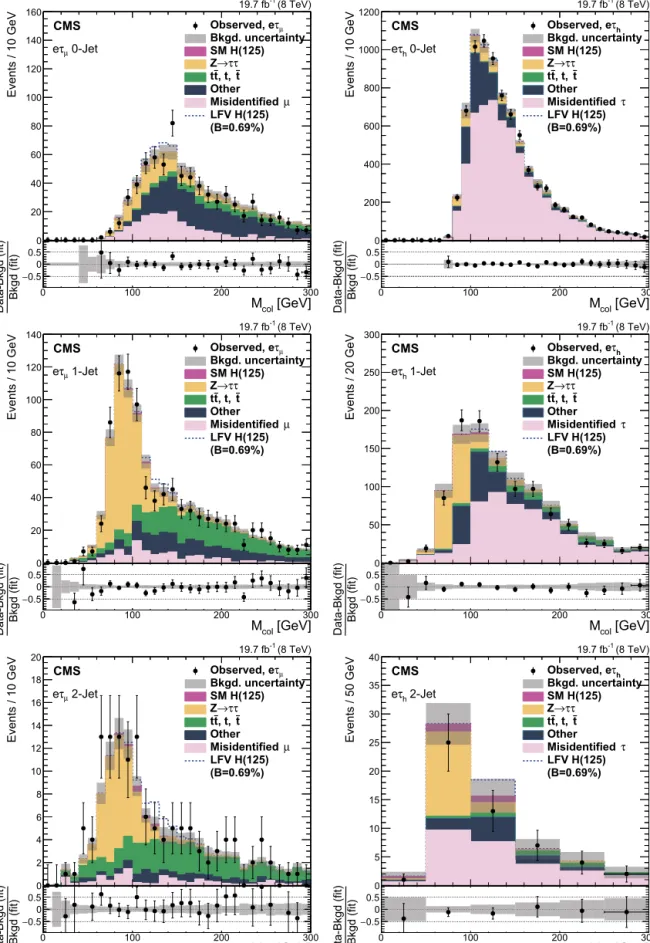
The distributions of the fitted signal and background contri- butions, afterthe full selection, areshown inFig. 3andthe cor- responding event yields in the mass range 100 GeV< Mcol<
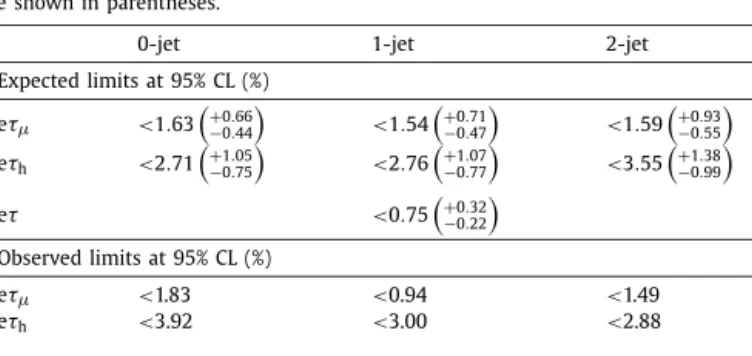
150 GeV aregiveninTable 8.Thereisnoevidenceofasignal.Ta- ble 9showstheexpectedandobserved95%CLmeanupperlimits on B(H→e
τ
) whicharesummarizedin Fig. 4fortheindividual categoriesin theeτ
μ andeτ
h channelsandfor thecombination.The combined observed (expected)upperlimit on B(H→e
τ
) is 0.69 (0.75)%at95%CL[70,71,82].7.2. H→e
μ
The Meμ distributionofthecollisiondatasample, afterall se- lectioncriteria,forallcategoriescombinedisshowninFig. 5.Also shownarethecombinationsoftheinclusivejet-taggedcategories (0–8)andtheVBFcategories(9–10).Theexpectedyieldsofsignal (B(H→e
μ
)=0.1%)andbackgroundeventsfor124 GeV<Meμ<126 GeV,afteralltheselection criteria,are giveninTable 10and comparedtothecollisiondataeventyield.Thecontributionstothe background are takenfrom simulationand givenfor information only,they arenotusedintheanalysis. Thedominantbackground contributions are from Drell–Yan production of
τ
lepton pairs andelectroweakdibosonproduction.Thereis nosignal observed.An exclusion limit on the branching fraction B(H→e
μ
) with MH=125 GeV isderived usingthe CLs asymptoticmodel[83].It isshowninFig. 4fortheinclusivecategoriesgroupedbynumber of jets, the VBF categories, and all categories combined. The ex- pected limitis B(H→eμ
)<0.048% at 95% CLandthe observed limitisB(H→eμ
)<0.035% at95%CL.7.3. Limitsonleptonflavourviolatingcouplings
The constraints on B(H→e
τ
) and B(H→eμ
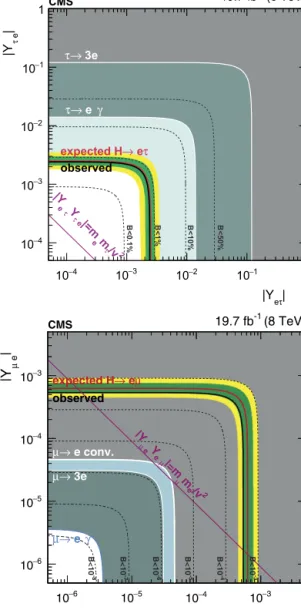
) can be inter- preted in terms of the LFV Yukawa couplings |Yeτ|, |Yτe| and|Yeμ|,|Yμe|respectively[33].TheLFVdecaysH→e
τ
,eμ
ariseat treelevelintheLagrangian, LV,fromtheflavour-violatingYukawa interactions, Yαβ, where α,β denote the leptons e,μ
,τ
, andFig. 3.Comparisonoftheobservedcollinearmassdistributionswiththebackgroundexpectationsafterthefit.Thesimulateddistributionsforthesignalareshownforthe branchingfractionB(H→eτ)=0.69%.TheleftcolumnisH→eτμ andtherightcolumnisH→eτh;theupper,middleandlowerrowsarethe0-jet,1-jetand2-jet categories,respectively.
Table 8
Eventyieldsinthesignalregion,100 GeV<Mcol<150 GeV,afterfittingforsignalandbackgroundfortheH→eτ channel,normalizedtoanintegratedluminosityof 19.7 fb−1.TheLFVHiggsbosonsignalistheexpectedyieldforB(H→eτ)=0.69% assumingtheSMHiggsbosonproductioncrosssection.
Jet category H→eτμ H→eτh
0-jet 1-jet 2-jet 0-jet 1-jet 2-jet
Misidentified leptons 85.2±5.9 38.1±3.9 2.1±0.7 3366±25 223±11 8.7±2.2
Z→ee,μμ 2.3±0.6 5.4±0.5 – 714±30 85±4 3.2±0.2
Z→τ τ 84.7±2.1 113.3±4.2 8.5±0.6 270±10 32±3 1.6±0.3
tt,t,t 13.8±0.3 69.4±2.3 12.7±0.8 10±2 13±2 0.5±0.2
ZZ,WZ,WW 83.0±2.7 51.7±2.0 3.6±0.4 53±2 6±1 0.3±0.1
Wγ(∗) 2.2±1.0 1.2±0.6 – – – –
SM H background 2.3±0.3 3.6±0.4 1.1±0.2 12±1 3±1 1.0±0.1
Sum of background 273.5±6.1 282.0±6.0 28.1±1.3 4425±28 363±11 15.3±2.3
Observed 286 268 33 4438 375 13
LFV H signal 23.1±1.6 16.0±1.2 5.9±1.0 61±4 15±1 2.8±0.5
Fig. 4.95%CLupperlimitsbycategoryfortheLFVdecaysforMH=125 GeV.Left:H→eτ.Right:H→eμforcategoriescombinedbynumberofjets,theVBFcategories combined,andallcategoriescombined.
Table 9
Theexpectedand observedupper limits at 95%CL,and best fit valuesfor the branchingfractions B(H→eτ)fordifferentjetcategoriesand analysischannels.
Theasymmetriconestandard-deviationuncertaintiesaroundtheexpectedlimits areshowninparentheses.
0-jet 1-jet 2-jet
Expected limits at 95% CL (%) eτμ <1.63
+0.66
−0.44
<1<