Frequency, Schematic Strength, and the Processing of Metaphorical Utterances
Daniel Sanford Department of Linguistics University of New Mexico
Emergent Metaphor Theory, as described in Sanford 2012, asserts that meta- phors are schemata that link cognitive domains, that differences in the frequen- cies of metaphors are a core aspect of metaphorical systems, and that metaphor is operated upon by frequency effects at the level of both overall mappings and individual utterances. This paper presents a corpus study and a series of experiments that support key predictions of Emergent Metaphor Theory. The corpus method makes use of a preliminary survey to elicit core terminology from speakers of English on ten metaphorical source domains; these are used as search terms in identifying similes that instantiate each of ten metaphori- cal mappings. The survey method supports the assertion that metaphors differ in their frequency, as well as that some terms from a given source domain are used more frequently than others to invoke the mapping. A series of experi- ments uses the corpus frequencies of metaphors as established in the corpus study to test whether more frequent mappings are more productive, more accessible, and more acceptable to speakers than less frequent metaphors. Both the results of the corpus study and experimental approaches support the view that metaphor is a usage-based phenomenon, and that many of the properties of metaphorical utterances are best accounted for as arising from the interaction of the conceptual schemata that license cross-domain mappings, and syntactic schemata that link meanings to syntactic templates.
Key words: Emergent Metaphor Theory, metaphor, frequency, conventional- ization, exemplar, schema, emergence
Journal of Cognitive Science 14: 1-45, 2013
©2013 Institute for Cognitive Science, Seoul National University
1. Introduction
A thesis central to the field of metaphor research since Lakoff & Johnson (1980) has been that metaphor, while deeply important to cognition and highly worthy of study, isn’t special. Metaphor isn’t anomalous, operat- ing outside of the rules and principles which govern ‘normal’ speech, but is rather at the core of the conceptual systems which govern thought and (accordingly) language, inextricably tied up with language at the lexical, phrasal, syntactic, and discourse levels. As many times as this assertion has been made, however, it’s unclear that it has been fully implemented. If it is the case that metaphor is an essential structuring feature of language, then it ought to be demonstrably true not only that metaphor has an effect on linguistic structure (as has been repeatedly and convincingly demonstrated), but that metaphors will themselves be subject to principles that govern lan- guage more generally.
One such principle is that repetition plays a major role in the storage, use, expression and overall structure of language. “The frequency with which certain items and strings of items are used,” write Bybee & Hopper (2001:
3), “has a profound influence on the way language is broken up into chunks in memory storage, the way such chunks are related to other stored material and the ease with which they are accessed.” The greatest strength of the fre- quency-based approach to language lies in the fact that it grounds accounts of linguistic structure in factors that are not specific to language, but oper- ate on cognition more generally. The phonological reduction of a frequent word has the same underlying causes as, for example, the streamlining, for experienced drivers, of the process of putting a key into the ignition of a vehicle. Metaphors are cognitive entities, their psychological reality repeat- edly attested in three decades of research, and as such should be subject to frequency effects. Linguistic metaphors, moreover, should be in particular operated on by those frequency effects to which language is especially sub- ject. At the levels, then, of both linguistic expressions (e.g. he churns out ideas) and of the underlying cognitive structures that sanction them (e.g.
THE MIND IS A MACHINE) metaphor should be affected by frequency.
It has been repeatedly demonstrated that metaphorical idioms (such as he
spilled the beans) and so-called ‘formulaic metaphors’ (such as the surgeon is a butcher, for which there is a standard interpretation) are processed more rapidly than innovative metaphors (such as the surgeon is a woodworker, for which there is no standard interpretation), indicating that repeated expo- sure streamlines processing (Hoffman 1984)— a basic, domain-general fre- quency effect. The existence of a standard interpretation suggests repeated prior exposure. Blank (1988), in a study comparing processing speeds for literal vs. metaphorical speech, compared reaction times for words that completed sentences with either a literal or metaphorical meaning. The study found longer processing speeds for metaphorical than literal speech, but also that more familiar metaphors are processed more quickly than less familiar ones. Gentner & Wolff (1997) demonstrate that comprehension time for novel metaphors is decreased equally by the priming of either the source or target term, whereas for conventional metaphors priming for the source term speeds comprehension more than priming for the target. For the conventional metaphor a job is a jail, for example, prior exposure to either jail or job speeds comprehension for the entire metaphor. For Johnny is a rocket, on the other hand, previous exposure to rocket, with its highly con- ventionalized figurative meaning referring to speed, primed the metaphor as a whole far more effectively than Johnny. They argue that these results indicate that metaphorical conventionalization arises as abstractions from source terms are repeatedly projected to target-domain terms, resulting in source-domain terms taking on easily accessible metaphorical meanings.
Building on findings such as these that suggest an important role for a speaker’s previous exposure to metaphor in processing subsequent meta- phorical utterances, both at the level of individual words and utterances and at level of conceptual metaphors as outlined by Lakoff & Johnson (1980), Emergent Metaphor Theory (Sanford 2012) asserts that metaphor is oper- ated upon by frequency effects in a manner analogous to that which has been repeatedly observed to take place in phonological, morphological, syn- tactic and lexical phenomena. Representations of patterns to which speak- ers are frequently exposed are ‘strong’—easily accessed & productive—in proportion to their frequency. Specific instantiations of such patterns, as a result of the high frequency of the instantiation relative to the pattern over- all, can themselves gain in strength, independently of the overall pattern.
This article, following a review of the relevant literature on experimental approaches to frequency and schematic strength (§1.1), presents a series of three experiments that directly assesses specific claims relating to how frequency affects metaphor. For all three experiments, the variable manipu- lated is the overall frequency of the cross-domain mappings instantiated in the stimuli. A survey method, in which participants rate the acceptability of metaphorically predicated stimuli, is used to assess the relationship between the frequency of an underlying mapping and the acceptability of utter- ances that instantiate the metaphor (§3.1). A computer-based reaction time experiment is used to gauge how the accessibility of metaphorical utter- ances follows from metaphorical frequency (§3.2). A sentence completion task analyzes how the frequency of a metaphorical mapping bears on the productivity of the mapping (§3.3). A corpus study (§2) provides frequency data for metaphorical mappings which is used to inform the experiments;
the study also directly supports the claim that metaphors differ from one another in their frequency and that within a given source domain the fre- quency with which different terms are used to invoke the mapping varies greatly as well. The corpus and experimental results support a model for understanding metaphors as schemas that emerge over tokens of use.
1.1 Literature Review: Experimental Approaches to Frequency
Various experimental approaches have borne out several of the key claims of the frequency-based approach to linguistic structure—namely, that gram- matical knowledge is probabilistic, that frequency increases accessibility, and that type frequency influences productivity. The great majority of such studies have focused on phonotactics, morphology, and (less commonly) constructions. The first such prediction is that grammatical judgments aren’t absolute, but probabilistic, based on a speakers’ previous experience with the language. In Pierrehumbert (1994), subjects were presented with pairs of nonsense words and asked questions assessing their acceptability to a native speaker. Each pair contained one word with a low-frequency and another with a high-frequency tri-syllabic sequence. The author’s hypoth- esis was that the more probable a consonant cluster was, the more likely it would be to be judged as acceptable by a native speaker. This hypoth- esis was supported, indicating that speakers have statistical knowledge of
phonological structure which is based on their previous experience, and that they use this knowledge to evaluate novel forms, indicating that such knowledge has a place in their mental grammars. Vitevich et al. (1997) uses, in an initial experiment, a method similar to that used in Pierrehumbert (1994), but incorporating stress placement as well as phonotactic probabil- ity and asking subjects to rate items on a scale from 1 to 10 with respect to their acceptability rather than having them pick one item out of a pair. This experiment was followed up by a second one in which processing times (as measured by recognition time, the time from the presentation of the stimuli to subjects’ pressing of a button indicating that they understood it) were measured for the same stimuli. Acceptability was demonstrated to increase, and processing time to decrease, as phonotactic probability increased. In addition, then, to indicating that a word’s phonotactic probability, which for any individual speaker is a function of their previous language experience, has a clear effect on their intuitions about language, the study also indicated a direct effect on processing.
The claim that frequency has a direct effect on processing speed (acces- sibility) is more directly assessed in Hare et al. (2001), which builds on earlier studies such as Morton (1969) and Rubenstein et al. (1970), which have indicated that access is faster for frequent than for infrequent words.
Hare et al. extend these relatively uncontroversial findings to morphologi- cally complex words in two experiments which assess processing time by having subjects write sentences in which particular verbs occur, and then by having subjects perform a lexical decision task on a past-tense verb after it has been primed by its base form. They show that not only are irregular verbs subject to frequency effects which ease their access, but regular verbs are as well, corroborating the usage-based account’s assertion that the units of use in language are also the units of storage: morphemes which co-occur regularly come to be stored together, regardless of whether or not their co- occurrence can be predicted a by a regular rule (Bybee 1985, 1995).
The third of the three key claims regarding frequency with which this study will be primarily concerned is that the frequency of a pattern has a direct effect on its productivity. Studies such as Dabrowska & Szczerbin- ski (2006), which examined the effect of several variables on the produc- tivity of genitive, dative, and accusative inflections of varying stages of
diachronic development, Wang & Derwing (1994), which examined how speakers of English formed the past tense of nonce ablaut verbs, and others (Baayen & Lieber 1991, Moder 1992) have all lent support to the predic- tion that type frequency has the effect of strengthening a pattern/schema, a major factor in causing the pattern to be more likely to be applied to new items.
The experiments reported in §3 are based directly on experimental meth- ods that have demonstrated the role of frequency in affecting how language is stored and processed, indicating that, at the level of metaphor as at other levels of linguistic structure, the frequency of a schema causes instantiating tokens to be more acceptable and accessible to speakers, and the schema itself more productive.
1.2 Synthesis
Bybee (2001: 6) writes that:
Experience affects representation. The use of forms and patterns both in production and perception affects their representation in memory.
High- [token] frequency words and phrases have stronger representa- tions in the sense that they are more easily accessed and less likely to undergo analogical change. Low- [token] frequency words are more difficult to access and may even become so weak as to be forgotten.
The lexical strength of words may change as they are used more or less in different contexts. Patterns (represented as schemata…) that apply to more items are also stronger and more accessible, and thus more pro- ductive than those applying to fewer items.
Emergent Metaphor Theory asserts that metaphors are such patterns, and as such are subject to frequency effects. These effects operate on metaphor both at a conceptual level, pertaining to the source-target mapping itself, and at the level of linguistic realization, pertaining to individual metaphori- cally predicated utterances. As claims relating to source-target mappings are stronger and have less precedence in the literature, this study focuses on providing experimental evidence for frequency effects at this level.
2. Corpus study
This section presents a method for assessing the corpus frequencies of con- ceptual metaphors. The data gleaned from it support the assertions, made in Sanford 2012, that metaphors differ from one another in their frequency and that some terminology from a given source domain is used more fre- quently than other semantically viable choices from the same domain. It also provides the frequency data upon which the experiments reported in §2 are based. The goal of the corpus study, predicated on the use of basic ter- minology from a given source domain as a means for sampling a corpus for instantiations of a particular metaphor, is to determine the overall frequency of a number of metaphorical mappings. Accordingly, a preliminary study, based on the timed survey method used by Rosch in classic prototype the- ory experiments (Rosch & Mervis 1975, Rosch 1978), was used to establish basic terminology for ten separate cognitive domains which are of recurrent use as metaphorical sources: WAR, RACING, LIGHT, CHILDREN, FOOD, WRITING, PLANTS, BATTERIES, MACHINES, and THE BODY. The ten metaphors of which the project presented here assesses the frequency represent ten mappings from the above source domains. The method searches for similes in a large (385+ million word) corpus for the purpose of ascertaining quantitative data for underlying conceptual metaphors.
2.1 Metaphors Used in the Study
In order to provide meaningful comparisons of the overall frequencies of metaphorical mappings in discourse, it was necessary to select mappings that could be meaningfully compared. In selecting metaphors to be used in the study, the following criteria were applied.
1) Each metaphor is generally accepted as a productive cognitive entity that sanctions instantiating metaphorical utterances.
To this end, all metaphors used are taken from the Master Metaphor List (MML) (Lakoff, Espenson, & Schwartz 1991). The MML is described by its compilers as an “attempt to compile in one place the results of meta-
phor research since the publication of Reddy’s The Conduit Metaphor and Lakoff and Johnson’s Metaphors We Live By. [The] list is a compilation taken from published books and papers, student papers at Berkeley and elsewhere, and research seminars” (p. 1). While the list is far from complete (comprising, by the best estimates of its compilers, about 20% of conceptual metaphors currently reflected in English), those entries that are included represent conceptual metaphors that are widely accepted as such within the community of metaphor researchers, and which are relatively uncontrover- sial with respect to their formulation.1
2) All of the metaphors exist at approximately the same level with respect to metaphorical hierarchies.
Families of metaphors are characterized by hierarchical relationships (an idea fully explored in Kövecses 1995), such that many metaphors have sub- metaphors. To as great an extent as possible, however, all of the metaphors selected for the study are relatively isolated, neither instantiating more gen- eral metaphors, nor having clearly patterned special cases.
3) The metaphors come in matched pairs that can be meaningfully compared.
On this basis, pairs of metaphors were selected which share a single target domain (e.g., “COMPETITION”), but draw on different source domains (e.g., “WAR”, “RACING”). In the experiments reported in §3, the approach will allow a direct comparison of stimuli, instantiating each of the map- pings, that are identical except for a single word or phrase, the difference determining whether the stimulus instantiates a more or less frequent meta- phor (e.g., “he argues like a soldier” vs. “he argues like a racer”).
1 ‘Relatively’ is the key term. The formulation of labels for cross-domain mappings is notoriously contentious; it’s unlikely that there is any wholly undisputed mapping in the literature. Many readers will disagree with the formulation of individual metaphors posited by the MML. The use of mappings proposed by the MML for the purposes of this study is advanced as the least of many evils, rather than as a perfect solution.
Based on these three criteria, the ten metaphors selected for use in the study are as follows (examples from the Master Metaphor List are provided below each entry):
Competition
COMPETITION IS WAR COMPETITION IS RACING
· The debate team brought · The arms race.
out their big guns. · We’ve been playing chess for
· The other team sent in the years, and he’s finally pulling cavalry against us. ahead of me.
Hope
HOPE IS A CHILD HOPE IS LIGHT
· He fostered hope that the · The clouds were a glimmer of project would come. hope that rain might continue.
· She nourished the hope that · He has bright hopes.
he would return.
Ideas
IDEAS ARE WRITING IDEAS ARE FOOD
· The mind is a wax tablet. · His idea was half baked.
· His words didn’t register. · Let me chew on that for a while.
People
PEOPLE ARE BATTERIES PEOPLE ARE PLANTS
· I’m all charged up and full of · She’s a late bloomer.
energy.
· He got a charge out of it. · He’s a budding artist.
The Mind
THE MIND IS A MACHINE THE MIND IS A BODY
· He has a screw loose. · His mind is strong and supple.
· I could see the wheels turning. · In the summer, the mind tends to go flabby.
2.2 Key terms timed survey
A timed survey task was used to arrive at ‘basic’ concepts and vocabulary for each of the ten metaphorical source domains, to be used as search terms in the method outlined below. The approach is based on both the methods and theoretical underpinnings of classic prototype theory (Rosch & Mervis 1975, Rosch 1978), which maintains that when subjects are asked to list features or examples of a category, those features/examples which are listed most frequently, and which tend to occur higher on lists, correspond to those examples/features which are closest to the core of a prototypically defined category2. The guiding assumption of the approach used here is that the terms that are listed most frequently by participants correspond to con- cepts that are basic to speakers’ understanding of a given domain.
40 students, undergraduates at a large research university offered a small amount of extra credit in exchange for participation, were used as partici- pants in the task. Participants were all adult native speakers of American English.
The survey instrument began with the following instructions, adapted from Rosch & Mervis (1975):
This is a very simple experiment to find out the things that people think are most important in defining a concept. For example, for bicycles you might think of things they have in common, or that you associate with them, like wheels, handlebars, riding, or Schwinn. For dogs, you might think of things like barking, fur, or terrier.
There are 10 pages that follow, and each one has a word at the top that describes a concept. For each page, you’ll have a minute to write down all the words you can think of. Any word that you think is an important part of the concept is a good answer. You can write down anything that you think of, but try not to just free associate- for example, if bicycles
2 A similar method has been previously applied to finding words basic to a concept in studies such as Diaz-Guerrero, Rogelio, & Szalay (1991), which adapted the methodology to analyze cross-cultural conceptions of race.
just happen to remind you of your father, don’t write down father.
Okay- I’ll give you two minutes for each word. When I say ‘go to the next word,’ read the word printed in bold and write down words that you think are an important part of that concept. Write as many words as you comfortably can, until you’re told to go to the next page.
The following ten pages, presented in one of five different random orders to each participant, each bore a heading corresponding to one of ten meta- phorical source domains (“WAR”, “RACING”, “LIGHT”, “CHILDREN”,
“FOOD”, “WRITING”, “PLANTS”, “BATTERIES”, “MACHINES”, and
“THE BODY”). The instructions were read aloud, and then participants had two minutes to write a relevant list for each domain.
In analysis, those words occurring on the most participants’ lists for each domain were isolated. For “LIGHT”, for example, the five terms that occurred on the most participants’ lists were, in descending order of fre- quency, sun, bright, bulb, lamp, and dark. Ties, those items occurring on an equal number of participants’ lists, were broken on the basis of which term averaged a higher ranking across all subjects’ lists. Words differing only in inflection were considered to be the same word; the form used in the experi- ments is the most common inflectional form.
2.3 Corpus Methods
In the corpus component of the study, a large corpus was searched for simi- les instantiating the target mappings.3 Similes are operationally defined here
3 The major advantage of using similes in trawling corpora for figurative lan- guage is their eminent searchability: the addition of ‘like’ to figurative search terms creates a much smaller set of returns, as well as a set of returns which contains a far higher percentage of target mappings. As an example, a search for shark in the 385+ million-word Corpus of Contemporary American English (Davies 2008) yields 3383 hits, of which only a small portion can be expected to be figurative— a sampling of the first 100 hits yielded four figurative uses. like a shark, on the other hand, yields 62 hits, 60 of which are figurative. The approach therefore makes a far larger corpus accessible for study. Several lines of research support the idea that metaphors and similes perform similar functions: the career of metaphor hypoth-
as ‘x is like y’ expressions that fit the criteria for metaphor offered above.
The corpus used for this method was the Corpus of Contemporary Ameri- can English (COCA) (Davies 2008), a corpus of (at the time of study) 385 million words. With respect to content, the corpus is equally divided across the years spanning 1990 to 2011, and also between spoken language, fiction, popular magazines, newspapers, and academic texts.
The simile form favors the use of nouns as source terms. In the similes method, the six most frequently occurring nouns from the key terms experi- ment, for each metaphorical source domain, were used as search terms (for example, for WAR the search terms used were soldier, gun, bomb, army, general, and tank). The search was for like x, (where x is the source term), with between 0 and 5 words between like and x. This method was used to
‘fish’ for similes which instantiate the given source-domain mapping, with a given token coded as such provided that it met each of the criteria for the operational definition of metaphor provided in Sanford 2008 (the system- aticity of one domain is applied to another domain, an incongruity exists between domains, and a literal interpretation of the utterance in a sense compatible with context is not possible), and that it could be plausibly read as an instance of the target mapping.
2.4 Data and Analysis
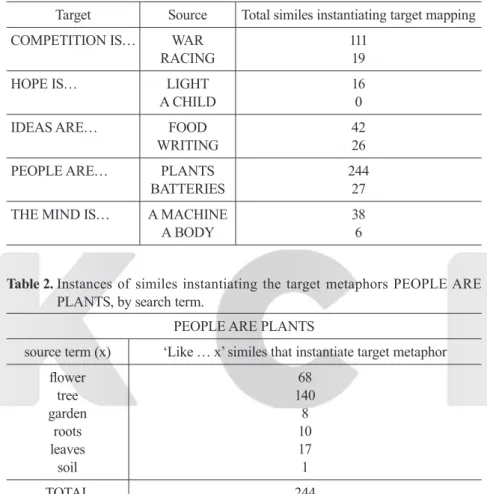
Table 1 presents the results of the large-corpus method, totaling results for individual search terms within the mapping overall.
These data clearly indicate a significant, clear difference in the frequen-
esis (Bowdle & Gentner 2005), for example, suggests that both similes and novel metaphors are processed analogically. Chiappe & Kennedy (2000) argue that the two forms are functionally equivalent when they are not purposefully used to con- trast one another. In experimental research that does argue for a difference between the two as to processing (Aisenman 1999, Haught 2005), subjects’ preference for one form over another seems to be more dependent on the specific source domain terminology used, rather than on the cross-domain mapping itself. Metaphors and similes are not equivalent; they differ in both linguistic form and pragmatic func- tion. The view is, however, taken here, following Conceptual Metaphor Theory, that both similes and metaphors prompt cross-domain mappings (Lakoff & Johnson 1980). These mappings are the object of inquiry here.
cies of metaphorical mappings. They also indicate a marked difference in the frequencies with which specific terminology is used to invoke a given source domain. Table 2 presents results for individual search terms for PEOPLE ARE PLANTS, typical in the spread of frequencies for individual search terms within a single metaphor that it represents.
All of the search terms for PEOPLE ARE PLANTS returned some results; people are compared to trees and flowers, specifically, with a very high degree of frequency, although tree was used more than twice the amount of flower. Garden, roots, leaves, and soil are clustered at the low Table 1. Large-corpus method results by domain
Target Source Total similes instantiating target mapping
COMPETITION IS… WAR
RACING 111
19
HOPE IS… LIGHT
A CHILD 16
0
IDEAS ARE… FOOD
WRITING 42
26
PEOPLE ARE… PLANTS
BATTERIES 244
27
THE MIND IS… A MACHINE
A BODY 38
6
Table 2. Instances of similes instantiating the target metaphors PEOPLE ARE PLANTS, by search term.
PEOPLE ARE PLANTS
source term (x) ‘Like … x’ similes that instantiate target metaphor flower
gardentree roots leaves
soil
14068 108 171
TOTAL 244
end of the spectrum, with between only 1 and 17 citations. Full results for all ten metaphors are presented in the Appendix, the data showing a tre- mendous amount of variation, within a single metaphorical mapping, as to the frequency with which different words are used to invoke the source domain.
3. Experiments
A series of experiments tests three key predictions of the view of meta- phorical cross-domain mappings as cognitive entities upon which frequency effects operate in language. According to the view of metaphor outlined here, every time that an individual is exposed to a metaphorical utterance, it represents a token of use. ‘Clouds’ of tokens form around cross-domain mappings that are common in a language, as speakers are exposed to meta- phorical systems in use. Schemata emerge around common metaphors as speakers generalize across tokens of use, leading to conventional cross-do- main mappings and stock metaphorical interpretations. Additional tokens of use further entrench the schema. Metaphors with particular target domains in common (for example, LOVE IS MADNESS, LOVE IS A JOURNEY) are, in some sense, in competition with one another. Speakers make on-line choices, in language use, regarding what source domain to use to refer to a particular target domain. These decisions are based on a host of factors, including the concreteness of the source domain (Stefanowitsch 2005, San- ford 2008), and are dependent on the speaker’s previous exposures to each metaphor. These choices, across time and across many speakers, contribute to the overall frequency, in the language, of each metaphorical mapping.
The dependence of schema formation and entrenchment on frequency means that schematic strength is directly tied to numerical probability:
if x is the set of all metaphorical utterances to which a speaker has been exposed, and y the subset of metaphors that instantiate a particular cross- domain mapping, then y over x is the probability (in a historical, rather than predictive, sense), for that speaker, of a given metaphor occurring.
The literature on frequency effects in language (Bybee 1985, Moder 1992, Pierrehumbert 1994, Dabrowska & Szczerbinski 2006, Wang & Derwing 1994) speaks to three main effects from frequency (see §1.1). Accompany-
ing an increase in token frequency (i.e., an increase in the tokens of use to which to the typical speaker of a language is exposed), there is an increase in:
1) Accessibility. The more frequent a schema, the more rapidly it is accessed. Following from this, the speed at which stimuli instantiat- ing a schema are comprehended increases as well.
2) Acceptability. Speakers make decisions as to the acceptability of utterances based on the frequency of the utterance and/or its similar- ity to frequent utterances.
3) Productivity. High type frequency (in combination with the open- ness of the schema) determine the likelihood that the schema will be applied to new items.
The experiments reported below test these effects for metaphor, evaluat- ing metaphorical mappings as cognitive representations that are acted upon by linguistic frequency. These experiments demonstrate an effect from frequency not at the level of lexical entrenchment for figurative meanings for individual words and expression, but for schemata that have emerged over multiple stored tokens of use from the sum of a speaker’s history of language exposure. As language users encounter novel utterances, they are processed through a process of analogy to existing schemata, with proxim- ity to and the strength of such schemata having a direct effect on how novel utterances are processed.4
These effects have not previously been tested for metaphor; doing so requires some rethinking of experimental methods by which they can be
4 While these hypotheses may appear patent from the perspective of learning theory, which has long embraced the effect of frequency on storage and processing, they are far from accepted within linguistics, within which the role of repetition has not widely been attributed a significant role in shaping metaphorical systems (indeed, the role of frequency in shaping linguistic structure is itself very far from universally recognized). In addition, while a number of studies (see §1) have indi- cated a role from repetition on the processing of specific metaphorical words and utterances, the effect of repetition on processing for metaphorical mappings them- selves is neither well researched nor well understood.
addressed. The methods outlined below build on experimental approaches to confirming these effects at other levels of linguistic structure, as well as experimental work addressing other aspects of metaphor.
3.1 Experiment 1: Acceptability
The first experiment is an acceptability-judgment task in which partici- pants are presented with sentences the meaning of which is predicated on an underlying metaphor, and asked to rate each sentence on a scale from 1-5 with respect to its acceptability as a sentence. It is hypothesized that sentences instantiating more frequent cross-domain mappings are deemed more acceptable than sentences instantiating less frequent ones. The effect assumes an approximately similar level of frequency for the instantiations themselves, accomplished here by using novel comparisons (presumed to have a token frequency of ‘0’ in participants’ history of exposure to meta- phor). This is predicted to occur as a result of acceptability judgments being made on the basis of previous exposure: the more that speakers have been exposed to the metaphorical schema (a particular source-domain mapping) sanctioning a particular utterance, the more likely they are to determine a sentence instantiating the schema to be acceptable. The results of the experiment will be interpreted as supporting this hypothesis if, as a group, the stimuli instantiating more frequent metaphors are judged to be more acceptable than the group of stimuli instantiating less frequent metaphors.
3.1.1 Methods
18 students from a large public research university (11 males and 7 females) participated in the experiment. The participants were native speakers of English between the ages of 18 and 30 and were offered a small amount of extra credit for their participation by the instructors of their introductory Linguistics classes.
Stimuli (see Table 1) comprise 40 sentences: for each of five frequent/
infrequent metaphor pairs, there are eight stimuli. Four instantiate the more frequent metaphor, applying terminology from a given source domain to a given target domain (e.g., ‘When it comes to people, kids are like small plants,’ instantiating PEOPLE ARE PLANTS), while the other four sen- tences use source terminology from the less frequent metaphor (‘When it
comes to people, kids are like AAA batteries,’ instantiating PEOPLE ARE BATTERIES). Stimuli occur in matched pairs, embedding words triggering either infrequent or frequent mapping in otherwise identical sentences.
All stimuli are of the form ‘When it comes to z, x is like y.’ The simile form (i.e., the use of like) was used to prompt a figurative interpretation, and specifically to avoid a sentence being read as a literal categorization state- ment, so that numerical ratings for each stimulus reflect the acceptability of the figurative mapping rather than the felicity of the statement as a literal assertion. The functional equivalence of novel similes and novel metaphors is supported by Gentner & Bowdle’s Career of Metaphor Hypothesis (2001, 2005), as well as by Chiappe & Kennedy (2000), who note that metaphors and similes have the same strength for speakers when used in isolation.
The introductory clause of each stimulus sets up a clear target domain;
the main clause identifies something from the source domain (e.g., AAA batteries), likening it to something analogous in the target domain (kids).
In selecting source domain terminology, words were selected from the key terms survey which represented domain-specific terminology (i.e., words such as fun or boring, which do not have a meaning linked to any specific domain of thought, were excluded) and of which there were at least five occurrences across subjects in the key terms survey. From these, four words were selected that represented a variety of concepts from the domain- for example, in writing, the words selected represent an object on which one writes (paper), the act of interpreting something written (reading), a person who habitually writes (author), and a unit used in written language (sen- tence). All the terms used in the stimuli for the experiment, in that they are drawn from the key terms survey, are words representing semantic associa- tions that the population sampled have relating to the source domain; the stimuli embed these terms, which label core concepts from the domain, into semantically coherent English sentences.
To prevent biasing the stimuli in either experimental group towards either a more straightforward or difficult-to-interpret form, all stimuli were writ- ten previous to the corpus component of the study. The researcher therefore did not know, at the time that the stimuli were composed, which metaphors were more frequent and which were less frequent.
Subjects were given the following instructions for the experiment:
The following is a list of items. Each one is a sentence that compares something to something else. What I’m interested in is your thoughts, as a speaker of English, on how acceptable it is.
You’ll be ranking these items on a scale that runs between ‘not accept- able’ at one end, and ‘very acceptable’ at the other. You’d rate an item as highly acceptable if you think that it’s something you might expect a speaker of English to say, and it’s clear what the sentence is saying.
You’d rate it as ‘not acceptable’ if you think that it’s not a sentence that a speaker of English would ever say, and it’s unclear what the sentence means.
Directions For each item below, rank it according to how acceptable you think it is. A ranking of ‘1’ will correspond to items that you think are not at all acceptable. A ranking of ‘5’ will correspond to items that you think are very acceptable. You can rank items anywhere along the scale, from 1 to 5.
Participation was untimed. Stimuli were presented on a two-page instru- ment, printed to present the stimuli in one of five different random orders to each participant.
3.1.2 Results
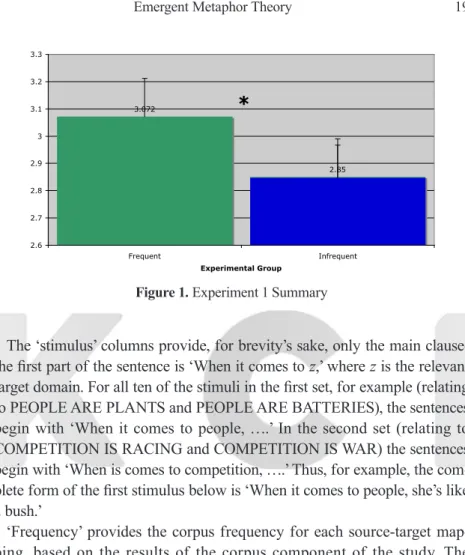
Figure 1 provides the results of Experiment 1. Averaging across both partic- ipants and stimuli, acceptability ratings were .25 higher (5% higher on the 1-5 scale) for the frequent group than for the infrequent group of stimuli.
In the subject analysis, a paired t-test of mean acceptability ratings demon- strated that participants judged frequent items to be more acceptable than infrequent items at a level that reaches significance, t(17) = 3.72, p = <.005.
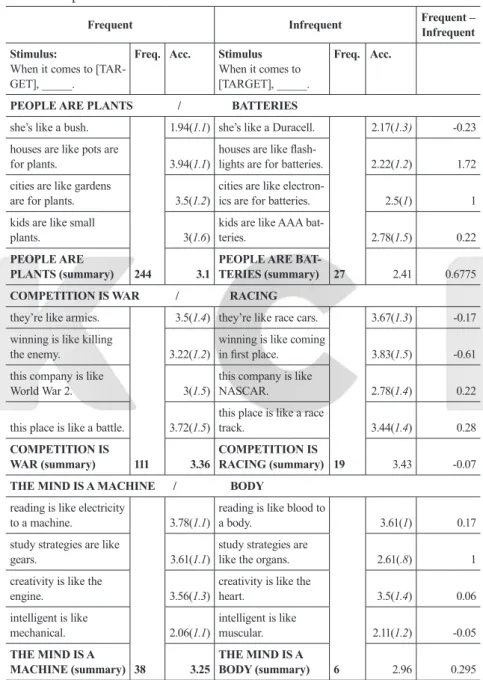
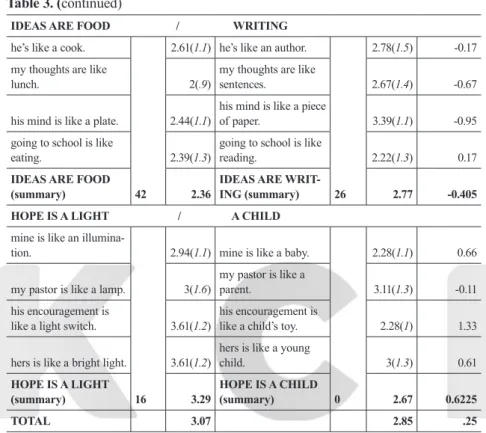
Table 3 presents a more detailed view of the results of Experiment 1. The table is divided into two main data columns, with more frequent mappings on the left and less frequent mappings on the right. Pairs of mappings, reflecting a more and less frequent metaphorical cross-domain mapping, are presented side by-side, so that the more frequent mapping is on the left, the less frequent mapping in the column adjacent.
The ‘stimulus’ columns provide, for brevity’s sake, only the main clause- the first part of the sentence is ‘When it comes to z,’ where z is the relevant target domain. For all ten of the stimuli in the first set, for example (relating to PEOPLE ARE PLANTS and PEOPLE ARE BATTERIES), the sentences begin with ‘When it comes to people, ….’ In the second set (relating to COMPETITION IS RACING and COMPETITION IS WAR) the sentences begin with ‘When is comes to competition, ….’ Thus, for example, the com- plete form of the first stimulus below is ‘When it comes to people, she’s like a bush.’
‘Frequency’ provides the corpus frequency for each source-target map- ping, based on the results of the corpus component of the study. The
‘acceptability’ (Acc.) column provides, for each stimulus, the mean accept- ability rating across all 18 participants. A higher number corresponds to a higher degree of acceptability. Stimuli are grouped into the source-target mappings that they instantiate, with the final row in each grouping reflect- ing an average for the mapping overall. The members of each frequent- infrequent pair appear side by side; the right-most column subtracts the
‘Infrequent’ values from values for the corresponding ‘Frequent’ values.
Positive values are therefore in line with the predicted experimental effect;
negative values are not. Standard deviations are reported in parentheses to the right of the average rating, across participants, for each stimulus. The
*
3.072
2.85
2.6 2.7 2.8 2.9 3 3.1 3.2 3.3
Frequent Infrequent
Experimental Group
Acceptability (1 - 5)
Figure 1. Experiment 1 Summary
Table 3. Experiment 1 Data
Frequent Infrequent Frequent –
Infrequent Stimulus:
When it comes to [TAR- GET], _____.
Freq. Acc. Stimulus When it comes to [TARGET], _____.
Freq. Acc.
PEOPLE ARE PLANTS / BATTERIES she’s like a bush.
244
1.94(1.1) she’s like a Duracell.
27
2.17(1.3) -0.23 houses are like pots are
for plants. 3.94(1.1) houses are like flash-
lights are for batteries. 2.22(1.2) 1.72 cities are like gardens
are for plants. 3.5(1.2) cities are like electron-
ics are for batteries. 2.5(1) 1
kids are like small
plants. 3(1.6) kids are like AAA bat-
teries. 2.78(1.5) 0.22
PEOPLE ARE
PLANTS (summary) 3.1 PEOPLE ARE BAT-
TERIES (summary) 2.41 0.6775
COMPETITION IS WAR / RACING they’re like armies.
111
3.5(1.4) they’re like race cars.
19
3.67(1.3) -0.17 winning is like killing
the enemy. 3.22(1.2) winning is like coming
in first place. 3.83(1.5) -0.61
this company is like
World War 2. 3(1.5) this company is like
NASCAR. 2.78(1.4) 0.22
this place is like a battle. 3.72(1.5) this place is like a race
track. 3.44(1.4) 0.28
COMPETITION IS
WAR (summary) 3.36 COMPETITION IS
RACING (summary) 3.43 -0.07
THE MIND IS A MACHINE / BODY reading is like electricity
to a machine.
38
3.78(1.1) reading is like blood to a body.
6
3.61(1) 0.17
study strategies are like
gears. 3.61(1.1) study strategies are
like the organs. 2.61(.8) 1
creativity is like the
engine. 3.56(1.3) creativity is like the
heart. 3.5(1.4) 0.06
intelligent is like
mechanical. 2.06(1.1) intelligent is like
muscular. 2.11(1.2) -0.05
THE MIND IS A
MACHINE (summary) 3.25 THE MIND IS A
BODY (summary) 2.96 0.295
frequency (F) column provides (both here, and also in the data tables for each of the other two experiments) the corpus frequency of each mapping, from the large-corpus study, in order to allow the reader to compare the mean results for each group of stimuli with the frequency of the sanction- ing mapping.
Turning to judgments of individual item pairs, there were exceptions to the general pattern for two of the groups of stimuli (relating to COMPETI- TION and to IDEAS). In explaining these results, it seems likely that par- ticipants found some of the sentences for COMPETITION IS RACING and IDEAS ARE WRITING to be more or less literal: sentences predicated on these mappings rated high in acceptability because the terminology of com- petition applies literally to racing (i.e., winning isn’t just like coming in first place, it is coming in first place) and because ideas are literally expressed in
IDEAS ARE FOOD / WRITING he’s like a cook.
42
2.61(1.1) he’s like an author.
26
2.78(1.5) -0.17 my thoughts are like
lunch. 2(.9) my thoughts are like
sentences. 2.67(1.4) -0.67
his mind is like a plate. 2.44(1.1) his mind is like a piece
of paper. 3.39(1.1) -0.95
going to school is like
eating. 2.39(1.3) going to school is like
reading. 2.22(1.3) 0.17
IDEAS ARE FOOD
(summary) 2.36 IDEAS ARE WRIT-
ING (summary) 2.77 -0.405
HOPE IS A LIGHT / A CHILD mine is like an illumina-
tion.
16
2.94(1.1) mine is like a baby.
0
2.28(1.1) 0.66
my pastor is like a lamp. 3(1.6) my pastor is like a
parent. 3.11(1.3) -0.11
his encouragement is
like a light switch. 3.61(1.2) his encouragement is
like a child’s toy. 2.28(1) 1.33
hers is like a bright light. 3.61(1.2) hers is like a young
child. 3(1.3) 0.61
HOPE IS A LIGHT
(summary) 3.29 HOPE IS A CHILD
(summary) 2.67 0.6225
TOTAL 3.07 2.85 .25
Table 3. (continued)
writing.
Large differences, for a given pair of stimuli, between the stimulus instantiating the more vs. the less frequent mappings tend to be accounted for by the higher-frequency item ranking extremely high in acceptability, as is the case for houses are like pots for plants, his encouragement is like a light switch, and her [hope] is like a bright light (which rank 3.94, 3.61, and 3.61, respectively, against an average rating of 2.96 across all stimuli).
Those pairs of stimuli which run most contrary to the hypothesized effect are winning is like killing the enemy/winning is like coming in first place, my thoughts are like lunch/my thoughts are like sentences, and his mind is like a plate/his mind is like a piece of paper. In all three cases, the item instantiating the less frequent metaphor has an average acceptability at least .5 (10% of the 1 -5 scale) higher than that for the item instantiating the more frequent metaphor. The extremely high ranking for winning is like coming in first place accounts in large part for the high average ranking for COMPETITION IS RACING overall, being the exemplar for the prob- lem (outlined above) that sentences in this category tend to read as literal assertions. The second two pairs of stimuli are both members of the IDEAS ARE FOOD/IDEAS ARE WRITING group. my thoughts are like lunch received one of the lowest ratings in the survey rating (a 2- only she’s like a bush ranked lower, at 1.94). Based on informal follow-up questions, this is apparently because people felt that the interpretation was too open-ended:
lunch doesn’t assign any attributes to food, and it was therefore difficult to transfer any meaning to thought. his mind is like a plate was outranked by his mind is like a piece of paper due to the high ranking (3.39) of the latter, most likely due its similarity to the highly conventional X’s mind is (like) a blank slate.
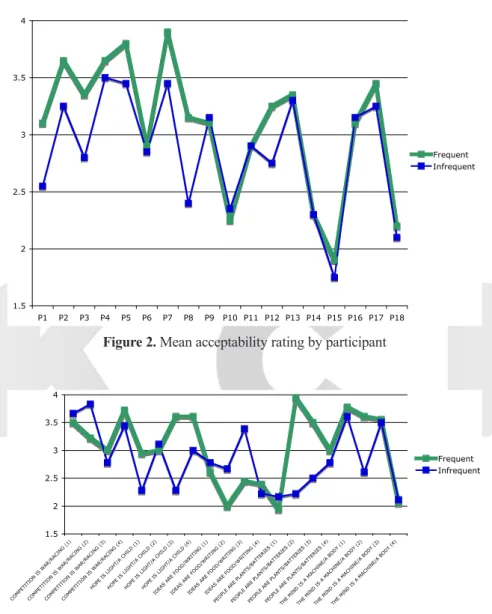
Figure 2 shows the results of the study by participant. For 15 of the 18 participants, mean ratings for the frequent stimuli were greater than or equal to mean rating for the infrequent group. The large portion of par- ticipants for which frequent stimuli were more acceptable than infrequent stimuli, as well as the closely matched curves for frequent and infrequent stimuli, attest to a clear difference across the two levels of the independent variable ‘frequency.’
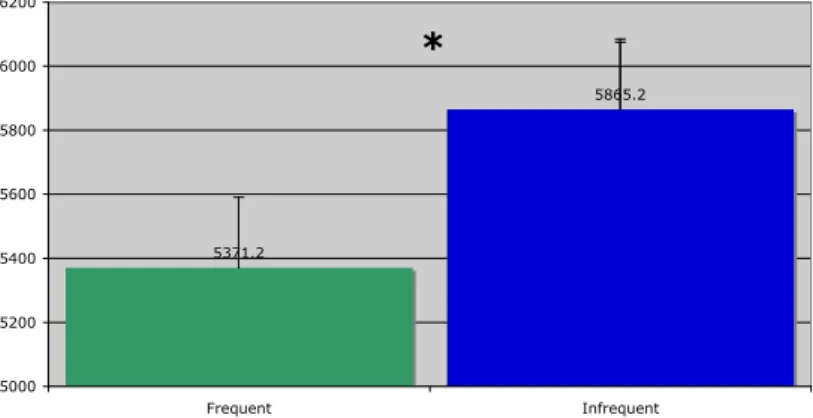
Figure 3 shows the results of Experiment 1 by stimulus. Within each
group of metaphorical stimuli (as defined by target domain), each pair of stimuli is numbered one through four, in the order in which they appear in Table 1.
1.5 2 2.5 3 3.5 4
P1 P2 P3 P4 P5 P6 P7 P8 P9 P10 P11 P12 P13 P14 P15 P16 P17 P18
Frequent Infrequent
1.5 2 2.5 3 3.5 4
COMPETITION IS WAR/RACING
(1)
COMPETITION IS WAR/RACING
(2)
COMPETITION IS WAR/RACING
(3)
COMPETITION IS WAR/RACING
(4)
HOPE IS LIGHT/A CHILD
(1)
HOPE IS LIGHT/A CHILD
(2)
HOPE IS LIGHT/A CHILD
(3)
HOPE IS LIGHT/A CHILD
(4)
IDEAS ARE FOOD
/WRITING (1)
IDEAS ARE FOOD /WRITING (2)
IDEAS ARE FOOD /WRITING
(3)
IDEAS ARE FOOD /WRITING (4)
PEOPLE ARE PLANTS/B ATTERIES
(1)
PEOPLE ARE PLANTS/B ATTERIES
(2)
PEOPLE ARE PLANTS/B ATTERIES
(3)
PEOPLE ARE PLANTS/B ATTERIES
(4)
THE MIND IS A
MACHINE/A B ODY (1)
THE MIND IS A
MACHINE/A B ODY (2)
THE MIND IS A
MACHINE/A B ODY (3)
THE MIND IS A
MACHINE/A B ODY (4)
Frequent Infrequent
Figure 2. Mean acceptability rating by participant
Figure 3. Mean acceptability rating by stimulus
For 12 of 20 stimuli, and for three of the five groups of stimuli, frequent stimuli were deemed more acceptable than corresponding infrequent stim- uli. A by-stimulus analysis is not significant, t(19) = 1.49, p = .08. In these results (as in Experiments 2 and 3), a by-subject paired t-test provides a more meaningful interpretation of the results than either a comparison of averages or a by-stimulus t-test. This is the case because no threshold sepa- rates the two levels of the independent variable frequency. In each matched pair of stimuli, the frequent item is higher in frequency than the infrequent item (and as a result, the ‘frequent’ group of stimuli is of higher average frequency than the infrequent group). It is not the case, however, that all of the frequent items are higher in frequency, nor the infrequent items lower, than any particular figure (indeed, many of the ‘infrequent’ stimuli instanti- ate metaphors that are more frequent than other metaphors in the ‘frequent’
category, and vice-versa). A by-stimulus t-test is primarily a test of whether or not there is clear difference, with respect to the independent variable, between the two groups- in this case, there is not. For this reason, a by- subjects analysis is of much greater utility than a by-stimulus analysis in interpreting the data, for all three experiments.
The clear difference in acceptability between the two levels of the independent variable (frequency) observed here provides support for the entrenchment of metaphorical mappings as schema which operate on the same principles as schema posited at other levels of linguistic structure.
3.1.3 Discussion
These results are interpreted as providing strong support for the proposed hypothesis, that metaphorical utterances will be judged to be more accept- able by speakers when they are predicated on underlying metaphors to which they have had frequent exposure. The data reported here correspond to experimental findings which have been reported for other levels of lin- guistic structure, that grammatical judgments aren’t absolute, but probabi- listic, based on speakers’ previous experience with language (Pierrehumbert 1994, Vitevich et al. 1997, Bybee & Eddington 2006). In the case of speak- ers’ acceptability judgments regarding metaphorical stimuli, participants appear to be making determinations as to semantic felicity—essentially, how easily an utterance can be associated with a literal meaning—rather
than grammaticality. In both cases, however, language users are making determinations as to how acceptable an utterance is based on its probability.5 The less frequent the pattern underlying an utterance (whether said pattern be a particular sequence of segments, a string of morphemes, or a particular source-target metaphorical mapping), and therefore the less its probability, the less such a pattern will have likelihood and strength of entrenchment as a schema. This lack of participation in a highly entrenched schema cor- responds to ‘oddness’ in an utterance- that is to say, a lack of acceptability, whether such a lack of acceptability be labeled grammatical or semantic.
3.2 Experiment 2: Comprehension Time
The second experiment is a computer-based comprehension-time (CT) task in which participants were presented with metaphorical stimuli (e.g.,
‘When it comes to love, he’s a magician’) and asked to press a button when they understand the sentence. It is hypothesized that sentences instantiating more frequent metaphors are processed more quickly than sentences instan- tiating less frequent ones, as a result of frequent mappings having been entrenched in speakers’ minds due to frequent activation. This hypothesis is tested in two ways, with the experimental results interpreted as support- ing the hypothesis stated above if 1) there is an overall correlation between frequency and reaction time, and 2) as a group, the stimuli instantiating fre- quent metaphors are processed more quickly than the stimuli instantiating less frequent metaphors.
3.2.1 Methods
26 students from a large public research university (14 males and 12 females) participated in the experiment, a group different from those who participated in Experiment 1. The participants were native speakers of
5 Semantic factors are themselves important in syntactic schemata. Bybee & Ed- dington (2006), in a study of Spanish verbs meaning ‘become’ and accompanying adjectives, demonstrate that the token frequency of constructions has a direct ef- fect on how speakers rate the acceptability of sentences. Moreover, they show that expressions semantically similar to highly frequent ones are also judged to be more acceptable, demonstrating that semantic relations play a primary role in formation of exemplar-based representations.
English between the ages of 18 and 30 and were offered a small amount of extra credit for their participation by the instructors of their introductory linguistics classes. Stimuli (see Table 5.2) comprise 30 sentences, occurring in matched pairs: for each frequent/infrequent metaphor pair, there are six stimuli. Three instantiate the more frequent metaphor, applying terminol- ogy from a given source domain to a given target domain (e.g., ‘Her mind has gears,’ instantiating THE MIND IS A MACHINE), while the other three sentences are identical except that they use source terminology from the less frequent metaphor (‘Her mind has muscles,’ instantiating THE MIND IS A BODY). Stimuli were constructed using terminology which emerged as basic to the domain in the key terms survey, with the first pair of stimuli constructed around the metaphorical use of nouns from the source domain, the second around the metaphorical use of verbs from the source domain (although in some cases applying them in present participle form), and the third around the metaphorical use of adjectives from the source domain.
The words selected for use in each matched pair were analogous with respect to their role in the domain.6 Stimuli were controlled for mean lexical frequency, as assessed using the Corpus of Contemporary American English (Davies 2008). While the mean lexical frequencies for the members of each stimulus pair are in many cases unequal, there was no significant difference in mean lexical frequency between the two groups of experimental items overall: t(14) = .9, p = .38. All stimuli were written previous to the corpus component of the study, so that the researcher did not know which meta- phors were more frequent and which were less frequent at the time of their being composed.
The experiment was computer-based, with all participants completing the experiment on the same machine (a Macintosh G4 MacBook). The experi- ment was designed and run using PsyScope X, and the machine’s track but- ton was used as an input device. This setup guaranteed timing accuracy to within 17ms (more than sufficiently accurate for the relatively long reaction
6 For example, the words selected for PLANTS and BATTERIES are flower and Duracell (a type of plant, and type of battery), growing and charging (things that plants and batteries do, respectively), and small and rechargeable (traits that can apply to members of the category).
times recorded in the experiment).
Participants first read an introductory screen on which they were advised that they would be presented with a series of sentences, and that they were going to be asked to assess each sentences’ meaning. On beginning the experiment, participants viewed, for each stimulus, the following series of screens: an initial screen advises them that for the following screen, they are being asked to press a button as soon as they feel that they understand the sentence. Once they press a button to advance to the screen containing the stimulus, a screen appears containing the stimulus. Once the button is pressed a second time, indicating the sentence has been read and under- stood, a screen appears which prompts them to write in a brief description of the meaning of the sentence, and to press a specific key (cueing the intro- ductory screen for the next stimulus) when their description is complete.
All trials began with a block of 5 ‘warm-up’ items, from which data were not recorded, following which the stimuli were presented to each partici- pant in a different random order. For each stimulus, the time recorded was the time between the stimulus appearing on the screen, and the button being pressed.
3.2.2 Results
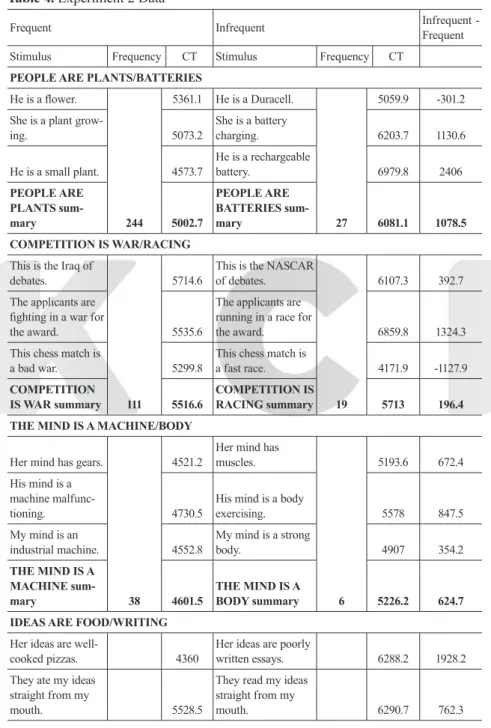
Figure 4 provides the results of Experiment 2. Comparing results across the two levels of the independent variable, corresponding to the average of
*
5371.2
5865.2
5000 5200 5400 5600 5800 6000 6200
Frequent Infrequent
Experimental Group
Reaction Time (ms)
Figure 4. Experiment 2 Summary
Table 4. Experiment 2 Data
Frequent Infrequent Infrequent -
Frequent
Stimulus Frequency CT Stimulus Frequency CT
PEOPLE ARE PLANTS/BATTERIES He is a flower.
244
5361.1 He is a Duracell.
27
5059.9 -301.2 She is a plant grow-
ing. 5073.2 She is a battery
charging. 6203.7 1130.6
He is a small plant. 4573.7 He is a rechargeable
battery. 6979.8 2406
PEOPLE ARE PLANTS sum-
mary 5002.7
PEOPLE ARE BATTERIES sum-
mary 6081.1 1078.5
COMPETITION IS WAR/RACING This is the Iraq of
debates.
111
5714.6 This is the NASCAR of debates.
19
6107.3 392.7 The applicants are
fighting in a war for
the award. 5535.6
The applicants are running in a race for
the award. 6859.8 1324.3
This chess match is
a bad war. 5299.8 This chess match is
a fast race. 4171.9 -1127.9
COMPETITION
IS WAR summary 5516.6 COMPETITION IS
RACING summary 5713 196.4
THE MIND IS A MACHINE/BODY Her mind has gears.
38
4521.2 Her mind has muscles.
6
5193.6 672.4 His mind is a
machine malfunc-
tioning. 4730.5 His mind is a body
exercising. 5578 847.5
My mind is an
industrial machine. 4552.8 My mind is a strong
body. 4907 354.2
THE MIND IS A MACHINE sum-
mary 4601.5 THE MIND IS A
BODY summary 5226.2 624.7
IDEAS ARE FOOD/WRITING Her ideas are well-
cooked pizzas. 4360 Her ideas are poorly
written essays. 6288.2 1928.2
They ate my ideas straight from my
mouth. 5528.5
They read my ideas straight from my
mouth. 6290.7 762.3
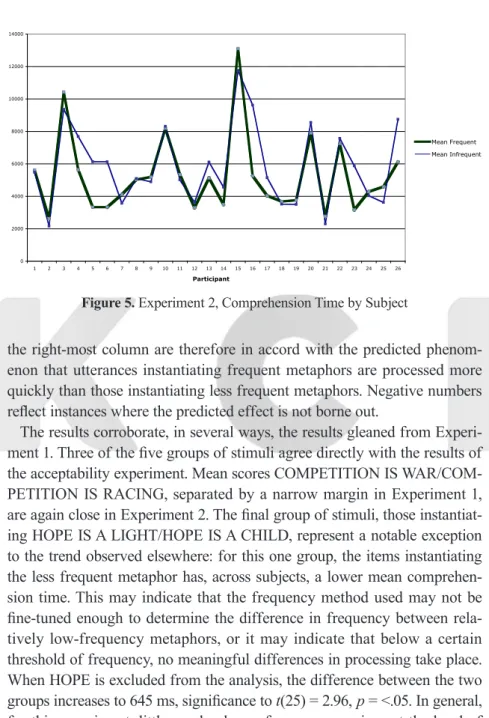
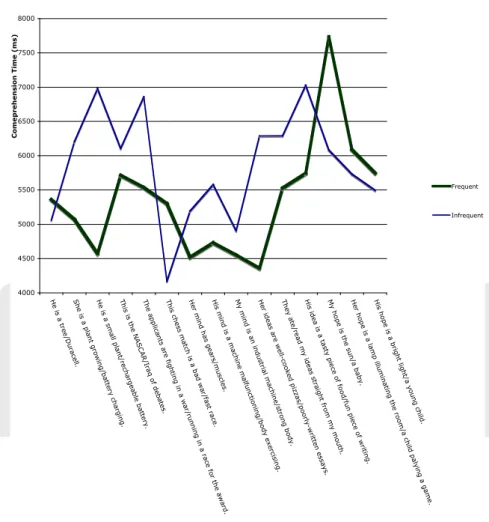
responses for the more frequent and less frequent items for each participant, the experiment bears out the prediction that utterances instantiating more frequent metaphors are processed more quickly than utterances instantiating less frequent ones. Mean reaction time for the infrequent stimuli is 5865.2 ms, while mean reaction time for the frequent stimuli was 5371.2 ms—al- most 500 ms less. These results are statistically significant for a by-subjects analysis, t(25) = 2.11, p = <.05.
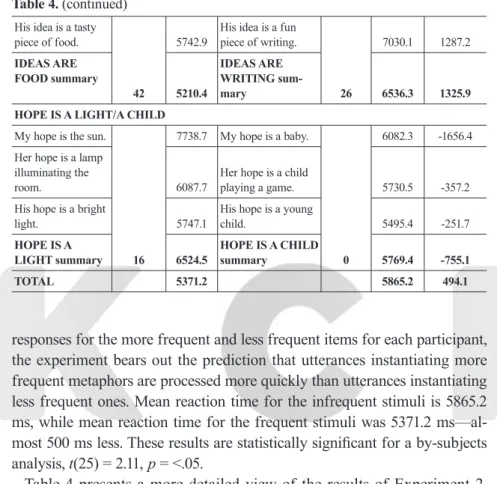
Table 4 presents a more detailed view of the results of Experiment 2, averaged by stimulus. Both Table 4 and Figure 4 reflect a preliminary cleaning up of the data in which all responses under 100 ms (assumed to represent a ‘double-click’ from the previous response) and over 100,000 ms (assumed to represent a distraction from the experimental task) were excluded. Data were also excluded from items for which there was a null response in the paraphrase (i.e., items for which participants entered noth- ing in the field where they were prompted to explain the meaning of the sentence). A total of 35 responses (4% of the data) were discarded based on these criteria. Values for each item are averaged across participants. The values in the right-most column are differences yielded by subtracting val- ues from the first column from values in the second. Positive numbers in Table 4. (continued)
His idea is a tasty piece of food.
42
5742.9 His idea is a fun piece of writing.
26
7030.1 1287.2 IDEAS ARE
FOOD summary
5210.4
IDEAS ARE WRITING sum-
mary 6536.3 1325.9
HOPE IS A LIGHT/A CHILD My hope is the sun.
16
7738.7 My hope is a baby.
0
6082.3 -1656.4 Her hope is a lamp
illuminating the
room. 6087.7 Her hope is a child
playing a game. 5730.5 -357.2
His hope is a bright
light. 5747.1 His hope is a young
child. 5495.4 -251.7
HOPE IS A
LIGHT summary 6524.5 HOPE IS A CHILD
summary 5769.4 -755.1
TOTAL 5371.2 5865.2 494.1