Consequences of the First Law
Chapter 5
Advanced Thermodynamics (M2794.007900)
Min Soo Kim
Seoul National University
A.1 Partial Derivatives
Consider a function of three variables, 𝑓 𝑥, 𝑦, 𝑧 = 0
since only two variables are independent, we can write 𝑥 = 𝑥 𝑦, 𝑧 , 𝑦 = 𝑦 𝑥, 𝑧
Then d𝑥 = ( 𝜕𝑥
𝜕𝑦 )𝑧𝑑𝑦 + (𝜕𝑥
𝜕𝑧 )𝑦𝑑𝑧, and d𝑦 = ( 𝜕𝑦
𝜕𝑥 )𝑧𝑑𝑥 + ( 𝜕𝑦
𝜕𝑧 )𝑥𝑑𝑧 We obtain,
d𝑥 = ( 𝜕𝑥
𝜕𝑦 )𝑧 ( 𝜕𝑦
𝜕𝑥 )𝑧𝑑𝑥 + ( 𝜕𝑦
𝜕𝑧 )𝑥𝑑𝑧 + ( 𝜕𝑥
𝜕𝑧 )𝑦𝑑𝑧
A.1 Partial Derivatives
d𝑥 = ( 𝜕𝑥
𝜕𝑦 )𝑧 ( 𝜕𝑦
𝜕𝑥 )𝑧𝑑𝑥 + ( 𝜕𝑦
𝜕𝑧 )𝑥𝑑𝑧 + ( 𝜕𝑥
𝜕𝑧 )𝑦𝑑𝑧
= ( 𝜕𝑥
𝜕𝑦 )𝑧( 𝜕𝑦
𝜕𝑥 )𝑧𝑑𝑥 + ( 𝜕𝑥
𝜕𝑦 )𝑧( 𝜕𝑦
𝜕𝑧 )𝑥 + ( 𝜕𝑥
𝜕𝑧 )𝑦 𝑑𝑧 If d𝑧 = 0 and d𝑥 ≠ 0 ,
𝝏𝒙
𝝏𝒚 𝒛 = 𝝏𝒚𝟏
𝝏𝒙 𝒛
. This expression is known as the reciprocal relation.
If d𝑥 = 0 and d𝑧 ≠ 0 ,
𝜕𝑥
𝜕𝑦 𝑧
𝜕𝑦
𝜕𝑧 𝑥 = − 𝜕𝑥
𝜕𝑧 𝑦
A.1 Partial Derivatives
𝜕𝑥
𝜕𝑦 𝑧
𝜕𝑦
𝜕𝑧 𝑥 = − 𝜕𝑥
𝜕𝑧 𝑦 (previous slide)
𝜕𝑥
𝜕𝑧 𝑦 = 𝜕𝑧1
𝜕𝑥 𝑦
(using reciprocal relation)
Substituting these equations yield,
𝝏𝒙
𝝏𝒚 𝒛
𝝏𝒚
𝝏𝒛 𝒙
𝝏𝒛
𝝏𝒙 𝒚 = −𝟏. The cyclical rule, or cyclical relation.
A.1 Partial Derivatives
Consider a function 𝑢 of three variables x, y, z can be written as a function of only two variables and those two variables are independent.
𝑢 = 𝑢 𝑥, 𝑦 Alternatively,
𝑥 = 𝑥 𝑢, 𝑦 Then
d𝑥 = 𝜕𝑥
𝜕𝑢 𝑦 𝑑𝑢 + 𝜕𝑥
𝜕𝑦 𝑢 𝑑𝑦.
If we divide the equation by d𝑧 while holding 𝑢 constant,
𝜕𝑥
𝜕𝑧 𝑢 = 𝜕𝑥
𝜕𝑦 𝑢
𝜕𝑦
𝜕𝑧 𝑢. The chain rule of differentiation.
5.1 The Gay-Lussac-Joule Experiment
In general,
𝑢 = 𝑢 𝑇, 𝑣
using the cyclical and reciprocal relations,
(
𝜕𝑇𝜕𝑣
)
𝑢= −
(𝜕𝑢
𝜕𝑣 )𝑇 (𝜕𝑢
𝜕𝑇)𝑣
for a reversible process,
𝑐
𝑣= (
𝜕𝑢𝜕𝑇
)
𝑣∴ (
𝜕𝑢𝜕𝑣
)
𝑇= −𝑐
𝑣(
𝜕𝑇𝜕𝑣
)
𝑢Then how can we keep
𝑢
constant during the expansion?5.1 The Gay-Lussac-Joule Experiment
𝑑𝑢 = 𝛿𝑞 − 𝛿𝑤 ⇒ free expansion
𝑇
1= 𝑇
0+
𝑣0
𝑣1
(
𝜕𝑇𝜕𝑣
)
𝑢𝑑𝑣, 𝜂 ≡
( 𝜕𝑇𝜕𝑣 )𝑢 : Joule’s coefficient From Joule’s experimental result,
𝜂 = 𝜕𝑇
𝜕𝑣 𝑢 < 0.001 K kilomole m−3
𝒗𝟎 , 𝑻𝟎 𝒗𝟏 − 𝒗𝟎
thermal insulation gas
sample
diaphragm
vacuum
= 0 (adiabatic)
= 0 (no work)
5.1 The Gay-Lussac-Joule Experiment
for a Van der Waals gas, (Problem 5-3)
𝜂 = − 𝑎 𝑣
2𝑐
𝑣for an ideal gas,
by using the equation
𝑑𝑢 = 𝑇𝑑𝑠 − 𝑃𝑑𝑣
,𝜕𝑢
𝜕𝑣 𝑇
= 𝑇
𝜕𝑠𝜕𝑣 𝑇
− 𝑃 = 𝑇
𝜕𝑃𝜕𝑇 𝑣
− 𝑃 = 𝑇 [
𝜕𝜕𝑇
𝑅𝑇
𝑣
]
𝑣− 𝑃
=
𝑅𝑇𝑣
− 𝑃 = 0
Then 𝑢 = 𝑢(𝑇)
5.1 The Gay-Lussac-Joule Experiment
for a real gas,
by using the equation
𝑑𝑞 =
𝜕𝑢𝜕𝑇 𝑣
𝑑𝑇 +
𝜕𝑢𝜕𝑣 𝑇
+ 𝑃 𝑑𝑣
divide by the temperature T,𝑑𝑞
𝑇
=
1𝑇
𝜕𝑢
𝜕𝑇 𝑣
𝑑𝑇 +
1𝑇
𝜕𝑢
𝜕𝑣 𝑇
+ 𝑃 𝑑𝑣
𝜕
𝜕𝑣 1 𝑇
𝜕𝑢
𝜕𝑇
=
𝜕𝜕𝑇 1 𝑇
𝜕𝑢
𝜕𝑣
+ 𝑃
1 𝑇
𝜕2𝑢
𝜕𝑣𝜕𝑇
= −
1𝑇2
𝜕𝑢
𝜕𝑣
+ 𝑃 +
1𝑇
𝜕2𝑢
𝜕𝑣𝜕𝑇
+
1𝑇
𝜕𝑃
𝜕𝑇
𝜕𝑢
𝜕𝑣 𝑇
= 𝑇
𝜕𝑃𝜕𝑇 𝑣
− 𝑃
5.2 The Joule-Thomson Experiment
Since the process takes place in an insulated cylinder,
δ𝑞 = 0
specific work done in forcing the gas through the plug, 𝑤1 = 𝑣
1
0 𝑃1 𝑑𝑣 = −𝑃1𝑣1 specific work done by the gas in the expansion, 𝑤2 = 0𝑣2𝑃2 𝑑𝑣 = 𝑃2 𝑣2
Porous plug
Initial state Final state
𝑷𝟏, 𝒗𝟏 , 𝑻𝟏 𝑷𝟐, 𝒗𝟐 , 𝑻𝟐
5.2 The Joule-Thomson experiment
The total work, 𝑤 = 𝑤1 + 𝑤2 = 𝑃2 𝑣2 − 𝑃1 𝑣1 = 𝑢1 − 𝑢2 𝑢1 + 𝑃1 𝑣1 = 𝑢2 + 𝑃2 𝑣2 ⟺ ℎ1 = ℎ2
Thus, a throttling process occurs at constant enthalpy.
constant
5.2 The Joule-Thomson experiment
Joule-Thomson coefficient
𝜇
𝐽𝑇≡ (
𝜕𝑇𝜕𝑃
)
ℎthe point where 𝜇𝐽𝑇 = 0 is called inversion point.
from ℎ = ℎ 𝑇, 𝑃 , 𝑑ℎ = ( 𝜕ℎ
𝜕𝑇 )𝑃 𝑑𝑇 + ( 𝜕ℎ
𝜕𝑃 )𝑇 𝑑𝑃 𝜇𝐽𝑇 ≡ ( 𝜕𝑇
𝜕𝑃 )ℎ = 𝑇2−𝑇1
𝑃2−𝑃1 ℎ
𝑇2 = 𝑇1 − 𝜇 𝑃2 − 𝑃1
The gas is cooling when the 𝜇 is positive and heating when the 𝜇 is negative
5.2 The Joule-Thomson experiment
Joule-Thomson coefficient
𝜇
𝐽𝑇=
𝜕𝑇𝜕𝑃 ℎ
= −
𝜕𝑇𝜕ℎ 𝑃
𝜕ℎ
𝜕𝑃 𝑇
=
1𝐶𝑃
𝑇
𝜕𝑣𝜕𝑇 𝑃
− 𝑣
for an ideal gas, 𝜇𝐽𝑇 = 0,
𝜕ℎ
𝜕𝑃 𝑇 = 0 and ℎ = ℎ 𝑇 for a Van der Waals gas, 𝑃 = 𝑅𝑇
𝑣−𝑏 − 𝑎
𝑣2
𝜇
𝐽𝑇= 1 𝑐
𝑃2𝑎
𝑅𝑇 1 − 𝑏 𝑣
2
− 𝑏 1 − 2𝑎
𝑣𝑅𝑇 1 − 𝑏 𝑣
2
If 𝜇𝐽𝑇 = 0,
𝑇
𝑖=
2𝑎𝑏𝑅
1 −
𝑏𝑣 2
5.3 Heat engines and the Carnot cycle
Carnot cycle
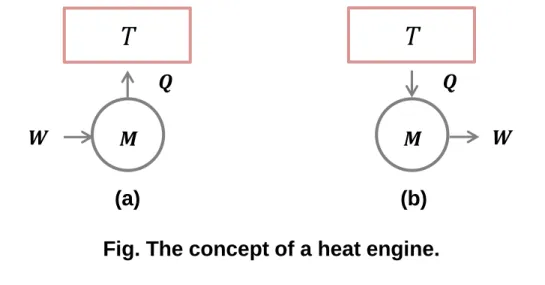
In (a), work is done on the system and is converted to heat.
In (b), heat is extracted from a reservoir and is converted to mechanical work.
This configuration is not possible.
𝑇
𝑸
𝑾 𝑴
𝑇
𝑸 𝑴 𝑾
(a) (b)
Fig. The concept of a heat engine.
5.3 Heat engines and the Carnot cycle
Carnot cycle
Can the work done by the system be equal to the heat in?
The second law of thermodynamics states unequivocally that it is impossible to construct a perfect heat engine.
𝑇
𝑸 𝑴 𝑾
(b) (c)
Fig. The concept of a heat engine.
𝑇𝑏
𝑇𝑎
𝑸𝑯
𝑸𝑳 𝑴 𝑾
5.3 Heat engines and the Carnot cycle
Clausius statement
It is impossible to construct a device that operates in a cycle and whose sole effect is to transfer heat from a cooler body to a hotter body.
Kelvin-Planck statement
It is impossible to construct a device that operates in a cycle and produces no other effect than the performance of work and the exchange of heat with a single reservoir.
5.3 Heat engines and the Carnot cycle
Carnot cycle
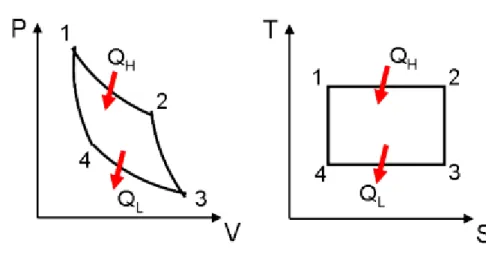
1 – 2 : isothermal expansion 2 – 3 : adiabatic expansion 3 – 4 : isothermal compression 4 – 1 : adiabatic compression 𝑇𝑏
𝑇𝑎
𝑸𝑯
𝑸𝑳
𝑾
Fig. P-V and T-S diagrams of Carnot cycle.
5.3 Heat engines and the Carnot cycle
The efficiency of the engine, 𝜂 = 𝑊
𝑄𝐻 = 𝑊
𝑄𝐻 = output input Applying the first law to the system,
∆𝑈 = 𝑄𝐻 + 𝑄𝐿 − 𝑊 = 𝑄𝐻 − 𝑄𝐿 − 𝑊
Since the system is in a cyclical process, ∆𝑈 = 0. Then, 𝑊 = 𝑄𝐻 + 𝑄𝐿 or 𝑊 = 𝑄𝐻 − 𝑄𝐿
Substituting the equations,
𝜂 =
𝑄𝐿+𝑄𝐻𝑄𝐻
= 1 +
𝑄𝐿𝑄𝐻
= 1 −
𝑄𝐿𝑄𝐻
5.3 Heat engines and the Carnot cycle
for an ideal gas, 𝑃𝑣 = 𝑅𝑇 , 𝑢 = 𝑢 𝑇 ,
for isothermal process, 𝑄𝐻 = 𝑊12 = 𝑛 ത𝑅 𝑇𝑏 ln𝑉2
𝑉1
𝑄𝐿 = 𝑊34 = 𝑛 ത𝑅 𝑇𝑎 ln𝑉4
𝑉3
⇒ 𝑄𝐻
𝑄𝐿 = −𝑇𝑏
𝑇𝑎
for adiabatic process, 𝑃𝑉𝛾 = 𝑐𝑜𝑛𝑠𝑡𝑎𝑛𝑡 , 𝑇𝑏 𝑉2𝛾−1 = 𝑇𝑎 𝑉3𝛾−1
𝑇𝑏 𝑉1𝛾−1 = 𝑇𝑎 𝑉4𝛾−1
⇒ 𝑉2
𝑉1 = 𝑉3
𝑉4
The efficiency of the Carnot cycle, 𝜂 = 1 + 𝑄𝐿
𝑄𝐻 = 1 − 𝑇𝑎
𝑇𝑏
𝑠2 − 𝑠1 = 𝑐𝑣ln𝑇2
𝑇1 + 𝑅ln𝑣2 𝑣1
= 𝑐𝑝ln𝑇2
𝑇1 − 𝑅ln𝑃2
𝑃1 = 0 𝑐𝑣 = 1
𝜅 − 1𝑅, 𝑐𝑝 = 𝜅 𝜅 − 1𝑅 𝑃2
𝑃1 = 𝑣2 𝑣1
𝜅
5.3 Heat engines and the Carnot cycle
Carnot engine has the maximum efficiency for any engine that one might design.
1. Carnot engine operates between two reservoirs and that it is reversible.
2. If a working substance other than an ideal gas is used, the shape of curves in the P-V diagram will be difference.
3. The efficiency would be 100 percent if we were able to obtain a low temperature reservoir at absolute zero. →However this is forbidden by the third law.
5.3 Heat engines and the Carnot cycle
Carnot refrigerator
Reverse process of Carnot engine Coefficient of performance(COP)
COP ≡ − 𝑄
𝐿𝑊 = 𝑄
𝐿𝑊 = 𝑄
𝐿𝑄
2− 𝑄
𝐿= 𝑇
1𝑇
2− 𝑇
1We introduce a minus sign in order to make the COP a positive quantity :
The heat 𝑄𝐿 is extracted from the low temperature reservoir and W is the work done on the system. 𝑄𝐿 is positive (heat flow into the system) and W is negative (work done on the system)
𝑇𝑏
𝑇𝑎
𝑸𝑯
𝑸𝑳
𝑾
5.3 Heat engines and the Carnot cycle
Typical refrigerator
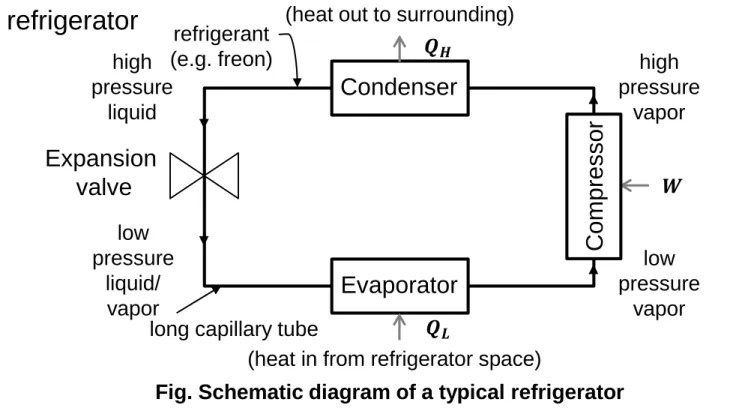
1. The refrigerant is a substance chosen to be a saturated liquid at the pressure and temperature of condenser.
2. The liquid undergoes a throttling process in which it is cooled and is partially
Condenser
Evaporator 𝑸𝑯
𝑸𝑳
𝑾
Compressor
Expansion valve
low pressure
liquid/
vapor
low pressure
vapor high pressure
vapor high
pressure liquid
(heat out to surrounding)
(heat in from refrigerator space) refrigerant
(e.g. freon)
long capillary tube
Fig. Schematic diagram of a typical refrigerator
5.3 Heat engines and the Carnot cycle
Condenser
Evaporator 𝑸𝑯
𝑸𝑳
𝑾
Compressor
Expansion valve
low pressure
liquid/
vapor
low pressure
vapor high pressure
vapor high
pressure liquid
(heat out to surrounding)
(heat in from refrigerator space) refrigerant
(e.g. freon)
long capillary tube
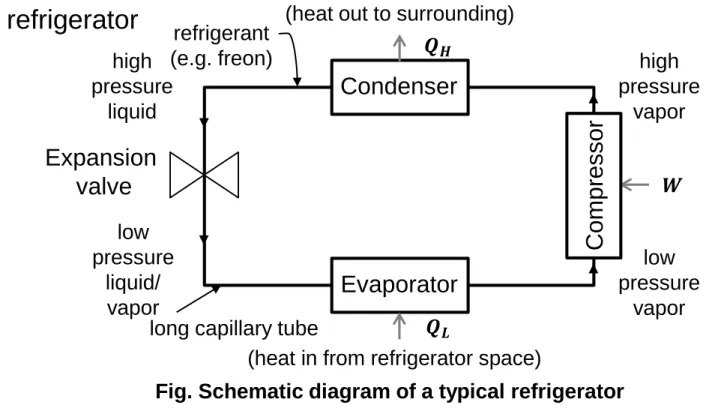
Fig. Schematic diagram of a typical refrigerator
Typical refrigerator
3. The vaporization is completed in the evaporator: the heat is absorbed by the refrigerant from the low temperature reservoir (the interior refrigerator space).
4. The low pressure vapor is then adiabatically compressed and isobarically cooled
5.3 Heat engines and the Carnot cycle
Typical refrigerator
Refrigerator are designed to extract as much heat as possible from a cold reservoir with small expenditure of work.
The coefficient of performance of a household refrigerator is in the range of 5 to 10.